
Compacted soil chokes the life out of your lawn. Water pools on the surface, fertilizer runs off, and grass roots struggle to breathe. A spike lawn aerator solves this by punching deep holes directly into the earth, creating instant channels for air, water, and nutrients. But not all spike aerators are the same—spike length, steel thickness, and handle design determine whether you finish the job or quit halfway.
I’m Rikta — the co-founder and writer behind Lawn Gear Lab. I’ve spent dozens of hours comparing spike lengths, foot plate dimensions, and welding quality across manual lawn aerators, analyzing owner feedback on failure points like bent handles and broken welds to find the models that actually hold up against compacted clay and rocky soil.
Whether you’re prepping a small backyard for overseeding or trying to revive a patch of dead turf, this guide breaks down the top models. Here’s everything you need to find the best spike lawn aerator for your property and budget.
How To Choose The Best Spike Lawn Aerator
Picking the right spike aerator starts with matching the tool’s physical specs to your soil type and yard size. Here are the three decisions that matter most.
Spike Length and Thickness
The depth of each hole controls how much air reaches the root zone. Look for spikes at least 2.75 inches long. Spikes that are 3.5 inches long go deeper into compacted clay. Thicker spikes (0.25 inches or more in diameter) create wider holes that resist closing back up after rain. More spikes mean more holes per step, but don’t chase a high spike count if the individual spikes are short or thin.
Foot Plate and Frame Strength
A narrow foot plate forces your weight onto a small surface, making each step unstable. The best models use a wide, textured foot plate (5 to 6 inches across) that accommodates large boots and gives you a solid platform to push down. The foot plate should connect to the handle shaft with reinforced welds. Cheap spot welds snap under repeated pressure in hard soil.
Handle Height and Grip
If the handle is too short, you have to bend your back to drive the spikes, which defeats the purpose of a stand-up tool. Look for handles that reach 36 to 43 inches tall. Taller users (over 6 feet) need handles closer to 40 inches. A padded T-handle reduces hand fatigue during longer sessions, while a bare metal T-handle can cause blisters after 20 minutes of work.
Quick Comparison
On smaller screens, swipe sideways to see the full table.
| Model | Category | Best For | Key Spec | Amazon |
|---|---|---|---|---|
| Grenebo 16-Spike | Premium | Medium lawns needing self-cleaning | 3.1 in spikes, auto-eject | Amazon |
| Seasky Dual-Spring | Mid-Range | Retractable safety storage | 3 in spikes, adjustable 28-38 in | Amazon |
| Jardineer 36-Inch | Mid-Range | Small lawns with clay soil | 12 spikes, 2.75 in length | Amazon |
| Colwelt 38-Inch | Mid-Range | Heavy clay soil penetration | 3.5 in spikes, 2/5 in dia | Amazon |
| FULONGJI 43.3-Inch | Premium | Tall users avoiding back strain | 3.5 in spikes, pre-assembled | Amazon |
| Coopvivi 15-Spike | Budget-Friendly | Light soil and small patches | 15 spikes, 3 lb weight | Amazon |
| Yard Butler IM-7C | Entry-Level | Minimal storage space | 4 spikes, 2.25 lb weight | Amazon |
In‑Depth Reviews
1. Grenebo Lawn Aerator Manual Aerator Lawn Tool with 16 Spikes
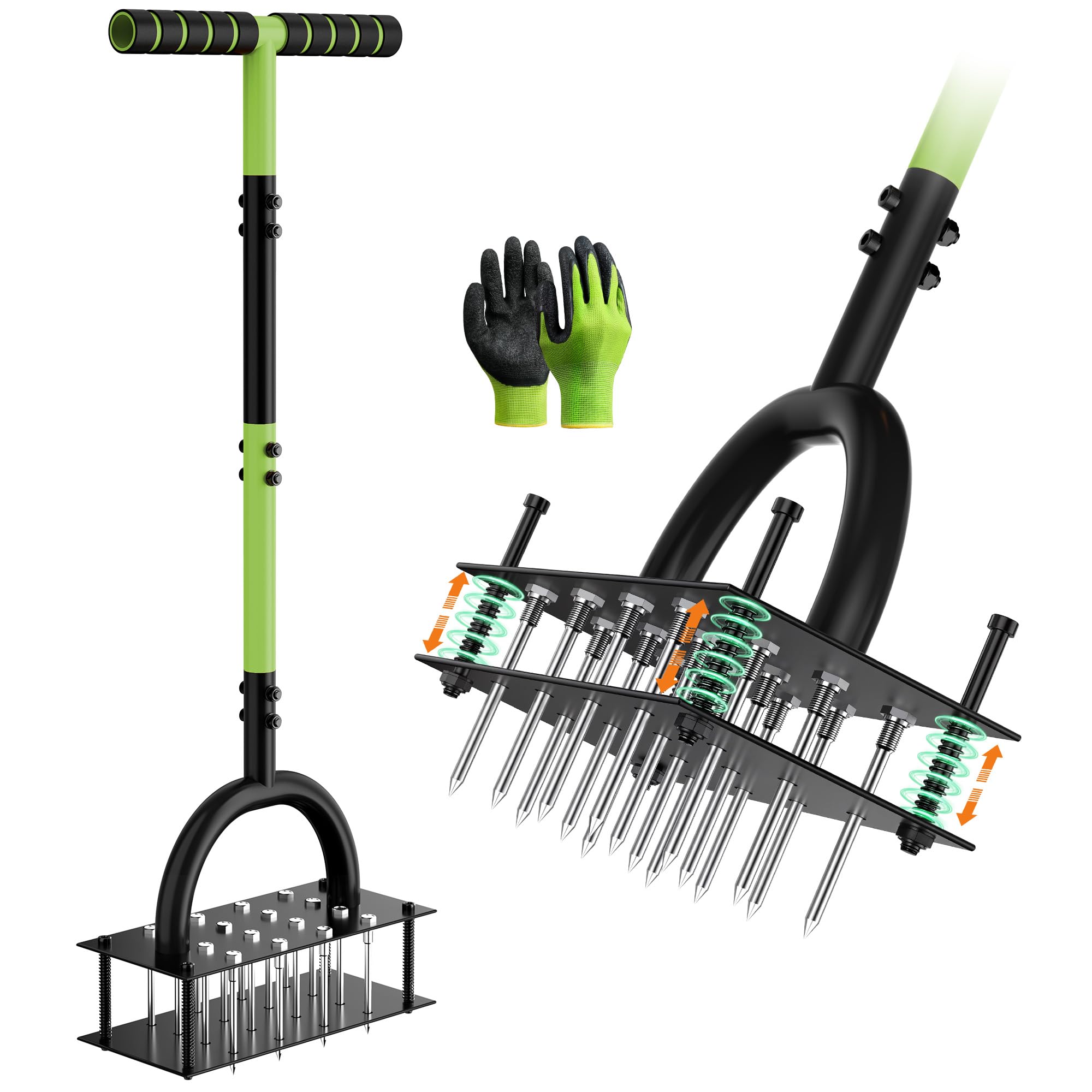
The Grenebo sits at the top because it solves the most annoying problem with spike aerators: soil clogging the spikes. Its dual-layer rebound springs automatically shake off soil and debris after each plunge, so you never have to stop and scrape the tines clean. With 16 sharp spikes arranged in a stable 4×4 pattern, you create more holes per step than any 4-spike or 12-spike model, cutting total work time on a medium lawn by roughly 30 percent.
The steel construction uses 2mm reinforced metal with heavy-duty welding, and a rust-resistant powder-coated finish keeps it looking fresh after a full season. The padded T-handle and foot pedal make each push comfortable, even when you’re working through compacted clay. When you’re done, the spikes retract into the base for safe, space-saving storage—no exposed points to snag your leg in the garage.
Some users reported that the weld on the base detached after a handful of uses when twisting aggressively in extremely hard soil. For most residential lawns with moderate compaction, this is not a common issue, but if your soil is rock-hard, take the manufacturer’s advice: water the lawn thoroughly two days before aerating.
What works
- Self-cleaning spring mechanism eliminates manual scraping.
- 16 spikes create deep holes quickly for medium lawns.
- Retractable spikes make storage safer and more compact.
What doesn’t
- Base weld can fail under extreme twisting force in hard ground.
- Too slow for large lawns over 3,000 square feet.
2. Seasky Lawn Aerator Manual Lawn Aerator Tool with Padded T-Handle
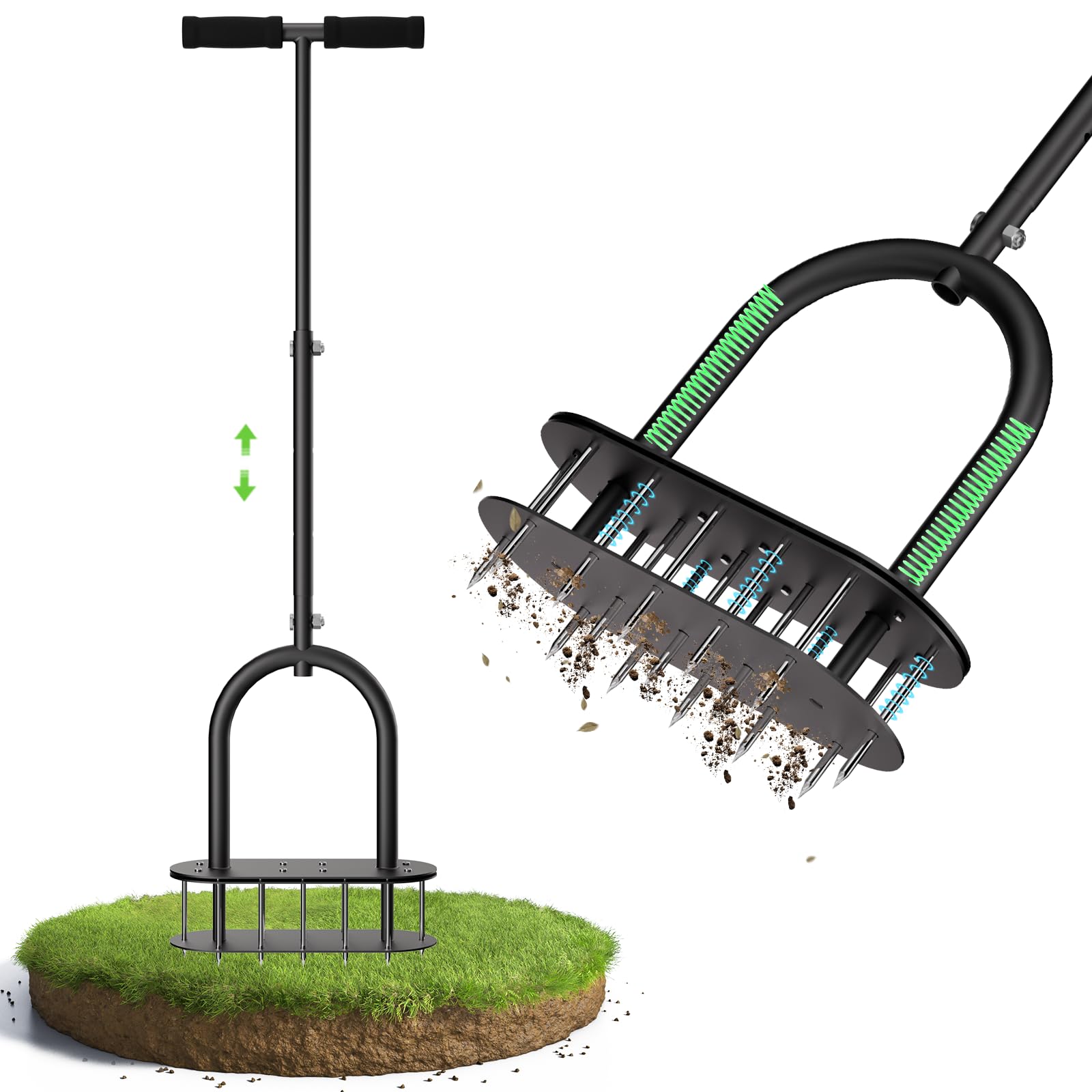
The Seasky stands out for its adjustable handle that telescopes from 28 to 38 inches, a rare feature that lets tall and short users share the same tool without back strain. It also uses a dual-layer spring design that addresses the messy side of aeration: the springs eject soil and debris from the spikes after each step, keeping the tool clean and your lawn looking tidy.
It carries 15 spikes that are 3 inches long, which is solid for most residential loam and sandy soils. The wide footrest accommodates any shoe size and provides a stable platform for pushing down. The padded grip on the T-handle prevents blisters, and the spikes retract into the panel when not in use, eliminating the hazard of exposed points during storage or transport.
Some users noted that the holes left by the 3-inch spikes could be slightly wider to improve water percolation in heavy clay. The handle assembly can feel a bit loose over time if the locking mechanism is not tightened periodically. This is a well-rounded tool that works best when you take the extra minute to tighten the adjustment collars before each use.
What works
- Adjustable handle height fits users from 5 to 6 feet tall.
- Dual-layer spring self-cleans spikes effectively.
- Retractable spikes for safe garage storage.
What doesn’t
- Spikes could be wider for better results in heavy clay.
- Handle locking mechanism requires periodic tightening.
3. Colwelt Lawn Aerator Tool 38-Inch Heavy Duty Grass Spike Aerator

The Colwelt is purpose-built for the toughest soil types. Its claim to fame is spike dimensions: 3.5 inches long and 2/5 inches in diameter, which is nearly double the thickness of standard budget spikes. Those bigger spikes carve wider, deeper channels that stay open longer, letting water and oxygen reach the root zone even in baked clay.
The foot plate is 6 inches wide and 5.5 inches high—large enough to fit any work boot comfortably and gives you a stable platform to push your full weight onto. The cushioned T-handle provides a solid grip, and the 38-inch overall height keeps you upright during work. Assembly is quick with the included tools, and the steel construction feels rugged enough to last through years of seasonal aeration.
Because the spikes are thicker, they do require more downward force to penetrate. In very hard, dry soil, you may need to rock the handle back and forth to get full depth. The manufacturer recommends watering the lawn thoroughly before aerating, and that advice is especially important with this model to avoid excessive strain on the handle connection.
What works
- Thick 0.4-inch spikes create wider holes that resist closing.
- Large foot plate provides stable, balanced downward force.
- Rugged steel frame handles repeated hard soil use.
What doesn’t
- Hard to penetrate dry soil without significant effort.
- Only four spikes means slower coverage on large areas.
4. FULONGJI Lawn Aerator Tool, 43.3″ Pre-Assembled Manual Grass Spikes Aerator

The FULONGJI is the tallest spike aerator on this list at 43.3 inches, a critical advantage if you are 6 feet tall or more and tired of bending your back during lawn work. It comes pre-assembled out of the box—just attach the handle with the included tools and you are aerating within minutes, no confusing multi-step build process.
It uses 12 spikes that are 3.54 inches long and 0.25 inches thick, giving you deeper penetration than the average 2.75-inch competitor. The spikes are double-locked with nuts and high-temp welding, so they stay put even when you twist the handle to widen the hole. The foot pedal is generously sized to fit a size 15 work boot, and the T-grip gives you good leverage for pushing down into compacted ground.
A few owners reported that the handle bent slightly after aggressive twisting to break up clay and roots. For normal back-and-forth rocking, the steel holds up fine. If your soil is extremely hard, pre-watering is essential to avoid bending the shaft. The included Allen wrench is small and can be easy to misplace, so keep it in your tool pouch after assembly.
What works
- Extra-long handle eliminates back strain for tall users.
- Pre-assembled design saves setup time.
- Double-locked spikes stay secure under twisting force.
What doesn’t
- Handle can bend under aggressive twisting in hard clay.
- Small Allen wrench included is easy to lose.
5. Jardineer Lawn Aerator Tool, Updated 36″ Spike Aerator with Longer Spikes
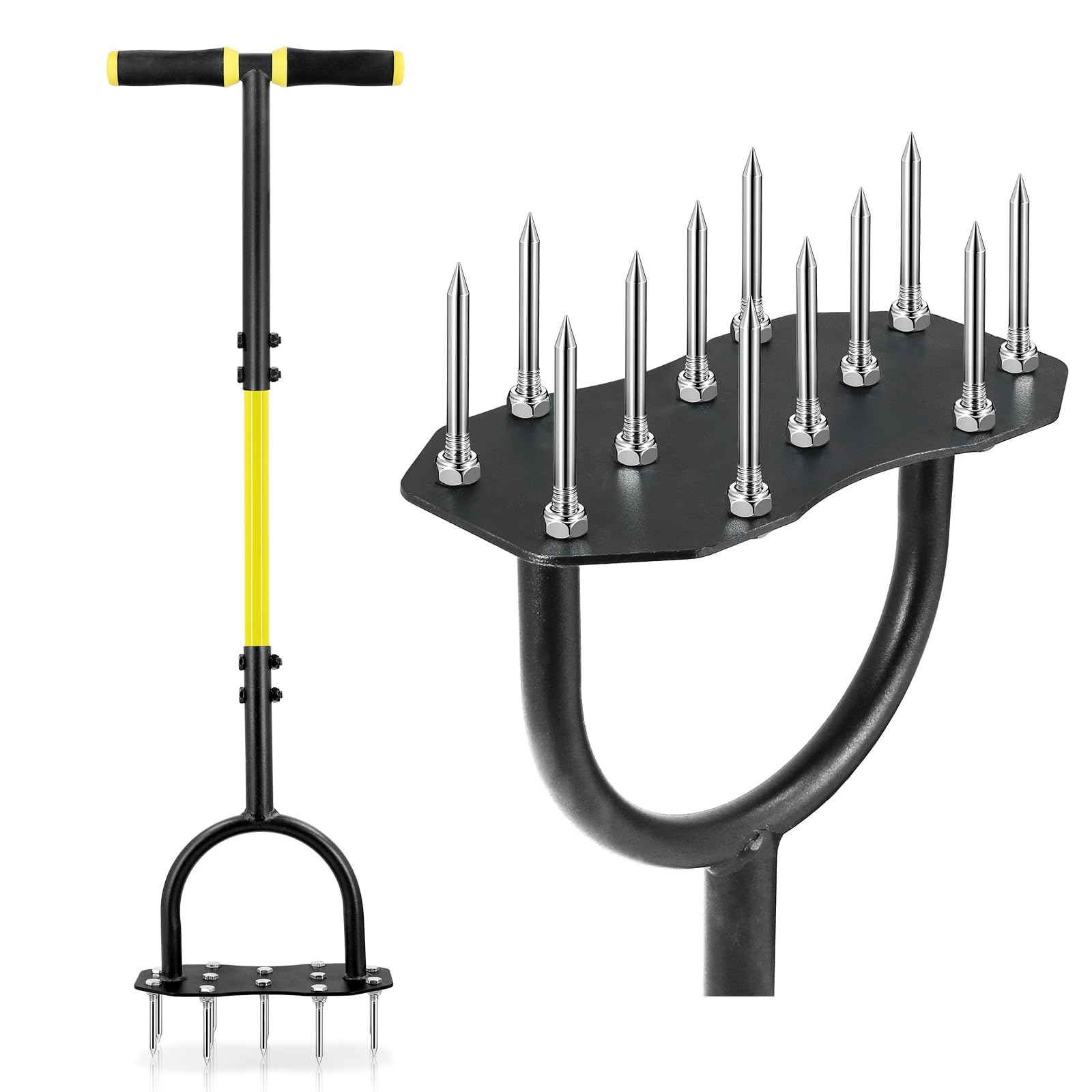
The Jardineer hits the sweet spot between spike count and ease of use. Its 12 heat-treated steel spikes measure 2.75 inches total length, which is long enough to break through light to moderate compaction in loam and sandy soil. The 36-inch handle and comfortable rubber grip reduce hand fatigue, making this a good choice for weekly aeration maintenance rather than a one-time heavy renovation.
The thick steel foot plate bears your full weight without bending, and the powder-coated finish resists rust season after season. It comes pre-assembled with a wrench and manual, so you can take it out of the box and start working immediately—no confusing hardware to sort through. When you are done, it detaches for compact storage.
Some owners noted that this tool is best suited for small to medium areas. On lawns larger than 1,500 square feet, the repetitive stepping and pulling can become tiring. It works best when the soil is moist, and a slight twisting motion helps the spikes penetrate deeper into clay patches.
What works
- 12 spikes balance coverage speed with manageable weight.
- Pre-assembled design saves setup time.
- Solid foot plate holds up under full body weight.
What doesn’t
- Too tiring for large lawns over 1,500 square feet.
- Spike length is adequate but not ideal for deep clay.
6. Coopvivi Lawn Aerator Tool – Grass & Soil Aerator with 15 Spikes
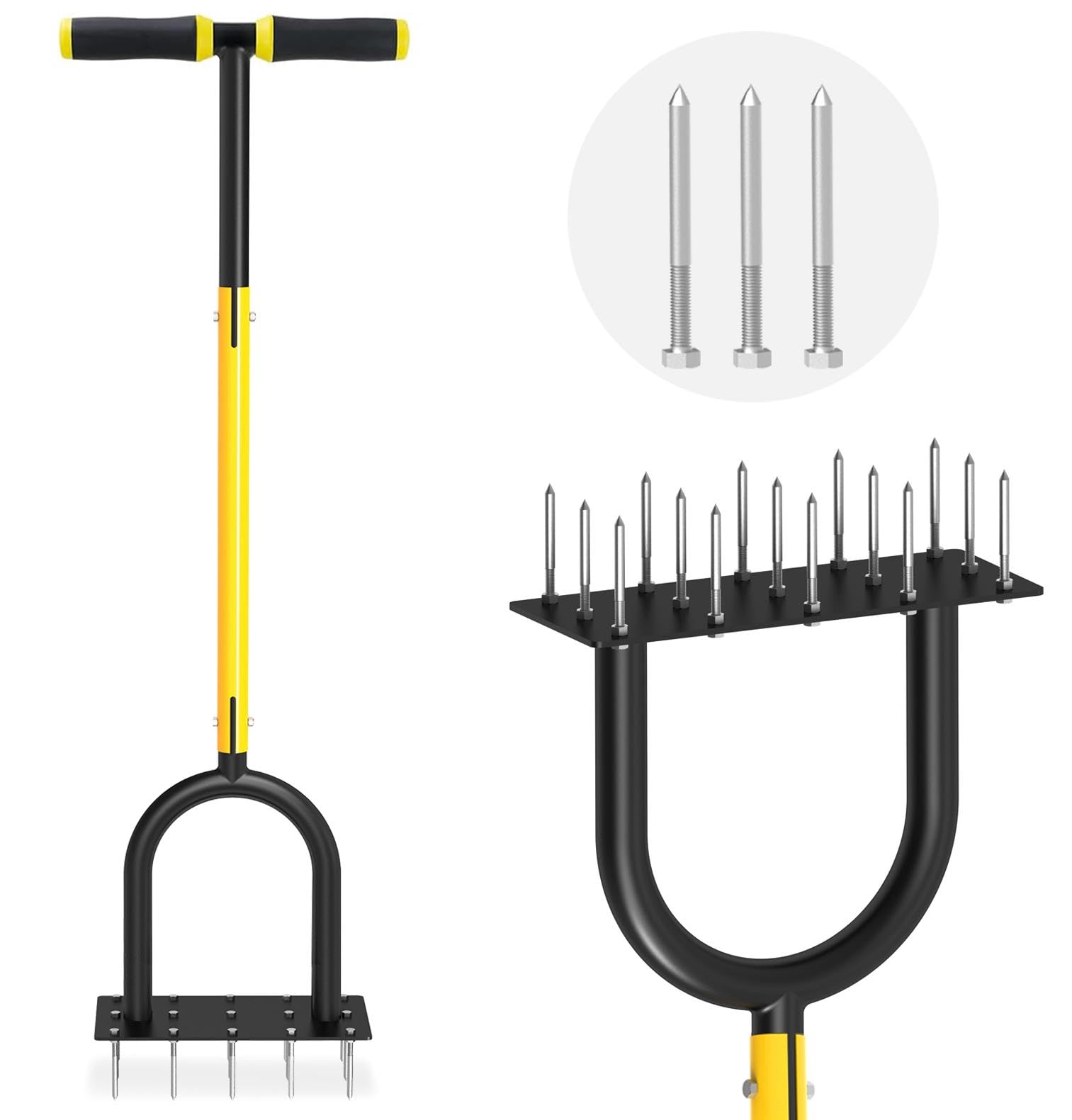
The Coopvivi offers the highest spike count in the budget tier with 15 sharp spikes working simultaneously. This high density means you cover more ground per step compared to 4-spike or 12-spike models. It is made of heavy-duty iron with a rust-resistant powder-coated finish, and the thick steel foot plate provides a stable surface for pushing down.
Assembly takes just a few minutes with the included tools, and the tool disassembles for easy storage. At only 3.85 pounds, it is one of the lightest options on the list, which makes it easier to carry around the yard but also means the frame can feel a bit rickety after extended use in harder soil. It works best for light to moderate compaction and small patch repairs.
Owners noted that the punched holes are not as clean as those made by heavier, sturdier aerators. The frame can develop some wobble over time, especially if you apply twisting force to widen holes. For occasional use on soft soil, it is a perfectly functional entry-level tool.
What works
- 15 spikes provide high hole density per step.
- Lightweight and easy to carry around the yard.
- Quick assembly and disassembly for storage.
What doesn’t
- Frame feels rickety after repeated use in hard soil.
- Holes are less clean than heavier, sturdier models.
7. Yard Butler Spike Aerator IM-7C Durable Lawn Aerator
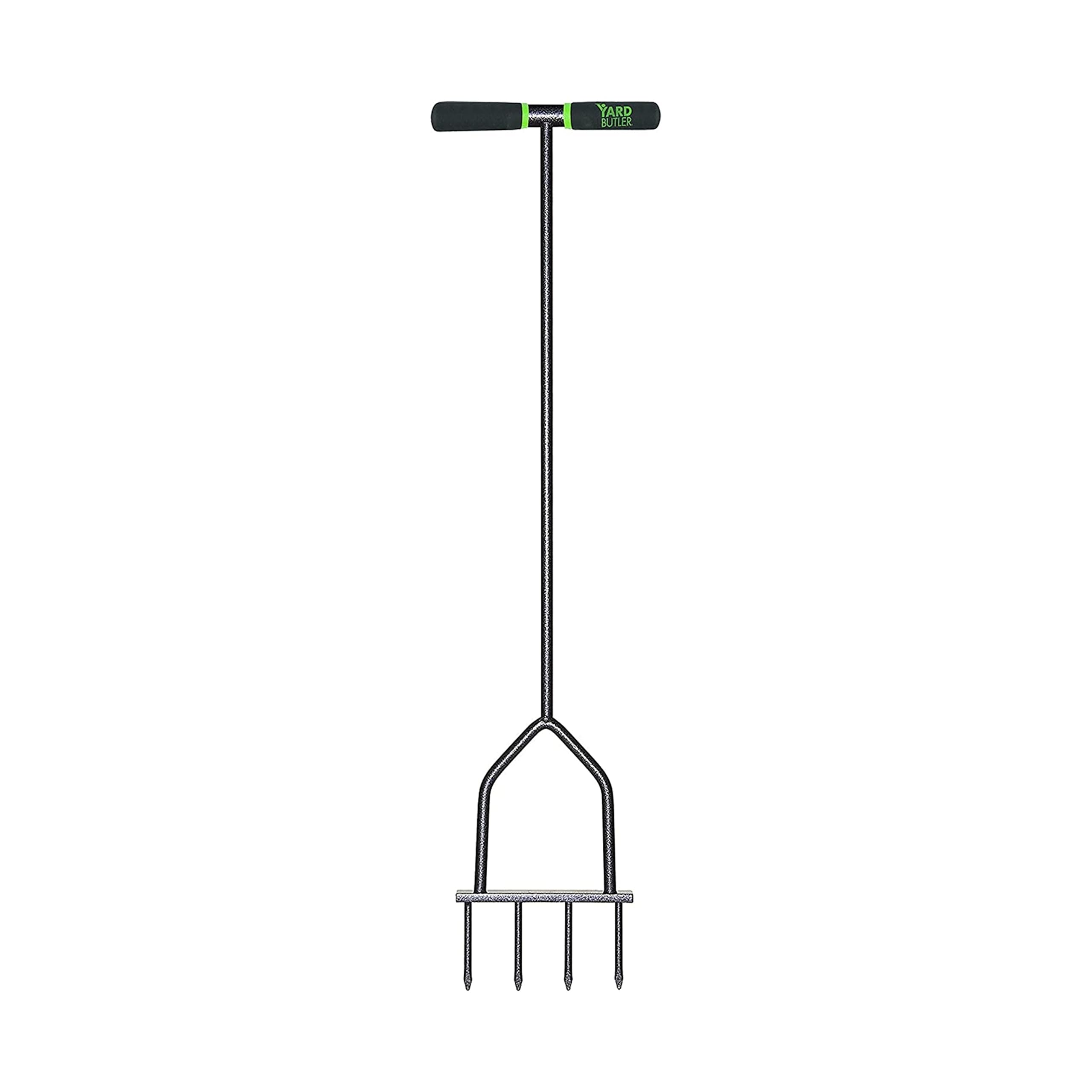
The Yard Butler is the classic, no-frills spike aerator that has been around for years. It uses four 3-inch spikes on a powder-coated steel frame. While four spikes means fewer holes per step, each spike is thick enough to penetrate tough ground, and the simple construction eliminates any mechanical failure points like springs or welds on moving parts. The long handle provides leverage without requiring you to bend over.
At just 2.25 pounds, it is the lightest model in this guide. This makes it extremely portable and easy to store in a closet or shed corner. It is best suited for small patches of lawn—treating bare spots, prepping for overseeding, or aerating around tree roots where a larger tool cannot reach. Owners report that it works best after a light rain when the soil is moist but not muddy.
Taller users (over 6 feet) often wish the handle was 3 to 4 inches longer to reduce back strain. The four-spike design is also painfully slow for anything larger than 500 square feet. This is not a tool for whole-lawn renovation; it is a spot-treatment tool for the gardener who needs precision and simplicity.
What works
- Extremely lightweight and easy to store.
- Simple design with no mechanical parts to break.
- Thick 3-inch spikes penetrate well in moist soil.
What doesn’t
- Only four spikes makes it very slow for large areas.
- Handle is too short for users over 6 feet tall.
Hardware & Specs Guide
Spike Length and Diameter
Spike length determines how deep your aeration holes go. For light compaction in loam, 2.75-inch spikes are sufficient. For clay soil, look for 3.5-inch spikes. Spike diameter controls how wide the hole is and how long it stays open. Standard spikes are 0.2 inches in diameter; heavy-duty models like the Colwelt use 0.4-inch spikes that create wider channels that resist closing up after rain. Thicker spikes also pull up less soil when you extract them, reducing surface mess.
Foot Plate Dimensions and Stability
The foot plate transfers your body weight into the ground. A narrow plate (under 4 inches wide) forces your foot into an unstable position, making it harder to keep the tool vertical. The best models use plates that are 5 to 6 inches wide and match the shape of a work boot. A textured or anti-slip surface is essential when working on wet grass. Wider plates also distribute force more evenly, reducing the risk of bending the spike base during aggressive pushes.
Handle Height Adjustability
A fixed-height handle works well if you are average height, but adjustable handles between 28 and 38 inches accommodate both short and tall users without back strain. The handle should connect to the spike base with a solid metal bracket or reinforced welding—plastic adjustment collars can crack over time. Padded T-handles reduce friction on the palms during extended sessions; unpadded metal handles can cause hot spots and blisters after 30 minutes of continuous use.
Frame Material and Weld Quality
Most spike aerators use powder-coated steel or iron. The coating prevents rust, but the real durability comes from the weld quality where the handle meets the foot plate. Spot welds can snap under heavy pressure. Full bead welds or double-locked nuts provide much better longevity. If you plan to aerate more than once per season, invest in a model with reinforced welding rather than a cheap stamped steel frame that twists under load.
FAQ
Should I water my lawn before using a spike aerator?
How many spikes do I need for a small lawn under 1,000 square feet?
Can a spike aerator damage my lawn?
Final Thoughts: The Verdict
For most gardeners, the best spike lawn aerator winner is the Grenebo 16-Spike because its self-cleaning mechanism and high spike count deliver the fastest, least messy results on medium lawns. If you want deeper penetration for heavy clay, grab the Colwelt 38-Inch for its thicker, longer spikes. And for tall users who need to avoid back strain, nothing beats the FULONGJI 43.3-Inch pre-assembled model.