
Getting the bloom color you see on the tag — whether vivid blue, deep purple, or soft pink — depends almost entirely on what’s happening in the soil around the roots. If your hydrangeas are turning out a muddy, washed-out shade or refusing to bloom altogether, the problem is rarely the plant itself. It’s the pH balance, the drainage, and the nutrient content of the ground it’s sitting in, and those three factors are entirely within your control once you know what to look for.
I’m Rikta — the co-founder and writer behind Lawn Gear Lab. I’ve spent dozens of hours analyzing soil chemistry data, comparing NPK ratios, and cross-referencing thousands of verified owner reports to identify which soil amendments and conditioners consistently deliver the color and growth that gardeners actually want.
This guide is built around that research to help you pick the best soil for hydrangeas regardless of whether you are maintaining an established border or planting new nursery stock into containers.
How To Choose The Best Soil For Hydrangeas
Hydrangeas are unique among flowering shrubs because the same variety can produce different bloom colors depending on soil chemistry. Before you buy a bag of anything, focus on three variables: pH level, aluminum availability, and nutrient balance.
Understanding Soil pH and Bloom Color
Bigleaf hydrangeas (Hydrangea macrophylla) are pH-sensitive. A soil pH below 6.0 makes aluminum soluble and available to the roots, which produces blue flowers. A pH above 6.5 locks aluminum out, which produces pink flowers. If you want blue blooms, you need a soil amendment or mix that drives the pH down to the 5.2–5.5 range. If you prefer pink, you want a pH around 6.5–7.0. Testing your soil before amending is non-negotiable — guessing the pH wastes an entire growing season.
NPK Ratios for Acid-Loving Plants
Hydrangeas require a fertilizer with a low middle number (phosphorus) because excess phosphorus can bind with aluminum and prevent blue coloring even at a low pH. An NPK ratio like 4-3-4 or something close to that works well. The first number (nitrogen) drives leaf growth, and the last number (potassium) supports root development and flower quality. Avoid high-phosphorus bloom boosters unless you are certain you want pink flowers.
Texture and Drainage
Hydrangeas need consistently moist soil, but they rot quickly if the root zone stays waterlogged. A good soil mix for containers should include sphagnum peat moss or compost for moisture retention combined with perlite or coarse sand for drainage. For in-ground planting, amend heavy clay soil with organic matter to improve aeration — pure topsoil straight from the bag will compact and suffocate the roots.
Quick Comparison
On smaller screens, swipe sideways to see the full table.
| Model | Category | Best For | Key Spec | Amazon |
|---|---|---|---|---|
| Coast of Maine Acid-Loving Soil | Potting Mix | Ready-to-use planting soil | Low pH mix, 20 qt volume | Amazon |
| Espoma Organic Holly-Tone | Granular Fertilizer | Long-term feeding | NPK 4-3-4, 4 lb bag | Amazon |
| Miracle-Gro Water Soluble Food | Water-Soluble Fertilizer | Quick feeding for containers | 5 lb, dissolves in water | Amazon |
| Fertilome Aluminum Sulfate | Soil Conditioner | Blue color intensification | Aluminum content, 4 lb | Amazon |
| Earth Science Fast Acting Sulfur | pH Reducer | Lowering soil pH | Elemental sulfur, 5 lb | Amazon |
| Coast of Maine Veggie Soil | Potting Mix | Versatile container mix | Compost & peat moss, 20 qt | Amazon |
| Miracle-Gro Potting Mix 3-Pack | Potting Mix | Budget container planting | 8 qt per bag, 3-pack | Amazon |
In‑Depth Reviews
1. Coast of Maine Acid Loving Plants Soil

This potting mix is formulated specifically for plants that require lower pH levels, with a blend of sphagnum peat moss, composted manure, and aged bark. The 20-quart bag weighs noticeably less than standard topsoil, which makes it practical for filling multiple containers without exhausting yourself hauling wet dirt. Multiple verified buyers report that their hydrangeas established quickly in this mix and produced strong blooms in the first season.
The moisture retention balance is what sets this apart from generic potting soils — the peat holds enough water to keep the root zone from drying out between waterings while the bark pieces create air pockets that prevent compaction. Several users mentioned that blueberry plants also thrived in this mix, confirming that the pH stays reliably low without needing additional sulfur or aluminum amendments right away.
OMRI-listed for organic production, this mix contains no synthetic wetting agents or chemical fertilizers. That means you control the feeding schedule yourself rather than relying on embedded slow-release nutrients that may or may not match the NPK ratio your hydrangeas need. For gardeners who prefer to manage every variable, this is the cleanest starting point available.
What works
- Pre-mixed low pH ideal for blue hydrangeas out of the bag
- Balances moisture retention with drainage for container use
- Lightweight formulation reduces strain when filling pots
What doesn’t
- Price per quart is higher than bagged topsoil blends
- Not suitable for in-ground beds without mixing with native soil
2. Espoma Organic Holly-Tone 4-3-4
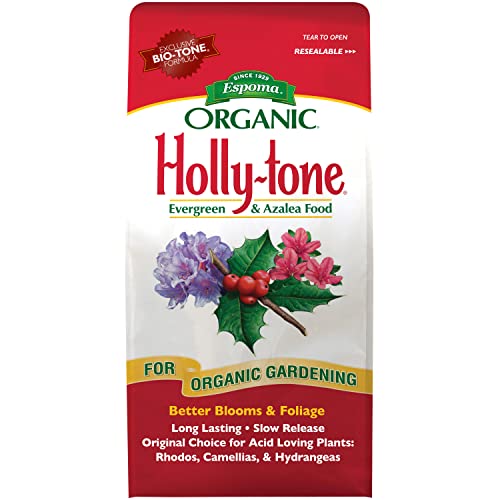
Holly-Tone has been the standard granular food for acid-loving plants since 1929, and the 4-3-4 NPK ratio explains why it works for hydrangeas. The low phosphorus content (the middle number) keeps aluminum available to the roots, which directly supports blue bloom production. A single 4-pound bag covers a surprising amount of ground — roughly 100 square feet at the recommended spring and fall application rate.
The Bio-tone formula includes beneficial microbes that break down organic matter in the soil over several weeks, creating a slow-release feeding cycle rather than a quick flush. Multiple long-term users report that their hydrangeas showed greener leaves and larger flower heads within two to three weeks of the first spring application. The 5 percent sulfur content also helps maintain a lower soil pH over time without requiring a separate soil acidifier.
Approved for organic gardening by the Organic Input Material registry, this product contains no biosolids or synthetic chemicals. The granules are ready to use straight from the bag — just sprinkle around the drip line and water in. One common note from experienced users is that the granules have a mild natural odor from the feather meal and bone char, but that fades after watering.
What works
- Low phosphorus ratio supports blue hydrangea blooms
- Slow-release granules feed for weeks without burning roots
- Contains sulfur to help maintain acidic soil conditions
What doesn’t
- Not a complete soil — must be applied to existing planting medium
- Natural odor can attract curious pets before watering settles it
3. Miracle-Gro Water Soluble Azalea Food

This water-soluble formula is designed specifically for acid-loving plants and dissolves completely in water with no gritty residue left in the bottom of the watering can. The 5-pound bag contains enough powder to treat a large collection of container hydrangeas for an entire growing season if applied every 7 to 14 days as directed. The mix ratio changes depending on whether you are feeding indoor plants or outdoor garden beds, which is clearly printed on the bag.
Several reviewers noted that their rhododendrons and hydrangeas greened up visibly within a week after the first feeding, and blooms appeared fuller than the previous season. The formula is designed not to burn foliage or roots when used at the recommended dilution, which makes it a safe choice for gardeners who are new to liquid feeding schedules. The resealable bag closure helps keep the powder dry between uses, though a few users noted that powder on the zipper track can compromise the seal over time.
Because this product feeds instantly through the roots rather than breaking down slowly in the soil, you can adjust the color response more precisely throughout the season. If you see the blooms shifting toward pink and you want blue, increasing the application frequency can help lower the root-zone pH faster than granular amendments alone.
What works
- Dissolves completely for precise feeding control
- Visible results in leaf and bloom quality within a week
- Safe for all acid-loving plants when diluted correctly
What doesn’t
- Requires mixing every 1-2 weeks during active growth
- Resealable bag can lose its seal if powder gets on the zipper
4. Fertilome Aluminum Sulfate Soil Conditioner

Aluminum sulfate is the single most direct way to shift pink hydrangea blooms to blue because it adds both acidity and soluble aluminum to the soil. This 4-pound bag of powder from Fertilome provides a high-concentration source that works much faster than elemental sulfur or organic matter alone. Users report seeing a color change in established plants within one to two weeks after application, provided the soil pH was already somewhat acidic to begin with.
One verified reviewer noted that larger doses turned their hydrangea blue within a week but caused a smaller plant to drop all its leaves before recovering. This is not a product for casual guesswork; a pH test before and after application is essential.
Beyond hydrangeas, this conditioner works on other acid-loving plants including azaleas, gardenias, and camellias. It can also be used as a soil acidifier for blueberries that are showing chlorosis from high pH. The powder form dissolves into the soil with watering, but direct contact with foliage should be avoided to prevent leaf burn.
What works
- Fastest color change agent for shifting pink to blue blooms
- Small quantity goes a long way — a single bag lasts seasons
- Effective for other acid-loving plants beyond hydrangeas
What doesn’t
- Requires precise dosing to avoid plant shock or leaf drop
- Not suitable as a general fertilizer — lacks nitrogen and potassium
5. Earth Science Fast Acting Sulfur Granules

When your soil pH is too high for hydrangeas to absorb iron and aluminum, elemental sulfur is the corrective tool. Earth Science Fast Acting Sulfur granules use their patented Nutri-Bond Technology to bind with soil particles and reduce leaching, which means the pH adjustment stays in the root zone longer than loose powder formulations. The 5-pound bag covers a large area — roughly enough to treat 200 square feet of garden bed depending on your target pH drop.
Reviewers with alkaline soil and water report that this product brought their pH from 8.5 down into the 6.0 range over several weeks of consistent application. The granules are larger and denser than powdered sulfur, so they break down more slowly and carry less risk of an immediate pH crash that could damage roots. Multiple owners of hydrangeas noted visible improvement in leaf color and bloom vibrancy after two to three weeks of use.
The product is labeled safe for people and pets, and the manufacturer states that lawns can be used immediately after application. The granular form is easier to broadcast evenly compared to fine powders, and the Nutri-Bond coating reduces dust during application. For gardeners who need to manage pH across a large area rather than individual pots, this is the more efficient option compared to aluminum sulfate.
What works
- Granules bond with soil to reduce pH drift after watering
- Safe for immediate lawn access after application
- Lower burn risk than aluminum sulfate for pH correction
What doesn’t
- Granules dissolve slowly — not a fast fix for urgent pH issues
- Does not supply aluminum, so may not shift bloom color alone
6. Coast of Maine Vegetable & Tomato Soil

Although this mix is labeled for tomatoes and vegetables, its core composition of composted manure and sphagnum peat moss makes it a strong base for hydrangeas when you need to improve soil texture in containers or raised beds. The 20-quart bag is lightweight and fluffy, with visible perlite and bark pieces that keep the mix from compacting into a dense block. Multiple reviewers noted that their moisture-loving plants thrived in this mix because it holds water without becoming soggy.
The organic compost content feeds soil microbes and releases nutrients slowly, which reduces the need for synthetic fertilizers during the early growing season. The peat moss component helps maintain a slightly acidic pH, though not as aggressively as the dedicated acid-loving mix from the same brand. One reviewer specifically mentioned that their hydrangeas in containers looked fuller and produced more flower clusters after switching to this mix from a standard potting soil.
A few users reported encountering fungus gnats in the bag, which is a common risk with any compost-based product that has high moisture content during storage. Treating the soil with neem oil or letting it dry out slightly before planting usually resolves the issue. For gardeners who want an OMRI-listed organic soil that works across multiple plant types, this versatile mix reduces the number of different bags you need to keep on hand.
What works
- Lightweight texture with excellent drainage for containers
- Organic compost feeds soil biology without synthetic inputs
- Versatile enough for vegetables, herbs, and flowering shrubs
What doesn’t
- Not specifically formulated for low pH — may need sulfur addition
- Fungus gnats reported in some bags due to compost moisture
7. Miracle-Gro Potting Mix 3-Pack

This 3-pack of 8-quart bags is a practical entry-level option for gardeners who need to fill multiple containers quickly. The mix includes a fertilizer charge that feeds plants for up to six months, which eliminates the need for immediate additional feeding. Each bag fills roughly two 8-inch pots, so the bundle covers six medium containers right out of the box. The texture is lighter than native garden soil, with enough perlite to prevent the root zone from becoming waterlogged.
Hydrangeas planted in this mix will show fast initial growth due to the soluble nutrients embedded in the formulation. The 6-month feeding window covers the entire active growing season in most climates, meaning you may not need to apply any additional fertilizer until the following spring. Several reviewers mentioned that they use this mix for both indoor and outdoor container plants and appreciate the smaller bag size because it avoids the waste of opening a massive bale for just a few pots.
The limitation for hydrangea-specific use is that this mix is pH-neutral by design rather than acid-adjusted. Gardeners aiming for blue blooms will need to amend with aluminum sulfate or elemental sulfur separately. For those who are growing pink varieties or who are less concerned with bloom color manipulation, the convenience and low cost per bag make this a no-fuss container solution.
What works
- Built-in fertilizer feeds for 6 months with no mixing required
- Small 8-qt bags are easy to handle and store
- Lightweight, well-draining texture suitable for containers
What doesn’t
- Neutral pH requires amendment for blue hydrangea blooms
- Fertilizer content may not match specific acid-loving needs
Hardware & Specs Guide
Soil pH Range
Hydrangeas outside the pH range of 5.2 to 6.5 struggle to absorb nutrients and will not produce the bloom color you see on nursery tags. Blue blooms require pH below 6.0 with available aluminum, and pink blooms appear above pH 6.5 when aluminum is locked out. A pH meter or test kit is the only reliable way to know your starting point before choosing an amendment.
Aluminum vs. Sulfur
Aluminum sulfate provides both acidity and soluble aluminum, making it the faster option for switching bloom color. Elemental sulfur only lowers pH without adding aluminum, so it works best when the soil already contains some natural aluminum. Applying aluminum sulfate without testing can push pH too low and damage roots, while sulfur is gentler but takes weeks to react.
FAQ
Can I use regular potting soil for hydrangeas in containers?
How long does it take for aluminum sulfate to turn hydrangeas blue?
Final Thoughts: The Verdict
For most gardeners, the soil for hydrangeas winner is the Coast of Maine Acid Loving Plants Soil because it provides a ready-to-use low pH foundation that works straight out of the bag for containers and raised beds. If you want complete control over feeding and pH, grab the Espoma Organic Holly-Tone 4-3-4. And for correcting high pH across a large garden area without burning your plants, nothing beats the Earth Science Fast Acting Sulfur.