
Specs are compiled from manufacturer listings and verified buyer reviews and can change over time — please confirm the key details on the product page before buying.
You want fresh, crunchy sprouts for salads, sandwiches, and soups — but you do not want a complicated science project on your counter. The right seed sprouting kit makes it simple: soak tiny seeds, rinse them twice a day, and in a handful of days you have homegrown greens for pennies compared to store prices. The hard part is picking one that drains well, blocks light when needed, and is actually easy to clean.
I’m Rikta — the founder and writer behind Lawn Gear Lab. This guide is built by comparing the manufacturers’ published specifications and the patterns across verified customer reviews, so you get each pick’s real strengths and trade-offs instead of marketing spin.
Whether you are a beginner growing alfalfa for the first time or looking to stack multiple crops side by side, the details of jar size, screen material, and drainage really matter. Choosing from the best seed sprouting kits means matching the setup to your daily routine.
Quick Picks
- Zestigreens Premium Seed Sprouting Kit & Green Onion Regrower — Best Overall
- Malastar Complete Sprouting Jar Kit — Best Value
- ALCEDIA Premium Sprouting Jar Kit — Compact & Premium
- Handy Pantry Complete Sprouts Growing Kit — Tray System
- Haswe Seed Sprouting Jar Kit — Budget Starter
How To Choose The Best Seed Sprouting Kits
The first big choice is jar-based versus tray-based. A jar kit is the classic method — you soak seeds inside a wide-mouth mason jar, then tip it at an angle on a stand so water can drain and air can flow. A tray system (sometimes called a sprouter) uses stackable perforated trays where you spray or rinse the seeds directly in each layer. Jar kits take up less counter space and are more traditional; tray systems let you grow several different varieties at the same time because each tray is its own little crop.
Screen Material Matters a Lot
The mesh lid that holds seeds inside the jar while letting water drain is the single most hard-working part of any jar-based kit. Cheaper kits use plastic mesh that can warp, clog, or tear. Better kits use 316 stainless steel — a higher grade that resists rust and corrosion even with constant exposure to moisture. If you plan to sprout daily for months or years, 316 stainless steel is worth paying a little extra for. The hole size matters too: a fine enough mesh holds tiny seeds like alfalfa and broccoli inside while still draining fast enough to prevent mold.
Quick Comparison
| Model | Best For | Number of Jars / Trays | Weight | Drainage Lid Material | Amazon |
|---|---|---|---|---|---|
| Zestigreens 2-Jar Kit | High volume & green onion regrower | 2 jars | 3.04 lbs | Stainless steel mesh | Amazon |
| Haswe 1-Jar Kit | Budget-friendly starter | 1 jar | 1 lbs | Stainless steel mesh | Amazon |
| Malastar 2-Jar Kit | Two-crop versatility | 2 jars | 32 oz (2 lbs) | 316 stainless steel mesh | Amazon |
| ALCEDIA Single Jar | Premium single jar & decor | 1 jar | — | 316 stainless steel mesh | Amazon |
| Handy Pantry 3-Tray | Multi-crop stacking system | 3 trays | 2.2 lbs | Plastic (perforated tray) | Amazon |
In‑Depth Reviews
1. Zestigreens Premium Seed Sprouting Kit & Green Onion Regrower
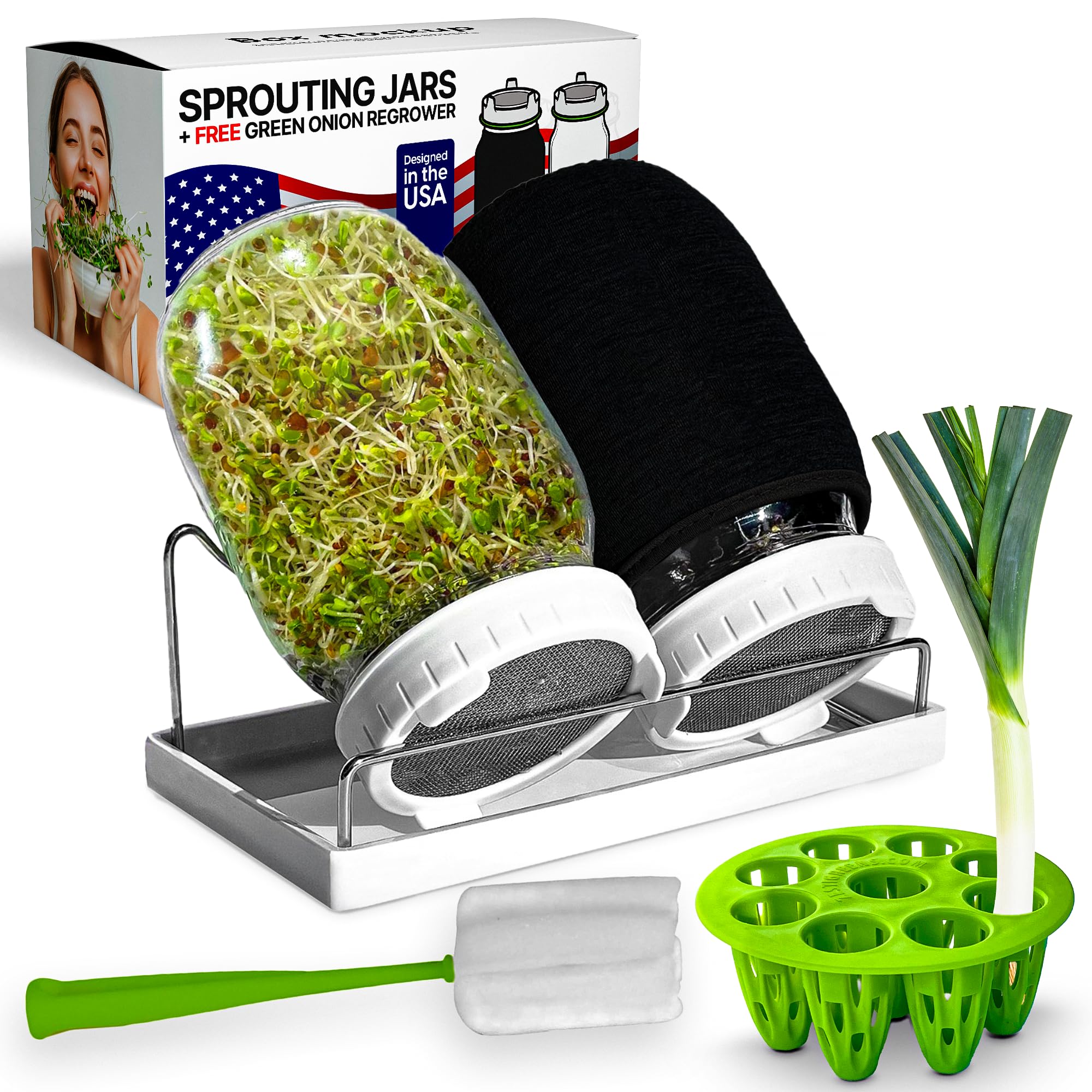
The only kit that also regrows your green onion scraps into a month-long supply.
With two 32 oz wide-mouth glass jars and 12 total components, this is the most versatile answer for anyone wanting to sprout two different batches at the same time — or keep a continuous cycle going. Buyers report the kit is “convenient” and that the wide-mouth jars and lids are simple and clean. The standout extra is the green onion regrower lid, a simple hydroponic attachment that lets you stick the white root ends of store-bought scallions in water and watch them bounce back fresh.
At 3.04 pounds, this is the heaviest kit on the list — the stainless steel stand and drip tray add real heft, which means it stays planted on the counter when you rinse. Some owners mention the blackout sleeves can be fiddly to put on and off; a few simply set the jars in a dark cabinet instead. The payoff: owners report fast results, and one owner said the onion regrower kept fresh green onions available.
Why it leads
- Two jars for side-by-side sprouting or continuous harvest
- Stainless steel stand and mesh won’t rust
- Green onion regrower lid is a genuinely useful bonus
The trade-offs
- Heavier than other kits at 3.04 pounds
- Blackout sleeves are hard to use for some — cabinet works better
Reach for this if: you want to grow two varieties at once, regrow kitchen scallions, and have counter space for a sturdy stand.
Look elsewhere if: you prefer the lightest possible setup at 1 pound or only need a single jar.
2. Malastar Complete Sprouting Jar Kit

Two jars with 316 stainless steel mesh for buyers who care about rust-proof longevity.
This kit matches the Zestigreens on jar count (2 wide-mouth 32 oz jars) at a total weight of 32 ounces, versus the Zestigreens at 3.04 pounds. The defining difference is the mesh material: Malastar uses 316 stainless steel, a premium marine-grade alloy that resists pitting and corrosion much longer than standard stainless. That matters because even “stainless” can develop tiny rust spots after months of constant wet-dry cycles; 316 essentially eliminates that risk. The number of levels is 2 (one for each jar), and the product dimensions are 5.91 x 7.09 x 8.86 inches.
While the complete specs list a 2-pound capacity and blackout sleeves for light control, there are no customer reviews available in the source data to confirm real-world feedback. On paper, the material upgrade is 316 mesh rather than standard stainless steel. The drip tray is dishwasher-safe unbreakable plastic, which makes cleaning straightforward.
Material advantage: 316 stainless steel mesh is the highest corrosion resistance you will find at this price tier.
Who it fits: buyers who want two jars but prioritize a lifetime of rust-free screens over a lower weight or extra accessories.
Take it if: you plan to sprout every day for years and want lids that will not corrode.
skip it if: you need the green onion regrower or prefer to read verified reviews before buying.
3. ALCEDIA Premium Sprouting Jar Kit
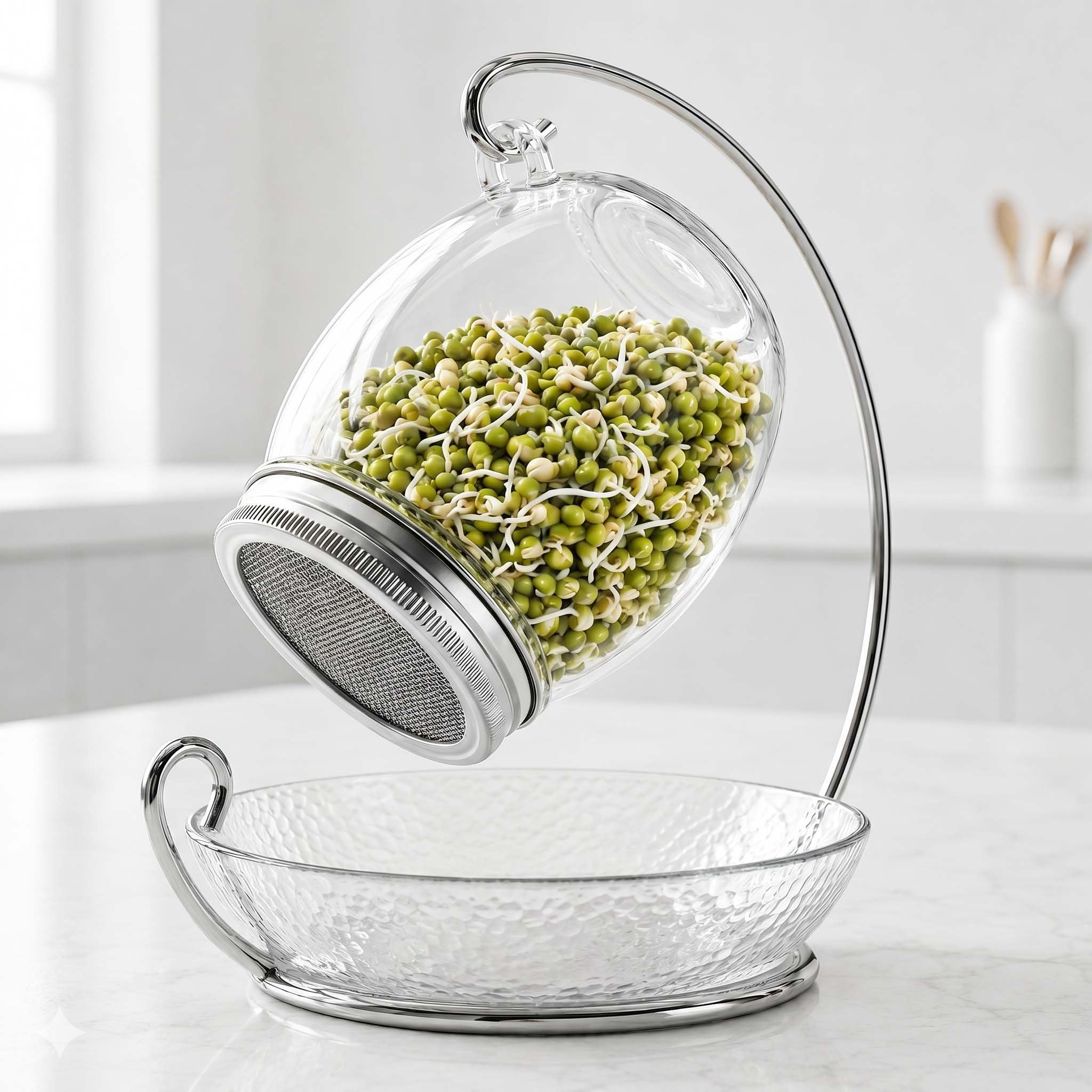
A single premium jar made of borosilicate glass that looks good enough for the dining table.
While the Malastar kit uses two standard glass jars, the ALCEDIA focuses on one exceptional jar: 850 milliliters (roughly 30 oz) of borosilicate glass, which is stronger and more temperature-resistant than the soda-lime glass used in typical mason jars. The stainless steel mesh lid keeps tiny seeds like alfalfa in place while water drains freely. Buyers consistently mention the “high-quality, clean glass” and note the kit is “beautiful and useful” enough to display.
Reviewers report alfalfa sprouts ready in as little as 2 days, and the stand and drip tray keep the counter neat. The catch, echoed by a buyer: “a little smaller than I had expected.” At 1 quart capacity, this offers a smaller batch size than a 2-jar setup, but the wide mouth makes cleaning simple and the rounded shape prevents moisture from pooling in corners. It is also dishwasher and microwave safe, which is rare for a sprouting kit.
Design bonus: borosilicate glass is tougher and clearer than standard mason jars, so you see root growth easily.
Honest limitation: one jar means one crop at a time — if you want variety, grab the 2-jar kits above.
Choose this for: a countertop centerpiece that grows clean, fast sprouts and fits a modern kitchen aesthetic.
Pass on this if: you need high volume output or want to sprout two different seeds on the same day.
4. Handy Pantry Complete Sprouts Growing Kit

A stackable tray system that grows three different crops at once without the jar-and-stand dance.
This is the only tray-based sprouter on the list, and it works differently from every jar kit above. Instead of tilting a jar on a stand, you fill three BPA-free plastic trays with seeds and stack them vertically — each tray has perforations for drainage, and the design blocks light from the top so roots grow downward. It includes three 2-oz packets of organic seeds (Alfalfa, 5 Part Salad Mix, and Protein Powerhouse Mix), so you can start immediately without a separate seed purchase. The manufacturer is Handy Pantry, and the kit is designed and made in the USA with a lifetime replacement warranty.
Long-term owners are emphatic about its durability: one reviewer noted using it “daily for over two years” and it “still holds up perfectly.” Another buyer mentioned it saves water since a spray uses about 0.5L, versus 1L per rinse for a jar. The trade-off is a slightly longer harvest time — about 6 to 8 days in a cool house, according to one user — but the yield is generous: roughly 4 cups per tray from just 2 tablespoons of seeds. Because you can stagger batches across the three trays, you can eat fresh sprouts every week without a gap.
System advantages
- Grow 3 different crops at once in separate trays
- Includes organic seeds and full instructions
- Lifetime replacement warranty from a US-based company
What to know
- Takes 6-8 days, versus 3-5 days for jar kits
- Plastic trays need gentle handling near perforations to avoid cracks
Best for: families who want a continuous supply of different sprouts and prefer a set-and-forget stacking system over daily jar tilting.
Not ideal if: you want sprouts in 3 days, have very limited counter height, or hold jar-based aesthetics are important to you.
5. Haswe Seed Sprouting Jar Kit

The lightest and most affordable entry point at just 1 pound for the complete setup.
This kit weighs 1 pound, versus the Zestigreens at 3.04 pounds — the difference is noticeable if you plan to move your sprouter around the kitchen or store it between uses. It comes with everything needed: one wide-mouth mason jar, a stainless steel mesh lid, a blackout sleeve, a drip tray, and a stand. The jar holds a 2-pound capacity, and the lid uses food-grade ABS plastic with stainless steel mesh for drainage and airflow. Customers note it is a “good bargain” and “easy to use” for beginners.
There is a real capacity catch, though. One reviewer warns: “be careful not to put more than 1-2 tablespoons of sprouts seeds” per batch. Overfill it and the seeds swell beyond what the jar can handle, leading to poor airflow. That same buyer reported mung bean sprouts ready in about 5 days. The single jar means one crop at a time, which is fine for solo households or first-timers testing the waters before committing to a larger double-jar system. The item dimensions are 8.27 x 2.76 x 5.12 inches.
Why it works
- Lightest kit on this list at 1 pound
- All-in-one — includes stand, tray, sleeve, and lid
- Proven review track record for ease of use
Watch out for
- Only 1 jar — no side-by-side sprouting
- Seed quantity is limited to 1-2 tablespoons per batch
- Single-level jar vs 2-level kits above
Grab this for: the lowest commitment weight and price point if you just want to try sprouting for the first time.
Graduate from this when: you outgrow a single jar and want to grow two varieties at once or need more batch volume.
Understanding the Specs
Number of Jars vs Trays
Most kits are either jar-based (you soak seeds inside a mason jar and tip it to drain) or tray-based (you spread seeds in stackable perforated trays). More jars mean you can grow different seeds at the same time — a 2-jar kit lets you sprout broccoli in one and alfalfa in the other. Tray systems often have 3 levels, perfect for continuous harvest scheduling.
Screen Material: Stainless Steel Mesh
The lid’s mesh holds your seeds in while letting water and air pass through. Stainless steel mesh is commonly used because it resists rust and allows good drainage and airflow. A fine mesh also helps keep tiny seeds like alfalfa and broccoli inside the jar while you rinse.
FAQ
How long does it take to grow sprouts from a seed sprouting kit?
Can I grow different seeds in the same kit at the same time?
Do I need special seeds for a sprouting kit or can I use grocery store beans?
How much seed should I put in a jar per batch?
What is the difference between a blackout sleeve and a regular cover?
Can I wash a sprouting kit in the dishwasher?
Do I need a stand or can I just leave the jar upright?
How is a tray sprouter different from a jar sprouter?
Will stainless steel mesh rust?
Final Thoughts: The Verdict
For the majority of shoppers, the best seed sprouting kits winner is the Zestigreens Premium Kit because you get two sturdy jars, a rust-resistant stand, and the unique green onion regrower — all backed by confident buyer reports. If you want the highest corrosion resistance in a dual-jar setup, grab the Malastar 2-Jar Kit with its 316 stainless steel mesh. And for a continuous multi-crop system that includes seeds, the Handy Pantry 3-Tray Sprouter is your best pick.
How We Picked
We do not accept paid placement. Every pick is matched to a real buyer and a real use-case; we do not hands-on test units.
Sources & Methodology
Specifications: manufacturer listings and product documentation. Review insights: verified customer reviews, as of July 2026. Pricing: not shown on this page (it changes often); check the current price via the retailer link.
As an Amazon Associate, Lawn Gear Lab earns from qualifying purchases. This does not affect which products we feature.