
Specs are compiled from manufacturer listings and verified buyer reviews and can change over time — please confirm the key details on the product page before buying.
Picking the right organic tomato fertilizer is the single biggest decision you will make for your tomato plants this season. Get the NPK (Nitrogen-Phosphorus-Potassium) ratio wrong, and you will get a forest of lush green leaves with hardly any fruit. The difference between a plant that grows and one that actually produces a heavy, flavorful harvest depends on a few key numbers on the bag. This guide cuts through the brand names and marketing promises to compare six top-rated organic options by their real specs—the mixing ratio, the form (granules, powder, or liquid), and the unit count that tells you how much coverage you are actually getting.
I’m Rikta — the founder and writer behind Lawn Gear Lab. This guide is built by comparing the manufacturers’ published specifications and the patterns across verified customer reviews, so you get each pick’s real strengths and trade-offs instead of marketing spin.
Whether you are prepping a few tomato plants on a patio or feeding a full backyard garden, understanding the difference between a slow-release granular and a fast-acting liquid makes all the difference. Here is everything you need to know to pick the right organic tomato fertilizer for your specific growing style.
Quick Picks
- Dr. Earth Organic Fertilizer, Tomato Vegetable & Herb — Best Overall
- Down To Earth All Natural Fertilizers Organic All Purpose Tomato & Vegetable Mix — Top Performer
- Big A Tomato Premium Organic Fertilizer with Kelp — Compact Pick
- Great Big Tomatoes and Vegetables Liquid Fertilizer Booster — Best Value
- Espoma Organic Tomato-Tone 3-4-6 with 8% Calcium — Premium Pick
- Jobe’s Organics Vegetable & Tomato Fertilizer Spikes — Easiest to Use
How To Choose The Best Organic Tomato Fertilizer
Choosing an organic fertilizer for tomatoes is different from picking one for your lawn or houseplants. Tomatoes are heavy feeders that need a specific balance of nutrients to produce big, flavorful fruit instead of just leaves. Here are the three most important specs to look for.
NPK Ratio: The Three Numbers That Decide Your Harvest
The three numbers on any fertilizer bag—Nitrogen (N), Phosphorus (P), and Potassium (K)—tell you the nutrient balance inside. For tomatoes, you generally want the second number (phosphorus) to be higher than the first (nitrogen). Too much nitrogen pushes the plant to grow tall and leafy at the expense of flowers and fruit. Look for a ratio where the middle number is equal to or higher than the first, like a 3:4:2 or a 4:6:2 mix, to support root development and fruit set (the process where flowers turn into tomatoes).
Granules vs. Liquid: Speed vs. Duration
Granular fertilizers (like the 18-pound Espoma product) release nutrients slowly over weeks or months as soil microbes break them down. This feeds both your plant and the soil biology. Liquid fertilizers (like the 32-ounce booster from Great Big Plants) get absorbed within days, making them ideal for reviving struggling plants or giving a mid-season push. Many experienced gardeners use a granular feed at planting time and supplement with a liquid feed during peak fruiting.
Calcium and Micronutrients: The Blossom End Rot Defense
Blossom end rot—the dark, sunken patch that appears on the bottom of your tomatoes—is caused by a calcium deficiency at the fruit-setting stage. Some fertilizers include a notable percentage of calcium (Espoma’s Tomato-tone lists 8% calcium) to help prevent this problem. Beyond calcium, look for products that contain kelp meal, humic acid, or beneficial microbes (mycorrhizae) because these ingredients improve nutrient uptake and help your plants handle heat and drought stress better.
Quick Comparison
| Model | Best For | NPK Ratio | Form | Unit Count | Amazon |
|---|---|---|---|---|---|
| Dr. Earth Organic Fertilizer | Soil Biology & Microbes | 3:2:2 | Granules | 128 oz | Amazon |
| Down To Earth All Purpose Mix | High Phosphorus for Fruit | 4:6:2 | Granules | 5 lb | Amazon |
| Big A Tomato Premium | Small-Space & Potted Plants | 1:1 | Powder | 12 oz | Amazon |
| Great Big Tomatoes & Veggies Liquid | Mid-Season Revival | 1 tbsp per pint | Liquid | 32 fl oz | Amazon |
| Espoma Tomato-tone | Large-Garden Value | 3:4:6 | Granules | 18 lb | Amazon |
| Jobe’s Organics Fertilizer Spikes | low-maintenance Ease | 2:7:4 | Spikes | 200 Count | Amazon |
In‑Depth Reviews
1. Dr. Earth Organic Fertilizer, Tomato Vegetable & Herb

The microbiology powerhouse that grows 9-foot plants with no burn.
Getting your soil biology right is half the battle with tomatoes, and this is where Dr. Earth excels. Each 128-ounce bag (that is 8 pounds per bag in a pack of two) contains seven champion strains of beneficial soil microbes plus both ecto and endo mycorrhizae—tiny fungi (ecto and endo refer to how they attach to roots) that expand your plant’s root reach to grab water and nutrients you cannot see. The 3:2:2 mixing ratio is gentler than the Down To Earth 4:6:2, so even a heavy application will not scorch your seedlings. One reviewer noted planting 3-inch seedlings and having 6-foot tall plants covered in blossoms and cherry tomatoes just 50 days later.
The trade-off is that the 3:2:2 ratio has a lower phosphorus number than many tomato-specific fertilizers. If your soil is already rich, this will not be an issue, but growers in poor or sandy ground might prefer the higher-fruit Down To Earth (4:6:2) for a stronger fruit-set kick. Still, for the sheer biological diversity and the “no chicken manure or sewage sludge” guarantee, this is the best foundation for any organic garden. If you want long-term soil health over a single-season phosphorus blast, this is your pick.
Microbe-Rich Formula
- Contains 8 select strains of mycorrhizae for drought tolerance and nutrient uptake
- Feeds for several months from a single application
- Buyers report 9-foot tall plants at 85 days
One Consideration
- Phosphorus level (2) is low compared to fruit-focused competitors like Down To Earth (6)
Reach for this if: you want a complete microbial soil food that grows massive, healthy plants over a long season without burning.
Look elsewhere if: you need a high-phosphorus boost for quick fruit set in poor soil.
2. Down To Earth All Natural Fertilizers Organic All Purpose Tomato & Vegetable Mix

The fruit-set specialist that revived pale plants in two weeks.
Where the Dr. Earth leads on soil biology, Down To Earth leads on fruit-production chemistry. Its 4:6:2 ratio lists 6 phosphorus versus 2 in the Dr. Earth 3:2:2, which directly supports flower development and fruit formation. This is the granular you reach for if your tomato plants look leafy but are not setting fruit. One buyer mentioned it “revived pale, flimsy tomato plants in two weeks after application.” The ingredients list is clean: fish bone meal, blood meal, feather meal, rock phosphate, langbeinite, greensand, humates, and kelp meal. It is also OMRI-listed (Organic Materials Review Institute, a certification for use in certified organic production) for use in certified organic production, so it meets the strictest growing standards.
The catch is the smaller 5-pound box—compared to the 18-pound Espoma bag, it is 5 pounds versus 18 pounds. The smell from the fish and blood meal is also notably strong for the first few days, though owners mention it dissipates quickly after watering. Over-apply Dr. Earth if you want the soil biology, but pick this one for the phosphorus punch.
Fruit-Focused Formula
- Higher phosphorus (6) directly drives flower and fruit production
- OMRI-listed for certified organic production
- Buyers confirm it revives weak plants in two weeks
Keep in Mind
- 5 lb box covers fewer plants than the 18 lb Espoma offering
- Strong organic smell for the first few days after application
Best for: tomato plants that are leafy but fruit-light—the high phosphorus gives a targeted fruit-set push.
Skip if: you need a season-long supply for a large garden; the 5 lb box runs out quickly.
3. Big A Tomato Premium Organic Fertilizer with Kelp

A concentrated kelp powder for small spaces that punches above its weight.
If you are growing tomatoes in a few pots on a patio or balcony, a bag this small (12 ounces compared to the 128-ounce Dr. Earth) might be exactly what you need because you will not have half a bag left over at the end of the season. The powder form dissolves quickly in water so roots absorb it fast. The formula is enriched with North Atlantic sea kelp, plus amino acids, humic acid, and secondary nutrients like calcium and magnesium. One buyer in growing zone 7 fed it weekly to 6 plants starting in July and reported “produced large tomatoes by Oct 13.”
The obvious limit is the unit count—at just 12 ounces, it holds 12 ounces versus the Dr. Earth pack at 128 ounces. For a single-season patio setup that is fine, but if you are planting a full garden with a dozen or more plants, you will be buying multiple bags. The 1:1 ratio is also less specialized for tomatoes compared to the 4:6:2 Down To Earth. Go with the Down To Earth if you need more phosphorus per application; this is your pick for fast mixing in a tight space.
Fast & Convenient
- Highly soluble powder for rapid nutrient delivery to roots
- Contains kelp, amino acids, and humic acid for balanced nutrition
- Buyers see large late-season harvests with weekly feeding
Note the Size
- 12 oz bag is small; not cost-effective for large gardens
- 1:1 ratio is less targeted than a high-phosphorus tomato blend like Down To Earth’s 4:6:2
Pick this for: container growers and small patio gardens who want a fast-acting, easy-to-mix kelp booster.
Not for: large in-ground gardens—you will run out fast and the ratio is not optimized for heavy fruiting.
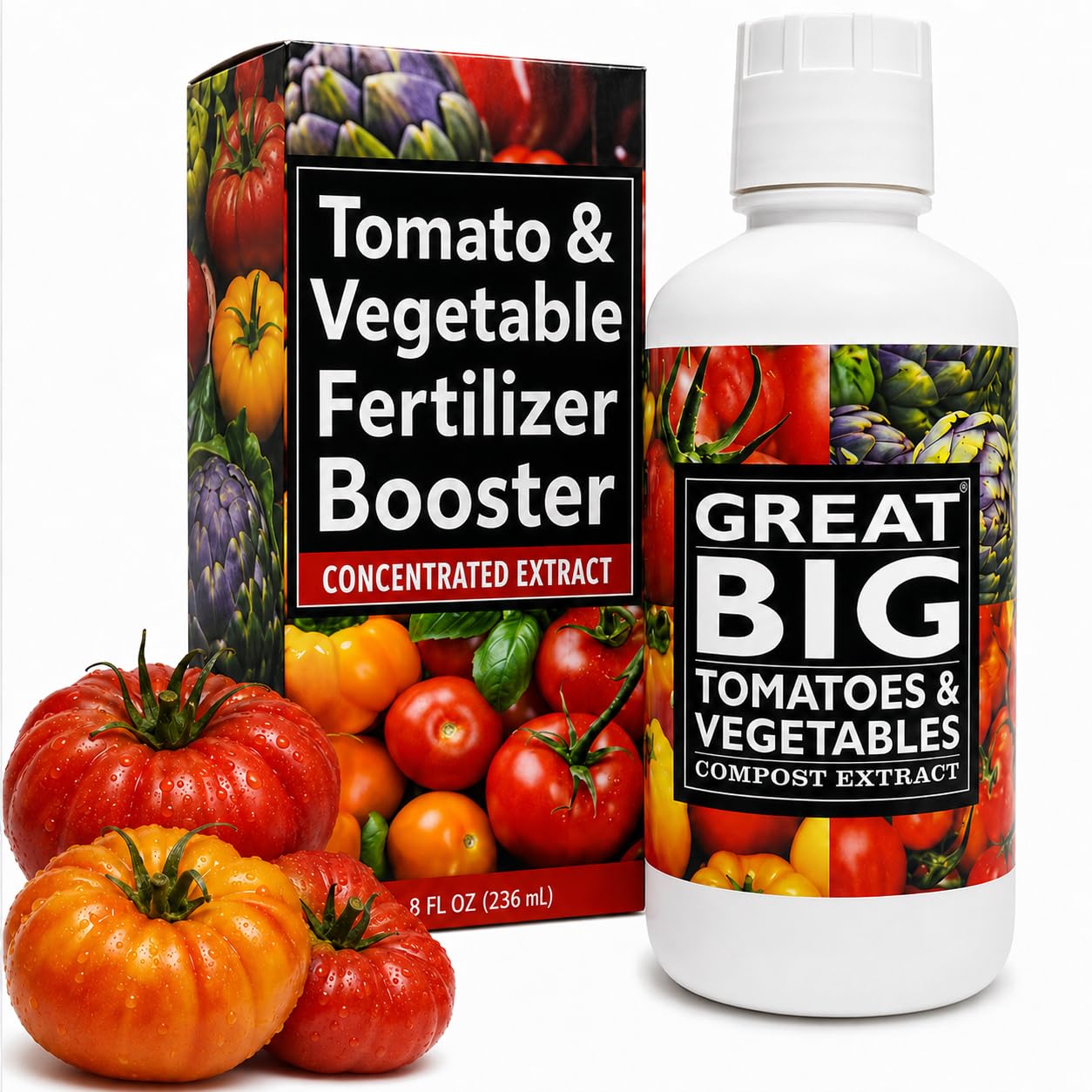
4. Great Big Tomatoes and Vegetables Liquid Fertilizer Booster
The liquid reviver that turns struggling vines into 1-pound fruit producers.
Every tomato grower faces that mid-season moment when a plant looks yellow, wilted, or just stops producing. This liquid booster is designed exactly for that. It flows straight to the root zone and makes existing soil nutrients plant-available again, which is different from granular products that need time to break down. It is a proprietary compost extract with humic acid (from leonardite, a soft brown coal), over 70 chelated trace minerals, kelp seaweed, potassium sulfate, and citric acid. Customers note that harvests “reach the 1-pound-plus range, with vines requiring double or triple staking to manage the weight.” You apply one tablespoon per pint of water directly to the soil.
Unlike the granular Dr. Earth or Down To Earth products, this is not a standalone fertilizer for the whole season. Think of it as a rescue treatment or a weekly supplement alongside a granular base feed. It is registered by the California Department of Food and Agriculture as a true organic input, so it meets organic certification standards. If your plants are healthy and you just want set-and-forget feeding, the Jobe’s spikes or the Espoma granules are a better fit.
Quick Recovery Tool
- Delivers over 70 chelated trace minerals directly to root zone
- Reviewers point out harvests over one pound per tomato
- Registered organic input material in California
How to Use It
- Works best as a supplement to a granular base feed, not a solo solution
- Requires mixing (1 tbsp per pint) and frequent reapplication
Grab this if: you want a fast-acting liquid boost to revive struggling plants or push an existing crop to monster size.
Pass on it if: you prefer a single application that feeds all season without mixing.
5. Espoma Organic Tomato-Tone 3-4-6 with 8% Calcium

The 18-pound workhorse with built-in calcium to stop blossom end rot.
Volume alone makes this a standout. The 18.1-pound bag is 18.1 pounds versus the Down To Earth 5-pound box at 5 pounds, giving you a full season of feeding for a serious garden without needing a restock. Equally important is the 8% calcium content, a feature none of the other granulars here match. Calcium deficiency is the primary cause of blossom end rot—that dark sunken spot that ruins tomatoes right at the bottom. Espoma addresses this head-on by blending calcium into a 3:4:6 NPK, where the high potassium (6) supports overall plant health and disease resistance. It uses a proprietary Bio-tone formula with beneficial microbes, and it requires no mixing—just sprinkle around the drip line and water in every two weeks.
One buyer in North Alabama noted they use it for roughly 100 tomato plants a year, calling the NPK “the best fit of NPK needs for tomato plants” and praising the easy application and good price. The main trade-off is that you cannot use this as a foliar spray, and you need to be careful not to over-apply in containers because the granules are slow-release and build up over time. The Jobe’s spikes offer even simpler “stick and forget” application for potted plants. If you want that volume for the price, this beats the Down To Earth for season-long coverage.
Season-Long Supply
- 18 lb bag covers a large garden without mid-season repurchase
- 8% calcium is a real defense against blossom end rot
- No mixing required; just sprinkle and water
Watch For
- Granules can accumulate in containers if over-applied
- Not suitable for foliar feeding
Ideal for: medium-to-large in-ground gardens where you want season-long feeding with built-in blossom end rot prevention.
Not ideal for: small container gardens or if you prefer a liquid weekly feed.
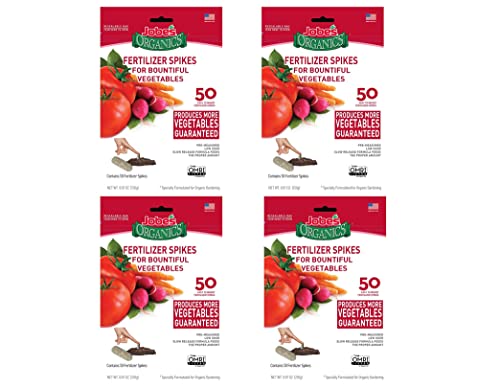
6. Jobe’s Organics Vegetable & Tomato Fertilizer Spikes
The “drive it in and walk away” solution that feeds for 8 weeks straight.
If measuring, mixing, or remembering a weekly schedule is the barrier between you and a good tomato harvest, this is the product that removes the friction. Each spike is a pre-measured stick with a 2:7:4 NPK ratio—the highest phosphorus (7) of any product on this list, which directly targets flower and fruit production. You simply use a stick to make a starter hole, push a spike into the soil near the root zone, and it releases nutrients slowly for up to 8 weeks. A pack of 4 boxes gives you 200 spikes total, enough for 50 plants if you use 4 spikes per plant as recommended. One owner reported they “got ready for veggie flowers” and saw improvement in a small nectarine tree within two weeks.
The catch is control. Unlike the Dr. Earth or Espoma granules that you can spread evenly across a wide root zone, spikes deliver nutrients in a concentrated column. For plants in raised beds with a wide root spread, granules are more effective at reaching all feeder roots. Also, the 2:7:4 ratio is heavy on phosphorus and light on nitrogen, so if your soil is already phosphorus-rich, you risk locking out other nutrients. In that scenario, the balanced 3:2:2 Dr. Earth or the 3:4:6 Espoma would be a safer all-around choice. The convenience here is class-leading for hands-off feeding.
Minimal Effort
- Pre-measured spikes require zero mixing or measuring
- 200 spikes cover up to 50 plants for the season
- Highest phosphorus ratio (7) of all picks for maximum fruit support
One Trade-Off
- Concentrated spike delivery is less effective for wide-spreading roots than granular spreading
- High phosphorus (7) can cause nutrient lockout in already-rich soil
Choose this if: you want the absolute easiest feeding method—stick it in and forget it for two months.
skip it if: you are growing in raised beds or in-ground soil where spreading granules gives better root coverage.
Understanding the Specs
NPK Ratio (Nitrogen – Phosphorus – Potassium)
Every fertilizer package shows three numbers, like 3:4:6 or 4:6:2. These stand for the percentage of nitrogen (leaves and stems), phosphorus (roots, flowers, and fruit), and potassium (overall plant health and disease resistance). For tomatoes, a higher middle number (phosphorus) supports fruit production. If the first number (nitrogen) is too high, your plant will grow tall and leafy but produce very few tomatoes. Compare the 4:6:2 Down To Earth mix with the 3:2:2 Dr. Earth mix—the first lists 6 phosphorus while the second lists 2, making it better suited for plants that are not setting fruit.
Form: Granules, Powder, Liquid, or Spikes
The form of a fertilizer changes how you use it and how fast it works. Granules (like the Espoma and Dr. Earth picks) are sprinkled onto the soil and release nutrients slowly over weeks as microbes break them down. Powders (like the Big A product) are mixed with water and absorbed within days. Liquids (like the Great Big Plants booster) flow straight into the root zone for the fastest response. Spikes (like Jobe’s) are pushed into the soil and release nutrients in a concentrated column for up to 8 weeks. Your choice depends on how often you want to apply and whether you are feeding in-ground plants or containers.
FAQ
What does organic mean on a tomato fertilizer label?
Can I use a lawn fertilizer on my tomato plants?
How often should I apply organic tomato fertilizer?
What causes blossom end rot and which fertilizer helps prevent it?
Is a 4:6:2 ratio better than a 3:2:2 ratio for tomatoes?
Can I mix granular and liquid organic fertilizers together?
How much fertilizer does one plant need per season?
Do organic tomato fertilizers expire?
Is organic fertilizer better for container tomatoes than synthetic?
Final Thoughts: The Verdict
For most buyers, the organic tomato fertilizer winner is the Dr. Earth Organic Fertilizer because its eight strains of mycorrhizae build the soil biology that sustains heavy harvests all season without burning your plants. If you want targeted fruit production from a high-phosphorus granular, grab the Down To Earth All Purpose Mix. And for the absolute easiest feeding method—just push a spike into the ground and forget it—the standout is the Jobe’s Organics Fertilizer Spikes.
How We Picked
We do not accept paid placement. Every pick is matched to a real buyer and a real use-case; we do not hands-on test units.
Sources & Methodology
Specifications: manufacturer listings and product documentation. Review insights: verified customer reviews, as of July 2026. Pricing: not shown on this page (it changes often); check the current price via the retailer link.
As an Amazon Associate, Lawn Gear Lab earns from qualifying purchases. This does not affect which products we feature.