
Specs are compiled from manufacturer listings and verified buyer reviews and can change over time — please confirm the key details on the product page before buying.
If your back aches after a day of weeding, you are using the wrong tool. An action hoe (also called a scuffle hoe or stirrup hoe) cuts weeds just below the soil surface with a push-and-pull motion, so you never have to bend, chop, or strain. The trick is picking the right blade width, handle length, and build quality for your garden’s soil type and your own height.
I’m Rikta — the founder and writer behind Lawn Gear Lab. This guide is built by comparing the manufacturers’ published specifications and the patterns across verified customer reviews, so you get each pick’s real strengths and trade-offs instead of marketing spin.
Because a tool that saves your back also has to survive years of dirt and roots, I focused on blade material, handle durability, and weight to find the most reliable action hoe weed remover for every kind of gardener.
Quick Picks
- Hoss Stirrup Hoe — Best Overall
- Corona Clipper SH61000 Diamond Hoe — Top Precision
- Rogue Scuffle Hoe — Toughest Build
- Hoss Tools Push Pull Hoe — Best for Drip Lines
- Xtreme Weeder Scuffle Hoe (Skidger) — Most Versatile Head
- True Temper 1866300 Action Hoe — Budget-Friendly
- Garden Hoe (COCONUT) Heavy Duty Hula Hoe — Entry-Level Value
How To Choose The Best Action Hoe Weed Remover
An action hoe is a simple tool — a sharp blade on a long handle that you slide back and forth near the soil surface. But small differences in blade shape, handle material, and weight make one a joy to use and the other a chore. Here is what separates the good from the great.
Blade Shape and Width
The blade is the business end. A stirrup-style blade (a loop of metal) cuts on both the push and pull strokes and works best for slicing weeds in loose, cultivated soil. A V-shaped or diamond blade gives you a pointed tip for reaching between plants, but it only cuts on one side unless the manufacturer sharpens all edges. Wider blades (6 inches or more) cover ground faster; narrower ones maneuver better in tight rows.
Handle Length and Material
Your height determines the handle length you need. A 60-inch handle suits tall gardeners and lets you stand fully upright, while 54 inches is comfortable for average heights. The material matters too — hardwood (ash or hickory) absorbs vibration and feels warm in the hand, but it can crack over time. Fiberglass or steel handles are nearly indestructible but add weight.
Weight and Balance
A hoe that is too light feels flimsy and bounces off roots, while one too heavy wears out your arms. the balance for most people falls between 1.5 and 2.5 pounds. More important than raw weight is balance — a well-balanced hoe feels lighter than its actual pounds because the weight is distributed evenly between your hands.
Blade Steel and Edge Retention
You want carbon steel or tempered steel that can take a sharp edge and hold it. Cheaper hoes come with a blade that dulls after a season, forcing you to work harder. High-end blades are often sharpened on both sides or all three edges, so you get a clean cut no matter which direction you move.
Quick Comparison
| Model | Best For | Blade | Handle Length | Weight | Amazon |
|---|---|---|---|---|---|
| Hoss Stirrup Hoe | Best Overall | 6″ spring steel (stirrup) | 60 inches | 1 pounds | Amazon |
| Corona Clipper SH61000 | Hard-to-Reach Weeds | Diamond (carbon steel) | 65 inches | — | Amazon |
| Rogue Scuffle Hoe | All-Around Toughness | 6″ triangle (tempered steel) | 60 inches | 2.3 Pounds | Amazon |
| Hoss Tools Push Pull Hoe | Precision Weeding | V-shaped (tempered steel) | — | 1 pounds | Amazon |
| Xtreme Weeder Scuffle Hoe | Versatile Surfaces | V-blade (stainless steel) | 54 inches | 1.8 Pounds | Amazon |
| True Temper 1866300 | Budget-Friendly | Triangular | 54 inches | 1 pounds | Amazon |
| Garden Hoe (COCONUT) | Entry-Level Value | Stirrup (metal) | 62 inches | — | Amazon |
In‑Depth Reviews
1. Hoss Stirrup Hoe

The American-built stirrup hoe that rocks instead of chops.
The Hoss Stirrup Hoe uses a 6-inch spring steel blade that is sharpened on both sides — so it cuts weeds whether you push or pull. The blade “rocks” or oscillates 20 degrees in either direction, meaning you can keep a steady rhythm without lifting the tool. That rocking motion is what separates it from cheaper fixed-blade hoes: you stay in the cut zone longer.
The 60-inch ash handle is waxed instead of varnished, which the maker says prevents peeling and cracking over time. Buyers report the handle feels solid and well-balanced, even for taller gardeners who hate stooping. At 1 pound versus the Rogue Scuffle Hoe at 2.3 pounds, it is lighter and more maneuverable, making it the better choice for long weeding sessions without tiring your arms.
One reviewer noted the powder-coated steel frame resists rust well and that the unique square peg design keeps the blade securely attached. The biggest trade-off is the 6-inch stirrup width — it covers ground fast but does not have a pointed tip for threading between tight plant stems.
Rock-solid value: Lifetime durability from a US-made tool with an oscillating blade that cuts effort in half — ideal for average-to-large garden beds where speed matters.
One real limitation: No pointed tip, so row-planting precision is not its strength.
Reach for this if: You want a durable, lightweight stirrup hoe that covers large beds fast and never needs sharpening.
Look elsewhere if: You need to reach around individual plants or navigate drip tape — a V-blade is better for that.
2. Corona Clipper SH61000 Diamond Hoe

Four sharpened edges and a diamond shape for reaching tiny weeds.
The Corona Clipper SH61000 takes a completely different approach from the stirrup-style hoes above. Its diamond-shaped head has four sharpened edges, so every stroke — forward, backward, left, or right — is a cutting stroke. The points of the diamond can nick even small weeds out of tight corners, which is difficult with a round stirrup loop.
With a 65-inch overall length, this is the longest tool in the lineup, making it ideal for tall gardeners or anyone who wants maximum reach without bending. The carbon steel blade is easily sharpened when it dulls, unlike treated steel blades that need special tools. The welded solid socket connection is built for maximum service life.
Owners mention that the diamond shape excels around garden borders and between stepping stones where larger hoes cannot fit. The main trade-off: the diamond blade is less effective for covering wide, open beds compared to the 6-inch stirrup on the Hoss, and the blade is not self-sharpening like spring steel.
Why it stands out
- Four sharpened edges for cutting in any direction
- 65-inch handle — longest in the test — for tall gardeners
- Pointed diamond nicks small weeds in hard-to-reach spots
The honest trade-offs
- Slower on large, open beds than a 6-inch stirrup
- Carbon steel needs occasional sharpening
Best for: Gardeners with lots of tight spaces, borders, and small weed patches who want one blade that cuts in every direction.
skip it if: You are weeding a large vegetable patch or field — a stirrup hoe will be faster.
3. Rogue Scuffle Hoe

A 6-inch triangle blade handmade from recycled disc blades that can bust new ground.
The Rogue Scuffle Hoe is built from recycled agricultural disc blades — high-grade tempered steel that is precision sharpened on all three sides. At 2.3 pounds versus the Hoss Stirrup Hoe at 1 pound, it is the heaviest hoe in this review, but that heft gives it real chopping authority. This is not just a weeder; it can bust open new ground, rake rocks, and move dirt around plants.
The 60-inch hickory handle provides a comfortable grip, and the perfect weight balance reviewers describe makes the 2.3 pounds feel more manageable. Unlike the Hoss, this one has a triangular pointed tip for slipping between plants, and the three sharpened sides mean you cut on every stroke. The manufacturer offers a 2-year warranty for the head of the tool only.
Customers note that it handles everything from light weeding to breaking up compacted soil, and the handmade quality stands out. The catch is the weight — if you are weeding for hours in soft, loose soil, the lighter Hoss or True Temper will leave you less fatigued.
Heavy-duty versatility: More than a weeder — a ground-breaking, rock-raking, dirt-moving tool for serious gardeners who want one implement that does it all.
The real catch: At 2.3 lbs it is noticeably heavier than other options, so consider your stamina for long sessions.
Reach for this if: You need a single tough tool that weeds, breaks new ground, and moves soil — and you prefer a hickory handle with a 2-year warranty.
Look elsewhere if: All your weeding is in soft, maintained beds and you want something lighter.
4. Hoss Tools Push Pull Hoe

Slides under drip irrigation lines without nicking the tape.
The Hoss Tools Push Pull Hoe uses a sharpened, V-shaped head made from tempered steel. The V-notch is designed to easily navigate around plant stems without cutting them, and it slides underneath drip irrigation lines without snagging or damaging the tape. If you have an established garden with irrigation tubing running between rows, this is the safest hoe for the job.
At 1 pound, it ties the Hoss Stirrup Hoe and the True Temper as the lightest in the lineup, which keeps fatigue low during long sessions. The Amish-made construction and lifetime build quality mirror the Hoss Stirrup Hoe above, but the V-shape gives it a completely different purpose — precision near plants rather than wide-area sweeping.
Reviewers point out that the V-notch makes it easy to straddle seedlings and get close to the stem without damaging the plant. The trade-off against the stirrup-style Hoss is that the V-blade is slower for open-bed weeding because it cuts a narrower path per stroke.
Surgical weeding: The V-shaped head offers class-leading precision around plants and drip tape — a purpose-built tool for the meticulous gardener.
The trade-off: Slower coverage on open beds compared to a stirrup hoe.
Best for: Gardeners with drip irrigation or closely spaced plants who need to weed without cutting tubing or stems.
pass on it if: You have large open beds and want to clear weeds fast — the stirrup is faster.
5. Xtreme Weeder Scuffle Hoe (Skidger)
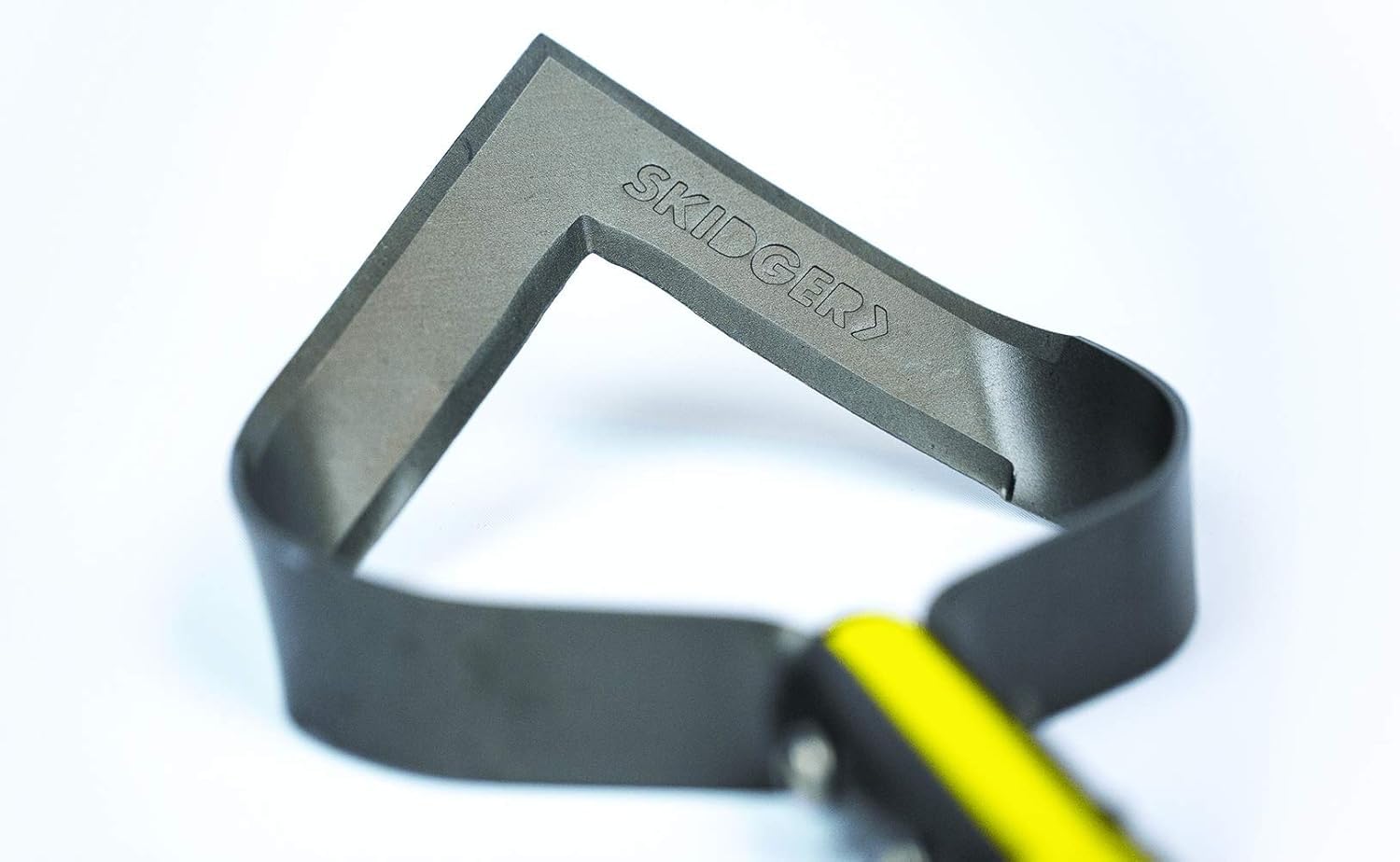
A stainless V-blade with an open head that glides through gravel and mulch.
The Xtreme Weeder from Skidger has a precision V-shaped blade made from stainless steel, but its standout feature is the open head design. Unlike closed-loop stirrup hoes that can clog with bark or gravel, the open construction lets loose material pass through freely, making this the best choice if you mulch heavily or have rock pathways.
The curved blade gives you a clear line of sight while working, which shoppers say helps with accuracy around plants. The 54-inch fiberglass handle with grips reduces bending and strain, and at 1.8 pounds versus 1 pound for the lightest hoes and 2.3 pounds for the Rogue, it lands in the middle of the lineup. The precision pointed tip reaches between plants and near drip irrigation lines.
One buyer mentioned the stainless steel resists rust better than carbon steel blades, especially in humid climates. The main limitation is the 54-inch handle — compared with the 60-inch and 65-inch options, taller gardeners may still need to stoop slightly.
The versatility advantage
- Open head design works in soil, gravel, mulch, and bark without clogging
- Stainless steel blade resists rust
- Curved blade gives clear sightline while weeding
The honest downside
- 54-inch handle is shorter than the premium 60-inch options
- Not as durable as US-made tempered steel for breaking tough ground
Reach for this if: You garden in mixed surfaces — soil, gravel, mulch, or bark — and need one tool that works cleanly in all of them.
Look elsewhere if: You are over 6 feet tall and want to stand fully upright while weeding.
6. True Temper 1866300 Action Hoe

A classic triangular action hoe at a no-fuss price point.
The True Temper 1866300 is the old-school entry-level action hoe that will not break the bank. It has a triangular-shaped head that cuts weed roots below the surface, paired with a 54-inch hardwood handle that the maker describes as strong and durable. At 1 pound, it ties for the lightest hoe in this review alongside the Hoss Stirrup Hoe and the Hoss Push Pull Hoe.
The hardware-store classic, it is about simplicity — no oscillating blade, no diamond edges, no V-notch. Just a plain triangular blade that does the basic job of cutting roots as you push and pull. The 54-inch handle is shorter than the premium 60-inch options, which may require a slight bend for very tall gardeners.
Buyers report this hoe works well for light weeding in soft soil and that the price makes it easy to own as a backup. The catch is that the blade comes unsharpened and dulls faster than the tempered or spring steel options — so you will need to file it yourself to keep it cutting cleanly.
Simple and affordable: A no-frills triangular hoe that handles basic weeding at a budget-friendly price — great for occasional use or as a spare.
Where it falls short: The unsharpened blade dulls quickly, and the 54-inch handle is shorter than premium competitors.
Best for: Budget-conscious gardeners who need a basic action hoe for light, occasional weeding in soft soil.
it’s not for you if: You have tough, compacted soil or want a blade that stays sharp without your own filing.
7. Garden Hoe (COCONUT) Heavy Duty Hula Hoe

A 2-in-1 stirrup and cultivator that flips between weeding and digging.
The COCONUT Garden Hoe tries to do two jobs with one handle: a stirrup-style blade for weeding on one side and a rake head for cultivating on the other. A simple flip of the handle switches between the two, so you can weed a row and then loosen the soil without swapping tools. The 62-inch adjustable handle is the longest in the budget tier, which helps reduce back strain.
It assembles by screwing rods together in minutes, making it convenient for shipping and storage. The blade is sharp on both ends, cutting weeds on the push and pull strokes, and the maker says the sturdy metal construction is built for soft to medium soil. It assembles from screw-together rods, which makes it easier to ship and store.
The catch, as owners mention, is that the blade is not as durable as a forged one-piece design — the screw-together construction can loosen over time, and the metal stirrup will dull faster than the spring steel on the Hoss. This is a value pick for the casual gardener, not a lifetime tool.
Two tools in one: The flip-head design gives you a weeder and a cultivator in a single budget-friendly package — ideal for small gardens and beginners.
The honest trade-off: The screw-together construction and softer metal mean it will not hold up as long as a forged, solid-frame hoe.
Reach for this if: You are a new gardener with a small plot who wants both a stirrup hoe and a cultivator in one budget-friendly buy.
Look elsewhere if: You need a daily-use tool that lasts years — the Hoss or Rogue is a better long-term investment.
Understanding the Specs
Blade Shape and Cutting Action
The blade shape determines where and how you can weed. A stirrup loop cuts on both push and pull strokes and is best for open soil. A V-shaped or diamond head has a pointed tip for reaching between plants but may only cut on one side unless all edges are sharpened. A triangular head is the simplest and cheapest but usually only sharp on one or two edges.
Handle Length and Material
Handle length controls how upright you can stand. A 60-inch or longer handle lets most people work without bending. Hardwood handles (ash or hickory) absorb vibration but can crack; fiberglass is durable and lighter; steel is strongest but heaviest. Choose your handle material based on how much shock absorption and weight you prefer.
Weight and Balance
A hoe that weighs between 1 and 2.5 pounds is typical. Lighter hoes (1 pound) reduce arm fatigue on long weeding sessions but may bounce off roots. Heavier hoes (2.3 pounds) cut through tough soil better but tire you out faster. Balance is just as important — a well-balanced hoe feels lighter than its actual weight because the load is spread evenly between your hands.
Blade Steel and Edge Retention
The steel type determines how long the blade stays sharp. Spring steel and tempered steel hold an edge longest and often come pre-sharpened on both sides. Carbon steel is easily sharpened at home but dulls faster. Stainless steel resists rust but is harder to sharpen. Cheap, soft metal blades will need frequent filing to cut cleanly.
FAQ
What is the difference between an action hoe and a regular hoe?
How long of a handle do I need for my height?
Will a stirrup hoe work in gravel or mulch?
Can I use an action hoe near drip irrigation lines?
How do I sharpen an action hoe blade?
Is a heavier hoe better for tough soil?
How do I know if a blade is sharp enough?
Will a wooden handle crack or rot over time?
Can I leave my action hoe outside in the garden?
What is the best action hoe for a new gardener?
Final Thoughts: The Verdict
For the majority of shoppers, the action hoe weed remover winner is the Hoss Stirrup Hoe because it combines an oscillating, double-sharpened 6-inch spring steel blade with a light 1-pound weight and a lifetime US build — perfect for fast, low-effort weeding in open beds. If you need precision around drip tape and plants, grab the Hoss Tools Push Pull Hoe for its V-shaped head. And for versatility across soil, gravel, and mulch, the Xtreme Weeder Scuffle Hoe with its open-head stainless steel design has you covered.
How We Picked
We do not accept paid placement. Every pick is matched to a real buyer and a real use-case; we do not hands-on test units.
Sources & Methodology
Specifications: manufacturer listings and product documentation. Review insights: verified customer reviews, as of July 2026. Pricing: not shown on this page (it changes often); check the current price via the retailer link.
As an Amazon Associate, Lawn Gear Lab earns from qualifying purchases. This does not affect which products we feature.