
Pushing a mower across a steep, sun-baked hill in summer heat is a workout nobody signed up for. An RC lawn mower lets you take the labor out of the equation — you stand in the shade with a remote control while the machine tackles the grass, slopes, and uneven terrain for you. Whether you’re managing a tricky hillside, recovering from an injury, or simply tired of sweating through your Saturday, these remote-controlled mowers offer a legit shortcut to a manicured yard.
I’m Rikta — the co-founder and writer behind Lawn Gear Lab. I spend my days studying horticultural equipment specs, analyzing hundreds of hours of owner feedback, and comparing the mechanical and electrical systems that separate a toy from a true yard tool, so this guide reflects real-world data on the current best rc lawn mower options available right now.
After comparing battery capacities, deck widths, slope ratings, and real owner experiences across nine distinct models, I’ve sorted through the noise to highlight which remote mowers actually earn their keep on residential property.
How To Choose The Best RC Lawn Mower
Not every remote mower can handle the same terrain. Before you buy, you need to match the machine’s physical limits to your yard’s specific challenges. Slope grade, battery chemistry, cutting width, and deck construction are the four pillars that determine whether a mower will breeze through your lawn or stall out on the first bump.
Slope Rating: Degrees vs. Percentage
Manufacturers advertise slope capability in either degrees or percentage. A 30-degree slope is roughly a 58% grade — that’s steep enough that a standard push mower would be dangerous. Always check this spec. If your yard has a 35-degree incline, a mower rated for 20 degrees will struggle, lose traction, or tip. Look for mowers with all-wheel drive and a slope rating at least 5 degrees higher than your steepest section.
Cutting Width and Deck Material
Wider decks cut faster but struggle in tight spaces between flower beds. An 18-inch deck is a good middle ground for most suburban lots. Deck material matters too: steel or aluminum decks handle impacts better than polypropylene. For thick St. Augustine or Bermuda grass, a steel deck with a high-torque motor will resist flexing and deliver a cleaner cut.
Battery System and Runtime
Battery voltage dictates torque. A 20V system is fine for light duty; 40V or higher is better for thick grass and hills. Amp-hour (Ah) ratings tell you how long the battery lasts under load — a 5Ah pack at 40V can run a mower for roughly 45–60 minutes on a medium lawn, but runtime drops significantly when the grass is wet or overgrown. Look for dual-battery systems or swappable packs if your yard exceeds a quarter acre.
Quick Comparison
On smaller screens, swipe sideways to see the full table.
| Model | Category | Best For | Key Spec | Amazon |
|---|---|---|---|---|
| Mowrator S1 4WD | Premium RC | Steep slopes & heavy terrain | 21″ deck, 37° slope rating | Amazon |
| ANTHBOT Genie 3000 | Wire-Free Robot | Large, complex yards | RTK+4-eye vision, 0.9 acre | Amazon |
| Segway Navimow i215 | LiDAR Robot | Shaded yards with weak GPS | LiDAR+Vision fusion, 45% slope | Amazon |
| ECOVACS Goat A2000 LiDAR PRO | LiDAR Robot | Medium-large lawns up to 1/2 acre | 32V motor, TruEdge trimmer | Amazon |
| ECOVACS Goat O1000 LiDAR PRO | LiDAR Robot | Small yards with tight spaces | Dual-LiDAR, 200+ obstacle types | Amazon |
| WORX Landroid Vision Cloud | RTK Cloud Robot | Custom mowing patterns | RTK cloud + Vision AI, 8.7″ cut | Amazon |
| Segway Navimow i206 AWD | AWD Robot | Sloped, compact lawns | NRTK+Vision, 45% slope rating | Amazon |
| ZIPmow RC Mower | Handheld RC | Small, flat properties | 18″ deck, all-wheel drive | Amazon |
| YARDCARE M800Plus | GPS Robot | First-time robot mower buyers | GPS+3D vision, 32 ft magnetic strip | Amazon |
In‑Depth Reviews
1. Mowrator S1 4WD 18Ah
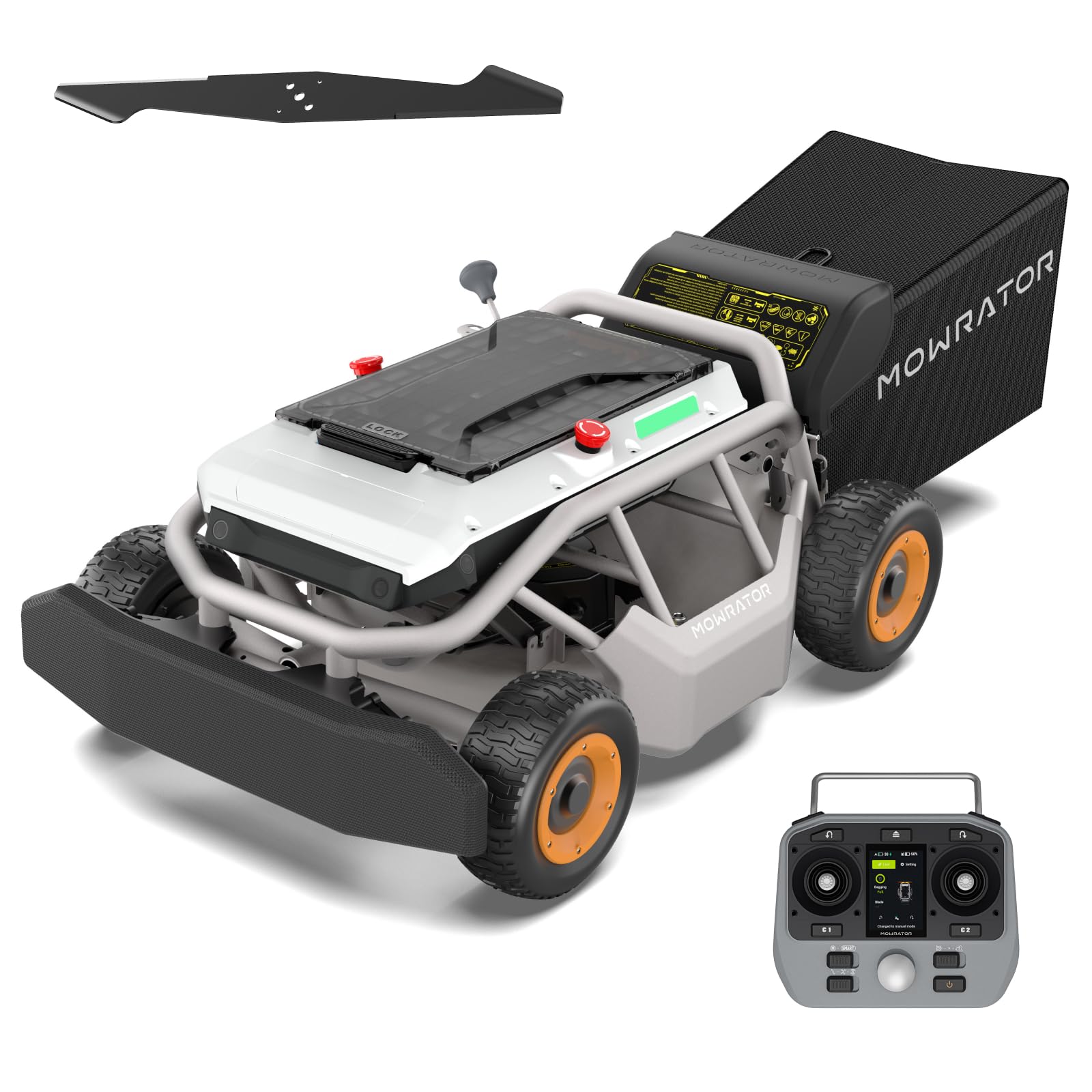
The Mowrator S1 is built like a piece of heavy equipment — 147 pounds of steel, aluminum, and polyurethane riding on four driven wheels. Its 21-inch cutting deck with a 1.5 to 4.3-inch adjustable height range makes short work of thick grass, and the 75% (37°) slope rating is the highest in this roundup. Owners consistently report it chewing through 20-30 inch tall weeds and wet grass without bogging down, something no robot mower can match.
The 18Ah battery delivers a real-world runtime of roughly 2.25 hours, enough to cover over an acre in a single session. That’s a serious advantage for anyone managing a large, steep property. The remote control has low-latency response, and the four-wheel drive provides near-mountain-goat traction on loose terrain. Optional accessories add mulching, snow plowing, and towing, turning this into a year-round machine.
Owners do report occasional error codes with no detailed troubleshooting guide, and the wide tires can tear turf during sharp turns on soft ground. The price is the steepest in the guide, and the initial customer support response has been slow for some buyers. Yet for extreme terrain — 23-degree hillsides, swampy low areas, or rutted overgrowth — the S1 is in a class of its own.
What works
- 21-inch deck covers ground fast
- 37° slope rating handles extreme hills
- 2+ hour runtime covers over 1 acre
- All-season attachments add real utility
What doesn’t
- Wide tires can rip turf during turns
- Error codes lack clear troubleshooting
- Very heavy to move manually
2. ANTHBOT Genie 3000
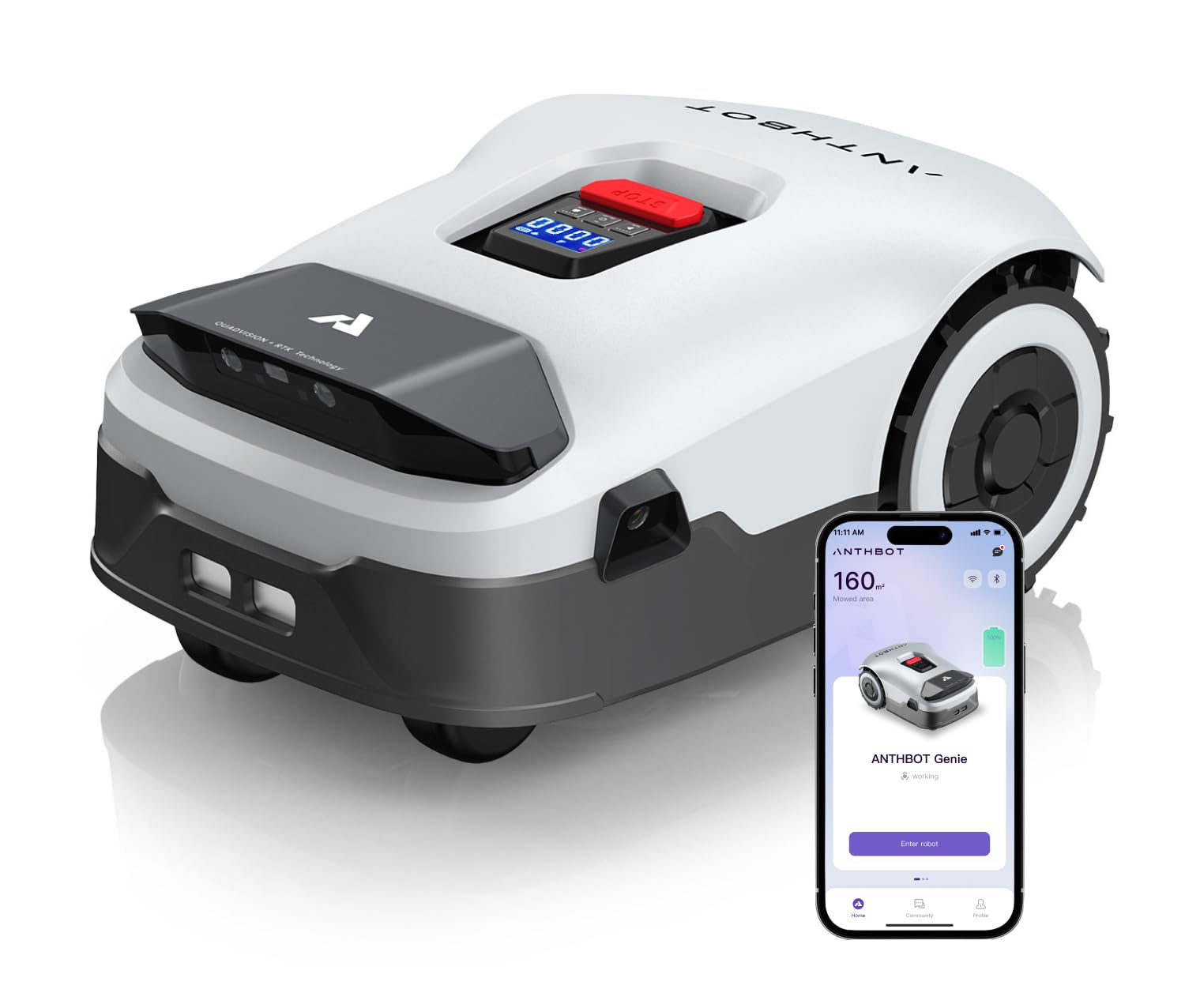
The ANTHBOT Genie 3000 is a wire-free robot mower that combines full-band RTK positioning with a four-camera vision system. This dual positioning approach keeps the mower functioning under dense trees, eaves, and near buildings where GPS often fails. It covers up to 0.9 acres automatically, mapping your lawn with its Adaptive Cruise Control technology that identifies boundaries and creates optimal cutting routes without manual guidance.
The 300-degree field-of-view camera with AI algorithms detects over 1,000 common garden objects — from toys to sprinklers to pets — and adjusts its path accordingly. Owners who have used it for several weeks report a near-golf-course finish after a few mowing cycles, with the ability to create custom patterns by alternating zone directions. The mower supports 30+ multi-zone management, letting you customize mowing schedules for different sections of your property.
There are trade-offs. After a year, some owners experience random charging failures, frequent “suspended in air” errors, and a clicking noise from the battery system. The mower also struggles on the steepest inclines and may leave 3-foot unmowed strips along borders. The Genie 3000 requires patience for software updates, but ongoing firmware improvements have added edge mowing and better direction control, making it a strong value for large, complex yards.
What works
- RTK+4-eye vision works under tree cover
- Detects over 1,000 obstacle types
- Excellent battery life for large lawns
- Frequent firmware updates add features
What doesn’t
- Reliability concerns after one year
- Struggles on the steepest slopes
- App lacks some basic navigation tools
3. Segway Navimow i215 LiDAR
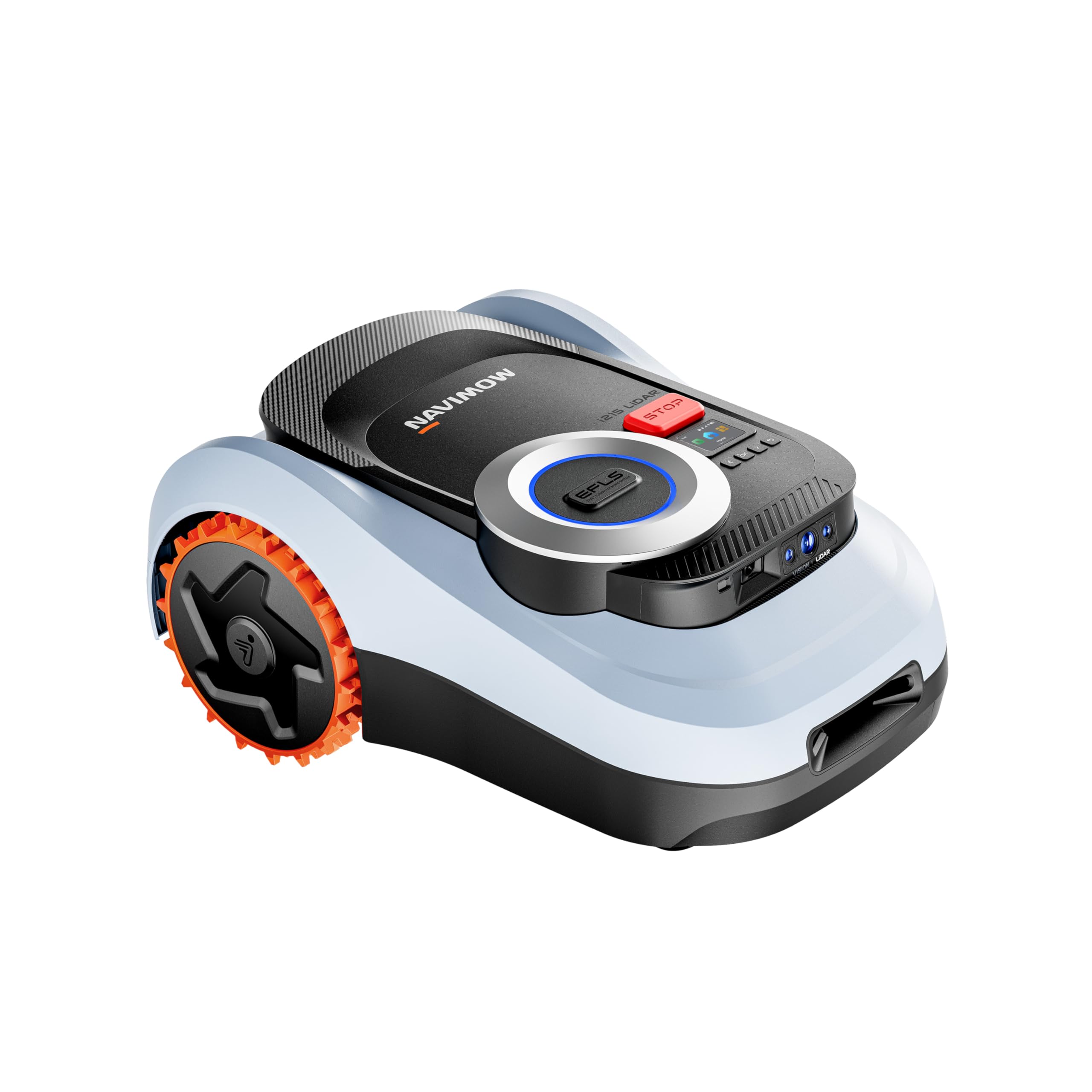
The Segway Navimow i215 uses solid-state LiDAR combined with vision sensors to navigate without GPS or boundary wires. This makes it ideal for yards with tall trees, narrow side passages, or other obstructions that block satellite signals. The dual fusion system provides 3D awareness day or night, detecting over 200 obstacle types with 0.4-inch accuracy. It handles slopes up to 45% (24°) thanks to off-road wheels and electronic stability control.
The app lets you manage up to 20 mowing zones with customizable travel paths, and the GeoSketch feature allows you to edit maps on an interactive interface. Owners find the setup straightforward — one-tap auto mapping creates a usable first map within minutes. The mower returns to its dock automatically, pauses during rain, and integrates with Alexa and Google Home for voice control. It cuts at 2–4 inches with a 6-blade disc, delivering a clean finish on mixed grass types.
Some owners report that the mowing algorithm can be inefficient — making 360-degree turns, retracing sections, and leaving small islands of uncut grass. Battery life is sometimes overrated; one owner on a 0.25-acre lot found the mower completed only 27% of the area in 1.8 hours, requiring them to split the yard into 7 zones. The 100W motor is adequate but not overpowered for very dense grass. For most users, the quiet operation and reliable LiDAR navigation outweigh the slower pace.
What works
- LiDAR works without GPS signal
- Very quiet at 59 dB(A)
- Detects 200+ obstacle types
- Alexa and Google Home compatible
What doesn’t
- Mowing algorithm can be inefficient
- Battery runtime overrated in reviews
- Customer support response can lag
4. ECOVACS Goat A2000 LiDAR PRO
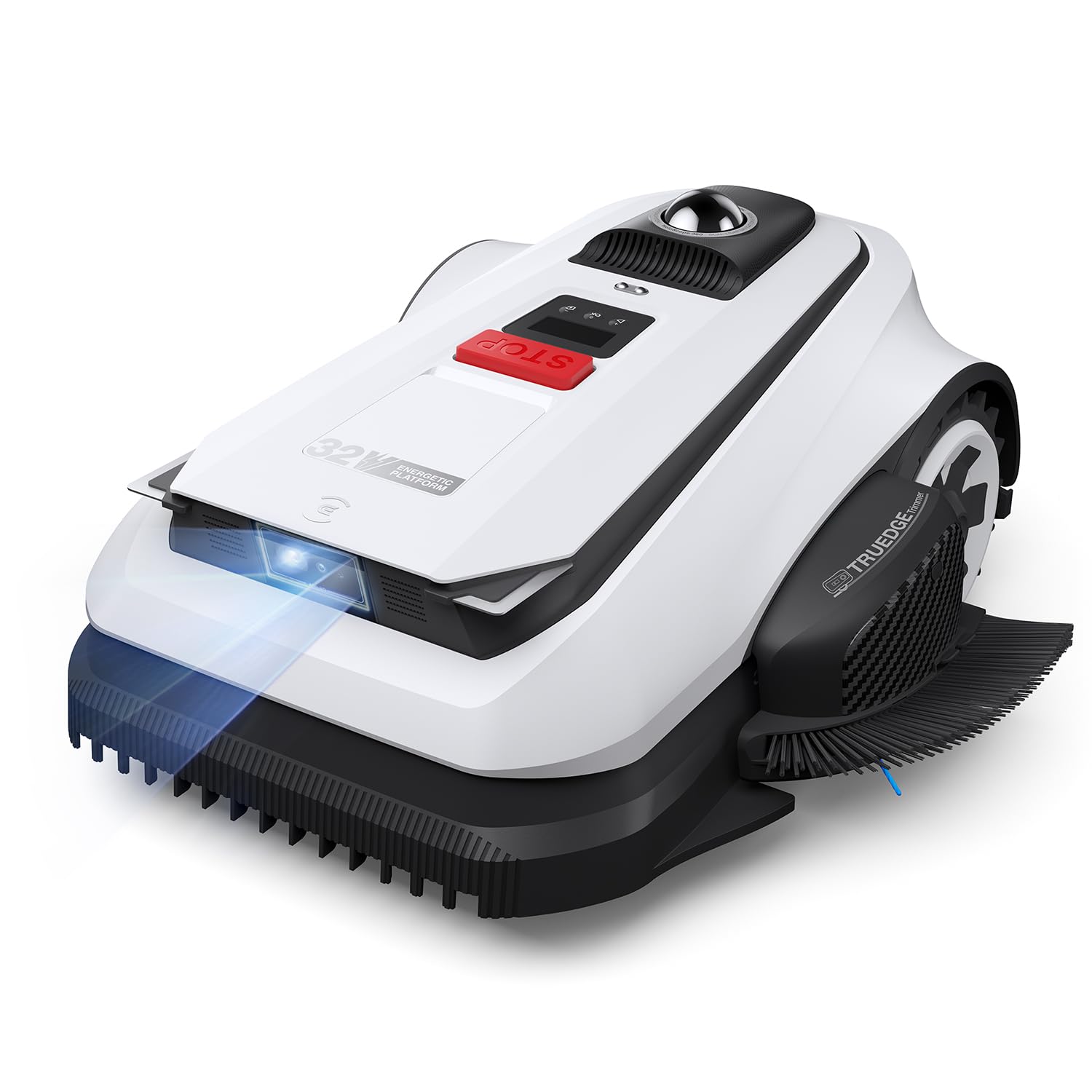
The ECOVACS Goat A2000 LiDAR PRO is engineered for medium to large lawns, covering up to half an acre without any perimeter wire or RTK antenna. Its HoloScope 360° Dual-LiDAR system delivers 2 cm positioning accuracy, even under trees and near fences where GPS-based mowers lose lock. The 32V motor paired with a dual-blade disc provides stronger cutting torque than the O1000, making it better suited for thick Bermuda, Zoysia, and St. Augustine grass.
The integrated TruEdge trimmer is a standout feature — it uses a trimmer line to cut right up to driveways, sidewalks, and flower beds, reducing manual edging by a significant margin. The mower includes 2 rolls of trimming line, each covering roughly 3 km of edging. Fast charging (113.4W) brings the 3.0Ah battery from empty to full in about 50 minutes, minimizing downtime during peak mowing season. The ECOVACS app allows custom zone creation, no-go areas, and schedule adjustments.
Owner feedback is minimal at this stage since the A2000 is relatively new to the market. The cutting width of 3.6 inches is narrow compared to the 8.7-inch standard on many robot mowers, which means it will take longer to cover open areas. The plastic construction is lighter than steel-deck alternatives but raises questions about long-term durability on rocky terrain. For anyone with a half-acre lawn who wants wire-free operation plus edging, this model is worth a close look.
What works
- 32V motor tackles thick grass
- Dual-LiDAR works in shaded areas
- Fast 50-minute recharge time
- TruEdge trimmer reduces manual edging
What doesn’t
- Narrow 3.6″ cutting width is slow
- Plastic body may not handle rocks
- Limited long-term owner reviews yet
5. ECOVACS Goat O1000 LiDAR PRO
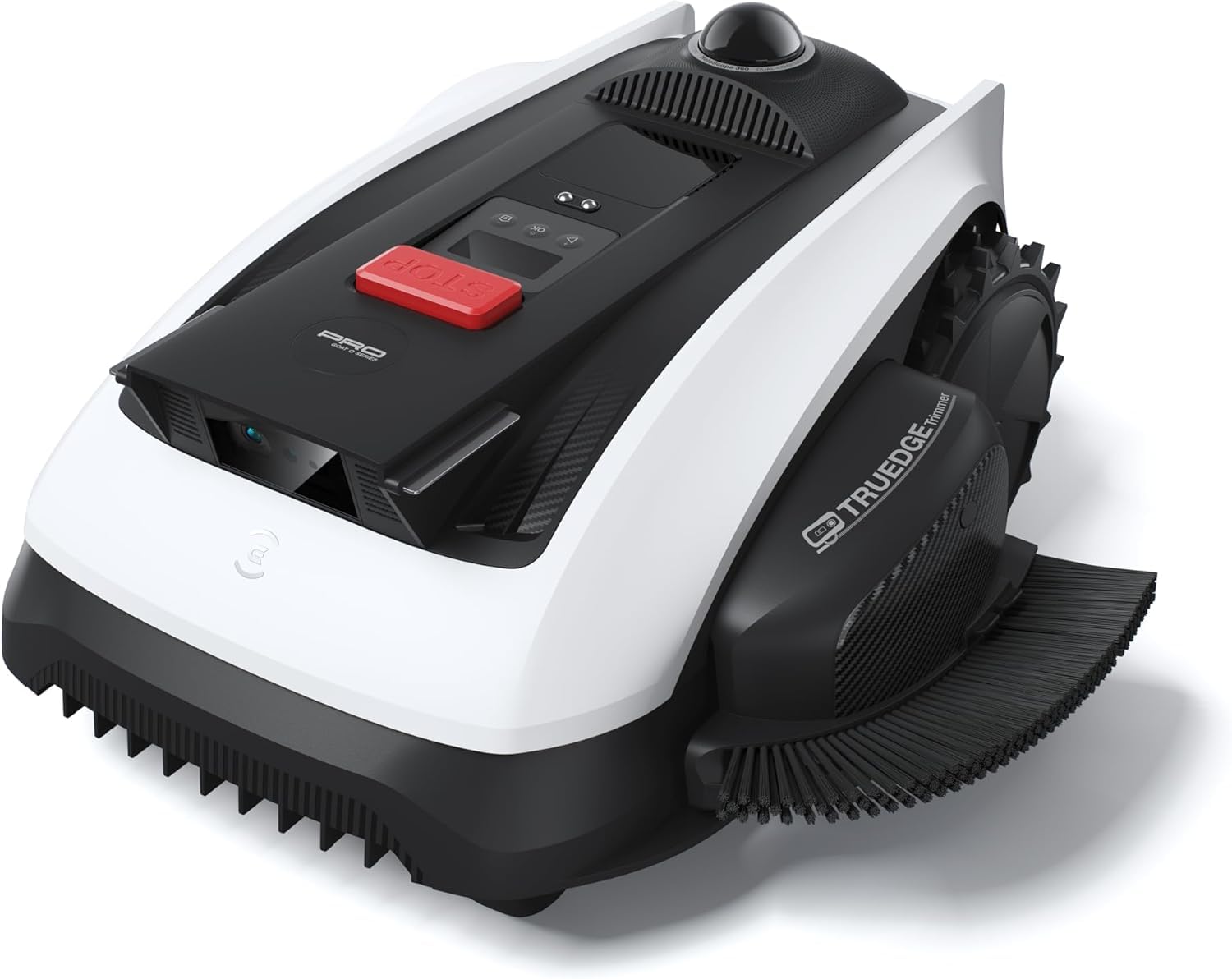
The Goat O1000 LiDAR PRO from ECOVACS is a wire-free robotic mower that uses the same HoloScope 360° Dual-LiDAR system as the A2000 but in a smaller, lighter package designed for up to a quarter-acre. The narrow body — just 1.56 feet wide — can pass through gaps as slim as 0.8 meters, making it ideal for side lawns, narrow paths, and complex layouts where larger mowers get stuck. The LiDAR system provides 2 cm positioning accuracy even under tree cover or near fences.
Its integrated TruEdge trimmer delivers edge-to-edge cutting along driveways, flower beds, and irregular borders. While not a full replacement for a string trimmer on very complex corners, owners report it handles 90% of edging work. The 3D obstacle detection uses AI Vision and ToF LiDAR to identify over 200 obstacle types — toys, furniture, pets, and wildlife — down to 5 cm detection precision. The ECOVACS app supports custom zones, no-go areas, and scheduled mowing.
Not all feedback is glowing. Some owners find the mower gets confused on curved areas and paved zones despite setting no-go boundaries, and the TruEdge trimmer line is described as mediocre by a few users. The wheels can get stuck on soft ground or dips, and the mower sometimes misses edges near sidewalks and garden walls. For tight, compact lawns under a quarter-acre where most robot mowers can’t navigate, the O1000 offers a strong wire-free solution.
What works
- Narrow body fits tight passages
- LiDAR navigation works in shade
- Detects over 200 obstacle types
- Good cut quality for small lawns
What doesn’t
- Gets confused on curved areas
- TruEdge trimmer is not robust
- Wheels get stuck on soft ground
6. WORX Landroid Vision Cloud WR310
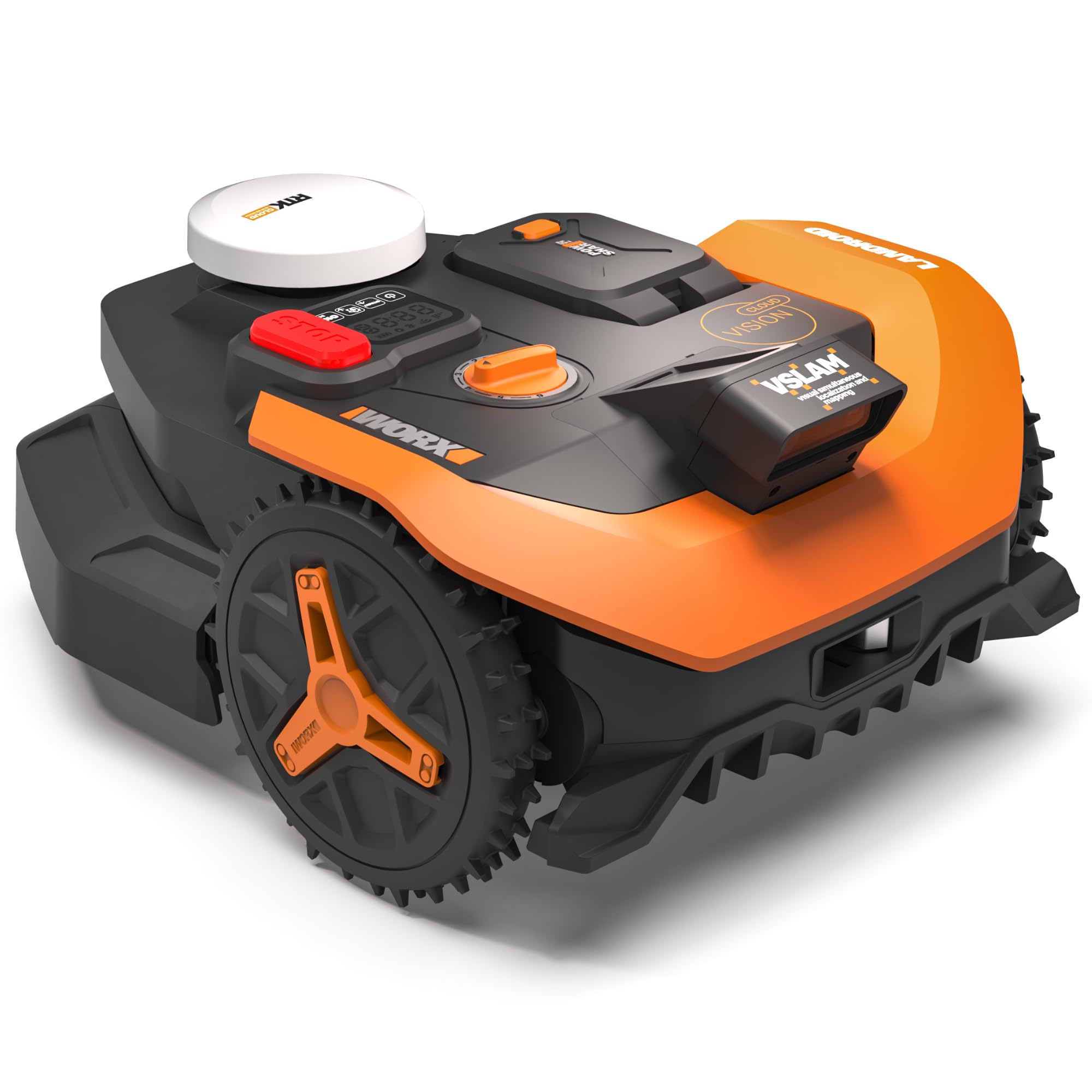
The WORX Landroid Vision Cloud WR310 uses commercial-grade RTK technology delivered via cloud — no local RTK antenna installation required and no ongoing cloud subscription costs. The Vision AI neural network processes up to 10 trillion operations per second, recognizing not just objects but understanding their context to avoid them intelligently. It handles up to a quarter-acre with an 8.7-inch cutting width, and it can switch between Parallel, Checkerboard, Diamond, and Natural mowing patterns through the app.
One of the standout features is the Infinite Zone Mowing. You can manage unlimited mowing zones with custom pathways, define no-go areas, and edit your map in real time. The RTK Cloud provides centimeter-level accuracy, and in shaded areas where GPS is weak, V-SLAM-based sensor fusion with Vision AI takes over seamlessly. The Cut-to-Edge border system lets the mower cross ridable edges and cut as close as possible along fixed borders, minimizing leftover grass.
Setup is the main hurdle. Owners consistently report a frustrating initial experience — the iOS app has a 2.5-star rating, the mower requires a dedicated 2.4 GHz network, and firmware updates can take 20 minutes or more. Some units refuse to work after initial mapping. Customer support is helpful but resolution can be slow. Once the mower is finally configured, it runs quietly and produces clean, consistent stripes. For tech-savvy users who can push through the setup, this is a capable machine.
What works
- RTK Cloud without antenna install
- Multiple mowing patterns via app
- Infinite zone management
- Vision AI works in shaded areas
What doesn’t
- Very frustrating initial setup
- iOS app has poor user ratings
- Needs a dedicated 2.4 GHz network
7. Segway Navimow i206 AWD
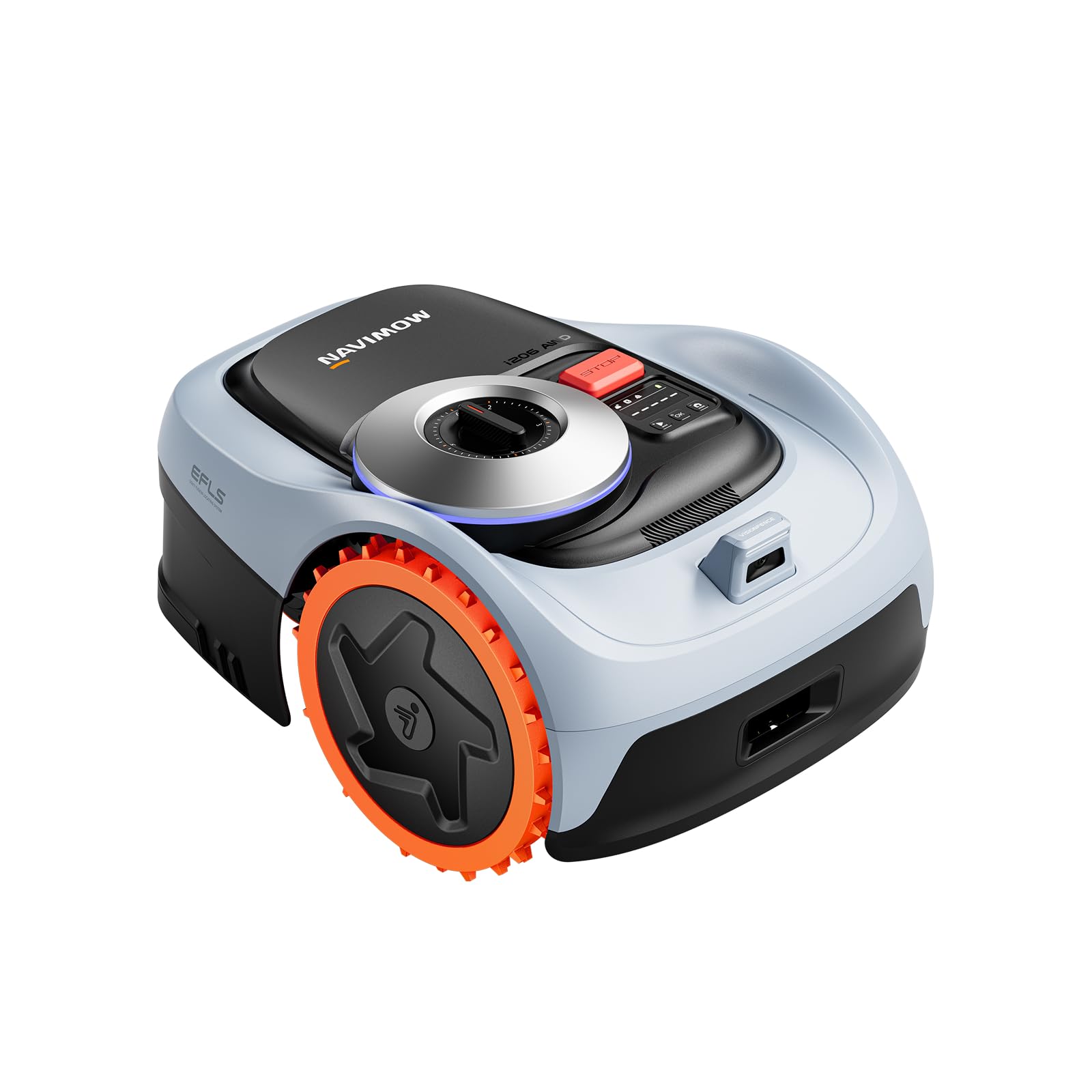
The Navimow i206 AWD is a compact robot mower designed specifically for sloped, uneven terrain up to 0.15 acre. Its all-wheel drive system, combined with automotive-grade electronic stability control, handles 45% (24°) slopes confidently — a rare spec in this size class. The third-wheel design enables true zero-turn steering without scraping the grass, which is gentler on the turf than traditional skid-steer mowers.
Setup is wire-free thanks to EFLS Network RTK with one-tap auto mapping. The tri-frequency RTK combined with vision delivers centimeter-level accuracy even near obstacles. The adaptive drive system provides extra torque only when needed, extending the 2.5Ah battery’s runtime. You can manage up to 20 zones with optimized mowing paths, and the mower auto-resumes after charging. Real-time GPS alerts notify you if the mower is lifted or leaves designated areas.
Owners report the mower is very quiet, avoids obstacles well, and handles slopes that would stop other robot mowers. However, some have experienced failures within two months — no power, red light on the base, and frozen app. Setup can be technically demanding, requiring careful reading of the manual. For small, sloped lawns where other mowers can’t operate, this is a niche solution that works well when it works.
What works
- AWD handles 45% slopes steadily
- Zero-turn steering protects grass
- Very quiet operation
- Centimeter-level RTK accuracy
What doesn’t
- Some units fail within two months
- Leaves large gaps near fences
- Customer support can be unresponsive
8. ZIPmow RC Lawn Mower
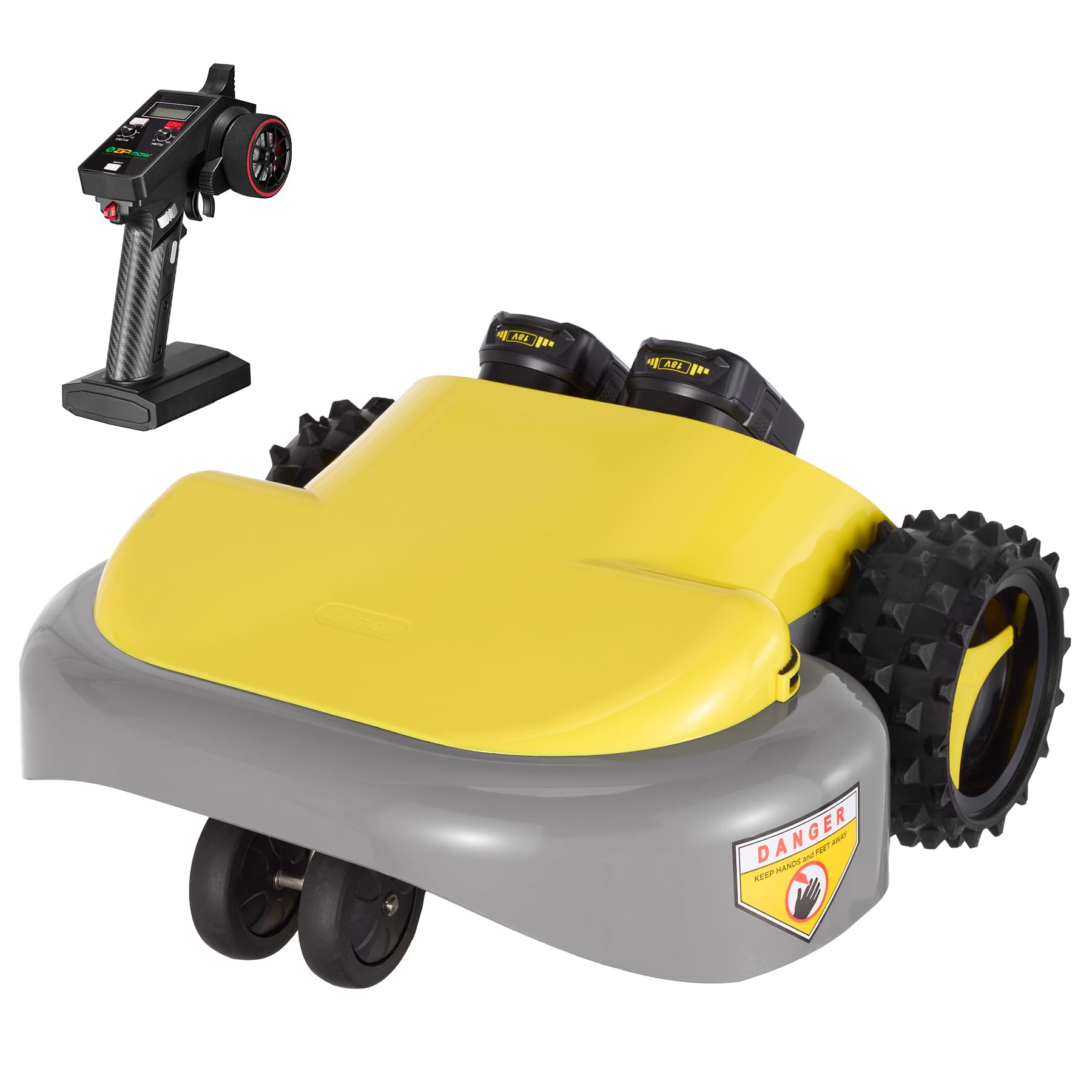
The ZIPmow RC mower is a lightweight, battery-powered remote mower that weighs only 17 pounds. That makes it one of the most portable options — you can lift it into a car trunk, carry it up stairs, or store it vertically with its collapsible handle. The 18-inch cutting deck is paired with all-wheel drive traction that handles slopes up to 30 degrees on dry grass. Cutting height adjusts between 2 and 3 inches, and the speed is adjustable from 0.5 to 2.5 mph via the 2.4 GHz remote.
The kit includes the mower, 3 blades, 2x 3Ah batteries, a fast wall charger, and a blade guard. Dual batteries provide up to 60 minutes of runtime, though real-world use on thick grass cuts that roughly in half. The remote has a 98-foot range with an emergency stop button, and the mower auto-shuts off if tilted beyond 30 degrees for safety. Tool-free blade replacement makes maintenance straightforward.
Owner experiences are mixed. Some love it — it cuts well, runs smoothly, and lets them mow from the shade. Others report that it flips on steep hills when the trigger is pressed too fast (causing wheelies), and the wheel motor and blade motor can fail from rocks or thick grass. Parts are hard to find. The dual 3Ah batteries use modified connectors that may block cheaper aftermarket replacements. For flat, small lawns under a quarter acre, this is a fun and functional tool. For challenging terrain, it’s underbuilt.
What works
- Very lightweight at 17 lb
- All-wheel drive for moderate slopes
- Tool-free blade replacement
- Dual battery system for extended runtime
What doesn’t
- Flips on steep hills with fast trigger
- Motors fragile against rocks/thick grass
- Modified battery connectors limit replacements
9. YARDCARE M800Plus Robot Mower
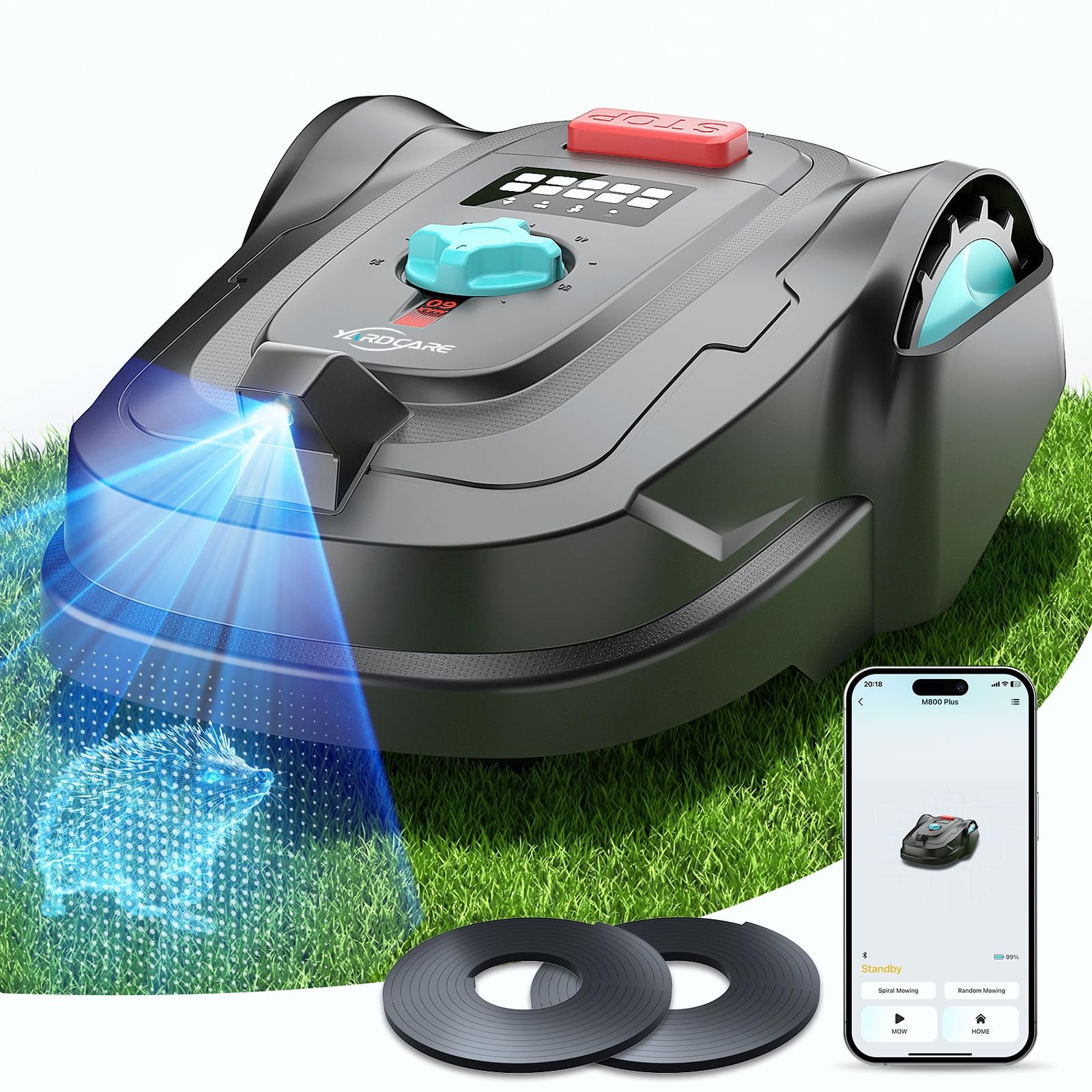
The YARDCARE M800Plus is a cordless robot mower that uses GPS and a 3D vision system to navigate without boundary wires. It’s designed for lawns up to 8,611 square feet with clear visual boundaries. The included 32-foot magnetic strip lets you create no-go zones without digging or external power. The vision-based camera system recognizes common lawn obstacles like trees, rocks, and furniture, adjusting movement to avoid them. It handles slopes up to 35% (20°) — adequate for most residential lots.
The cutting deck uses a three-blade disc with a 7-inch cutting width, adjustable from 0.8 to 2.4 inches. A spiral spot mowing mode focuses on areas with faster-growing grass for more uniform coverage. The YARDCARE App manages mowing schedules, patterns, and firmware updates. At 28.7 pounds, it’s lighter than most robot mowers, making it easier to carry if needed. The manufacturer recommends an initial manual trim if grass exceeds 2.6 inches before the first autonomous run.
Most owners are satisfied with the M800Plus, praising its silent operation (<60 dB), uniform cutting, and simple configuration. The wire-free setup is a major selling point — no perimeter wires to bury or troubleshoot. However, some note the cutting width is narrow, meaning it takes longer to cover open areas. Performance on very thick or wet grass is below average due to the low-torque motor. For first-time robot mower buyers with relatively flat, well-maintained lawns, this is a reliable entry point into wire-free mowing.
What works
- Wire-free GPS+3D vision navigation
- Very quiet at under 60 dB
- Magnetic strip for no-go zones
- Easy app control for schedules
What doesn’t
- Narrow 7-inch cutting width is slow
- Struggles with thick/wet grass
- Needs initial manual trim on tall grass
Hardware & Specs Guide
Slope Rating (Degrees vs. Percentage)
The most critical spec for any RC mower is its maximum slope rating. A 30-degree slope equals a 58% grade — that’s the equivalent of a steep driveway. Mowers like the Mowrator S1, rated at 37 degrees (75%), can handle hills where most robot mowers (rated at 20–24 degrees) would lose traction or tip. Always measure your steepest section with an inclinometer app and buy a mower rated at least 5 degrees higher than your yard’s maximum. All-wheel drive models always outperform two-wheel drive on slopes.
Battery Voltage and Amp-Hours
Battery voltage determines torque — thicker grass and steeper slopes require higher voltage motors. Entry-level RC mowers use 20V systems, while heavy-duty models run 40V or higher. Amp-hours (Ah) predict runtime: a 5Ah pack at 40V can sustain a mower for 45–60 minutes on medium grass, but that number halves in wet or overgrown conditions. Swappable battery systems (like the ZIPmow’s dual 3Ah packs) let you hot-swap and extend runtime without waiting for recharge cycles.
FAQ
Do RC lawn mowers work on steep hills?
Can an RC mower replace my push mower completely?
How long do RC mower batteries last per charge?
Do I need Wi-Fi to use a robot lawn mower?
Final Thoughts: The Verdict
For most gardeners, the best rc lawn mower winner is the Mowrator S1 4WD because it combines a 21-inch deck, 37-degree slope rating, and 2.25-hour runtime into a single machine that can handle the toughest yards without compromise. If you want a fully autonomous wire-free experience for a complex, medium-sized lawn, grab the ANTHBOT Genie 3000. And for compact lawns with narrow passages where most robot mowers can’t navigate, nothing beats the ECOVACS Goat O1000 LiDAR PRO.