
Annual bluegrass (Poa annua) is the most persistent winter annual weed in lawns, germinating in cool soil and spreading seed heads before warm-season grass even wakes up. A single plant can produce hundreds of seeds that survive in the soil for years, making a targeted pre-emergent the only reliable defense against a full-blown infestation.
I’m Rikta — the co-founder and writer behind Lawn Gear Lab. I spend hundreds of hours cross-referencing active-ingredient concentrations, application rates, and soil-temperature timing data against verified owner results to separate products that truly prevent poa annua from those that just claim to.
Whether you are managing a Bermuda, St. Augustine, or tall fescue lawn, this guide breaks down the active ingredients, granular vs. liquid formats, and split-application strategies that define the best pre emergent for poa annua this season.
How To Choose The Best Pre Emergent For Poa Annua
Poa annua seeds germinate when soil temperatures drop below 70°F in late summer through fall, and again in early spring. The wrong active ingredient or a single split-second-late application can leave your lawn vulnerable to a full winter takeover. Here are the three factors that separate effective prevention from wasted product.
Active Ingredient: Prodiamine vs. Dithiopyr vs. Isoxaben
Prodiamine (found in Barricade and generics) is the most widely used pre-emergent for poa annua because it provides 8–12 weeks of residual control with a single application at the correct rate. Dithiopyr (Dimension) offers a unique advantage: early post-emergent activity on crabgrass, plus strong poa suppression when applied before germination. Isoxaben (Snapshot) targets broadleaf weeds and some grassy weeds but is less reliable as a standalone poa treatment in cool-season turf.
Granular vs. Liquid Formulation
Granular prodiamine fertilizers, like The Andersons 18-0-4 Barricade, combine a nitrogen feeding with weed prevention and are easiest to apply with a broadcast spreader over large lawns. Liquid concentrates, like Syngenta Barricade 4FL, require a sprayer but allow precise rate control and better penetration into the soil-thatch interface where poa seeds sit. For lawns with heavy thatch, liquids generally outperform granules.
Split-Application Timing Is Everything
Poa annua germinates in two distinct windows: early fall (soil temps 65–70°F) and late winter/early spring (soil temps 45–55°F). A single pre-emergent application in September will break down by January, leaving the spring flush unprotected. The most effective strategy is an initial application when soil temperatures first hit 70°F in late summer, followed by a second application 8–10 weeks later, timed before the spring germination wave.
Quick Comparison
On smaller screens, swipe sideways to see the full table.
| Model | Category | Best For | Key Spec | Amazon |
|---|---|---|---|---|
| Barricade 4FL | Liquid Concentrate | Precise early-season barrier | 40.7% Prodiamine | Amazon |
| Yard Mastery 0-0-7 Prodiamine | Granular Fertilizer | Large-acreage fall barrier | 0.37% Prodiamine, 45 lbs | Amazon |
| Quali-Pro Prodiamine 65 WDG | Wettable Granule | Cost-effective spray program | 65% Prodiamine WDG | Amazon |
| The Andersons 18-0-4 Barricade | Fertilizer + Pre-Emergent | Spring feed + poa prevention | 0.426% Prodiamine, 40 lbs | Amazon |
| Dimension 2EW | Liquid Concentrate | Early post-emergent crabgrass + poa | 23.5% Dithiopyr | Amazon |
| DOW Snapshot 2.5 TG | Granular Pre-Emergent | Flower bed and ornamental area | Isoxaben + Trifluralin, 50 lbs | Amazon |
| Roundup Weed & Grass Killer | Post-Emergent Concentrate | Spot-treating emerged poa clumps | Glyphosate + Triclopyr mix | Amazon |
In‑Depth Reviews
1. Syngenta Barricade 4FL Herbicide
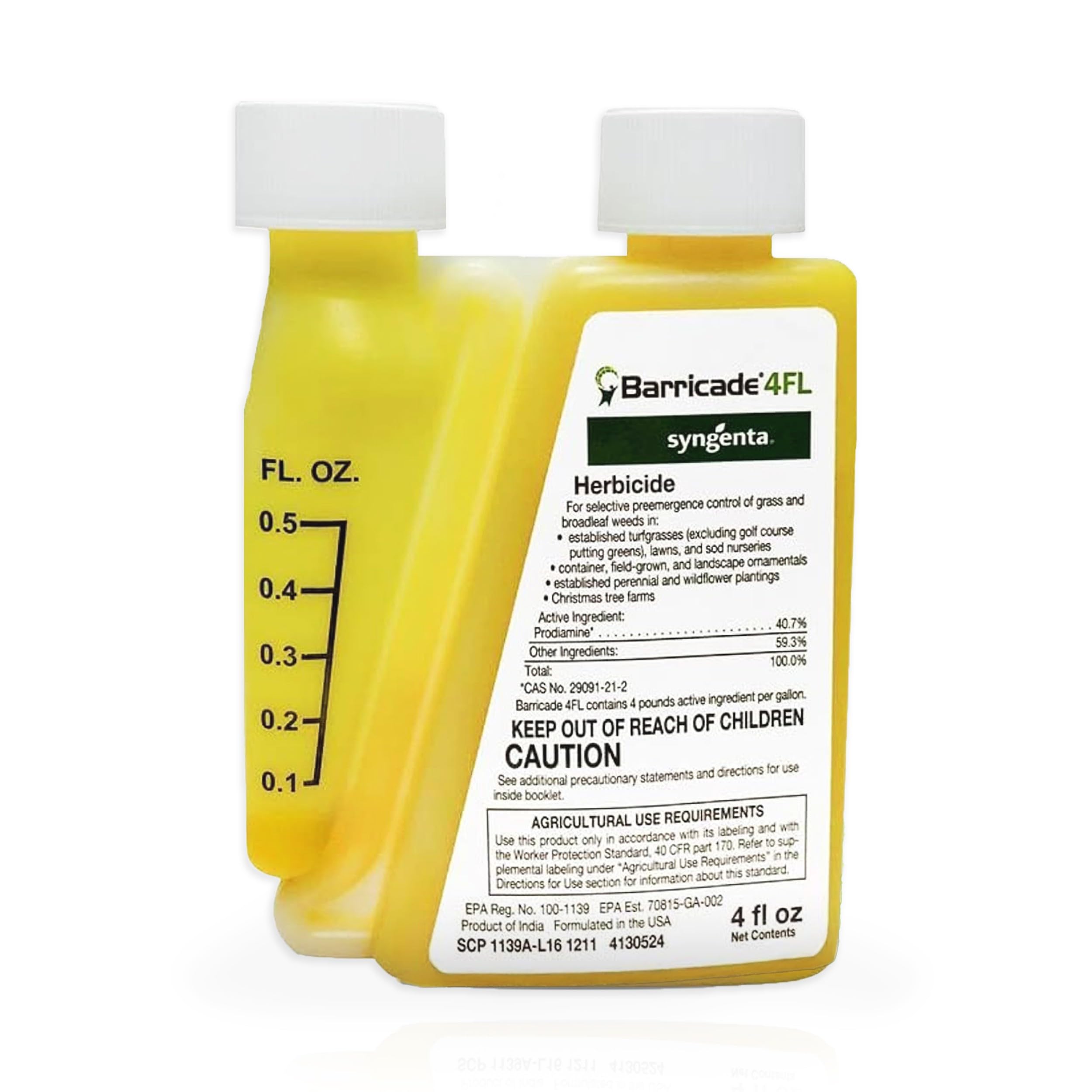
Syngenta Barricade 4FL is the industry benchmark for poa annua prevention, packing 40.7% prodiamine in a concentrated liquid form. A single 4-ounce bottle treats up to 1 acre at the standard ornamental rate, delivering 8–12 weeks of residual barrier from a single application. The liquid formulation penetrates thatch layers where granular products often hang up, making it especially effective on lawns with heavy organic matter buildup.
Users consistently report near-complete suppression of winter annuals when applied at the right soil-temperature window (55–60°F consistently in fall). The concentrate mixes easily with water and can be applied with any standard pump sprayer or backpack rig. Because prodiamine has a long soil half-life, a single well-timed fall treatment often carries through the entire winter germination window without requiring a spring follow-up in northern climates.
The main trade-off is the cost per bottle vs. granular generics, but the per-application cost remains competitive because of the high active-ingredient concentration. Some users also note that the product must be watered in within 7 days of application to activate the barrier — a step that is critical and easy to forget after a dry spell.
What works
- High-concentration prodiamine provides a full season of coverage with one treatment
- Liquid formulation penetrates thatch better than granules for consistent soil barrier
- Labeled for turf, ornamentals, and even Christmas tree farms — very versatile
What doesn’t
- Requires watering in within 7 days for activation; dry spells can reduce efficacy
- Cost per bottle is higher than generic prodiamine alternatives on the shelf
2. Yard Mastery 0-0-7 Granular Prodiamine
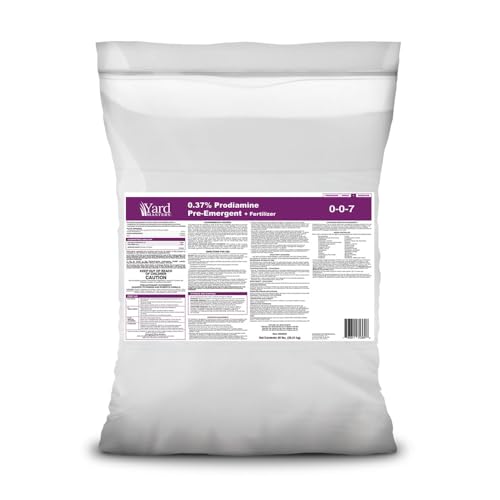
Yard Mastery 0-0-7 is a straight granular pre-emergent with 0.37% prodiamine and zero nitrogen, making it a clean option for fall applications when you want to stop poa without pushing top growth that could be damaged by frost. The 45-pound bag covers 15,000 square feet at the label rate of 3 pounds per 1,000 square feet, giving you a full-season barrier for a medium to large lawn in a single bag.
Users with Bermuda and zoysia grass note that the large yellow granules spread evenly through rotary spreaders and do not clump even in moderate humidity. Because there is no fertilizer component, you can pair this with a separate nitrogen program without guessing how much N you have already applied. The lack of instructions on the bag is a common complaint, requiring a call to the manufacturer to verify rates for poa annua specifically.
The product is manufactured by Turf Care Supply, a company respected in the golf-course and sports-turf industry, so the formulation quality is consistent. The per-square-foot cost is among the lowest of any prodiamine product on the market, making this a strong candidate for large properties where budget is a primary concern.
What works
- Very low per-square-foot cost for large lawns; covers 15,000 sq ft per bag
- Zero nitrogen allows precise fall feeding without excess growth
- Granules spread easily with standard rotary spreaders
What doesn’t
- No dosage instructions printed on the bag — must contact manufacturer
- Large granules may clog drop spreaders with narrow hopper openings
3. Quali-Pro Prodiamine 65 WDG
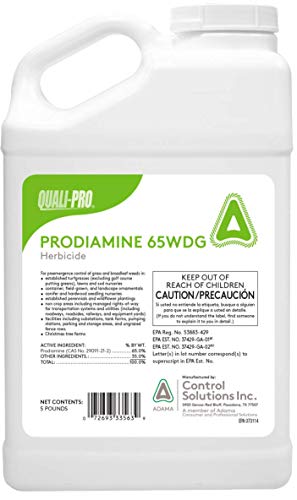
Quali-Pro Prodiamine 65 WDG is a generic alternative to Barricade that delivers 65% prodiamine in a wettable dispersible granule form. The 5-pound bag covers a huge area — at the standard 0.185–0.55 ounces per 1,000 square feet, one bag treats between 14,500 and 43,000 square feet depending on the target weed and soil type. This makes it the most cost-efficient option for professional-scale applications and large residential properties.
WDG (wettable dispersible granule) formulations mix into a suspension that stays suspended long enough for even application through a backpack or boom sprayer. Users report excellent results against poa annua, crabgrass, and henbit when applied in late summer before soil temperatures drop below 70°F. The product also mixes well with liquid fertilizers for a single-pass application that saves time.
The main drawback is the need for a sprayer — you cannot simply spread this with a broadcast spreader. The mixing instructions require careful measurement, and the powder can be dusty during transfer. Users on Long Island and in the Midwest report that a single fall application followed by a light spring booster eliminated all poa annua through June.
What works
- Extremely high active concentration lowers per-application cost dramatically
- WDG formulation stays suspended for even coverage through spray equipment
- One bag treats up to 43,000 sq ft at low rates — ideal for large properties
What doesn’t
- Requires a sprayer; not suitable for spreader-only users
- Powder can be dusty; mixing requires careful measurement and PPE
4. The Andersons 18-0-4 Barricade Fertilizer
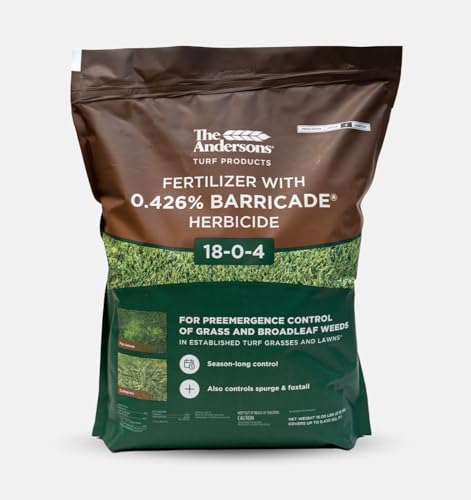
The Andersons 18-0-4 Barricade combines a pre-emergent dose of 0.426% prodiamine with a balanced 18-0-4 fertilizer, making it an excellent early-spring application when you want both weed prevention and a green-up push. The patented DG Technology (dispersible granule) ensures granules dissolve rapidly upon watering, moving the prodiamine into the soil while releasing nitrogen directly to the root zone.
Users in the South report outstanding results on zoysia and Bermuda lawns, noting that a single application in late winter stopped poa annua, henbit, and crabgrass from emerging through mid-summer. The small granule size means more particles per square inch, reducing the chance of missed spots that allow poa to sneak through. The 40-pound bag covers exactly 10,000 square feet at the label rate, making coverage calculations simple.
The downside is that the 18-0-4 fertilizer component may push too much top growth if applied too early in cool-season grass regions, potentially leading to disease pressure. Some users also feel the price per bag is high for the coverage area compared to mixing separate products, though the convenience of a single-pass application offsets the cost for many homeowners.
What works
- DG Technology granules dissolve quickly for even distribution and activation
- NPK 18-0-4 feeds the lawn while preventing poa germination
- Small particles reduce gaps in coverage compared to larger granules
What doesn’t
- High nitrogen can cause excess growth if applied too early in cool-season turf
- Coverage per bag is 10,000 sq ft, less than some pure pre-emergent options
5. Roundup Weed & Grass Killer Concentrate

Roundup Weed & Grass Killer Concentrate is not a pre-emergent, but it serves a critical role in poa annua management: spot-treating emerged clumps that your pre-emergent barrier missed. The formula combines glyphosate, triclopyr, and diquat dibromide for rapid knockdown of existing poa plants before they set seed. Each gallon concentrates makes up to 10 gallons of spray solution, covering roughly 3,000 square feet at the standard mix rate.
Users report visible results within 24–48 hours on emerged poa annua, with the plants yellowing and collapsing over the first week. The product is rainproof in 30 minutes, which is valuable for late-winter applications when weather is unpredictable. Roundup kills everything it contacts, so spot-treatment with a shielded sprayer is essential in lawn settings — overspray onto desirable grass will kill it.
The main limitation is that this product provides zero residual protection — any poa seeds that germinate after the spray has dried will grow unhindered. It is best used as a rescue tool in early winter before poa plants mature and produce seed heads, not as a standalone prevention strategy. The strong chemical odor and requirement for full PPE during mixing are drawbacks for users sensitive to herbicide fumes.
What works
- Kills emerged poa annua in 24–48 hours, stopping seed production
- Rainproof in 30 minutes for reliable late-winter application
- High concentrate makes up to 10 gallons of spray solution
What doesn’t
- Non-selective — kills any turf it contacts, requiring careful spot-treatment
- Zero residual effect; new poa seeds will germinate after application
6. Dimension 2EW Herbicide

Dimension 2EW (dithiopyr) is unique among pre-emergents because it offers limited early post-emergent activity on crabgrass, but it also provides strong suppression of poa annua when applied before germination. The 23.5% dithiopyr formulation from Dow AgroSciences (now Corteva) is registered in every state and labeled for use on both cool- and warm-season turfgrasses as well as over 440 ornamental species.
The key advantage for poa management is the application window flexibility. If you miss the ideal prodiamine timing, dimension still provides good control when applied just as poa begins to emerge, and it has excellent turf safety at standard rates. Users with mixed warm-season / cool-season lawns appreciate that dimension does not cause the same root pruning as prodiamine on certain sensitive grasses during transition periods.
The half-gallon bottle treats a significant area, but the per-bottle cost is higher than prodiamine equivalents. Some users report that the product does not provide quite the same residual duration as Barricade for late-winter poa flushes, requiring a second application in early January for full season-long control in southern climates.
What works
- Early post-emergent activity offers forgiveness for slightly late applications
- Excellent turf safety on both cool- and warm-season grass types
- Registered nationwide with zero state restrictions on use
What doesn’t
- Residual duration is shorter than prodiamine in some soil types
- Higher per-bottle cost relative to equivalent active ingredient coverage
7. DOW Snapshot 2.5 TG Granular Pre-Emergent
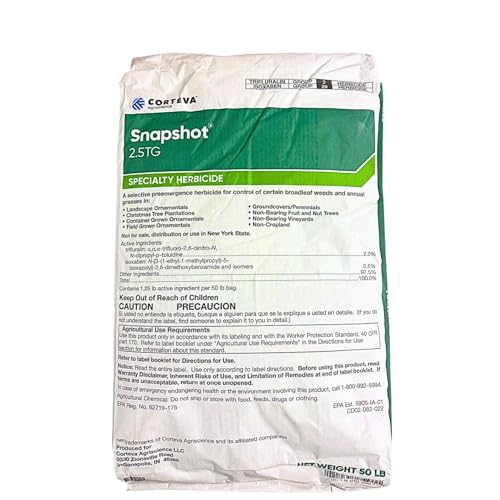
DOW Snapshot 2.5 TG is a granular pre-emergent designed primarily for landscape beds and ornamental areas rather than open turf. It combines isoxaben (broadleaf weed prevention) and trifluralin (grassy weed prevention) to control 111 different weed species, including poa annua. The 2.3–4.6 pounds per 1,000 square feet application rate provides 6–8 months of residual control from a single application.
Users with St. Augustine lawns report that Snapshot applied around planting beds and along fence lines completely eliminates poa annua and other winter annuals through the entire cool season. The product must be applied before rainfall or irrigation to incorporate it into the soil — a step that is non-negotiable for activation. It is safe on established ornamentals when used at label rates, making it a go-to for protecting flower beds and shrub borders.
The downsides are the cost per bag and the specific use case limitation. Snapshot is not labeled for use in open turfgrass — only around ornamentals and landscape beds. Users applying it to large turf areas risk damaging desirable grass and violating the label. For pure lawn applications, a prodiamine or dithiopyr product is the correct choice.
What works
- 8-month residual control stops poa annua through full winter cycle
- Safe on over 400 ornamental species when applied at label rates
- Controls 111 weed species — broad-spectrum landscape protection
What doesn’t
- Not labeled for open turfgrass — only landscape beds and ornamentals
- Must be watered in immediately; dry conditions reduce activation success
Hardware & Specs Guide
Prodiamine (Barricade-Type) Concentrations
Prodiamine products range from 0.37% in granular fertilizers (Yard Mastery, The Andersons) to 40.7% in liquid concentrates (Syngenta Barricade 4FL) and 65% in WDG formulations (Quali-Pro). Higher concentration means fewer pounds or ounces needed per 1,000 square feet, which directly reduces per-application cost. For poa annua prevention in turf, the effective prodiamine rate is 0.5–0.75 lbs active ingredient per acre per application.
Dithiopyr (Dimension Type) Strengths
Dimension 2EW contains 23.5% dithiopyr as the active ingredient. Dithiopyr provides the same pre-emergent barrier as prodiamine but with the added benefit of early post-emergent activity on crabgrass. For poa annua, Dimension is most effective when applied at 0.5–0.75 lbs per acre before soil temperatures drop below 65°F in fall. The half-life in soil is roughly 40–60 days, requiring reapplication for full winter coverage.
Granular vs. Liquid Application
Granular pre-emergents like Yard Mastery 0-0-7 and The Andersons Barricade require a broadcast spreader set to the correct gate setting for even coverage. Liquids like Barricade 4FL and Dimension 2EW require a pump sprayer or backpack sprayer calibrated to deliver 1–2 gallons per 1,000 square feet. Granules are easier for large lawns but liquids provide better coverage on sloped or irregular terrain.
Watering-In Requirements
All pre-emergents must be watered in within 7 days of application to move the active ingredient into the top 1–2 inches of soil where poa seeds germinate. Products with DG Technology (The Andersons) dissolve faster with less irrigation. Prodiamine requires 0.5 inches of water or rainfall for activation. Dimension needs 0.25–0.5 inches. Failure to water in reduces efficacy by up to 70%.
FAQ
When should I apply pre-emergent for poa annua in fall?
Can I use prodiamine on fescue lawns without damage?
Why did my pre-emergent fail to stop poa annua this year?
Final Thoughts: The Verdict
For most gardeners, the best pre emergent for poa annua winner is the Syngenta Barricade 4FL because its high-concentration prodiamine penetrates thatch and provides a single-application barrier that lasts the full winter. If you want a granular feed-and-prevent combo for spring green-up, grab the The Andersons 18-0-4 Barricade. And for large-scale budget-conscious prevention on a big lawn, nothing beats the per-square-foot value of the Yard Mastery 0-0-7 Granular Prodiamine.