
An azalea’s blooming power is determined long before the bud appears — by the precise acid balance and nutrient profile of the food you choose. The wrong pH or a missing micronutrient like iron can lock your soil, turning vibrant shrubs into yellow-leafed disappointments before the first flower emerges.
I’m Rikta — the co-founder and writer behind Lawn Gear Lab. I’ve spent hundreds of hours cross-referencing horticultural trial data, analyzing NPK ratios and micronutrient delivery systems, and filtering thousands of owner reports to isolate what actually drives deeper blooms and healthier foliage in ericaceous plants.
Whether you are rehabilitating a struggling shrub or maximizing next season’s flower display, this guide breaks down the specific chemical profiles and application strategies that deliver consistent results for the best plant food for azaleas on the market right now.
How To Choose The Best Plant Food For Azaleas
Azaleas are obligate acidophiles — they require a soil pH between 4.5 and 6.0 to access the iron and manganese necessary for chlorophyll production. Selecting a fertilizer without considering its acidifying capacity and micronutrient profile is the most common reason for failure.
NPK Ratio and Nitrogen Sources
The ideal nitrogen-to-phosphorus-potassium ratio for azaleas is slightly higher in phosphorus to support bloom initiation. Look for N values around 8–14 and P values around 4–15. Nitrogen should come from ammonium-based sources rather than nitrate, as ammonium uptake naturally acidifies the root zone.
Iron and Micronutrient Engineering
Azaleas are notoriously prone to iron chlorosis in alkaline soils. A premium fertilizer will list at least 3% iron content, preferably from multiple sources such as ferrous sulfate, iron EDTA, and iron DTPA, which remain available across different pH ranges. Manganese and magnesium are secondary but essential.
Release Mechanism and Application Frequency
Granular slow-release formulas require two to three applications per growing season — early spring, post-bloom, and late fall. Water-soluble powders deliver an immediate boost within 7 to 14 days but demand biweekly reapplication. For established shrubs, slow-release granules reduce the risk of root burn from over-fertilization.
Quick Comparison
On smaller screens, swipe sideways to see the full table.
| Model | Category | Best For | Key Spec | Amazon |
|---|---|---|---|---|
| Espoma Organic Holly-Tone 4-3-4 | Organic | Large property feeding | 36 lb bag, 5% sulfur | Amazon |
| Nelson NutriStar 9-13-11 | Premium | Heavy blooming | 3.2% iron, 4 acidifiers | Amazon |
| Fertilome 9-15-13 | Granular | High-volume coverage | 10 lb bag, 9-15-13 | Amazon |
| Miracle-Gro Water Soluble 30-10-10 | Soluble | Quick green-up | 5 lb powder, 80 oz | Amazon |
| Dr. Earth Acid Lovers 4 lb | Organic | Pet-safe gardens | Non-GMO verified, OMRI | Amazon |
| Schultz ACR 14-7-7 | Slow-Release | Minimal-fuss feeding | 3.5 lb, 14-7-7 | Amazon |
| Gardenwise 8-4-8 | Bio-Solid | Microbe enrichment | 1 lb, 8-4-8 | Amazon |
In‑Depth Reviews
1. Espoma Organic Holly-Tone 4-3-4 (36 lb)

The 36-pound bag of Holly-Tone is the definitive bulk solution for anyone managing multiple azaleas, hydrangeas, or rhododendrons across a property. Its 4-3-4 analysis is deliberately low in nitrogen compared to synthetic competitors because the Bio-tone microbial inoculants gradually unlock organic nitrogen already present in the soil. The 5% sulfur content actively drives pH downward, making it particularly effective in regions with naturally alkaline tap water or limestone-influenced soil.
Owner reports consistently describe full-bush recovery within a single season: shrubs that had not bloomed in three years produced heavy flower loads after a spring and fall application. The granular form requires no mixing — you simply broadcast under the drip line and water in. One 36-pound bag covers approximately 900 square feet at the recommended rate, making it the most economical option for large-scale feeding when measured by cost per pound of active ingredient.
The organic formulation breaks down slowly, providing a reservoir of nutrients that lasts through the growing season without the spike-and-crash pattern of water-soluble fertilizers. It is OMRI-listed and approved for organic production, so there is no risk of synthetic salt buildup in the root zone.
What works
- Massive bag covers large property areas with a single purchase
- Bio-tone microbes improve long-term soil structure and nutrient cycling
- 5% sulfur provides reliable soil acidification
What doesn’t
- Oversized bag is cumbersome to store and handle for small gardens
- Slow release means it will not correct acute deficiencies quickly
2. Nelson NutriStar 9-13-11 (2 lb)

The Nelson NutriStar 9-13-11 is engineered specifically for maximizing bloom mass and flower count. Its phosphate level of 13 is the highest among the products evaluated — phosphorus is the primary driver of flower initiation and bud set in ericaceous shrubs. The three separate sources of iron total 3.2%, which is clinically sufficient to reverse chlorosis in even heavily alkaline soils where iron availability is chemically blocked.
Landscapers who rely on this formula report that azaleas treated in early spring produce noticeably larger individual blossoms and a denser canopy of flowers by late spring. The four acidifying sources — ammonium nitrogen, sulfur, and organic acids from cottonseed meal — work synergistically to drop the localized pH around the root ball within two to three weeks of application. The 20% cottonseed meal also provides a slow-release organic nitrogen buffer that prevents the rapid flush followed by yellowing that some synthetic formulas cause.
At 2 pounds, the packaging is compact and easy to store, but the coverage per bag is limited compared to bulk options. For a homeowner with five to ten medium-sized azalea bushes, however, a single bag will cover the entire season’s feeding schedule when applied at the spring and post-bloom intervals.
What works
- Triple-source iron combats chlorosis more effectively than single-source formulas
- High phosphorus ratio pushes maximum bloom density
- Cottonseed meal provides consistent slow-release feeding
What doesn’t
- Small bag size requires multiple purchases for large landscapes
- Higher phosphate content may not suit already phosphorus-rich soil
3. Fertilome Azalea, Camellia, Rhododendron Food 9-15-13 (10 lb)
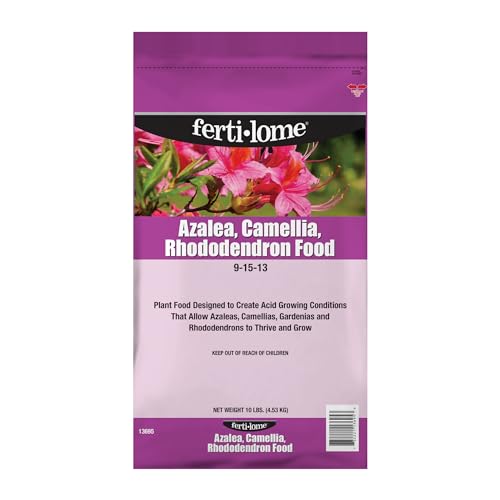
Fertilome’s 9-15-13 formulation is the granular benchmark for gardeners who want a conventional synthetic approach with a proven track record. The 15% phosphate level is the highest in this comparison, and it is supported by micronutrients that include iron, manganese, and zinc — each chelated to remain plant-available across a wider pH window than non-chelated alternatives. The 10-pound bag delivers sufficient material to feed a dozen mature azaleas across three seasonal applications.
Customer data shows that rhododendrons which had not flowered in three years produced a full flush of blooms within one season of switching to Fertilome. The product is designed to acidify the soil as it breaks down, creating a localized growing environment that mimics the forest-floor conditions azaleas naturally prefer. The application rates are clearly scaled by plant height — 1/4 cup for a 1-foot shrub up to 1 1/4 cups for a 12-foot specimen — reducing the guesswork that leads to under- or over-fertilization.
The synthetic base means nutrients are immediately water-soluble upon granule contact with moisture, so results are visible within two to three weeks. However, because the release is not buffered by organic matter, there is a higher risk of root burn if the granules are applied too heavily or concentrated near the main stem.
What works
- Highest phosphorus ratio in the lineup for aggressive bloom forcing
- Chelated micronutrients remain available in less-than-ideal pH conditions
- Clear height-based dosing instructions
What doesn’t
- Synthetic salts can burn roots if application rate is exceeded
- Not certified organic and not suitable for OMRI-required gardens
4. Miracle-Gro Water Soluble Azalea, Camellia, Rhododendron Food (5 lb)

The Miracle-Gro water-soluble formula delivers the fastest observable response of any product here — leaves typically darken within five to seven days after the first application. Its 30-10-10 ratio is skewed heavily toward nitrogen, which is ideal for pushing vigorous vegetative growth on azaleas that have suffered winter dieback or insect damage. The 5-pound bag yields approximately 64 gallons of ready-to-use solution when mixed at the standard outdoor rate of one tablespoon per gallon of water.
The product is safe to use with a standard watering can or a hose-end sprayer, and the label explicitly states it will not burn foliage when used at the recommended dilution. This makes it a strong emergency intervention for shrubs showing acute nitrogen deficiency symptoms such as uniform yellowing of older leaves. For acid-loving plants specifically, the ammonium-based nitrogen source provides a mild acidifying effect that helps maintain the 5.0 to 5.5 pH range azaleas require.
The trade-off is that water-soluble feeding requires reapplication every 7 to 14 days throughout the growing season. A user who misses a two-week window will see the foliage fade and bloom set decline. Additionally, the bag’s resealable closure is widely reported to fail, so transferring the powder to an airtight container is recommended.
What works
- Visible greening within one week of application
- Versatile for both in-ground and container azaleas
- Does not burn foliage when mixed correctly
What doesn’t
- Requires biweekly reapplication for sustained results
- Bag closure is prone to failure, requiring secondary storage
5. Dr. Earth Acid Lovers Azalea, Camellia, Rhododendron & Maple Fertilizer (4 lb)

Dr. Earth Acid Lovers is the most rigorously certified organic fertilizer in this lineup — it carries OMRI, CCOF, and Non-GMO Project verification, meaning every ingredient is traceable to human-grade or feed-grade sources. The 4-pound bag is formulated with a proprietary blend of multi-minerals, proteins, carbohydrates, humic acids, and trace elements designed to rebuild soil biology rather than simply feed the plant directly. This is the product to choose if your azalea care philosophy prioritizes long-term soil health over short-term bloom volume.
User reports from camellia and gardenia owners confirm that the product reliably restores bloom cycles on shrubs that have not flowered in multiple years. One account noted that a rhododendron which had been flowerless for two seasons produced large pink blossoms within months of a single spring application. The granular formula is applied by broadcasting and watering in — no digging or mixing required. Because it is free of synthetic chemicals and GMO-contaminated chicken manure, it is safe around pets and children immediately after watering.
The lower 4-pound weight means the bag covers fewer plants than the bulk organic alternatives. For a garden with more than five or six mature azaleas, you will likely need to purchase multiple bags for a full season’s feeding program. The cost per square foot is higher than the synthetic options.
What works
- Triple organic certification provides maximum ingredient transparency
- Humic acids and trace minerals improve long-term soil ecology
- Safe for use around children and pets
What doesn’t
- Small bag size limits coverage for large gardens
- Nutrient release is slower than synthetic water-soluble alternatives
6. Schultz Azalea, Camellia, Rhododendron ACR 14-7-7 (3.5 lb)

The Schultz ACR 14-7-7 is the simplest “set it and forget it” option for azalea feeding. Its slow-release granular coating meters nutrients over approximately three months, requiring only two applications per year — early spring and post-bloom. The 14-7-7 ratio provides a moderate nitrogen drive without the extreme vegetative push of the Miracle-Gro formula, making it appropriate for balanced growth where foliage and flowers are equally important.
Customer reports consistently note visible improvement within one week of application, particularly in leaf color and density. Camellia and azalea owners describe blooms as “luscious” with a “pearly iridescence” in direct sun, which indicates that the micronutrient package is delivering adequate iron and magnesium for chlorophyll and anthocyanin production. The granules are small enough to spread evenly by hand or with a broadcast spreader, and no mixing is required.
The 3.5-pound bag is a middle-ground size — larger than the specialty organic options but smaller than the bulk synthetics. Coverage is adequate for 10 to 15 medium shrubs per bag. The product’s target species list is narrow, so it is not ideal if you need a single fertilizer for a mixed bed that includes non-acid-loving plants.
What works
- Two-application schedule minimizes gardener effort
- Granules spread easily and do not require mixing
- Visible leaf green-up within one week
What doesn’t
- Not suitable for non-acid-loving plants in mixed beds
- Slow-release mechanism cannot correct acute deficiencies rapidly
7. Gardenwise 8-4-8 Acidic Fertilizer (1 lb)
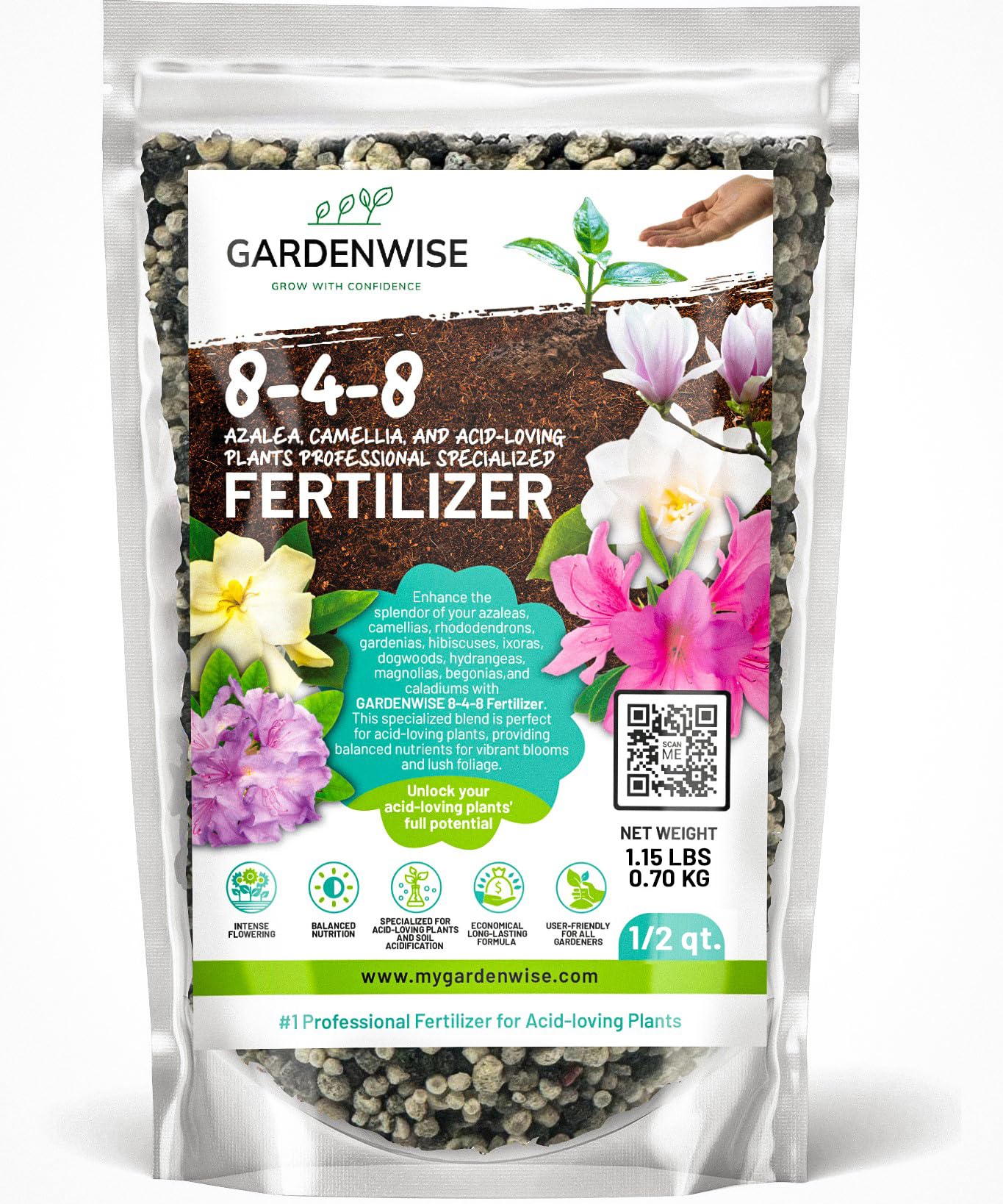
The Gardenwise 8-4-8 is a niche product that distinguishes itself through its bio-solid manufacturing process. The granules are produced from heat-treated, dried, and prilled wastewater biosolids that have been stripped of heavy metals and toxins, resulting in a fertilizer that is rich in live bacterial microbes. These microbes act as soil inoculants, accelerating the decomposition of organic matter and improving nutrient cycling in the root zone — a unique feature absent from standard synthetic or even most organic fertilizers.
Owner reports are striking: one magnolia tree that was “on the brink of death” produced twice the leaf mass and a blossom within one week of application. A rhododendron that had been declining showed greener leaves and a large number of blooms the following season after a single treatment. The 8-4-8 ratio is balanced and gentle, making it nearly impossible to over-fertilize even if applied generously. The manufacturer recommends only three feedings per year, which aligns with the slow-release granular format.
The 1-pound bag is the smallest offering in this comparison and is best suited for a gardener with one or two specimen shrubs rather than a whole landscape. The bio-solid processing also means the product has a distinct earthy odor when wet, which some users may find off-putting.
What works
- Live microbial content improves soil biology beyond simple nutrition
- Very low risk of root burn due to gentle 8-4-8 balance
- Three-feedings-per-year schedule is low maintenance
What doesn’t
- Small bag size limits use to a few plants
- Distinct earthy odor when wet may be unpleasant
Hardware & Specs Guide
NPK Ratio Decoding
The three-number format on every bag represents Nitrogen-Phosphorus-Potassium by weight percentage. For azaleas, a phosphorus number (the middle digit) between 8 and 15 supports bloom initiation, while the nitrogen number (the first digit) should come from ammonium sources to maintain soil acidity. A potassium number between 4 and 13 strengthens root systems and disease resistance.
Iron Content and Chelation
Iron deficiency in azaleas manifests as interveinal chlorosis — yellow leaves with green veins. The best fertilizers list iron content as a percentage and specify the chelation agent. Iron EDTA is stable up to pH 6.0, while iron DTPA remains available up to pH 7.5. Products with multiple iron sources provide broader protection across variable soil conditions.
Organic vs. Synthetic Release Curves
Organic fertilizers like Espoma Holly-Tone and Dr. Earth Acid Lovers rely on microbial decomposition to release nutrients, producing a gradual curve that lasts 8 to 12 weeks. Synthetic slow-release granules (Schultz, Fertilome) use polymer coatings to meter nutrients, providing a more predictable but less biologically active release. Water-soluble synthetics (Miracle-Gro) produce an immediate spike followed by a rapid drop-off within 10 to 14 days.
Sulfur and Soil Acidification
Sulfur content in the fertilizer drives the chemical reaction that lowers soil pH. Elemental sulfur (S) is the most common acidifier. A product with 5% or higher sulfur content can shift the root-zone pH by 0.5 to 1.0 points over a growing season. For azaleas planted in naturally alkaline soils (pH above 7.0), a sulfur-rich formula is essential to prevent iron lockup.
FAQ
Should I use a water-soluble or granular fertilizer for established azaleas?
How can I tell if my azalea needs iron instead of a general fertilizer?
Can I use a general all-purpose garden fertilizer on my azaleas?
Final Thoughts: The Verdict
For most gardeners, the best plant food for azaleas winner is the Espoma Organic Holly-Tone 4-3-4 because its organic Bio-tone formula, 5% sulfur content, and 36-pound bulk size deliver reliable acidification and sustained feeding across a full growing season with minimal effort. If you want the heaviest possible bloom set and are targeting specific shrubs, grab the Nelson NutriStar 9-13-11. And for a quick emergency green-up on a struggling azalea, nothing beats the Miracle-Gro Water Soluble formula for speed of visible results.