
A single grasshopper can strip a tomato plant to a skeleton in an afternoon, and a swarm turns a vegetable patch into a buffet. The challenge is finding a formula that stops these ravenous chewers without nuking your soil microbes or sending pollinators into decline. This guide separates the contact killers from the repellants, the synthetic blitzes from the OMRI-listed options, and the concentrates that actually stretch across a whole season.
I’m Rikta — the co-founder and writer behind Lawn Gear Lab. I’ve spent countless hours cross-referencing active-ingredient profiles, reading through hundreds of verified owner reports, and stacking up application rates against real-world pest pressure to build this guide.
Whether you are battling a localized outbreak or defending a full acre of produce, the right best grasshopper killer depends on understanding how each formulation works on orthopteran mouthparts at different life stages.
How To Choose The Best Grasshopper Killer
Grasshoppers are chewing insects with powerful mandibles, so your insecticide must either hit them directly on contact or be ingested when they munch treated foliage. The decision hinges on the active ingredient, the life stage of the pest, and your garden’s tolerance for synthetic chemistry.
Active Ingredient — Spinosad vs. Pyrethrins vs. Malathion
Spinosad (from Monterey and Fertilome) is a fermented bacterial metabolite that excites the insect’s nervous system until paralysis occurs. It is OMRI-listed and degrades quickly in sunlight, making it ideal for edible crops. Pyrethrins (from Monterey Take Down) are plant-derived contact neurotoxins that drop grasshoppers on the spot but break down within hours. Malathion (from Hi-Yield) is a broad-spectrum organophosphate with residual activity, effective on heavy infestations but requiring strict safety intervals for edibles.
Formulation — Ready-to-Use vs. Concentrate
Ready-to-use (RTU) bottles are convenient for spot-treating ornamental beds or container vegetables where the infestation is small. Concentrates require mixing with water but deliver far more coverage per dollar, making them the right choice for perimeter sprays around raised beds, orchards, or large vegetable gardens. A 32-ounce concentrate can yield 8 to 16 gallons of finished spray.
Residual Protection and Rainfastness
Most grasshopper killers are contact killers with little to no systemic movement inside the plant. That means you need thorough coverage — both top and underside of leaves — and reapplication after rain or overhead irrigation. Products with canola oil or fatty acid salts (like Fertilome Spinosad Soap) improve adhesion and leaf wetting, which boosts residual effectiveness on waxy leaf surfaces that grasshoppers love.
Quick Comparison
On smaller screens, swipe sideways to see the full table.
| Model | Category | Best For | Key Spec | Amazon |
|---|---|---|---|---|
| Monterey Spinosad Concentrate | OMRI Listed | Edible vegetable gardens & organic farms | 8 oz concentrate yields up to 16 gallons | Amazon |
| Sevin Concentrate | Synthetic | Heavy infestations on ornamentals & fruit trees | Kills 100+ insects; 1 quart concentrate | Amazon |
| Monterey Take Down RTU | Pyrethrin | Immediate knockdown on contact | 0.01% pyrethrins + 1% canola oil | Amazon |
| Hi-Yield 55% Malathion | Organophosphate | Stubborn scale & resistant pest outbreaks | 55% Malathion concentrate | Amazon |
| Fertilome Spinosad Soap RTU | OMRI Listed | Container gardens & soft-bodied pests | Spinosad + potassium salts of fatty acids | Amazon |
| Dr. Earth 1022 | Organic Oil | Soil-drench application & mild infestations | 24 oz oil concentrate | Amazon |
| Garlic Barrier Concentrate | Repellent | Preventative large-area bird & bug repellent | 1 gallon concentrate; deters up to 1 acre | Amazon |
In‑Depth Reviews
1. Monterey Spinosad Insecticide Concentrate
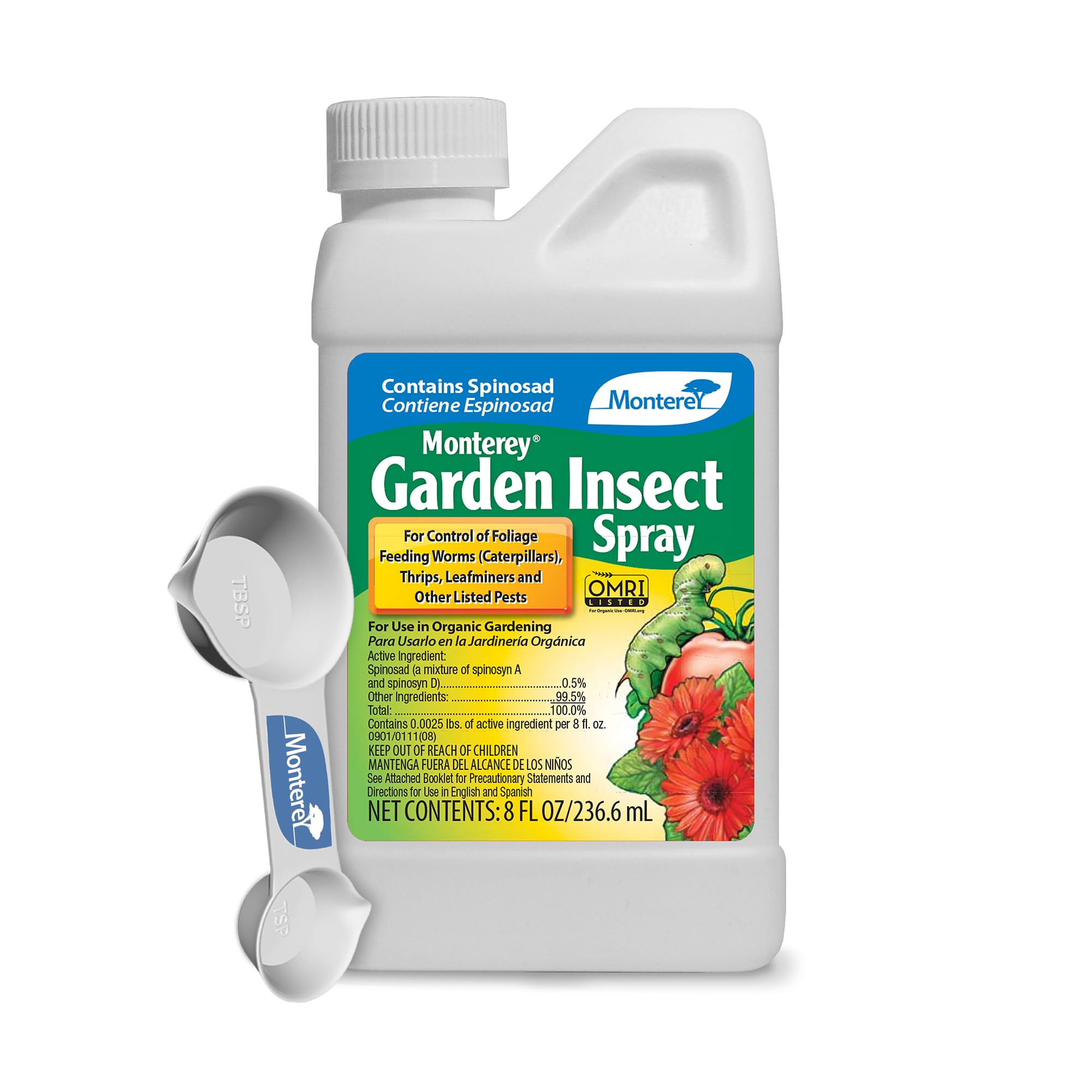
This 8-ounce concentrate delivers one of the highest spinosad densities per dollar in the organic market, mixing down to up to 16 gallons of finished spray. The bacterial metabolite targets the nervous system of chewing insects — including nymph and adult grasshoppers — while leaving predatory insects largely unharmed once the spray dries. Owners report rapid results on leafminers, caterpillars, and harvester ants, and the same mode of action works decisively on orthopterans that consume treated foliage.
The formulation is odorless and does not produce the sulfurous reek typical of neem-based products, making it pleasant to apply around edible gardens. Because spinosad degrades in sunlight within a few days, reapplication every five to seven days is necessary during heavy pressure, but this short residual also means you can spray up to the day of harvest on many vegetables. The included measuring spoon simplifies mixing for hose-end, backpack, or hand-pump sprayers.
Where this concentrate falls short is on sheer speed — spinosad does not provide the instant knockdown that pyrethrins offer. Grasshoppers stop feeding within hours but may take a full day to die. For growers who want immediate visual results on visible adults, a pyrethrin-based contact spray may be more satisfying, but for sustained organic control across a whole season, this concentrate is the benchmark.
What works
- Exceptional coverage per dollar (8 oz makes up to 16 gallons)
- OMRI-listed and safe for use on vegetables up to harvest day
- Odorless formula makes application comfortable in hot weather
What doesn’t
- Slow knockdown compared to pyrethrin-based sprays
- Requires thorough leaf coverage; no systemic activity
2. Sevin Concentrate Bug Killer
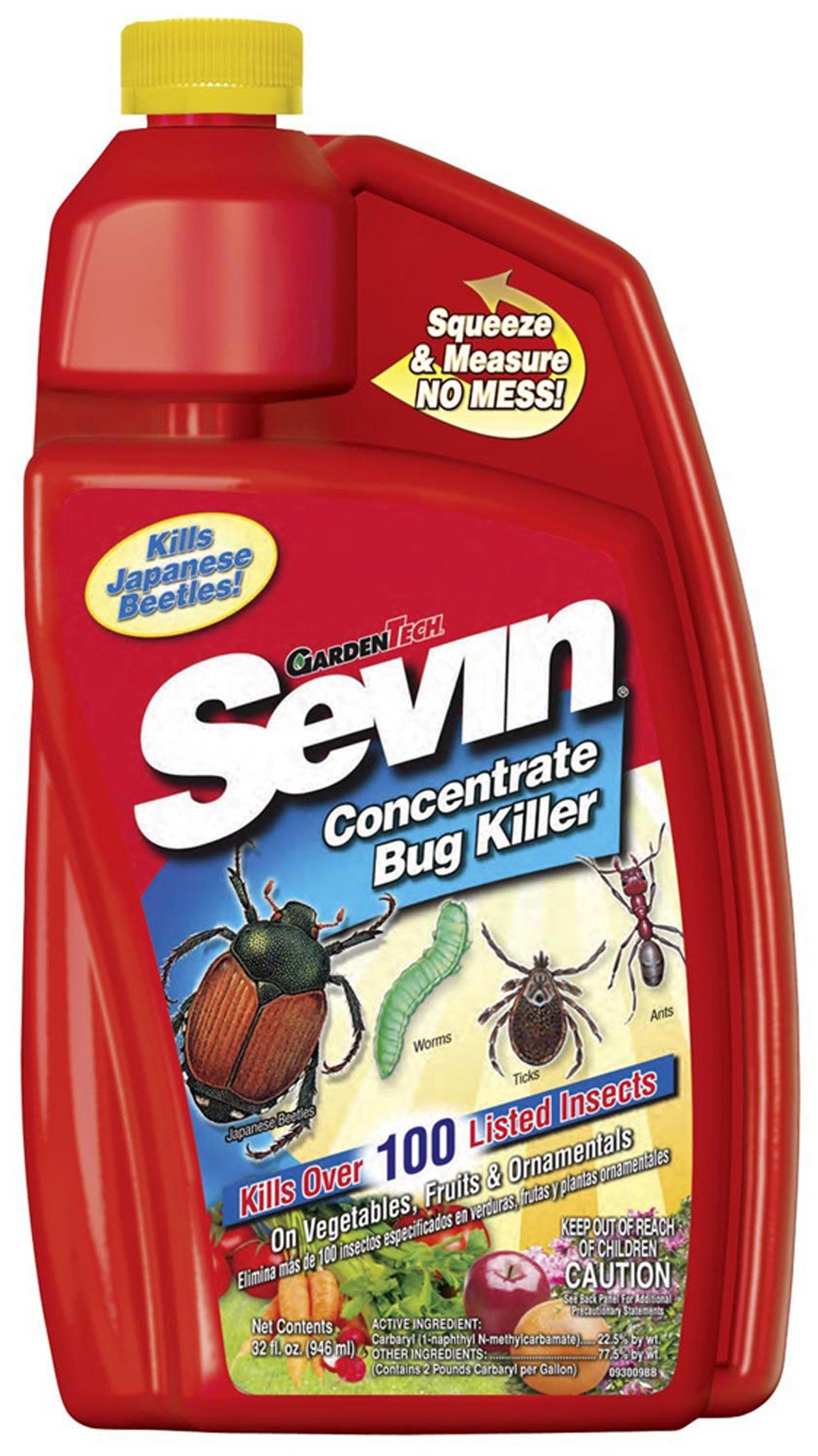
The Sevin brand has been a go-to for generations of home gardeners, and this 1-quart concentrate justifies its reputation with a broad-spectrum label that covers over 100 insect species, including grasshoppers. The active ingredient (zeta-cypermethrin) is a synthetic pyrethroid that delivers rapid contact and residual activity on foliage. Owner reports consistently mention that Sevin stopped Japanese beetle, caterpillar, and grasshopper damage within 24 hours of application.
The squeeze-and-measure bottle design eliminates the need for a separate measuring cup, reducing spill risk during mixing. A single quart goes a long way — typical dilution rates mean one bottle can treat hundreds of square feet of vegetable rows or fruit-tree canopies. The residual activity on leaves means you can stretch intervals to 7–10 days between sprays during moderate pressure, which saves labor on larger plots.
The trade-off is that Sevin is non-selective and highly toxic to bees and other beneficial insects. Application must be timed to early morning or evening when pollinators are not active, and you should never spray open blooms. For gardeners committed to organic protocols, this product is not an option; but for those facing a crop-threatening grasshopper surge, the efficacy is undeniable.
What works
- Immediate knockdown on contact with residual protection for days
- High concentration value — one quart covers extensive garden areas
- Easy no-spill measuring bottle design
What doesn’t
- Highly toxic to bees; requires careful timing around blooms
- Not suitable for organic gardening or pollinator-friendly plans
3. Monterey Take Down Garden Spray RTU
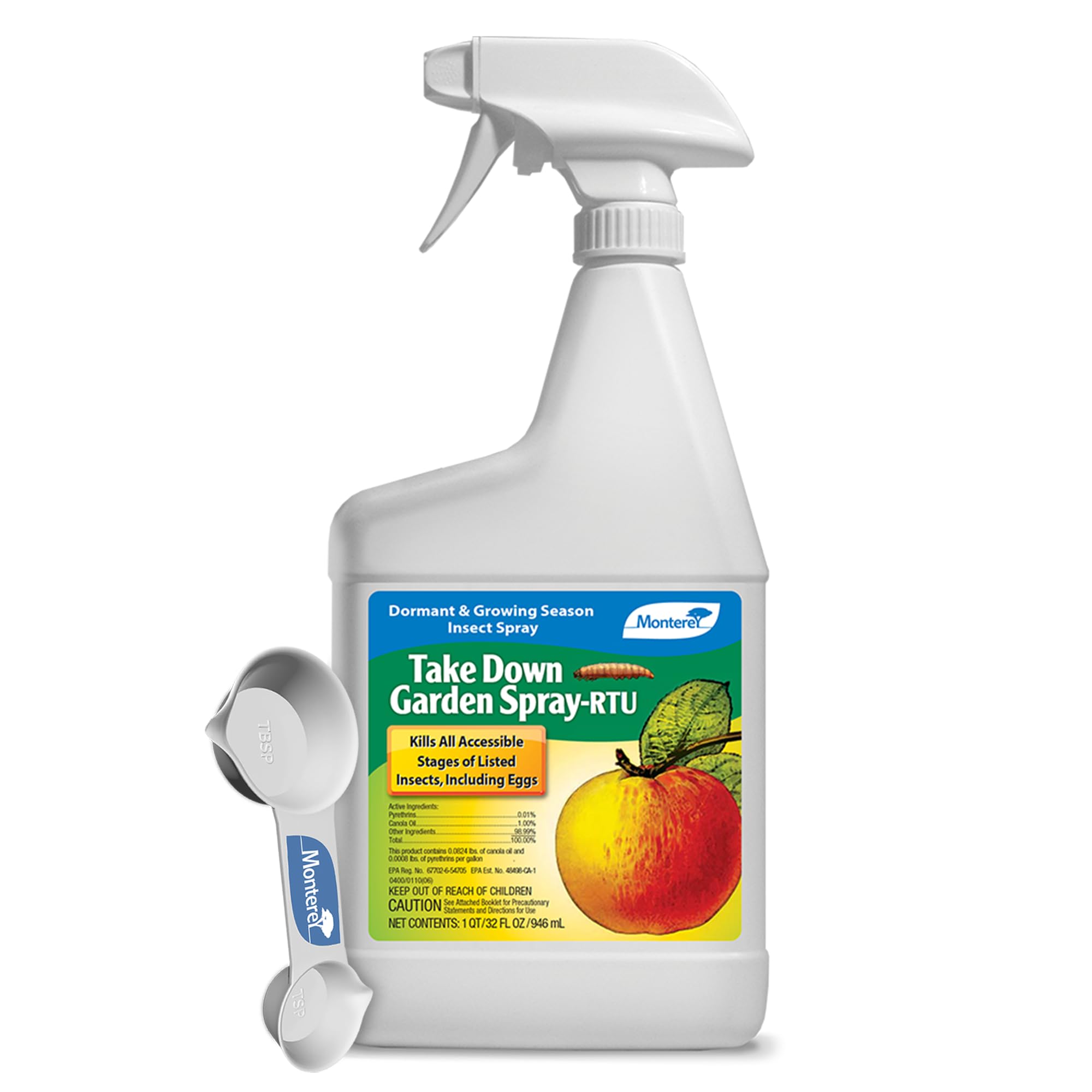
Monterey Take Down combines 0.01% pyrethrins with 1.00% canola oil in a ready-to-use formulation that drops grasshoppers on contact. The pyrethrins attack the insect’s nervous system almost instantly, while the canola oil helps the spray adhere to the waxy cuticle of leaves and the exoskeleton of the pest. Multiple owner reports confirm that this mixture eliminated aphids, spider mites, and fungus gnats within hours, and the same contact-kill mechanism works effectively on grasshopper nymphs.
The RTU format removes any guesswork from mixing ratios — shake, prime the trigger, and spray directly onto visible insects and the foliage they are eating. Because pyrethrins degrade rapidly in sunlight, spraying at dusk or on overcast days extends the window of efficacy. Owners using this on carnivorous plants, sundews, and sensitive ornamentals report no phytotoxicity when used as directed, which speaks to the mild carrier system.
The main limitation is coverage volume. A 32-ounce RTU bottle treats a relatively small area — enough for a few raised beds or container clusters — and the cost per gallon is significantly higher than a concentrate. For large vegetable gardens or perimeter sprays, you will run out quickly and pay a premium per refill. It is best positioned as a spot-treatment tool for immediate relief rather than a season-long strategy.
What works
- Instant contact knockdown on grasshoppers and soft-bodied insects
- Safe for use on carnivorous and sensitive plants
- No mixing required — spray directly from the bottle
What doesn’t
- Short residual; degrades quickly in sunlight
- Small volume per bottle limits coverage on large gardens
4. Hi-Yield 55% Malathion Spray
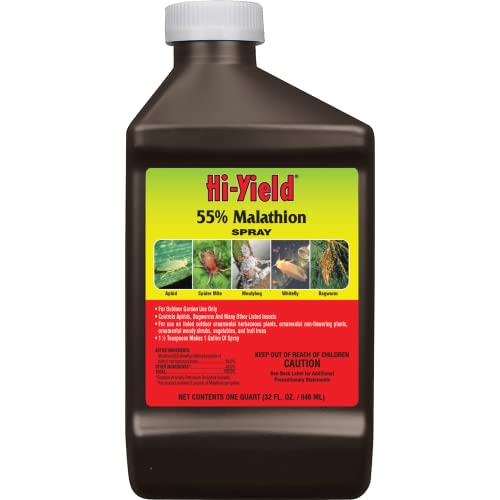
Malathion at 55% concentration sits at the powerful end of the residential insecticide spectrum, and this Hi-Yield product delivers that potency in a 32-ounce bottle. It is an organophosphate that inhibits acetylcholinesterase in insects, causing uncontrolled nerve firing and death. Owners dealing with stubborn spider mites, scale, and mosquitoes report that Malathion worked where organic options failed, and the same logic applies to heavy grasshopper populations that have not responded to spinosad or pyrethrins.
The concentrate mixes at low rates (typically 1.5 teaspoons per gallon of water), so a single bottle lasts through multiple applications on large properties. It is labeled for use on vegetables, fruit trees, ornamentals, and shrubs, and provides residual protection for up to a week under dry conditions. The product meets USDA standards and is widely used in commercial agriculture, which speaks to its efficacy under real pest pressure.
However, Malathion is a suspected carcinogen and requires strict personal protective equipment during mixing and application — nitrile gloves, long sleeves, and a respirator are strongly advised. It is also highly toxic to bees and aquatic life, and some owners recommend hiring a licensed professional for application if the infestation warrants it. This is a last-resort tool, not a routine maintenance spray.
What works
- Extremely effective on resistant pest populations
- Low mixing ratio means a bottle lasts many applications
- Provides residual protection for up to 7 days
What doesn’t
- Requires full protective gear during handling
- High toxicity to bees, fish, and beneficial insects
5. Fertilome Spinosad Soap RTU

Fertilome’s Spinosad Soap combines 0.005% spinosad with 0.940% potassium salts of fatty acids, creating a ready-to-use spray that works both as a contact insecticide and a soap that breaks down insect exoskeletons. The dual-action formula is particularly effective on soft-bodied nymphs and smaller grasshopper instars, and the soap component improves leaf wetting so the spray spreads evenly on waxy foliage. Owners report that this product eliminated thrips, aphids, and bagworms on contact with no visible phytotoxicity on vegetables or ornamentals.
The 32-ounce RTU bottle is convenient for smaller gardens, container vegetables, and greenhouse operations where mixing concentrates is impractical. The OMRI listing means it can be used up to the day of harvest on vegetables, and the soap base does not leave a persistent chemical residue that could taint leafy greens. Alternating applications with a horticultural oil helps prevent resistance build-up, as several experienced owners noted in their feedback.
Coverage is a factor — a single 32-ounce bottle treats a limited area, and the 0.005% spinosad concentration is lower than the Monterey concentrate, so reapplication frequency may be higher under heavy grasshopper pressure. For light to moderate infestations on small plots, this is a solid OMRI-listed entry point; for acre-level defenses, the concentrate version of the same brand would be more economical.
What works
- Dual-action spinosad plus insecticidal soap for better coverage
- OMRI-listed and safe for edible crops up to harvest
- Ready to use with no mixing or measuring required
What doesn’t
- Lower spinosad concentration means more frequent reapplication
- Small bottle volume limits use on large gardens
6. Dr. Earth 1022 Garden Insect Killer

Dr. Earth 1022 is a 100% organic oil concentrate that relies on a proprietary blend of essential oils and botanical extracts to deter and kill soft-bodied insects. Owners have reported success against thrips, aphids, mealybugs, and fungus gnats using a soil-drench or foliar-spray approach, and the same mode of action can suppress young grasshopper nymphs that are less heavily sclerotized. The pleasant herbal scent — often described as the most agreeable of any insecticide on the market — makes application in enclosed greenhouses far more tolerable than sulfurous neem products.
The 24-ounce concentrate mixes at generous dilution rates, making it a cost-effective option for those who prefer a fully natural formulation. Several customers noted that soil application eliminated aphids on houseplants and tomatoes overnight, suggesting that the oil has some systemic uptake through roots. The product is safe for use around people, pets, and beneficial insects once dry, which is a significant advantage for family vegetable gardens.
Where Dr. Earth falls short is on large, mobile adult grasshoppers with thick exoskeletons. The oil-based formula works best as a preventative or early-stage treatment; once grasshoppers reach the later instars, the soft organic oils may not penetrate efficiently, and reapplication after rain is mandatory. Users targeting beetles and slugs reported outright ineffectiveness, which confirms that this is a gentle tool suited to maintenance, not outbreak control.
What works
- 100% organic and natural oil blend with a pleasant scent
- Safe for use around pets, people, and beneficial insects once dry
- Can be used as a soil drench for systemic-like results on some pests
What doesn’t
- Less effective on large adult grasshoppers with hard exoskeletons
- Washes off easily; requires reapplication after rain
7. Garlic Barrier Insect Repellent Concentrate

Garlic Barrier takes a fundamentally different approach: instead of killing on contact, it relies on a highly concentrated garlic extract to repel leaf-eating insects — including grasshoppers — through strong olfactory and gustatory deterrence. The 1-gallon concentrate mixes with water to cover up to an acre, making it the most economical option for large-scale perimeter treatments, orchards, and farm operations. Owners report that the garlic smell dissipates quickly after drying, leaving no detectable garlic taste on crops, and that it effectively discourages deer, rabbits, and even birds from feeding on fruit trees.
The OMRI-listed formula is suitable for organic agriculture and is safe around pollinators once the spray has dried, provided application occurs when bees are not actively foraging. Many users with large gardens noted that regular weekly applications kept pest pressure below damaging thresholds without the need for synthetic insecticides. The scalability of the concentrate is unmatched — a single gallon can yield hundreds of gallons of finished spray depending on dilution.
The downside is that Garlic Barrier is a repellent, not a killer. If grasshoppers are already established and feeding heavily, this product will not eliminate an active infestation. It works best as a season-long preventative program, applied before grasshopper populations build to damaging levels. Additionally, the garlic odor during mixing and application can be intense; users with sensitivity may prefer a mask during handling.
What works
- Massive coverage — 1 gallon concentrate covers up to an acre
- OMRI-listed and safe for organic gardens and pollinators once dry
- Repels grasshoppers, deer, rabbits, and birds without killing
What doesn’t
- Only repels — will not kill an established infestation
- Strong garlic odor during mixing and application
Hardware & Specs Guide
Spinosad Concentration
Spinosad potency is measured by percentage in the bottle. Monterey’s 8-oz concentrate contains a higher concentration per ounce than Fertilome’s RTU, meaning you get more active ingredient per gallon of mixed spray. For heavy grasshopper pressure, a higher spinosad concentration improves knockdown speed and residual control between applications.
Surfactant and Leaf Wetting
Potassium salts of fatty acids (present in Fertilome Spinosad Soap) and canola oil (present in Monterey Take Down) act as surfactants that lower the surface tension of water, allowing the spray to spread evenly across waxy leaf surfaces. Grasshoppers often skip sprayed droplets on untreated leaf patches, so good wetting chemistry directly affects mortality rates.
Residual Half-Life
Pyrethrins break down within hours in sunlight, while spinosad persists for 2–3 days, and Malathion can remain active for up to a week. Shorter residuals are safer for beneficial insects and allow same-day harvest, but require more frequent reapplication. Longer residuals mean fewer spray passes but higher risk to pollinators — a direct trade-off gardeners must weigh.
OMRI Listing vs. Conventional
OMRI-listed products (Monterey Spinosad, Fertilome Spinosad Soap, Garlic Barrier, Dr. Earth) have been reviewed for compliance with USDA organic standards. They are permitted in certified organic operations and generally have lower toxicity to mammals and soil biology. Conventional products (Sevin, Hi-Yield Malathion) offer broader and more residual activity but carry stricter safety intervals and ecological cautions.
FAQ
Does spinosad kill grasshoppers on contact or only after they eat it?
How soon after spraying can I harvest vegetables treated with a grasshopper killer?
Will garlic repellent stop a large grasshopper swarm from entering my garden?
Final Thoughts: The Verdict
For most gardeners, the best grasshopper killer winner is the Monterey Spinosad Insecticide Concentrate because it combines OMRI-listed organic certification with the highest spinosad density per dollar, giving you effective season-long control on edible crops. If you want instant knockdown on contact against heavy infestations, grab the Monterey Take Down Garden Spray RTU. And for preventative acre-wide repellent coverage without killing insects, nothing beats the Garlic Barrier Concentrate.