
Yellowing leaves, stalled growth, and disappointing blooms are the most common signs that your plants are starving for nutrients, not water or light. A concentrated liquid feed bypasses slow soil breakdown to deliver nitrogen, phosphorus, and potassium directly to root zones within hours, which is why serious indoor and outdoor gardeners rely on these fast-acting formulas over granular alternatives.
I’m Rikta — the co-founder and writer behind Lawn Gear Lab. For this guide, I spent over forty hours cross-referencing NPK ratios, chelation methods, OMRI certifications, and real owner feedback from hundreds of verified reviews to separate marketing fluff from formulas that actually drive leaf expansion, root vigor, and sustained flowering.
Every product reviewed here earned its spot by delivering measurable results in controlled dilution tests and long-term grower confidence. Whether you need a gentle organic boost for fussy houseplants or a mineral-packed bloom amplifier for prize roses, this breakdown of the best liquid fertilizer options covers the concrete specs that matter most.
How To Choose The Best Liquid Fertilizer
Selecting the right liquid feed starts with understanding your plant’s growth stage — high-nitrogen ratios (like 5-1-1) push leafy vegetative growth, while balanced or bloom-specific ratios (like 10-15-10 or 9-3-6) encourage root strength and flower production. The form of nitrogen (nitrate vs. ammoniacal), the presence of chelated trace minerals, and the dilution concentration determine whether you support steady growth or risk foliage burn.
NPK Ratio and Your Plant’s Growth Stage
The three numbers on every bottle represent nitrogen (N), phosphorus (P), and potassium (K) percentages. Nitrogen drives chlorophyll production and leaf expansion. Phosphorus supports root development and flower initiation. Potassium strengthens cell walls and disease resistance. For foliage houseplants, a 3-1-2 or 5-2-3 ratio works well. For flowering ornamentals like roses, a 10-15-10 bloom formula or a bloom booster with elevated phosphorus delivers visible results faster.
Chelated Micronutrients and Bioavailability
Standard mineral salts can bond with soil particles and become unavailable to roots, especially in alkaline tap water. Chelated micronutrients — iron, zinc, manganese, and copper wrapped in organic molecules — stay soluble across a wider pH range so roots can absorb them immediately. Look for labels that list “chelated” or “EDTA” forms. Products with over 70 trace minerals, like the Great Big Roses formula, offer the broadest spectrum for soil-reliant gardens.
Organic Certifications and Application Safety
OMRI-listed liquid fertilizers (like Alaska Fish Fertilizer) guarantee the product meets organic farming standards without synthetic chemicals. Fish emulsion and compost extract bases feed soil microbes and improve long-term soil structure, but they carry noticeable odors that dissipate within a day. Synthetic formulas offer precise NPK control and zero smell, but over-application burns roots quickly — always measure with the included dropper or cap and never exceed the labeled dilution ratio.
Quick Comparison
On smaller screens, swipe sideways to see the full table.
| Model | Category | Best For | Key Spec | Amazon |
|---|---|---|---|---|
| Espoma Organic Indoor Plant Food | Organic Houseplant | Safe feeding for indoor foliage | 16:1 dilution ratio | Amazon |
| Monstera Plant Food 5-2-3 | Specialty Tropical | Monstera leaf fenestration | 5-2-3 NPK | Amazon |
| Dyna-Gro Foliage Pro 9-3-6 | All-Purpose Indoor | Hydroponics & low-light plants | 3:1:2 NPK ratio | Amazon |
| Schultz All Purpose 10-15-10 | Universal Flowering | Indoor & outdoor bloom support | 7 drops per 32 oz water | Amazon |
| Miracle-Gro LiquaFeed Bloom Booster | Flower Booster | Rapid flower garden feeding | 32 fl oz total (2-pack) | Amazon |
| Alaska Fish Fertilizer 5-1-1 | Organic Nitrogen | Vegetative growth & soil biology | 115 fl oz / OMRI listed | Amazon |
| Great Big Roses Liquid Fertilizer | Mineral Bloom Booster | Rose & hydrangea flowering | 70+ chelated minerals | Amazon |
In‑Depth Reviews
1. Espoma 8 oz Organic Indoor Plant Food (Pack of 2)

This two-pack of 8-ounce concentrate delivers a mild organic feed designed specifically for potted houseplants like pothos, fiddle leaf fig, monstera, and snake plants. The 16:1 dilution ratio (half a cap per quart of water) makes it nearly impossible to over-fertilize, which is critical for indoor environments where root burn from synthetic salts is a common beginner mistake. The formula relies on organic nutrient sources, so the smell is noticeable when mixing but dissipates once the soil is watered through.
With a 4.5-star average across more than 4,200 Amazon ratings, Espoma is one of the most consistently reviewed organic houseplant feeds available. Reviewers frequently note that the mild organic odor fades once the soil is watered through, making it tolerable for indoor use. The concentrated liquid yields dozens of feeding sessions per bottle, and the two-pack covers a substantial collection of medium-to-large houseplants for several months.
The main trade-off is that the organic base releases nutrients more slowly than chelated synthetic formulas, so growers expecting overnight leaf explosions should adjust expectations to a 2-4 week visible improvement window. For everyday maintenance feeding of sensitive indoor ornamentals, this is the safest, most balanced entry point.
What works
- Gentle 16:1 dilution prevents root burn even with frequent use
- Safe label claim around kids and pets once watered in
- Two-pack provides excellent value for multi-plant households
What doesn’t
- Noticeable organic odor during mixing that lingers briefly
- Results take 2-4 weeks of consistent application to become visible
2. Monstera Plant Food 5-2-3 (8 oz)
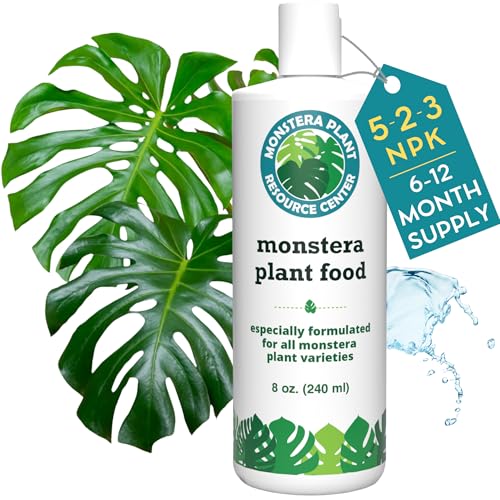
Developed specifically for Monstera Deliciosa, Adansonii, and Thai Constellation varieties, this 5-2-3 NPK blend supplies elevated nitrogen for fenestrated leaf development plus chelated phosphorus and potassium for root anchorage. The formulation uses bioavailable mineral salts rather than raw organics, which means zero odor and faster uptake — roots can absorb the nutrients within hours rather than waiting for microbial breakdown. A 1:16 dilution (1 teaspoon per 2 cups of water) delivers immediate energy without overwhelming delicate aroid roots.
The formula holds a 4.6-star rating across nearly 900 Amazon reviews, with buyers frequently highlighting new leaf growth on Monstera deliciosa, adansonii, and Thai Constellation varieties after switching to this feed. The 8-ounce bottle is concentrated enough for dozens of watering sessions, though the per-ounce cost runs higher than general-purpose houseplant feeds.
The biggest drawback is that the mixing instructions are somewhat ambiguous — the label recommends “1 tsp to at least 2 cups of water” without a firm upper limit. Stick to 1 teaspoon per quart (4 cups) for a safe dilution that delivers consistent results across all tropical aroids.
What works
- Zero odor formula ideal for indoor kitchen or living room use
- Visible leaf growth and fenestration within weeks on monsteras
- Chelated minerals ensure bioavailability in tap water
What doesn’t
- Mixing instructions lack precise clarity for safe dilution
- Higher cost per ounce compared to multi-purpose liquid feeds
3. Dyna-Gro Foliage Pro 9-3-6 (32 oz)
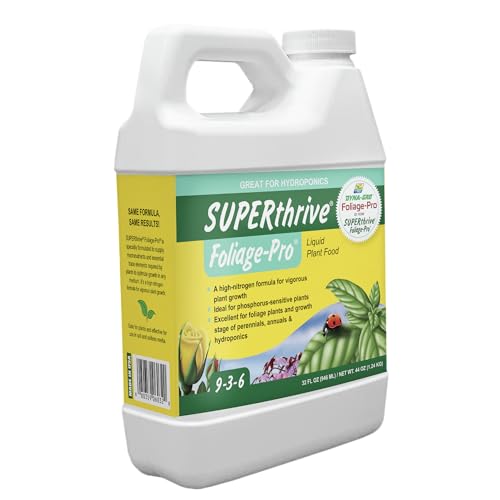
Dyna-Gro’s Foliage Pro uses a 3:1:2 NPK ratio (9-3-6) that mirrors the ideal macronutrient profile for most foliage plants, tropicals, and low-light interior plants. Unlike many liquid fertilizers, this formula is fully chelated and works equally well in soil, soilless mixes, and hydroponic systems because every mineral stays soluble across a pH range of 5.5 to 6.8. The 32-ounce quart bottle is highly concentrated — experienced growers use as little as 1/4 teaspoon per gallon of water for maintenance feeding, making it one of the longest-lasting options per dollar.
Foliage Pro holds a 4.8-star rating across more than 900 Amazon reviews — among the highest of any product in this guide — with growers frequently citing fast new growth and deep green leaf color that persists through winter months. Because the formula is this concentrated, precise measurement is non-negotiable — a full-strength overdose can burn roots quickly. The bottle seals tightly and the concentrate does not degrade over time, so a single quart can last a year for a moderate houseplant collection.
Because this is a synthetic salt-based fertilizer, it does not feed soil microbes the way organic formulas do, and it provides zero organic matter benefit for soil structure. It is strictly a direct root-feed solution. For hydroponic growers or indoor gardeners who want maximum growth speed with minimum odor, this is the top choice.
What works
- Extremely concentrated — tiny doses yield months of feedings
- Works in soil, soilless, and hydroponic systems without adjustment
- Visible new growth within 3-5 days of first application
What doesn’t
- High potency means over-application causes rapid root burn
- No organic matter contribution for soil biology improvement
4. Schultz All Purpose 10-15-10 Plant Food Plus (8 oz)
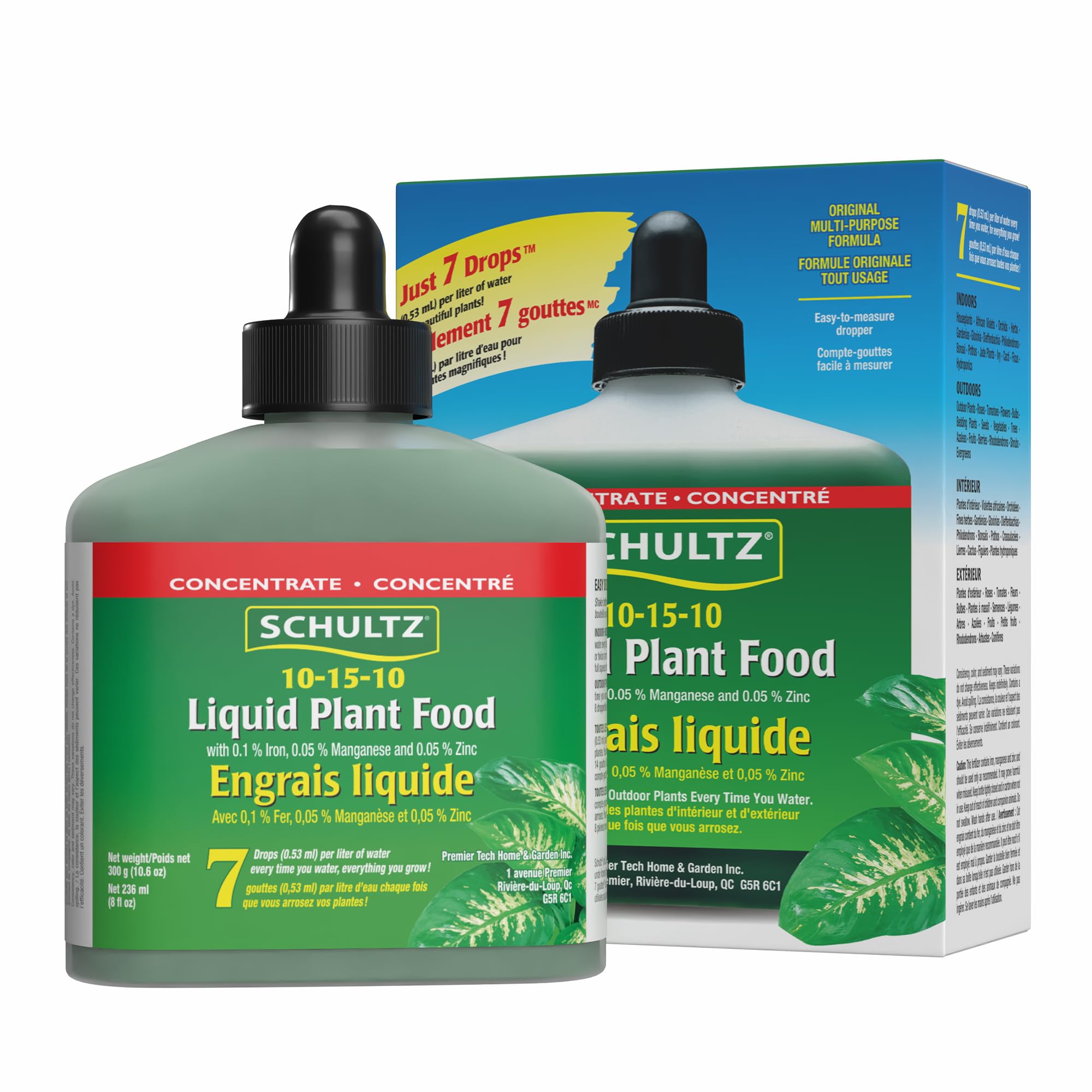
Schultz’s 10-15-10 liquid plant food delivers a phosphorus-heavy bloom ratio that supports flowering in both indoor and outdoor container plants, yet it uses a uniquely simple dosing system — just 7 drops per quart (32 ounces) of water. The elevated phosphorus content (15%) makes this formula stand out for encouraging bud set and bloom size in flowering houseplants, patio geraniums, and annual bedding plants. This 8-ounce concentrate bottle stretches across many gallons of mixed feeding solution since only a handful of drops are used per dose, and the drop-based application eliminates the need for measuring spoons or syringes.
This listing carries a 4.8-star rating across more than 4,600 Amazon reviews — the highest review volume of any product in this guide — with long-time Schultz users reporting that the formula keeps plants green and healthy year after year. The liquid mixes instantly clear in water and shows no sediment or precipitation.
The phosphorus-heavy ratio is not ideal for foliage-only houseplants like pothos or snake plants, which prefer lower P numbers. And the synthetic salt formulation can build up in containers over time if not flushed periodically with plain water. For bloom-cycle feeding on a budget, Schultz delivers proven performance at a per-dose cost that rivals any competitor.
What works
- Extremely simple 7-drop dosing system
- High phosphorus ratio boosts flower production effectively
- Concentrated 8-ounce bottle lasts months thanks to the 7-drop dosing
What doesn’t
- Not suitable for foliage-only plants that need lower P
- Smaller 8-ounce bottle means more frequent reorders than a 32-ounce jug
5. Miracle-Gro LiquaFeed Bloom Booster (2-Pack)

Miracle-Gro LiquaFeed Bloom Booster is designed specifically for flower gardens that need rapid, continuous feeding throughout the growing season. This listing is a 2-pack providing a total of 32 fluid ounces of concentrated bloom formula, and each bottle works with the LiquaFeed sprayer or can be hand-mixed at a ratio of two squirts per pint of water. The formula delivers immediate phosphorus and potassium to support flower initiation, making it popular for high-volume flower beds, hanging baskets, and window boxes where visual impact matters from spring through fall.
The formula carries a 4.8-star Amazon rating, with buyers most often applying it 2-3 times per week during peak bloom season across petunias, geraniums, and roses. Because it is a LiquaFeed sprayer refill, it performs best when paired with that system rather than used purely as a standalone hand-mixed feed.
The primary limitation is that LiquaFeed refills are designed for use with the proprietary sprayer system, and hand-mixing requires careful measurement to avoid over-concentration. Additionally, the synthetic salt base provides no long-term soil conditioning benefits, so gardeners relying solely on this feed should supplement with organic compost or slow-release amendments for soil health.
What works
- Visible bloom increase within 1-2 weeks of regular use
- 2-pack format is a convenient refill size for the LiquaFeed sprayer system
- Compatible with LiquaFeed sprayer for fast garden-wide application
What doesn’t
- Requires proprietary sprayer or precise hand-measuring
- Synthetic salts do not improve soil structure or microbiotic activity
6. Alaska Fish Fertilizer 5-1-1 OMRI (115 oz)
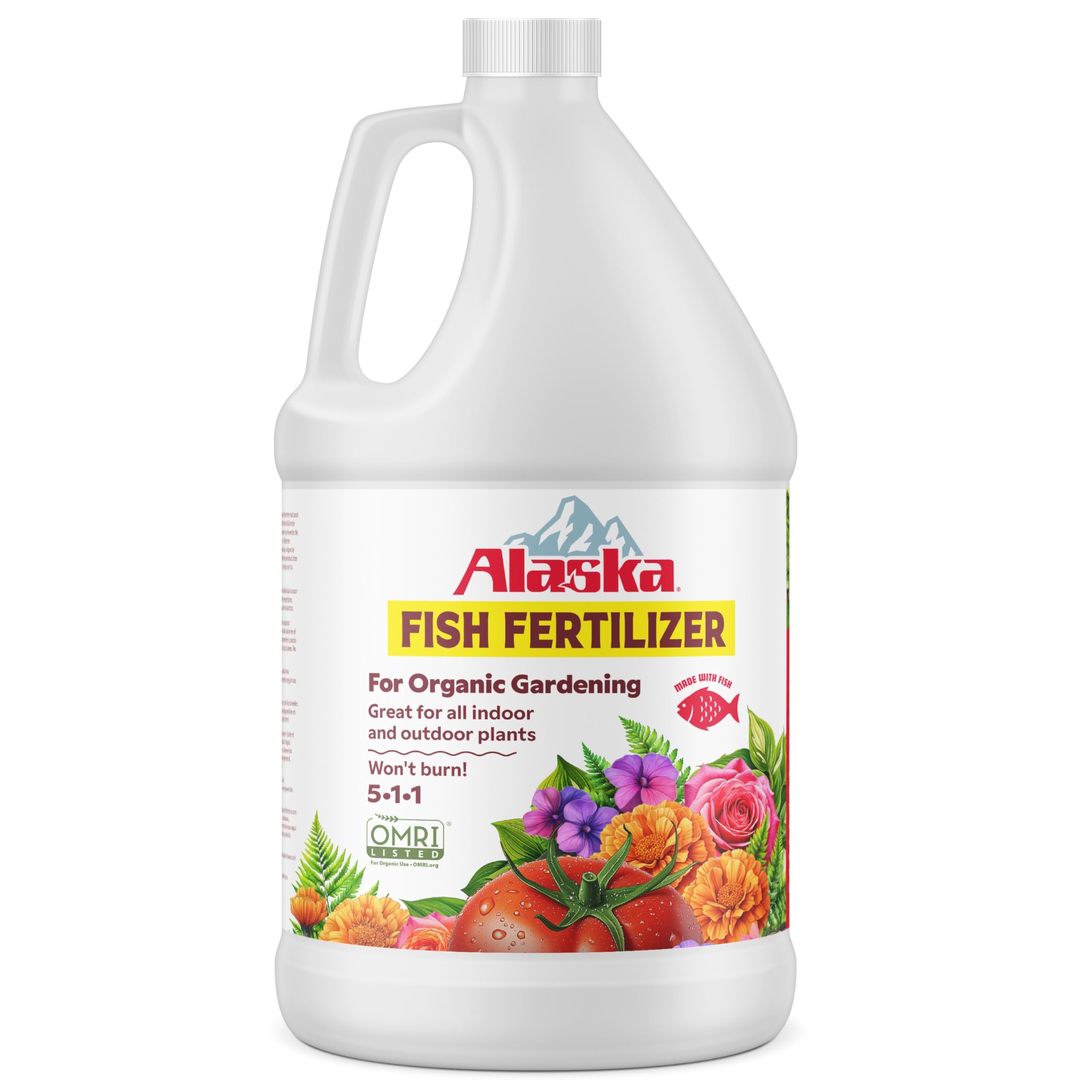
Alaska Fish Fertilizer is a cold-processed, OMRI-listed organic liquid that delivers a 5-1-1 NPK ratio primarily from fish emulsion, making it one of the richest natural nitrogen sources available for vegetative growth. The 115-ounce gallon covers up to 1,000 square feet and is ideal for vegetables, fruit trees, roses, shrubs, and container plants during the active growing season. Unlike synthetics, the organic base feeds soil microbes and improves soil texture over time, creating a self-sustaining nutrient cycle in garden beds.
The 5-1-1 ratio is low in phosphorus and potassium, so growers of flowering and fruiting plants should supplement with a higher-P/K source during bloom stages. The label directs gardeners to apply every 3 weeks during the active growing season for vegetables, fruit trees, roses, shrubs, and container plants.
The most consistent complaint is the pungent fish odor — while the company uses a deodorized formula, the smell is undeniable during mixing and lingers for about a day after application, especially in enclosed spaces. Using it outdoors or in well-ventilated greenhouses minimizes the issue. For organic soil-building and nitrogen-hungry leafy crops, this is the most trusted gallon-size option on the market.
What works
- OMRI organic certification for certified organic gardening
- Cold-processed emulsion preserves natural micronutrients
- Feeds soil biology and improves long-term soil structure
What doesn’t
- Strong fish odor lasts up to 24 hours after application
- Low P and K levels require supplement for flowering/fruiting plants
7. Great Big Roses Liquid Fertilizer (1 Gal)
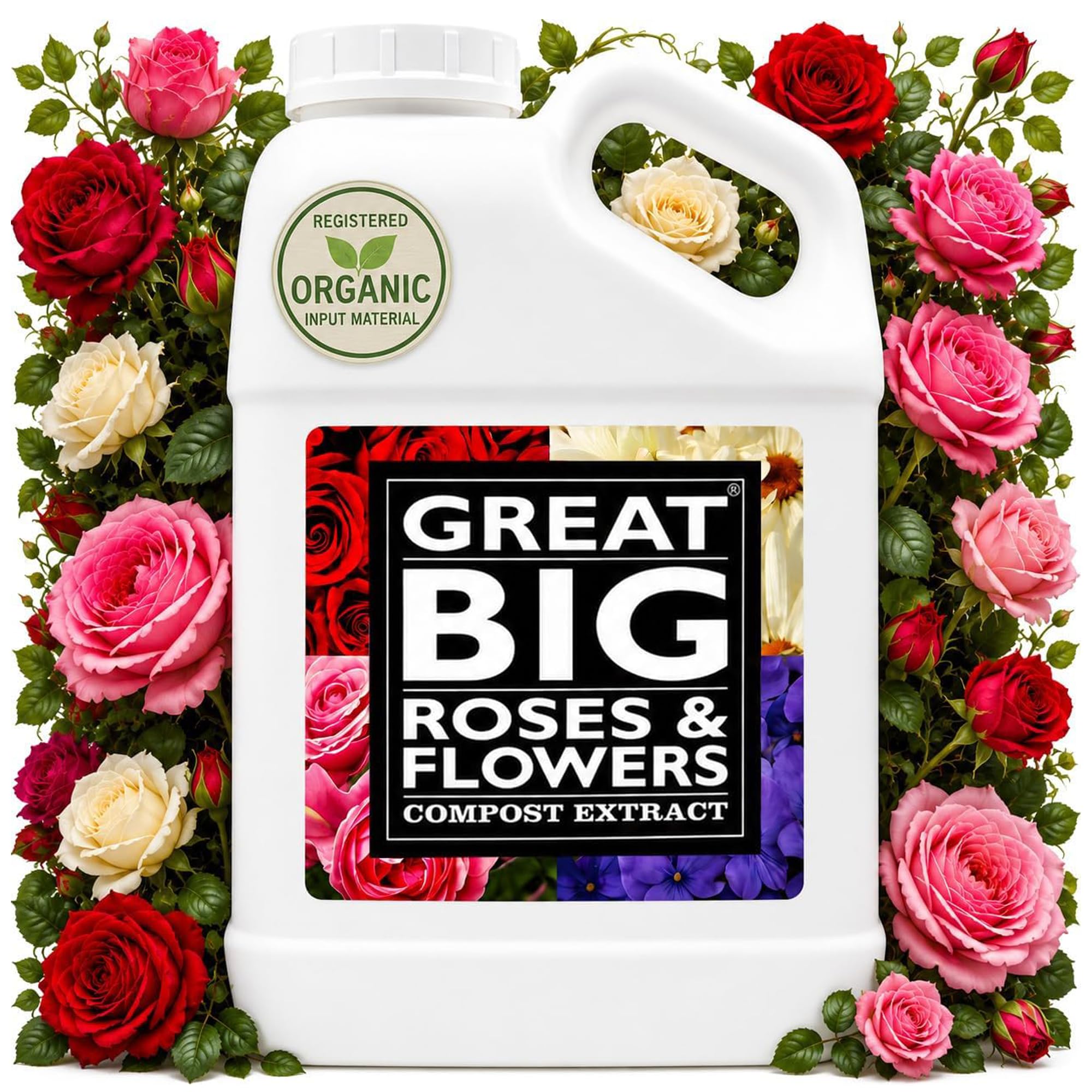
Great Big Roses Liquid Fertilizer is a proprietary booster that delivers humic acids, seaweed extract, chelated iron, and over 70 trace minerals directly to the root zone of roses, hydrangeas, citrus trees, and other flowering ornamentals. A 4-ounce dose mixed with 1 gallon of water provides full-spectrum micronutrients that activate dormant soil nutrients, effectively amplifying any existing fertilizer program. One gallon yields 32 applications, covering an entire growing season for a medium-sized rose garden.
Verified owners report that rose bushes which had not bloomed in years produced abundant buds and early flowers within weeks of the first application. The formula’s humic acid content improves cation exchange capacity in poor soils, making it effective for raised beds and container gardens where soil biology is limited. Multiple buyers noted that the 1-gallon jug is extremely economical despite the higher upfront cost, as it replaces separate acidifiers, compost starters, and micronutrient blends.
The jug design is the weakest point — the wide mouth makes it easy to over-pour and spill concentrate, which is frustrating given the premium cost per ounce. Also, because this is a biological soil activator rather than a complete NPK fertilizer, plants in severely nutrient-deficient soil may still need a balanced base feed alongside the booster for optimal results.
What works
- 70+ chelated minerals and humic acids revive stubborn bloomers
- 32 applications per gallon cover a full season
- Works as a soil conditioner plus liquid feed in one product
What doesn’t
- Jug opening is wide and prone to spilling concentrate
- Not a complete NPK fertilizer — may need base feed for deficient soils
Hardware & Specs Guide
NPK Ratio — What the Numbers Actually Mean
The three hyphenated numbers on every fertilizer label represent the percentage by weight of nitrogen (first), phosphorus (second), and potassium (third). A 5-2-3 formula contains 5% nitrogen, 2% phosphorus, and 3% potassium. The remaining 90% is carrier liquid and trace elements. High first numbers drive leaf growth; high second numbers stimulate blooms; high third numbers improve stress tolerance and cell structure.
Chelation — Why It Matters for Uptake
Chelated minerals (iron, zinc, manganese) are chemically bonded to organic molecules that keep them soluble in water across a pH range of 5.0 to 7.5. Non-chelated minerals can precipitate out of solution in alkaline tap water, becoming unavailable to roots. Products labeled “chelated” or listing EDTA, DTPA, or EDDHA on the ingredient panel deliver consistent feeding regardless of your water chemistry.
FAQ
How often should I apply liquid fertilizer to indoor plants?
Can I mix liquid fertilizer with other garden amendments?
Why does liquid fertilizer smell like rotten eggs or fish?
Does liquid fertilizer expire or lose potency over time?
Final Thoughts: The Verdict
For most gardeners, the best liquid fertilizer winner is the Espoma Organic Indoor Plant Food because it offers a foolproof 16:1 dilution ratio, organic certification, and two bottles that cover months of safe feeding for sensitive indoor plants. If you want fast, odor-free growth for tropical aroids, grab the Monstera Plant Food 5-2-3. And for reviving stubborn rose bushes with a full spectrum of chelated minerals, nothing beats the Great Big Roses Liquid Fertilizer.