
Bermuda grass has a reputation for being the toughest warm-season turf on the block, but even the most resilient lawn turns pale, thin, and patchy when it’s starved of the right nitrogen-to-potassium balance. Choosing a fertilizer that delivers a dense, deep-green canopy without triggering explosive leaf growth or burning the stolons is the difference between a showpiece lawn and one that fights you every step of the way.
I’m Rikta — the founder and writer behind Lawn Gear Lab. I spend my time analyzing NPK ratios, comparing slow-release technologies, cross-referencing spreader settings, and studying hundreds of verified owner reports to identify which blends actually perform on Bermuda grass rather than just marketing hype.
After breaking down the granular and liquid options on the market, I’ve isolated the formulations that consistently deliver a thick, resilient, weed-resistant turf. This is your evidence-based guide to the best fertilizer for bermuda grass across every budget and application style.
How To Choose The Right Fertilizer for Bermuda Grass
Bermuda grass differs from fescue or Kentucky bluegrass because it thrives on a higher nitrogen diet during active growth, but it punishes over-application with thatch buildup and disease pressure. The decision boils down to three variables: the NPK ratio, the nitrogen release profile, and the secondary additives that influence root zone health.
NPK Ratio — Why Phosphorus Is Usually Optional
Most established Bermuda lawns sitting on healthy soil already have adequate phosphorus levels. A 24-0-6 or 16-0-8 formulation skips the middle number entirely, which prevents algae runoff issues and avoids locking up micronutrients in high-pH soils. The first number (nitrogen) should land between 16 and 28 for active growing months, and the third number (potassium) between 6 and 20 to support root density and drought tolerance.
Slow-Release vs. Quick-Release Nitrogen
A bag that lists 63% slow-release nitrogen delivers a gradual color response over 8 to 12 weeks without the dangerous green-up-then-crash cycle. Products with 24% slow-release nitrogen and the remainder as quick-release give you an immediate visual pop in three to four days but require stricter watering discipline to avoid burn spots on stolons and leaf tips.
Iron, Humic Acid, and Micronutrient Additives
Bermuda grass responds strongly to iron supplementation — 3% iron content in a granular or liquid product deepens the green tone without forcing vertical leaf extension. Humic DG (dispersible granular humic acid) improves nutrient uptake in the root zone and buffers soil pH swings. Micronutrient packs containing boron, copper, and manganese help the grass metabolize nitrogen efficiently and resist summer stress.
Quick Comparison
On smaller screens, swipe sideways to see the full table.
| Model | Category | Best For | Key Spec | Amazon |
|---|---|---|---|---|
| GreenView Fairway Formula | Granular | 12-week steady feeding | 27-0-5, 63% slow-release N | Amazon |
| Yard Mastery 24-0-6 Flagship (18 lb) | Granular | Deep blue‑green color + iron | 24-0-6, 3% iron, Bio-Nite | Amazon |
| Yard Mastery 7-0-20 Stress Blend | Granular | Summer heat and drought recovery | 7-0-20, 20% potash, 3% iron | Amazon |
| The Andersons PGF 16-0-8 (18 lb) | Granular | Precision spreading + humic acid | 16-0-8, Humic DG, dual‑release N | Amazon |
| Petramax 28-0-0 Liquid | Liquid | Fast green‑up on stressed turf | 28-0-0, 70% quick‑release N | Amazon |
| Scotts Turf Builder Lawn Food (37.5 lb) | Granular | Budget large‑lawn coverage up to 15k sq ft | 32-0-4, all grass types, 15,000 sq ft | Amazon |
| Simple Lawn Solutions Advanced 16-4-8 (1 gal) | Liquid | Budget liquid booster with seaweed & fish | 16-4-8, covers 12,800 sq ft | Amazon |
In‑Depth Reviews
1. GreenView Fairway Formula 33 lb (27-0-5)

The 27-0-5 NPK ratio on this bag is practically built for Bermuda grass’s ravenous appetite for nitrogen. With 63% of that nitrogen locked into a slow-release coating, the grass gets a consistent 12-week feed that avoids the green-up-then-bronze cycle that plagues quick-release formulas. Owner reports across multiple warm-season species — from Bermuda to centipede — confirm a deep color shift within 4 to 7 days and sustained density through the hottest part of the growing season.
The zero-phosphorus composition is a smart hedge against runoff restrictions and high soil phosphorus levels that can suppress micronutrient availability. Granule size is consistent enough for rotary spreaders, and testers noted no clumping or bridging in the hopper even during humid application windows. The 33-pound bag covers a full 10,000 square feet, which aligns perfectly with a quarter-acre lot in one pass.
Where this blend separates itself is the balance between immediate visual response and long residual. The quick-release fraction gives a three-day color kick that satisfies the impatient lawn owner, while the slow-release nitrogen keeps the stolons thickening without forcing vertical growth that demands mowing every 72 hours. Users who applied this in early spring reported the fastest transition out of winter dormancy they had ever seen.
What works
- 63% slow-release nitrogen delivers full 12-week feeding window
- Zero phosphorus avoids runoff issues and works on high-P soil
- Consistent granule size prevents spreader clogs and uneven strips
What doesn’t
- No iron additive — color depth depends entirely on nitrogen content
- Not phosphate-free for organic gardens despite zero phosphorus
2. Yard Mastery 24-0-6 Flagship (18 lb)
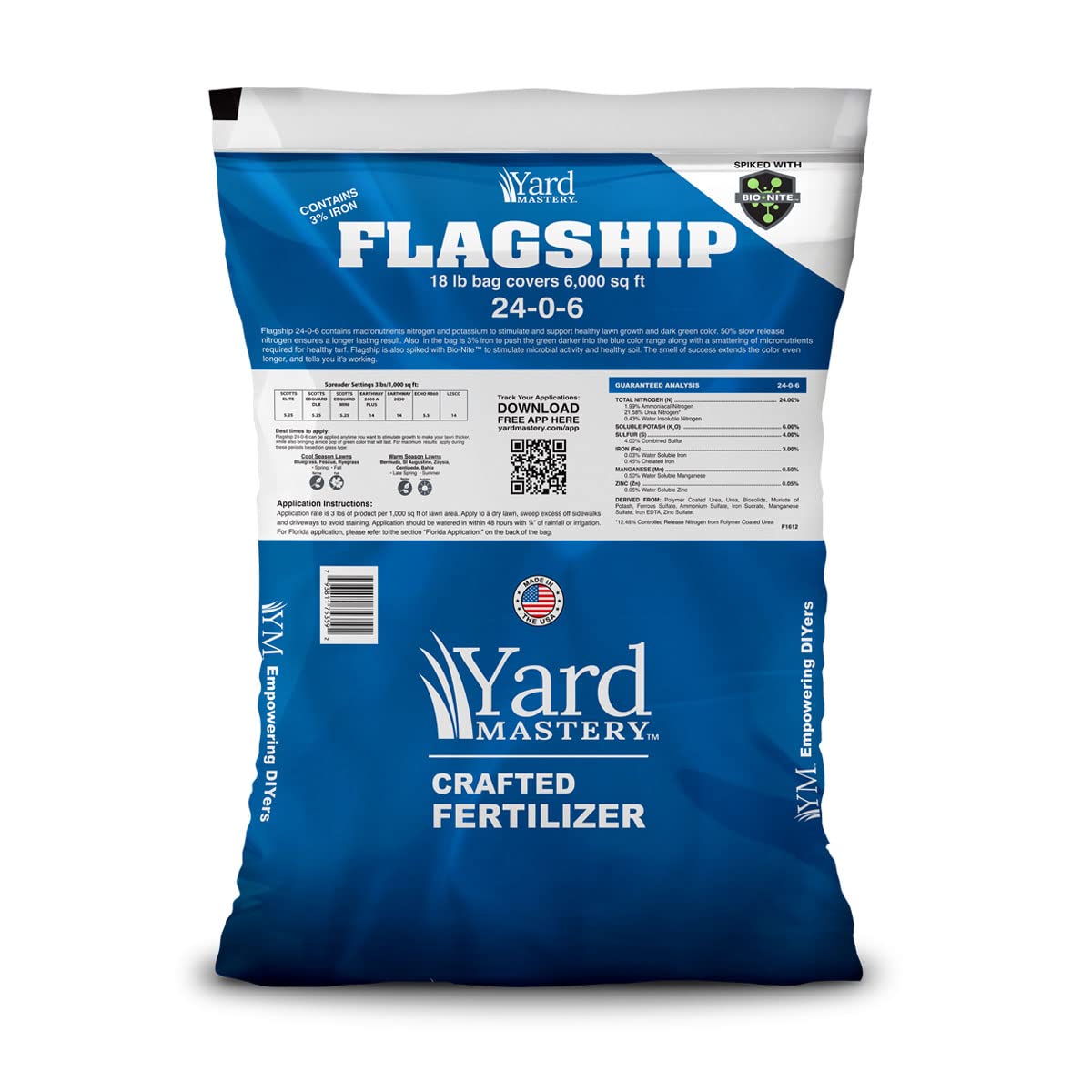
The 24-0-6 Flagship from Yard Mastery leans hard into visual results by pairing a high-nitrogen front number with 3% iron and the Bio-Nite natural fertilizer base. The iron is the key differentiator here: it drives the blue-green tone that Bermuda grass enthusiasts chase without needing to push nitrogen levels into burn territory. Verified owner reports mention that one bag thickened Bermuda stolons enough to choke out visible weeds after a single application.
With 24% slow-release nitrogen, the feeding curve is front-loaded — you see a noticeable color pickup within 72 hours, but the residual extends long enough to stretch application intervals to 6 to 8 weeks during peak growth. The micronutrient mix includes boron, copper, manganese, and zinc, which helps Bermuda grass process the nitrogen load efficiently and reduces the risk of tip burn on the leaf blades during hot afternoons.
The 18-pound bag covers 6,000 square feet, placing it in the sweet spot for smaller lots or targeted spot-feeding on weaker sections of the lawn. Users who paired this with a monthly chelated iron supplement reported the deepest color saturation of any granular product tested. The Bio-Nite carrier also provides a modest organic matter boost to the soil profile over repeated applications.
What works
- 3% iron delivers rich blue-green color without forcing leaf growth
- Bio-Nite organic base improves soil biology over time
- Micronutrient package helps prevent nitrogen burn on stolons
What doesn’t
- Smaller bag size means more frequent purchases on larger lawns
- Front-loaded nitrogen requires careful watering to avoid surge growth
3. Yard Mastery 7-0-20 Stress Blend (18 lb)

This 7-0-20 Stress Blend flips the conventional thinking by putting potassium at a dominant 20% while keeping nitrogen low. For Bermuda grass entering the brutal July-to-September window, high potassium content supports root depth, cell turgor, and disease resistance far better than a heavy nitrogen load that would force lush growth the heat can’t sustain. Users in zone 8B reported that this blend revived centipede and Bermuda from summer yellowing and helped newly planted zoysia plugs establish through a drought stretch.
The 3% iron content provides enough color pop to keep the lawn looking healthy even when growth naturally slows in extreme temperatures. The Bio-Nite carrier matches the Flagship’s quality, and the granule distribution is fine enough to work through drop spreaders without bridging. The label recommends applying only when temperatures stay below 80°F, which usually means early morning or late evening applications during peak summer.
For Bermuda grass, this is not a primary grow-out fertilizer — it is a season-specific stress reliever. Apply it as a transition feed coming out of summer dormancy or as a late-summer fortifier ahead of fall. The 18-pound bag covers 6,000 square feet, and users who followed the 3-to-4-day watering schedule after application saw the most consistent results without leaf tip burn.
What works
- 20% potassium dramatically improves heat and drought tolerance
- Light nitrogen prevents lush growth that heat stress can damage
- Iron content maintains visual appeal during slow-growth periods
What doesn’t
- Not suitable as a primary spring green-up fertilizer
- Requires strict temperature and watering discipline for best results
4. The Andersons PGF 16-0-8 with Humic DG (18 lb)
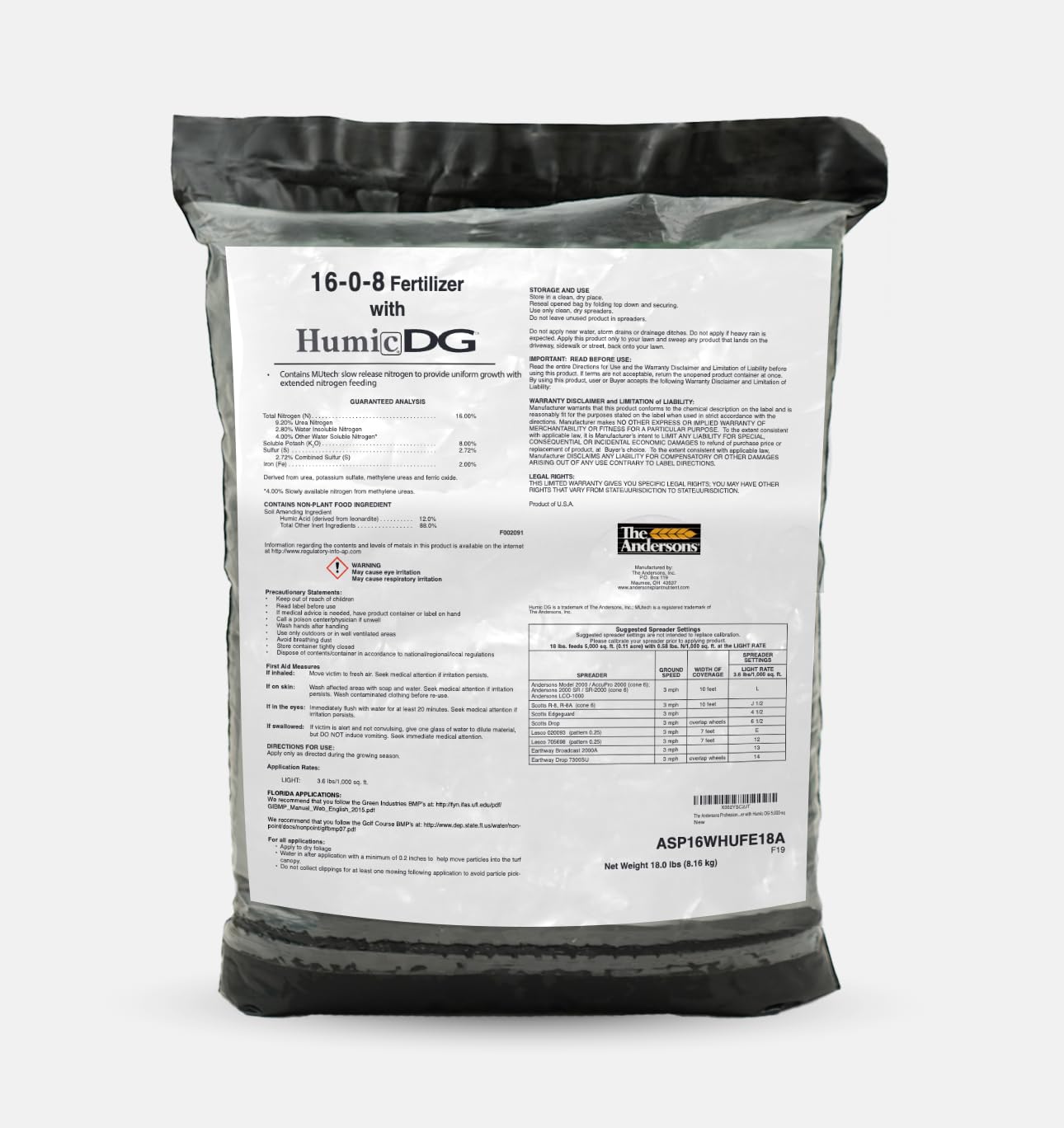
The Andersons PGF line is famous for its super-fine particle size, which delivers roughly twice the number of granules per square foot compared to standard lawn fertilizers. That distribution density eliminates the striping and streaking that can happen with larger granules on Bermuda grass — a critical advantage when trying to avoid patchy color on a uniform warm-season turf. The 16-0-8 NPK ratio provides a moderate nitrogen load with a healthy potassium kick for root and cell wall strength.
The dual-release nitrogen system gives a quick flush of green within the first week followed by an extended feeding curve that lasts up to 8 weeks. The Humic DG additive is the real headline here: humic acid in dispersible granular form improves cation exchange capacity in the root zone, helping Bermuda grass extract more nutrition from whatever is already in the soil. This is especially useful on sandy or heavily leached soils where nutrients wash through quickly.
The 18-pound bag covers a generous area, and Andersons recommends it for spring and summer application windows. Owner reports consistently describe this as a “professional-grade” product that raised their lawn quality above neighborhood standards, though the price per pound is higher than big-box store blends. Users with phosphorus-heavy soil from prior over-fertilization found the zero-phosphorus formulation particularly liberating.
What works
- Ultra-fine particles prevent striping and ensure even green coverage
- Humic DG enhances nutrient uptake beyond the NPK numbers
- Dual-release nitrogen provides immediate color plus 8-week residual
What doesn’t
- Not available in California or Oregon due to state regulations
- Higher cost per square foot than commodity granular fertilizers
5. Petramax 28-0-0 Liquid Nitrogen (1 Gallon)

When Bermuda grass enters the growing season pale and nitrogen-deficient, a liquid 28-0-0 formulation can turn it dark green in a matter of days. Petramax blends 70% quick-release nitrogen for an immediate visual kick with 30% slow-release nitrogen to stretch the feeding window between applications. The concentrate dilutes at 5 ounces per gallon of water for maintenance feeding or 10 ounces per gallon for correcting deficiency — covering up to 25,600 square feet on the maintenance rate.
The liquid format gives you control that granular bags simply cannot offer. You can spot-treat thin patches, adjust rates mid-season based on visual cues, and apply through a hose-end or backpack sprayer without worrying about spreader calibration. Verified reviews note that this product turned yellow, stressed Bermuda green within a week and kept it there through repeated applications. The 28-0-0 ratio is all nitrogen with no phosphorus or potassium, so it pairs well with a soil test that already confirms adequate P and K levels.
Downsides center on the labor: liquid applications require mixing, sprayer cleanup, and more frequent reapplication compared to a slow-release granular. The 1-gallon jug is compact, but the concentrate is heavy and must be stored away from freezing temperatures. For homeowners who already own a sprayer and want surgical precision over large-scale coverage, this is the most efficient nitrogen delivery system available.
What works
- 70% quick-release nitrogen delivers dramatic green-up in 3-5 days
- Liquid format allows targeted spot application on thin Bermuda patches
- Ultra-high coverage — up to 25,600 sq ft per gallon at maintenance rate
What doesn’t
- Requires sprayer equipment and thorough mixing routine
- No potassium — must supplement with a separate source for root health
6. Scotts Turf Builder Lawn Food (37.5 lb)

Scotts Turf Builder Lawn Food is not a Bermuda-specific or warm-season formula, but its 37.5-pound bag covers the same 15,000 square feet as the large-format options above at a lower shelf price, which makes it a legitimate budget alternative for owners with big lots who mainly need nitrogen volume. The label lists it for use on any grass type, and Scotts backs it with a large verified review base (4.6 stars across roughly 8,000 ratings on Amazon at the time of this review) and clear spreader-setting guidance for broadcast, drop, and Wizz spreaders.
The 32-0-4 NPK ratio is nitrogen-heavy with only 4% potassium and no phosphorus — useful for a quick canopy color response, but it sits below the 6-to-20% potassium range this guide recommends for Bermuda’s drought and heat tolerance, and it carries no iron or humic acid additive. That means it is best treated as a coverage-and-cost play rather than a color or stress-recovery specialist, ideally rotated with a potassium- or iron-rich product (like the Yard Mastery or Andersons picks above) during peak summer months.
For homeowners who simply need to feed a large Bermuda lawn on a budget without chasing a specific stress or color outcome, this is a defensible, widely available option — just go in aware that it is a general-purpose lawn food rather than a formula engineered around Bermuda’s nutrient profile.
What works
- 15,000 sq ft per bag at a lower price than the dedicated Bermuda blends in this guide
- Widely stocked with a large, strong verified rating history
- Clear spreader-setting instructions for consistent application
What doesn’t
- Not formulated specifically for Bermuda or warm-season grass
- Only 4% potassium and no iron or humic acid additive
7. Simple Lawn Solutions Advanced 16-4-8 (1 Gallon)

Simple Lawn Solutions’ Advanced 16-4-8 is a liquid concentrate that the manufacturer explicitly lists as safe for Bermuda grass alongside St. Augustine, Zoysia, centipede, and several other warm- and cool-season species. Unlike the straight-nitrogen Petramax liquid above, this formula carries a genuinely balanced 16-4-8 NPK ratio plus fish and seaweed kelp, positioning it as a complete monthly supplement rather than a pure green-up product. It holds a 4.5-star rating across roughly 1,300 Amazon ratings.
Diluted at the labeled 1:10 ratio, one gallon treats up to 12,800 square feet, which puts it in the same application-labor category as other liquid options: no spreader needed, but mixing and sprayer cleanup are part of the routine. The 4% phosphorus content is worth flagging for Bermuda owners specifically — most established lawns with healthy soil already carry adequate phosphorus (as this guide’s “How To Choose” section explains), so this product makes more sense as an occasional micronutrient and seaweed/fish-emulsion boost than as a primary feeding program.
As a value pick, it fills a different role than the granular bags in this list: a lower-cost, easy-to-apply liquid supplement for owners who want trace nutrients and a mild NPK top-up between regular granular feedings, rather than a stand-alone Bermuda fertilization plan.
What works
- Manufacturer explicitly lists Bermuda grass as a compatible turf type
- Balanced 16-4-8 NPK plus fish and seaweed kelp for trace nutrients
- Budget-friendly liquid format with no spreader required
What doesn’t
- 4% phosphorus is unnecessary on most established Bermuda soils
- Requires sprayer mixing and isn’t a stand-alone feeding program
Hardware & Specs Guide
NPK Ratio Explained
The three numbers on a fertilizer bag represent Nitrogen (N), Phosphorus (P), and Potassium (K). For established Bermuda grass, a high first number (16 to 28) and a low or zero middle number is standard because Bermuda consumes nitrogen aggressively and most soils already have adequate phosphorus. The third number (6 to 20) supports root development and drought tolerance.
Slow-Release Nitrogen Percentage
This number tells you what fraction of the total nitrogen is coated or chemically bound to release gradually over weeks. A 63% slow-release nitrogen bag feeds for up to 12 weeks with minimal risk of burn. A bag with 24% slow-release nitrogen will produce a faster visible response but requires more disciplined watering to avoid surge growth and leaf tip burn on stolons.
Iron Content
Iron is not a macronutrient, but Bermuda grass uses it to produce chlorophyll and achieve a deep blue-green color. Products with 3% iron content can visually green the lawn without forcing the vertical growth that a pure nitrogen load would cause. Iron works best when soil pH stays between 6.0 and 6.8; above 7.0, iron availability drops sharply.
Humic DG Technology
Humic DG stands for dispersible granular humic acid. This additive improves the soil’s cation exchange capacity, meaning the soil can hold onto positively charged nutrients like ammonium, potassium, and magnesium for longer. For Bermuda grass on sandy or leached soils, Humic DG can effectively extend the feeding window of any fertilizer it is blended with.
FAQ
Can I use a 30-0-0 fertilizer on Bermuda grass?
How often should I fertilize Bermuda grass during the growing season?
Is liquid or granular fertilizer better for Bermuda grass?
Final Thoughts: The Verdict
For most gardeners, the best fertilizer for bermuda grass winner is the GreenView Fairway Formula 27-0-5 because its 63% slow-release nitrogen provides a full 12-week feeding curve with zero phosphorus, perfectly matching Bermuda’s nutritional demands without surge growth or runoff risk. If you want a deep blue-green color with iron supplementation, grab the Yard Mastery 24-0-6 Flagship (18 lb). And for a mid-summer stress break that protects roots during extreme heat, nothing beats the Yard Mastery 7-0-20 Stress Blend.