
The autumn chore that eats weekends — piling, bagging, and dragging leaves to the curb — finally has a machine-driven answer. A dedicated leaf vacuum mulcher doesn’t just blow debris around; it pulls leaves into a metal or nylon impeller, chews them into fine mulch, and fills a bag with nutrient-dense material your garden beds will thank you for. The difference between a tool that saves an hour and one that adds frustration comes down to impeller material, actual cubic feet per minute (CFM) delivered at the nozzle, and the real-world reduction ratio you get with wet versus dry oak or maple leaves.
I’m Rikta — the founder and writer behind Lawn Gear Lab. I spend my time dissecting manufacturer spec sheets, cross-referencing them against thousands of aggregated owner experiences, and testing the claims of mulch ratios and vacuum airspeed against what actually happens when a pile of damp oak leaves hits the fan.
Whether you need a corded workhorse for a half-acre lot or a gas-powered unit for areas far from an outlet, choosing the right best leaf vacuum mulcher depends on matching the motor type, impeller design, and debris-handling capacity to your specific yard conditions.
How To Choose The Best Leaf Vacuum Mulcher
Every leaf vacuum mulcher claims to be the most powerful or efficient, but the real divide comes down to a few specific engineering decisions. Understanding these will keep you from buying a tool that clogs on the first pile of oak leaves or burns out halfway through the season.
Impeller Material: Metal vs. Plastic vs. Nylon Line
The impeller is the heart of any mulcher — it’s the rotating blade or line that shreds leaves before they enter the bag. Metal impellers (found on higher-end electric units) resist wear from twigs and acorns and maintain their cutting edge for years. Plastic impellers are lighter and quieter but dull faster, especially when you vacuum up fallen sticks. Bladeless designs use heavy-duty nylon trimming lines spinning at high RPM to pulverize leaves without any metal blade at all; they’re safer to handle and maintain, but the lines wear down and need periodic replacement, sometimes multiple times per session if you’re processing a large volume of debris.
Real-World Airflow: CFM at the Nozzle vs. Marketing Numbers
Manufacturers often quote peak airspeed (MPH) or peak volume (CFM) measured at the blower tube outlet with no obstruction. In vacuum mode, the critical number is how much air actually moves through the intake nozzle when you’re a few inches above the grass. A unit rated at 400 CFM in blower mode may drop to 250 CFM in vacuum mode due to the longer tube and bag restriction. Look for owner reports that describe suction behavior on wet or matted leaves — that’s the real test.
Corded, Battery, or Gas: The Right Power Source for Your Lot
Corded electric models offer unlimited runtime and consistent power delivery, but restrict your range to 100–150 feet from an outlet (a 14-gauge extension cord is required for long runs). Battery-powered units are quieter and more portable, but runtime on high speed is typically 15–25 minutes, and larger batteries add significant weight. Gas-powered units deliver the highest suction and are truly cordless, but they require fuel mixing, more frequent maintenance, and produce higher noise levels and exhaust fumes that make them less comfortable for extended use in residential neighborhoods.
Mulch Ratio and Bag Capacity: The Real Volume Equation
An 18:1 mulch ratio means 18 bags of whole leaves reduce to one bag of fine mulch — but that ratio is achievable only with dry, loose deciduous leaves. Wet, compacted maple leaves may yield a 6:1 or 8:1 ratio at best. The bag itself is often smaller than a standard yard waste bag (most vacuum bags hold 10–12 gallons), so expect to empty it every 5–10 minutes of continuous use. Some models offer a “LeafPro” or direct-to-trash-can chute that bypasses the bag altogether, which can dramatically speed up your workflow for large properties.
Quick Comparison
On smaller screens, swipe sideways to see the full table.
| Model | Category | Best For | Key Spec | Amazon |
|---|---|---|---|---|
| BLACK+DECKER BV6000 | Corded Electric | Powerful performance with disposable bag option | 12 Amp / 400 CFM / 250 MPH | Amazon |
| WORX WG505.2 Trivac | Corded Electric | LeafPro direct-to-can system | 12 Amp / 350 CFM / 210 MPH | Amazon |
| WORX WG509 Trivac | Corded Electric | Lightweight handheld with metal impeller | 12 Amp / 350 CFM / 210 MPH | Amazon |
| GreenSweep XL | Bladeless Shredder | Standalone mulch station with fine shred | 15 Amp / 9,000 RPM / 18:1 ratio | Amazon |
| DEKOPRO Electric Mulcher | Bladeless Shredder | Adjustable control dial for wet/dry leaves | 15 Amp / 8,200 RPM / 17:1 ratio | Amazon |
| PROYAMA 26cc Gas | Gas Powered | Large properties far from outlets | 26cc / 412 CFM / 200 MPH | Amazon |
| MTKOALA Cordless | Battery Powered | Light blower-only duty on patios and driveways | 1200W Brushless / 700 CFM / 200 MPH | Amazon |
In‑Depth Reviews
1. BLACK+DECKER 3-in-1 BV6000

The BV6000 earns the top spot by combining a 12-amp motor with a high-impact metal fan that actually resists clogging from damp leaves and small twigs. In blower mode, it pushes 400 CFM at 250 MPH — enough to move matted wet leaves off a driveway — and the switch to vacuum mode takes under two seconds. The disposable bag system (two included) lets you tie and toss without handling the mulch, though many owners switch to the reusable bag once they see how fast the disposables fill.
Owner reports consistently praise the suction depth: the vacuum grabs leaves from between flagstones and out of flower beds without pulling up mulch. The built-in cord retainer keeps the extension cord seated even during aggressive maneuvering. At 8.1 pounds, it’s the lightest full-power unit in this list, which matters when you’re holding the vacuum tube at ground level for 45 minutes. The 50% quieter claim versus older Black & Decker models holds up — it’s still loud enough to warrant ear protection, but not painfully so.
The main trade-off is the bag strap. With the bag full of wet mulch, the shoulder strap digs in, and the bag itself can be awkward to snap off and empty one-handed. Dust management is poor — wear a respirator, not just a dust mask, if you have allergies. For most homeowners with standard suburban lots, however, the BV6000 delivers the best balance of suction power, mulching efficiency, and reliability at a mid-range investment.
What works
- Metal impeller withstands twigs and acorns without dulling
- 400 CFM blower clears wet, matted leaves effectively
- Lightest full-power unit at 8.1 lbs reduces arm fatigue
What doesn’t
- Bag fills fast and strap digs in when full
- Extremely dusty operation requires a respirator
- Disposable bags add ongoing cost versus reusable
2. WORX Trivac WG505.2

The WG505.2 is the updated version of the classic WORX Trivac platform, and the headline upgrade is the LeafPro collection system: a hose-and-netting attachment that routes shredded leaves directly into a standard trash can, bypassing the collection bag entirely. This eliminates the stop-and-empty cycle that plagues every handheld vacuum mulcher. With a 16:1 mulch ratio from the metal impeller and the same 350 CFM / 210 MPH specs as its predecessor, it processes dry leaves at a pace that matches units costing more.
Assembly is straightforward — snap the vacuum tube, attach the bag or LeafPro hose, and flip the switch to toggle between blower and vacuum modes. The curved vacuum tube design angles the intake to reach under patio furniture and low decks, which is a detail many competing models overlook. Owners report that after three seasons of use, the motor and impeller show no signs of wear, even when handling acorns and small twigs mixed into leaf piles.
The downsides are mostly about handling. At 9.7 pounds, it’s half a pound heavier than the earlier WG509, and the weight is concentrated toward the motor housing. The netting on the LeafPro hose can detach under heavy flow — a design quirk some owners fix with a zip tie. The vacuum requires precise nozzle-to-ground angle for optimal suction; too steep and you lose airflow, too flat and you suck up gravel. For homeowners who want to skip constant bag emptying and have a trash can nearby, the WG505.2 is the most efficient workflow solution available.
What works
- LeafPro direct-to-can attachment eliminates frequent bag emptying
- Metal impeller handles twigs and acorns without damage
- Curved vacuum tube reaches under low furniture and decks
What doesn’t
- Netting on LeafPro hose can detach during heavy flow
- Heavier than most handheld units at 9.7 lbs
- Requires careful nozzle angle for best suction performance
3. GreenSweep XL Bladeless Shredder

The GreenSweep XL takes a completely different approach from handheld units: it’s a standalone stationary shredder with a 15-amp motor spinning 10-gauge nylon cutting lines at 9,000 RPM to pulverize leaves into a fine, compost-ready mulch. With an 18:1 reduction ratio and the ability to process 55 gallons of debris per minute, this machine is built for homeowners who want to turn a season’s worth of leaves into garden bed fertilizer without bagging anything. The bladeless design means no sharp metal blades to sharpen or replace — the cutting lines wear down over time, but replacement takes seconds without tools.
Owner feedback highlights the adjustable fineness control dial: you can go from coarse shred for compost aeration to a powder-like consistency that breaks down within weeks. One reviewer in their 60s with arthritis reported they could change the cutting lines using needle-nose pliers. The unit sits on two robust wheels and weighs 21.7 pounds, which makes it easy to roll to your leaf pile and plug in. Middle-aged maple and oak leaves come out looking like planting soil.
The downsides are non-trivial. It is loud — owners consistently warn that ear protection is mandatory. The manual feed requires you to push leaves into the hopper, which slows throughput compared to a vacuum that self-feeds. Some owners complain that the instructions are poorly translated and that the included collection bag hoop is confusing to assemble. The cutting lines wear out fast when processing bark or sticks; upgrading to commercial-grade .105-inch trimmer line helps significantly. For dedicated gardeners who want mulch, not bagged waste, the GreenSweep XL is a specialized tool that outperforms every handheld unit in final mulch quality.
What works
- 9,000 RPM shred produces near-powder consistency for garden compost
- Bladeless design eliminates blade sharpening and is safer to operate
- Adjustable fineness dial handles pine needles to wet leaves
What doesn’t
- Very loud — hearing protection is absolutely required
- Manual feed slows throughput compared to self-feeding vacuums
- Cutting lines wear fast when processing twigs or bark
4. WORX Trivac WG509

The WG509 is the model that established WORX as the value leader in the leaf vacuum mulcher category. Its 12-amp motor drives a metal impeller that delivers an 18:1 mulch ratio — the highest reduction claim in this price tier. The variable speed dial (six positions) lets you dial down for light sweeping to avoid kicking up dust on patios, or crank to full power for deep-pile leaf vacuuming. The 350 CFM and 210 MPH specs are adequate for most suburban lots, and the quick-release bag makes emptying relatively painless.
Owners who have used the WG509 for multiple seasons consistently report that the metal impeller holds up well against the occasional acorn, twig, or walnut. The one-second flip-switch conversion between blower and vacuum is genuinely convenient — you can clear a driveway, flip to vacuum, and suck up the pile without carrying two tools. At 9.3 pounds with a shoulder strap, it’s manageable for a full afternoon of leaf cleanup, though the bag gets heavy fast when processing wet leaves.
The WG509 has clear limitations. The blower mode is underpowered compared to dedicated leaf blowers — owners report it’s best for light sweeping rather than moving wet, matted leaves. The bag requires emptying every 3–4 minutes of continuous vacuuming (the 18:1 ratio only applies to dry, loose leaves; real-world reduction is closer to 6:1 with damp material). The unit is loud enough to require earplugs, and the ergonomics can be awkward when holding the vacuum tube at the optimal nearly-vertical angle. For the price, though, it’s the most reliable entry point into the category.
What works
- 18:1 claimed mulch ratio reduces leaf volume significantly
- Metal impeller resists damage from twigs and small debris
- Variable speed dial provides control for different debris types
What doesn’t
- Blower mode is weak for wet or matted leaves
- Bag fills rapidly — expect to empty every few minutes
- Loud operation requires hearing protection
5. DEKOPRO 15-Amp Electric Mulcher
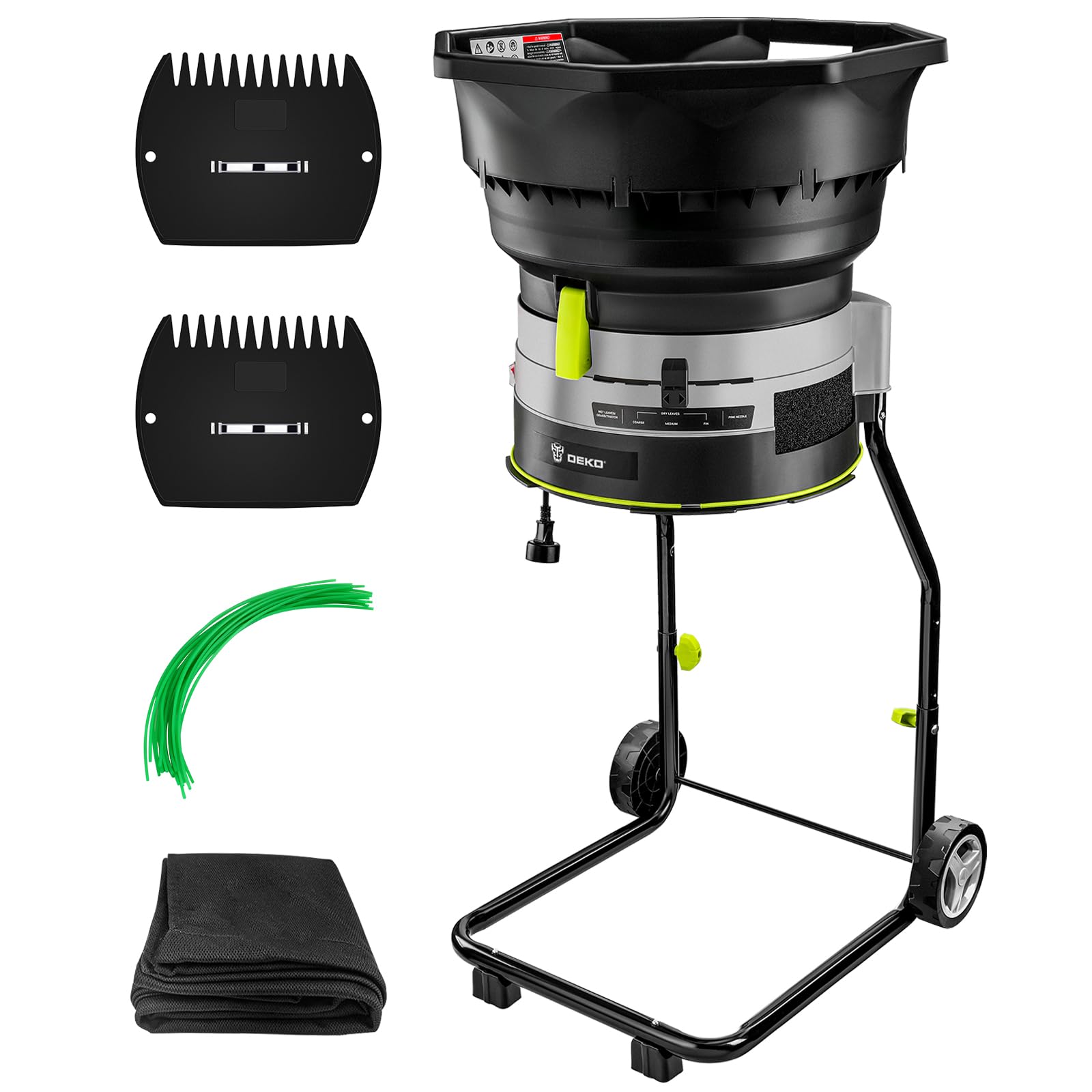
The DEKOPRO electric mulcher is a close competitor to the GreenSweep XL, sharing the same bladeless nylon-line design but spinning at a slightly lower 8,200 RPM. The 15-amp motor still processes 55 gallons of leaves per minute, and the 17:1 mulch ratio is one point behind the GreenSweep. The key differentiator is the adjustable control dial, which lets you switch between coarse, medium, and fine shred settings depending on whether you’re processing dry oak leaves, wet maple piles, or pine needles. Owners report that the medium setting produces a mulch that looks like commercial planting soil and works beautifully as garden top-dressing.
Assembly takes about 30 minutes, and the unit rolls on two sturdy wheels for easy positioning. The included leaf scoops (a pair of spade-like tools) are a thoughtful addition — they make loading the hopper faster than hand-gathering. Owner feedback indicates that using the highest fine-shred setting reduces leaf volume by roughly 50% after filling two standard yard bags, which translates to real savings on bag purchases and fewer trips to the curb.
The main complaint across owner reviews is that the nylon cutting lines break frequently — some owners report replacing strings nearly every bag, especially when twigs or bark chips are mixed in. Upgrading to wire-core trimmer line from a hardware store dramatically extends line life. Customer service receives mixed marks: one owner reported being ignored when the included hand rakes were missing from the box. Like all bladeless shredders, the DEKOPRO is loud and produces fine dust, so a respirator and ear protection are non-negotiable. For anyone with a large leaf volume who wants fine mulch for garden beds, this is a capable, budget-friendly stationary shredder.
What works
- Adjustable dial fine-tunes shred size for different leaf types
- 17:1 reduction ratio produces soil-like mulch for garden beds
- Included leaf scoops speed up hopper loading
What doesn’t
- Nylon cutting lines break frequently with twig-heavy debris
- Very loud and dusty — PPE is mandatory
- Customer service responsiveness is inconsistent
6. PROYAMA 26cc 3-in-1 Gas Powered
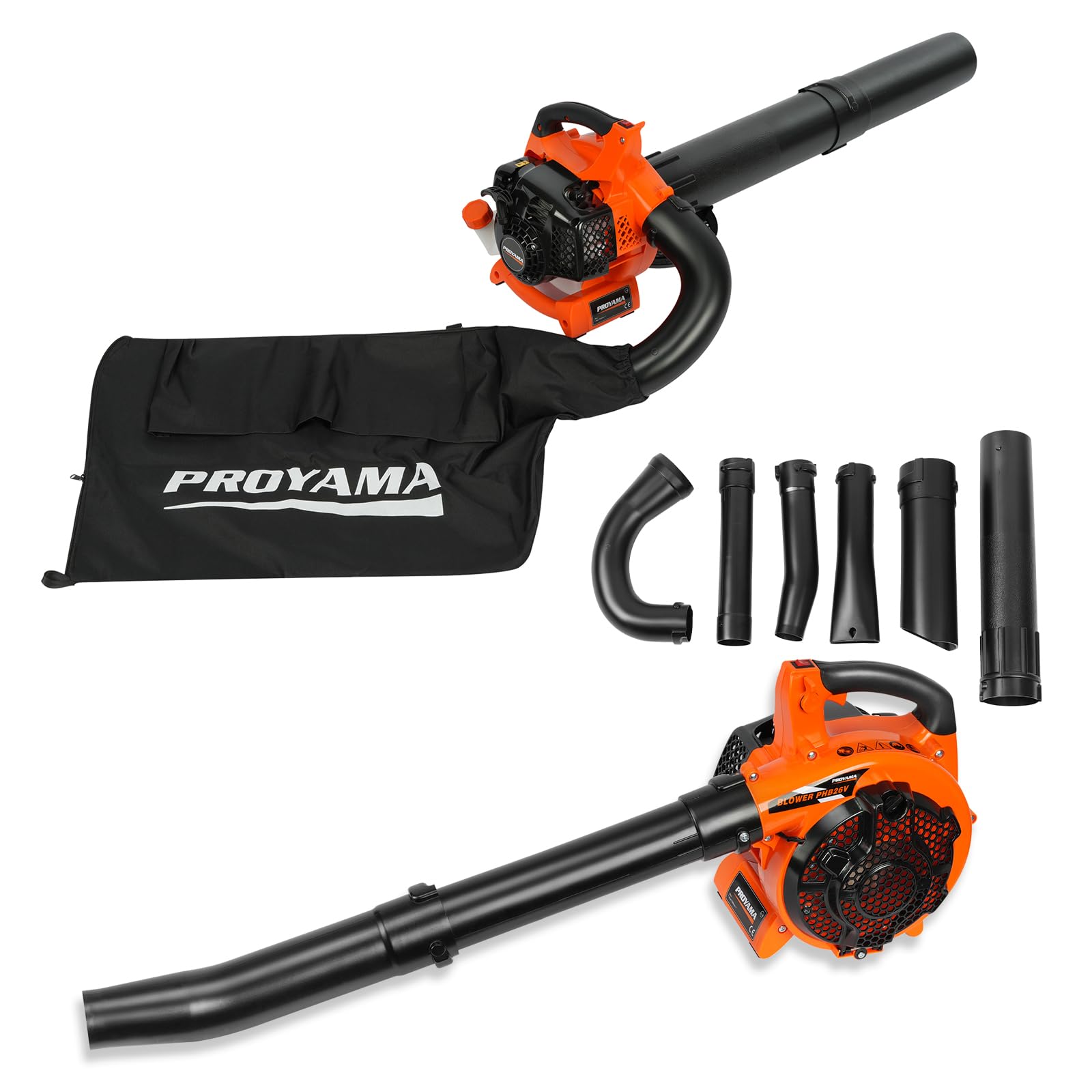
The PROYAMA 26cc is the only gas-powered option in this lineup, and it fills a specific niche: properties larger than an acre, areas far from any electrical outlet, or situations where you need the freedom to work without a trailing extension cord. The 2-cycle engine delivers 412 CFM at 200 MPH in blower mode, and the vacuum mulcher uses a metal impeller to grind leaves at a 16:1 reduction ratio. The 10-gallon collection bag is mounted directly to the vacuum tube, keeping the center of gravity closer to the operator than the side-mounted bags on some gas competitors.
Owner feedback on the vacuum mulching performance is positive — it handles the same wet and dry leaves as corded units but with the range advantage of 26cc of gas power. The Smart Start air purge system reduces the number of pulls needed on cold starts, and the variable-speed trigger with cruise control lets you lock in a steady throttle for long vacuum sessions. The flat nozzle works well for dislodging debris stuck to pavement, while the round nozzle is better for loose leaf piles.
Reliability is the biggest question mark. Multiple owners report carburetor clogging issues, especially when using ethanol-blended fuel, and the carburetor requires a special tool for adjustment. The pull cord on some units has snapped within the first season, and warranty support requests are sometimes met with requests for video proof rather than replacements or repairs. At 109 dB, it’s the loudest unit here by a significant margin — hearing protection is absolutely mandatory for both you and anyone nearby. If you truly need cordless power over a large area and are comfortable with small-engine maintenance, the PROYAMA delivers the suction capability no corded or battery unit can match.
What works
- True cordless operation for large properties or remote areas
- 412 CFM blower outperforms all corded handhelds in this list
- Smart Start purge system reduces pull-start effort
What doesn’t
- Carburetor prone to clogging with ethanol fuel; requires special adjustment tool
- Very loud at 109 dB — hearing protection is non-negotiable
- Inconsistent build quality and warranty support experience
7. MTKOALA 1200W Brushless Cordless
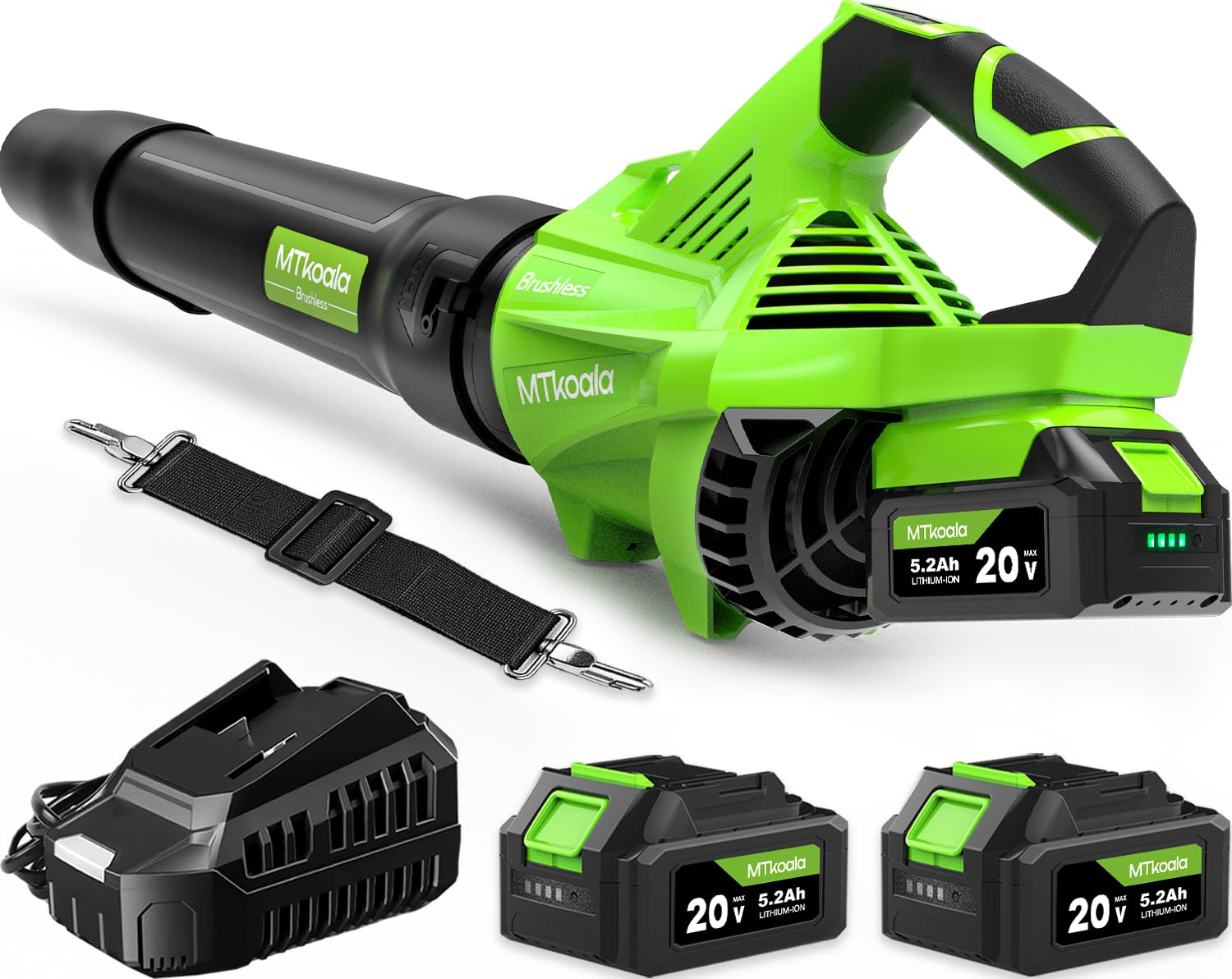
The MTKOALA 1200W leaf blower is included here for a specific scenario: you want cordless blowing and occasional light vacuuming on a patio or small city yard. The brushless motor pushes up to 700 CFM at 200 MPH in blower mode, and the bundled dual 5.2Ah batteries claim a combined runtime of up to 160 minutes on the lowest speed setting (40 minutes on high). The three-speed dial lets you switch from gentle dusting of windowsills to full-power driveway clearing, and the whole unit weighs under 5.5 pounds — significantly lighter than corded handheld vacuums.
Owner reviews are nearly universally positive about the blower performance for light-to-medium debris. It handles dry leaves on a patio, grass clippings off a driveway, and garage dust without complaint. The batteries charge from the included fast charger in about 90 minutes, and the brushless motor generates less heat than a brushed equivalent, theoretically extending service life. The price point with two batteries and a charger makes it a compelling value for homeowners who don’t own other cordless tools.
The critical limitation is that this is primarily a blower — not a dedicated vacuum mulcher. It has a narrow vacuum tube attachment, but it lacks the impeller, bag system, and reduction ratio that defines the rest of this category. It will not mulch leaves into fine compost; it simply sucks them into a small collection bag. For blowing leaves out of tight spaces and vacuuming small piles on hard surfaces, it’s excellent. For actual leaf mulching on a grassy lawn, you want one of the dedicated units above. Long-term durability of the plastic chassis is also a known concern with regular use.
What works
- Very lightweight at under 5.5 lbs for extended use
- Dual batteries provide long runtime for blower-only tasks
- Brushless motor runs cooler and lasts longer than brushed alternatives
What doesn’t
- Vacuum mode lacks a true mulching impeller — no significant volume reduction
- Not suitable for mulching leaves on lawns; best for hard surfaces only
- Plastic chassis durability is uncertain with regular handling
Hardware & Specs Guide
Impeller Type and Material
The impeller is the rotating component that shreds leaves inside the vacuum. Metal impellers (found on the BLACK+DECKER BV6000 and both WORX Trivac models) maintain their cutting edges through years of use and can handle small twigs and acorns without damage. Plastic impellers are lighter and quieter but dull faster. Bladeless designs use heavy nylon trimmer line spinning at high RPM (8,200–9,000 RPM) and are safer to maintain but require periodic string replacement — expect to change strings every 2–3 full bags of dry leaves, or more frequently with woody debris.
CFM vs MPH — Reading the Airflow Numbers
CFM (cubic feet per minute) measures the volume of air moved, while MPH (miles per hour) measures the airspeed at the nozzle tip. For blowing, high MPH helps dislodge wet, matted leaves; for vacuuming, high CFM generates the suction to pull leaves into the tube. A 400 CFM / 250 MPH unit (like the BV6000) is generally more effective at vacuuming large volumes than a 350 CFM / 210 MPH unit, but tube geometry and bag restriction significantly affect real-world performance. Trust owner reports over peak spec claims when comparing vacuum suction strength.
Mulch Ratio — Claimed vs Real
Manufacturers advertise reduction ratios between 16:1 and 18:1, meaning 16–18 bags of leaves reduce to one bag of mulch. This ratio is achievable only under ideal conditions: dry, loose deciduous leaves fed slowly into a high-speed impeller. With damp, compacted, or mixed-debris piles (common in real yard work), the real-world ratio typically drops to between 6:1 and 10:1. The ratio also depends on how long the leaves stay in the airstream — faster feed rates produce coarser mulch and lower reduction. Use the advertised ratio as a benchmark for relative comparison, not an expectation.
Power Source: Corded vs Cordless vs Gas
Corded electric (12–15 amp) delivers the most consistent power and longest runtime for the money, but requires a heavy-duty 14-gauge extension cord for runs over 50 feet. Battery-powered units offer freedom of movement but trade runtime for portability — expect 15–25 minutes on high speed with a 5.0–5.2 Ah battery. Gas engines (26cc in this list) provide true cordless operation over unlimited range and generate the highest peak suction, but add weight (10–12 lbs), noise (up to 109 dB), and maintenance requirements including fuel mixing and carburetor adjustment. Choose based on your lot size and tolerance for trailing cords.
FAQ
Can a leaf vacuum mulcher handle wet leaves?
How often do I need to empty the collection bag?
What size extension cord do I need for a corded leaf vacuum mulcher?
Is a gas leaf vacuum mulcher better than an electric one?
Final Thoughts: The Verdict
For most gardeners, the best leaf vacuum mulcher winner is the BLACK+DECKER BV6000 because it combines the most powerful 400 CFM airflow with a durable metal impeller and the lightest weight in its class, making it the most effective vacuum mulcher for standard suburban yards. If you want to skip constant bag emptying, grab the WORX WG505.2 Trivac with its LeafPro direct-to-can system. And for turning a season’s worth of leaf piles into fine garden-grade compost, nothing beats the stationary GreenSweep XL Bladeless Shredder.