
Keeping a flower bed weed-free without damaging your prized petunias or delicate daisies is the central challenge of ornamental gardening. Using the wrong spray can turn a vibrant border into a brown wasteland in hours, making the choice of chemistry as critical as the selection of the flowers themselves.
I’m Rikta — the co-founder and writer behind Lawn Gear Lab. I’ve spent hundreds of hours cross-referencing active ingredients, analyzing owner-reported efficacy on specific weed species, and comparing coverage rates across the market to build this guide.
Whether you need to spot-treat invasive nutsedge or blanket-spray a bed of established perennials, selecting the right herbicide for flower beds requires understanding selectivity, residual activity, and application timing.
How To Choose The Best Herbicide For Flower Beds
Selecting a flower-bed herbicide is a balancing act between elimination power and plant safety. The wrong active ingredient can sterilize soil or drift onto ornamental leaves, causing dieback. Focus on three criteria before buying.
Selective vs. Non-Selective Chemistry
A non-selective herbicide like glyphosate kills any green tissue it touches — useful for clearing a bed before planting but disastrous if overspray reaches your flowers. Selective formulas, typically built around dicamba, triclopyr, or 2,4-D, target broadleaf weeds while leaving grass and many ornamentals unharmed. For established flower beds, selective products offer the widest safety margin.
Active Ingredient Match to Weed Type
Nutsedge requires a specific chemistry (halosulfuron-methyl or sulfentrazone) that standard broadleaf killers ignore. Clover and oxalis respond to triclopyr, while creeping charlie demands a dicamba-dominant mix. Read the label’s weed list — if your target species isn’t named, the product likely won’t work on it regardless of concentration.
Formulation and Application Gear
Ready-to-use (RTU) sprayers are convenient for small beds but expensive per square foot. Concentrates offer better value for large areas and let you adjust mix strength, but require a separate tank sprayer and careful measuring. The Accumeasure-style system on some concentrates simplifies mixing but adds a plastic component that can break mid-project.
Quick Comparison
On smaller screens, swipe sideways to see the full table.
| Model | Category | Best For | Key Spec | Amazon |
|---|---|---|---|---|
| Ferti-lome Weed Free Zone | Selective | Creeping charlie & stubborn broadleaf | Dicamba-based concentrate | Amazon |
| Ortho Max Nutsedge Killer | Selective | Nutsedge in lawns & beds | 2 x 24 oz RTU bottles | Amazon |
| Bonide Chickweed, Clover & Oxalis Killer | Selective | Large clover/chickweed patches | 128 oz RTU, 10,000 sq ft | Amazon |
| Spectracide Weed & Grass Killer | Non-Selective | Driveways & bed prep | Diquat concentrate, 1350 sq ft | Amazon |
| Bonide Captain Jack’s Deadweed Brew | Non-Selective | Organic beds & gravel paths | 128 oz RTU, organic-approved | Amazon |
| Control Solutions Eraser | Non-Selective | Total vegetation kill on a budget | 41% glyphosate concentrate | Amazon |
| Southern AG Brush Weed Killer | Non-Selective | Vines & woody brush control | Triclopyr concentrate, 32 oz | Amazon |
In‑Depth Reviews
1. Ferti-lome Weed Free Zone (32 oz)
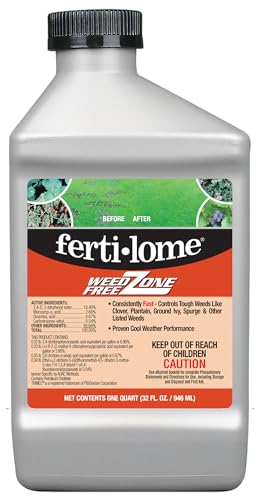
The Ferti-lome Weed Free Zone sits at the premium end of the selective herbicide spectrum because its dicamba-dominant formulation is one of the few chemistries proven to eliminate creeping charlie, ground ivy, and wild violet — weeds that shrug off 2,4-D alone. Users report visible injury within hours and complete death of dandelions and spurge within five days, even when rain falls shortly after application. The concentrate dilutes to cover a substantial area, making the per-application cost reasonable despite the higher bottle price.
Owner feedback reveals that clover requires a double-strength mix (beyond label rate) for full knockdown, and adding a non-ionic surfactant like dish soap noticeably improves leaf adhesion. The formula is safe on Kentucky bluegrass, Bermuda, Zoysia, and other common turfgrass species when used as directed, and many gardeners report no damage to hostas, lilies, or sedums when spot-treating nearby weeds. This versatility makes it a top pick for flower beds surrounded by lawn.
Where the Weed Free Zone truly earns its reputation is on hard-to-control perennials. Multiple long-term users describe it as the only product that stops creeping charlie from returning season after season. The trade-off is price sensitivity — budget-conscious buyers may wince at the initial purchase, but the concentrated format means a single bottle often lasts an entire growing season for a medium-sized yard.
What works
- Kills creeping charlie and wild violet that resist weaker formulas
- Concentrated formula provides excellent value per treated square foot
- Rainfast within hours; visible wilting often by next day
What doesn’t
- Clover may need double the labeled rate for full effect
- Premium price point; not ideal for one-time light weed pressure
2. Ortho Max Nutsedge Killer RTU (2 Pack)
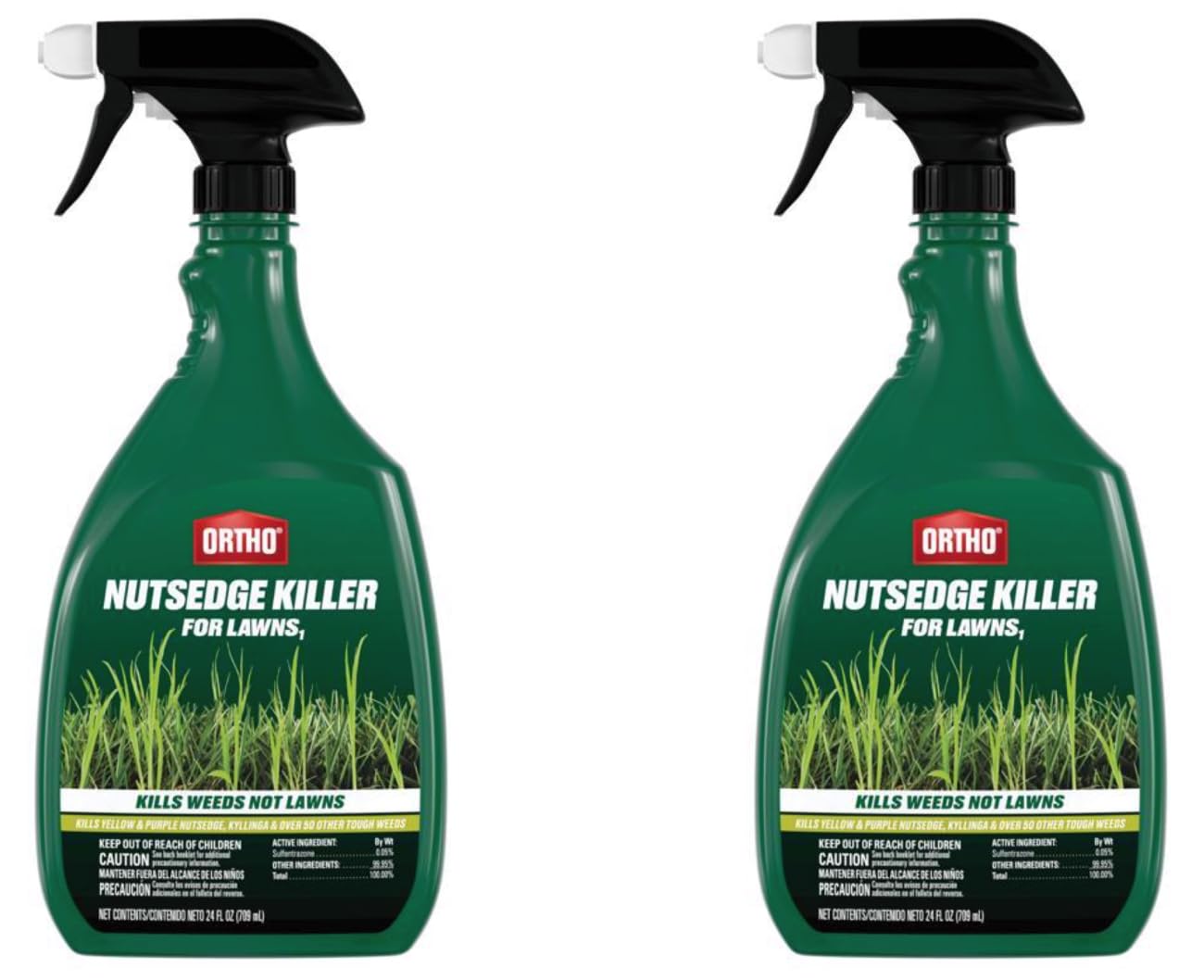
Nutsedge is the bane of flower bed enthusiasts because it grows faster than ornamentals and standard broadleaf herbicides leave it untouched. Ortho Max Nutsedge Killer uses sulfentrazone, a selective chemistry that targets sedges without harming lawn grasses or most flower bed plants. The two-pack of 24-ounce ready-to-use bottles means zero mixing — just attach the sprayer and apply directly to the weed foliage.
User reports consistently highlight that timing is everything. Applying when nutsedge shoots first emerge — before they develop the waxy cuticle of mature plants — delivers kill in one to two days. Taller, established nutsedge requires thorough coverage and may need a second application after ten days. The product also controls kyllinga, wild onion, garlic, and over 50 other broadleaf weeds, giving it broader utility than the name implies.
The ready-to-use format is convenient for spot treatment in small to medium beds, but the per-ounce cost is higher than concentrates. Some users note that the sprayer nozzle can dribble if held at the wrong angle, and the bottle volume runs out quickly during large infestations. For targeted nutsedge removal in ornamental beds, however, this remains the most reliable selective option on the market.
What works
- Specifically formulated to kill nutsedge without harming lawn or ornamentals
- Convenient RTU format eliminates mixing errors
- Rainproof in two hours
What doesn’t
- Expensive per ounce compared to concentrates
- Less effective on mature, tall nutsedge with heavy waxy coating
3. Bonide Chickweed, Clover & Oxalis Killer (128 oz)

Bonide combines triclopyr and dicamba in this ready-to-use 128-ounce jug to tackle the three most stubborn flower-bed weeds: chickweed, clover, and oxalis. The dual-action chemistry attacks both the leaf surface and the root system, with visible dying reported by most users within 24 hours. At roughly 2.40 per 1,000 square feet, it undercuts the cost of Ortho Weed B Gon while covering a full 10,000 square feet without any mixing.
Owner experiences show that dandelions wither after a single spray, and the formula is nearly odorless — a real advantage when working near open windows or seating areas. The clear liquid mixes easily with non-ionic surfactant if you want better adhesion on waxy leaves, though the manufacturer does not require it. Users also praise the lack of residual soil activity, meaning you can replant treated areas relatively quickly without fear of harming new transplants.
The main limitation is that the product has no effect on crabgrass or nutsedge, so it cannot serve as a total weed solution. The included hand-sprayer trigger is adequate for small beds but becomes fatiguing and slow for larger properties — many users transfer the contents to a pump sprayer for efficiency. For those whose primary weed pressure is broadleaf and who want grab-and-go convenience, this jug delivers the lowest cost per gallon in the selective RTU category.
What works
- Excellent cost per 1,000 sq ft among selective RTU formulas
- Kills dandelions, clover, chickweed, and oxalis in under 24 hours
- Nearly odorless; low risk of vapor drift damage to flowers
What doesn’t
- Ineffective on crabgrass, nutsedge, and grassy weeds
- Included hand sprayer trigger is poor for large-scale application
4. Spectracide Weed and Grass Killer Concentrate (32 oz)
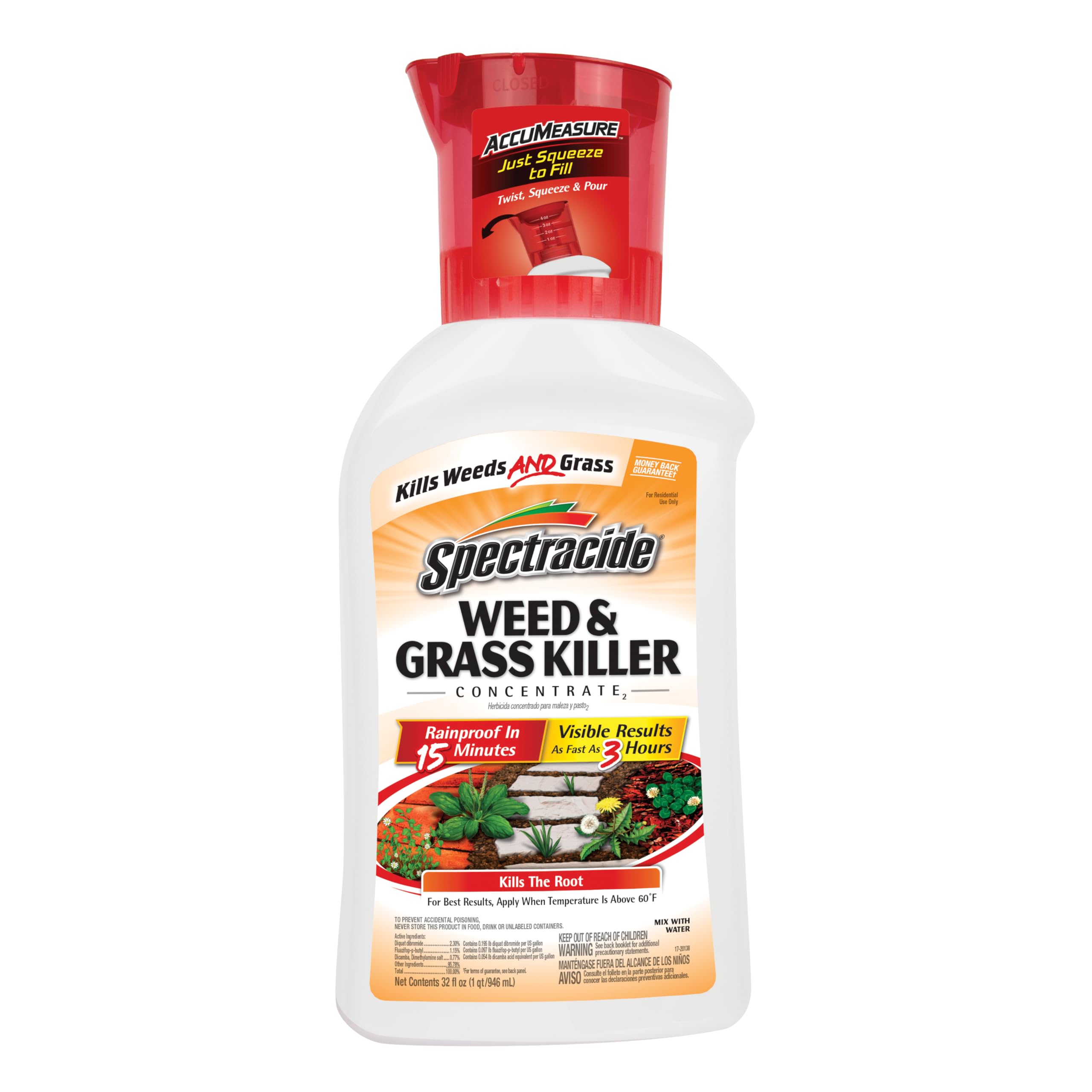
Spectracide’s Weed and Grass Killer uses diquat dibromide, a contact herbicide that disrupts plant cell membranes on contact, producing visible results in as little as three hours on sunny days. This is not a systemic killer — it destroys only the foliage it touches, leaving roots intact — making it ideal for cleaning up weeds along fence lines, driveways, or in flower beds where you plan to replant ornamentals the same weekend since diquat has no residual soil activity.
The Accumeasure cap system twists to dispense the correct concentrate amount directly into the sprayer tank, reducing measuring errors. Users report that a 32-ounce bottle mixes to cover about 1,350 square feet, which is modest but adequate for targeted bed treatment. Rainfastness after 15 minutes is a strong practical advantage, allowing application even in regions with afternoon showers. The diquat formula has a lower environmental persistence than glyphosate, appealing to gardeners concerned about soil microbiome impact.
Where Spectracide falls short is regrowth management. Because it does not translocate to roots, perennial weeds like dandelion or bindweed will re-sprout within weeks, requiring repeated applications. Some users find the Accumeasure cap’s plastic mechanism fragile — a few report breakage mid-season, forcing them to revert to the old-style measuring cup. For one-time cleanup of annual weeds in empty beds, this is a fast and effective tool; for deep-rooted perennial control, look to a systemic alternative.
What works
- Visible wilting in as little as 3 hours on warm, sunny days
- No residual soil activity allows same-weekend replanting
- Accumeasure cap simplifies concentrate measuring
What doesn’t
- Doesn’t kill roots; perennial weeds regrow quickly
- Accumeasure cap is prone to mechanical failure over time
5. Bonide Captain Jack’s Deadweed Brew (128 oz)

Captain Jack’s Deadweed Brew is a non-selective, fast-acting formula approved for organic gardening, making it one of the few options for growers committed to OMRI-listed inputs. The active ingredient — a pelargonic acid-based contact killer — works by stripping the waxy cuticle from weed leaves, causing rapid desiccation. Users consistently report dead weeds within an hour of application on hot days, and the product becomes waterproof once dry, preventing wash-off during subsequent irrigation.
The 128-ounce ready-to-use jug covers a significant area without any mixing, and the included spray nozzle delivers a wide fan pattern. Gardeners praise its effectiveness on stubborn thistle, pigweed, and clover, though multiple applications are generally needed to deplete root reserves. The formula remains effective down to 40 degrees Fahrenheit, extending the spraying window into early spring and late fall when many other herbicides stall.
The trade-off for organic certification is reduced translocation. Deep-rooted perennials like dandelion or bindweed will re-sprout from the taproot within two to three weeks, requiring vigilant re-spraying. Some users also report batch inconsistency — the gallon-size bottle occasionally performs worse than the quart size, raising suspicions of production variability. For organic gardeners who accept repeat applications as part of the regimen, this is the top choice; for those wanting one-and-done eradication, a systemic synthetic may be more satisfying.
What works
- OMRI-approved for organic gardening
- Kills weeds in under an hour on warm days
- Works down to 40°F, extending seasonal use
What doesn’t
- Perennial weeds regrow from roots; needs repeated spraying
- Some reported quality inconsistency between bottle sizes
6. Control Solutions Eraser Weed Killer Concentrate (32 oz)
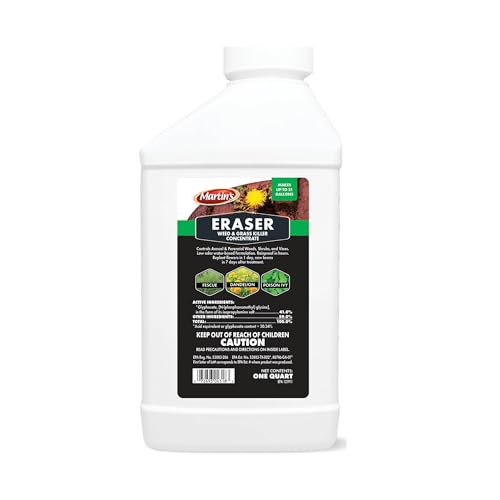
Control Solutions Eraser concentrates 41% glyphosate — the same active ingredient as Roundup but at a fraction of the per-ounce cost. Mixed at eight ounces per gallon of water, it delivers a systemic, non-selective kill that moves from foliage down to the root system, ensuring treated weeds do not re-sprout. Users who have relied on this formula for 17 years attest to its consistency, with annual weeds dead in three to five days and woody perennials taking up to two weeks.
The concentrate format provides exceptional economy for large flower bed renovations, driveway edges, and fence lines. A single 32-ounce bottle mixes to produce four gallons of spray solution — enough to cover over 2,000 square feet depending on weed density. Experienced users emphasize adding a non-ionic surfactant (or a drop of Castile soap) to break surface tension on hairy leaves like poison ivy, and applying on sunny mornings for maximum uptake. The low-odor, water-based formula is pleasant to work with compared to solvent-based alternatives.
Patience is required: glyphosate shows no visible effect for the first two days, and impatient gardeners often re-spray too early, wasting product and increasing chemical load. The product has zero residual soil activity, so it binds tightly to soil particles and degrades quickly, allowing replanting after the weeds are dead. For budget-focused gardeners who understand the delayed-action profile, this is the most cost-effective total vegetation killer available.
What works
- Excellent value; 41% glyphosate at a fraction of name-brand cost
- Systemic kill prevents regrowth from roots
- No residual soil activity; safe to replant after weed death
What doesn’t
- Slow visual results — no change for 2-7 days
- Requires surfactant for optimum adhesion on waxy or hairy leaves
7. Southern AG Brush Weed Killer (32 oz)

Southern AG’s Brush Weed Killer uses triclopyr, a systemic herbicide that excels against woody vines, brush, and hard-to-kill perennials like poison ivy, blackberry, and wild rose. For flower beds overrun by invasive woody growth, this concentrate provides the punch that standard glyphosate or 2,4-D mixes cannot match. Users report that triclopyr at this concentration equals the effectiveness of name-brand BioAdvanced at a noticeably lower price.
The formula works well on cut stumps to prevent re-sprouting — a key feature for clearing overgrown bed borders or removing unwanted trees. Coverage is rated at 512 to 1,024 square feet per mixed gallon, which is concentrated enough to tackle serious infestations without requiring huge volumes. Owners who have struggled with strangler fig, wild grape, or multiflora rose describe this as the only product that made headway after multiple failures with general-purpose killers.
The biggest limitation is the narrow use case. Triclopyr is overkill for ordinary chickweed or dandelion and carries higher cost than glyphosate for basic weed suppression. It also has slight soil activity and may damage desirable shrubs if applied near their root zones. For flower bed maintenance against annual broadleaf weeds, this is not the right tool; for targeted elimination of woody invaders and stump treatment, it is indispensable.
What works
- Exceptional against woody vines, brush, and hard-to-kill perennials
- Effective as a cut-stump treatment to prevent re-sprouting
- High triclopyr concentration matches premium brands at lower price
What doesn’t
- Overpowered and expensive for routine annual weed control
- Slight soil activity may affect nearby ornamentals
Hardware & Specs Guide
Selective vs. Non-Selective Chemistry
Selective herbicides (dicamba, triclopyr, 2,4-D, sulfentrazone) target physiological pathways unique to broadleaf plants, leaving grass and many ornamentals unharmed when applied correctly. Non-selective herbicides (glyphosate, diquat, pelargonic acid) destroy any green tissue they contact. For flower beds with desirable plants, selective formulas are the first line of defense; non-selective products should be reserved for spot treatment of isolated weeds or full bed renovation before planting.
Concentrate vs. Ready-to-Use
Concentrates store more active ingredient per ounce and offer lower cost per gallon of mixed spray. They require a tank sprayer and careful measurement, but one 32-ounce bottle can make three to four gallons of finished solution. Ready-to-use products include a sprayer and require no mixing, making them safer for beginners and ideal for small beds. The trade-off is price: RTU formulas typically cost three to five times more per gallon of coverage than concentrates.
FAQ
Can I spray herbicide directly on flowers to kill weeds around them?
How long should I wait before planting flowers after using a non-selective herbicide?
Why does my nutsedge survive after I spray it with a standard weed killer?
Final Thoughts: The Verdict
For most gardeners, the herbicide for flower beds winner is the Ferti-lome Weed Free Zone because its dicamba formula conquers creeping charlie and tough perennials that leave other products baffled. If you need targeted nutsedge control without harming turf, grab the Ortho Max Nutsedge Killer. And for large-scale, low-cost bed renovation, nothing beats the value of Control Solutions Eraser concentrate.