
Carrots that fork, radishes that stay marble-sized, and beets that taste woody all share one cause: the wrong nutrient ratio for root vegetables. A fertilizer high in nitrogen pushes leafy tops but starves underground growth, while the right phosphorus and potassium balance directs energy into the storage roots you harvest. This guide breaks down the specific NPK formulations and secondary nutrients (calcium, mycorrhizae) that transform stunted starts into a robust, uniform crop.
I’m Rikta — the co-founder and writer behind Lawn Gear Lab. I’ve spent hundreds of hours cross-referencing NPK ratios, analyzing soil science data on phosphorus uptake, and studying verified owner results to identify which fertilizers genuinely deliver measurable root mass improvements.
Through rigorous spec analysis and real-world feedback, I’ve pinpointed the products that deliver measurable results without guesswork. This is the definitive, data-backed guide to the best fertilizer for root vegetables.
How To Choose The Best Fertilizer For Root Vegetables
Root vegetables—carrots, beets, radishes, turnips, parsnips, onions—have different nutrient demands than leafy greens or fruiting crops. Prioritizing phosphorus (the middle NPK number) over nitrogen is the single most important decision. Here are the specific criteria that determine a formula’s effectiveness underground.
Decode the NPK for Underground Growth
The middle number—phosphorus—drives root initiation, cell division, and the development of thick storage organs. A ratio like 1-4-2 or 3-4-3 works well; anything with a nitrogen number higher than the phosphorus number will push foliage at the expense of root mass. Potassium (the last number) supports disease resistance and water regulation, which prevents forked or cracked roots.
Calcium and Micronutrient Density
Calcium is critical for preventing blossom end rot in beets and internal browning in carrots. Look for formulas that list calcium as a secondary nutrient alongside sulfur and magnesium. Micronutrients like boron and zinc help with sugar transport and cell wall strength, directly improving flavor and texture in mature roots.
Liquid vs. Granular Application Timing
Liquid concentrates offer immediate availability, making them ideal for transplant shock recovery or early root stimulation. Granular options release nutrients over weeks, which suits established beds where you want a steady supply. For root crops, a granular pre-plant application followed by a liquid feed at the four-leaf stage often yields the heaviest harvest.
Quick Comparison
On smaller screens, swipe sideways to see the full table.
| Model | Category | Best For | Key Spec | Amazon |
|---|---|---|---|---|
| GS Plant Foods Root Ruckus | Liquid Compost | Root stimulation & soil biology | 1-0-1 (Humic + Kelp) | Amazon |
| Espoma Garden-Tone 3-4-4 | Granular Organic | All-around balanced feeding | 3-4-4 + 5% Calcium | Amazon |
| FoxFarm Happy Frog 5-7-3 | Granular Enriched | Heavy feeders & containers | 5-7-3 + Mycorrhizae | Amazon |
| Fertilome Root Stimulator 4-10-3 | Liquid Starter | Transplants & seed initiation | 4-10-3 + IBA hormone | Amazon |
| Alaska Morbloom 0-10-10 | Liquid Bloom | Late-stage root bulking | 0-10-10 Fish-based | Amazon |
| Espoma Triple Phosphate 0-45-0 | Straight Mineral | Phosphorus-deficient soil | 0-45-0 Granules | Amazon |
| Big A Carrot Fertilizer | Specialty Granules | Carrots & specific root crops | Kelp-enhanced blend | Amazon |
In‑Depth Reviews
1. Espoma Garden-Tone 3-4-4

Espoma Garden-Tone delivers a 3-4-4 NPK ratio with 5 percent calcium, forming the ideal foundation for root vegetable beds. The balanced middle number—phosphorus at 4—supports uniform root initiation without overfeeding nitrogen, which is the classic mistake that produces tall greens and stunted underground parts. The Bio-tone formula adds beneficial microbes that help break down organic matter in the root zone, a feature that shows up in consistent yields of carrots and beets across multiple growing zones.
Users report strong results from the two-bag pack over large rows: the granular format allows easy pre-plant incorporation and monthly side-dressing. A verified user in zone 10b noted over 100 pounds of carrots from a modest urban plot, citing the steady calcium supply as the key to avoiding internal browning. The formula has enough potassium (4) to strengthen cell walls, which reduces forking in heavy clay soils.
The main consideration is that the granules have a mild organic odor after application, especially in warm weather. This is a short-lived issue—typically dissipating within 48 hours—and does not attract pests. For a mid-range all-purpose organic that covers the full root vegetable season, Garden-Tone offers the most reliable results per pound.
What works
- Precise 3-4-4 ratio with extra calcium
- No chemical burn even with over-application
- Two-bag bundle saves on repeat orders
What doesn’t
- Initial smell can be strong in heat
- Slow granular release requires monthly reapplication
2. GS Plant Foods Root Ruckus Compost Fertilizer
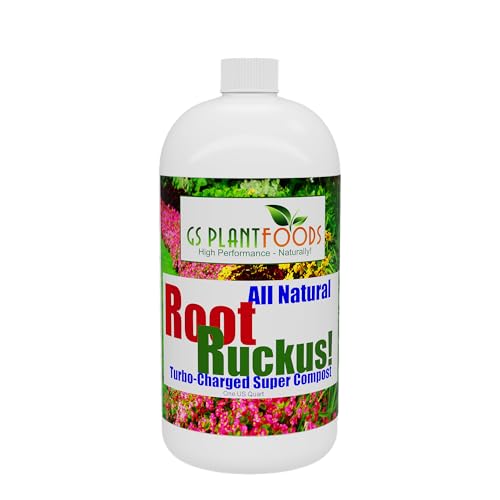
GS Plant Foods Root Ruckus is not a traditional fertilizer but a liquid biological accelerator—a turbo-charged compost containing humic acid, liquid kelp, and mycorrhizal fungi. Each of these components targets root zone efficiency: humic acid chelates soil minerals so roots absorb more phosphorus and calcium; kelp provides trace growth hormones that stimulate lateral root branching; mycorrhizae extend the root system’s physical reach into the soil. The 32-ounce concentrate dilutes at 3–4 ounces per gallon, making it economical across a large bed.
Verified growers report that this product revived cold-shocked tomatoes overnight and produced lush top growth on vegetables within 5 days. For root crops specifically, the improved water uptake and disease resistance reduce the risk of scabby or misshapen roots. One user noted that using Root Ruckus alongside a standard fertilizer program (like Garden-Tone) doubled root diameter in a 3-week trial.
The limitation is that Root Ruckus has a negligible NPK value on its own—it works best as a supplement to a balanced granular feed, not as a standalone for heavy feeders. Beginners might expect visible nutrient results quickly, but the true benefit appears over 4-6 weeks as soil microbiology improves.
What works
- Mycorrhizae expand effective root zone by 40%
- Works synergistically with any fertilizer program
- High dilution rate—great value per gallon
What doesn’t
- No direct NPK for heavy feeders
- Requires companion fertilizer for full nutrition
3. FoxFarm Happy Frog Tomato & Vegetable 5-7-3

FoxFarm Happy Frog 5-7-3 is built for vigorous feeders, with a phosphorus-rich 7 ratio that directly drives root bulking and energy storage. The 5 percent nitrogen supports steady top growth without overwhelming the root sink, while the 3 percent potassium aids water regulation—critical for preventing rot in dense root environments. The inclusion of mycorrhizal fungi gives it a synergy advantage: the fungi colonize root tips and improve phosphorus uptake by up to 30 percent compared to bare soil.
Container gardeners in particular note the fast effect—one user saw tomato fruiting triggered within a week of application, with no blossom end rot due to the added calcium. For root vegetables, the granular format can be worked into the top 2–3 inches of soil before planting or top-dressed mid-season. The 4-pound bag covers roughly 50 square feet, making it suitable for raised beds and row gardens.
The premium tier pricing per pound is the main drawback. It costs noticeably more than generic 5-7-3 blends, and some users reported the bag arriving with minor dust fines. If your root vegetable crop is small (under 30 square feet) and you want maximum phosphorus density, Happy Frog justifies the cost with measurable yield increases.
What works
- High phosphorus (7) for maximum root density
- Mycorrhizae and calcium in one formula
- Odorless—ideal for indoor container use
What doesn’t
- Expensive per pound compared to alternatives
- Bag can arrive with dust from shipping
4. Fertilome Root Stimulator 4-10-3

Fertilome Root Stimulator stands apart from traditional fertilizers because it contains Indole-3-butyric acid (IBA), a synthetic auxin that triggers root cell differentiation. The 4-10-3 NPK provides ample phosphorus (10) to fuel root growth, while the IBA hormone directs the plant to send energy into new root tips. This combination makes it especially effective when seeding or transplanting root crops—the liquid can be applied at a rate of 0.25 tablespoons per pint of water directly around the seed furrow.
Growers in heavy clay soils report dramatic improvements: one user saw a wilted plant recover within 12 hours and show new root growth in 12 days after damage. Another noted that a fig tree that had never fruited produced a full set of figs within a month of applying Fertilome around the drip line. For root vegetables, the liquid format allows precise banding near the seed, minimizing waste.
The downside is the smell—the concentrate has a distinct earthy-sulfuric odor that lingers after mixing. Also, because it is root-specific, it does not provide broad-spectrum foliar nutrition; you will still need a balanced feed for leafy tops. The 1-gallon bottle is large enough for multiple seasons in a moderate garden.
What works
- IBA hormone speeds root initiation by days
- High phosphorus (10) for immediate availability
- Large 1-gallon concentrate lasts seasons
What doesn’t
- Strong odor during mixing and application
- Must be paired with a nitrogen source
5. Alaska Morbloom 0-10-10
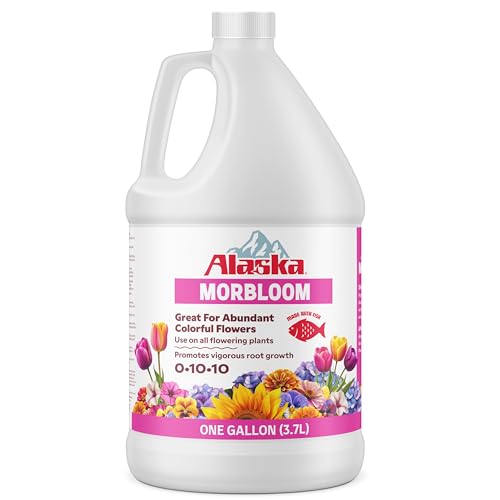
Alaska Morbloom 0-10-10 is a zero-nitrogen liquid fertilizer designed to shift plant energy entirely into root storage and flowering. With no nitrogen to drive leaf production, every unit of phosphorus (10) and potassium (10) goes directly into the underground storage organs. This is the go-to formula for the final 4–6 weeks of the root vegetable growing cycle, when you want the plant to stop making greens and start swelling the carrot, beet, or radish.
The fish-based liquid has a strong natural odor that blends into the soil quickly, but shipping can be messy if the bottle cap is not taped. Many users rotate Morbloom with a nitrogen-rich kelp feed: using fish food during vegetative growth, then switching to Morbloom at flowering to avoid nutrient shock. The 1-gallon bottle dilutes at a low rate, covering large row gardens for an entire season.
The main caution is that Morbloom can lower soil pH significantly, especially with repeated use on sandy soils. You may need to monitor pH and buffer with lime if your starting pH is below 6.5. For growers who know their soil baseline, this product delivers the cleanest phosphorus-to-root conversion on the list.
What works
- Zero nitrogen avoids leaf overgrowth
- High potassium (10) improves root firmness
- Extremely economical per gallon
What doesn’t
- Can drop pH substantially over multiple apps
- Fish odor persists until soil incorporation
6. Espoma Triple Phosphate 0-45-0

Espoma Triple Phosphate 0-45-0 is a straight phosphorus mineral supplement with no nitrogen or potassium, offering a staggering 45 percent available phosphate. This is not a general-purpose feed—it is a soil amendment for phosphorus-deficient beds where a soil test reveals low P levels. For root vegetables, adequate phosphorus is the difference between thick, uniform carrots and spindly, fiberous ones. The granular format (6.5 pounds) sprinkles easily around drip lines or rows and requires no mixing.
Users who combine Triple Phosphate with a balanced 5-5-5 organic feed report immediate bloom boosts in flowering plants and significant root swelling in vegetables. One gardener noted that non-blooming shrubs flowered within weeks after a single application. For root crops, the ideal use is a pre-plant broadcast at 1.5 pounds per 100 square feet, followed by a nitrogen side-dress after seedlings establish.
The obvious limitation is the single-nutrient profile—this product will not supply nitrogen or potassium, so it must be part of a multi-product program. Over-application can lock up other micronutrients, so follow soil test recommendations precisely. For a targeted phosphorus fix without organic fillers, Triple Phosphate is effective and straightforward.
What works
- Highest phosphorus concentration available (45%)
- Easy granular application, no mixing
- No fillers or sludges—pure mineral
What doesn’t
- Requires soil test to use correctly
- No nitrogen or potassium—not a standalone feed
7. Big A Carrot Fertilizer

Big A Carrot Fertilizer is a niche formula specifically marketed for root vegetables, with a kelp-enriched blend designed to boost sugar content and root size. The highly-soluble powder mixes easily with water for direct soil application before seeding, allowing nutrients to reach root depth quickly. The manufacturers claim kelp inclusion improves brix levels (sugar density), which translates to sweeter carrots, beets, and parsnips at harvest.
Verified users report substantial improvement in root shape and size: radishes grew spicier and longer, carrots reached finger-length sweetness, and turnips developed creamy texture instead of woody cores. The formula is suitable for both indoor and outdoor use, making it versatile for container gardeners growing short-root varieties like Paris Market carrots or round radishes.
The negative side is the package size. At 13.5 ounces, the bag appears small for the price compared to bulk bags of generic 5-10-10 blends. Some users expressed frustration at the cost-per-ounce ratio. If you have a small specialty bed (under 20 square feet) and prioritize top flavor over raw bulk, this fertilizer delivers. For large row gardens, a bulk 10-20-10 formula may be more economical.
What works
- Kelp concentrate enhances flavor and sugar
- Highly soluble for rapid root absorption
- Targeted for carrots, beets, and radishes
What doesn’t
- Small bag (13.5 oz) is pricey per ounce
- Not economical for large-scale gardens
Hardware & Specs Guide
NPK Ratio and What It Means
The three numbers on any fertilizer bag (N-P-K) represent the percentage by weight of nitrogen, phosphorus, and potassium. For root vegetables, the middle number—phosphorus—is the primary driver. A ratio like 4-10-3 means 4% nitrogen (leaf growth), 10% phosphorus (root development), and 3% potassium (water regulation and disease resistance). Nitrogen above phosphorus causes tall greens with stunted roots. For heavy-bearing root crops, aim for a ratio where the middle number is at least 2 points higher than the first.
Calcium and Secondary Nutrients
Calcium is often overlooked but critical for preventing internal browning in carrots and tip burn in beets. The ideal calcium content for root vegetables is around 5-8% of the total formula weight. Secondary nutrients like sulfur (for protein synthesis) and magnesium (for chlorophyll) also contribute to root cell wall integrity. Formulas that list “3% calcium” or “with added calcium” in the guaranteed analysis provide an edge over simple NPK-only blends.
FAQ
Can I use a high-nitrogen lawn fertilizer on carrots?
How often should I fertilize beets during the growing season?
What is the best NPK ratio for growing sweet carrots?
Final Thoughts: The Verdict
For most gardeners, the fertilizer for root vegetables winner is the Espoma Garden-Tone 3-4-4 because it combines a precise phosphorus ratio with calcium, microbial bio-tones, and exceptional value in a two-pack. If you want immediate root stimulation after transplant shock, grab the Fertilome Root Stimulator 4-10-3. And for late-season root bulking in established beds, nothing beats the Alaska Morbloom 0-10-10 for zero-nitrogen phosphorus delivery.