
An orchid’s roots are its lungs, and a standard pot suffocates them. The difference between a struggling Phalaenopsis and one that blooms twice a year often comes down to one thing: the container. A sealed ceramic jar traps moisture and starves the roots of oxygen, leading to the rot that kills more houseplants than any other mistake.
I’m Rikta — the co-founder and writer behind Lawn Gear Lab. I’ve spent countless hours comparing the micrometer dimensions of side-slot ventilation, the specific clay porosity ratings that influence root temperature, and the chemical composition of glazes to determine which materials actually support epiphytic root systems rather than simply looking decorative.
This guide breaks down the key specs that separate a healthy root zone from a stagnant one, helping you find the right container for orchids based on air flow, drainage architecture, and long-term material behavior.
How To Choose The Best Container For Orchids
Unlike most houseplants, orchids are epiphytes that naturally cling to tree bark rather than sitting in soil. A standard pot with a single bottom hole fails their root system. The ideal container mimics a tree branch: open, draining, and breathable from all sides.
Evaluating Side Ventilation Architecture
Side holes are not cosmetic. Measure the width of each slot: slots wider than 3 mm will let fine bark or sphagnum moss escape during watering, while slots narrower than 2 mm restrict air flow. The best containers balance these dimensions — enough oxygen exchange to dry the root core within 4–5 days, but tight enough to retain the potting medium. Look for at least 8 to 12 side openings on a 5- to 6-inch pot.
Choosing Between Porous and Non-Porous Materials
Terracotta fired above 1800°F becomes a breathable shell that wicks moisture away from the root surface, reducing rot risk. Unglazed clay mimics natural bark better than any synthetic polymer. Clear polypropylene containers sacrifice porosity for visibility — you can monitor root color and moisture without pulling the plant out. Glazed ceramic sits at the other extreme: attractive but essentially non-breathing, relying entirely on its side-and-bottom hole pattern for aeration. Match the material to your watering consistency, not just the look of the pot.
Matching Diameter to Root Mass
Orchid roots spread horizontally, not downward. A container measuring 5 to 6.5 inches in diameter accommodates most mature Phalaenopsis root balls. Oversizing invites moisture pockets that never dry. Undersizing forces roots to circle and rot against the wall. The ideal container width leaves about half an inch of space between the outermost roots and the pot wall — enough for air movement, not enough for soggy dead zones.
Quick Comparison
On smaller screens, swipe sideways to see the full table.
| Model | Category | Best For | Key Spec | Amazon |
|---|---|---|---|---|
| Orceler 6in Terracotta | Terracotta | All-around breathability | Fired at 1922°F | Amazon |
| vensovo 6in Terracotta | Terracotta | Budget-friendly 3-pack | Fired at 1796°F | Amazon |
| W&W 6.5in Teal | Glazed Ceramic | Stylish display | Side cutouts for aeration | Amazon |
| Mama Cozy Life 6.5in | Porcelain Ceramic | Elegant indoor display | Floral lace side holes | Amazon |
| BUYMAX 5in & 6in | Glazed Ceramic | Dual-size set | Leaf-shaped ventilation slots | Amazon |
| T4U 7.5in Clear | Clear Plastic | Root monitoring | 3 mm side slots | Amazon |
| JGB 7in Clear | Clear Plastic | Bulk repotting | 9-pack with saucers | Amazon |
In‑Depth Reviews
1. Orceler 6 Inch Terracotta Orchid Pots with Holes, Saucers — 3 Pack

The Orceler terracotta pot is fired at 1922°F, 126°F hotter than typical clay kilns, which drives out more moisture and leaves the ceramic body remarkably porous. That thermal gap translates directly to faster root drying — the unglazed side walls wick water out of the bark mix within hours, not days. Orchids potted in these showed no stem or base rot across multiple owner reports, even when water was left in the saucer for 24 hours.
Each of the three pots measures 6 inches wide with a 4.7-inch height, a proportion that suits Phalaenopsis and Cattleya root balls without leaving dead air space. The saucer matches the pot diameter closely, so the unit sits flush on a windowsill without wobbling. Several owners noted the side holes are large enough for air exchange but small enough to retain medium-grade bark without spillage.
The biggest knock against this set is the shipping speed — some orders took over a week to arrive despite being well-packaged. One unit arrived with a hairline crack, though the drop-test packaging from the factory survived the trip in most cases. For a terracotta three-pack at this quality level, the firing temperature alone justifies the pick.
What works
- High firing temperature creates excellent porosity for root aeration
- Side hole dimensions hold medium bark without spilling
- Matching saucer prevents tabletop water damage
What doesn’t
- Shipping can be slower than average
- One pot in the set arrived cracked for some buyers
2. vensovo 6 Inch Terracotta Orchid Pots with Holes and Saucers — 3 Pack
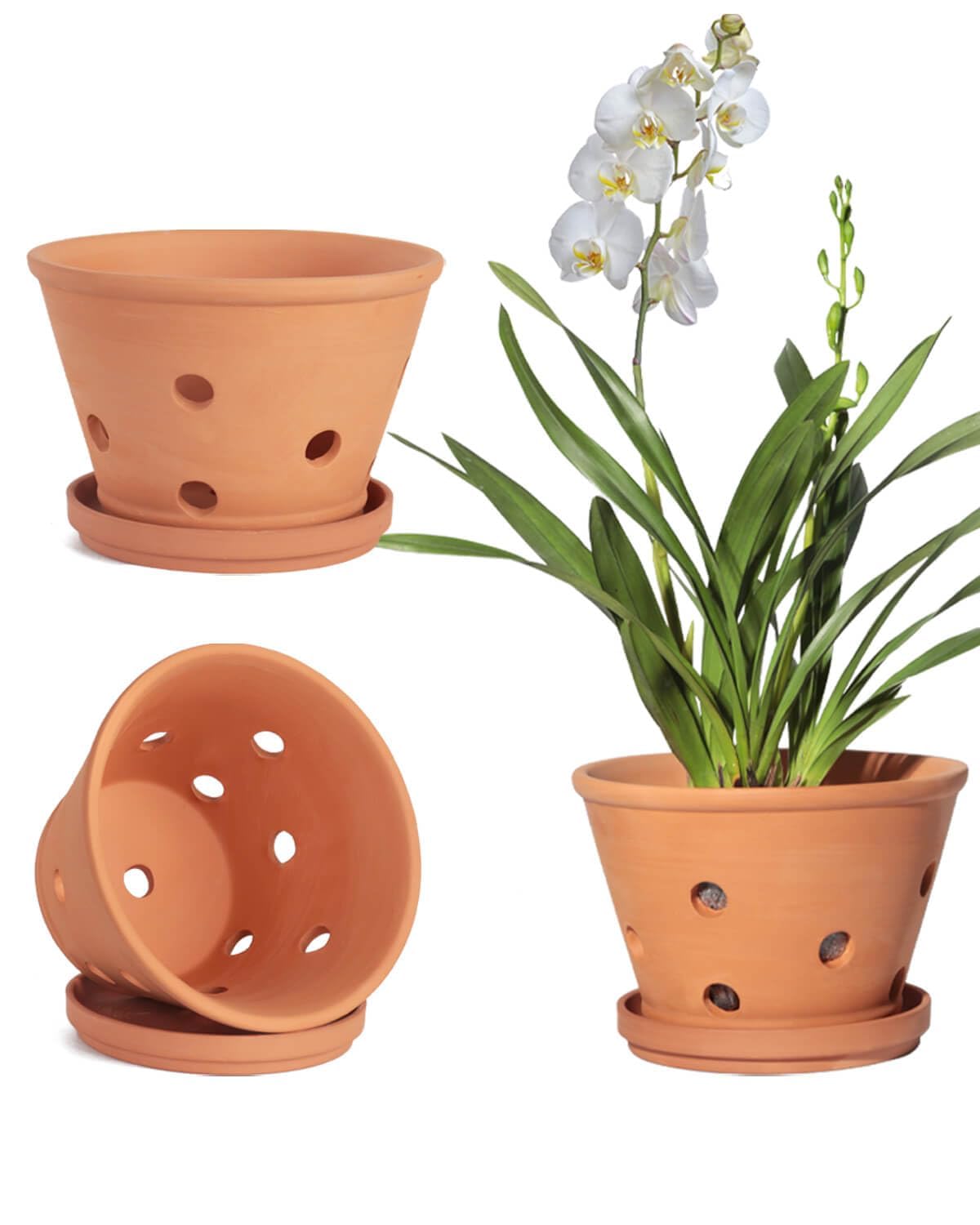
The vensovo terracotta pack brings solid clay construction at a lower price point than the Orceler set, though the firing temperature of 1796°F makes the body slightly less porous. In practical terms, this means the pot still breathes better than any glazed container, but the sides dry about 12 to 18 hours slower — a meaningful difference for growers in humid climates. The unglazed brown surface develops a natural patina over time, which some owners find aesthetically pleasing.
The set includes three pots measuring 4.6 inches tall with a 6-inch outer diameter and 4-inch bottom diameter, plus three saucers that match the pot color. Multiple reviewers praised the packaging — each pot is individually wrapped with bubble foam, and the three-pack survived a 3-foot drop test in factory testing. Two delivery reports confirmed all pieces arrived intact, which is rare for terracotta shipped by mail.
A minority of users reported that their orchids declined after switching to these pots, suggesting that the terracotta may not suit every grower’s watering schedule. The material pulls moisture out faster than plastic, so growers accustomed to watering every 10 days may need to shift to a 6- or 7-day rhythm. For the price of a single premium pot, this set works well as a starter bundle.
What works
- Well-packaged with individual bubble wrap layers
- Saucer color matches pot for a clean look
- Excellent value for a three-piece set
What doesn’t
- Lower firing temperature reduces moisture wicking speed
- Not all orchids adapt to the faster drying cycle
3. W&W Orchid Pot with Holes and Saucer, Teal, 6.5″

The W&W pot stands apart from the terracotta crowd with its high-gloss teal glaze and integrated legs that lift the pot above the attached drip tray. This elevation creates a small air gap under the drainage holes, allowing water to escape freely rather than sitting against the bottom of the pot. The glazed finish is non-porous, so all aeration comes from the side cutouts — wide scoops on opposing faces that provide ample ventilation for the root core.
Weighing 1.75 kg, this is the heaviest container in the comparison, a deliberate trade-off for stability. A mature Phalaenopsis in spike will not tip this pot over, even on a breezy open windowsill. The 6.5-inch width comfortably fits a root ball that has outgrown a standard 5-inch nursery liner, and the wider top opening simplifies repotting without scraping roots against the rim.
The attached saucer is the main functional limitation. Because the drip tray is fixed to the pot body, water that drains through the side slots cannot be captured separately — you have to tilt the entire pot to empty the tray. Owners who bottom-water will find this inconvenient. The teal color is striking but the glazed surface shows water spots if not wiped regularly.
What works
- Integrated legs elevate the pot for unobstructed drainage
- Heavy ceramic base prevents tipping during flowering
- Generous 6.5-inch width fits mature root systems
What doesn’t
- Attached saucer cannot be removed for separate draining
- Glazed surface shows water spots easily
4. Elegant Orchid Pot with Holes — Mama Cozy Life, 6.5″
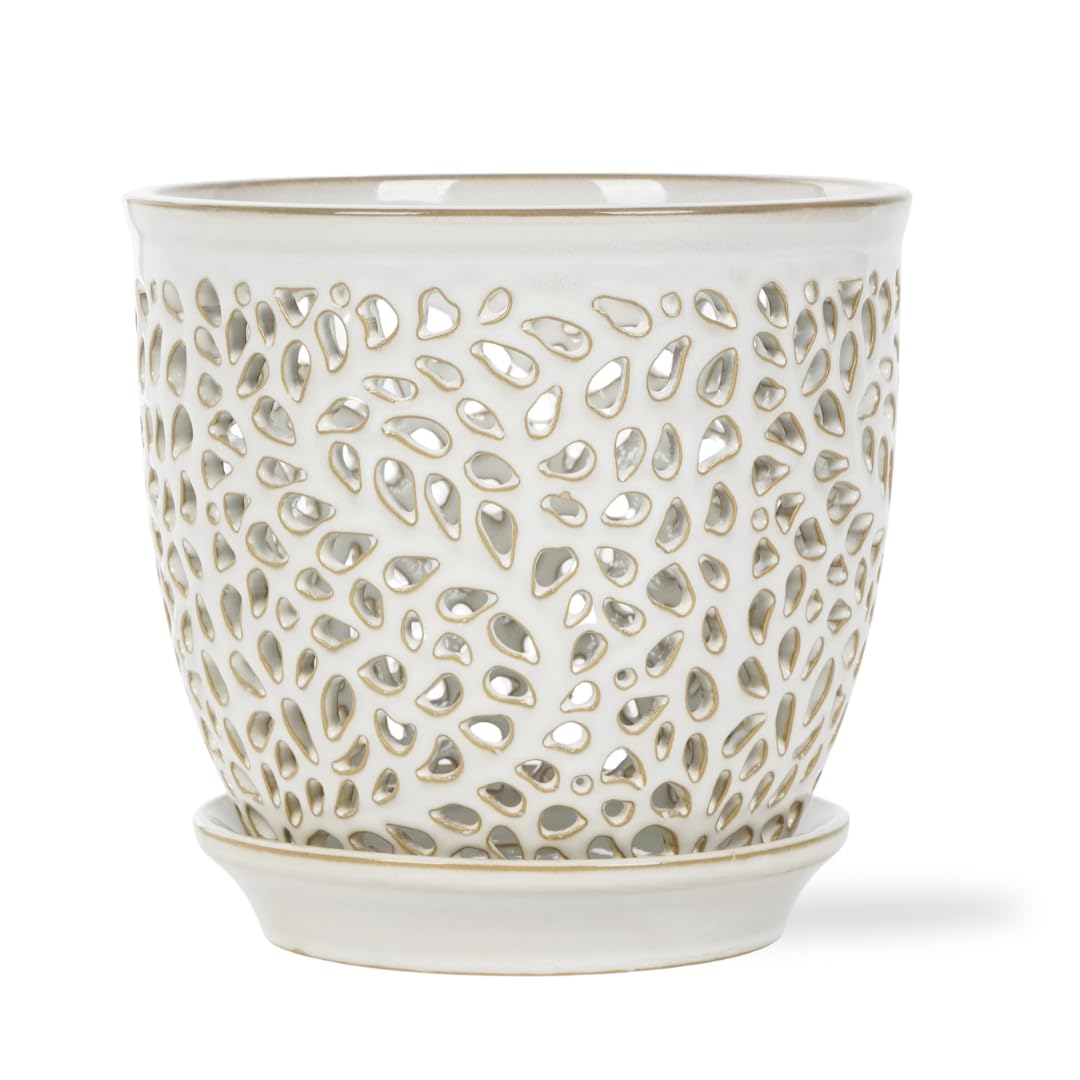
The Mama Cozy Life pot trades raw porosity for craftsmanship. Constructed from high-fired porcelain, the body features an intricate floral lace pattern where the holes are cut — not drilled — into the ceramic wall. This gives the pot a decorative edge that blends with fine china, making it suitable for living room or dining table display. The lace openings are small enough to retain fine orchid bark but numerous enough to sustain root aeration.
A standalone ceramic saucer sits beneath the pot, completely removable for cleaning or bottom-watering. The 6.5-inch width and 6.2-inch height give the root system vertical breathing room that short pots lack. At 1.15 kg, the pot is lighter than the W&W option but still dense enough to feel substantial. Several owners noted that the off-white glaze matches Lenox dinnerware, adding a cohesive look to a table centerpiece.
The primary drawback is the entrance size for the roots. The 1-inch saucer lip is relatively short, so the pot can slide off the tray if bumped from the side. One buyer reported accidentally breaking the saucer, then using a spare serving bowl as a replacement. For growers who prioritize aesthetics over rugged handling, this is the most visually refined option in the group.
What works
- Intricate floral lace hole pattern is visually striking
- Removable saucer allows easy bottom-watering
- Lightweight porcelain is easy to move and clean
What doesn’t
- Short saucer lip allows pot to slide off easily
- Higher price point for a single container
5. BUYMAX 5 Inch & 6 Inch Orchid Pots with Holes & Removable Trays — White Ceramic

The BUYMAX two-pack includes one 5-inch and one 6-inch white ceramic pot, each with leaf-shaped ventilation cutouts carved into opposing sides. The glazed finish is polished to a mirror sheen, repelling water and preventing mineral buildup on the outer surface. The dual-size approach is practical: the smaller pot accommodates a Phalaenopsis during its first year after division, while the larger one handles a mature specimen.
Each pot comes with a matching removable saucer. The 6-inch model’s saucer has a 5.5-inch diameter, which is slightly undersized — water draining from the side holes can drip onto the table surface rather than into the tray. Some owners solved this by placing the pot inside a larger drip dish. The ceramic construction is dense and feels substantially thicker than the W&W teal pot, resisting chips during handling.
The side holes are the largest in this comparison at roughly 0.4 inches wide, which provides exceptional air movement but allows medium bark to fall through during watering. A mesh liner or coconut coir plug may be needed to retain the potting medium. The price for two pots with trays is competitive against single-unit premium ceramics, making this a strong option for growers building a collection.
What works
- Two useful sizes cover different growth stages
- Thick ceramic walls resist chipping during repotting
- Polished glaze prevents ugly mineral deposits
What doesn’t
- Side holes are large enough for bark to spill through
- Saucer is too small to catch water from side drainage
6. T4U Orchid Pot, 6 Pack 7.5 Inch Clear Orchid Pots with Holes and Saucers
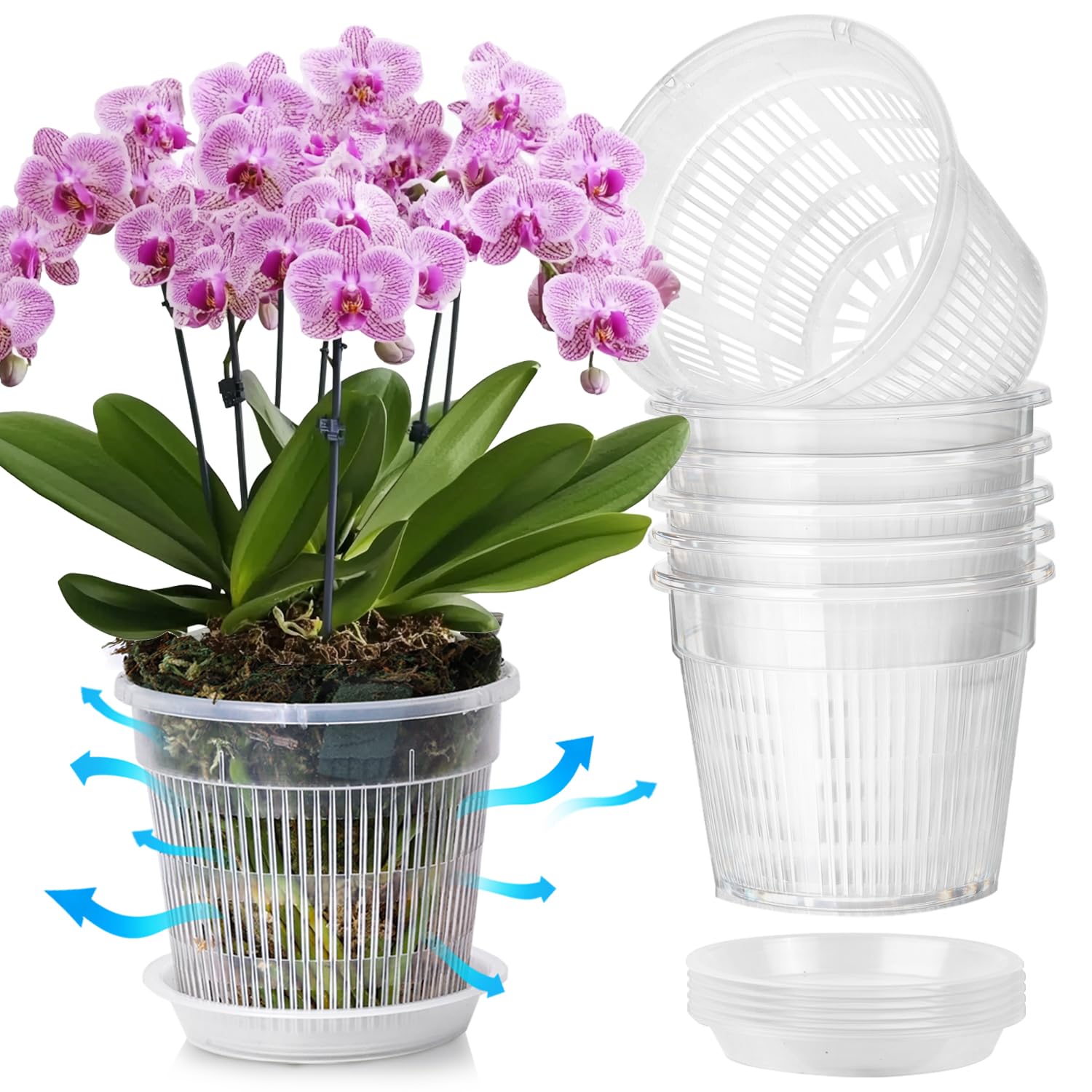
The T4U clear plastic pots solve one of the most persistent orchid-growing frustrations: blind root monitoring. The transparent polypropylene wall lets you see root color and moisture levels without lifting the plant. Silver-green roots are healthy; brown or black indicates rot. The 7.5-inch diameter is the largest in this lineup, giving generous room for vigorous root systems found in Dendrobium and Oncidium varieties.
Each pot features multiple rows of 3 mm side slots and a patterned drainage base. The slot width is tight enough to retain medium bark but wide enough for air to circulate freely. The six-pack includes matching saucers, making this a comprehensive kit for repotting a whole collection. Owners reported that the saucers are durable enough for bottom-watering, drawing moisture up through the drainage holes without the pot tipping.
The flat bottom is a minor structural flaw: roots that reach the base tend to grow horizontally across the plastic rather than circling downward, which can create a mat of roots that requires careful separation at the next repotting. The plastic is also lighter than ceramic, so a top-heavy orchid in spike may need a decorative outer cache pot for stability. For visibility and scale, this set is unmatched.
What works
- Clear material enables instant root health inspection
- 3 mm slots retain bark while allowing strong airflow
- Large 7.5-inch size suits vigorous orchid species
What doesn’t
- Flat base encourages horizontal root matting
- Light plastic requires a heavier outer pot for stability
7. JGB 9 Pack 7 Inches Orchid Pots for Repotting, Clear Orchid Pot with Holes and Saucers

The JGB nine-pack delivers the lowest per-unit cost in this comparison, making it the go-to option for growers managing multiple orchids or starting a small nursery. Each pot measures 7 inches wide and is molded from clear PP plastic with vertical slotted openings along the side wall. The slots are narrower than the T4U holes, which means fine-grade bark and moss stay inside the pot more reliably during overhead watering.
The nine saucers are identical in diameter to the pot base, so water collected from bottom drainage stays contained. Several owners pointed out that the clarity of the plastic is slightly hazy compared to the T4U units, but still sufficient for observing root color and moisture levels. The pots stack neatly when empty, saving shelf space between uses.
The trade-off for the low cost is edge durability. The plastic rim is thin and can flex during repotting, especially when the root ball is tight. Some buyers noted that the pot developed hairline cracks after several months of UV exposure on a porch. For indoor use with indirect light, the nine-pack represents a sensible buy for high-volume repotting without breaking the budget.
What works
- Extremely low per-unit cost for bulk repotting
- Narrow slots retain fine bark and moss effectively
- Saucers fit snugly and prevent water leakage
What doesn’t
- Thin plastic rim flexes under pressure during repotting
- Plastic may become brittle after extended UV exposure
Hardware & Specs Guide
Terracotta Firing Temperature
The kiln temperature determines how porous the clay body becomes. Pots fired between 1796°F and 1922°F retain enough microscopic air channels to wick moisture from the bark mix into the outer wall, where it evaporates. Lower temperatures leave the clay brittle and less breathable; higher temperatures cross the vitrification threshold where clay becomes glass-like and loses its wicking function entirely. Always check the firing spec — premium terracotta for orchids lands in the 1800°F to 1950°F sweet spot.
Side Slot Width vs. Bark Particle Size
The width of side ventilation holes directly interacts with the particle size of the potting medium. Holes measuring 3 mm or wider will shed fine bark (typical for orchid mixes), requiring either a mesh liner or a shift to medium-grade bark with particles above 1 cm. Slots narrower than 2 mm restrict airflow so severely that the core of the root ball stays wet for over a week. Match hole width to your bark size: 2–3 mm slots work with standard medium bark; anything wider demands a bark blend with large chunks.
FAQ
Should I choose a clear plastic pot or a terracotta pot for my Phalaenopsis?
How do I measure the correct pot diameter for repotting an orchid?
Why do my orchid roots grow out of the side holes of the pot?
Final Thoughts: The Verdict
For most gardeners, the container for orchids winner is the Orceler 6 Inch Terracotta Pots because the high firing temperature and multiple side holes deliver the most breathable environment without sacrificing durability. If you want to see root health at a glance and water with precision, grab the T4U Clear 7.5 Inch Pots. And for a living room display where aesthetics matter as much as function, nothing beats the Mama Cozy Life Porcelain Pot with its floral lace pattern and removable saucer.