
A patchy, yellowing lawn is the single most visible frustration for a homeowner — it announces neglect even when you’ve been watering and mowing on schedule. The difference between a tired-looking yard and a carpet of deep, emerald turf almost always comes down to the nitrogen strategy you deploy, not how often you drag the sprinkler across the grass. Getting the right balance of quick-feeding and slow-release nitrogen means you can see visible greening within days without the surge-and-crash cycles that leave lawns thin and stressed by midsummer.
I’m Rikta — the co-founder and writer behind Lawn Gear Lab. I’ve spent hundreds of hours studying fertilizer NPK ratios, slow-release coating technologies, granular particle sizes, and organic matter carriers to understand exactly what separates a professional-grade greening tool from a bag of filler that just makes a mess in the spreader.
Whether you’re fighting off winter dormancy, repairing summer heat stress, or just trying to make the neighbors ask what your secret is, the right choice depends on your grass type, season, and tolerance for frequent application. This guide breaks down the top contenders for the best fertilizer for green grass across every key spec that actually moves the needle on turf color and density.
How To Choose The Right Fertilizer For Green Grass
The first thing to understand is that not all nitrogen is created equal — and the number on the bag only tells half the story. The speed at which nitrogen becomes available to the grass, the presence of iron for color enhancement, and the soil conditioners mixed into the pellet all determine whether your lawn turns a deep blue-green or just grows taller without changing color.
Nitrogen Source: Quick Release vs. Slow Release
The fastest route to a dark green lawn is quick-release nitrogen (often listed as urea or ammonium sulfate). It’s water-soluble and hits the turf within hours, producing visible results in two to three days. The downside: it fades fast and can burn the grass if over-applied or not watered in immediately. Slow-release nitrogen (coated, polymer-encapsulated, or methylene urea) feeds steadily over eight to twelve weeks, producing a consistent green without the burn risk, but the initial color change is more gradual. The best formulations blend both — giving you a rapid color pop from the quick-release portion and sustained feeding from the slow-release portion.
NPK Ratio and Iron
For pure green color, the first number (nitrogen) is the priority, but the other numbers matter for overall lawn health. A 25-0-0 or 28-0-0 formula is almost pure nitrogen, ideal for a targeted color boost. A balanced 10-10-10 is better for general plant health across a wider garden but delivers a weaker green response in grass alone. Iron is a powerful color amplifier — it deepens the green without stimulating excessive leaf growth, meaning you get a richer color without doubling your mowing frequency. Products that include 3% iron or more are specifically designed for cosmetic greening.
Particle Size and Coverage
Finely milled granules distribute more evenly through a broadcast spreader and break down faster in the soil, but they’re harder to see during application, which increases the risk of overlapping and burning. Larger prills are easier to spot but can leave stripes if the spreader pattern isn’t perfect. Coverage area (square footage per bag) should match your lawn size — a 5,000-sq.-ft. bag on a 12,000-sq.-ft. lawn means you’re buying two bags and potentially mismatching application timing. Always check the bag’s coverage spec before buying.
Quick Comparison
On smaller screens, swipe sideways to see the full table.
| Model | Category | Best For | Key Spec | Amazon |
|---|---|---|---|---|
| Andersons Dark Green Lawn 25-0-0 | Granular | Ultra-fast dark green color | 25-0-0 NPK, quick-release, 18 lb | Amazon |
| Yard Mastery Flagship 24-0-6 | Granular | All-season sustained greening | 24% slow release N, 3% iron, 45 lb | Amazon |
| Andersons Green Shocker 7-1-2 | Granular | Spoon-feeding and soil health | Humic DG, fast-release N, iron | Amazon |
| GreenView Fairway Formula 27-0-5 | Granular | Medium to large lawn spring feed | 63% slow release N, 12-week feed | Amazon |
| Petramax Liquid Nitrogen 28-0-0 | Liquid | Quick liquid green-up spray | 28-0-0 NPK, 70% quick release | Amazon |
| Yard Mastery Summer Stress 7-0-20 | Granular | Heat/drought color and stress relief | 7-0-20 NPK, 3% iron, 45 lb | Amazon |
| GreenView Multi-Purpose 10-10-10 | Granular | Garden-wide feeding (not just turf) | Balanced 10-10-10 NPK, 33 lb | Amazon |
In‑Depth Reviews
1. The Andersons Professional DGL Dark Green Lawn 25-0-0 Fertilizer
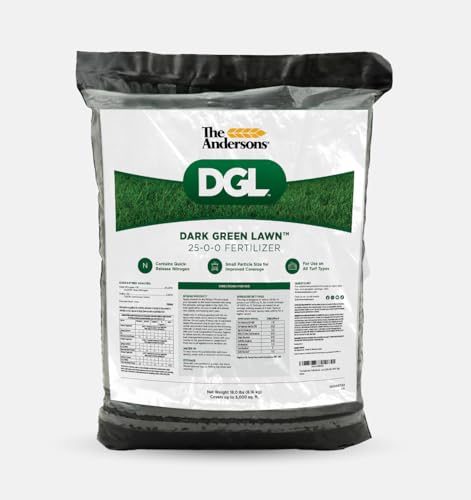
The Andersons DGL (Dispersion Granule Low Dust) line is a staple among turf professionals who need immediate visual results, and this 25-0-0 formulation delivers exactly that — a pure nitrogen hit with zero phosphorus or potassium, designed exclusively for color and growth. The particle size is extremely fine, which allows the granules to settle into the grass canopy and dissolve quickly upon watering, producing visible greening in as little as 48 to 72 hours. Users consistently report a deep, dark blue-green color shift within four to seven days, making this one of the fastest-acting granular fertilizers on the market for cosmetic turf improvement.
The 18-pound bag covers 5,000 square feet, which is a relatively small coverage area compared to larger bags from GreenView or Yard Mastery, but the concentration of pure nitrogen means you’re paying for intensity rather than volume. The fine prills, however, create a visibility challenge — the dark granules are nearly invisible on dark soil or thick grass, making it easy to accidentally double-pass and cause striping or burn spots. Several experienced users recommend dialing the spreader setting down by one or two notches from the default recommendation to compensate for the fine particle density.
Because this is 100% quick-release nitrogen, the effect peaks around three to four weeks and then fades, so it works best as a season-opener or a mid-season color boost rather than a standalone feeding program. It contains no iron, so the green comes entirely from nitrogen-driven chlorophyll production. For homeowners who want a dramatic, fast cosmetic result and are comfortable with a four-week reapplication cadence, this is the most reliable color trigger in the granular category.
What works
- Visible dark green color in 3-4 days
- Ultra-fine particles dissolve fast for even feeding
- Professional-grade formula for all turf types
What doesn’t
- Hard to see prills during spreading — high burn risk
- Effects fade in 4 weeks, requiring frequent reapplication
- No iron or soil conditioners for long-term soil health
2. Yard Mastery 24-0-6 Flagship Granular Fertilizer with 3% Iron

Yard Mastery’s Flagship blend is the most complete all-in-one granular fertilizer in this lineup. With a 24-0-6 NPK ratio, it provides a high nitrogen count for aggressive greening, plus 6% potassium for root strength and drought tolerance, and 3% iron — a significant iron load that pushes the lawn into a deep, almost iridescent green that nitrogen alone cannot achieve. The 24% of the nitrogen is slow-release, meaning you get a rapid color response from the quick-release portion while the slow-release fraction sustains the color for six to eight weeks between applications.
The 45-pound bag covers 15,000 square feet, making it one of the highest-value options for homeowners with medium to large lawns. Users with Bermuda grass report that a single application thickened the turf enough to choke out visible weeds, replacing years of inconsistent lawn service results. The inclusion of Bio-Nite™, an organic additive, improves soil microbial activity and nutrient uptake efficiency, which translates to better utilization of the nitrogen and iron you’re spreading.
The only downside is the growth response — the combination of high nitrogen and iron stimulates significant leaf production, which means you’ll be mowing more frequently during the active grow period. Some users noted a nearly doubled mowing cadence, going from once a week to twice a week during peak growth. If you’re looking for a single product that handles spring green-up, summer feeding, and fall recovery with minimal complexity, this Flagship formula is the strongest year-round choice.
What works
- Full-season color and health with 24% slow-release nitrogen
- 3% iron delivers a deeper green than nitrogen alone
- Covers 15,000 sq ft per bag — great value per square foot
What doesn’t
- Stimulates strong leaf growth — expect more frequent mowing
- Premium price per bag relative to basic nitrogen-only products
3. The Andersons Green Shocker 7-1-2 Fertilizer with Humic DG

Green Shocker is a unique entry in the greening category because it takes a double-pronged approach: it delivers all fast-release nitrogen for an immediate color boost, and it includes Humic DG — a dispersion-granule humic acid that improves soil structure, nutrient retention, and root zone microbiology. The NPK ratio of 7-1-2 is relatively low in nitrogen compared to the 25-0-0 and 24-0-6 options, but the presence of iron in the formula amplifies the visual green response far beyond what the 7% nitrogen number suggests.
Users report seeing a noticeable shift toward deep green in as little as three days, with some describing the color as a “blueish deep green” that made their lawn stand out dramatically against neighboring yards. The 16-pound bag is deliberately sized for “spoon feeding” — applying at light rates throughout the growing season to maintain consistent color without the surge-and-fade pattern of high-nitrogen quick-release products. The Humic DG also acts as a delivery vehicle, binding to the nutrient granules and carrying them deeper into the soil profile for better root uptake.
The trade-off becomes apparent when you calculate cost per square foot — the 16-pound bag is priced similarly to much larger bags of conventional fertilizer, making it a premium option for smaller lawns or precision applications. It also lacks the potassium content found in the Yard Mastery Flagship, so lawns that are potassium-deficient may still show stress during heat or drought. Green Shocker is best positioned as a supplementary color tool for homeowners who already have a solid base fertilizer program and want to push the lawn into contest-level green without overloading it with nitrogen.
What works
- Humic DG improves soil health and nutrient uptake
- Fast greening within 3 days with iron-enhanced color
- Safe for spoon-feeding with low burn risk at proper rates
What doesn’t
- Small bag size limits coverage for larger lawns
- No potassium — may need separate supplement for stress resistance
4. GreenView Fairway Formula Lawn Fertilizer 27-0-5

GreenView Fairway Formula is engineered for the lazy perfectionist — it delivers a high nitrogen load (27-0-5) with 63% of that nitrogen coated in a slow-release polymer that feeds continuously for up to 12 weeks. This means one spring application can carry your lawn through the entire cool-season growth window without a second pass, making it the lowest-maintenance entry in this guide. The 33-pound bag covers 10,000 square feet, squarely targeting medium to large properties.
The primary benefit of the slow-release technology is the elimination of the surge growth pattern that forces you to mow twice a week. Users report that the grass greens up steadily over the first two weeks and maintains a deep, consistent color without the explosive vertical growth typical of quick-release urea. The 0-5 portion of the NPK is phosphate-free, which is an important consideration for properties near waterways or in regions with phosphate restrictions, though it does mean the formula leans heavily on nitrogen alone for color.
Several users noted that the granules are larger and easier to see during spreading, which reduces the risk of overlap burn compared to the fine-particle Andersons products. The downside is that the color response is noticeably slower than a pure quick-release product — you won’t see a dramatic shift in 48 hours. If you’re willing to trade instant gratification for a steady, worry-free twelve weeks of consistent green, Fairway Formula is the most time-efficient choice in the lineup.
What works
- Single application feeds for up to 12 weeks
- Visible prills reduce risk of accidental over-application
- No phosphate — environmentally responsible near waterways
What doesn’t
- Slower initial greening — not for instant color seekers
- No iron or humic additives for extra color depth
5. Petramax Liquid Nitrogen Fertilizer 28-0-0

Petramax Liquid Nitrogen 28-0-0 is the only liquid entry in this guide, and it carves out a clear niche for homeowners who want the fastest possible green-up without waiting for granules to dissolve. As a 28-0-0 concentrate, it delivers the highest nitrogen percentage in the lineup, with a 70/30 split between quick-release and slow-release nitrogen — meaning you get an almost instant color response from the quick-release fraction while the slow-release portion carries the effect for a few extra weeks.
The 32-ounce bottle treats up to 12,800 square feet at maintenance rates, which is impressive for a liquid product. The application process requires a hose-end sprayer or a dedicated battery-powered sprayer to cover the lawn evenly, and users report that a single thorough spray pass produces visible greening within 24 to 48 hours. Multiple verified buyers describe turning “yellow, nitrogen-deficient grass into a lush thick green” within a week, with some noting that neighbors started asking which lawn service they hired.
The main limitation of liquid fertilizer is the short residual effect — even with the slow-release component, the color peak lasts about three to four weeks, so maintaining season-long green requires multiple applications. Additionally, liquid applications are dependent on weather windows; you need to avoid heavy rain for at least four hours after spraying to prevent wash-off. For a quick mid-season touch-up or a targeted spot treatment for nitrogen-deficient patches, Petramax is the most efficient tool, but it won’t replace a granular base program for sustained results.
What works
- Visible greening in 24-48 hours — fastest in the lineup
- Covers up to 12,800 sq ft per bottle at maintenance rate
- Blended quick/slow release extends effect beyond pure liquid
What doesn’t
- Short feeding window — requires reapplication every 3-4 weeks
- Requires sprayer equipment and dry weather for application
6. Yard Mastery 7-0-20 Summer Lawn and Turf Stress Fertilizer

The Yard Mastery Summer Stress formula is the most specialized product in the list — it’s built for exactly one scenario: keeping your lawn green and healthy when temperatures climb above 80°F and traditional high-nitrogen fertilizers risk burning the grass. With a 7-0-20 NPK ratio, the nitrogen is deliberately low to avoid forcing growth during heat stress, while the 20% potassium content strengthens cell walls and improves drought tolerance. The 3% iron content provides the visual green that the low nitrogen can’t deliver on its own.
Users in warm-season grass zones (especially centipede and zoysia in coastal regions) report that this formula pulls lawns back from yellow, stressed conditions within a week, producing a healthy green color without the explosive growth that would require extra mowing during the hottest part of the year. The 45-pound bag covers 15,000 square feet, matching the Yard Mastery Flagship in coverage. The inclusion of Bio-Nite™ further helps the soil retain moisture and nutrients during dry spells.
The clear limitation is timing — this is not a general-purpose spring green-up fertilizer. Applying it when soil temperatures are below 60°F or during rapid spring growth will underperform because the low nitrogen content can’t fuel the color response that a 24-0-6 or 25-0-0 product delivers. It also requires careful watering conditions; several users stress that it should not be applied when the temperature exceeds 80°F and must be watered in thoroughly for three to four days to avoid leaf burn. For summer-specific stress management, it’s the best option available.
What works
- Keeps grass green during heat without forcing excess growth
- 3% iron and high potassium improve stress and drought tolerance
- Large 15,000 sq ft bag covers most properties in one go
What doesn’t
- Not suitable for spring green-up — nitrogen is too low
- Requires careful temperature and watering management
7. GreenView Multi-Purpose Fertilizer 10-10-10

GreenView Multi-Purpose 10-10-10 is the balanced, budget-friendly generalist that works across the entire property — lawn, vegetable beds, flower borders, trees, and shrubs. The equal 10-10-10 NPK ratio is designed to support overall plant health rather than push aggressive grass greening, which makes it a less targeted tool for pure turf color but a more versatile option for gardeners who want one bag to cover everything. The 33-pound bag is a solid value and covers a generous area when applied at the rates specified for different plant types.
User feedback consistently highlights its reliability across diverse applications: gardeners in the Midwest use it on hostas, vegetables, and trees with good results, while Hawaii-based users describe it as a cost-effective alternative to locally available 16-16-16 blends. The granules are well-formed and resist clumping, even in humid storage conditions, and the low price point makes it an accessible entry-level fertilizer for new homeowners who aren’t ready to invest in specialized turf formulas.
The compromise is immediately visible when comparing grass color results to the nitrogen-dominant products above. A 10-10-10 application will green up the lawn — but the response is slower and less dramatic than a 25-0-0 or 24-0-6 product because half the nutrient weight is going to phosphorus and potassium rather than nitrogen. For a dedicated lawn enthusiast chasing deep-green perfection, this bag is a placeholder, not a solution. For a general-purpose yard feed that keeps everything looking healthy without the need for five different bags, it’s the most practical single product in the guide.
What works
- Single bag feeds lawn, garden, trees, and flowers
- Low cost per pound — most budget-friendly option in the guide
- Non-clumping, well-formed granules for easy spreading
What doesn’t
- Grass green-up is slower and less intense than high-N products
- Balanced NPK is less efficient for pure turf color goals
Hardware & Specs Guide
NPK Ratio: What the Numbers Mean for Green
The three numbers on a fertilizer bag — nitrogen, phosphorus, and potassium — represent the percentage by weight of each nutrient. For grass green-up, the first number (N) is dominant because chlorophyll contains nitrogen atoms at its core. A ratio like 25-0-0 means the product is almost pure nitrogen, delivering maximum color response per pound. Ratios with a high middle number (P) or last number (K) divert energy toward root and flower development rather than leaf color, which is why 10-10-10 is a weaker turf greener. Always match the NPK to your seasonal goal: spring green-up demands high N; summer stress demands higher K.
Granule Size and Spreader Compatibility
Granule size determines distribution uniformity and burn risk. Fine particles (like The Andersons DGL line) dissolve rapidly and produce fast results, but they are difficult to see against soil or grass, increasing the chance of overlapping and creating dark stripes or brown burn spots. Larger prills (like GreenView Fairway Formula) are easier to track during application, reducing overlap, but they take longer to break down and show results. Most drop and broadcast spreaders handle both sizes, but the spreader setting (typically numbered 1-10) must be adjusted according to the granule density — a setting of 5 for large prills may need to drop to 3.5-4 for fine particles to avoid dumping too much material in one pass.
Slow-Release Technology and Feeding Duration
Slow-release nitrogen comes in several forms: polymer-coated sulfur-coated urea (PCSCU), methylene urea, and organic-based carriers like Bio-Nite™ or Humic DG. Polymer-coated options release nitrogen based on soil temperature, providing a steady feed for 8-12 weeks regardless of rainfall. Methylene urea releases through microbial activity and is more dependent on soil moisture and warmth. The percentage of slow-release nitrogen on the label (e.g., 63% slow release on GreenView Fairway Formula) tells you how much of the total nitrogen is delayed. A higher percentage means longer feeding intervals but slower initial color. A blend of 70% quick- and 30% slow-release (like Petramax) offers the best compromise for rapid visible results with extended residual effect.
Iron Content and Color Chemistry
Iron (chelated or elemental) amplifies grass green without stimulating leaf elongation, producing a darker, richer color without the mowing penalty that high-nitrogen-only fertilizers cause. Products with 3% iron or more (such as Yard Mastery Flagship 24-0-6 or Yard Mastery Summer Stress 7-0-20) deliver a cosmetic color boost that is visibly distinct from nitrogen greening alone — the grass takes on a deep blue-green or “contest green” appearance. Iron works best when soil pH is below 7.0; alkaline soils can lock iron into an unavailable form, so a soil pH test is recommended before relying on iron-fortified formulas. Iron can also stain concrete surfaces permanently, so it must be swept or blown off sidewalks and driveways before watering.
FAQ
How long does it take for fertilizer to turn grass green?
What NPK ratio is best for making grass dark green?
Can I use the same fertilizer for green grass and for my vegetable garden?
How often should I apply fertilizer to keep my grass green all season?
What is the best fertilizer for green grass during hot summer months?
Final Thoughts: The Verdict
For most gardeners, the fertilizer for green grass winner is the Yard Mastery Flagship 24-0-6 because it combines fast-visible greening with sustained slow-release feeding, plus 3% iron for the deepest possible color without excessive mowing. If you want the absolute fastest color change and are comfortable with a four-week reapplication schedule, grab the The Andersons DGL 25-0-0. And for low-maintenance, set-and-forget green that lasts a full quarter with one application, nothing beats the GreenView Fairway Formula 27-0-5.