
Wild violets aren’t just another broadleaf weed. Their waxy, heart-shaped leaves and creeping root system make them one of the toughest targets for any lawn herbicide. Most off-the-shelf sprays slide right off that leaf surface, leaving the plant untouched while the surrounding lawn takes the hit. The difference between a wasted season of spot treatments and actual control comes down to selecting a product with the right surfactant package and active ingredient ratio — not just a high concentration of one chemical.
I’m Rikta — the co-founder and writer behind Lawn Gear Lab. I’ve spent hundreds of hours cross-referencing chemical spec sheets, decoding active ingredient ratios, and analyzing aggregated owner feedback to find which weed killers actually penetrate violet’s defenses without torching turf.
This guide walks through seven herbicides that stand a real chance against wild violets, ranked by efficacy, turf safety, and speed of visible results. I focused on products with triclopyr, dicamba, and carfentrazone combinations — proven chemistry for waxy-leaf challenges. If you’re looking for a weed killer for wild violets that delivers knockout results without turning your yard into a chemistry experiment, these picks are your starting point.
How To Choose The Best Weed Killer For Wild Violets
Wild violets are perennial weeds with rhizomatous roots that store energy deep in the soil. A spray that only burns leaves will fail because the root system sends up new shoots within weeks. The herbicides that work share three key attributes: effective plant-uptake chemistry, a strong surfactant system, and a timing strategy that drains the root reserves over two or more growing seasons. Below are the core factors that determine whether a product will stop violet regrowth or waste your spring.
Active Ingredient Profile — Triclopyr and Dicamba
Triclopyr is the heavy hitter for waxy-leaved broadleaf perennials like wild violet. It penetrates leaf cuticles that standard 2,4-D can’t breach. Dicamba provides systemic movement into the root system. Products pairing dicamba with triclopyr — or triclopyr with 2,4-D — are more likely to suppress regrowth than single-ingredient broadleaf formulas. Avoid products relying on only 2,4-D as the primary active; they typically produce top-kill but leave the rhizomes intact.
Surfactant Technology and Leaf Penetration
The waxy cuticle on violet leaves repels water-based sprays. An herbicide without a built-in non-ionic surfactant will bead up and run off before the active ingredients can absorb. Look for products that list “surfactant” or “spreader-sticker” in the label ingredients, or be prepared to add a surfactant at the specified rate. SpeedZone and Fertilome Weed Free Zone both contain the carfentrazone-ethyl molecule, which burns through the cuticle very quickly, enabling faster visual results.
Application Timing and Season-Long Strategy
Spray wild violets in early autumn when the plant is translocating nutrients down to the roots for winter storage — that’s when systemic herbicides travel most efficiently to the rhizomes. A spring application provides top-kill but rarely eradicates the colony. Plan for two treatments per year (spring + autumn) for two consecutive seasons to exhaust the rhizome energy stores. Products labeled as “rainfast in 3 hours” allow more flexibility in unpredictable weather, a key spec for cool-season applications when rain is frequent.
Quick Comparison
On smaller screens, swipe sideways to see the full table.
| Model | Category | Best For | Key Spec | Amazon |
|---|---|---|---|---|
| SpeedZone EW Lawn Weed Killer | Selective | Cool-season turf with violet outbreaks | Carfentrazone + 2,4-D + Dicamba + MCPP-p | Amazon |
| Fertilome Weed Free Zone | Selective | Creeping Charlie and violet mix | Carfentrazone + Dicamba + 2,4-D + MCPP-p | Amazon |
| PBI/Gordon Trimec Lawn Weed Killer | Selective | Large lawn blanket treatment | 128 oz ready-to-mix per gallon | Amazon |
| PBI Gordon SpeedZone EW 128oz | Selective | Stubborn perennials and morning glory | Carfentrazone + Dicamba + 2,4-D + MCPP-p | Amazon |
| Southern Ag Trimec Lawn Weed Killer | Selective | General broadleaf control on warm-season turf | 32 oz concentrate treats 5k sqft | Amazon |
| Bonide Captain Jack’s Deadweed Brew | Non-selective | Driveways, patios, bare ground | 128 oz ready-to-use spray | Amazon |
| Southern Ag Crossbow Specialty Herbicide | Non-selective | Brush, vines, heavy perennial patches | 2,4-D + Triclopyr — up to 96 gal spray | Amazon |
In‑Depth Reviews
1. SpeedZone EW Lawn Weed Killer (20 oz concentrate)

SpeedZone EW is the closest thing to a “fix-it-in-a-weekend” solution for wild violets. The four-way active blend — carfentrazone-ethyl for rapid tissue burn, plus dicamba, 2,4-D, and MCPP-p for systemic root penetration — attacks violets from both the leaf surface and the root system simultaneously. Users report visible wilting and leaf curling within hours on warm sunny days, a speed that sets it apart from traditional Trimec-only formulas. The carfentrazone component is the reason: it desiccates the waxy cuticle within minutes, creating entry points for the systemic partners.
The formulation is labeled for cool-weather performance, meaning it remains effective when soil temperatures dip into the 50s — prime autumn violet treatment weather. Reseeding is safe after just 7 days, a generous window that fits a fall overseeding schedule. The main caveat is the 20-ounce bottle size: homeowners covering more than 5,000 square feet of dense violet patches will need to buy multiple units or move up to the 128-ounce bulk version.
The most consistent feedback from users who finally beat violet patches after years of failure points directly to SpeedZone’s surfactant package. The liquid stays wet on violet leaves for extended periods, allowing the actives ample time to penetrate. A small subset of northern lawn owners noted that heavy violet infestations required a second application at the upper label rate, but no one reported that it did nothing — a claim many other products in this category can’t make.
What works
- Noticeable leaf damage within hours on violet plants
- Effective in cooler fall temps when violets store root energy
- Reseed-safe after only 7 days
What doesn’t
- 20 oz size runs out fast on properties larger than a quarter-acre
- Contains four active ingredients; not suitable for all grass types (check label)
2. Fertilome Weed Free Zone (32 oz concentrate)
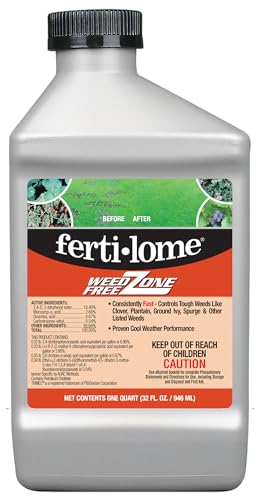
Fertilome Weed Free Zone shares the same active chemistry backbone as SpeedZone but in a 32-ounce bottle that goes further per dollar. The carfentrazone component delivers the same rapid burn-through of violet’s waxy leaf surface, while the dicamba fraction pushes the herbicide into the rhizomes. Users battling creeping Charlie, ground ivy, and violet multi-species infestations consistently rank this product as the one that finally broke the cycle after years of failed attempts with weaker Trimec blends.
Where this product shines is its turf safety profile on southern grasses like Bermuda, zoysia, and bahia — three warm-season types that are notoriously sensitive to heavy dicamba loads. Several reviewers successfully spot-sprayed violets growing among flower beds without collateral damage to ornamentals, a rare feat for a four-active herbicide. The trade-off is rainfast timing: the label recommends 6 hours of dry weather, twice the window of SpeedZone, which can be a problem during unpredictable autumn showers.
The most common adjustment reported by experienced users is the need to bump the mix rate above the label’s minimum for dense violet patches. Many found that 2 ounces per gallon (instead of the standard 1.5 ounces) produced the kind of deep-brown wilt that signals true root absorption. Adding a drop of non-ionic surfactant further improved adhesion to the shiny upper leaf surface. For homeowners who prefer a single product that works on both cool-season and warm-season lawns without a separate surfactant purchase, this is the most versatile entry in the mid-range category.
What works
- Four-active-chemistry mix attacks both leaf and root system
- Safe on Bermuda, zoysia, and bahia when applied correctly
- Effective spot treatment around ornamentals
What doesn’t
- Needs 6 hours of dry weather for rainfast guarantee
- Some users report needing double the label rate for dense violet colonies
3. PBI/Gordon Trimec Lawn Weed Killer (1 gallon concentrate)

The classic Trimec three-way blend (2,4-D + dicamba + MCPP-p) is the industry benchmark for broadleaf control, but it has a specific limitation with wild violets: no carfentrazone or triclopyr in the mix means the waxy cuticle isn’t breached as fast. The result is top-kill that may take 7–14 days and often leaves enough leaf tissue for regrowth. However, this gallon bottle provides massive coverage — roughly 20,000 square feet per bottle at standard rates — making it the most cost-effective option for blanket treatments on large lawns where violet is mixed with dandelions, clover, and other easy-to-kill broadleaf weeds.
Where Trimec excels is consistency. It’s the most widely tested selective herbicide in the US, and its safety on cool-season grasses (Kentucky bluegrass, tall fescue, perennial ryegrass) is well-documented across thousands of applications. The 128-ounce concentrate format is built for pump sprayer and hose-end sprayer use, and the three-active formula is gentle enough to use during late spring green-up without shocking the turf. For homeowners managing a five-acre property who can’t justify premium spot-treatment products at per bottle, this is the workhorse choice.
The trade-off for violet suppression is real. Multiple user reviews note that Trimec controls 95 percent of clover and dandelions in one pass but leaves violet patches unphased unless the application rate is doubled and a surfactant is added. Users who did add a non-ionic surfactant and applied during the fall translocation window reported “browning within a week and noticeably fewer shoots the following spring.” The gallon format gives you room to experiment with rate increases without running out early.
What works
- Phenomenal coverage value — 128 oz concentrate per bottle
- Proven safety on all common cool-season grass types
- Works great for clover, dandelions, and chickweed alongside violets
What doesn’t
- No carfentrazone or triclopyr; slower on violet’s waxy leaf surface
- Requires added surfactant and rate increase for consistent violet results
4. PBI Gordon SpeedZone EW 128oz (1 gallon bulk)

This is the gallon-sized version of the SpeedZone EW reviewed above, and it’s the preferred format for homeowners who treat more than 10,000 square feet annually. The same four-active chemistry (carfentrazone, dicamba, 2,4-D, MCPP-p) that makes the 20-ounce format so effective against wild violets is here, but the 128-ounce bulk price shifts the per-treatment cost significantly lower. Users tackling multi-year violet invasions that require three to four applications per season will find the gallon format saves roughly 30 percent compared to buying three 20-ounce bottles individually.
The standout feedback from bulk users is the sheer potency against deep-rooted perennials like field bindweed (morning glory) and wild violet simultaneously. One reviewer who had tried everything over a decade reported the gallon concentrate finally eradicated a 10-year bindweed infestation after a single application — a level of systemic penetration that speaks to the carfentrazone-dicamba synergy. The milky liquid stays wet on leaves for extended periods, which is critical for violet’s hydrophobic leaf surface.
The major limitation is regulatory: SpeedZone EW is not registered for sale in California, Colorado, and several other states due to its high chemical loading. Users in restricted states will need to find an alternative (Fertilome Weed Free Zone is an excellent substitute). Additionally, the label prohibits more than two applications per year, which means the bulk gallon is realistically a two-year supply for most single-home lots. The upfront investment is steep, but the per-ounce cost makes it the most economical choice for committed violet fighters with large properties.
What works
- Four-way active chemistry built for waxy perennials
- 128-ounce bulk format is cost-per-ounce leader for this chemistry
- Proven results on violets, bindweed, and ground ivy in single applications
What doesn’t
- Not legal to ship to CA, CO, and 15 other states
- High upfront investment; two-application-per-year limit extends timeline
5. Southern Ag Lawn Weed Killer with Trimec (32 oz concentrate)

Southern Ag’s Trimec formula is a budget-friendly entry that mirrors the industry-standard three-way blend but at a lower per-bottle cost than the PBI/Gordon gallon. The 32-ounce concentrate covers roughly 5,000 square feet, which aligns well with the average suburban lawn. Users report excellent knockdown of clover, dandelions, spurge, and chickweed — the typical broadleaf mix that coexists with wild violets — but the same limitation applies: without carfentrazone or triclopyr, the violet-specific results are inconsistent unless you boost the rate and add a surfactant.
The product stands out for its clean handling. The liquid has a low odor profile compared to other Trimec brands, and it mixes easily in both pump sprayers and hose-end applicators. The label explicitly lists compatibility with nine turf types, including St. Augustine, which is rare among dicamba-heavy formulas. Several reviewers in the humid Southeast noted that the product performed well on violet patches when applied in late September, with visible yellowing within 5 days and significant reduction by week three — but they all emphasized that a second spring application was necessary.
For the price point, this is a solid entry for homeowners who want a general-purpose broadleaf killer that can handle violets as part of a larger weed spectrum. The main downside is that it won’t deliver the one-pass knockout that carfentrazone-based formulas provide. Plan for at least two treatments per season and supplement with a surfactant to improve leaf wetting. If your violet infestation is light — a few scattered patches rather than a full lawn takeover — this product delivers enough value to keep it in your rotation.
What works
- Very affordable per-bottle price for 32 oz concentrate
- Low odor and easy mixing for hose-end sprayers
- Labeled safe for St. Augustine, a sensitive southern turf
What doesn’t
- Standard three-active blend lacks cuticle-penetration speed
- Two annual applications minimum needed for violet control
6. Southern Ag Crossbow Specialty Herbicide (1 gallon)

Crossbow is the oddball in this lineup because it’s not primarily a lawn herbicide — it’s a brush and vine killer built for pastures, fence lines, and roadside ditches. But its active ingredient combo of triclopyr and 2,4-D is chemically ideal for penetrating wild violet’s waxy leaf shield. Triclopyr is the same compound used in professional forestry herbicides for woody brush, and it breaks down violet’s cuticle faster than dicamba alone. For homeowners dealing with a full acre of violet carpet mixed with poison ivy, brambles, or blackberry vines, Crossbow is a nuclear option.
The spread rate is astonishing: one gallon of concentrate makes up to 96 gallons of finished spray, covering up to 2.23 acres. That’s roughly the entire lawn of a rural property. Users who applied Crossbow during violet’s active growth phase in midsummer reported complete top-kill within 4 days and, most importantly, a noticeable reduction in shoot emergence the following spring. The triclopyr component is rainfast within 24 hours, a moderate window that requires planning but is manageable for most weekend applicators.
The major concern with Crossbow is non-selectivity. It will kill grass, ornamentals, and anything else it touches. This is strictly a spot-treatment or bare-ground tool — do not blanket-spray your fescue or Bermuda lawn with it. The strong odor and need for protective gear (gloves, long sleeves, respirator recommended) also deter casual users. One reviewer noted it was “ineffective on wild violets” in their specific soil type, but the majority of users report that it’s the only product that finally pushed violet back in heavy brush situations. This is a tool for the desperate or the large-property owner, not the weekly lawn-maintenance crowd.
What works
- Triclopyr + 2,4-D chemistry is excellent for waxy leaf penetration
- Extreme coverage — up to 2.23 acres per gallon of concentrate
- Effective on brush, vines, and perennials beyond just violet
What doesn’t
- Non-selective — will kill grass and ornamentals on contact
- Strong odor and requires full PPE during handling
7. Bonide Captain Jack’s Deadweed Brew (128 oz ready-to-use)

Captain Jack’s Deadweed Brew is a non-selective, OMRI-listed organic herbicide designed for use around patios, driveways, fence lines, and other non-lawn areas. Its active ingredients are natural fatty acids and ammonium salts rather than synthetic auxins, which means it cannot provide systemic root penetration. On wild violets growing in the lawn, this product will burn the leaves to a crisp within hours but will not kill the rhizomes — the plants will regrow from the roots within two to three weeks.
Where this product has a role in a violet control strategy is in containment: spot-treating violet patches on patios, walkways, or in garden beds where selective herbicides would damage nearby desirable plants. The ready-to-use format requires no mixing — you spray directly until the leaves drip — and it works even in cooler 40-degree temperatures, which is rare for organic contact sprays. Users who applied it to violets growing in gravel driveways reported complete top-kill in under 6 hours on a sunny day.
The catch is that non-selective means non-selective. It will kill grass, flowers, vegetables, and anything else it touches, and its lack of soil activity means it won’t prevent regrowth from seeds or rhizomes left in the ground. This product is best viewed as a maintenance tool for violet patches on hardscapes, not a solution for violet infestations in turf. For the organic gardener who only needs to clean up isolated clumps on a concrete edge or paver border, it’s a convenient, no-brainer option that avoids the broader risks of synthetic systemic herbicides.
What works
- OMRI-listed; safe for use near edibles when label directions are followed
- Works fast — visible leaf damage in under 6 hours on sunny days
- Ready-to-use format eliminates mixing errors
What doesn’t
- Non-selective — kills any plant it contacts
- Contact-only action; does nothing to violet rhizomes underground
Hardware & Specs Guide
Active Ingredient Packages for Violet
Wild violet requires at least two systemic active ingredients in combination for reliable control. The most effective formulas in this guide contain carfentrazone-ethyl (for rapid cuticle burn and leaf penetration) paired with either dicamba or triclopyr (for root translocation). Products relying solely on 2,4-D and MCPP-p without a contact aid like carfentrazone typically require double applications and added surfactant. The bulk 128-ounce formats of Trimec and SpeedZone represent different chemistries — SpeedZone includes carfentrazone, while standard Trimec does not. Choose based on whether you prioritize speed (SpeedZone) or coverage volume (Trimec).
Rainfast Window
The time between application and the first rainfall is critical for violet control because the waxy cuticle already resists absorption. SpeedZone EW (both the 20 oz and 128 oz versions) is rainfast in 3 hours — the shortest window among the selective herbicides tested. Fertilome Weed Free Zone requires 6 hours. The Trimec-based formulas from Southern Ag and PBI/Gordon are rainfast after 24 hours, meaning you need a full window of dry weather for reliable results. For fall applications when rain is frequent, prioritize products with a sub-6-hour rainfast window to avoid losing the treatment to an unexpected shower.
Surfactant Requirements
None of the seven products above include a built-in non-ionic surfactant at levels sufficient for violet’s leaf surface — meaning you should budget for a separate surfactant purchase if you want consistent results. The carfentrazone in SpeedZone and Fertilome provides some built-in wetting action, but users fighting dense violet patches added an extra 0.25% to 0.5% surfactant per gallon to achieve full leaf coverage on the waxy upper surface. For Trimec and Crossbow, a surfactant is nearly mandatory. Southern Ag recommends using their Surfactant for Herbicide product. A small bottle of non-ionic surfactant will outlast multiple herbicide bottles and is the single cheapest upgrade you can make to improve violet control.
Application Equipment
A standard 1- or 2-gallon pump sprayer is sufficient for the 20 oz and 32 oz concentrate bottles, but the 128-ounce gallon formats of Trimec and SpeedZone EW are better paired with a backpack sprayer (2–4 gallon capacity) for comfortable coverage of large lawns. The ready-to-use Bonide Captain Jack’s includes a trigger sprayer nozzle but users with over 500 square feet of treatment area should transfer it to a hand-pump sprayer for better output consistency. Crossbow’s extreme mixing ratio (up to 96 gallons from one gallon concentrate) demands a hose-end sprayer or a large-capacity tow-behind sprayer for users treating more than half an acre.
FAQ
Why do wild violets survive most weed killers?
Should I apply weed killer to wild violets in spring or fall?
Can I mix weed killer for wild violets with liquid fertilizer?
How many applications will it take to completely eliminate wild violets?
Is there a pre-emergent that prevents wild violets?
Final Thoughts: The Verdict
For most homeowners battling a typical suburban infestation, the weed killer for wild violets winner is the SpeedZone EW Lawn Weed Killer because the carfentrazone-ethyl penetrates violet’s waxy leaves within hours while the dicamba fraction carries the kill to the roots, giving you visible results in a single weekend. If you need a larger treatment volume with the same chemistry on a tighter budget, grab the Fertilome Weed Free Zone — it shares the same four-active formula in a 32-ounce bottle that costs less per ounce. And for large-property owners facing thick violet mats mixed with brush and vines, nothing beats the extreme coverage and triclopyr punch of the Southern Ag Crossbow Specialty Herbicide, provided you keep it away from your lawn turf.