
Planting a food plot is only half the battle — the real question is whether your soil has the nutrients to turn seed into a protein-rich, fast-growing forage that keeps deer coming back through the season. A generic lawn fertilizer can push leafy growth but often lacks the phosphorus and potassium balance needed for root establishment and sustained attraction in a woodland setting. Getting the NPK ratio right for your specific plot size, soil type, and legume blend is the difference between a field of sparse weeds and a lush, high-protein buffet that holds deer on your property.
I’m Rikta — the co-founder and writer behind Lawn Gear Lab. My approach to this guide means studying hundreds of owner reviews, cross-referencing NPK ratios against crop-specific recommendations, and analyzing manufacturer technical data to isolate which formulations deliver measurable results in real food-plot conditions.
This guide breaks down the specifics of nitrogen timing, phosphorus for root mass, and potassium for plant hardiness, helping you select the most effective fertilizer for food plots based on plot composition and your seasonal goals.
How To Choose The Best Fertilizer For Food Plots
Selecting a food plot fertilizer isn’t about grabbing the bag with the highest first number. Nitrogen drives leaf growth, but too much can overpower clover’s natural ability to fix its own, leading to weedy competition. Phosphorus is critical for root expansion and early seedling vigor, especially in disturbed or low-fertility soils. Potassium strengthens stalks against grazing pressure and frost. The right blend depends entirely on whether your plot is built on legumes, brassicas, grains, or a mix of all three.
Understand Your Plot’s Primary Crop
Clover and soybean plots benefit from a low-nitrogen, legume-specific formula that won’t burn the roots or push grass weeds. Antler King Clover Fuel, for instance, is designed exclusively for legumes and uses liquid delivery to avoid the scorching risk of granulars. Brassica and grain blends like the Hit List Seed No Till mix, however, thrive on a balanced starter like 10-10-10, which provides equal parts establishment support across multiple forage types without favoring one species over another.
Release Speed and Application Timing
Slow-release nitrogen (SRN) formulations, such as the Pendelton Turf Supply 18-3-6, provide sustained feeding over weeks without a sudden growth flush that attracts deer at the wrong time. For pre-planting application, liquid concentrates that can be mixed with herbicides or grass killers save a trip across the plot. Granular options like GreenView 10-10-10 are cost-effective for large acreage but require rain incorporation within 24-48 hours to activate.
Soil Test Before You Buy
No formulation can fix a pH that’s too low for clover (which prefers 6.0-7.0) or a phosphorus level so high it locks out zinc. A simple soil test kit tells you exactly which of the three macronutrients is lacking. If your pH is already optimal and you just need a maintenance boost, a balanced blend like FoxFarm Marine Cuisine 10-7-7 provides micronutrients from ocean-based ingredients that a basic 10-10-10 doesn’t offer.
Quick Comparison
On smaller screens, swipe sideways to see the full table.
| Model | Category | Best For | Key Spec | Amazon |
|---|---|---|---|---|
| Antler King Clover Fuel | Liquid Legume | Established clover plots | 32 oz per acre | Amazon |
| FoxFarm Marine Cuisine 10-7-7 | Slow-Release Granular | Heavy feeders after planting | 4 lb bag, 2x season | Amazon |
| Hit List Seed No Till Mix | Seed + Blend | Quick no-till plots | 5 lbs / ½ acre | Amazon |
| Pendelton Turf Supply 18-3-6 | High-Nitrogen Liquid | Large acreage coverage | 2.5 gal, 50% SRN | Amazon |
| Great Big Roses Booster | Liquid Booster | Amplifying existing fertilizer | 32 oz, 8 apps | Amazon |
| Alaska Fish Fertilizer 5-1-1 | Organic Liquid | Organic vegetable plots | 115 oz, OMRI listed | Amazon |
| GreenView 10-10-10 | Balanced Granular | Large plot foundation | 33 lb, 10K sq ft | Amazon |
In‑Depth Reviews
1. Antler King Clover Fuel
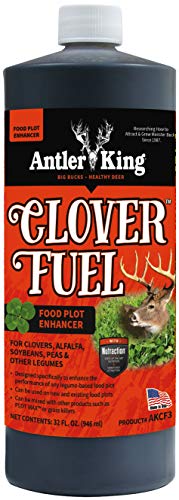
Antler King Clover Fuel is engineered exclusively for legume-based food plots, making it the first liquid fertilizer that can be applied both before planting and after seedlings emerge without burning roots. The formula is designed to work with clover, soybeans, alfalfa, and peas, and the mixing ratios are straightforward — two bottles per acre for pre-planting and one bottle per acre monthly after emergence. Owner feedback consistently highlights how quickly clover stands thicken and green up after application, with multiple reports of improved deer traffic within the same season.
Because it’s liquid, Clover Fuel can be tank-mixed with grass killers or Plot Mix, eliminating an extra trip across the plot. The product is labeled as non-burning, which is a critical advantage over granular fertilizers that can scorch tender legume foliage if rain doesn’t arrive promptly. The concentration is enough for medium-sized plots, and the coverage math is simple enough for first-time food plot managers to execute without guesswork.
One limitation is that Clover Fuel is specifically formulated for legumes only — it will not benefit brassicas, grains, or mixed-species plots that include non-legume forages. The price per bottle is higher than a standard balanced granular, but the results for dedicated clover or soybean plots justify the cost for serious habitat managers who value consistency over budget.
What works
- Formulated specifically for legumes to avoid nitrogen burn and weed pressure
- Can be used pre-planting and post-emergence for flexible scheduling
- Mixes with herbicides to save labor during plot establishment
What doesn’t
- Ineffective on brassica, grain, or mixed-forage blends
- Requires calibrated sprayer for accurate per-acre dosing
2. FoxFarm Marine Cuisine 10-7-7
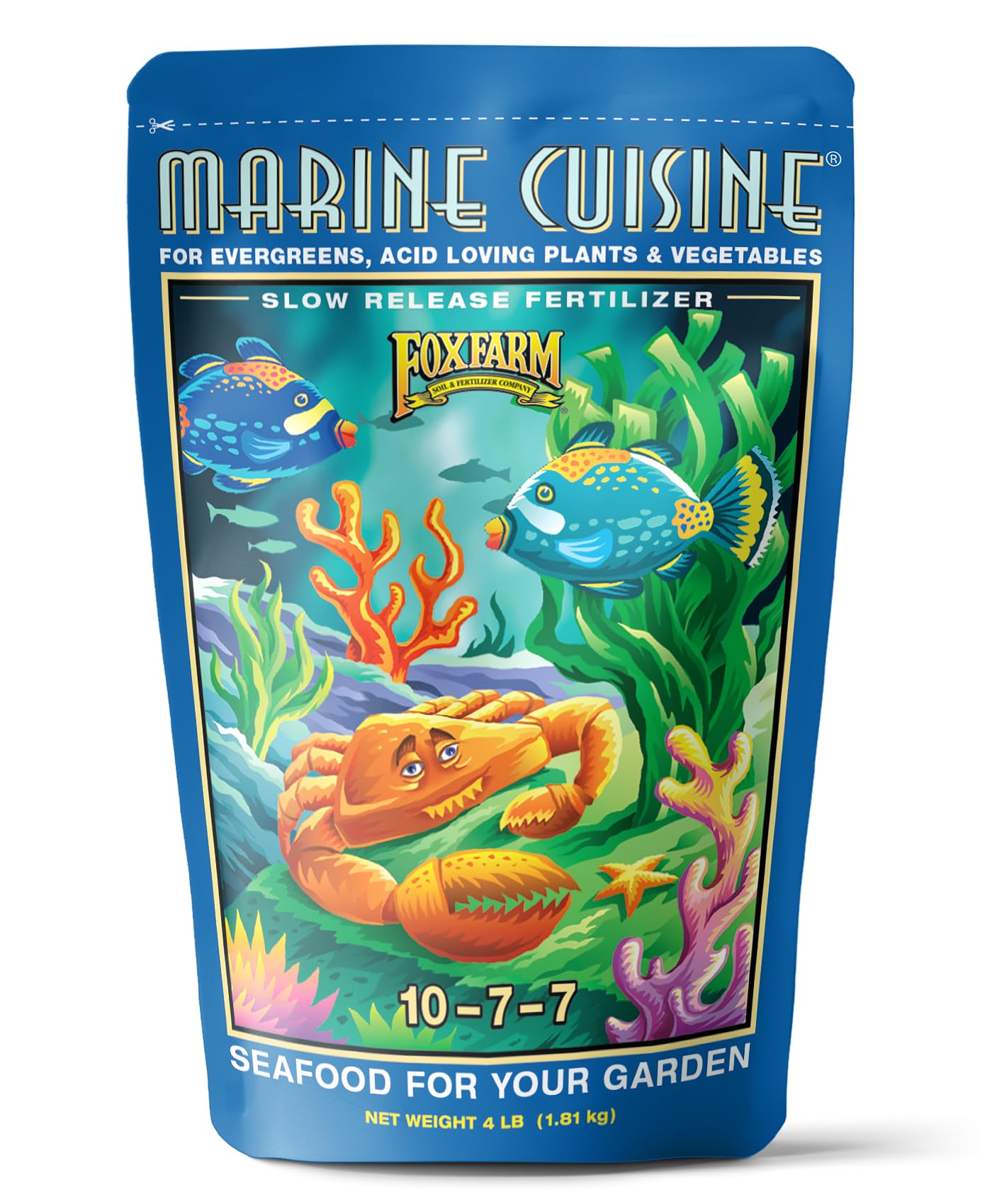
FoxFarm Marine Cuisine 10-7-7 delivers a heavy-feeder formula built on ocean-sourced ingredients — crab meal, shrimp meal, seabird guano, and kelp — that provide both quick-available nutrients and slow-release feeding over months. The NPK profile leans slightly toward the vegetative side but keeps phosphorus and potassium high enough to support root and flower development in established food plots. Owners frequently note that squash, pepper, and heavy-feeding vegetable plants showed visible greening within days of application, with sustained vigor across the growing season.
The application schedule is notably simple: twice per season, spaced three to four months apart, which makes the 4-pound bag last longer than its weight suggests for small to medium plot areas. The powder form mixes easily into the top inch of soil around plants or can be broadcast over a patch and watered in thoroughly. Reviews emphasize that the ocean-based mineral blend improves soil biology over time, not just immediate nitrogen availability.
The main drawback is bag size — 4 pounds covers a relatively small footprint compared to bulk granular options, making it less economical for acre-scale food plots. Also, the 10-7-7 ratio is not legume-specific, so applying it to pure clover stands may push nitrogen levels that encourage grass competition. It works best in mixed plots where a general fertility boost is the goal.
What works
- Ocean-based ingredients deliver trace minerals not found in synthetic blends
- Slow-release feeding reduces application frequency to twice per season
- Visible results reported within days on heavy-feeding plants
What doesn’t
- Small bag size limits use to patches and micro-plots
- Rich nitrogen content can fuel grass weeds in pure legume plots
3. Hit List Seed No Till Food Plot Mix

The Hit List Seed No Till Food Plot Mix bundles five forage species — crimson clover, purple top turnips, forage brassica, forage oats, and rye — into a single bag that germinates quickly with minimal soil prep. This is not a fertilizer itself, but it earns a spot in a food plot fertilizer guide because the species composition determines which fertilizer formula will work best. A balanced 10-10-10 applied at planting gives all five components equal access to phosphorus for root development and potassium for frost tolerance through late season.
Owner reports confirm germination within four to seven days under good moisture, with deer and turkey hitting the plots as soon as leafy forage emerges. The blend is designed to stay attractive from early bow season through late firearms season as different species peak at different times. No-till application means simply scattering seed on prepared ground and covering lightly with hay or light raking, making it accessible for first-time plot managers without heavy equipment.
Coverage estimates are somewhat optimistic — the 5-pound bag is labeled for half an acre, but several users found it thin on the upper end of that range and recommend doubling the seeding rate for consistent biomass. Because the mix includes three broadleaf species and two grasses, no single fertilizer ratio optimizes every plant, so a general-purpose formula is the pragmatic choice.
What works
- Fast germination with no-till planting method simplifies setup
- Multi-species blend provides food from early season through late winter
- Works with a standard balanced fertilizer for straightforward nutrition
What doesn’t
- Coverage rate may be thin at half-acre claim without heavier seeding
- Requires separate fertilizer purchase to maximize growth potential
4. Pendelton Turf Supply 18-3-6 Liquid Fertilizer

Pendelton Turf Supply’s 18-3-6 liquid fertilizer packs the highest nitrogen concentration in this lineup, with a crucial twist — half of that nitrogen is slow-release (SRN), meaning it feeds steadily over weeks rather than forcing a single growth spike. This makes it a strong candidate for grain-heavy or brassica plots where dense, sustained leaf canopy matters more than root nodulation. The included micronutrients — copper, iron, manganese, zinc — address common deficiencies in disturbed food plot soils that simple NPK formulations ignore.
At 2.5 gallons, this bottle covers roughly one acre across three applications when used at the turf rate of 3 ounces per 1,000 square feet. Ornamental application rates are gentler at 1 to 2 ounces per gallon of water. Owners transitioning from granular fertilizers frequently report that the liquid form gives them more control over distribution, especially on uneven terrain where a spreader might miss spots. The 50% SRN component also means less risk of nitrogen leaching after heavy rain compared to fast-release liquids.
The trade-off is the nitrogen-to-phosphorus ratio: 18-3-6 is extremely leaf-focused, with minimal phosphorus for root establishment. It should not be used at planting time for new clover or legume-heavy plots, as the high nitrogen can suppress nodulation. It’s best applied to established grain or grass plots where a green boost is the priority.
What works
- Half the nitrogen is slow-release for steady, sustained feeding
- Micronutrient package addresses trace mineral deficiencies
- Liquid form allows precise coverage on uneven plot surfaces
What doesn’t
- Low phosphorus content limits effectiveness for new legume plots
- Must be used immediately after mixing to maintain potency
5. Great Big Roses Liquid Booster
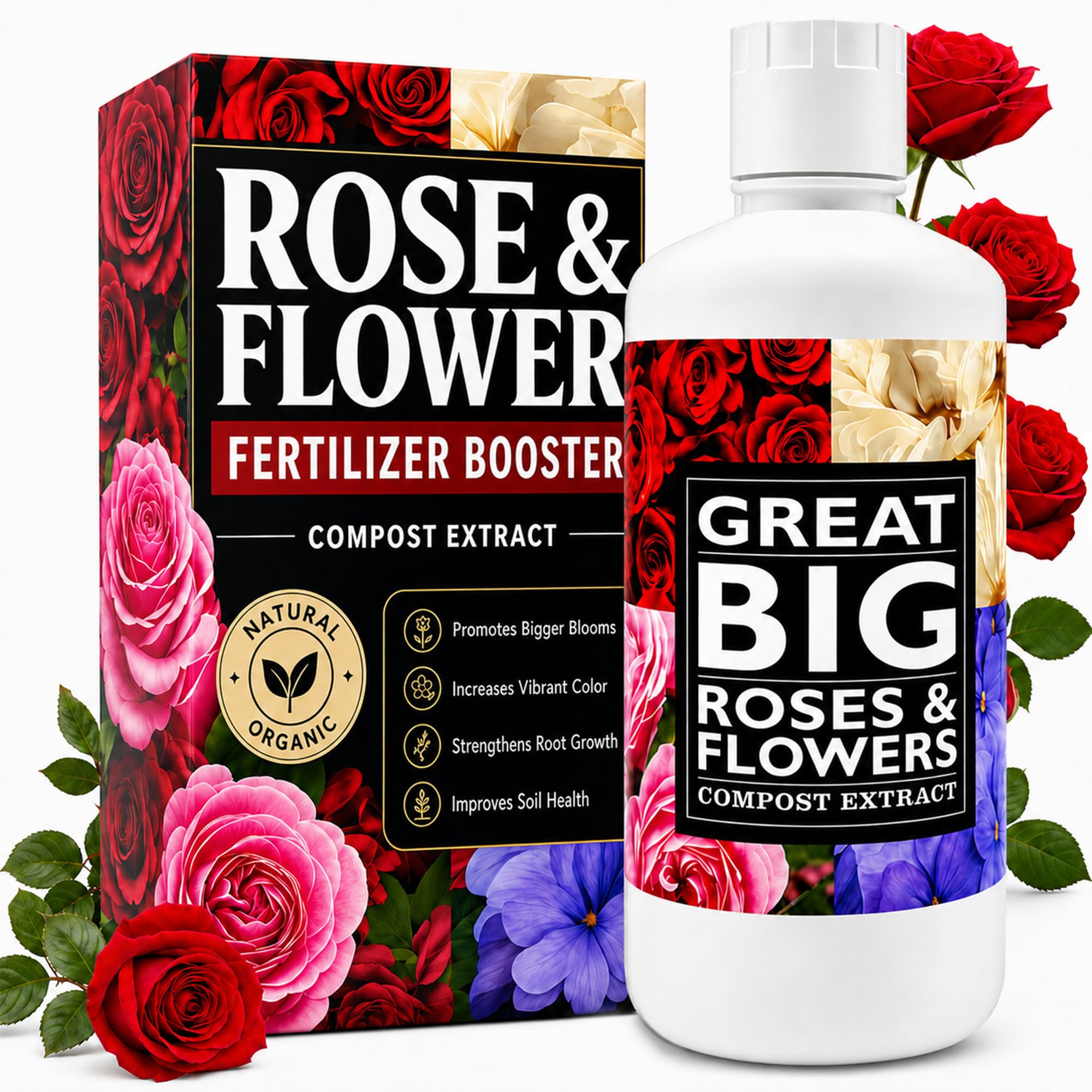
Great Big Roses Liquid Booster is not a standalone fertilizer — it’s a soil activator designed to amplify the results of existing fertilizers by delivering humic acids, seaweed, and over 70 chelated trace minerals directly into the root zone. For food plot managers who have already applied a base granular but want to unlock locked-up soil nutrients, this booster can make a measurable difference in growth density. Owner reports describe rose bushes that hadn’t bloomed in years producing flowers within weeks, and the same principle applies to clover and brassica root systems in compacted plot soils.
The 32-ounce bottle mixes at 4 ounces per gallon of water and covers a full growing season for most garden-sized plots. It’s compatible with organic fertilizers, fish emulsion, bone meal, and worm castings, meaning it fits into an existing regiment without forcing you to abandon what’s working. The humic acid component improves cation exchange capacity, helping sandy or thin plot soils hold onto applied nutrients longer between rain events.
Because the formula is a booster rather than a complete feed, it must be paired with a base NPK fertilizer to deliver macronutrients. The concentrate is expensive per ounce, but the ability to wake up dormant soil biology and improve nutrient uptake from your existing fertilizer can reduce how much granular product you need over time. The bottle design is a known pain point — the wide mouth makes measuring and pouring messy, especially when mixing small batches.
What works
- Unlocks nutrients already present in soil to maximize existing fertilizer
- Humic acid and seaweed improve soil structure and microbial activity
- Compatible with organic and synthetic fertilizers for flexible integration
What doesn’t
- Requires a separate base NPK fertilizer for complete nutrition
- Wide-mouth bottle design leads to spillage during measuring
6. Alaska Fish Fertilizer 5-1-1
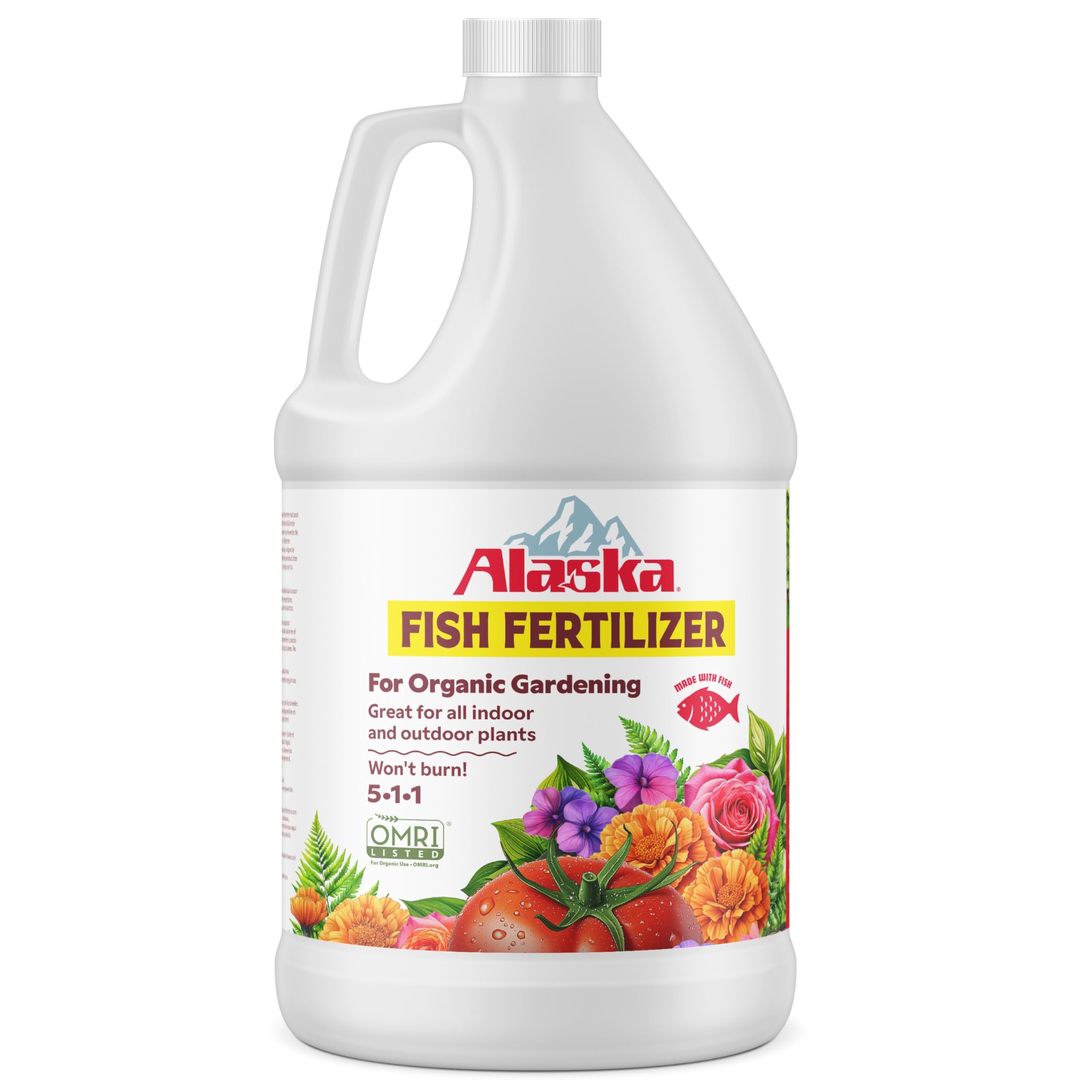
Alaska Fish Fertilizer 5-1-1 is an OMRI-listed organic emulsion that delivers gentle nitrogen from cold-processed fish byproducts while preserving the micronutrients that synthetic heat treatments destroy. The 5-1-1 NPK ratio is deliberately low in phosphorus and potassium because the primary role here is vegetative leaf growth — ideal for brassica greens, grain leaves, and early-season clover flush after the first mow. Owner feedback spanning over a decade consistently points to stronger stems, deeper green coloration, and noticeable resistance to transplant shock when used at the recommended dilution.
The 115-ounce bottle offers broad coverage: mixed at the standard rate, it can handle several hundred square feet of plot, and the liquid consistency makes it easy to apply through a hose-end sprayer or watering can. It’s formulated to be safe around pets and kids once watered in, and the fish odor, while strong during application, dissipates within a day in outdoor conditions. The organic certification makes it a solid choice for food plots adjacent to organic gardens where synthetic inputs are restricted.
The major limitation is the lack of phosphorus and potassium — a pure clover or soybean plot will need a supplemental bloom or root formula to support flowering and pod set. The smell, while temporary, can be intense, especially if applied on a still, humid day near a dwelling. It also requires more frequent application (every three weeks) compared to slow-release granular alternatives.
What works
- OMRI-listed organic formula suitable for certified organic growing areas
- Cold-processed to preserve beneficial micronutrients from fish
- Safe for pets and children once adequately watered into soil
What doesn’t
- Lacks phosphorus and potassium for flowering and root development
- Strong fish odor during application requires good ventilation
7. GreenView Multi-Purpose Fertilizer 10-10-10

GreenView Multi-Purpose Fertilizer 10-10-10 is the straight-ahead, no-surprises granular that serves as an affordable foundation for large food plots when soil tests don’t indicate a specific deficiency. The equal NPK ratio delivers a baseline boost to all three macronutrients, making it suitable for mixed-species plots where clover, brassicas, and grains coexist. The 33-pound bag covers up to 10,000 square feet, giving acre-scale managers a cost-effective way to blanket a plot before seeding without needing multiple specialized products.
Owner reports across gardening and food plot communities confirm that the granules are well-formed, non-clumping, and spread evenly through a rotary broadcast spreader. Users in both northern and southern climates report consistent greening across trees, shrubs, hostas, vegetables, and perennials, which speaks to the formulation’s general-purpose versatility. For a new food plot with unknown soil conditions, starting with a balanced 10-10-10 is the safest initial move before fine-tuning with specialty products later.
The downsides are inherent to its generic nature: it provides no slow-release mechanism, so nutrients are water-soluble and can leach quickly in sandy soil or heavy rain. It’s not organic and contains no micronutrients beyond the three main numbers, so plots with trace mineral deficiencies will still struggle. And because it’s balanced, it doesn’t optimize for any single crop — clover managers will still need a low-nitrogen supplement for best performance.
What works
- Large 33-pound bag offers excellent coverage for acre-scale plots
- Balanced 10-10-10 ratio works safely across mixed forage species
- Non-clumping granules spread evenly through standard broadcast spreaders
What doesn’t
- No slow-release technology leads to rapid leaching in rain events
- Lacks micronutrients and organic certification for specialty applications
Hardware & Specs Guide
NPK Ratio and Crop Matching
The three numbers on a fertilizer bag represent nitrogen (promotes leaf growth), phosphorus (supports roots and blooms), and potassium (aids overall hardiness and stress resistance). For food plots, a low or zero first number is ideal for legumes like clover and soybeans, which fix their own nitrogen. A balanced 10-10-10 works best for mixed-species blends, while a high-first-number formula like 18-3-6 is appropriate for established grass or grain plots where leaf mass is the priority.
Slow-Release vs. Fast-Release Nitrogen
Fertilizers containing slow-release nitrogen (SRN) feed plants gradually over several weeks, reducing the risk of nutrient burn and leaching. Fast-release formulas provide an immediate green flush but require more frequent application and precise timing to avoid wasting nutrients before plants can absorb them. In food plots, SRN fertilizers are especially valuable in sandy soils where rain can wash away soluble nitrogen quickly, and for managers who cannot reapply on a strict biweekly schedule.
Liquid vs. Granular Application
Liquid fertilizers offer precise, even coverage and can be tank-mixed with herbicides or pesticides to save trips across the plot. They are faster acting because nutrients are immediately available to roots and foliage. Granular fertilizers, on the other hand, are more economical for large acreage and provide longer residual feeding if they contain slow-release coatings. The trade-off is that granules require rainfall within 24 to 48 hours to dissolve, and uneven spreading can lead to patchy growth in the plot.
Micronutrient Content
Beyond the NPK ratio, secondary and micronutrients — calcium, magnesium, sulfur, zinc, iron, manganese, copper — play critical roles in plant enzyme function and disease resistance. Soil in old agricultural fields or newly cleared woodland plots is often deficient in these trace elements. Formulas that include chelated micronutrients (like the FoxFarm Marine Cuisine or the Pendelton Turf Supply) can correct these deficiencies more effectively than straight NPK blends, leading to denser, healthier forage that deer prefer.
FAQ
Can I use a standard lawn fertilizer on my food plot?
How do I know which NPK ratio my food plot needs?
Should I fertilize before or after planting my food plot seed?
How often should I reapply fertilizer to my food plot?
Final Thoughts: The Verdict
For most food plot managers, the fertilizer for food plots winner is the Antler King Clover Fuel because it’s specifically engineered for legume-based plots and delivers safe, measurable results with a simple, repeatable application schedule. If you want a slow-release granular that feeds heavy feeders all season with ocean-based minerals, grab the FoxFarm Marine Cuisine 10-7-7. And for large mixed-species plots where budget is the primary constraint, nothing beats the coverage and versatility of the GreenView 10-10-10.