
Every autumn, you face the same choice: drag out the gas blower that wakes the neighbors, wrestle with an extension cord that tangles around every bush, or just give up and let the leaves win. A cordless garden blower solves that — it starts with a trigger pull, never needs a fuel mix, and follows you anywhere without a cord. The catch is that one wrong pick leaves you reaching for a second battery before the driveway is clean. This guide cuts through the specs to find the blower that actually finishes your yard in one go.
I’m Rikta — the co-founder and writer behind Lawn Gear Lab. This guide is built by comparing the manufacturers’ published specifications and the patterns across verified customer reviews, so you get each pick’s real strengths and trade-offs instead of marketing spin.
Whether your yard is a patio, a half-acre lot, or a carpet of heavy wet leaves, you need a cordless garden blower that matches the job without breaking your back or your budget.
How To Choose The Best Cordless Garden Blower
Not all battery-powered blowers are built the same. Slap a “40V” sticker on something weak and it still won’t push a wet oak leaf across a driveway. Here is what actually separates a blower that finishes the job from one that just makes noise.
Match the airflow (CFM) to your yard’s mess
CFM (cubic feet per minute) measures the volume of air the blower moves — think of it as the “push.” For light leaf dust on a patio, 130 CFM is enough. For wet leaves, gravel paths, and pine needles, you want at least 400 CFM. The SEESII 40V delivers 650 CFM, which is enough to shift small stones, while the compact EWORK manages 130 CFM — a gap that decides whether you finish in 10 minutes or 30.
Battery voltage and amp-hours are your real fuel gauge
Voltage (V) is the power potential — higher voltage typically means more torque (twisting force). Amp-hours (Ah) is the fuel tank: more Ah means longer runtime between charges. A 40V blower with a 5.2Ah battery has a 2.6x larger “fuel tank” than a 20V 2.0Ah unit, so you clear more driveway before the battery dies. If you have a larger yard, a 60V or 80V platform with a high Ah battery is worth the jump.
Brushless motors are not a marketing gimmick
A brushless motor has no carbon brushes that wear down over time. It runs cooler, quieter, and delivers more torque per watt of battery than a brushed motor. Every blower on this list uses a brushless motor — which means they all last years longer than older brushed models you might have owned.
Quick Comparison
On smaller screens, swipe sideways to see the full table.
| Model | Category | Best For | Key Spec | Amazon |
|---|---|---|---|---|
| SEESII 40V | Best Overall | Large yards, wet leaves, heavy debris | 650 CFM / 160 MPH | Amazon |
| Greenworks 60V | Premium Pick | Mid-size yards, green platform ecosystem | 610 CFM / 130 MPH | Amazon |
| Husqvarna 350iB | Top Performer | Professional-grade yard care, large properties | 800 CFM / 200 MPH | Amazon |
| Greenworks 80V | Heavy Duty | Replacing gas, tough wet debris | 770 CFM / 190 MPH | Amazon |
| CRAFTSMAN V20 | Best Value | Small to mid yards, Craftsman tool owners | 410 CFM / 110 MPH | Amazon |
| EWORK 21V | Budget Champion | Light debris, apartments, patios | 130 CFM / 200 MPH | Amazon |
| Mueller UltraStorm | Value Pick | Small patios, tight budgets, tool collectors | 140 MPH (max) | Amazon |
In‑Depth Reviews
1. SEESII 40V Leaf Blower
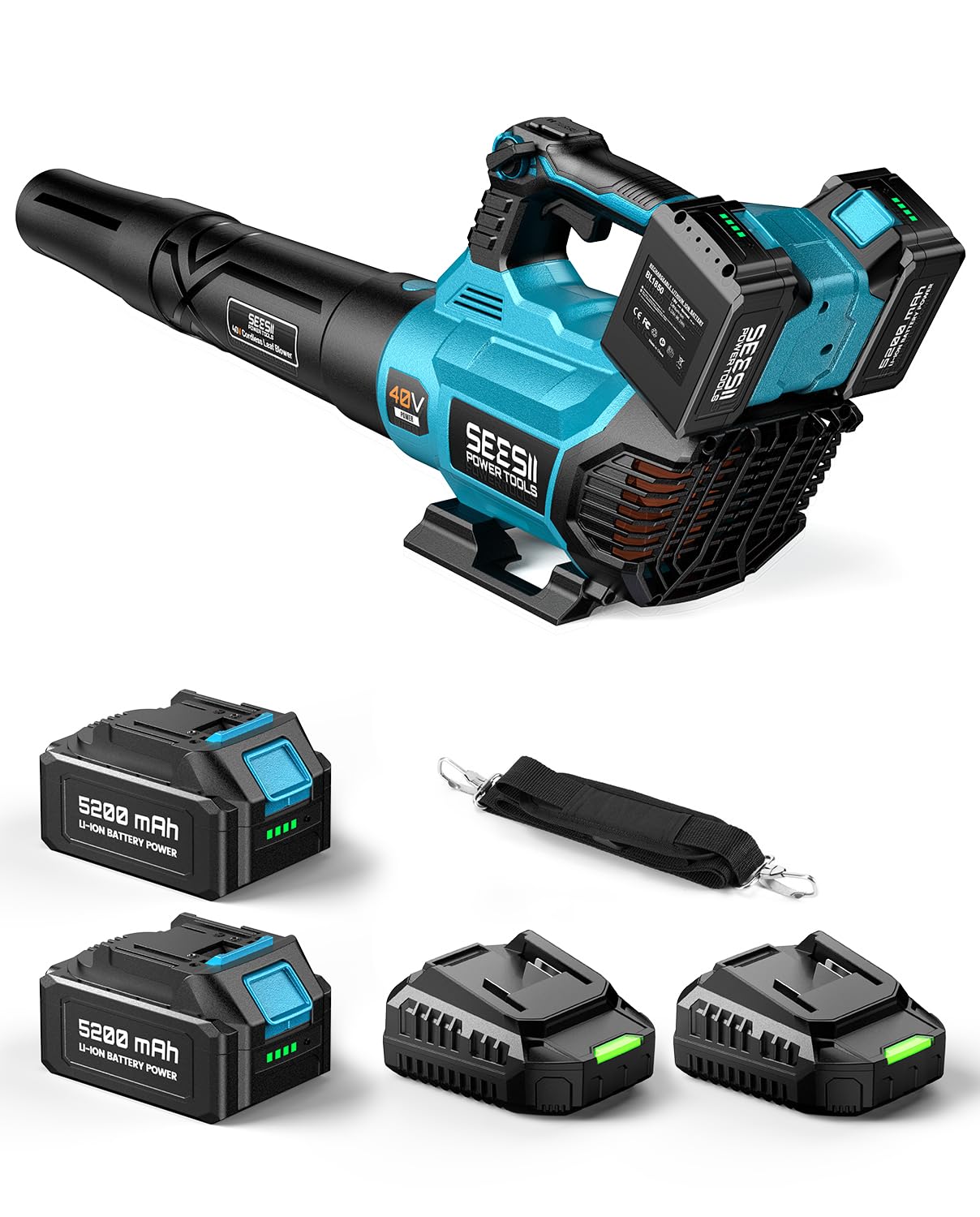
The SEESII 40V delivers 650 CFM and 160 MPH — the best balance of power and value in this guide — making it the top pick for anyone with a half-acre lot or stubborn debris like wet pine needles and small branches. It comes with two 5.2Ah batteries and two chargers, giving it a 2.6x larger battery capacity than a 2.0Ah model like the Mueller UltraStorm, so you spend far less time waiting for a charge.
Buyers report that the batteries lasted 40+ minutes and the blower cleared sticky pine needles and small branches easily. The brushless motor runs cooler and delivers more torque per watt, providing consistent power across a full yard. The variable speed trigger and a Turbo button let you dial in a gentle breeze for dust or an instant surge for wet leaves.
The honest catch is that this blower requires both batteries installed to reach 40V — it is not a hot-swap system where one battery runs it solo. You need both charged at once. If your yard is small and you just want to blow a few leaves off a patio, the SEESII’s power is more than you need, but for anyone with a half-acre lot or stubborn debris, this is the one that finishes the job.
Why it’s great
- 650 CFM and 160 MPH handles wet leaves and small stones
- Two 5.2Ah batteries provide 40+ minutes of runtime in real use
- Turbo button gives an instant power surge for tough debris
Good to know
- Requires both batteries to be inserted to operate
- Spare batteries are difficult to find separately
2. Greenworks 60V Cordless Leaf Blower

Compared to the top-pick SEESII, the Greenworks 60V delivers 130 MPH of air speed versus the SEESII’s 180 MPH, but it makes up for that with a 50-minute runtime on a 2.5Ah battery — nearly double the SEESII’s 28-minute runtime on turbo mode.
In real use, the variable-speed trigger and turbo mode push air up to 130 MPH, and the concentrator nozzle focuses that air into a jet for wet leaves and gravel. The 2.5Ah battery delivers up to 50 minutes on a charge, though owners mention the turbo mode cuts that runtime roughly in half. The most useful feature is the cruise control — it locks the trigger so you do not have to hold it down for an entire cleanup, which reduces hand fatigue significantly.
That ecosystem compatibility is the real value here: if you already own Greenworks 60V tools, this blower shares their battery, so you skip the extra cost of a dedicated battery system. Choose this if you already own Greenworks 60V gear or plan to buy more.
Where it shines
- 610 CFM and 130 MPH handles heavy debris and wet leaves
- Shares batteries with 75+ Greenworks 60V tools
- Cruise control lock eliminates trigger fatigue on long jobs
Worth noting
- Turbo mode reduces battery runtime significantly
- Some units have shipped with a defective charger reported by buyers
3. Husqvarna Leaf Blaster 350iB

Picture this: a flat roof covered in wet leaves that takes an hour with a rake. One reviewer noted the Husqvarna Leaf Blaster 350iB cleared that same roof in minutes. This is the most powerful handheld cordless blower on the list, with 800 CFM and 200 MPH — numbers that rival entry-level gas backpack blowers. It runs on a 40V 7.5Ah battery that delivers extended runtime, even at high power.
That level of airflow is exactly what you need for clearing gravel driveways, moving piles of wet leaves across a lawn, or blasting snow off walkways. The built-in debris scraper on the nozzle helps loosen sticky leaves that are plastered to the pavement. The Power Boost mode delivers 20 percent more power on demand, and the cruise control locks your speed so you don’t have to hold the trigger for the entire job.
At 10 pounds with the battery, it is heavier than the other picks — but the downside is genuine gas-replacing power. The 350iB delivers 800 CFM and 200 MPH from a handheld cordless tool.
What stands out
- 800 CFM and 200 MPH rivals gas backpack blowers
- 40V 7.5Ah battery provides long runtime on high power
- Power Boost mode delivers 20% more power on demand
The trade-offs
- Heavy at 10 pounds — more fatigue on long cleanups
- Battery is expensive to replace if lost or damaged
4. Greenworks 80V Cordless Leaf Blower

The number that matters most in the heavy-duty category is CFM — and the Greenworks 80V delivers 770 CFM at 190 MPH, matching the Husqvarna in raw flow but on an 80V platform. That voltage translates into real torque for moving deep, wet piles of leaves. The 4.0Ah battery provides up to 80 minutes of runtime at a 50% load, and the 4A rapid charger refills it in under an hour.
The trade-off you accept here is weight. At nearly 6 pounds (5.95 lbs), it is not the lightest blower — and with the battery installed, customers note it feels closer to 11.5 pounds, which makes a shoulder strap essential for extended use. The variable-speed trigger goes from a gentle 20 MPH for patio dust up to 180 MPH, and the cruise control locks the speed so you don’t have to hold the trigger.
This is a price-to-performance champion: for a mid-range investment, you get near-gas power without the noise, fumes, or maintenance. If your yard has heavy wet leaves and you want a battery platform that also runs a chainsaw or mower, the Greenworks 80V is the smartest buy per CFM-dollar.
The upsides
- 770 CFM and 190 MPH gas-equivalent performance
- 80V battery platform shares with other Greenworks 80V tools
- Variable speed from 20 MPH to 180 MPH for precise control
Keep in mind
- Heavy — needs a shoulder strap for comfortable use
- Turbo mode reduces runtime significantly
5. CRAFTSMAN V20 Brushless RP Blower

At 410 CFM and 110 MPH, the CRAFTSMAN V20 is not the most powerful blower on paper, but what you actually get at this lower price is a brushless motor (no brushes to wear out) that runs 37% more efficiently than the older brushed version and is 39% lighter than a gas blower. The included 5.0Ah battery gives up to 24 minutes of runtime in boost mode — a real advantage over 2.0Ah units that die in 20 minutes.
What you give up at this tier is raw power. It will not shift wet leaves packed against a fence or clear deep piles of gravel. Reviewers point out the blower is “good for small areas (garage, beds)” and that the 110 MPH claim feels optimistic compared to gas models. The Boost button helps — it pushes the airflow up to 410 CFM — but you need to hold it down, so runtime drops faster than on a variable-speed trigger.
This is the exact blower for someone who already owns Craftsman V20 tools (it shares the battery) and needs to clear a patio, driveway, or garage floor of light debris without spending on a premium system — it is the perfect budget buyer for the Craftsman ecosystem.
Why we’d pick it
- 410 CFM and 110 MPH with Boost button for stubborn debris
- Shares battery with all Craftsman V20 tools
- 39% lighter than gas blowers for easier handling
A few caveats
- Not powerful enough for heavy wet leaves or large yards
- Boost mode drains the battery faster than standard mode
6. EWORK Small Leaf Blower 21V

This EWORK is perfect for the apartment dweller, balcony gardener, or small-home owner whose outdoor space is mostly hardscape — a patio, a garage, a driveway, or a postage-stamp lawn.
At just 1.8 pounds (without battery), it is the lightest blower on this list — lighter than the SEESII by 2.6x. Its 21V motor pushes 130 CFM at 200 MPH, meaning high speed but low volume. What you get at this price are two 2.0Ah batteries and a fast charger, plus three short blow nozzles and one extension tube. Shoppers say that the battery lasted about 20 minutes on high — enough to clear a patio and garage — with charge remaining in the second pack. The noise level is 65 decibels, which is quieter than most conversations and quiet enough to use early in the morning without upsetting neighbors.
The EWORK is the perfect budget champion for anyone who lives in an apartment with a balcony, a studio with a garage, or a small home where the yard is a patio or a postage-stamp lawn. It is not for acreage, but for quick cleanups it is unbeatable for the price — just know that its high-speed, low-volume airflow will struggle with deep piles of wet leaves on a lawn.
Strong points
- Ultra-light at 1.8 lbs for one-handed patio cleaning
- 200 MPH airspeed blasts dust and light debris effectively
- Quiet 65 dB operation — neighbor-friendly
Before you buy
- Battery lasts about 20 minutes on high mode
- Not suitable for heavy wet leaves or large properties
7. Mueller UltraStorm Cordless Leaf Blower
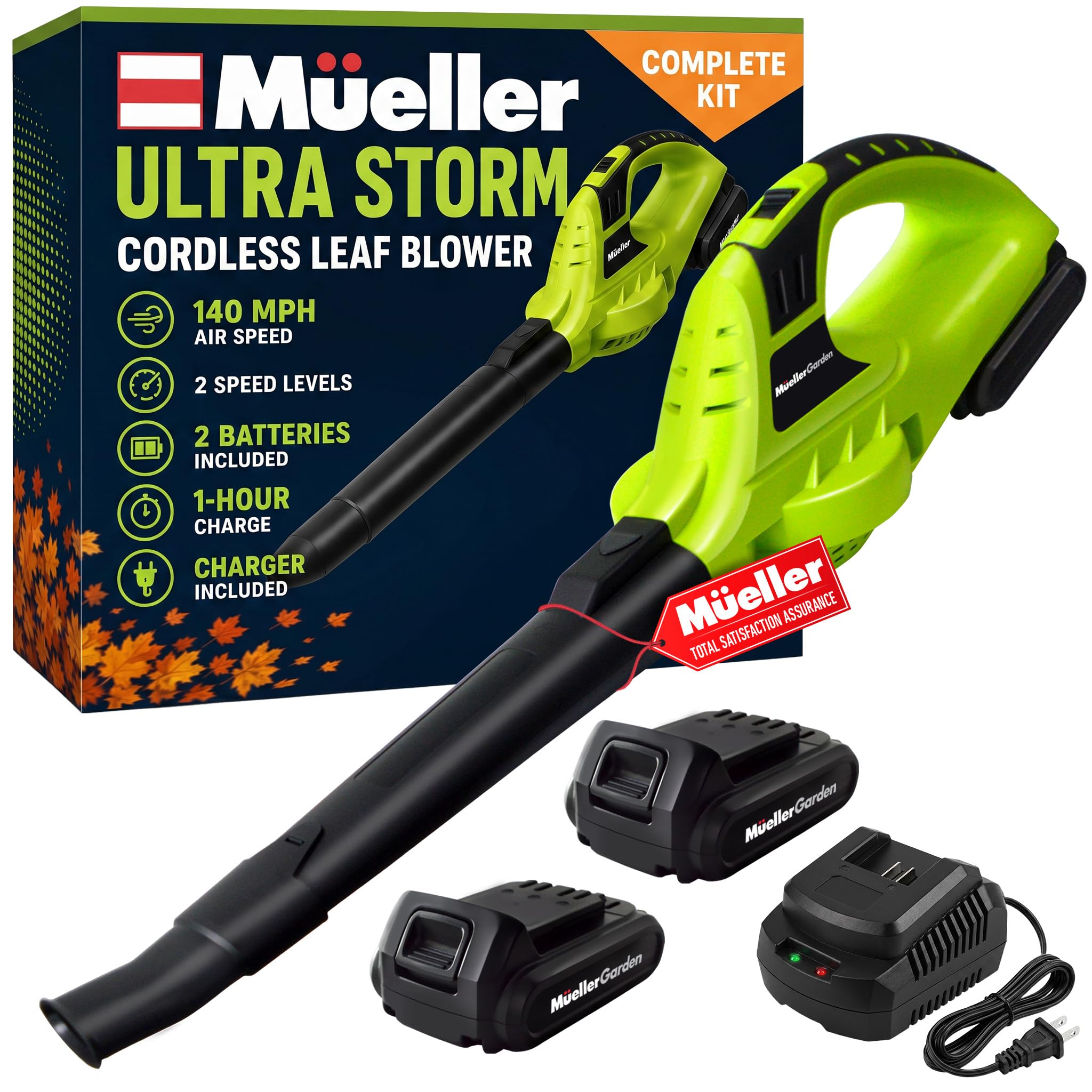
The Mueller UltraStorm is a value-driven alternative to the EWORK — it is slightly heavier at 3.3 pounds but delivers a broader airflow than the EWORK’s high-speed jet. Its 20V brushless motor pushes air at 140 MPH across a 2-speed dial, and the two included 2.0Ah batteries allow hot-swapping so you can keep blowing while one charges. Compared to the EWORK, the Mueller gives you a lower top speed (140 MPH vs 200 MPH) but a wider stream for moving larger areas of light debris.
What that money actually gets you is a twist: the Mueller blower shares its battery platform with other Mueller tools, and reviewers report that standard 20V batteries from other brands fit as replacements. However, the included battery only lasts about 20 minutes per charge — one buyer mentioned, “Good thing some batteries from other tools fit because the battery that comes with it only last about 20 minutes.” So plan to use the included two-battery swap system if your cleanup runs longer.
The one clear reason to choose the Mueller over the EWORK is that it covers more surface area per pass. If you are sweeping a wider driveway, the wider airflow means fewer passes. For tight budgets where every dollar matters and the job is light debris on hard surfaces, this is a solid pick.
What we like
- Two 2.0Ah batteries included for hot-swap continuous work
- Only 3.3 lbs — comfortable for users with arm or shoulder issues
- Shares battery with other 20V Mueller tools
The downsides
- Each battery lasts about 20 minutes in real use
- Not powerful enough for wet leaves or gravel
Understanding the Specs
CFM vs MPH — What Actually Moves the Leaves
CFM (cubic feet per minute) is the volume of air the blower moves — think of it as how wide a “push” you get. MPH (miles per hour) is the speed of that air — how hard it hits. For clearing a whole lawn of light leaves, CFM matters more (you want a high-volume push). For blasting a single stubborn leaf out of a crack, MPH matters more. A good all-rounder has at least 400 CFM and 120 MPH.
Battery Voltage and Amp-Hours
Voltage (V) determines how much power the motor can draw — higher voltage usually means more torque, which is important for moving wet, heavy debris. Amp-hours (Ah) is the battery’s fuel tank size — a 5.0Ah battery holds 2.5x more charge than a 2.0Ah battery, which directly translates to longer runtime. A 40V blower with a 5.0Ah battery stores twice the total energy of a 20V blower with a 5.0Ah battery, because voltage times amp-hours equals watt-hours (actual energy).
FAQ
How many CFM do I need for wet leaves?
Can I use a cordless blower for snow?
Do I need a separate battery for each tool brand?
Final Thoughts: The Verdict
When it comes down to it, the cordless garden blower winner is the SEESII 40V because it delivers 650 CFM of real-world clearing power with two 5.2Ah batteries that outlast the competition by a wide margin. If you want a premium ecosystem that shares batteries with a mower and trimmer, grab the Greenworks 60V. And for the largest properties where gas-replacing power is non-negotiable, the Husqvarna 350iB delivers the most CFM (800) on the list.