
If your garden is looking pale, with yellow leaves and dark green veins, your plants are starving for iron — even if the soil is full of it. The fix isn’t more iron; it’s the right kind. Chelated iron wraps each nutrient particle in a protective shell so your plant can absorb it instead of letting it get locked in the dirt. This article cuts through the chemistry to help you pick the chelated iron that actually works for your soil, plants, and watering style.
I’m Rikta — the co-founder and writer behind Lawn Gear Lab. This guide is built by comparing the manufacturers’ published specifications and the patterns across verified customer reviews, so you get each pick’s real strengths and trade-offs instead of marketing spin.
If your plants are showing signs of iron chlorosis, finding the right best chelated iron for plants can be the single most effective step toward restoring deep, healthy green growth in your garden, lawn, or containers.
How To Choose The Best Chelated Iron For Plants
The first thing to understand is that not all iron supplements are alike. If you just add iron sulfate to alkaline soil, the iron instantly becomes unavailable — a waste of money and effort. A chelated iron product uses an organic molecule to shield the iron from reacting with the soil, keeping it ready for your plant to drink up. The decision comes down to three factors: your soil pH, how you want to apply it, and the specific plants you are feeding.
Match the Chelate to Your Soil pH
This is the single most important spec. EDTA (ethylenediaminetetraacetic acid) works well in acidic to neutral soil (pH up to about 7.0). If your soil runs alkaline (pH 7.0 to 7.5), you need DTPA (diethylenetriaminepentaacetic acid) — it stays stable where EDTA fails. For very alkaline soil above pH 7.5, EDDHA is your only choice. Check your soil pH before you buy; the wrong chelate type means zero results.
Liquid, Powder, or Granule: What Fits Your Routine
Liquid concentrates are ready to mix and apply with a hose-end sprayer, which is convenient for lawns and large garden beds. Powders are more concentrated by weight (you get more iron per dollar) and work well for both soil drenching and foliar spraying. Granules, like the Earth Science IronPro, are designed for broadcast spreaders — they are slow-release and ideal for covering big lawns without mixing. Your watering setup and the size of your space decide the form.
Look at the Actual Iron Percentage
A 1-pound bag of 13% chelated iron delivers far more usable iron than a 32-ounce liquid with 6% iron. Check the guaranteed analysis on the label. A product that lists “Iron (Fe)” followed by a percentage tells you the real concentration. For a 1-pound container, a 13% iron product gives about 2.08 ounces of actual iron; a 6% iron liquid gives about 0.21 ounces of actual iron in a 32-ounce bottle. The number matters for cost-effectiveness and dosage.
Quick Comparison
On smaller screens, swipe sideways to see the full table.
| Model | Category | Best For | Key Spec | Amazon |
|---|---|---|---|---|
| Greenway Biotech DTPA 11% | Premium | Alkaline soils (pH up to 7.5) | 11% DTPA-chelate | Amazon |
| Greenway Biotech EDTA 13% | Premium | Highest iron concentration | 13% EDTA-chelate | Amazon |
| Earth Science IronPro | Granule | Lawns & large garden beds | 80 oz granules | Amazon |
| Liquinox 3032 Iron Zinc | Liquid | Fruit trees & deep-rooted shrubs | Iron + Zinc chelate | Amazon |
| Covington Chelated Liquid | Liquid | Quick stress recovery | 6% iron + 12% nitrogen | Amazon |
| Opulent Blends Liquid Iron | Liquid | Budget-friendly liquid | 6.5% iron, 32 oz | Amazon |
| Carl Pool Iron Chelate | Budget | Affordable soluble powder | 16 oz, 1:100 mix | Amazon |
In‑Depth Reviews
1. Greenway Biotech, Inc. Chelated Iron DTPA 11%
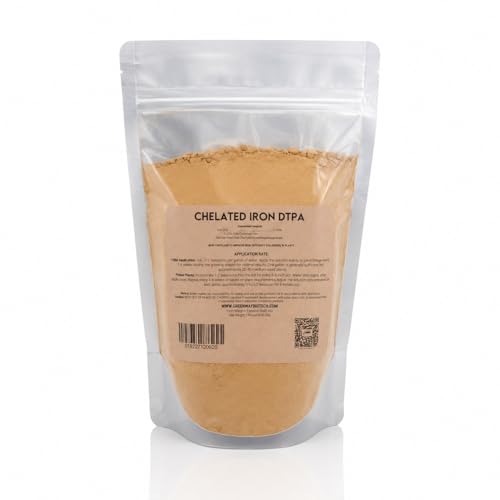
The 11% iron concentration and DTPA chelate make this the top pick for gardeners with alkaline soil up to pH 7.5 who need a fast-acting, versatile iron supplement. This 1-pound powder delivers many treatments — one buyer reports using a tablespoon weekly in aquaponic beds for spinach and seeing everything turn “super green.” You can use it as a foliar spray or a soil drench, and it dissolves completely with no sediment.
The DTPA chelate works in a pH range of 4.0 to 7.5, which is a clear advantage over the 13% EDTA version from the same brand (that one cuts out above pH 7.0). Buyers confirm that fruit trees with severe chlorosis perked up fast — one user’s pear tree even blossomed after treatment. The honest trade-off: if your soil is above pH 7.5, you would need the even stronger EDDHA chelate; but for most container, lawn, and orchard situations, this is the Goldilocks product. Trusted by commercial citrus growers since 1989, it lands with professional-grade reliability.
For most gardeners, this is the Goldilocks chelated iron that just works.
Why it’s great
- DTPA chelate stays stable up to pH 7.5, solving the alkaline soil problem
- 11% iron concentration in a 1-pound powder provides many treatments
- Dissolves completely for foliar spray, soil drench, or hydroponics; no residue
Good to know
- Not effective in soil above pH 7.5 where you would need EDDHA chelate
- Some buyers find the 1-pound bag small for large acreage applications
2. Greenway Biotech, Inc. Chelated Iron EDTA 13%
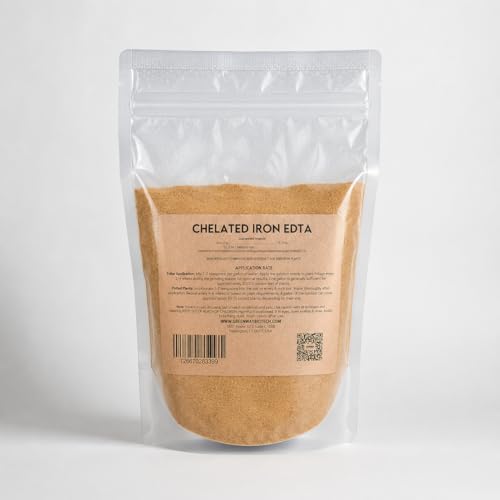
The 13% iron concentration makes this the most concentrated iron source in this category, beating the DTPA version’s 11% by a clear margin. If your soil is acidic to neutral (pH 4.0 to 7.0), you get more actual iron per dollar with this than with any other product here. Buyers report that it “dissolves faster and is 30% cheaper than Southern Ag,” which is a strong value signal.
The true strength here is for hydroponic and aquaponic setups. One reviewer running a 300-gallon aquaponics system reported that the EDTA iron “reversed severe interveinal chlorosis in lettuce and basil within 10 days” — and that the 1-pound bag lasts 4-5 months at a rate of 2 tablespoons per 5 gallons monthly. It is safe for fish (tilapia) and leaves zero sediment, which protects your pump and plumbing. For potted citrus in greenhouses, another reviewer says it turned “lots of large, deep green leaves” on their orange trees after a summer of feeding.
But remember: EDTA is less effective above pH 7.0. If your soil is alkaline, step up to the DTPA version. This one is the specialist for pH-conscious growers who want the highest iron concentration in their small-space or controlled setup.
Where it shines
- 13% iron concentration is the highest available in this lineup
- 100% water soluble with no residue, ideal for hydroponics and aquaponics
- Professional grade, CDFA registered, heavy-metal tested for purity
Worth noting
- EDTA chelate only works up to pH 7.0; loses effectiveness in alkaline soil
- Not as versatile as DTPA for varying soil conditions
3. Earth Science IronPro Fast Acting Lawn Garden Iron Supplement
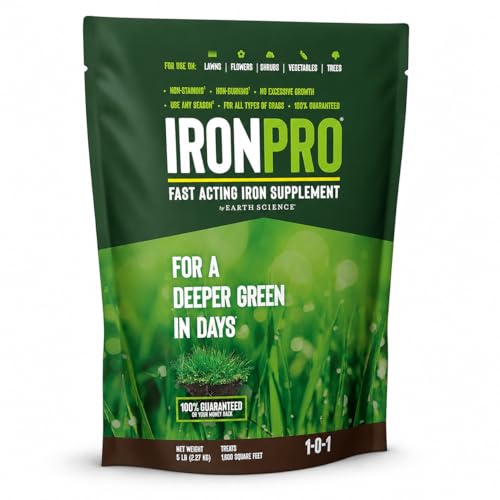
If you have a large lawn that needs an iron boost, you can walk across the yard with a spreader, throw down the granules, and water — covering up to 1,600 square feet per application, far more ground than any liquid product can handle in one go. The 80-ounce bag holds 5 times the unit count of the Carl Pool 16-ounce powder, a massive volume difference that makes this the most practical choice for covering a full yard. It is designed for grass, flowers, shrubs, vegetables, and trees, so you can treat the whole property with one bag.
The manufacturer claims a “patent-pending chelation technology” that increases iron uptake by 65%. Owners mention seeing results fast: “In a day or so after putting down and watering, my grass and tree are so rich in color and stature!” Another reviewer notes it helped treat lawn iron chlorosis promptly and also greened up gardenia leaves and bougainvilleas. It is a non-staining, non-burning formula, so you do not have to worry about dead spots or brown patches.
The catch is that granules are slow-release compared to liquid; you will see results over several days rather than hours. Compared to the Greenway Biotech DTPA powder, this is the set-and-forget choice for a pristine lawn with deep color all season — and it covers 1,600 square feet per application from a single 80-ounce bag.
What stands out
- Granular form works with standard broadcast spreaders for easy lawn coverage
- Non-staining and non-burning formula for safe application with pets and kids
- Feeds beneficial soil microbes for long-term soil health
The trade-offs
- Slower to show results than liquid foliar sprays
- Some users report a risk of burning plants if overdosed
4. Liquinox 3032 Iron Zinc Chelated Solution

The single number that matters most in this category is the chelated iron concentration, and this product scores 0.2% iron (by weight).
The 32-ounce bottle delivers both fully chelated iron and fully chelated zinc, so if your plants show interveinal chlorosis (yellow between the veins), you treat two deficiencies at once. The ready-to-use liquid dilutes at about 4 tablespoons per gallon. One buyer used it on an Indian laurel tree in full Arizona sun and saw “new growth turned bright green” after just one week.
The downside is concentration. A reviewer confirms the bottle contains 0.2% iron and 0.2% zinc (by weight), which makes it a lower-concentration solution than the Greenway powders by a wide margin. This means you will use the bottle faster for large areas. It is best suited for spot-treating individual trees, shrubs, and vines rather than blanketing a whole lawn. At this price-to-performance point, it is a fantastic entry-level chelate for beginner gardeners who want a simple pour-and-water solution without mixing powders.
The upsides
- Combination of fully chelated iron and zinc addresses two deficiencies at once
- Ready-to-use liquid; no mixing required beyond simple dilution
- Works well for fruit trees, avocado, lime, and deep-rooted shrubs
Keep in mind
- Low concentration (0.2% each) means you go through the bottle faster
- Not the best choice for large lawn coverage due to liquid volume needed
5. Covington Chelated Liquid Iron Concentrate
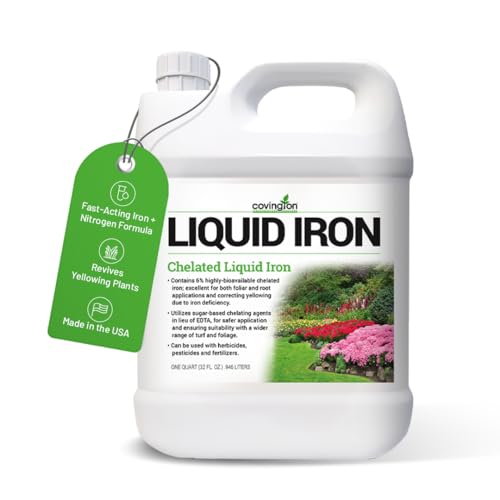
At this lower price you get a 6% iron concentrate with sugar-based chelation (no EDTA) plus 12% nitrogen, 3.3% sulfur, and 0.05% manganese — a full nutrient boost, not just an iron fix that helps plants bounce back from stress, compacted soil, or environmental shock. The added nitrogen gives your plants a simultaneous green-up and growth push, with buyers reporting results “in 3-4 days” and a full lawn turnaround in a week. The bottle covers 3,500 square feet, making it a compact solution for a moderate-sized yard.
One skeptic mixed 8 ounces in a gallon of water for roughly 1,000 square feet of yellow lawn and was “totally satisfied” after seeing all the grass go green. The trade-off is that one reviewer warns you must water the product in immediately after application, or it can blacken and potentially kill the grass — a real handling risk that the Liquinox or Opulent Blends liquids do not share. For gardeners who carefully read instructions and follow a watering schedule, this is a fast-acting, multi-nutrient iron solution; for the casual “spray and forget” user, the extra caution may be a dealbreaker.
This is the exact budget buyer it is perfect for: the attentive gardener who wants a low-cost, multi-nutrient iron fix and is willing to follow the watering-in step to avoid grass damage.
Why we’d pick it
- Contains 12% nitrogen for simultaneous green-up and growth stimulation
- EDTA-free, sugar-based chelation approach
- Quick results seen in 3-4 days on yellow lawns and stressed plants
A few caveats
- Must be watered in immediately to avoid burning or blackening the grass
- At 6% iron, it is half the concentration of the Greenway EDTA 13% powder
6. Opulent Blends Chelated Liquid Iron (32 oz)
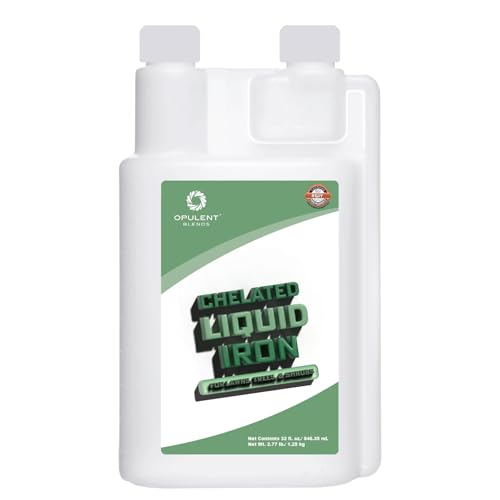
This budget-friendly liquid iron is perfect for the cost-conscious gardener who needs to cover a large area and is comfortable mixing their own concentrate. The 32-ounce bottle of EDTA-free liquid iron offers a 6.5% iron concentration and, according to the brand, covers up to 8,000 square feet when mixed at the recommended 1:100 ratio. At 2.77 pounds, this bottle provides 38% more product by weight than the 2-pound Liquinox liquid.
When it works, it works well: customers note “rapid results for iron deficiency in Carolina Laurel Cherry tree” with “dramatic greening within weeks.” However, the honest reality is that multiple reviewers point out the bottle leaks, with one reviewer noting the “product leaked in box and continues leaking from bottle; possible hairline crack.” Additionally, you must use the mixed solution immediately — one reviewer warns that if it sits overnight, the liquid “will gel up and may clog your nozzle.”
This is the perfect choice for the budget-conscious gardener who does not mind a little packaging fuss and will use the entire bottle in one or two applications. Just be aware that the bottle may arrive leaking, so plan to transfer it to a sealed container right away.
Strong points
- EDTA-free formula at a very accessible price point
- Claims coverage of 8,000 sq ft when mixed at the 1:100 ratio
- Shoppers say rapid greening of iron-deficient trees within weeks
Before you buy
- Multiple reports of bottle leaks in transit and upon arrival
- Mixed solution can gel and clog sprayer nozzles if not used promptly
7. Carl Pool Iron Chelate 1 Lb

Compared to the rest of the field, this 1-pound powder is the easiest on the wallet — but at 16 ounces, the bag is 5 times smaller than the Earth Science IronPro’s 80-ounce bag. You pay for a concentrated water-soluble powder that you mix at a 1:100 ratio. The real bargain is that a little goes a very long way if you are treating potted plants or a small garden. Buyers report real success with specific plants. One reviewer says it “revived a curry leaf plant with no new shoots in years; new shoots appeared in 2 months.” Another used it on gardenias and saw leaves “turn from yellow to green within a week.”
The one reason to choose this over the Opulent Blends liquid is that you control the mixing ratio; you can make a precise dose for a single potted plant without wasting a whole bottle. But a reviewer cautions it can “drastically lowers pH to super acidic” if you do not use a pH meter and pH Up solution — 5ml in a gallon can drop pH from 6.7 to the 3’s. So beginners need to be careful. It is perfect for the hands-on gardener who likes to mix their own solutions and does not mind checking pH levels.
What we like
- Very affordable entry point for a water-soluble chelated iron powder
- Dissolves instantly with no stirring needed; easy to mix small batches
- Owners mention success on curry leaf, gardenia, birch, and hibiscus
The downsides
- Can drastically lower pH of water, risking leaf burn if not monitored
- Small 1-pound bag is not cost-effective for large lawns
Understanding the Specs
EDTA, DTPA, EDDHA — Which Chelate Type?
The chelate type determines in what pH range the iron stays available. EDTA (ethylenediaminetetraacetic acid) works up to about pH 7.0 and is the most common and economical. DTPA (diethylenetriaminepentaacetic acid) extends that range to pH 7.5, making it better for slightly alkaline soils. EDDHA (ethylenediamine-N,N′-bis(2-hydroxyphenylacetic acid)) goes up to pH 9.0, but it is expensive and rarely needed for home gardens. Match the chelate to your soil pH — test your soil first, then pick the right letter.
Liquid vs. Powder vs. Granule
The form affects how you apply the product. Liquids are ready-to-dilute and work well with hose-end sprayers for foliar feeding and covering large lawns. Powders are concentrated by weight, giving you more actual iron per dollar; they dissolve in water for both foliar and soil use. Granules are designed for broadcast spreaders; they release slowly and are best for large lawns. Your choice depends on your equipment and whether you want instant feeding (liquid) or sustained release (granules).
FAQ
How quickly will chelated iron green up my yellow plants?
Can I use chelated iron with my other fertilizers?
What is the difference between chlorosis from iron deficiency and nitrogen deficiency?
Final Thoughts: The Verdict
Across the board, the best chelated iron for plants winner is the Greenway Biotech DTPA 11% because it handles the widest range of soil conditions (pH 4.0 to 7.5) in a professional-grade, water-soluble powder. If you want the highest iron concentration for controlled setups, grab the Greenway Biotech EDTA 13%. And for covering a full lawn with a spreader without mixing, the standout is the Earth Science IronPro granules.