
A balanced 13-13-13 fertilizer delivers equal parts nitrogen, phosphorus, and potassium — the three primary macronutrients every plant needs. Gardeners reach for this ratio when they want steady, all-around growth without guessing which nutrient is lacking. Whether you’re feeding a vegetable patch, a flower bed, or a row of shrubs, a reliable 13-13-13 formula simplifies feeding to a single, predictable application.
I’m Rikta — the co-founder and writer behind Lawn Gear Lab. I’ve spent many hours cross-referencing NPK ratios, analyzing slow-release coatings, and studying owner feedback across dozens of granular fertilizers to pinpoint which 13-13-13 products deliver consistent results without burning delicate roots.
After comparing seven formulations side by side, these picks rise above the rest. This is your data-backed guide to the best all purpose fertilizer 13 13 13 for lawns, gardens, and container plants in the current season.
How To Choose The Best All Purpose Fertilizer 13 13 13
A 13-13-13 bag looks simple enough — three equal numbers printed on the front. But the real performance depends on the nitrogen source, the presence of secondary nutrients, and the release mechanism. Here are the factors that separate a great feed from a bag that sits on the shelf.
Nitrogen Source and Release Speed
Nitrogen can come as fast-acting ammonium nitrate or slow-release urea coated with a polymer or sulfur. Fast-release forms green up leaves within days but risk burning tender roots, especially in hot weather. Slow-release coatings meter the 13% nitrogen over 6 to 8 weeks, which suits vegetable gardens and flower beds where steady feeding beats a single surge. Check the ingredient list for terms like “polymer-coated” or “SCU” (sulfur-coated urea) to gauge release speed.
Secondary Nutrients and Fillers
A 13-13-13 label guarantees only the big three. The rest of the bag contains filler material and sometimes valuable secondary nutrients. Pelletized lime, calcium, magnesium, and micronutrients like boron and zinc can turn a basic fertilizer into a soil correction tool. Products that list added calcium are especially helpful for tomatoes and peppers, which demand calcium to prevent blossom-end rot.
Particle Size and Spreader Compatibility
Fine, dust-like granules clump in humid conditions and drift unevenly from a broadcast spreader. Coarse, uniform prills flow cleanly through rotary and drop spreaders, delivering consistent coverage. If you plan to use a spreader over a large lawn or garden bed, look for particle descriptions that specify “prilled” or “uniform granules.” Small bags often use finer particles meant for hand application around individual plants.
Quick Comparison
On smaller screens, swipe sideways to see the full table.
| Model | Category | Best For | Key Spec | Amazon |
|---|---|---|---|---|
| Gardenwise 13-13-13 | Slow Release | All-around garden & lawn feeding | Feeds up to 8 weeks | Amazon |
| Pendelton 13-13-13 | Fast Release | Fruiting vegetables & vines | Includes pelletized lime | Amazon |
| Supply Solutions 16-16-16 | High N-P-K | Heavy feeders & established plants | 16% each N-P-K | Amazon |
| Espoma 10-10-10 | Quick Green | Roses, trees, shrubs | 2-pack, 13.5 lbs total | Amazon |
| Howard Johnsons 10-10-10 | Value Bulk | Large lawns & garden beds | 35-lb bag | Amazon |
| Jobe’s Organics 4-4-4 | OMRI Organic | Organic vegetable gardens | OMRI listed, 16 lbs | Amazon |
| Old Farmer’s Almanac 13-3-3 | Spikes | Deep-rooted trees & shrubs | 24 spikes, 13-3-3 | Amazon |
In‑Depth Reviews
1. Gardenwise 13-13-13 Slow Release Granular Fertilizer
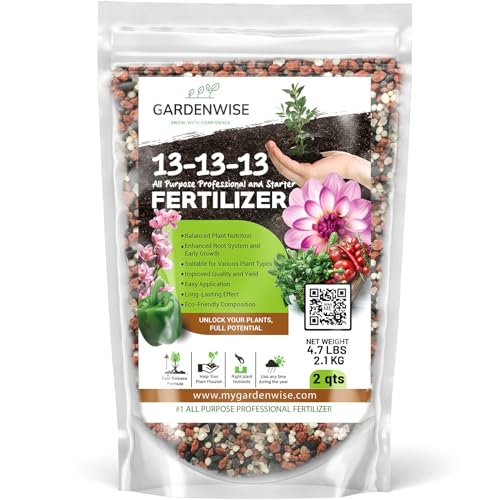
The Gardenwise 13-13-13 hits the sweet spot for gardeners who want a single bag to handle lawns, vegetable beds, roses, and shrubs. The slow-release coating meters out the 13-13-13 blend over roughly two months, which means fewer trips to the shed with a spreader. Each 4-lb bag covers about 2,000 square feet at the recommended 2-3 lbs per 1,000 sq ft rate for lawns, and the fine granules dissolve quickly into the soil surface for fast root uptake.
Owner reports highlight dramatic greening in St. Augustine grass and rapid growth in lime trees — one review noted a lime tree nearly doubling in size within three weeks. The slow-release mechanism also protects against burn, a common risk when applying 13-13-13 to shallow-rooted flowers or young transplants. The formula works equally well as a top-dress on potted plants, where the gradual feed prevents salt buildup in containers.
Gardenwise packages the fertilizer in several sizes from 1 lb to 40 lbs, so you can match the quantity to your project without overbuying. The resealable bag on smaller sizes keeps moisture out, preserving the integrity of the slow-release coating between applications.
What works
- Slow-release coating feeds for up to 8 weeks with one application
- Fine granules dissolve quickly and spread easily even in small beds
- Multiple bag sizes let you scale from containers to large lawns
What doesn’t
- Slow-release action delays visible green-up compared to fast-release formulas
- Bag weight labeled in quarts may confuse shoppers expecting pound-only measures
2. Pendelton Turf Supply 13-13-13 with Pelletized Lime
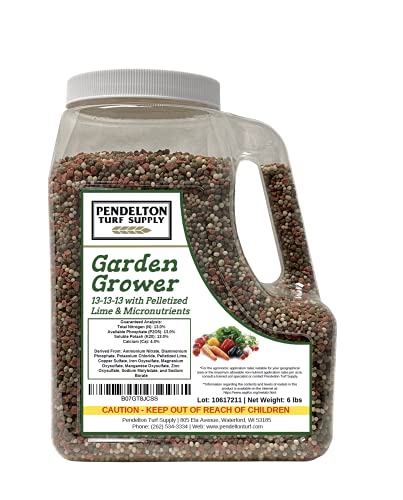
The Pendelton Turf Supply 13-13-13 stands out because it includes pelletized lime and micronutrients alongside the balanced NPK. The calcium from the lime is a direct benefit for tomato growers battling blossom-end rot and for soil that has drifted acidic from years of synthetic fertilizer use. At 6 lbs, the bag is light enough to carry in one hand yet covers a generous 300-400 sq ft of garden bed when worked into the top 4-6 inches before planting.
Application instructions are crop-specific rather than generic: 1/2 lb per 25 ft of row for vegetables and flowers, with follow-up side-dressings for tomatoes after blossom and vine crops every 4-6 weeks. This granular detail makes the bag feel like a companion guide for new gardeners who are unsure how much to apply. Reviews confirm that vegetables and fruit produce noticeably larger yields after switching to this formula.
The pelletized lime also buffers pH, which helps unlock soil nutrients that may be locked up in overly acidic conditions. This is a fast-release fertilizer, so expect a quick green-up within a week — but the trade-off is a higher risk of burn if over-applied. Measure carefully and water in thoroughly after each application to move the granules into the root zone.
What works
- Pelletized lime adds calcium and corrects acidic soil pH simultaneously
- Crop-specific feeding instructions help beginners apply correctly
- Fast-release formula produces visible results within days
What doesn’t
- Fast-release nitrogen requires careful measuring to avoid burn
- 6-lb bag runs out quickly on larger vegetable gardens
3. Supply Solutions 16-16-16 Complete Lawn & Garden Fertilizer
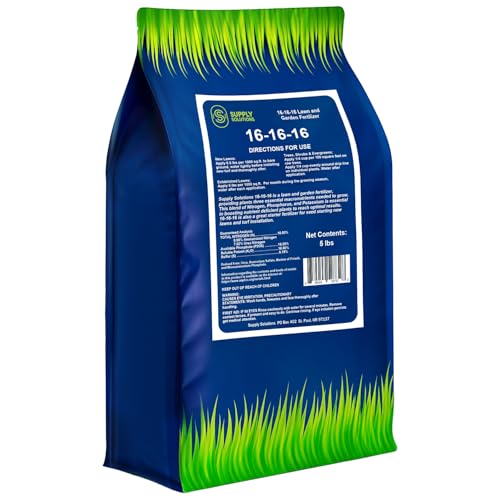
The Supply Solutions 16-16-16 is not a 13-13-13, but it lands on this list because its 1:1:1 ratio mirrors the same balanced philosophy at a higher concentration. Each of the three macronutrients sits at 16%, which means a smaller volume of granules delivers the same nutrient load as a larger scoop of a 13-13-13. This efficiency matters when you are feeding a large lawn or a dense stand of flowering annuals that need a robust boost.
The granular form spreads easily through a broadcast spreader, and the 5-lb bag (80 oz by weight) is compact enough to store on a garage shelf. Owners report rapid improvement in tomatoes and peppers — one review noted visible improvement in foliage and fruit set within five days. The nitrogen supports chlorophyll production for deep green leaves, while the phosphorus and potassium drive bloom formation and root reinforcement.
Because the NPK numbers are higher, beginners should apply at a reduced rate compared to a 13-13-13 to avoid over-concentrating nutrients in the soil. The product packaging has recently shifted from white to blue, but the formulation remains the same. This is a reliable option for gardeners who want more punch per pound.
What works
- Higher 16-16-16 ratio means less product needed for the same feeding effect
- Compact 5-lb bag is easy to store and handle
- Fast-acting formula greens up foliage within days
What doesn’t
- Not suitable for seedlings or young transplants without dilution
- Higher concentration increases burn risk if over-applied
4. Espoma 10-10-10 Garden Food (2-Pack)
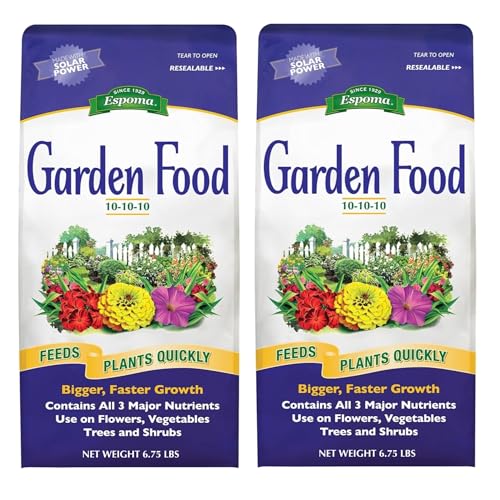
Espoma’s 10-10-10 Garden Food comes as a two-pack totaling 13.5 lbs, giving you flexibility to treat both spring and fall feedings without a second purchase. The 10-10-10 ratio is slightly milder than 13-13-13, which reduces the chance of burning sensitive plants like roses, young shrubs, and newly planted trees. The granular formula is ready to use straight from the bag — no mixing, no dissolving — and Espoma recommends applying monthly throughout the growing season.
Long-term Espoma users report dramatic results with trees and perennials. One review described a lightning-damaged magnolia tree reviving fully after two applications, and a fig tree producing so many fruits that the owner had to thin branches to prevent breakage. The balanced NPK supports both vegetative growth and flower set, making it a viable all-purpose choice for mixed beds of ornamentals and edibles.
Espoma products are made in the USA and use agricultural-grade ingredients without fillers. The 10-10-10 blend is particularly useful in sandy soils where a full-strength 13-13-13 might leach away quickly, because the lower concentration allows more frequent feeding without salt buildup. Apply around the drip line of trees and shrubs, then water thoroughly to drive nutrients to the root zone.
What works
- Lower NPK ratio is gentler on roses, trees, and young shrubs
- Two-bag pack covers both spring and fall feeding cycles
- Agricultural-grade ingredients with no filler shortcuts
What doesn’t
- 10-10-10 ratio is less concentrated, requiring more product per square foot
- Not slow-release — needs reapplication every 3-4 weeks
5. Howard Johnsons 10-10-10 All-Purpose Fertilizer (35 lbs)

The Howard Johnsons 10-10-10 is the volume play for gardeners with large properties. A 35-lb bag delivers a season’s worth of balanced nutrition for a quarter-acre lawn or an expansive vegetable plot. The granular mix is uniform and flows well through a broadcast spreader, which cuts application time compared to hand-scattering smaller bags. The 10-10-10 ratio provides the same 1:1:1 philosophy as 13-13-13 but at a lower concentration, giving you more forgiveness if your spreader overlaps.
Reviews highlight the bag’s value as a plain, no-frills fertilizer — no weed preventers, no pre-emergent herbicides, just straight NPK. This purity matters for gardeners who want to control their own weed management program separately. The grass responds with steady, slow growth rather than a sudden surge, and owners report healthy greening without the flush of top growth that requires more frequent mowing.
The powder-like dust in the bag can be an issue in humid climates, where clumps form if the bag is not resealed tightly. Storing the bag in a dry shed or transferring the contents to a sealed tub preserves the granular flow. For growers who measure by the scoop and feed by the acre, this bag offers the lowest cost per pound in this lineup.
What works
- 35-lb bag provides the lowest cost per pound for large-area feeding
- Balanced 10-10-10 formula works on lawns, gardens, and shrubs
- No pre-emergent or weed killer — clean NPK feed
What doesn’t
- Powder component can clump if stored in humid conditions
- Lower NPK ratio means heavier application rates for heavy feeders
6. Jobe’s Organics All Purpose Granular Fertilizer (16 lbs)

Jobe’s Organics 4-4-4 is the only OMRI-listed organic option on this list, making it the go-to for certified organic vegetable gardens. The 4-4-4 ratio is significantly milder than 13-13-13, but the organic nitrogen sources — feather meal, bone meal, and sulfate of potash — release nutrients as soil microbes break them down. This biological feeding process builds soil organic matter over time, which is the foundation of long-term soil health.
The 16-lb bag comes with a resealable closure that keeps the granules dry between applications. Users have reported fantastic results making a liquid feed by steeping one cup of granules in a gallon of dechlorinated water for 24 hours, then diluting that liquid one cup per gallon of water for weekly feeding. This method gives container gardeners the quick boost of a liquid fertilizer while still relying on organic inputs.
The granules have a mild organic odor — noticeable but far less pungent than raw manure. Spread the fertilizer every 2-3 weeks during the growing season, or mix it into the soil at planting time for a slow-release starter feed. Note that the low NPK means you will use more product per square foot compared to a synthetic 13-13-13, but the organic matter payoff justifies the extra volume for dedicated organic growers.
What works
- OMRI-listed for use in certified organic gardens
- Can be used dry or brewed into a liquid tea for faster uptake
- Organic ingredients build soil microbiology and structure
What doesn’t
- 4-4-4 ratio is less concentrated, requiring larger volumes per feeding
- Nutrient release depends on soil temperature and microbial activity
7. The Old Farmer’s Almanac Tree & Shrub Fertilizer Spikes (24 Count)
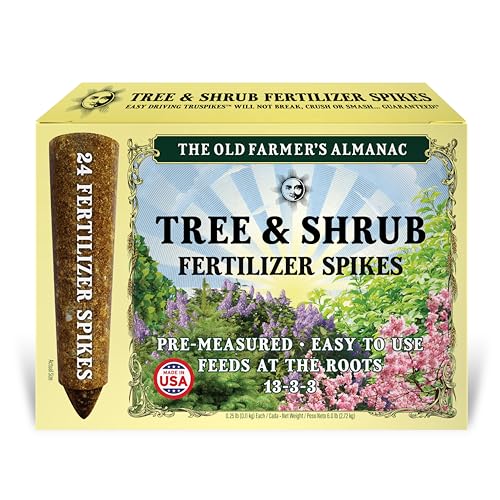
The Old Farmer’s Almanac Fertilizer Spikes deliver a 13-3-3 ratio that is top-heavy with nitrogen for foliage growth on trees and shrubs. While the N-P-K does not match the balanced 1:1:1 of a 13-13-13 granular, the spike format solves a common problem: deep root feeding. Each 5-inch TruSpike is driven into the soil around the drip line, releasing nutrients directly into the root zone without runoff or surface waste.
The spikes are formulated with natural ingredients including molasses, which feeds soil microbes and helps break down the nutrients for root absorption. Owners report that the spikes drive into clay soil without shattering — a notable improvement over some brittle spike brands that crack under a hammer. One user noted that a Japanese Stewartia tree produced more flowers than ever after a season of spike feeding, and a fountain beech tree leafed out fuller and earlier.
Apply the spikes twice per year: early spring and late fall. Each spike feeds a 2-inch diameter of trunk caliper, so a mature tree with a 10-inch diameter trunk needs five spikes evenly spaced around the drip line. The spikes are a clean, mess-free alternative to measuring and spreading granular feed, and they eliminate the risk of granules washing into storm drains or burning the trunk base.
What works
- Deep root delivery prevents runoff and targets tree feeding directly
- Spikes drive into clay soil without cracking or crumbling
- Natural molasses ingredient supports beneficial soil microbiology
What doesn’t
- 13-3-3 ratio is not balanced for general garden or lawn use
- Each spike covers a limited area — large trees require multiple packs
Hardware & Specs Guide
NPK Ratio Precision
The three numbers on a 13-13-13 bag represent the percentage by weight of nitrogen (N), available phosphate (P2O5), and soluble potash (K2O). A 13-13-13 bag contains 13 units of each macronutrient per 100 units of product, with the remaining 61% consisting of filler material and secondary nutrients. This ratio is ideal for balanced maintenance feeding because it prevents overloading any single nutrient while providing a steady supply for both foliage growth and flower/fruit development.
Release Mechanism and Coating
Slow-release 13-13-13 fertilizers use polymer, sulfur, or resin coatings around the nitrogen granule. These coatings dissolve gradually as soil moisture and temperature interact with the shell, extending the feeding window from 6 to 12 weeks. Uncoated or fast-release 13-13-13 dissolves within 1-2 weeks, making the nitrogen available immediately but requiring more frequent application. For gardens with sandy soil or heavy rainfall, slow-release formulations reduce nutrient leaching and improve uptake efficiency.
FAQ
Can I use a 13-13-13 fertilizer on my lawn every month?
How long does it take for 13-13-13 granular fertilizer to work?
Is 13-13-13 fertilizer good for tomatoes and peppers?
What does 13-13-13 mean on a fertilizer bag?
Final Thoughts: The Verdict
For most gardeners, the all purpose fertilizer 13 13 13 winner is the Gardenwise 13-13-13 because its slow-release coating feeds plants for up to 8 weeks with a single application, protecting against burn while delivering consistent growth across lawns, vegetables, and ornamentals. If you want a fast-acting formula with added calcium for fruiting crops, grab the Pendelton 13-13-13 with Pelletized Lime. And for covering large areas on a budget, nothing beats the Howard Johnsons 10-10-10 bulk bag.