
A push mower that can handle daily commercial use isn’t just about a bigger engine — it demands a heavy-duty steel deck, a transmission that won’t slip under load, and a wheel system that stays planted on uneven terrain. Utility crews and large-property owners need a machine that mows thick, wet grass without bogging down shift after shift, not a consumer model that fades after a season.
I’m Rikta — the co-founder and writer behind Lawn Gear Lab. I’ve spent hundreds of hours cross-referencing torque curves, deck gauge thickness, transmission types, and real owner feedback to separate the true workhorses from the weekend-only machines for this guide.
Whether you’re maintaining a rental portfolio or cutting multiple lots per week, finding the right commercial grade push mower means prioritizing durable drivetrains, reliable starting systems, and decks built for repetitive high-volume cutting.
How To Choose The Best Commercial Grade Push Mower
Commercial-grade mowers live in a different world than residential models. The cutting cycle is shorter, the grass is denser, and the machine’s frame endures hours of vibration every week. Three factors separate a true commercial workhorse from a dressed-up homeowner model: the deck’s structural integrity, the drivetrain’s slip resistance, and the engine’s sustained torque under load.
Deck Construction and Gauge
Look for a fabricated steel deck (typically 10- or 11-gauge) rather than stamped steel. A stamped deck is pressed from a single thin sheet and can flex or crack over time. Fabricated decks are welded from thicker steel plates with reinforcement ribs, maintaining blade-spindle alignment under heavy use. Aluminum decks offer corrosion resistance but can dent more readily on rocky terrain. The deck is the mower’s backbone — cheap out here and nothing else matters.
Transmission and Wheel Drive
Rear-wheel drive (RWD) provides superior traction on inclines and wet grass compared to front-wheel drive (FWD), which tends to lose grip when the bag fills. Commercial operators should prioritize a sealed hydrostatic or continuously variable transmission (CVT) rather than a gear-driven unit. Sealed transmissions are maintenance-free and resist contamination from dust and clippings. Variable-speed systems let you match ground speed to grass density without clutching, reducing fatigue over a long day.
Engine Selection and Torque
Displacement alone doesn’t tell the full story — look for engines with high torque at lower RPMs, typically 170cc to 201cc on push models. OHV (overhead valve) designs run cooler and more efficiently than older flathead engines. Automatic choke systems eliminate prime-and-pull guesswork, a significant time saver when starting and stopping repeatedly during commercial rounds. Consider parts availability and service network support; a mower that requires shipping for repairs costs you revenue.
Quick Comparison
On smaller screens, swipe sideways to see the full table.
| Model | Category | Best For | Key Spec | Amazon |
|---|---|---|---|---|
| Milwaukee M18 Fuel 21″ | Cordless Electric | Fleet compatibility with M18 tools | M18 Fuel dual battery, steel deck | Amazon |
| EGO Power+ LM2156SP-2 | Cordless Electric | Max runtime with dual 10Ah batteries | 75 min runtime, 8.3 ft-lbs torque | Amazon |
| EGO Power+ LM2200SP | Cordless Electric | Ultra-durable aluminum deck | 22″ cast aluminum deck, Select Cut | Amazon |
| Honda HRX217YXBEXA6 | Cordless Electric | Honda cut quality in battery form | 12Ah battery, MicroCut twin blades | Amazon |
| Makita XML08Z | Cordless Electric | 18V X2 platform extended runtime | 4-battery bays, variable speed 1.5-3 MPH | Amazon |
| YARDMAX YG2860 | Gas Self-Propelled | CVT speed variability on hills | 201cc engine, 6-speed CVT, 22″ deck | Amazon |
| SENIX LSSG-H4 | Gas Self-Propelled | Lightweight 170cc for slopes | 22″ steel deck, 72.8 lbs | Amazon |
| SENIX G-H-FIVE | Gas Self-Propelled | 4.7HP torque for thick grass | 201cc, 8.8 ft-lbs torque, vortex deck | Amazon |
| BILT HARD 21″ | Gas Self-Propelled | RWD traction on entry budget | 201cc, 9.0 ft-lbs torque, rear wheel drive | Amazon |
| Greenworks MO48L520 | Cordless Electric | 24V platform expandability | 48V (24Vx2), brushless motor, 45 min | Amazon |
| Earthquake 40314 | Gas String Mower | Heavy weeds and brush clearing | 160cc Viper, 22″ cut, airless wheels | Amazon |
In‑Depth Reviews
1. Milwaukee M18 Fuel 21″ Self-Propelled Dual Battery Mower

The Milwaukee M18 Fuel mower sits at the apex of the cordless commercial segment, offering a steel deck and the brute force of the M18 Fuel motor platform. For operators already invested in Milwaukee’s ecosystem, this mower eliminates the need to maintain a separate battery family while delivering cut quality that rivals gas. The variable-speed self-propel and push-button start make repetitive mowing cycles fast and fatigue-free.
Owner feedback consistently highlights the machine’s quiet operation and smooth acceleration, with multiple users reporting excellent results on lots approaching 3/4 of an acre. The steel deck provides the rigidity needed for consistent blade engagement even over uneven terrain, and the aluminum alloy steel construction keeps weight manageable at 65 pounds — notably lighter than many comparable gas models.
The dual-battery system (two M18 high-output batteries required, sold separately) delivers enough runtime for most commercial half-day routes. Where this mower truly distinguishes itself is in the seamless integration of speed control and cutting power: the Fuel brushless motor maintains blade speed regardless of forward motion, preventing the ragged cuts that plague cheaper electrics.
What works
- Steel deck provides commercial-grade rigidity for consistent cut quality on uneven ground
- M18 Fuel platform compatibility means shared batteries with drills, saws, and blasters
- Push-button electric start with no prime, no choke, no pull cord
What doesn’t
- Batteries and charger sold separately — substantial upfront cost if not already in the M18 ecosystem
- 21-inch deck feels narrow for wide-open properties larger than a half-acre
2. EGO Power+ LM2156SP-2 Select Cut Self-Propelled Mower
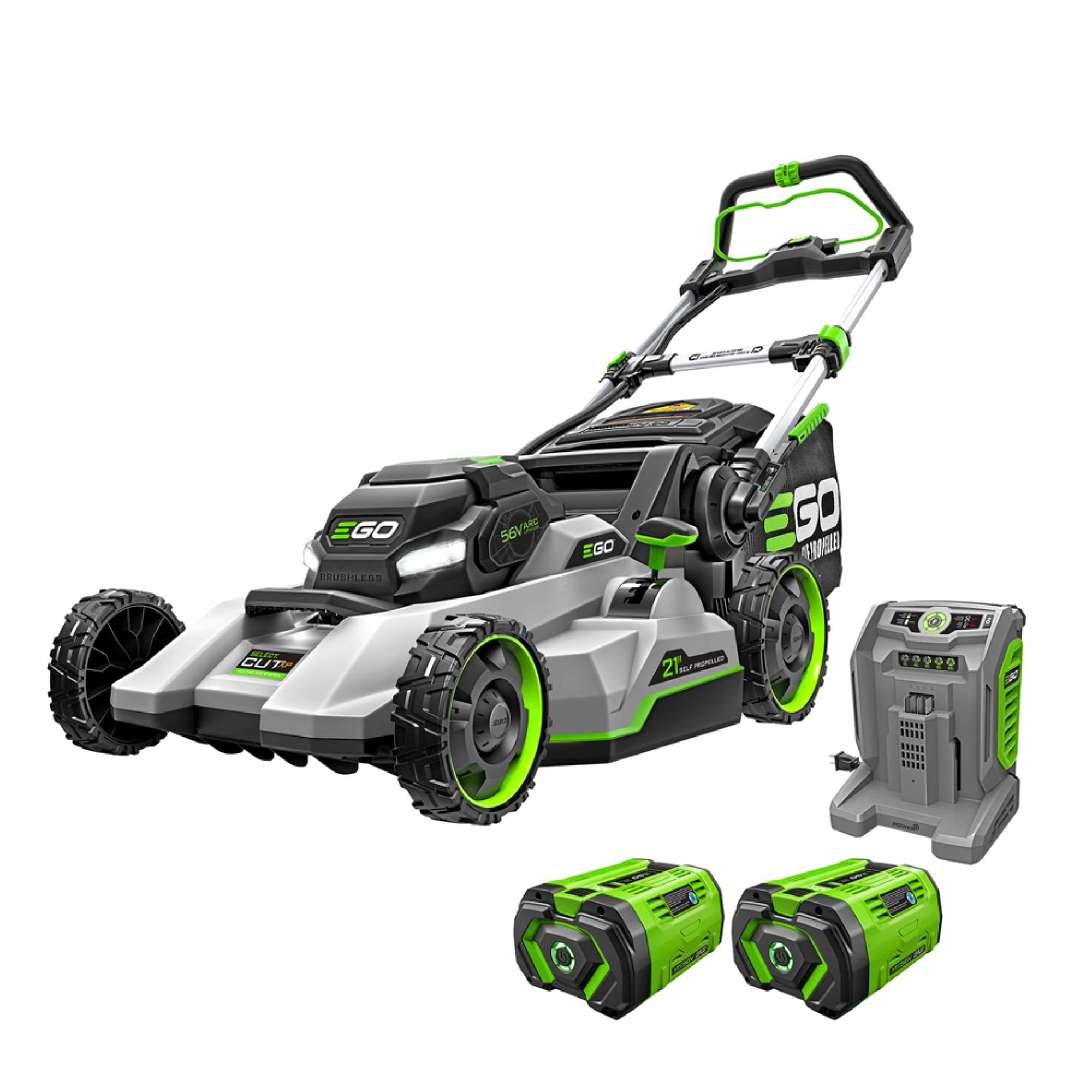
The EGO LM2156SP-2 is the full-kit version of EGO’s commercial-class mower, shipping with two 56V 10.0Ah ARC Lithium batteries and a 700W turbo charger. Rated at 75 minutes of runtime per battery, this setup easily covers an acre of dense grass without recharging mid-job — a critical advantage for production-focused operators who need uninterrupted cutting windows.
The Select Cut multi-blade system uses interchangeable lower blades (high-lift for bagging, extended runtime for mulching) plus an upper blade, giving the operator three distinct cutting personalities from one deck. Touch Drive self-propelled technology with digital variable speed (0.9 to 3.1 MPH) lets the user adjust pace precisely by finger pressure, reducing wrist fatigue over long shifts.
Real-world owner reports confirm the mower handles wet, thick grass up to 14 inches tall without bogging, and the 5-year tool and battery warranty provides confidence for daily commercial use. The IPX4 weather-resistant construction means rain delays won’t end your session, and the foldable handle with compact storage saves van or trailer space.
What works
- Two 10.0Ah batteries provide full-acre cutting without recharging
- Select Cut system offers mulching, bagging, and extended-runtime blade profiles
- Touch Drive self-propel with infinitely variable speed reduces operator fatigue
What doesn’t
- Unit weight of 99 pounds with batteries makes maneuvering feel heavier than gas equivalents
- Replacement battery cost is high — protecting the investment is essential
3. EGO Power+ LM2200SP Self-Propelled Lawn Mower

The EGO LM2200SP features a 22-inch cast aluminum deck backed by a lifetime warranty — a standout spec in the cordless mower market where stamped steel and plastic decks dominate. Cast aluminum won’t rust, resists corrosion from fertilizer and wet grass, and holds critical blade-spindle alignment indefinitely, making this deck the most durable option for operators cutting multiple properties weekly.
Equipped with EGO’s Select Cut system, the LM2200SP includes interchangeable high-performance and high-lift bagging blades plus a dedicated upper blade. The Touch Drive self-propel provides palm-actuated variable speed, while the push-button start eliminates pull-cord failures. At 11.1 ft-lbs of cutting torque and blade speeds reaching 3,350 RPM, this mower exceeds the power output of many gas competitors.
Owners praise the mower’s ability to handle thick, long, and wet grass effortlessly, with many reporting that the mulching performance leaves no visible clippings. The tool-only configuration (batteries and charger sold separately) allows buyers already on the EGO platform to upgrade without redundant battery purchases, though new adopters should budget accordingly for the 56V 10.0Ah battery and turbo charger.
What works
- Lifetime warranty on the cast aluminum deck — unmatched rust and structural protection
- 11.1 ft-lbs cutting torque with 3,350 RPM blade speed exceeds most gas mowers
- Select Cut multi-blade system delivers customizable cutting profiles
What doesn’t
- Batteries and charger sold separately — significant added cost for new EGO users
- Aluminum deck adds weight compared to stamped steel; mower feels heavier at 83.8 pounds
4. Honda HRX-BE HRX217YXBEXA6 Battery Powered Mower
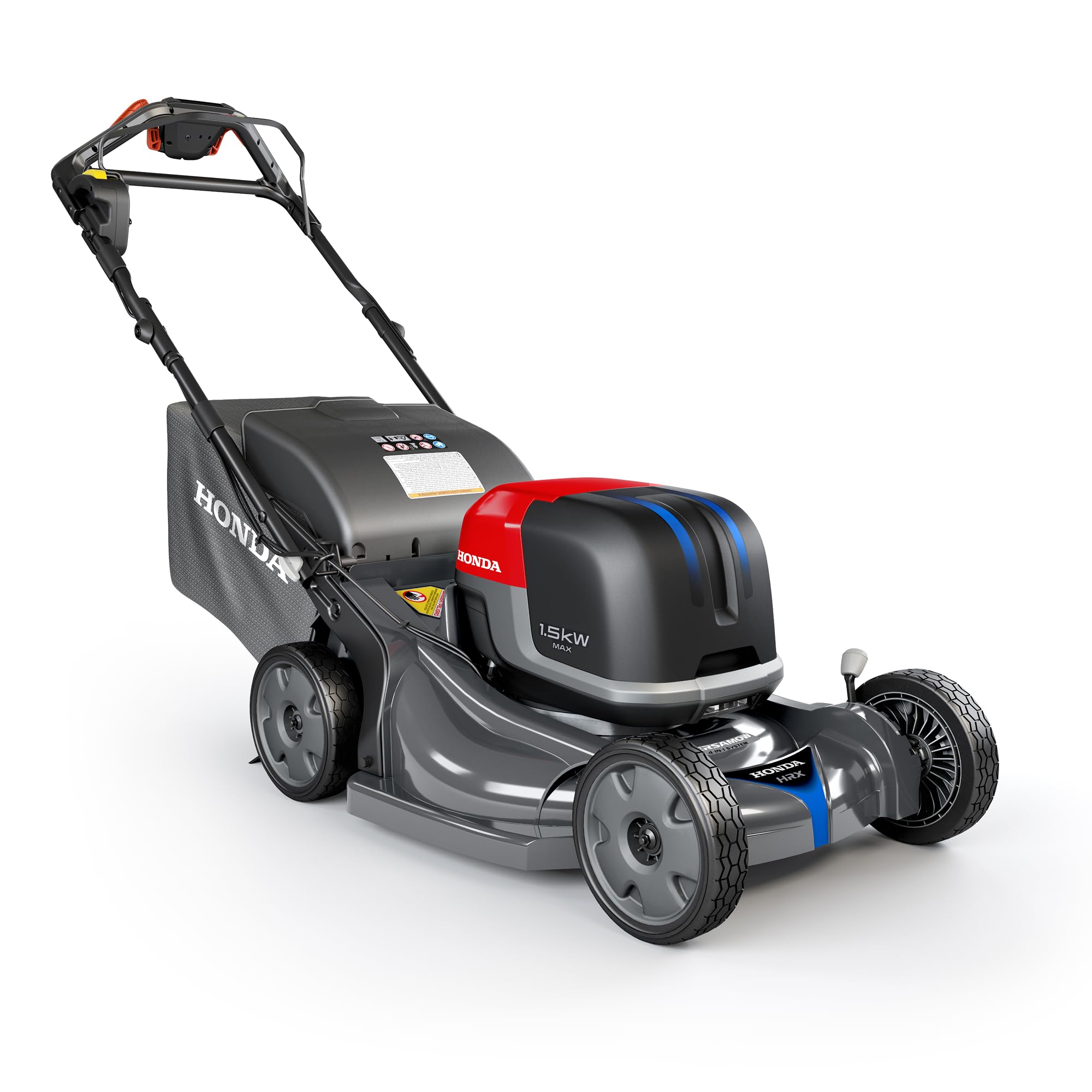
Honda brings its legendary GCV engine DNA into the battery-powered arena with the HRX217YXBEXA6, featuring the same high-torque motor architecture found in its gas fleet. The MicroCut twin-blade system creates four cutting surfaces per revolution, producing ultra-fine clippings that decompose quickly — a major advantage for commercial operators who need clean mulching without bagging. The e-Select Drive electric transmission offers infinitely variable speed from 0 to 4 MPH via a button touch.
The 2.2-bushel Easy-Off grass bag uses a top-release mechanism that empties without lifting the full weight, reducing back strain during repetitive dumping cycles. Seven cutting heights from 0.75 to 4 inches give precise control for different grass types and seasonal conditions. Honda backs this mower with a 5-year residential warranty and supports it through a nationwide service network — critical for commercial buyers who can’t afford downtime.
Real-world owners consistently report that the cut quality matches Honda’s gas HRX models, with the instant-start benefit and zero maintenance overhead. The 12Ah battery delivers about 45 minutes per charge, covering roughly 0.37 acres. A second battery (sold separately) doubles runtime and automatically switches between bays without interruption, making this viable for larger commercial lots.
What works
- MicroCut twin-blade system produces finer clippings than any single-blade competitor
- e-Select Drive delivers precise, button-controlled variable speed up to 4 MPH
- Nationwide parts and service network supports commercial repair needs
What doesn’t
- Included 2A charger is slow (6+ hours for a full charge); fast charger is an additional purchase
- Plastic deck construction lacks the dent resistance of steel or aluminum decks used on job sites
5. Makita XML08Z 36V (18V X2) LXT Brushless Mower
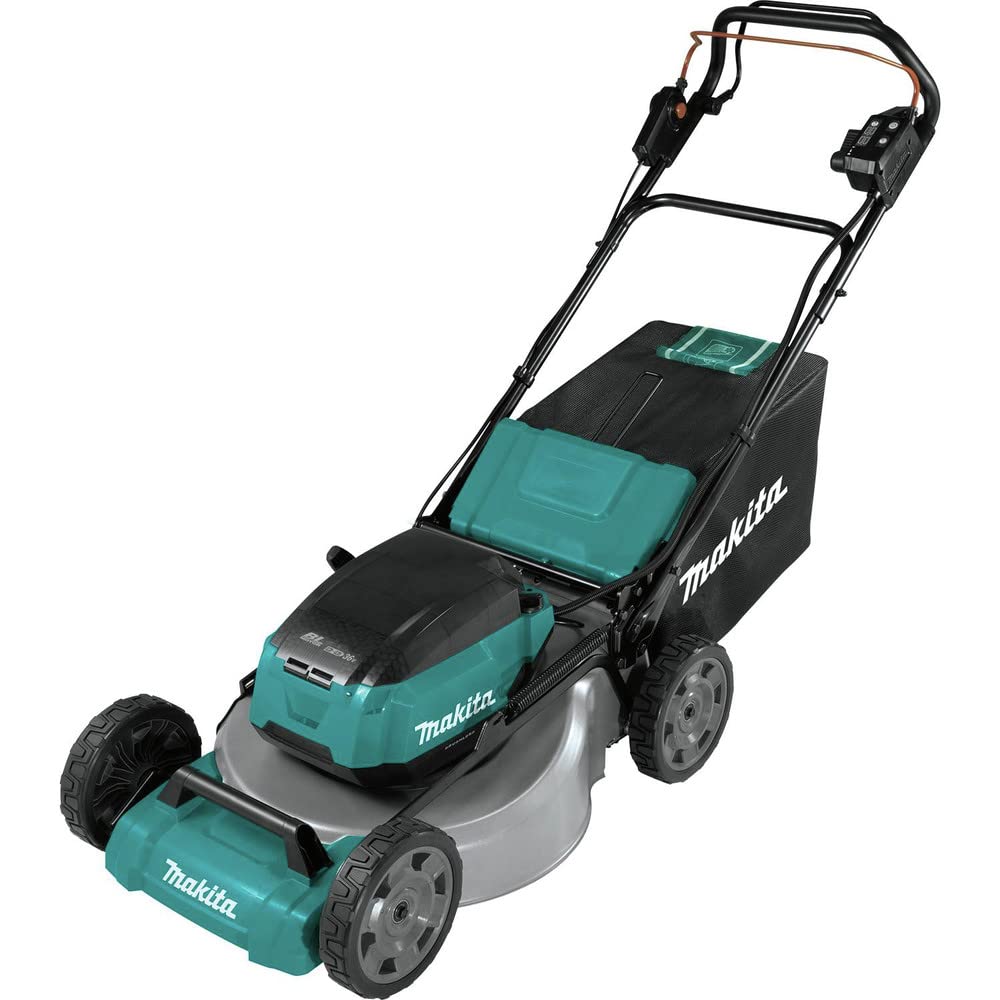
Makita’s XML08Z takes a unique approach to commercial runtime: a 4-battery bay system that accepts up to four 18V LXT batteries (two required, two optional for extended runtime). This design means operators can drop in their existing LXT batteries from drills and saws, mow for an hour on four batteries, then recharge and return to service using the same ecosystem. The brushless motor automatically adjusts torque when it senses tall grass, maintaining blade speed without operator intervention.
The variable-speed self-propel ranges from 1.5 to 3 MPH, adjustable via a dial on the handle, and the rear-wheel drive configuration maintains traction on hills when the grass bag fills. Eleven cutting height positions (from 1.25 to 4 inches) give the most granular deck height control of any mower in this comparison, allowing fine-tuning for different turf species and seasonal conditions.
Owner reports emphasize the powerful vacuum-like bagging performance — the twin-blade design fills the bag more densely than a typical gas mower, reducing the number of stops per lot. The commercial-grade steel deck and 3-year limited warranty signal Makita’s intent for this to handle daily use. The main trade-off is cut quality in mulching mode, where some users note it doesn’t chop as finely as a dedicated gas mulching deck.
What works
- Four-battery bay system allows up to 1 hour runtime with full LXT battery set
- Variable-speed self-propel with RWD provides excellent hill traction under load
- 11-position single-lever height adjustment offers precise deck level control
What doesn’t
- Mulching performance leaves more visible clippings compared to gas mowers with fine-chop decks
- Requires four high-capacity batteries and a fast charger to unlock full commercial potential
6. YARDMAX 22 in. 201cc CVT High Wheel FWD Self Propelled Mower (YG2860)
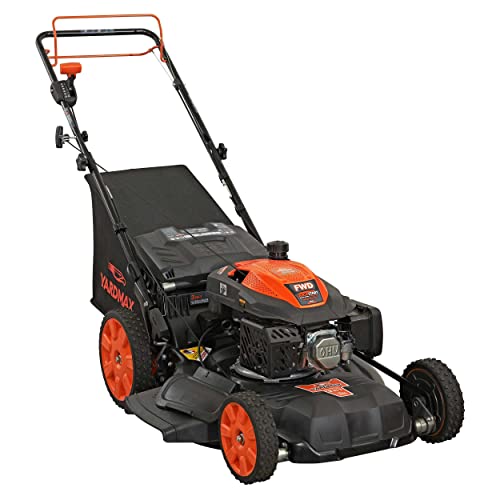
The YARDMAX YG2860 introduces a continuously variable transmission (CVT) with six selectable speed ranges to this category, allowing the operator to fine-tune ground speed independently of engine RPM. This is a meaningful advantage for commercial use: you can crawl through dense, wet patches at full blade speed or open up the pace on thin Bermuda without lugging the engine. The 201cc engine starts reliably with an automatic choke system that eliminates the prime-and-pull ritual.
The 22-inch stamped steel deck is paired with aggressive spiked-tread rubber tires for enhanced traction, and the single-lever deck adjustment lets you quickly switch between 10 cutting heights. A deck cleanout port enables quick underside washing without tilting the mower — a feature that saves minutes per cleaning cycle when you’re servicing multiple machines. The folding handle design reduces storage footprint in a trailer or shed.
Multiple owners confirm this mower starts on the first or second pull and handles 3/4-acre lots easily with good fuel economy. The caveat is the front-wheel-drive system: on wet grass or when climbing slopes with a full bag, FWD loses traction and becomes difficult to steer. Operators on flat terrain will find the CVT worth the compromise, but hillside crews should budget for RWD alternatives.
What works
- 6-speed CVT provides precise ground speed matching without sacrificing blade RPM
- Automatic choke system eliminates manual priming for fast, reliable starting
- Aggressive tread tires improve traction on uneven terrain for a FWD mower
What doesn’t
- Front-wheel drive loses traction on wet grass and slopes, especially with full bag
- Heavy unit at 84.9 pounds; maneuvering in tight spaces requires effort
7. SENIX 22″ 170cc Self Propelled Gas Lawn Mower (LSSG-H4)
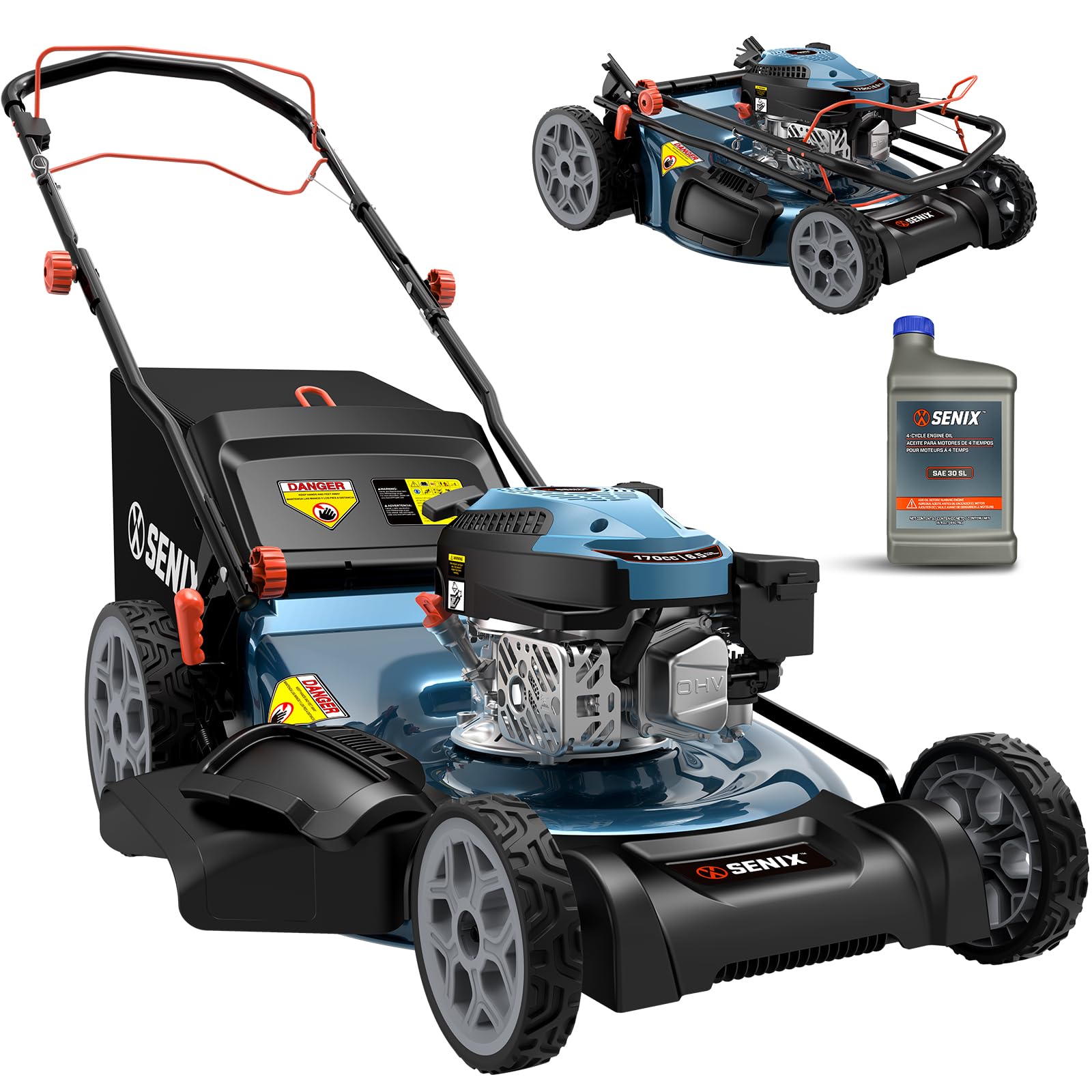
The SENIX LSSG-H4 targets the light commercial or heavy residential operator who values weight savings and ease of use over raw displacement. At 72.8 pounds with a 170cc OHV engine, it’s one of the lighter gas self-propelled models in this price tier — a meaningful advantage when loading in and out of a pickup truck multiple times per day. The rear-wheel-drive single-speed transmission provides consistent traction on inclines and through damp grass.
The 22-inch steel deck offers three cutting options (mulch, side discharge, rear bag) with a foldable handle for vertical storage. Six cutting heights from 1.25 to 4 inches cover most turf types, and the included 19-gallon grass bag handles small to medium lots without excessive dumping frequency. The integrated washout port simplifies deck cleaning, and SENIX backs the unit with a 2-year limited warranty.
Owner feedback is positive regarding assembly ease and immediate starting performance, with several users reporting first-pull starts even after storage. The mower handles wet grass up to 8 inches tall, though some stalling occurs in the thickest patches if you push too fast. The single-speed self-propel lacks variable control, so operators who prefer to jog-walk versus creep will need to adjust their pace to the mower’s fixed gear.
What works
- RWD provides traction on slopes and wet grass, superior to FWD alternatives
- Lightest gas self-propelled model at 72.8 pounds, ideal for frequent loading/unloading
- Integrated washout port makes deck cleaning fast and convenient
What doesn’t
- 170cc engine lacks reserve torque for the heaviest commercial grass conditions
- Single-speed self-propel doesn’t allow operator-paced speed adjustments
8. SENIX 22″ 201cc Rear Wheel Single Speed Mower (G-H-FIVE)
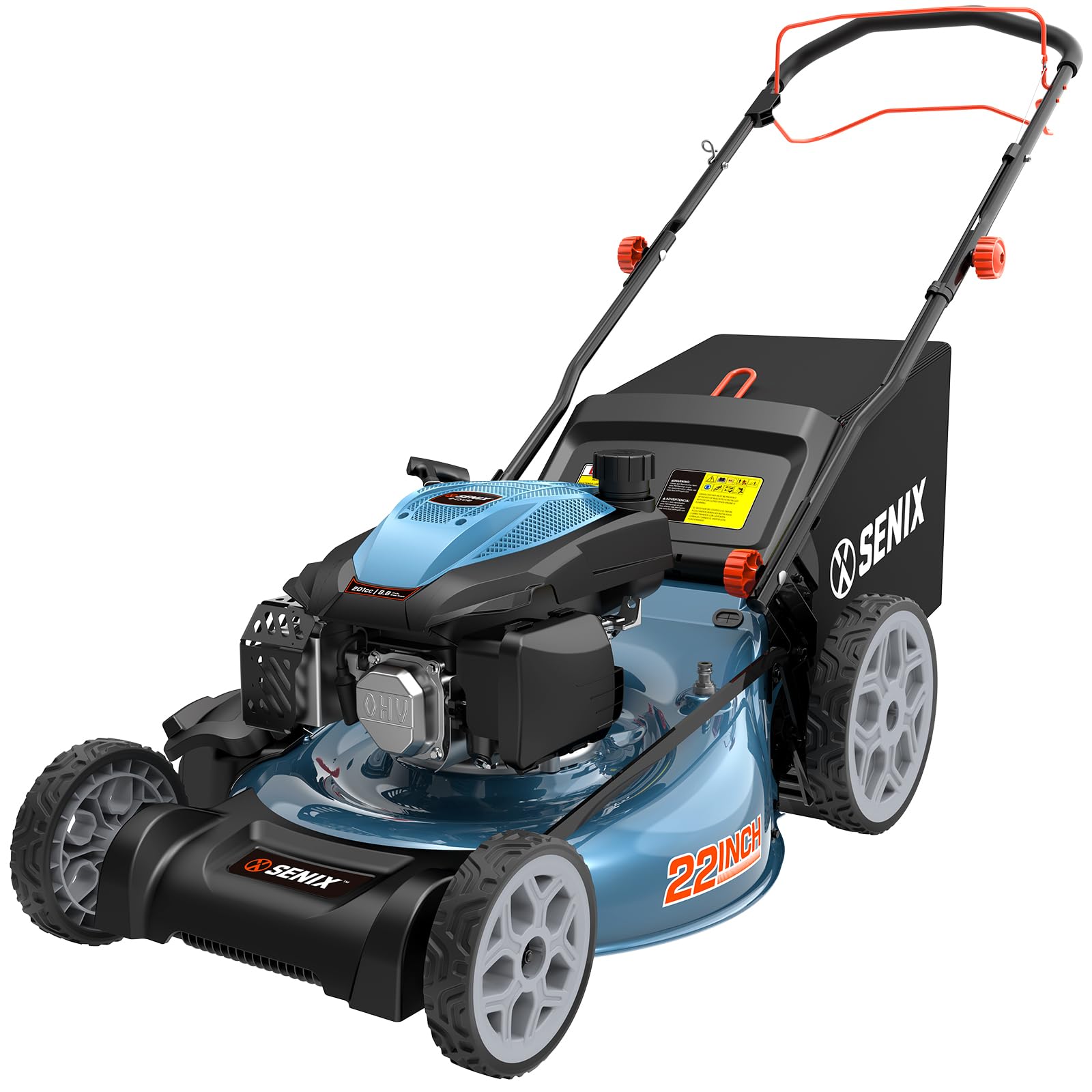
The SENIX G-H-FIVE is the torque-focused sibling in the SENIX lineup, swapping the 170cc engine for a 201cc OHV unit delivering 4.7HP and 8.8 ft-lbs of torque. This extra twist matters when cutting through damp, matted grass or over areas where clippings accumulate mid-deck. The rear-wheel-drive single-speed transmission provides traction on hills, and the 22-inch deck uses a vortex tunnel airflow design to improve grass discharge into the bag.
The deck is constructed from DC04-06 low-carbon high-strength steel — a material grade typically reserved for industrial applications — with a 45-50 HRC manganese steel alloy blade that holds its edge longer than standard blades. The foldable handle design and vertical storage capability save space, and the 2-year warranty provides baseline protection for light commercial use. Recommended for lawns up to 11/20 acre per the manufacturer.
Real-world buyers consistently cite the easy assembly (no tools required), quiet operation, and reliable first-pull starting as major wins. The mower handles overgrown weeds and small saplings effectively, making it useful for properties with transition zones between lawn and brush. Weak points reported include cheap wheels that can detach after a few uses (resolved by the manufacturer in some cases) and a poorly detailed manual that lacks gas/oil capacity specifications.
What works
- 201cc engine with 8.8 ft-lbs torque delivers cutting power close to premium gas mowers
- Vortex tunnel deck design improves bag filling density and reduces clumping
- Foldable handle and vertical storage save valuable shop or trailer floor space
What doesn’t
- Wheel assembly quality reported as inconsistent, with some units experiencing wheel detachment
- Manual lacks basic specifications like oil and gas capacity, frustrating for first-time users
9. BILT HARD 21″ 201cc Self Propelled Gas Lawn Mower
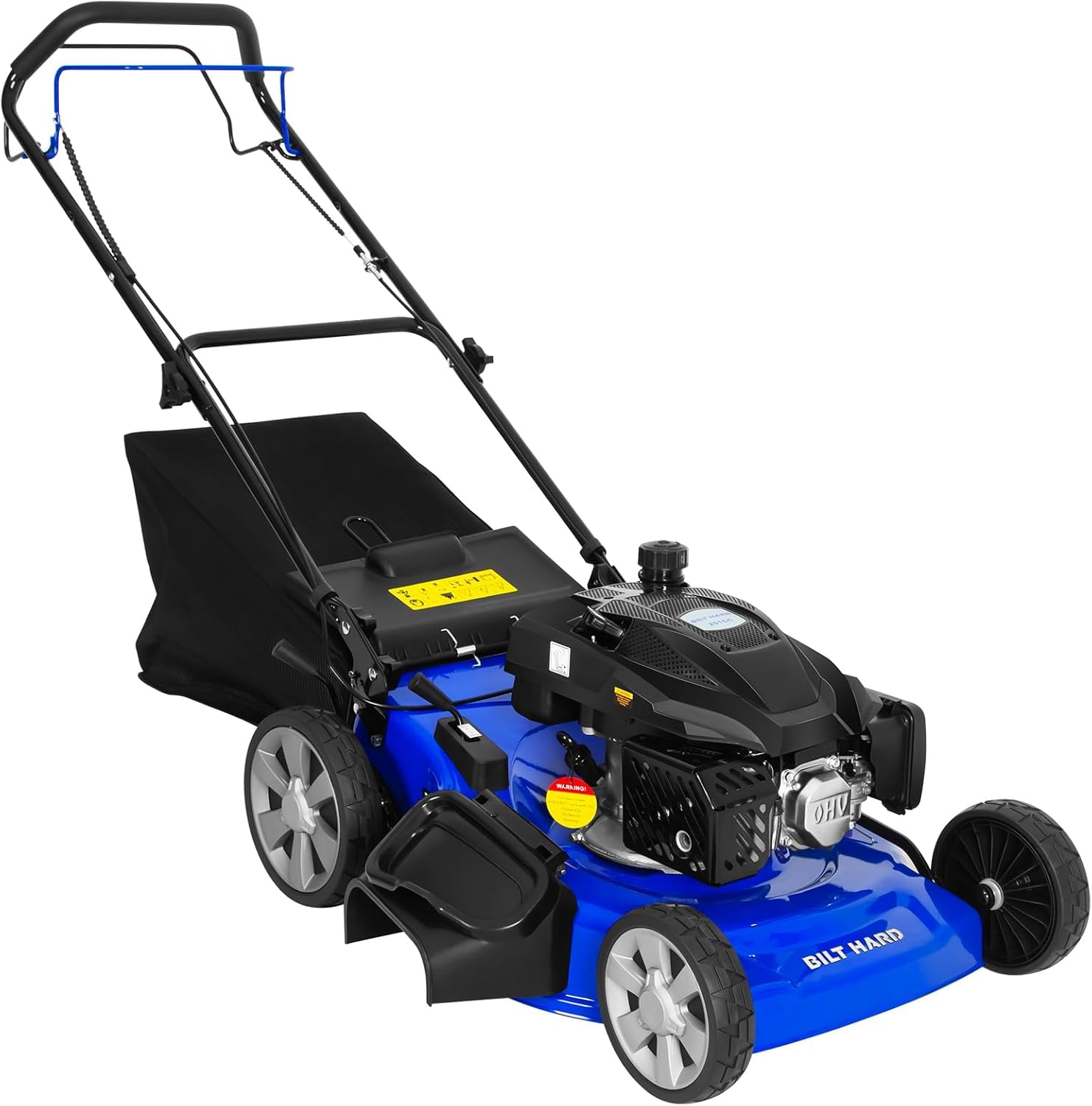
The BILT HARD offers an aggressive price-to-feature ratio for operators on a tight startup budget: a 201cc 4-stroke OHV engine with 9.0 ft-lbs of torque, a 21-inch steel deck with rear-wheel drive, and 8-position single-lever height adjustment from 1.2 to 3.75 inches. The rear-wheel-drive configuration at this price point is unusual and provides traction that FWD equivalents can’t match, especially on inclines or damp mornings.
The no-choke, no-primer starting system uses automatic enrichment to fire up on the first pull consistently, and the foam-wrapped ergonomic handle reduces hand fatigue during extended use. The 3-in-1 cutting system includes bagging, mulching, and side discharge. BILT HARD promotes US-based customer service support, which adds reassurance for buyers concerned about warranty fulfillment from less established brands.
Owner experiences split along durability lines. Some report the mower starts first pull, cuts tall grass well, and runs quietly for months without issues. Others experienced catastrophic vibration within hours of first use — a bent drive shaft causing plastic motor covers and the dipstick housing to crack or detach. The inconsistency in quality control makes this a gamble for commercial use, though the torque and RWD platform are genuinely competitive when the unit arrives defect-free.
What works
- 9.0 ft-lbs torque from a 201cc OHV engine — strong power for the price
- Rear-wheel drive at entry-level pricing, rare in this segment
- Automatic choke starting system simplifies operation for multiple users on a crew
What doesn’t
- Quality control is inconsistent; some units suffer bent shafts and cracked housings within hours
- Customer reports indicate wheel attachment may fail, requiring field repairs with zip ties or hardware
10. Greenworks 48V (24V x 2) 21″ Brushless Self-Propelled Mower (MO48L520)

The Greenworks MO48L520 runs on two 24V 5.0Ah batteries in series to produce 48V system power, and it supports over 200 compatible 24V Greenworks tools — a strong ecosystem play for operators who already own the brand’s trimmers, blowers, or chainsaws. The brushless motor delivers more torque and longer life than brushed alternatives while running quieter than any gas equivalent. The self-propelled rear-wheel drive with variable speed control provides solid traction on slopes.
The 4-in-1 cutting system includes mulching, rear bagging, side discharge, and a turbo button that boosts blade speed for maximum power during leaf pickup or thick patches. Seven cutting heights from 1 to 4 inches cover most grass types. The 45-minute advertised runtime (30 minutes real-world under load without self-propel) is sufficient for a typical 1/4-acre lot but will require a second battery set for larger commercial properties.
Owners consistently report easy setup (just attach the handle), quiet operation, and satisfaction with the push-button electric start. The main frustration is the 2-hour recharge time for the dual-port charger, which limits back-to-back job scheduling. The front LED headlight has no off switch, and the battery charging time limits this mower’s commercial viability unless you invest in additional batteries and a faster charging station.
What works
- Compatible with over 200 Greenworks 24V yard tools — strong ecosystem for fleet management
- Brushless motor provides quiet, maintenance-free operation with instant electric start
- Turbo button boosts blade speed on demand for tough cutting conditions
What doesn’t
- Real-world runtime of 30 minutes limits commercial use to small lots without extra batteries
- 2-hour recharge time creates significant downtime between jobs without spare battery sets
11. Earthquake Walk Behind String Mower 160cc (40314)

The Earthquake 40314 is not a conventional blade mower — it’s a walk-behind string trimmer with a 22-inch cutting diameter powered by a 160cc Viper 4-cycle engine. This specialization makes it an essential secondary machine for commercial operators who maintain fence lines, ditch banks, and overgrown areas that would dull or clog standard blades. The 14-inch Never-Go-Flat airless wheels float over uneven terrain without going flat, and the adjustable handlebar reduces operator fatigue.
The engagement bail design lets you stop and restart the cutting head without killing the engine: release the bail to pause the head while clearing a path, then re-engage to resume cutting. Loaded with 0.155-inch trim line, the mower cuts through 3-foot weeds, thick brush, and woody stalks up to 1/2-inch thick. The oversized debris deflector directs clippings away from the operator, improving safety and comfort compared to a handheld trimmer running at chest height.
Owners confirm it reduces brush clearing time by up to 75% compared to handheld string trimming. The 5-year limited warranty adds confidence for commercial use. Frequent line changes in heavy vegetation are the main operational friction — the head doesn’t auto-feed, so operators must stop to bump-feed or manually reload. The plastic bottom pieces are prone to cracking, though the primary metal frame and powerhead remain functional even after cosmetic breakage.
What works
- 22-inch cutting diameter clears three-foot weeds and half-inch woody stalks efficiently
- 14-inch airless wheels never go flat, ideal for rough overgrown terrain
- Engagement bail allows pausing the head without restarting the engine
What doesn’t
- Manual bump-feed head requires frequent stops to reload line in heavy vegetation
- Plastic bottom deck pieces are prone to cracking; handle bolts need periodic tightening
Hardware & Specs Guide
Deck Material and Gauge
Commercial mower decks fall into three categories: stamped steel (cheapest, prone to flex and cracking under heavy use), fabricated steel (welded from thicker plates, maintains blade alignment), and cast aluminum (rust-proof, lightweight, but can dent). Look for fabricated decks in 10- or 11-gauge steel for daily commercial operation. The deck’s structural integrity directly affects cut consistency and blade life — a flexing deck causes scalloped turf and accelerated blade dulling.
Transmission Type
Three drive types dominate: gear-driven (simple but lacks speed variability), continuously variable transmission or CVT (offers seamless speed adjustment via belt and pulley system), and hydrostatic (uses hydraulic fluid pressure, smoothest operation, sealed and maintenance-free). For commercial use, sealed hydrostatic or industrial-grade CVT units resist contamination from grass dust and operate without belt slippage. Single-speed drives work on flat properties but lack the flexibility needed for varied terrain within a single job.
FAQ
Is rear-wheel drive mandatory for a commercial push mower?
What engine displacement is enough for commercial-grade grass cutting?
Can cordless electric mowers truly replace gas for commercial work?
Final Thoughts: The Verdict
For most commercial operators, the commercial grade push mower winner is the Milwaukee M18 Fuel 21″ because it combines a steel deck, seamless M18 ecosystem integration, and push-button electric start in a package that’s 20 pounds lighter than most gas equivalents — critical for loading and unloading between job sites. If you need max runtime without battery management, grab the EGO LM2156SP-2 with its dual 10.0Ah batteries and 75-minute runtime per charge. And for properties with overgrown fence lines and brush, nothing beats the Earthquake 40314 walk-behind string mower, which cuts vegetation that would destroy standard blades in minutes.