
Every gardener who has opened a bag of cheap potting soil knows the frustration: dense, clumpy, and prone to turning into a brick itself after a single watering. Coco coir bricks solve that by delivering a consistent, aerated medium that holds moisture without suffocating roots — but only if you pick the right one. The difference between a brick that crumbles into fine, fluffy fibers and one that leaves you wrestling with dusty chunks comes down to washing, compression, and fiber grade.
I’m Rikta — the co-founder and writer behind Lawn Gear Lab. I’ve spent weeks comparing the expansion ratios, salt levels, and fiber consistency of these compressed coir bricks, cross-referencing hundreds of verified owner reports to find which ones actually deliver on their specs.
After hours of research, this guide cuts through the marketing to recommend only the best coco coir bricks for seed starting, soil amendment, hydroponics, and terrarium use.
How To Choose The Best Coco Coir Bricks
Not all coco coir bricks are created equal. The key factors that separate a premium growing medium from a dusty, salty disappointment are hidden in the processing details. Here’s what to look for before you buy.
Salt Content & Washing Quality
Coir naturally contains sodium from its growth near the ocean. Unwashed bricks can have an EC (electrical conductivity) above 1.5, which can burn delicate roots. Premium bricks advertise “triple washed” or “low EC” (<0.5). This step is essential for seedlings, hydroponics, and sensitive plants like ferns or succulents.
Expansion Ratio: What You Get Per Brick
A standard 1.5-pound brick should expand to 8-10 quarts of hydrated coir. Larger 10-11 pound blocks should yield 60-75 quarts. If a brick claims massive expansion but the compressed block feels lightweight, you’re paying for air. Look for actual volume measurements in customer reviews — they reveal the truth faster than any product page.
Fiber Grade: Fine vs. Coarse
Fine-grade coir (often called coco peat) holds more water and is ideal for seed starting, microgreens, and worm bins. Coarse-grade fibers (chips or chunks) improve drainage and aeration in raised beds and container mixes. Many premium blends offer a balanced mix. Read the reviews to confirm the texture — a “dusty” report usually indicates poorly processed fine-grade material.
Quick Comparison
On smaller screens, swipe sideways to see the full table.
| Model | Category | Best For | Key Spec | Amazon |
|---|---|---|---|---|
| Vivlly Coco Coir Brick | Block | Massive Expansion | 75 Quarts / Block | Amazon |
| MagJo Naturals 5kg Block | Block | Organic Gardening | OMRI Listed, 17 Gal | Amazon |
| Thunder Acres Coco Coir | Brick Pack | Seed Starting | 1.5 lbs / Brick | Amazon |
| GROW!T Coco Coir Mix Brick | Brick Pack | Indoor Pots | ~10 Quarts / Brick | Amazon |
| Viagrow Coconut Coir 2-Pack | Block Pack | Custom Soil Mixes | 18 Gal / Block | Amazon |
In‑Depth Reviews
1. Vivlly Coco Coir Brick 10 LB

This 10-pound block from Vivlly claims an impressive 75 quarts of finished coir, and verified buyers confirm it delivers. The triple-washed processing keeps EC under 0.5, which is critical for hydroponic systems and sensitive seedlings. With a neutral pH of 5.5-6.5 and air porosity around 30%, it strikes an excellent balance between water retention and root oxygenation.
Users consistently praise how quickly it absorbs warm water without forming stubborn clumps. The fine-to-medium fiber grade works well for seed trays, microgreens, and mixing into raised beds. Several reviewers mention it as their go-to for mushroom cultivation due to the clean, low-salt profile.
One minor complaint: the block can be dusty during initial handling. A few buyers recommend hydrating slowly over an hour to reduce powder. Still, the per-quart cost is hard to beat for the volume you get.
What works
- Massive 75-quart yield from a single 10 lb block
- Triple-washed, low EC (<0.5) ideal for hydroponics
- Absorbs water fast with minimal clumping
What doesn’t
- Can produce fine dust during initial handling
- Requires careful slow hydration for best texture
2. MagJo Naturals 100% Pure Coco Coir 11 lb Block

MagJo’s 11-pound block is OMRI-listed for organic gardening, which means it meets strict standards for organic production. The company sources from manufacturers that thoroughly wash the coir to remove salts — a key step often skipped by budget brands. After hydration, one block fills a 5-gallon container with ease, expanding into a light, aerated medium.
Users love it for lightening heavy clay soil and as a base for custom potting mixes. One reviewer measured TDS rise from 40 to 200 ppm after soaking — very low salt, confirming the wash quality. The fine texture makes it excellent for seed starting, though some note a faint earthy smell (not unpleasant) upon first opening.
The main drawback is the density: the 11-pound block is extremely hard compressed. Breaking it into pieces is nearly impossible — it’s best to soak the whole block at once. If you only need a small batch, this may produce more than you can store.
What works
- OMRI-listed for certified organic gardening
- Very low salt content after thorough washing
- Expands to fill a 5-gallon container easily
What doesn’t
- Block is extremely hard; best to hydrate whole
- Slight earthy aroma on initial hydration
3. Thunder Acres Coco Coir Brick (3 Pack)

The Thunder Acres three-pack offers individual 1.5-pound bricks that expand into fine, fluffy coir ideal for seed starting. Each brick hydrates to roughly 8-10 quarts. Users repeatedly mention the consistency — batch after batch, the texture remains light with minimal dust, which suggests reliable processing. The coir mixes well with perlite, pumice, or vermiculite for succulent and aroid blends.
Multiple long-term buyers report ordering this product for years without quality swings. The bricks break apart easily by hand once hydrated, and the material holds moisture without becoming soggy. Several reviewers highlight it as the best seed-starting medium they’ve tried, with seedlings sprouting within 1-2 weeks.
The packaging is minimal — plain shrink wrap — but it keeps the bricks dry. If you need a larger volume, the per-brick cost is slightly higher than bulk blocks. However, for casual gardeners who want portion control, this pack is ideal.
What works
- Consistent fine texture batch after batch
- Easy to break apart and hydrate
- Excellent for seed starting and succulent mixes
What doesn’t
- Higher per-brick cost compared to bulk blocks
- Minimal packaging; bricks not individually sealed
4. GROW!T JSCPB Coco Coir Mix Brick (3 Pack)

Hydrofarm’s GROW!T bricks are marketed as pathogen-free and seed-free, making them a safe choice for indoor plants. The fine texture holds more water than you might expect — one customer repotted three large Monstera and a Rhaphidophora from a single brick with leftovers. The high water-to-air ratio suits moisture-loving aroids and ferns that need consistent dampness without standing water.
The 3-pack keeps storage manageable. Users describe a clean, earthy smell with no chemical or saline odor. A few noted slight sand residue at the bottom after washing, but this is common with even well-processed coir. The price per brick sits in the entry-level range, but check the exact volume — some buyers found the expansion slightly less than advertised, estimating around 10 quarts per brick rather than the claimed volume.
For amending dense clay soil outdoors, long-term users confirm it improves porosity over multiple seasons.
What works
- Pathogen- and seed-free for indoor safety
- High water retention ideal for aroids
- Compact 3-pack for easy storage
What doesn’t
- Expansion slightly less than advertised
- May leave fine sand residue after washing
5. Viagrow Coconut Coir 11 lb Brick (2 Pack)
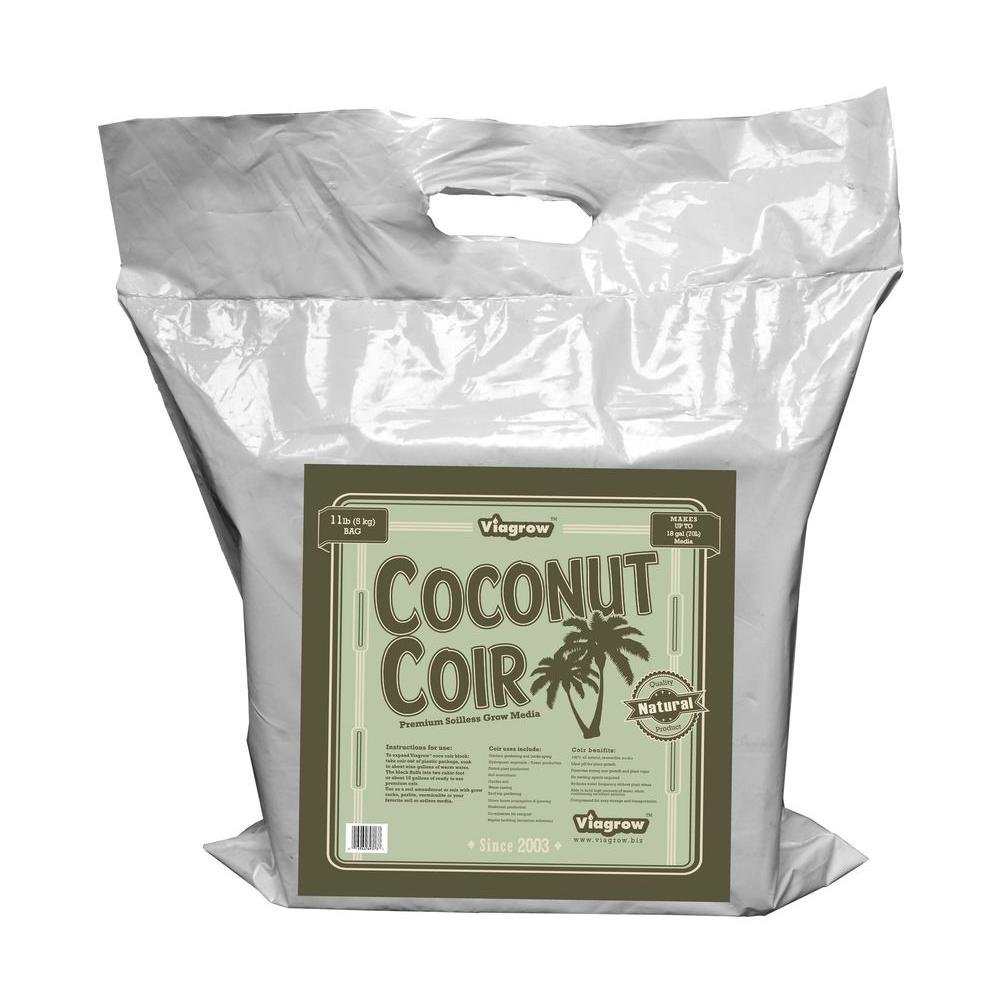
Viagrow’s 2-pack of 11-pound bricks provides a coarser fiber blend compared to the fine-grade options. This makes it better suited for raised beds, potted trees, and outdoor containers where drainage and aeration take priority over water retention. Each brick yields about 18 gallons of hydrated coir. The coarser texture also helps prevent soil compaction over time.
Experienced mixers report using a 7:2:2 ratio of this coir, worm castings, and perlite for a rich, fluffy medium that completely eliminated fungus gnat problems indoors. Users in hot climates praise the coarse fibers for slowing evaporation in raised beds. The pH-neutral profile and low sodium content make it safe for direct mixing without additional buffering.
Some buyers noticed inconsistency between batches — one order had longer fibers and more dust than a previous one. For those who prefer a uniform fine texture, this may be disappointing. If you need coarse aeration, it’s a solid choice, but inspect upon arrival if consistency matters.
What works
- Coarse fibers improve drainage in raised beds
- pH neutral and low sodium for direct mixing
- Good value per gallon in the 2-pack format
What doesn’t
- Batch consistency varies in fiber coarseness
- Too coarse for fine seed starting work
Hardware & Specs Guide
Expansion Ratio
The most critical spec for comparison shopping. A 1.5-pound brick should expand to 8-10 quarts; an 11-pound block should yield 15-18 gallons. Lower expansion means you pay more for compressed air. Always cross-check advertised volume against verified customer measurements. Premium blocks like Vivlly’s 10-pound offering achieve 75 quarts, outperforming many competitors at the same weight.
EC & Salt Content
Electrical conductivity (EC) measures dissolved salts. Coir with EC above 0.8 can damage sensitive roots, especially in hydroponics or seed starting. Look for “triple washed” or “low EC” labels. MagJo and Vivlly both measure under 0.5 mS/cm. If the product page does not mention washing, assume higher salt levels and budget for an extra rinse step before use.
FAQ
Do I need to rinse coco coir bricks before using them?
How much water does one 1.5 lb coco coir brick absorb?
Can I reuse coco coir for multiple growing cycles?
Final Thoughts: The Verdict
For most gardeners, the best coco coir bricks winner is the Vivlly Coco Coir Brick because it delivers the highest expansion ratio per pound with professional-grade triple washing at a mid-range cost. If you need an OMRI-listed block for certified organic beds, grab the MagJo Naturals 11 lb Block. And for seed starters who want portion control without commitment, the Thunder Acres 3-Pack offers consistent fine texture that beginner and expert growers alike can count on.