
A lawn clogged with dandelions, clover, and crabgrass isn’t just an eyesore—it’s a sign that your turf is losing the battle for nutrients and space. The right combination of granular or liquid products can both eliminate these invaders and deliver the nitrogen your grass craves, turning a patchy mess into a dense, uniform carpet without needing separate applications.
I’m Rikta — the co-founder and writer behind Lawn Gear Lab. I’ve spent countless hours cross-referencing NPK ratios, active herbicide ingredients, coverage rates, and verified owner experiences to separate the products that actually deliver from those that overpromise.
To cut through the noise, I evaluated formulations for feeding strength, weed-killing spectrum, ease of application, and value per square foot to assemble this guide to the chemicals for lawn that produce real, repeatable results season after season.
How To Choose The Best Chemicals For Lawn
Selecting the right lawn chemical isn’t about picking the most expensive bag on the shelf. Success depends on understanding your lawn’s specific weed pressure, grass type, and the time of year. Here are the critical factors to weigh before you buy.
Match the NPK to Your Season and Grass
The three numbers on the bag—nitrogen (N), phosphorus (P), and potassium (K)—dictate how your turf responds. A high first number like 21-0-3 pushes deep green color and blade growth, ideal for late spring and summer feeding. A formula like 18-0-4 provides steady, moderate feeding without forcing excessive mowing. Avoid high-phosphorus blends unless a soil test confirms a deficiency; most established lawns need primarily nitrogen and potassium.
Choose Your Active Ingredient Wisely
For post-emergent weed killing, look for the specific herbicide rather than the brand. 2,4-D and Mecoprop target broadleaf weeds like dandelion and clover, while Prodiamine works as a barrier pre-emergent that stops crabgrass and annual grass seeds from germinating. Mesotrione—the active in Tenacity—is unique because it can be applied during seeding without harming new grass, making it a favorite for renovation projects.
Granule Size and Spreader Compatibility
Uniform particle size prevents streaking and ensures every square foot receives the same dose. Products using patented DG (dispersible granule) technology dissolve rapidly on contact with water, moving the active ingredient into the root zone quickly. If you use a rotary spreader, avoid dense, clumpy formulas that can jam the mechanism or drop unevenly.
Know Your Weed Lifecycle
Pre-emergent products must be applied before soil temperatures reach 55°F for warm-season weeds—timing is everything. Post-emergent formulas work best when weeds are actively growing, not stressed by heat or drought. Combining a pre-emergent in early spring with a post-emergent in late spring gives you a season-long defense without resorting to harsh blanket applications.
Quick Comparison
On smaller screens, swipe sideways to see the full table.
| Model | Category | Best For | Key Spec | Amazon |
|---|---|---|---|---|
| The Andersons Surge | Premium | Large lawns needing heavy-duty weed kill | 16-0-9, covers 16,000 sq ft | Amazon |
| Tenacity Turf Herbicide | Liquid Concentrate | Seeding-safe weed control | Mesotrione 40% | Amazon |
| The Andersons Barricade | Pre-Emergent | Crabgrass prevention and dense turf | 18-0-4, Prodiamine 0.426% | Amazon |
| Spectracide Weed & Feed | Liquid | Easy hose-end application | 20-0-0, 7,500 sq ft bottle | Amazon |
| Jonathan Green Veri-Green | Granular | Fine particle coverage | 21-0-3, 3-month slow release | Amazon |
| Scotts Weed and Feed 3 | Granular | Dandelion and clover removal | 2,4-D 1.22%, Mecoprop 0.081% | Amazon |
| Scotts SummerGuard | Granular | Heat-stress protection and bug control | 20-0-8, 5,000 sq ft | Amazon |
In‑Depth Reviews
1. The Andersons Professional Surge Weed and Feed 16-0-9
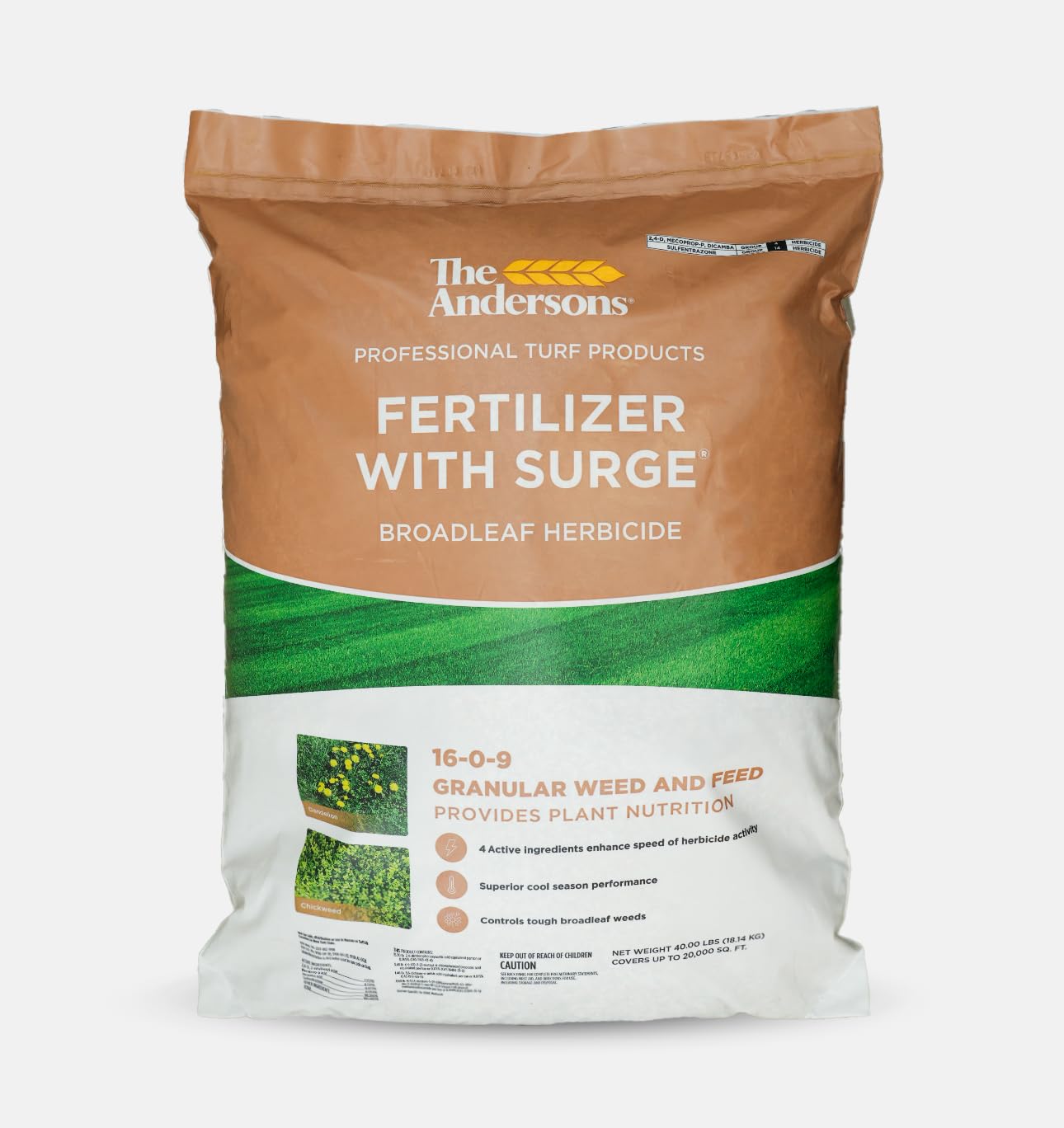
This professional-grade 40-pound bag delivers a four-way herbicide mix paired with a 16-0-9 fertilizer, making it the most comprehensive single-application solution for homeowners with medium to large lawns. The small granule size ensures dense coverage, and the active ingredients tackle over 250 broadleaf weeds including dandelion, clover, chickweed, and plantain without requiring a separate weed killer pass.
Owners consistently report visible results against tough perennials like creeping charlie—a weed that often resists milder formulas. The 16-0-9 ratio provides sufficient nitrogen for deep greening while the potassium supports root strength and drought tolerance. The 40-pound bag covers up to 16,000 square feet, dramatically reducing the number of refills needed for a half-acre or larger property.
Andersons uses patented DG Technology, meaning the granules dissolve rapidly upon watering so the herbicide reaches the soil surface quickly. This reduces the risk of granules sitting on blade tips and burning the grass. Avoid using this on Floratam St. Augustine or dichondra, as the herbicide mix can damage those specific turf types.
What works
- Massive coverage reduces application time significantly
- Four-way herbicide kills a very broad spectrum of weeds
- DG Technology ensures fast uptake and minimal burn
What doesn’t
- Not safe for Floratam St. Augustine or dichondra lawns
- Premium price per bag compared to basic weed and feeds
2. Tenacity Turf Herbicide (Mesotrione 40%)
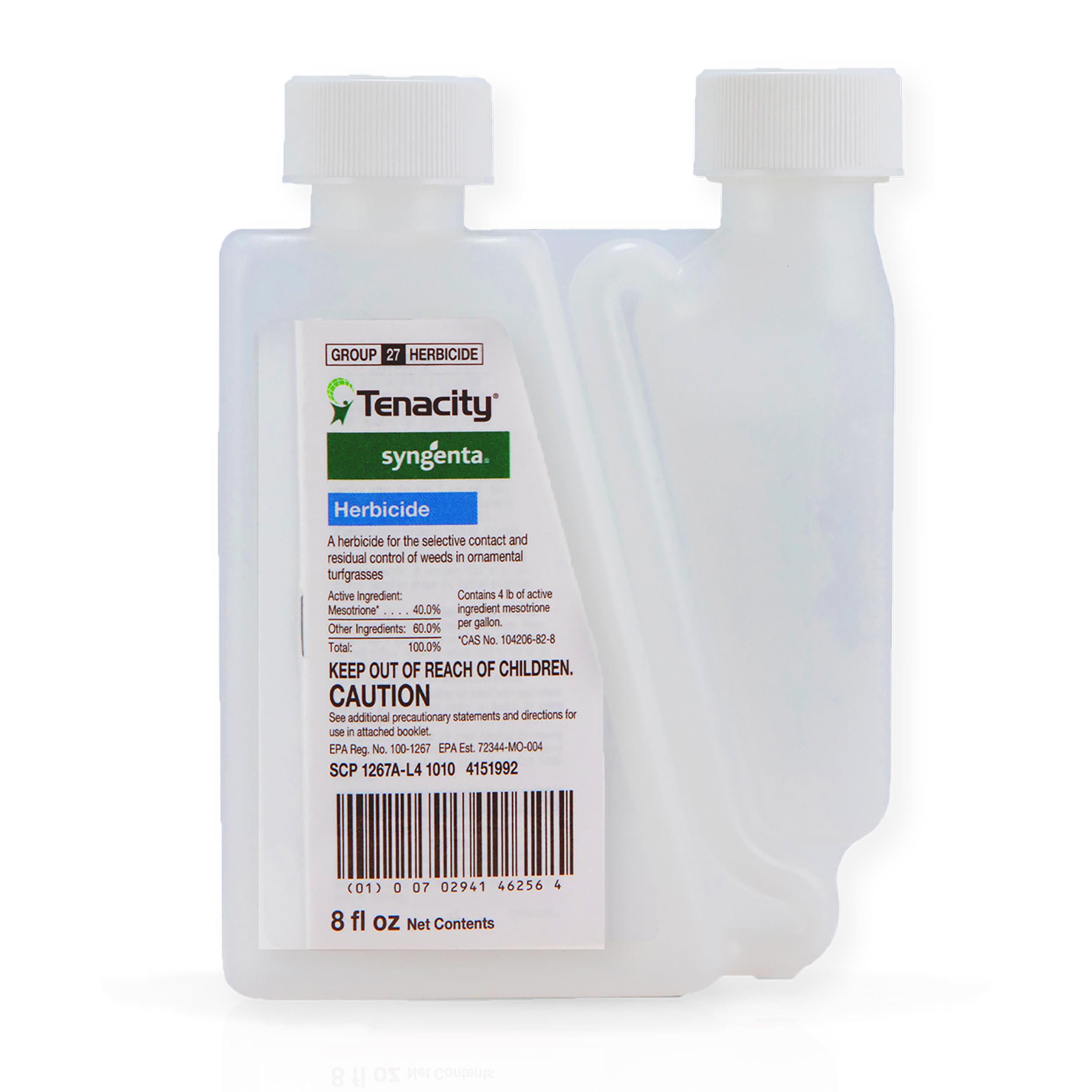
Tenacity is a rare product that works as both a pre-emergent and post-emergent herbicide, giving you season-long control from a single bottle. The active ingredient mesotrione disrupts photosynthesis in target weeds, turning them white within days before they die. It is especially valued because it can be applied when seeding new grass—most other herbicides require a waiting period that delays renovation.
The 8-ounce bottle concentrates at roughly 1/2 teaspoon per gallon of water, making it economical for large properties. Users treating a half-acre of nimblewill or bentgrass reported eliminating 85-90 percent of those stubborn weeds with just two or three applications. For creeping charlie, many mix Tenacity with Triclopyr for a complete knockdown.
Because mesotrione is a systemic herbicide, it moves through the plant to the roots, reducing regrowth compared to contact-only formulas. A surfactant is strongly recommended to improve leaf adhesion. The 5-8 year shelf life when stored properly means a single bottle can serve multiple seasons.
What works
- Safe to apply at the same time as overseeding
- Kills tough weeds like nimblewill and yellow nutsedge
- Dual pre- and post-emergent action reduces applications needed
What doesn’t
- Requires a surfactant and careful mixing for best results
- Can temporarily bleach fescue or fine fescue if overapplied
3. The Andersons 18-0-4 Barricade Fertilizer with Pre Emergent
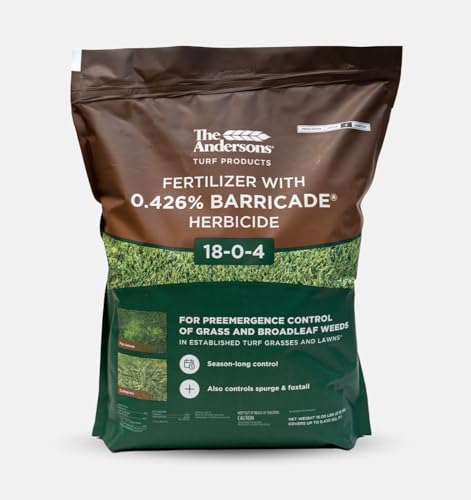
This formula combines a balanced 18-0-4 fertilizer with 0.426% prodiamine, a professional-grade pre-emergent that stops crabgrass, poa annua, goosegrass, and henbit before they germinate. Prodiamine is one of the most reliable active ingredients for season-long barrier control, and pairing it with a feeding pass saves you a separate application step in early spring.
The DG Technology used by Andersons ensures each small granule dissolves quickly once watered in, moving the prodiamine directly into the soil surface where it forms a protective layer. Users with zoysia and Bermuda lawns in warmer climates report outstanding results, with zero weed breakthrough when applied before soil temperatures hit 55°F. The 18-pound bag covers 5,000 square feet.
Because this is a pre-emergent, it will not kill existing weeds—timing is everything. Apply it in early spring and again in early fall for a full year of suppression. One unexpected bonus noted by users: the uniform particle size spreads easily through standard Scott’s spreaders without clogging or dumping.
What works
- Prodiamine provides exceptional crabgrass and annual grass control
- DG Technology prevents runoff and ensures even distribution
- Fertilizer component avoids excessive growth spikes
What doesn’t
- Will not eliminate existing weeds—strictly preventive
- Some users feel the 18-lb bag is overpriced for the coverage
4. Spectracide Weed & Feed 20-0-0, 3 Count
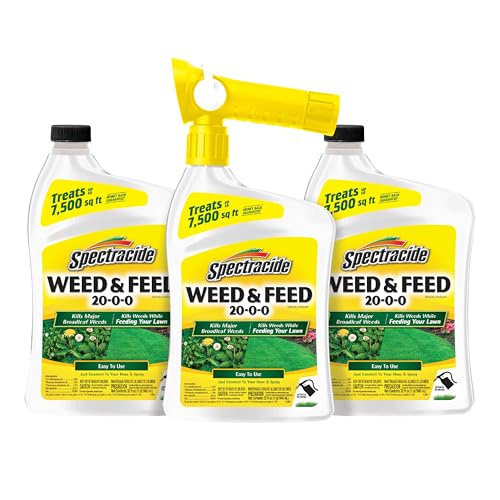
Spectracide’s liquid weed and feed is designed for homeowners who want simplicity: screw the bottle onto a standard garden hose, flip the sprayer, and walk. The 20-0-0 nitrogen content delivers rapid greening while the herbicide mix tackles dandelion, chickweed, knotweed, and clover. Each 32-ounce bottle covers 7,500 square feet, and this three-pack provides three bottles to cover multiple applications across the season.
Users report that visible weed kill begins within a week, with leaves turning white and dying. The fertilizer component shows results after about two weeks and a good rain. For St. Augustine grass, this formula is considered safe when applied according to label rates and below 85°F to avoid heat stress.
The QuickFlip sprayer design has received mixed feedback—some owners found the on/off mechanism inconsistent, while others had no issues. Applying when weeds are actively growing and the grass is dry maximizes effectiveness. A noticeable salty-chemical smell can linger on the lawn for a day or two after treatment.
What works
- No measuring or mixing—just attach the hose and spray
- High nitrogen content greens the lawn quickly
- Safe for St. Augustine when used correctly
What doesn’t
- Some users experienced sprayer malfunction
- May not kill deep-rooted weeds like violets in one pass
5. Jonathan Green Veri-Green Weed and Feed 21-0-3

Jonathan Green’s Veri-Green uses a fine particle size that spreads densely and evenly, ensuring that every square inch of your lawn contacts both the 21-0-3 fertilizer and the weed killer. The herbicide controls over 250 broadleaf weeds including dandelion, chickweed, clover, and poison ivy, while the nitrogen feeds the grass for up to three months with a slow-release mechanism.
Users consistently report visible lawn thickening within two weeks, with weeds gradually disappearing over the following month. The fine granule size is a standout—it prevents the “striping” that can occur with larger, clumpier products. The 15-pound bag covers 5,000 square feet, making it ideal for average suburban lots.
Because the weed killer works systemically, weeds must be actively growing for best results. Apply in late spring or early fall when temperatures are moderate. Do not apply this product at the same time you are seeding a new lawn, as the herbicide will harm tender grass seedlings.
What works
- Exceptional granule uniformity prevents burn spots
- Three-month slow release reduces application frequency
- Kills a very wide range of broadleaf species
What doesn’t
- Cannot be used during or immediately after overseeding
- Some tough weeds like wild violet may need a second treatment
6. Scotts Turf Builder Weed and Feed 3

Scotts’ Weed and Feed 3 is a granular option aimed squarely at homeowners dealing with dandelion and clover infestations. The active ingredients—2,4-D and Mecoprop—are time-tested broadleaf herbicides, and the accompanying fertilizer builds thicker turf that naturally crowds out weeds. The company’s Weedgrip Technology helps granules stick to weed leaves for better absorption.
Users report that a single application eliminates visible dandelions within two weeks and produces noticeably greener grass. The formula works best when applied to damp grass so the granules adhere to weed foliage. Avoid watering for 48 hours after application to allow the herbicide to fully absorb into the leaf tissue.
One important caveat: this product does not control crabgrass effectively. For that, you will need a separate pre-emergent or a product containing a different active ingredient. Also be aware that walking on treated grass before it dries can create temporary white footprints from displaced granules.
What works
- Excellent at clearing dandelions and clover quickly
- Fertilizer component thickens the lawn visibly
- Easy to apply with a standard broadcast spreader
What doesn’t
- Ineffective against crabgrass and some sedges
- Requires careful timing—rain within 48 hours ruins the application
7. Scotts Turf Builder SummerGuard Lawn Food with Insect Control

SummerGuard is designed for the hottest months when grass is stressed and insect pressure peaks. The 20-0-8 ratio provides high nitrogen for color along with potassium for root and drought tolerance, while the insect control component targets surface-feeding bugs like chinch bugs and armyworms that can devastate a lawn in mid-summer.
Users in warm climates report that regular application during June, July, and August keeps grass dark green and resilient despite heat waves. The “won’t burn lawn—guaranteed” claim holds up when applied according to label rates, even in direct sun. The 13.5-pound bag covers 5,000 square feet.
This product does not contain a herbicide, so weeds must be managed separately with a post-emergent spray or a different granular combo. Additionally, the insect control is preventative rather than curative—if an infestation is already heavy, you may need a targeted insecticide first.
What works
- Feeds and protects against heat stress simultaneously
- Insect control reduces bug damage without extra spray
- Safe for use in high temperatures without burn risk
What doesn’t
- No weed killing capability—must be paired with another product
- Insect prevention is limited to surface-feeding species
Hardware & Specs Guide
Active Herbicide Ingredients
The most common post-emergent herbicide in granular weed and feeds is 2,4-D, often combined with Mecoprop or Dicamba for broader spectrum control. Prodiamine is the gold standard for pre-emergent barriers, stopping crabgrass and annual grasses at the soil level. Mesotrione (Tenacity) is unique for being safe to use during seeding. Check the active ingredient list—not the brand—to match the product to your specific weed problem.
NPK Ratios for Lawn Health
The first number (nitrogen) drives leaf growth and color intensity. The second (phosphorus) supports root development but should be kept near zero unless a soil test shows deficiency. The third (potassium) strengthens cell walls and improves drought and disease tolerance. For summer, a ratio like 20-0-8 or 21-0-3 works well. For fall, a formula closer to 18-0-4 provides slow steady feeding without pushing excessive top growth.
FAQ
Can I apply a pre-emergent and a post-emergent in the same season?
How long after applying a granular weed and feed should I wait before mowing?
Why did my lawn turn brown in spots after using a weed and feed product?
Final Thoughts: The Verdict
For most gardeners, the chemicals for lawn winner is the The Andersons Professional Surge because it pairs professional-grade four-way weed control with a balanced 16-0-9 feed across 16,000 square feet—the best coverage-to-value ratio in this lineup. If you need seeding-safe performance that tackles nimblewill and bentgrass, grab the Tenacity Turf Herbicide. And for a no-mix, hose-end solution that makes application almost effortless, nothing beats the Spectracide Weed & Feed 3-Pack.