
Standing in the garage, manually twisting a dial that hasn’t changed in a decade, while your backyard turns into a mud pit and the front curb strip looks like the Sahara — that’s the daily frustration of a dumb sprinkler system. You need a controller that actually thinks, adapts to the weather, and waters the right zones for the right duration without you having to become a part-time meteorologist.
I’m Rikta — the co-founder and writer behind Lawn Gear Lab. I’ve spent hundreds of hours dissecting the specifications of irrigation timers, comparing evapotranspiration algorithms, analyzing zone capacities, and cross-referencing owner feedback across dozens of models to build this guide.
Whether you’re replacing a dead controller or upgrading your entire setup, this guide will help you navigate the best options among modern lawn sprinkler systems. I’ll break down the key specs, real-world reliability, and which features actually matter for a lush, water-efficient yard.
How To Choose The Best Lawn Sprinkler Systems
The irrigation controller market has split into two distinct camps: traditional standalone timers built for rugged reliability, and WiFi-enabled smart controllers that prioritize remote access and weather adaptation. Your choice depends on your landscape complexity, your tolerance for app-based management, and whether you need Apple HomeKit or Alexa voice control.
Zone Count and Expansion
Every valve in your yard controls one zone. A controller’s station count must match or exceed the number of valves you have. A 6-zone controller works for a modest front and back lawn, but if you have separate drip lines for flower beds, a dedicated zone for a vegetable garden, and a section for a slope, an 8-zone or 14-zone unit gives you headroom. Overbuying now is cheaper than a full replacement later.
Evapotranspiration (ET) and Weather Data
The most water-efficient controllers don’t just rely on a rain sensor — they pull hyperlocal weather data to calculate ET rates. This means the controller automatically shortens run times after a cool, cloudy day or lengthens them during a heat wave without you touching a dial. Premium models like the ImoLaza and Yardian Pro use real-time ET data to skip watering when rain is forecast, saving up to 50% on outdoor water use.
Connectivity and Fail-Safe Manual Control
Smart controllers are great — until your WiFi drops. The best units offer a wired Ethernet port (like the Yardian Pro) or physical buttons for on-device control that work without an internet connection. The Hunter X-Core and Irritrol Rain Dial, by contrast, have no WiFi at all, which some homeowners prefer for absolute reliability. Decide whether you want the convenience of an app or the peace of mind of a dial that always works.
Quick Comparison
On smaller screens, swipe sideways to see the full table.
| Model | Category | Best For | Key Spec | Amazon |
|---|---|---|---|---|
| Yardian Pro (6-Zone) | Smart Controller | Apple HomeKit Ecosystem | Ethernet + WiFi | Amazon |
| Rain Bird ARC8 (8-Zone) | Smart Controller | Weather-Based Savings | 8 Stations, WaterSense | Amazon |
| Rain Bird ESP-TM2 + LNK (6-Zone) | Hybrid Controller | Modular WiFi Upgrade | Backlit LCD Display | Amazon |
| ImoLaza Smart (16-Zone) | Smart Controller | High Zone Count | 16 Stations, OTA Updates | Amazon |
| Hunter X2 Outdoor (14-Zone) | Smart-Ready Controller | Outdoor Durability | Hydrawise Compatible | Amazon |
| Hunter X-Core XC800i (8-Zone) | Manual Controller | No-WiFi Reliability | 8 Stations, No App | Amazon |
| Irritrol Rain Dial RD600 (6-Zone) | Manual Controller | Long-Term Durability | Climate Logic Ready | Amazon |
| Rain Bird ARC6 (6-Zone) | Smart Controller | Entry-Level Smart | 6 Stations, WaterSense | Amazon |
| Garden In Minutes Grid (33.5″x66″) | Drip Grid | Raised Bed Gardens | 16 Streams Per Square | Amazon |
In‑Depth Reviews
1. Yardian Pro Smart Sprinkler Controller (6-Zone)

The Yardian Pro wins the top spot because it solves the two biggest pain points of smart controllers: spotty WiFi and lack of manual override. The built-in RJ45 Ethernet port provides a rock-solid wired connection that consumer-grade controllers lack, and the physical on-device buttons let you run zones instantly without a smartphone or internet connection — a critical fail-safe for contractors and homeowners alike.
Its ET-based watering engine pulls hyperlocal weather data to automate schedules, and owners report water savings of up to 50% compared to old-school timers. The real standout feature is native Apple HomeKit support, making it the only controller in this roundup that works seamlessly with Siri, the Apple Home app, and Home Assistant alongside Alexa and Google Home. The 6-zone capacity is modest, but for most residential properties, it’s more than sufficient.
The Yardian Pro also supports real-time leak and flow monitoring via wireless or wired sensors, sending instant alerts for burst pipes or clogged valves. The app interface is well-laid-out, though some users find the initial programming curve slightly steep. Overall, it’s the most feature-complete and future-proof smart controller for homeowners invested in the Apple ecosystem or those who demand wired network stability.
What works
- Ethernet port for stable, lag-free connectivity in garages with weak WiFi
- Native Apple HomeKit integration with Siri voice control
- Physical buttons for on-device control without an internet connection
- Real-time leak and flow monitoring with instant alerts
What doesn’t
- 6-zone capacity may feel limiting for complex landscapes with multiple drip zones
- App interface, while stable, could benefit from a step-by-step programming guide
- HomeKit integration is limited to basic on/off per zone without rain-skipping triggers
2. Rain Bird ARC8 App-Based Smart WiFi Timer (8-Zone)

The Rain Bird ARC8 is the sweet spot in the brand’s smart lineup, offering 8-zone capacity at a price that undercuts many 6-zone competitors. It features the same EPA WaterSense-certified weather-based scheduling found on premium models, automatically skipping or adjusting watering based on local forecast data and historic averages. Owners report installation takes about 10 minutes for the hardware and 15 minutes for the app setup.
The ARC8’s indoor/outdoor rating gives you flexibility to mount it in a garage or a weather-protected outdoor enclosure. It’s compatible with Amazon Alexa and Google Assistant, allowing voice-controlled zone activation. The Rain Bird mobile app provides full remote control — adjust schedules, delay watering, and check the local weather forecast from anywhere in the world. Multiple users can share control, making it easy for landscaping professionals to manage client systems.
Where the ARC8 stumbles is reliability: a small but notable number of owners report WiFi disconnection issues that cause scheduled programs to fail to execute. The app’s programming disable feature is reportedly broken, requiring a workaround using templates. For most users, however, the system works flawlessly, and the 30% water savings potential combined with municipal rebates (some owners report a – rebate) makes it a compelling entry into smart irrigation.
What works
- 8-zone capacity with EPA WaterSense certification for water savings
- Fast installation — under 30 minutes from box to full programming
- Alexa and Google Assistant voice control for hands-free zone management
- Weather-based scheduling with automatic rain skip and seasonal adjustment
What doesn’t
- Occasional WiFi disconnection causes missed watering schedules
- Minimal manual panel controls — heavy reliance on the app
- App program disable feature is broken, requiring workaround via templates
3. Rain Bird ESP-TM2 + LNK WiFi Module (6-Zone)

The ESP-TM2 is Rain Bird’s traditional workhorse controller, and the bundle with the LNK WiFi module gives you the best of both worlds: rock-solid manual programming with a large backlit LCD display, plus the option to add smartphone control when you’re ready. The base unit supports 6 zones with a simple three-step programming process, a 14-day watering delay feature, and Contractor Default settings to save and restore custom schedules.
The LNK WiFi module operates as a wireless remote control for onsite use and an internet-based monitoring system when you’re away. Automatic weather adjustments provide daily run time changes based on local conditions, and owners report water savings of up to 50%. The setup process is notably fast — one owner replaced a 15-year-old unit and had all 6 zones programmed and the WiFi connected in under 20 minutes.
The trade-off is that the LNK module’s companion app has a dated user interface compared to newer competitors, and some owners report incompatibility with the latest app version. The core controller, however, is built to last — the weather-resistant enclosure handles outdoor mounting well, and the backlit display is legible in both direct sunlight and low-light garage conditions. For homeowners who want a proven controller with optional smart capability, this is a safe bet.
What works
- Large backlit LCD display with excellent visibility in direct sunlight
- Three-step programming is genuinely simple for non-tech-savvy users
- Weather-based watering adjusts daily run times automatically
- 14-day delay watering with auto-resume for vacations
What doesn’t
- App user interface feels outdated and poorly designed
- WiFi range can be limited if the controller is mounted in a metal garage
- The LNK module is an extra purchase if bought separately
4. ImoLaza Indoor Smart Sprinkler Controller (16-Zone)
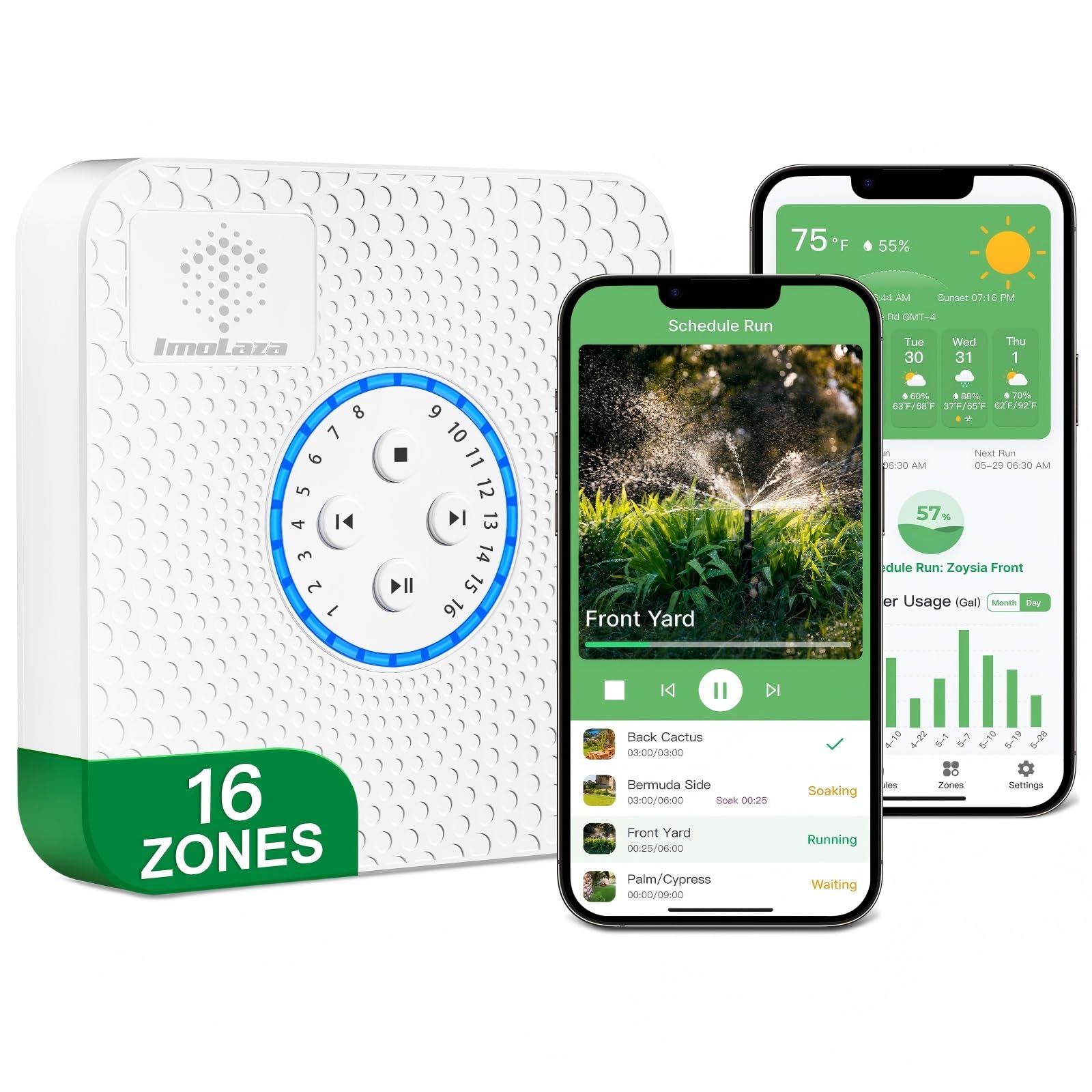
The ImoLaza is the only controller in this guide offering 16-zone capacity, making it the top choice for large properties with multiple irrigation zones, separate drip lines, and dedicated areas for grass, flower beds, and vegetable gardens. It uses real-time evapotranspiration (ET) calculations combined with hyperlocal weather data — rain, wind, freeze, and soil saturation sensors — to skip unnecessary watering with zero manual input.
Its “New Grass Schedule” feature is unique among controllers: it allows up to 24 start times for high-frequency watering cycles, perfect for newly seeded lawns that need multiple short bursts of water per day. The OTA (Over-the-Air) technology means the controller can receive algorithm updates remotely, continuously improving its watering efficiency over time without requiring hardware replacement. Owners consistently praise the automatic rain skip and the ability to monitor and control schedules from anywhere via the app.
The biggest caveat is WiFi reliability — a few owners found that units with weaker WiFi chips failed to reconnect after power outages, though the upgraded “Ultra” model solves this issue. Customer support is responsive and can remote-diagnose problems. The controller has no physical display, relying entirely on the app for programming, which could frustrate homeowners who prefer dial-based control. For those willing to trust the cloud, it’s the most sophisticated and water-efficient option available.
What works
- 16-zone capacity with individual scheduling for complex landscapes
- Real-time ET calculation with rain, wind, freeze, and saturation skip
- New Grass Schedule allows up to 24 start times for high-frequency watering
- OTA updates improve irrigation algorithms over time without hardware change
What doesn’t
- No physical display — fully reliant on the smartphone app for programming
- Base model has weak WiFi that may fail to reconnect after power loss
- Upgraded Ultra model needed for reliable WiFi reconnection
5. Hunter X2 Outdoor Sprinkler Controller (14-Zone)

The Hunter X2 is engineered for outdoor mounting with a weather-resistant enclosure that handles sun, rain, and extreme temperatures. It offers 14-zone capacity with three independent programs and four start times each, supporting run times up to 6 hours per zone — ideal for large lawns with deep-rooted turf that requires long, infrequent watering cycles. The large backlit display is easy to read in direct sunlight or low-light conditions.
The X2 is Hydrawise-compatible via a plug-in WAND module (sold separately), which unlocks weather-based scheduling, remote control, and real-time weather data integration. Even without the module, the base unit features QuickCheck diagnostics that detect wiring faults instantly and Easy Retrieve Memory that protects your schedule during power outages. Seasonal adjustment lets you dial run times up or down across all zones without reprogramming each one individually.
Owners consistently praise the X2’s build quality and ease of installation, noting it’s a direct replacement for older Hunter controllers with the same wiring and rain sensor compatibility. The main complaint is that the Hydrawise module adds significant cost — over — which makes the total investment comparable to all-in-one smart controllers. If you want smart control from day one, the X2 is better viewed as a future-proof platform rather than an immediate value.
What works
- Weather-resistant outdoor enclosure built for direct sun and rain exposure
- 14-zone capacity for large properties with complex irrigation needs
- QuickCheck diagnostics instantly detect wiring faults and valve issues
- Large backlit display visible in both bright sunlight and dark garages
What doesn’t
- Hydrawise WiFi module costs over extra, pushing total price high
- No smart features out of the box — module required for weather-based control
- Base unit lacks WiFi connectivity entirely if you skip the module
6. Hunter X-Core XC800i Indoor Sprinkler Timer (8-Zone)

The Hunter X-Core XC800i is the anti-smart controller: no WiFi, no app, no logins. Just a physical dial that lets you set programs, start times, and zone durations with zero fuss. It controls up to 8 zones with three independent programs and four start times each, giving you 12 total start time slots — more than enough for most residential landscapes. The metal case construction feels substantial compared to the plastic shells of many smart controllers.
Seasonal adjustment is handled via a simple rotary dial that increases or decreases run times across all zones by a percentage — no reprogramming needed when seasons change. The Smart Port (optional) allows compatibility with Hunter remotes for manual zone operation during installation or maintenance. Built-in surge protection safeguards the electronics against lightning strikes, a common killer of irrigation controllers. Owners report 10+ year lifespans, with one unit lasting 11 years before failing during a thunderstorm.
The X-Core is ideal for homeowners who value simplicity over connectivity, or who have experienced WiFi reliability issues with smart controllers. The downside is obvious: no remote control, no weather-based adjustments, and no rain skip unless you install a separate rain sensor. If you’re the type of person who sets a schedule in April and forgets about it until October, this is your controller. If you want to fine-tune watering from your phone on a hot July afternoon, look at the smart options above.
What works
- Rock-solid reliability with no WiFi or app dependencies
- Metal case construction feels durable and substantial
- Simple dial-based seasonal adjustment across all zones
- Built-in surge protection to guard against lightning damage
What doesn’t
- No remote control — must be at the unit to adjust schedules
- No weather-based watering or automatic rain skip
- Separate rain sensor required for basic rain delay functionality
7. Irritrol Rain Dial RD600-INT-R (6-Zone)

The Irritrol Rain Dial RD600 is a legend in the irrigation industry — owners consistently report 20 to 25-year lifespans, making it the most durable controller in this roundup. It’s a 6-station indoor unit with three independent programs, a rain sensor bypass switch, and Climate Logic readiness that automatically reschedules watering based on weather data from an optional sensor. The RD600 is not smart-home compatible, and it doesn’t pretend to be. It’s built for people who want to set a schedule and not touch it again for two decades.
Installation is remarkably simple — one owner replaced a 25-year-old Rain Dial controller in under two minutes and had it running immediately. The unit does not require a separate AC/DC adapter, a welcome improvement over older models. The programming logic is straightforward: three independent programs (A, B, C) allow you to run different schedules for lawn zones, drip zones, and shrub zones, each with its own start times and durations. The water well recovery feature adds a delay between stations to prevent well pump burnout.
The Rain Dial’s main limitation is its lack of modern connectivity. There’s no WiFi, no app, and no weather-based automation unless you add a separate Climate Logic sensor. The price is higher than many smart controllers with more features, which feels counterintuitive — but you’re paying for longevity, not features. For irrigation professionals or homeowners who’ve been burned by failed consumer-grade timers, the RD600 is an investment that pays off in decades of trouble-free operation.
What works
- Proven 20+ year lifespan with owners replacing 25-year-old units
- Three independent programs for separate lawn, drip, and shrub schedules
- Water well recovery delay prevents well pump burnout
- Rain sensor bypass switch and Climate Logic ready
What doesn’t
- No WiFi, no app, and no remote control capability
- Higher initial cost than many feature-rich smart controllers
- Climate Logic weather sensor required for automatic weather adjustments
8. Rain Bird ARC6 App-Based Smart WiFi Timer (6-Zone)

The Rain Bird ARC6 is the entry-level smart controller in the Rain Bird lineup, offering the same core app-based functionality as the ARC8 but limited to 6 zones. It’s EPA WaterSense certified and uses the same Rain Bird mobile app for remote control, weather-based watering adjustments, and Alexa/Google Assistant compatibility. The installation process is identical to the ARC8: about 10 minutes for hardware and 15 minutes for app setup, with most owners reporting a painless experience.
The ARC6’s water-saving capabilities are genuine — the system automatically skips or adjusts daily watering based on local weather forecasts and historic averages, and owners report up to 30% savings on outdoor water use. The ability to share control with family members or landscaping professionals via the app is a practical feature for multi-person households. The compact indoor design fits neatly on a garage wall without taking up much space.
The same reliability concerns that affect the ARC8 also apply here: a subset of owners experience WiFi disconnection issues that cause scheduled programs to fail. The ARC6 also has no outdoor rating, so it must be installed indoors or in a protected enclosure. For the price, it’s the most affordable way to get into Rain Bird’s smart ecosystem, but prospective buyers should be aware of the potential WiFi instability and the lack of manual panel controls for backup programming.
What works
- Lowest entry price for the Rain Bird smart ecosystem
- EPA WaterSense certified with up to 30% water savings
- Alexa and Google Assistant voice control for hands-free operation
- App-based control from anywhere with internet access
What doesn’t
- 6-zone capacity limits expansion for larger properties
- WiFi disconnection issues can cause missed watering schedules
- Indoor-only design requires installation in a garage or protected area
9. Garden In Minutes Garden Grid Watering System (33.5″x66″)
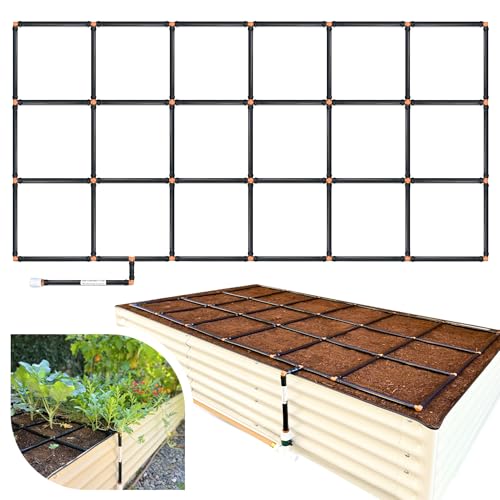
The Garden Grid is a completely different approach to lawn sprinkler systems — it’s a pre-assembled overhead grid designed specifically for raised garden beds. Rather than burying drip lines or running soaker hoses that only water along narrow paths, the Grid delivers 16 gentle streams of water per square foot directly at soil level, ensuring every plant gets even hydration without dry spots or overspray. Setup takes about two minutes: just connect it to a standard garden hose and you’re watering.
The durability claims are extraordinary — original units manufactured in 2013 are still in use today. The UV-resistant polypropylene construction withstands intense sun, heavy rain, and freezing winters without degrading. A built-in fine mesh filter screen keeps debris out of the water streams, and maintenance is as simple as brushing off the filter or tubes. Unlike drip irrigation systems that require replacing emitters every few seasons, the Garden Grid is designed to last 5 to 10 times longer than soaker hoses or drip lines.
The Grid is available in multiple sizes, with the 3×6 (33.5″x66″) fitting standard raised bed dimensions. It can be used manually or paired with a garden hose timer for automatic watering. The main drawback is cost — at roughly , it’s more expensive than a roll of soaker hose or a basic drip kit. However, when you factor in the 10+ year lifespan and the elimination of clogged emitters and tangled tubes, the total cost of ownership is competitive. It’s a purpose-built solution for square-foot gardeners who want hands-off, even watering.
What works
- Pre-assembled design sets up in under 2 minutes — no tools required
- 16 gentle water streams per square foot ensure even, root-level hydration
- UV-resistant construction with original 2013 units still in daily use
- Built-in fine mesh filter prevents debris from clogging the water streams
What doesn’t
- Higher upfront cost compared to basic soaker hoses or drip tape
- Fixed rectangular shape may not fit non-standard or irregular bed dimensions
- Requires connection to a hose — no hard-pipe integration for permanent installs
Hardware & Specs Guide
Zone Count and Valve Compatibility
Each zone on a controller corresponds to one solenoid valve in your yard. Most residential systems have 4 to 8 zones, but properties with separate drip lines, dedicated vegetable garden zones, and multiple turf areas often need 12 to 16 zones. Always buy a controller with at least one or two spare stations for future expansion. Check that the controller’s voltage matches your valves — most residential valves are 24V AC, and all the controllers in this guide support that standard.
WiFi Frequency and Connectivity
All smart controllers here operate on 2.4GHz WiFi, which offers better range and wall penetration than 5GHz. If your controller is mounted in a metal garage or a basement utility room with thick concrete walls, consider a model with an Ethernet port (like the Yardian Pro) or a WiFi range extender. Some controllers, like the ImoLaza, have weaker WiFi chips that may struggle with reconnection after power outages — the upgraded Ultra model solves this with a more robust radio.
WaterSense Certification and ET Calculations
EPA WaterSense certified controllers use weather data or soil moisture sensors to automatically adjust watering schedules, reducing outdoor water use by an average of 30% compared to manual timers. Higher-end models like the ImoLaza and Yardian Pro calculate real-time evapotranspiration (ET) rates based on hyperlocal weather data — temperature, humidity, wind speed, and solar radiation — to determine exactly how much water your lawn has lost since the last watering and how much to apply.
Physical Display vs. App-Only Control
Controllers with a built-in display and physical dial (Hunter X-Core, Irritrol Rain Dial) allow programming without a smartphone and work during WiFi outages. App-only controllers (ImoLaza, Rain Bird ARC6/ARC8) rely entirely on the app for setup and adjustments, which is fine if your WiFi is stable but problematic if the controller loses connection and you need to make an immediate change. Some models offer hybrid control — the ESP-TM2 has a full LCD display and optional WiFi module.
FAQ
Can I install a smart sprinkler controller myself or do I need a professional?
How does weather-based watering actually save water compared to a manual timer?
What happens to my watering schedule if the WiFi goes down or the power goes out?
What does WaterSense certification mean for a sprinkler controller?
Final Thoughts: The Verdict
For most homeowners, the lawn sprinkler systems winner is the Yardian Pro because it combines rock-solid Ethernet connectivity with native Apple HomeKit support, physical manual buttons, and ET-based weather scheduling at a price that undercuts many lesser-equipped competitors. If you need maximum zone capacity and are comfortable with app-only control, grab the ImoLaza for its 16 zones and OTA-updateable algorithms. And for those who value decades of trouble-free operation over smartphone convenience, nothing beats the Irritrol Rain Dial RD600.