
You know the feeling: you unroll a cheap fence from the big-box store, and within a year it’s rusted or bent out of shape. Livestock pushing through, predators getting in — it’s a waste of money. The good news is that you don’t need to spend a fortune to get a farm fence that actually works. You just need to pick the right gauge (wire thickness), coating (rust protection layer), and length for your specific animals and terrain — and that’s exactly what this guide helps you do.
I’m Rikta — the co-founder and writer behind Lawn Gear Lab. This guide is built by comparing the manufacturers’ published specifications and the patterns across verified customer reviews, so you get each pick’s real strengths and trade-offs instead of marketing spin.
Below, I break down six proven rolls to help you find the best cheap farm fencing for keeping your animals in and predators out without wasting money on the wrong material.
How To Choose The Best Cheap Farm Fencing
Farm fencing isn’t complicated once you know what three numbers to look at first. Focus on the gauge (wire thickness), the mesh size (gap between wires), and the coating (rust protection) — those three specs tell you everything about whether a roll will last or leave you frustrated in a year.
Wire Gauge: Thicker Means Stronger
Wire gauge is a measure of thickness. The counterintuitive rule is that a lower gauge number means thicker, stronger wire. A 12-gauge wire (0.1 inches thick) is far more rigid than a 19-gauge wire (about 0.04 inches). For containing large livestock like cattle or horses, you generally want 12 or 14 gauge. For poultry, gardens, or rabbit coops, 16 to 19 gauge is usually sufficient and much easier to bend by hand during installation.
Mesh Size: What Slips Through?
Mesh size refers to the gap between the wires. A 2-inch x 4-inch mesh is great for dogs and sheep, but a baby goat or a chicken can walk right through it. A 1/2-inch mesh stops snakes, rodents, and even the smallest poultry, but it costs more and restricts airflow more. Select the mesh size based on the smallest animal you need to contain or exclude.
Coating: The Real Fight Against Rust
The coating is what determines if your fence lasts two seasons or ten. Standard galvanized (a zinc layer applied to steel) is the baseline. Hot-dip galvanized forces a thicker zinc coating on by dipping the steel in molten zinc — this offers far superior rust resistance. PVC-coated fencing adds a layer of plastic over the galvanized steel for extra weatherproofing and a cleaner look, though the PVC can crack if the wire underneath bends too sharply.
Quick Comparison
On smaller screens, swipe sideways to see the full table.
| Model | Category | Best For | Key Spec | Amazon |
|---|---|---|---|---|
| Farm Fence 4FT x 164FT | Mid-Range | Medium-duty dog & livestock containment | 14 gauge, 164ft roll | Amazon |
| 12 Gauge Cattle Panels | Premium | Heavy livestock & rigid garden trellis | 12 gauge, 100ft roll | Amazon |
| Hardware Cloth 1/2in Mesh | Value | Poultry & small-pest exclusion | 19 gauge, 1/2in mesh | Amazon |
| PVC Coated Welded Wire | Style | Garden borders & deer deterrent | 16 gauge, 48in height | Amazon |
| PPOLB Electric Netting | Pro | Portable grazing & predator control | 35.4in height, 164ft | Amazon |
| Hot Dip Galvanized Welded Wire | Space | Underground mole barrier & heavy-duty fence | 14 gauge, hot-dip coated | Amazon |
In‑Depth Reviews
1. Farm Fence 4FT x 164FT, Galvanized Cattle Fence
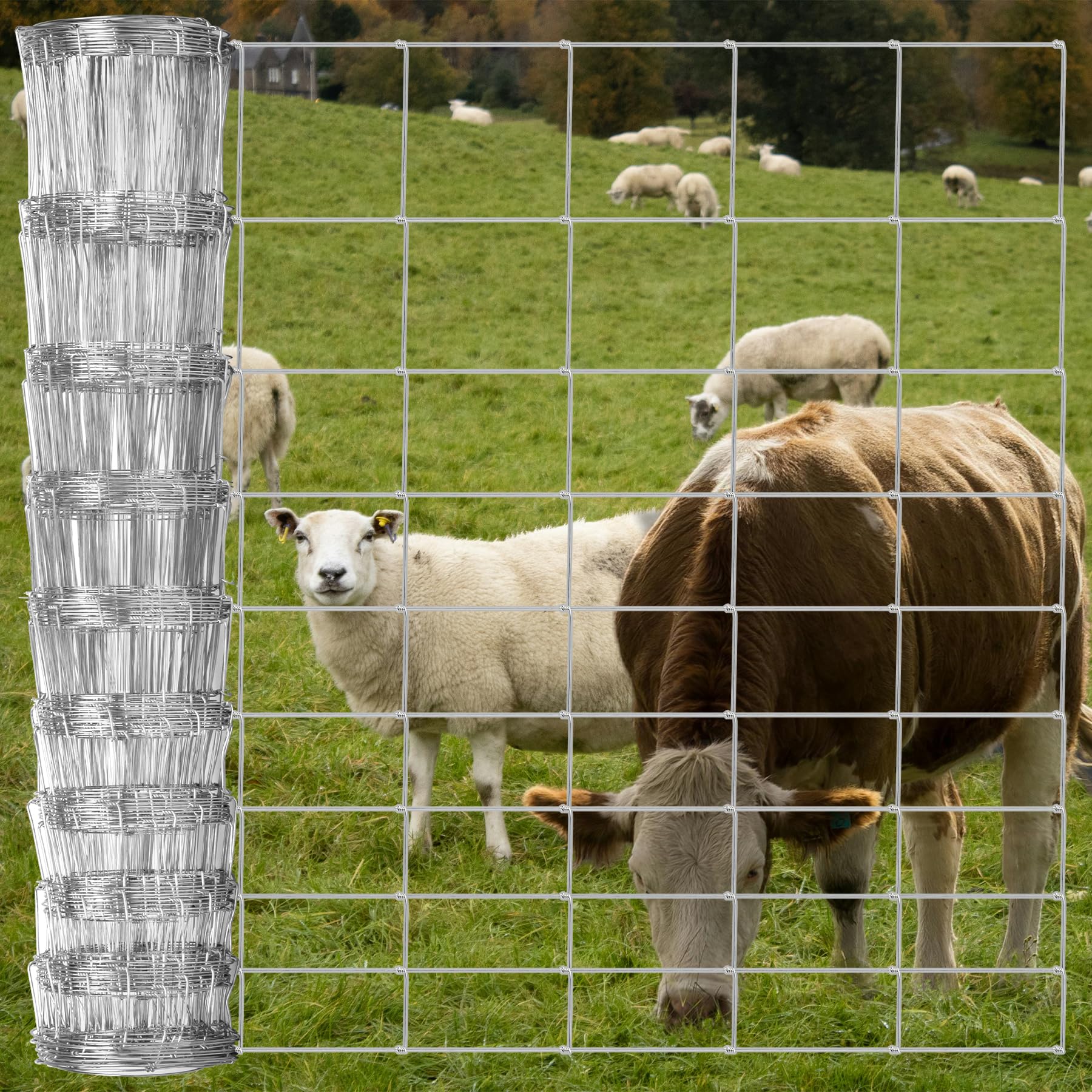
164 feet of 14-gauge wire (0.08 inches thick) gives you 64% more coverage than the 100-foot panels below, making the Farm Fence 4FT x 164FT the best all-rounder for anyone with medium-sized animals like goats, sheep, or an 80-pound dog that needs containing without paying for premium steel.
Buyers report that the “thick wire suitable for light/medium use” held up well against dogs over 80 pounds. The gradient mesh — larger gaps at the top, smaller squares near the bottom — means a determined hound can’t squeeze its head through the lowest row. At 49 pounds, it’s not the lightest roll here, but one reviewer noted it is “relatively easy to hang on your own” and the included needle-nose pliers make splicing and tensioning simpler.
This is a strong pick if you want a 4-foot tall barrier that spans a long run for medium-duty work. skip it if you need to contain full-grown bulls or aggressive cattle — the 14-gauge wire is not designed for that kind of pressure.
Why it’s great
- 164ft length covers more ground than most budget rolls
- 14-gauge wire easily holds 80+ lb dogs
- Gradient mesh blocks small animals at the bottom
- Includes a pair of quality needle-nose pliers for installation
Good to know
- Not sturdy enough for large livestock like bulls or heavy horses
- Some owners mention the wire feels slightly flimsy in high-wind areas
2. 12 Gauge Heavy Duty Cattle Panels for Garden Trellis, 4ftx100ft
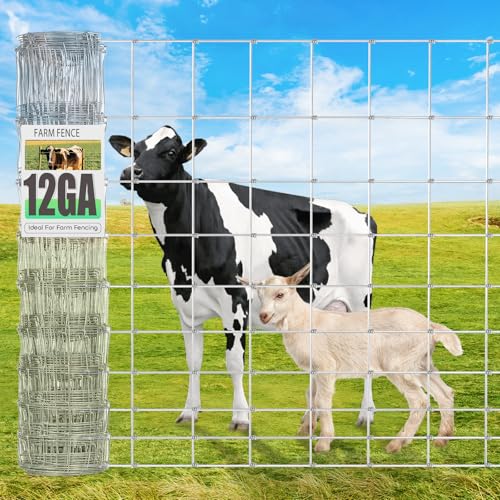
The 12 Gauge Cattle Panels beat the Farm Fence pick above on pure wire strength — at 0.1 inches thick, this 12-gauge wire is 58% thicker than a standard 19-gauge chicken wire, making it the most rigid roll in this lineup. However, it falls short on length (100ft vs 164ft) and total coverage, so you trade area for brute force.
In real use, customers note that “it is very heavy and sturdy 12GA galvanized wire for tall garden trellis” — one reviewer used it to build a pea and bean arch in the garden and loved how it held the weight of climbing vegetables without sagging. The hot-dip galvanized coating gives it superior rust resistance in wet climates, and the hinge-joint weaving design can withstand pressure from cattle, horses, and hogs without loosening up over time.
Choose this over the Farm Fence pick if your primary concern is containing large, heavy animals like full-grown cattle or if you need a self-supporting trellis that won’t buckle under the weight of a mature squash vine. The thick 12-gauge wire does require a mini bolt cutter to cut, as standard diagonal pliers simply cannot handle it.
Where it shines
- 12-gauge wire is the thickest and most durable in this set
- Hot-dip galvanized coating provides excellent rust resistance
- Hinge joints withstand pressure from cattle and horses
- Works perfectly as a tall garden trellis for heavy climbing plants
Worth noting
- Only 100ft long — less coverage than the 164ft competitor
- Too thick to cut with normal wire cutters; mini bolt cutter required
- A few reviewers received rolls that arrived damaged and stretched
3. Hardware Cloth 1/2inx36inx100ft, Chicken Wire Fencing Welded Wire Mesh
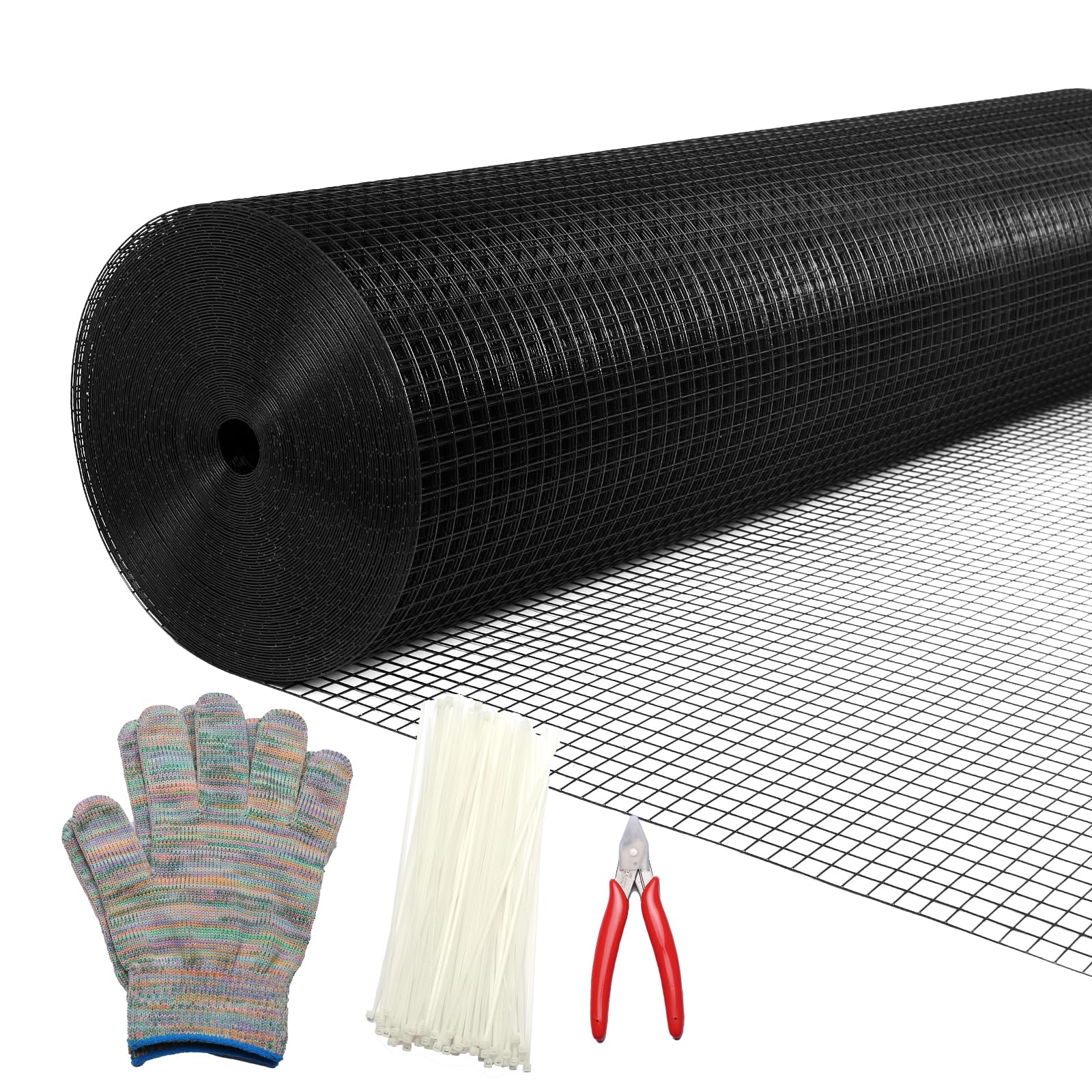
If you are building a chicken coop, a rabbit hutch, or protecting a garden from snakes and voles, the 1/2-inch mesh size (the gap between wires) is non-negotiable — and this roll delivers that tight grid across 100 feet for a very accessible price. The 19-gauge wire (about 0.04 inches) is thin enough to be “easily bent by hand” according to one reviewer, which makes wrapping it around the corners of a coop frame or stapling it to wooden beams a quick job.
Reviewers point out that “the 100’x24″ roll comes well packaged and also comes with snips to cut the wire mess” — a full accessory kit including 100 zip ties, a pair of work gloves, and wire cutters is included in the box, saving you a trip to the hardware store. The vinyl PVC coating over a galvanized steel core gives it double-layer protection against rust, so it stays black and clean-looking even through wet winters.
The catch is that 19-gauge wire will not stand up to a determined large predator like a coyote or a heavy dog pushing against it — for that, you want the thicker 14-gauge Farm Fence or the 12-gauge Cattle Panels. For small critters and birds, this is the perfect dedicated solution: 1/2-inch mesh, 100 feet, and a full accessory kit in one box.
What stands out
- 1/2-inch mesh blocks snakes, mice, and the smallest poultry
- Includes snips, zip ties, and gloves for immediate installation
- PVC-coated for extra rust resistance and a clean black finish
- Very easy to cut and bend by hand without special tools
The trade-offs
- 19-gauge wire is not strong enough for large livestock or predators
- At 36 inches high, it is too short for most cattle or horse fences
4. Garden Fence Black PVC Coated Welded Wire Fencing 48 Inch x 100 Foot
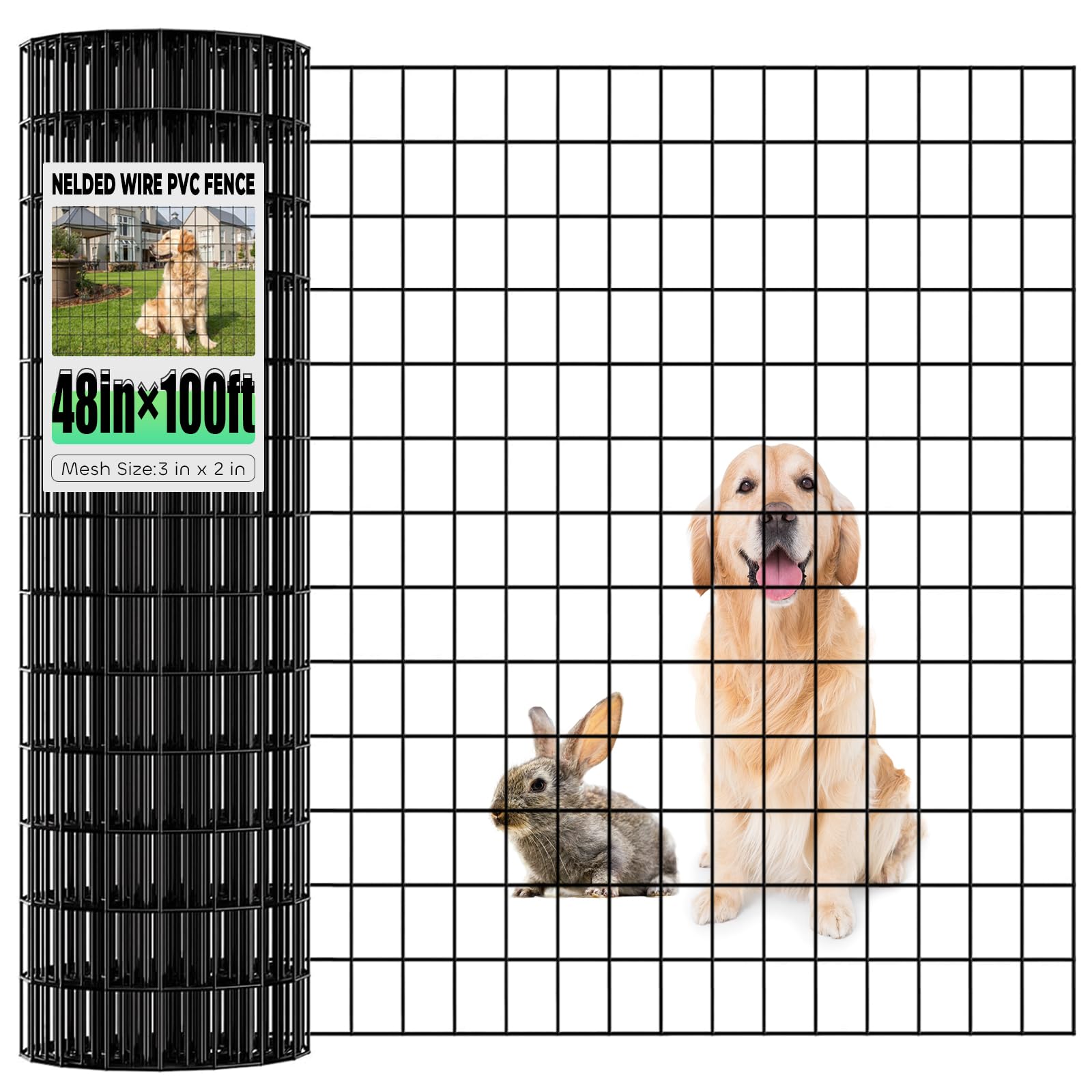
The number that matters most here is the 48-inch height at a 16-gauge thickness — this is a visually clean, all-black roll that stands tall enough to discourage deer from hopping over while keeping your dogs inside the yard. At a slightly higher price point, you are paying for the finished look and the dual coating: galvanized steel core plus a vinyl PVC outer layer that hides the metal in a matte black finish.
The downside you accept is that 16-gauge wire is not as rigid as the 14-gauge options — buyers describe it as “lightweight” and “a little flimsy” for large dog containment, though it held up fine for one reviewer’s four dogs. The 2-inch x 3-inch mesh is a good middle ground: too small for a sheep to get its head stuck, yet large enough to not block the view of your garden.
For the money, you get a fence that looks far more elegant than standard silver galvanized wire, and one buyer specifically noted the “48-inch height prevents deer entry when combined with 6-foot rope” — making it a smart choice for vegetable gardeners who want animal protection without an industrial appearance.
The upsides
- 48-inch height is effective against deer and medium-sized dogs
- Black PVC coating blends into gardens and yards beautifully
- Flexible enough to shape into circular tree cages or bean supports
- Lightweight roll is easy for one person to install
Keep in mind
- 16-gauge wire feels flimsy when stretched tight over long spans
- Not suitable for containing large livestock or strong predators
5. PPOLB Electric Fence Netting – 35.4″ H x 164′ L
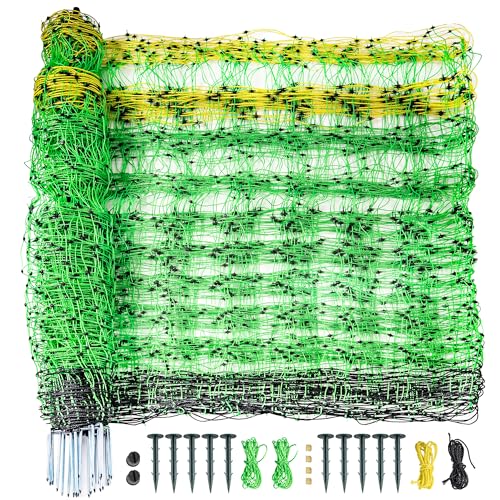
What you actually get at this price point is a portable electric netting system that covers 164 feet with 9 horizontal strands (8 of which are conductive), designed to deliver a low-impedance shock that trains animals to stay away after a single zap. Unlike welded wire rolls, this is not a permanent fence — it uses lightweight step-in posts with built-in glass fiber rods placed every 12.5 to 13.1 feet, so you can move the entire enclosure in under an hour.
What you give up is the physical barrier strength of steel: this netting relies entirely on the electric shock to keep animals in or out, and the non-electrified bottom line prevents shorts from grass contact but does not physically block a determined animal. One reviewer warned that “smaller chickens can get through the fencing” and that the step-in poles “break very easily” on hard or rocky ground. You also need to buy a separate fence energizer (a device that sends the electric pulse) and a grounding rod — the netting alone is just half the system.
This is perfect for homesteaders who practice rotational grazing for goats or sheep and need to move their enclosure weekly without digging post holes. Buyers confirm it is “outstanding and easy to set up” and that baby goats learn to respect the fence after one touch, making it a highly effective temporary solution.
Why we’d pick it
- Portable design — can be moved and reconfigured in under an hour
- 9 horizontal strands with 8 conductive lines for reliable shock
- Bottom non-electrified strands prevent grass from shorting the system
- Huge savings compared to other name-brand electric netting systems
A few caveats
- Fence energizer and grounding rod are sold separately
- Step-in poles can snap on rocky ground if not installed carefully
- Mesh is too large for chickens or other small birds
6. Metal Garden Fence, Hot Dip Galvanized, 2″x4″ 14 Gauge, 48inch H x 100ft L
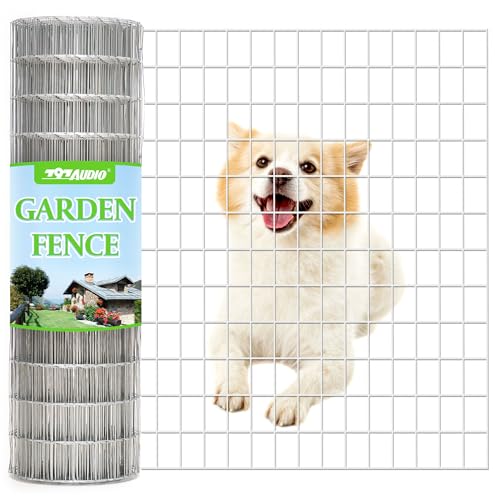
This fence is perfect for a buyer who needs a long-lasting, buried barrier in consistently wet or humid conditions, such as a mole-proof liner under a raised bed or a perimeter fence in a damp low-lying field. Compared to the PVC-coated Garden Fence above, this roll delivers the same 14-gauge thickness but with a hot-dip galvanized coating — a process that forces molten zinc onto the steel for a much thicker, longer-lasting rust barrier than standard galvanizing. At a similar price point, you are getting a fence that will outlast the alternative by years in consistently wet or humid conditions.
What that money gets you is a dense 54.7-pound roll of 2-inch x 4-inch mesh that buyers are using for everything from blocking coyotes in the backyard to laying under raised garden beds to stop pocket moles. One buyer mentioned that “by placing this hardware under my raised bed, the moles became a thing of the past” — the hot-dip coating means it can be buried in direct soil contact without corroding quickly. The wire is stiff enough to stay rigid when stapled to wooden posts, yet one buyer confirmed the included “wire cutters don’t work very well” so you might want your own heavy-duty snips.
The one reason to choose this is if you need a fence that lives in the ground — either buried as a mole barrier or set in a damp low-lying field where standard galvanized fencing would rust through within a season. It is the most durable 14-gauge option in this entire list, but be aware that the included wire cutters don’t work very well, so you will likely need your own heavy-duty snips for cutting the stiff mesh.
Strong points
- Hot-dip galvanized coating offers superior rust resistance for ground contact
- 14-gauge wire is stiff enough to stay taut on long fence runs
- Works well as an underground mole barrier in raised beds
- Large 2″x4″ mesh is ideal for gardens and dog containment
Before you buy
- Shipping can take up to double the estimated delivery time
- Included wire cutters are of poor quality — bring your own
- At 54.7 pounds, it is the heaviest roll in this comparison
Understanding the Specs
Wire Gauge
Gauge is the thickness of the steel wire used in the fence. A lower number means thicker wire. 12-gauge (0.10 inches) is extremely rigid and great for large livestock. 14-gauge (0.08 inches) is a strong all-purpose choice for dogs, goats, and sheep. 16-gauge (0.06 inches) works for gardens and light poultry enclosures. 19-gauge (0.04 inches) is thin and flexible, ideal for small animal coops where you need to bend the mesh around corners by hand.
Mesh Size
Mesh size is the gap between the horizontal and vertical wires. A 1/2-inch mesh stops snakes, mice, and even the tiniest chicks. A 2-inch x 4-inch mesh is standard for livestock fencing — large enough to not block wind or views, small enough to keep most goat heads from getting stuck. A 2-inch x 3-inch mesh is slightly tighter and works well for dog containment. Match the mesh size to the smallest animal you need to keep in or out.
Coating Types
Standard galvanizing adds a thin layer of zinc to the steel for basic rust protection. Hot-dip galvanizing submerges the steel in molten zinc, creating a coating 2-3 times thicker — this is the best choice for fences that touch soil or stay in wet climates. PVC coating adds a layer of black or green plastic over the galvanized wire for extra weatherproofing and a finished look, though it can peel or crack if the wire is repeatedly bent at sharp angles.
Roll Length and Height
Roll length determines how far one purchase will go. Common lengths are 50ft, 100ft, and 164ft. A 164-ft roll gives 64% more coverage than a 100-ft roll, meaning fewer splices and less waste. Height matters for the jumping or climbing ability of your animals: 36 inches works for chickens and small dogs, 48 inches is the standard for goats and medium dogs, while taller fences (5-6 feet) may be needed for deer or large predators.
FAQ
What gauge wire do I need for goats?
Can I use chicken wire to keep out predators?
How long does galvanized farm fencing last?
What is the difference between welded wire and woven wire fence?
Do I need an electric fence for my goats or sheep?
Final Thoughts: The Verdict
When it comes down to it, the cheap farm fencing winner is the Farm Fence 4FT x 164FT because it gives you the longest run at a mid-range price with 14-gauge wire that holds 80-pound dogs and medium livestock while staying affordable. If you need maximum brute strength for cattle or a rigid trellis, grab the 12 Gauge Cattle Panels. And for portable rotational grazing with goats or sheep, the standout is the PPOLB Electric Netting.