
If you want to turn kitchen scraps into the richest soil booster your garden can get, a worm composter (also called a vermicomposting bin) lets a colony of red wigglers eat your leftovers and produce crumbly, dark castings you can mix directly into your pots or beds. The challenge is picking the right bin: one that keeps smells contained, lets you harvest without disturbing the worms, and fits the amount of waste your household actually generates.
I’m Rikta — the co-founder and writer behind Lawn Gear Lab. This guide is built by comparing the manufacturers’ published specifications and the patterns across verified customer reviews, so you get each pick’s real strengths and trade-offs instead of marketing spin.
These seven models represent the best worm composter options today, from a compact tray system for a small apartment to a high-capacity continuous-flow bag for a bustling family kitchen. Each is evaluated for capacity, ease of harvest, odor control, and overall build quality.
How To Choose The Best Worm Composter
The right worm composter depends on how much food waste you produce, where you plan to keep it, and how much effort you want to put into harvesting the finished compost. Here are the three key factors to consider before buying.
Capacity
Capacity is measured in liters or gallons and tells you how much food waste the bin can handle at once. A 30-liter (roughly 8-gallon) bin is a good starting point for one or two people, while a 50-liter or larger bin suits a family of four. If you overfill a small bin, buyers report that the system can get smelly and the worms may struggle to keep up — so matching capacity to your weekly scraps is the first step to a trouble-free bin.
Harvest Method: Trays vs. Continuous Flow
Most worm composters use a stackable tray system: you add a new tray on top with fresh food, and the worms migrate upward, leaving finished castings in the lower tray for you to empty. That works well but requires you to rotate and empty trays one at a time. Continuous-flow bins, like the Urban Worm Bag, let you feed from the top and collect finished compost from a bottom opening — no tray stacking or worm separation needed. For someone who wants the least handling, a continuous-flow design is a major time saver.
Ventilation and Odor Control
A healthy worm bin should smell like fresh earth, not rot. Ventilation slits or air holes in each tray allow oxygen to circulate, which keeps the aerobic bacteria working and odors down. Some bins also include a spigot at the base to drain out “worm tea” (a liquid fertilizer), which prevents the bottom from getting soupy and stinky. Models with poor seals, however, can let worms escape or allow smells to leak out — a common complaint in a few of the budget designs.
Quick Comparison
On smaller screens, swipe sideways to see the full table.
| Model | Category | Best For | Key Spec | Amazon |
|---|---|---|---|---|
| Urban Worm Bag V2 | Premium | High volume, easy continuous harvest | 150.75L capacity | Amazon |
| Original Vermihut 5-Tray | Best Overall | Balanced capacity and harvesting ease | 50L / 5 trays | Amazon |
| VIVOSUN 5-Layer (50L) | Mid-Range | Large capacity with included accessories | 50L capacity | Amazon |
| Blütezeit 5-Tray (53QT) | Mid-Range | All-in-one kit for composting beginners | 13.2 Gal / 5 trays | Amazon |
| FCMP Outdoor Essential Living | Mid-Range | Compact, sturdy indoor 2-tray system | 8 Gal / 2 trays | Amazon |
| Blütezeit 3-Tray (32QT) | Value | Entry-level kit with tools and bedding | 7.93 Gal / 3 trays | Amazon |
| VIVOSUN 3-Layer (30L) | Budget | Starter bin at a low price point | 30L / 3 layers | Amazon |
In‑Depth Reviews
1. Urban Worm Bag Worm Composting Bin Version 2

The Urban Worm Bag V2 is the pick for anyone who wants the largest capacity and the simplest harvest system — it holds 150.75 liters, nearly three times more than any tray-based model here, and you collect finished castings through a removable fabric bottom without ever separating worms from trays.
Its continuous-flow design means you feed from the top and, after a few months, just reach under the bag to pull out pure, crumbly castings — owners mention harvesting 2 gallons at a time with no sifting required. The 900D Oxford fabric breathes well to keep odors down, and the steel frame supports the full weight without wobbling, though a couple of experienced users note the frame tubing feels a bit lightweight for the price.
If you produce a lot of kitchen scraps or simply hate the idea of stacking and unsticking trays, the Urban Worm Bag turns composting into a truly hands-off routine — feed on top, collect at the bottom, and let the worms do the rest.
Why it’s great
- Massive 150.75-liter capacity handles waste from a large family
- Continuous-flow harvest — no trays to stack or worms to separate
- Strong odor control and good ventilation from the fabric walls
Good to know
- Steel frame can feel wobbly and the tubing is not as sturdy as some metal alternatives
- Requires a few months of feeding before you can harvest the first batch of castings
2. Original Vermihut 5 – Tray Worm Composter
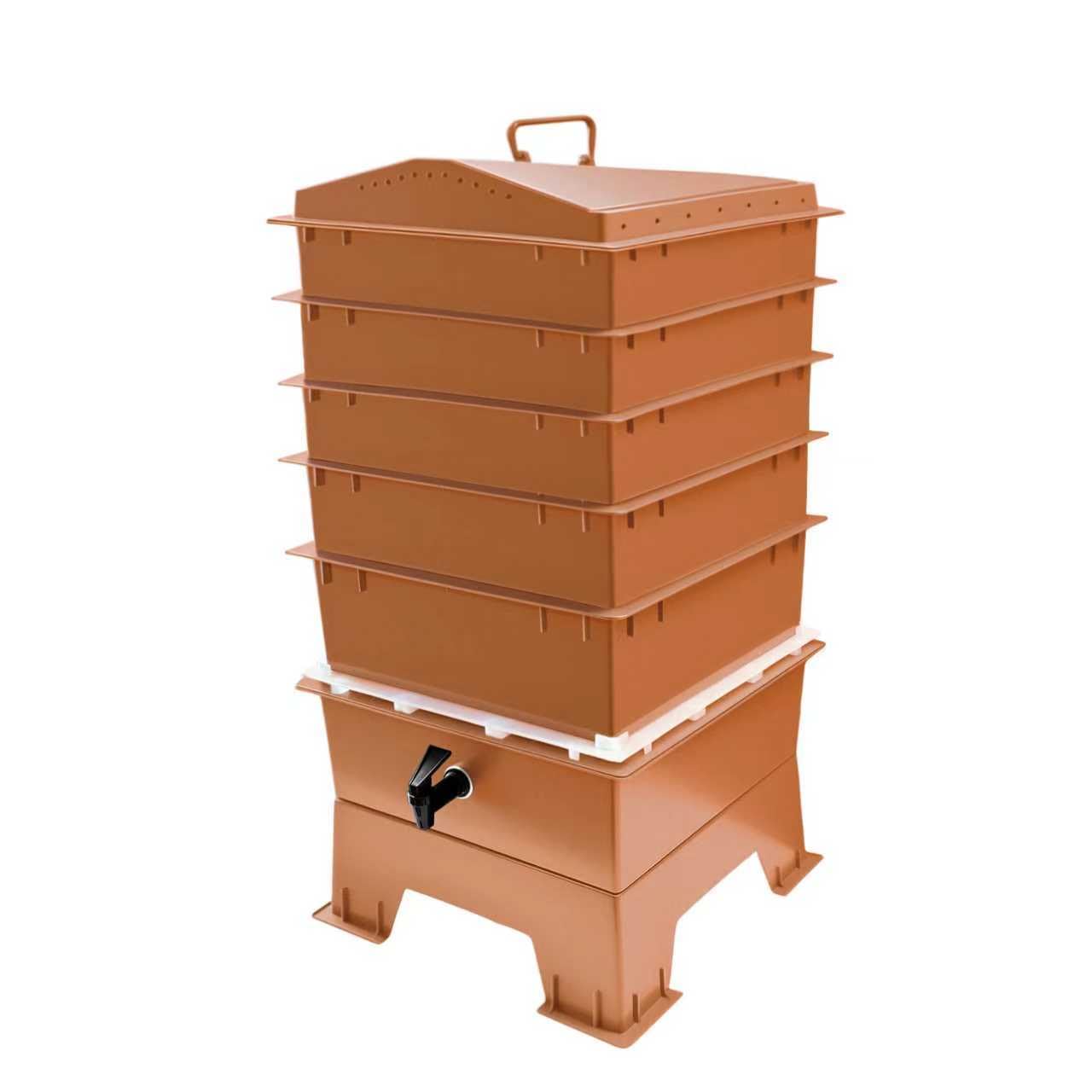
Compared to the top pick Urban Worm Bag, the Vermihut 5-Tray offers a more structured tray system with the same 50-liter capacity, but its built-in worm saver tray prevents worms from falling into the liquid reservoir — a feature the bag lacks, and customers note it provides better surface area than a DIY bucket or the VIVOSUN 5-Layer.
Setup takes about ten minutes, and the HDPE (high-density polyethylene) plastic is sturdy enough to withstand year-round use indoors or on a covered patio. Reviewers love that the five trays let you feed continuously: you add a new tray on top, the worms migrate up, and the bottom tray fills with pure castings ready to harvest with no need to sift.
If you want a no-fuss, proven tray system that supports a steady flow of food scraps without the higher cost of the Urban Worm Bag, the Vermihut is the dependable middle-ground that you can count on for seasons to come.
Where it shines
- 50-liter capacity with 5 trays offers plenty of room for a small-to-medium household
- Worm saver tray prevents worms from drowning in the liquid collection reservoir
- Sturdy HDPE construction holds up well in indoor and outdoor settings
Worth noting
- Can become top-heavy when all five trays are full, requiring a stable base
- Does not include a trowel or some of the extra accessories found in other kits
3. VIVOSUN 5-Layer Worm Compost Bin, 50L
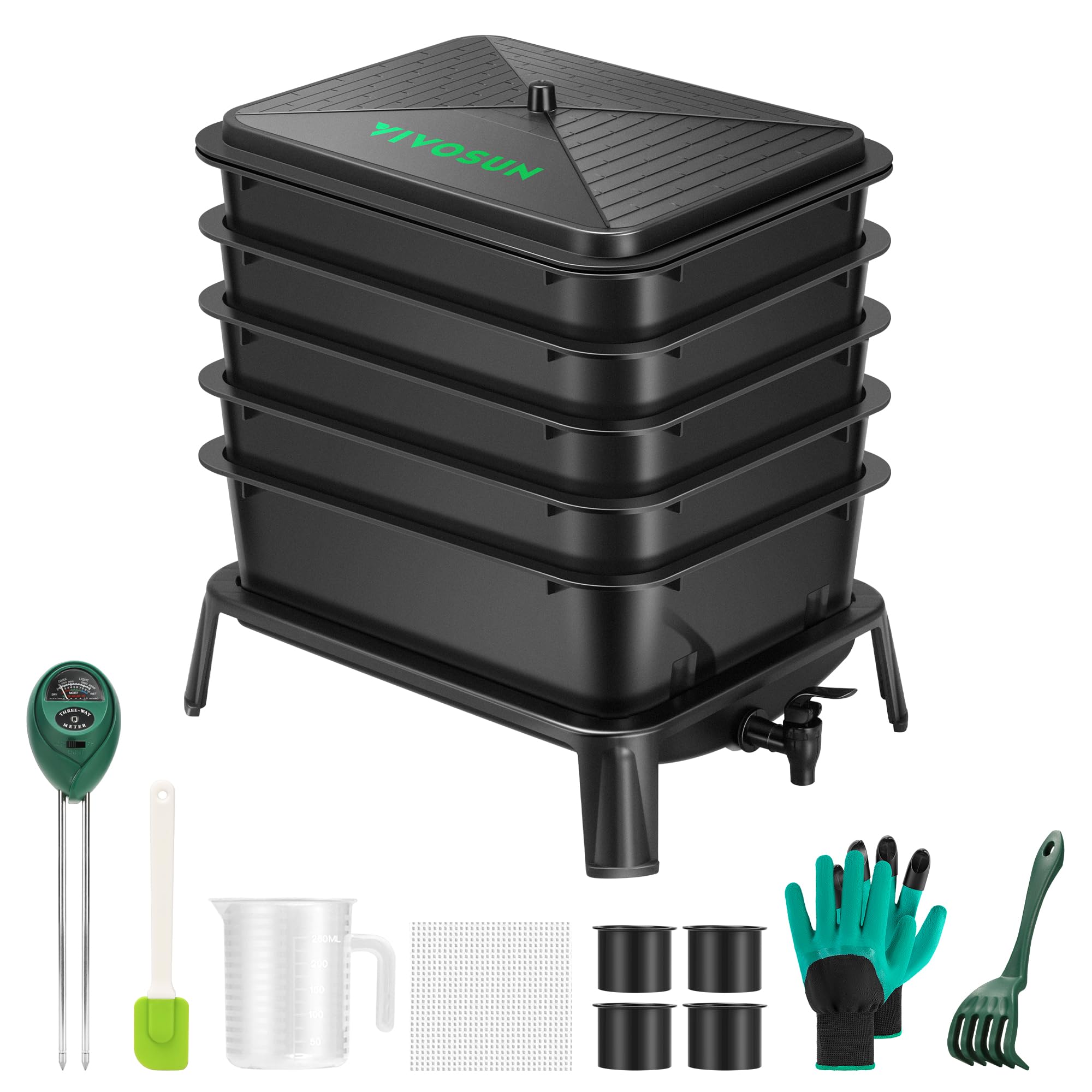
For the household that produces a steady stream of fruit peels, coffee grounds, and salad trimmings, the VIVOSUN 5-Layer holds 50 liters (13 gallons) of bedding and scraps — a 67% larger capacity than its own 30-liter 3-layer sibling, so you can go twice as long between emptyings.
It comes as a complete starter package with a measuring cup, soil meter, rubber scraper, non-woven fabric, and a pair of gloves, which reviewers point out helps avoid the second trip to buy tools. The stacked design uses ventilation slits to minimize odors, and the spigot on the base lets you drain worm tea directly into a container for your plants. Some users note that the instruction manual is thin, so you may need to do extra research on how to rotate trays and properly harvest castings.
The VIVOSUN 5-Layer gives you the same big 50-liter capacity as the Vermihut but with more included accessories, making it the better choice if you want everything in one box before you start your first worm bin.
What stands out
- 50-liter capacity handles a household’s weekly kitchen scraps with room to spare
- Comes with a full set of starter tools — measuring cup, soil meter, gloves, and more
- Ventilation slits and a base spigot help control odor and collect liquid fertilizer easily
The trade-offs
- Instruction manual provides limited detail — expect to watch a few online tutorials
- Some shoppers say the bin feels smaller than expected despite the 50-liter rating
4. Blütezeit 5-Tray Worm Composter, 53QT
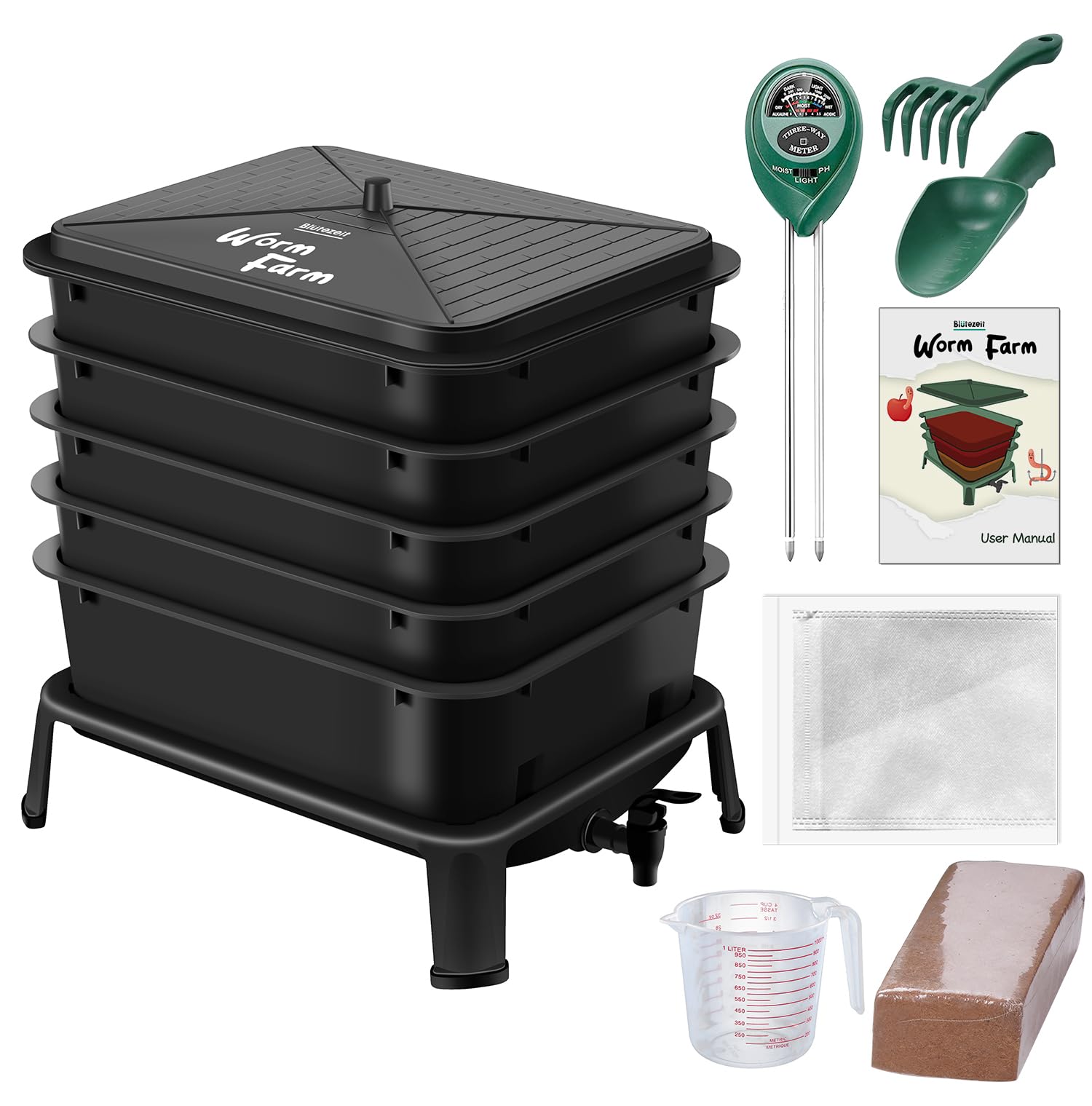
The single number that matters most in this category is capacity, and the Blütezeit 5-Tray delivers the same 13.2-gallon (50-liter) volume as the VIVOSUN 5-Layer and the Vermihut, but it packs in the richest accessory bundle — a turning fork, shovel, soil meter, coco-coir brick, non-woven fabric, anti-slip feet, a cup, and a spigot — so you have everything except the worms themselves.
However, the catch is that several experienced composters report worm escapes through the lid and side seals, especially in the first few days. The modular design lets you start with one tray and add more as your worm population grows, which buyers report helps ease into vermicomposting without feeling overwhelmed. The included soil meter tracks moisture, pH, and light levels, giving you a good read on whether the environment inside the bin is healthy.
If you value a complete tool set right out of the box and are willing to add a bead of silicone or a strip of foam to improve the seal, the Blütezeit 5-Tray offers the best bang for your buck on accessories among the mid-range options.
The upsides
- Includes a generous tool set: turning fork, shovel, soil meter, coco-coir brick, and more
- Modular 5-tray design lets you start with one tray and add as worms multiply
- Soil meter gives real-time feedback on moisture, pH, and light for better bin management
Keep in mind
- Poor seal on lid and between trays can allow worms to escape in the first few days
- Clearance under the base for the collection cup is tight, making spigot use awkward
5. FCMP Outdoor Essential Living Composter, 2-Tray
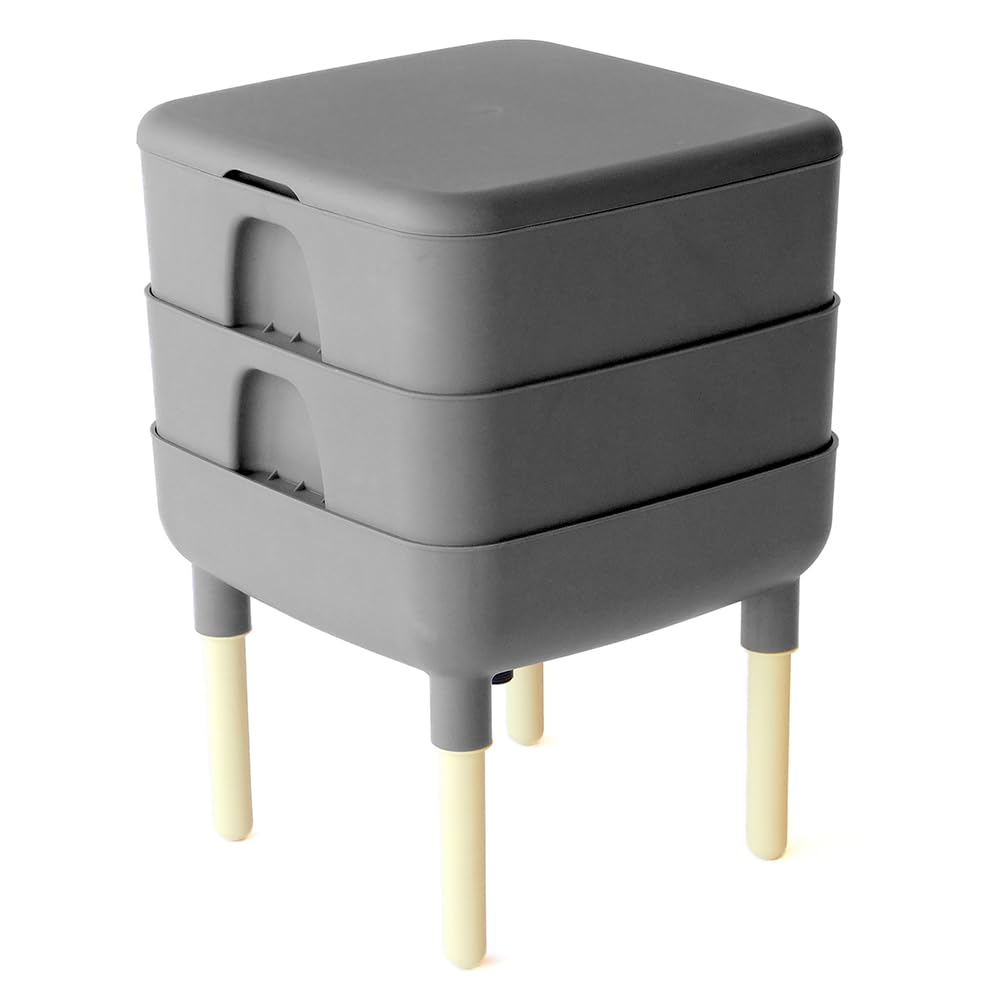
The FCMP Outdoor takes a different approach with only two trays and an 8-gallon capacity, but what you actually get at this lower price is UV-inhibited recycled polypropylene that is thick and rigid, plus 52 angled migration tunnels in each tray giving worms plenty of paths to move upward when the bottom tray is full.
Owners mention this bin is perfect for a single person or a couple with light kitchen waste, and after three months the worms were thriving with weekly feedings. The moisture control water retention channel around each tray prevents the bedding from drying out along the edges, which is a thoughtful detail that many larger bins lack. On the downside, the filter area for worm tea clogs easily and can get messy to clean.
Smaller capacity means more frequent harvests, but the FCMP is the bin to grab if you want a compact, odor-free composter made from recycled materials that can sit right on your kitchen counter without looking out of place — it is perfect for the budget buyer who prioritizes build quality and aesthetics over maximum volume.
Why we’d pick it
- Made from BPA-free, UV-inhibited recycled polypropylene — sturdy and eco-friendly
- 52 migration tunnels in each tray make it easy for worms to move upward
- Moisture control channel keeps the outer edges of the bedding from drying out
A few caveats
- Filter area for worm tea clogs frequently and can become messy during cleaning
- 8-gallon capacity means you will need to harvest and rotate trays more often
6. Blütezeit 3-Tray Worm Composter, 32QT

The Blütezeit 3-Tray is the ideal entry point for someone who wants to try worm composting without a big investment — its 7.93-gallon (30-liter) capacity is manageable for learning the ropes, and it comes with a turning fork, shovel, soil meter, coco-coir brick, and a spigot, so you have all the basics in one box.
One reviewer noted setting it up in about five days and said the worms looked healthy, though the bin felt somewhat smaller than expected. At 16.14 inches wide by 12.6 inches deep by 13.78 inches tall, it occupies a 31% larger footprint than the VIVOSUN 3-Layer but still fits neatly on a corner counter or a balcony shelf. The air holes in each tray keep smells under control as long as you do not overfeed — a common beginner mistake highlighted by several reviewers.
If you are not sure worm composting is for you and want a low-cost kit that lets you test the waters with a full set of tools, the Blütezeit 3-Tray is the most sensible way to start without buying extras later — just be aware that its modest capacity may feel cramped once your worm population grows.
Strong points
- Comes with a full starter kit: turning fork, shovel, soil meter, and coco-coir brick
- Compact size fits in apartments, on balconies, or in small kitchens
- Ventilation holes in each tray keep odors minimal when managed correctly
Before you buy
- Some buyers find the bin smaller than expected for a 3-tray system
- Poor seal on the lid can let worms escape initially, requiring a small fix
7. VIVOSUN 3-Layer Worm Compost Bin, 30L

The VIVOSUN 3-Layer is the lowest-priced bin in this roundup, but it still packs a 30-liter (8-gallon) capacity, a spigot for worm tea, and a full accessory kit (measuring cup, soil meter, rubber scraper, non-woven fabric, and gloves) that many pricier bins do not include.
What you give up is overall volume — at 30 liters, it holds 67% less than its 50-liter 5-layer sibling, which means you will need to harvest finished castings more frequently if you have more than one or two people generating scraps. Customers note that the bin is sturdy and odor-free when managed well, but that overfeeding caused issues — a note they chalk up to user error rather than a design flaw. The compact footprint (12.3 by 13.18 by 15.67 inches) makes it easy to tuck into a garage corner or under a kitchen cabinet.
The VIVOSUN 3-Layer is the perfect starting point for a single person or a couple who wants to dip into vermicomposting at the lowest possible cost without sacrificing the essential features like a spigot and ventilation slits.
What we like
- Lowest price point still includes a full tool kit: measuring cup, soil meter, and gloves
- 30-liter capacity is a good size for one or two people’s weekly food scraps
- Compact footprint fits in tight spaces like a garage shelf or under a cabinet
The downsides
- 30-liter capacity fills up quickly for larger households, requiring more frequent harvests
- Instruction manual is sparse, so you may need to search online for how to rotate trays
Understanding the Specs
Capacity (Liters / Gallons)
This tells you how much food waste and bedding the bin can hold at once. A 30-liter bin (about 8 gallons) is fine for light kitchen scraps, while a 50-liter bin or larger can handle the waste from a family of four. Bigger capacity means you feed less often and harvest less frequently, but the bin takes up more floor space.
Tray Count and Harvest Method
Stackable tray systems let you add a new tray on top with fresh food; worms migrate upward, leaving finished castings in the lower tray for you to empty. Continuous-flow bins (like the Urban Worm Bag) let you collect castings from the bottom without any stacking — a real time saver if you plan to produce compost in larger quantities.
Ventilation and Odor Control
Look for ventilation slits or air holes in each tray and along the sides. Good airflow keeps aerobic bacteria active, which prevents rotting smells. A spigot at the base lets you drain worm tea, which stops the bottom tray from getting too wet and starting to stink.
Worm Tea Collection
Worm tea is the liquid that drains from the bedding — it is a nutrient-rich fertilizer you dilute with water and feed to your plants. A bin with a spigot makes collecting this liquid simple, while bins without one require you to tilt or lift the bin to drain it, which can be messy.
FAQ
How many worms do I need to start a worm composter?
Why does my worm composter smell bad and how do I fix it?
Can I keep a worm composter indoors year round?
How often do I need to harvest the castings from a worm composter?
Final Thoughts: The Verdict
Across the board, the best worm composter winner is the Original Vermihut 5-Tray because it offers the ideal balance of 50-liter capacity, easy tray-based harvesting, and a built-in worm saver tray at a reasonable price. If you want the absolute simplest, most hands-off system and produce a lot of food waste, grab the Urban Worm Bag V2. And for a low-cost entry point that still includes helpful tools and a spigot, the VIVOSUN 3-Layer is the sensible starting bin for curious beginners.