
Your indoor plants start looking pale, leggy, and stop growing when they cannot get enough sun. The fix is a grow light, but you may worry the good ones cost too much. You do not need to spend a lot to give your plants the right light colors (the specific wavelengths they use for photosynthesis). This guide cuts through the “full spectrum” and “PPFD” (Photosynthetic Photon Flux Density — the number of usable light particles hitting a square meter each second) marketing to find the lights that deliver measurable output for less than $50.
I’m Rikta — the co-founder and writer behind Lawn Gear Lab. This guide is built by comparing the manufacturers’ published specifications and the patterns across verified customer reviews, so you get each pick’s real strengths and trade-offs instead of marketing spin.
If you are starting seeds on a windowsill or keeping a Monstera happy in a dark corner, you need a light that provides enough intensity without burning your plants or your wallet. Here are the best budget grow lights that actually work.
How To Choose The Best Budget Grow Lights
Picking a budget grow light comes down to one spec that matters for plant growth: PPFD (the number of light particles your plant can use that hit a square meter every second). A cheap lamp that claims 1000 lumens might be useless for plants if its spectrum is wrong. Here are three things to check before you buy.
Real Light Output vs. Bulb Wattage
Manufacturers often advertise “300W equivalent” — that number describes what an old incandescent bulb would need to match the same visible brightness. The actual power drawn from the wall is much lower, usually 20W to 36W. What matters more is the PPFD value at the distance you plan to place the light (usually measured at 1 foot). A light with a high PPFD (over 200 μmol/s/m²) will grow healthy, compact plants, so leaves stay dense and strong. A light with low PPFD will cause stretching and pale leaves.
Spectrum: White vs. Pink vs. Full Spectrum
Not all colored light is equal. Pink or “blurple” lights (red and blue LEDs) are efficient for growth but look harsh in a living room. Full spectrum lights (which include warm white and cool white LEDs alongside deep red) look like natural sunlight and let you see your plants’ true colors. For a budget pick, aim for a light with a Color Rendering Index (CRI) above 90 — this means the light shows colors accurately and covers a wide range of wavelengths.
Physical Fit and Mounting
Your setup decides the shape. A single E26 bulb (standard light bulb base) works in any regular desk lamp. Panel-style lights are best for shelves because they spread light evenly over a wide area. Clip-on goosenecks fit tight spaces, but check the clip strength — weak clips can let the light droop. Floor stand lights need a stable base; a heavy base prevents toppling.
Quick Comparison
On smaller screens, swipe sideways to see the full table.
| Model | Category | Best For | Key Spec | Amazon |
|---|---|---|---|---|
| SANSI 32W Bulb | Bulb | Single plant / clamp lamp | 32W, PPFD 423 μmol/s/m² at 1FT | Amazon |
| SANSI Clip Dual-Head | Clip | Desk / shelf plants | 20W, 2000LM, 300W equiv. | Amazon |
| Hlite 4-Pack Panel | Panel | Seedlings / shelves | 20W per panel, linkable 4-pack | Amazon |
| Mefflypee Tripod | Stand | Tall / floor plants | 6 heads, adjustable 26-59 in. | Amazon |
| SDOVUERC 4-Panel | Panel | Large shelves / seed starting | 144W total (36W per panel) | Amazon |
| SDOVUERC Tri-Head | Clip | Targeted / flexible positioning | 15W, 360° gooseneck | Amazon |
| Kullsinss Floor Light | Stand | Large / tall houseplants | 2 heads, 24-68.7 in. height | Amazon |
In‑Depth Reviews
1. SANSI 32W Grow Light Bulb

423 μmol/s/m² PPFD at 1 foot — the highest usable plant light in the budget class — makes this the pick for the gardener who wants maximum punch from a single E26 socket.
The secret is SANSI’s patented Ceramic COC technology: the chip is soldered directly onto a ceramic heat sink instead of the usual aluminum board, letting the 32W bulb run at full power without overheating. The flame-retardant ceramic shell (rated V0) adds a layer of safety that cheap plastic bulbs lack. The 4000K daylight color (neutral white, not harsh pink) keeps your room looking normal, and the full 400nm-780nm spectrum with a Color Rendering Index close to 95 shows true leaf colors.
One honest limit: at 32W actual power draw, the bulb runs warm enough that buyers report “the bulb itself does get a bit hot but it’s nothing to be concerned about.” Keep it away from delicate leaves and do not touch the heat sink after it has been on. This is the only bulb on this list that is ETL certified and backed by a 5-year warranty. For a single-plant setup or a clamp lamp, just buy this one and be done.
Why it’s great
- Highest PPFD in this class at 423 μmol/s/m² at 1FT — real plant-growing power
- Patented ceramic heat sink for safe, sustained high output
- ETL certified and covered by a 5-year protection plan
Good to know
- Bulb runs noticeably warm; avoid leaf contact
- No built-in timer or dimmer — you need a separate lamp with a timer
2. SANSI Dual-Head Clip Grow Light

This clip-on light falls short of the top pick on raw power — each head draws only 10W compared to the 32W single bulb, so your overall PPFD per plant is lower. But it makes up for it with flexibility and a truly unusual guarantee: lifetime free replacement of the bulbs themselves. Each head delivers 2000 lumens (a measure of total visible light) in a 300W incandescent equivalent. That is enough for a shelf of small houseplants like pothos, succulents, and orchids.
Owners mention the timer (4/8/12 hour options based on a 24-hour cycle) works reliably — just set it once and it turns on and off daily. The dual goosenecks are sturdy enough to hold their position. The clamp is strong, though a few buyers mention the clip “is now strong and hard to open” and needs careful handling on thin desks. The bulbs are replaceable PAR20 (a smaller floodlight shape) that screw out — a real money saver if one ever fails.
Anyone with a medium-sized collection of houseplants on a shelf or desk who wants hands-off timer convenience should choose this over the top pick. You get targeted light direction and the peace of mind that SANSI will replace the bulbs for free for life. If you need brute force for a single large plant, stick with the 32W bulb.
Where it shines
- Lifetime free bulb replacement — a rare guarantee in budget grow lights
- Built-in timer with 4/8/12 hour auto on/off schedule
- Two fully adjustable goosenecks for directional light
Worth noting
- Each head only draws 10W — less total punch than the 32W bulb
- Bulbs run hot; avoid leaf contact to prevent burns
3. Hlite 16-inch 4-Pack Panel
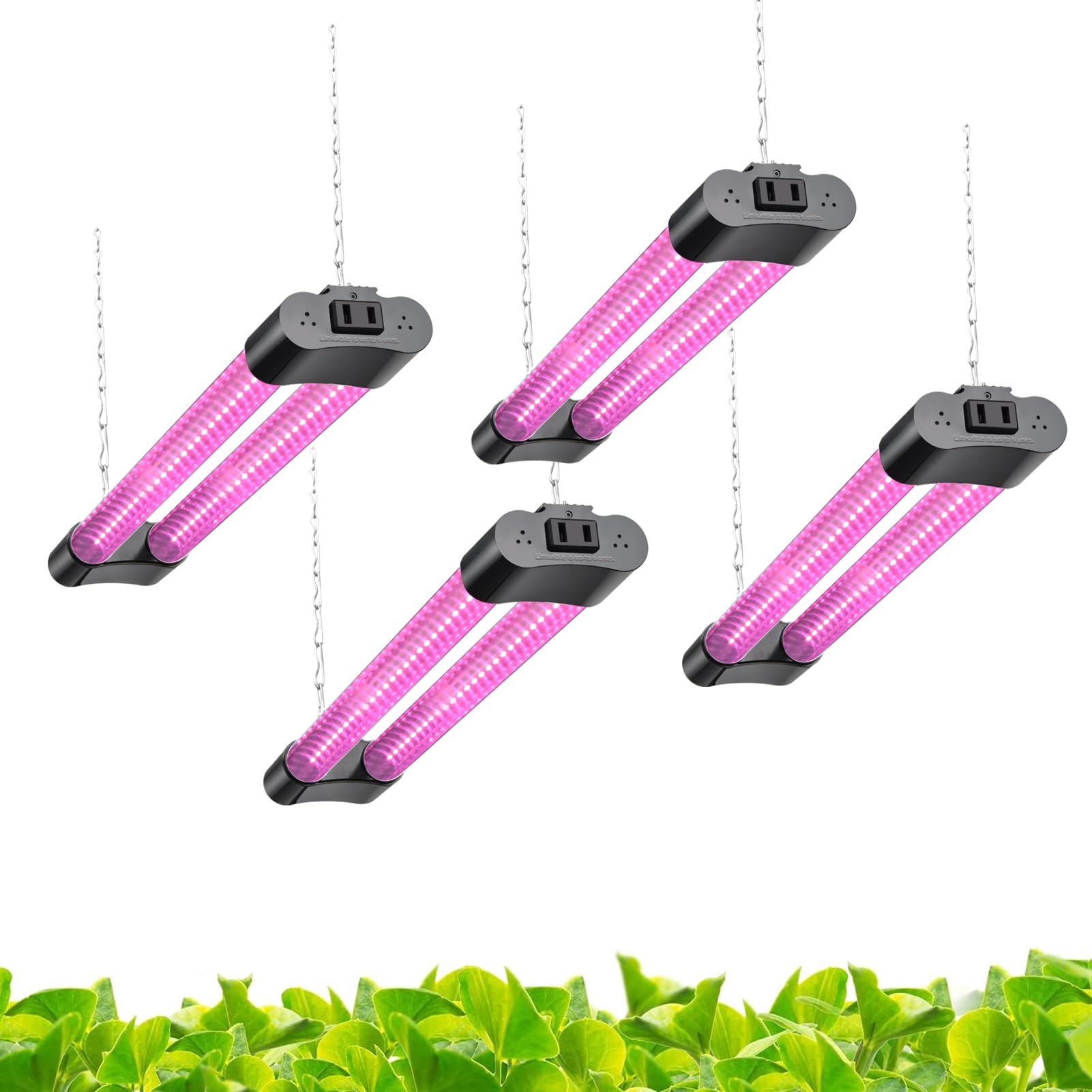
If you are starting seeds in a 2×2 foot tray or lighting a plant shelf, you need even coverage — not a single bright spot. The Hlite 4-pack of 16.5-inch panels spreads light across a wide area. The panels link together so you power everything from one wall outlet and run a single cord. Each panel consumes 20W and puts out a pink-spectrum light. Buyers confirm their “plants (tomatoes, peppers, melons, florals) healthier after days.”
The installation kit is generous: the box includes 8 J-hooks, 8 brackets, screws, anchors, zip ties, and chains. You can hang them from a tent pole, attach them under a shelf, or suspend them over a seedling tray. At 1.2 kilograms (about 2.6 pounds) per panel, they are light enough for a wire shelf. The pink light is very bright. Customers note it is “great for seedlings” and runs cool enough to mount close to leaves without heat damage. There is no dimmer or timer, just a simple on/off switch.
The standout spec here is the form factor: at just 1.3 inches thick and 16.5 inches long, each panel fits inside a standard wire shelving unit perfectly sideways, and the linkable design supports up to six units in a chain.
What stands out
- Link up to 6 panels from one outlet — clean wire management
- Comes with complete mounting hardware for multiple setups
- 20W per panel runs cool and safe for close proximity to seedlings
The trade-offs
- Pink (“blurple”) light is not pleasant to look at in a living space
- No timer or dimmer — you plug and unplug to control the schedule
4. Mefflypee Tripod Grow Light
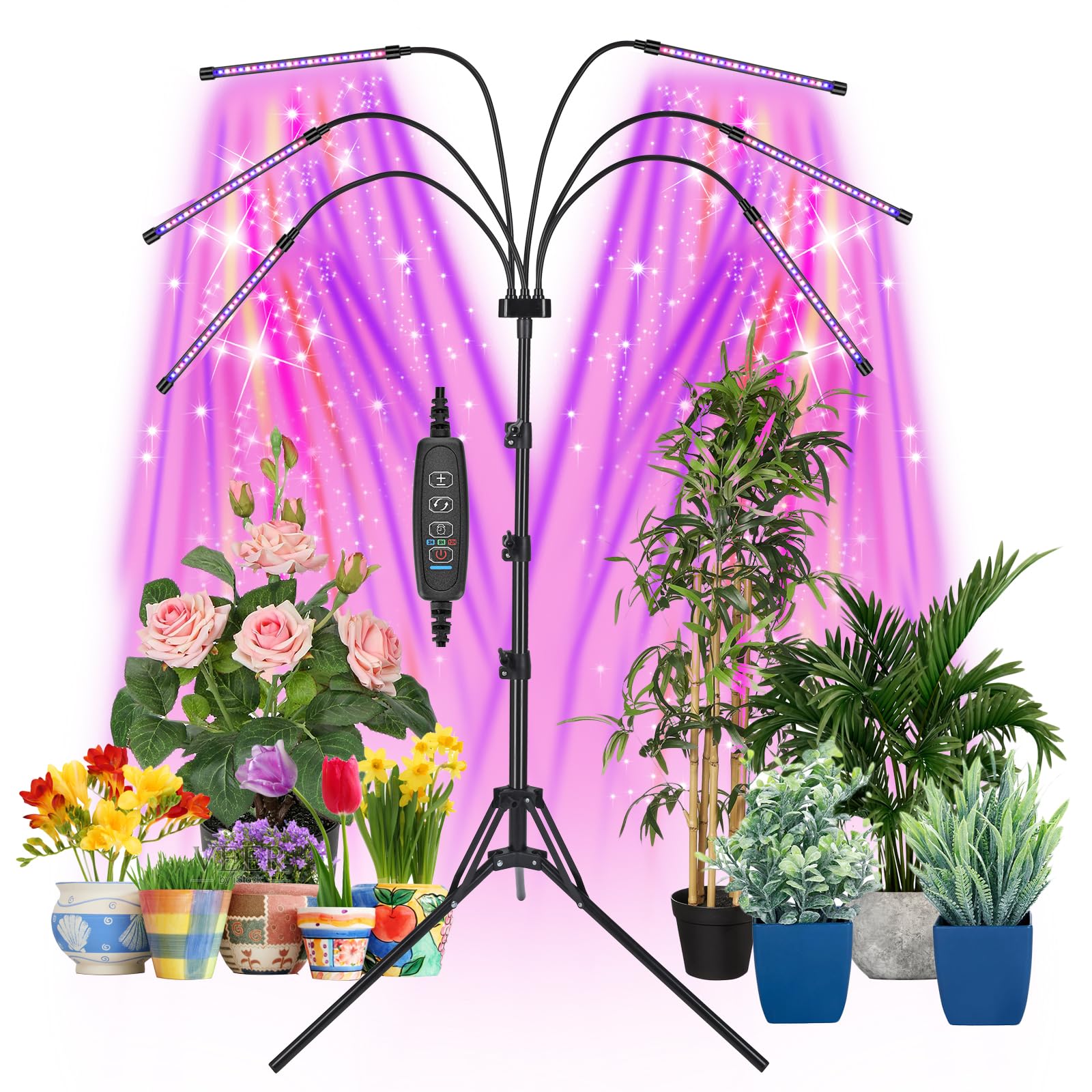
For tall plants that sit on the floor — a fiddle leaf fig, a large Monstera, or a bird of paradise — the single most important number is height range. The Mefflypee stand extends from 26 inches to 58.66 inches. That means it can tower over a plant that is already four feet tall. The tripod base sits on the floor and the six individual heads on 360° goosenecks can point inward from all sides, wrapping the plant in light.
The catch you accept is stability. Multiple reviewers mention the base “slides/falls unless positioned just right.” The tripod legs are not weighted, so a light bump or a heavy gooseneck angle can tip it over. You also get only 3 spectral modes (red, blue, yellow, or a mix) with 10 brightness levels and a 3/9/12 hour timer. But the actual wattage is low enough that you may need two units for large plants. The heat sink is designed for a 50,000-hour lifespan. Buyers who got it for “low wattage” needs say it is “perfect.”
At this price point, you are paying for the adjustable stand and the six-directional coverage. No other light on this list gives you a 58-inch tower with targeted heads for under $50. It is a good fit for the indoor gardener who has one or two large statement plants and needs the light to reach the top leaves without clamping to a shelf.
The upsides
- Telescoping stand reaches nearly 59 inches — fits tall floor plants
- Six independently adjustable heads for 360° coverage
- 10-level dimming and 3-spectrum modes for different growth stages
Keep in mind
- Base is lightweight and can tip over on uneven surfaces
- Low actual wattage means one unit may not be enough for large plants
5. SDOVUERC 4-Panel Daisy Chain Light
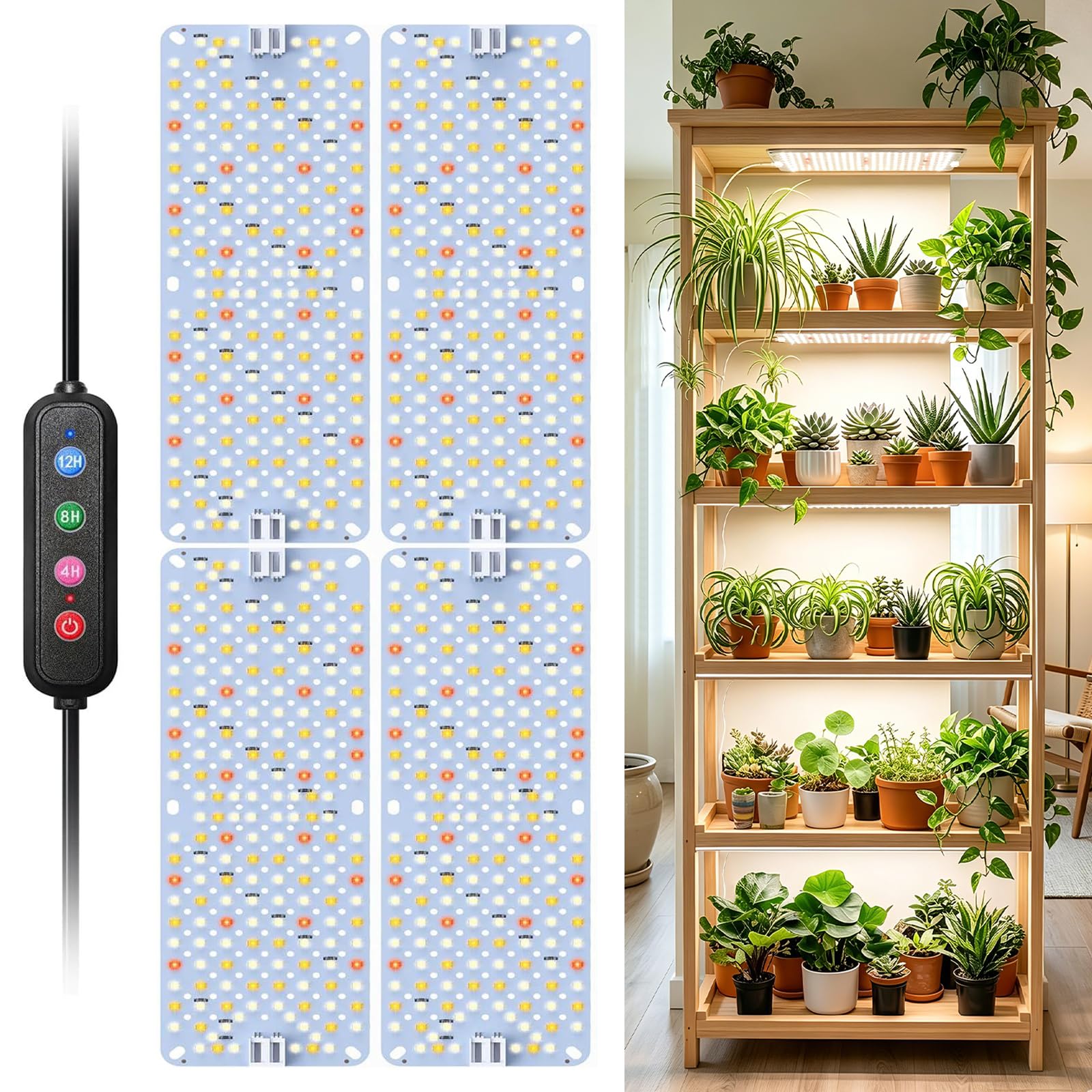
At this lower price, you get a 4-pack panel system delivering 144W total (36W per panel) with 768 high-efficiency LEDs. Each panel measures 11.7 x 3.8 inches and is just 0.8 inches thick, so four fit neatly on a 4-foot shelf.
What sets this apart from the Hlite panels is the timer: you get 6 settings from 4 to 24 hours with a memory function that keeps your schedule after a power cut. The spectrum combines 3000K warm white, 5000K cool white, and 660nm deep red, giving natural-looking white light (CRI 90) rather than harsh pink. Reviewers confirm “growth seen within 24 hours” and that houseplants “thrive” under these panels.
The honest limit: the panels are not super bright compared to high-end setups. One reviewer of carnivorous plants noted the light may be insufficient for extremely high-light species. At this price, the 4-panel pack gives you the highest total wattage and the most advanced timer on the list. It is the perfect pick for the serious budget grower who wants automation and coverage.
Why we’d pick it
- Highest total wattage on this list at 144W across 4 panels
- Advanced timer with 6 settings and memory after power loss
- Sunlike spectrum (3000K + 5000K + 660nm) is pleasant to look at
A few caveats
- Not dimmable — it is full brightness or off
- May be underpowered for very high-light carnivorous plants
6. SDOVUERC Tri-Head Clip Light

This 2-pack of tri-head clip lights is the right choice if you have plants in several awkward spots — a tight shelf corner, a windowsill that gets afternoon shade, or a desk where you want a focused light on one plant. Each unit has three heads on a fully flexible 360° gooseneck. The foam-padded clamp grabs onto shelves up to about an inch thick without scratching the surface.
The feature that serves that buyer best is the 6/12/18-hour timer with memory. No other light on this list offers an 18-hour cycle, which is ideal for seedlings and vegetative growth that thrive on longer “days.” You also get 5 brightness levels and 3 spectrum modes (cool white, cool white with 660nm deep red, and full-spectrum). Reviewers point out “the color options above timing capability” are a highlight, and plants “look better already.” At 15W per unit, the power draw is low enough that you can run both units on a standard USB wall adapter.
The honest limit is the clamp itself. Some reviewers found the heads “a bit awkward to attach and bend to a correct direction.” The clip-on design means the light position is limited by the edge thickness of your shelf. For a targeted, low-power light for a few small houseplants or happy seedlings, this is a solid choice — just be ready for some fiddling during setup.
Strong points
- 18-hour timer cycle — unique in this budget range for extended light schedules
- 5-level dimming and 3 spectrum modes for precise control
- Foam-padded clamp protects surfaces and grips securely
Before you buy
- 15W total output is low — best for small plants and seedlings
- Clamp positioning requires some trial and error to get the angle right
7. Kullsinss Floor Grow Light
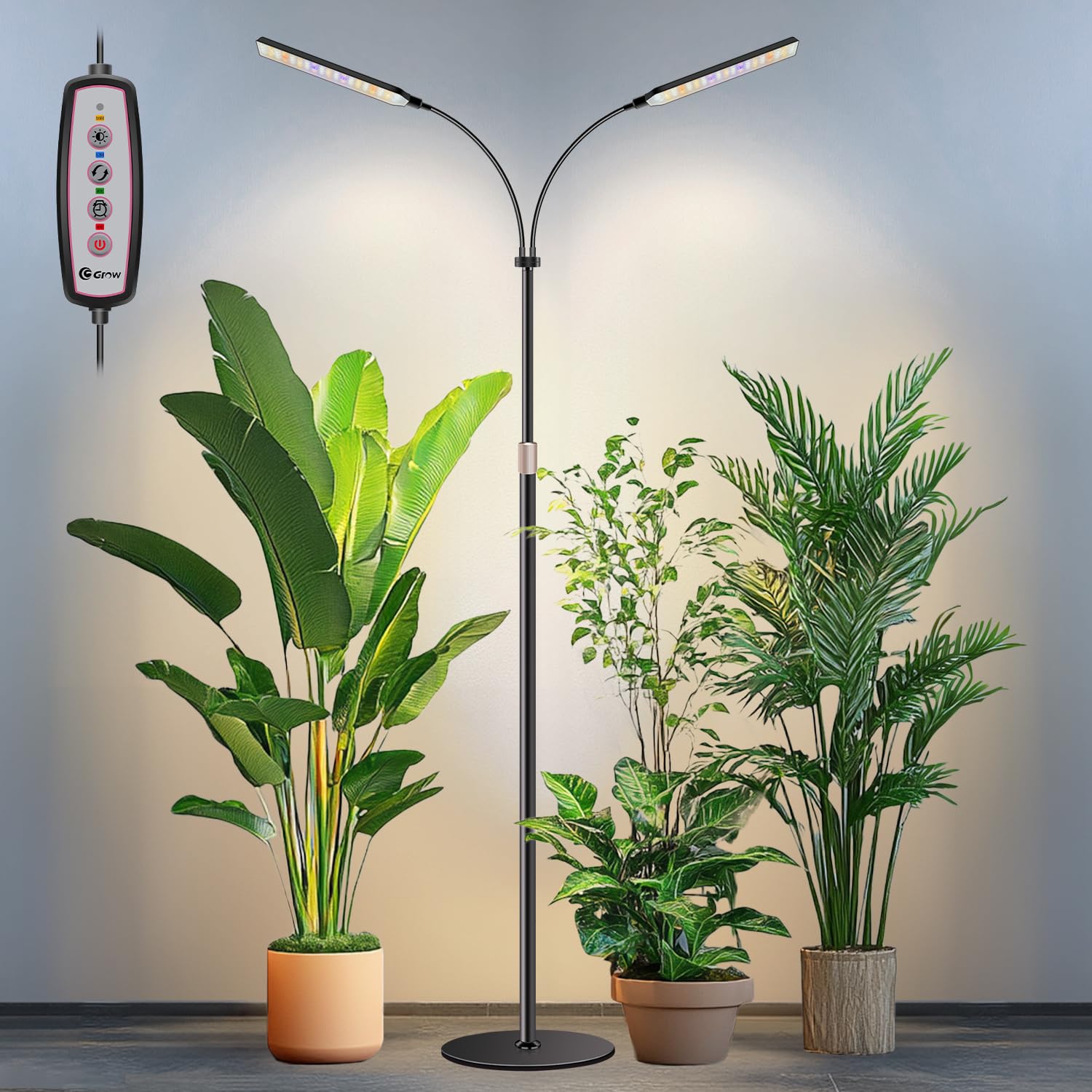
At a similar price to the Mefflypee tripod, this floor light takes a completely different approach: a solid metal base and telescoping pole (24 to nearly 69 inches) with two large head panels on long goosenecks, offering greater stability and a smaller floor footprint than the tripod design.
What that money buys is a very bright all-spectrum light with 114 high-efficiency LEDs (mixing 3000K, 6000K, 460nm blue, and 660nm red), a smart controller with 3 spectral modes, 5 dimmable levels from 20% to 100%, and a timer with 4/8/12/16 hour options. Shoppers say it “improved tropical/succulent health,” and one buyer sat the base inside a 15-year-old White Bird of Paradise planter to “reach the upper leaves” — a use the tripod cannot match. The unit runs cool, and the 360° goosenecks let you point each head from above or the side.
The one clear reason to choose this over the Mefflypee is if you want a sleek, stable floor lamp that disappears into your decor rather than a visible tripod frame, with a wide 9-inch base that one reviewer suggests weighting with a decorative book — though a few buyers report a high-pitched noise from the control buttons, likely a batch issue.
What we like
- Extends to nearly 69 inches — the tallest adjustable light on this list
- Heavy round base offers much better stability than a tripod
- Full spectrum (white + red + blue) with 5-level dimmer and 4-mode timer
The downsides
- Some units produce a high-pitched noise from the control panel
- Timer resets after a power outage, requiring you to re-set the schedule
Understanding the Specs
PPFD — The Real Number
PPFD (Photosynthetic Photon Flux Density) measures how many particles of light your plant can actually use per square meter. A high PPFD means more growth. For seedlings, you want at least 100-200 μmol/s/m²; for flowering, 300-500. The SANSI bulb hitting 423 at 1 foot is the clear winner here.
Wattage vs. “Equivalent” Wattage
A light advertised as “350W equivalent” only draws 32W from the wall. The “equivalent” number tells you how bright it looks compared to an old incandescent bulb — it is not a measure of plant-growing power. Always check the actual wattage (the real power draw) to compare lights fairly.
FAQ
Can I leave a budget grow light on 24 hours a day?
How close should I place the light to my plants?
Is pink or white light better for plants?
Final Thoughts: The Verdict
For the majority of shoppers, the best budget grow lights winner is the SANSI 32W Bulb because it delivers the highest real PPFD at a very low price — it grows plants, not just glows. If you want shelf coverage with a timer and memory, grab the SDOVUERC 4-Panel. And for tall floor plants that need targeted light from above, the standout is the Kullsinss Floor Light for stability and height range.