
You buy autumn fertilizer to build stronger roots for winter, not to keep your grass green. That late-season color push just wastes nutrients. The real job of an autumn lawn fertilizer is to help the roots grow deeper and stronger so the grass survives the cold and takes off in spring. This guide breaks down seven options by their NPK ratio (nitrogen-phosphorus-potassium), coverage area, and real buyer feedback, so you can match one to your lawn size and soil needs.
I’m Rikta — the co-founder and writer behind Lawn Gear Lab. This guide is built by comparing the manufacturers’ published specifications and the patterns across verified customer reviews, so you get each pick’s real strengths and trade-offs instead of marketing spin.
Choosing the right autumn lawn fertilizer comes down to matching the nitrogen and potassium levels to your grass type and knowing how big a bag you really need.
How To Choose The Best Autumn Lawn Fertilizer
Fall is not the time to push leaf growth. You want a fertilizer that feeds the roots while the grass blades slow down. The three numbers on the bag — nitrogen, phosphorus, and potassium (NPK) — tell the story. Nitrogen drives green top growth (you want less of that in fall). Phosphorus supports new roots and seed establishment. Potassium strengthens cell walls and boosts winter hardiness. For autumn, go with moderate or low nitrogen and high potassium.
NPK Ratio
The first number (nitrogen) should be lower than a summer feed — think 10 to 24 instead of 30-plus. The last number (potassium) should be between 10 and 20. That high potassium tells the grass to store energy in the roots instead of wasting it on new blades that will die in the frost.
Coverage Area
Bag sizes range from 12.5 pounds covering 5,000 square feet up to 48 pounds covering 15,000 square feet. Measure your lawn first. A bag that covers too little means you will run out halfway. A bag that covers too much means you haul and store extra weight you do not need.
Slow-Release vs. Quick-Release Nitrogen
Slow-release nitrogen (often called controlled-release or polymer-coated) feeds the lawn steadily over 8 to 16 weeks. It avoids a sudden growth spike that an early freeze could kill. Quick-release nitrogen gives you fast green-up but risks pushing tender new growth into a hard frost.
Quick Comparison
On smaller screens, swipe sideways to see the full table.
| Model | Category | Best For | Key Spec | Amazon |
|---|---|---|---|---|
| The Andersons Premium Fall Lawn Food | Premium | Multi-stage feeding & greening | 24-0-14 NPK, 18 lbs | Amazon |
| GreenView Fall Lawn Food | Premium | Large lawns (15,000 sq ft) | 22-0-10 NPK, 48 lbs | Amazon |
| Jonathan Green Winter Survival | Premium | High potassium root feeding | 10-0-20 NPK, 45 lbs | Amazon |
| Fertilome Winterizer | Mid-Range | Established centipede & warm-season lawns | 10-0-14 NPK, 40 lbs | Amazon |
| Espoma Organic All Season Lawn Food | Mid-Range | Organic / pet-safe lawn care | 9-0-0 NPK, 28 lbs | Amazon |
| Scotts Turf Builder WinterGuard | Mid-Range | Root repair after summer stress | 30-0-10 NPK, 12.5 lbs | Amazon |
| Green Thumb Winterizer | Budget | Small lawns on a budget | 32-0-10 NPK, 12.6 lbs | Amazon |
In‑Depth Reviews
1. The Andersons Premium Fall Lawn Food 24-0-14

24-0-14 NPK ratio makes The Andersons Premium Fall Lawn Food the top pick for homeowners who want a balanced, root-focused feed without pushing excessive leaf growth. The three-speed nitrogen system (quick-release, intermediate, and slow-release) delivers fast green-up plus steady root feeding, while the 14-point potassium dose stores energy in the roots for winter. Buyers report the grass turns a deep dark green within days, and one reviewer noted dramatic results in pictures taken 7 weeks after a first-week-of-September application.
The 18-pound bag covers 5,000 square feet, giving you more feeding power per pound than many competitors. The iron content deepens color without pushing leaf growth, and the formula is safe for all turf types including fescue and bluegrass. It is a better all-around ratio than the high-nitrogen Scotts WinterGuard — less risk of frost damage because you are not pushing tender new blades.
For a fall fertilizer that colors up fast and fortifies roots without overfeeding, The Andersons Premium Fall Lawn Food is the clear top pick.
Why it’s great
- Three-phase nitrogen release for fast green-up plus extended feeding
- 14-point potassium — high enough for serious winter root store
- Added iron deepens color without pushing leaf growth
Good to know
- 18-pound bag covers 5,000 sq. ft. — smaller lawns only
2. GreenView Fall Lawn Food

Compared to the top pick, the GreenView Fall Lawn Food covers 15,000 square feet from a single 48-pound bag, while the top pick covers 12,000 square feet from a 43-pound bag — giving you 312.5 square feet per pound versus the top pick’s 279 square feet per pound.
The 22-0-10 ratio gives you moderate nitrogen and solid potassium. The GreenSmart Enhanced Efficiency technology releases nutrients continuously for up to 8 weeks. One buyer who applied it noted they got good coverage and are waiting to see the spring green-up. Other reviewers report the grass turned very green without burning. At 48 pounds and covering 15,000 square feet, this is the best pick if you have a full quarter-acre or more — one bag, one application, the whole lawn done. It outpaces the top pick on coverage per bag, so you buy less overall.
At 48 pounds, the bag is heavy, so plan for transport and storage. Choose this over the top pick if you want the most square footage per bag and prefer a single application for a quarter-acre lawn.
Where it shines
- Covers 15,000 sq. ft. — the largest coverage in this roundup
- 8-week continuous feeding protects roots through the winter
- 22-0-10 ratio is a strong fall-specific blend
Worth noting
- 48-pound bag requires a heavy-duty spreader and some muscle to haul
3. Jonathan Green Winter Survival Fall Lawn Food 10-0-20

If root depth matters more to you than instant grass color, the Jonathan Green Winter Survival is your pick. Its 10-0-20 ratio has the highest potassium number in this list — a 20-point dose that tells the grass to store carbohydrates in the root system rather than push blades that will die in the first frost. That potassium bump also helps the lawn resist disease and winter stress. This 45-pound bag covers 15,000 square feet, matching the GreenView on coverage. One reviewer applied it in early November in the Northeast and reported their lawn was significantly healthier by mid-December compared to the untreated backyard. Another called it the best fertilizer they have used after following the full Jonathan Green year-round program. The slow-release nitrogen keeps grass greener later into fall without a growth spike.
The granules are larger than many competitors — some buyers found uneven spreader performance at the standard dose setting. Plan to calibrate your spreader a little higher than usual. If you want maximum winter root strength, this beats the Andersons on potassium percentage (20 vs. 14).
That 20-point potassium dose is the highest in this guide, and it is the only number that matters when the ground freezes.
What stands out
- 20-point potassium — the highest winter-strength ratio in this group
- Covers 15,000 sq. ft. per 45-pound bag
- Designed for a late-November second application for optimal spring green-up
The trade-offs
- Large granules may need a spreader recalibration for even distribution
4. Fertilome Winterizer for Established Lawns 10-0-14
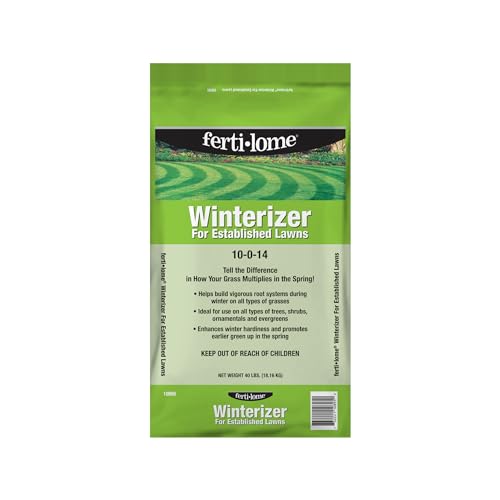
The single number that matters most in this category is the nitrogen rate: 0.4 pounds per 1,000 square feet — the ideal rate for a final fall application where you do not want any more blade growth. The 10-0-14 ratio delivers that, with the 14-point potassium providing solid root support. The 40-pound bag covers 10,000 square feet, making it a good fit for medium-sized lawns (roughly a fifth of an acre). One experienced buyer noted the 0.56 pounds of potassium per 1,000 square feet is good for stressed lawns but called out the low iron as the main shortcoming. A loyal Fertilome user who has had great success on a centipede lawn trusts the brand completely.
It has less iron than the Andersons, so do not expect a big cosmetic green-up. If you already have established turf and just want the roots fed correctly before the freeze, and you do not need the high-potassium focus of the Jonathan Green, the Fertilome is a sensible, mid-range choice.
For a straightforward root-feeding winterizer that skips the cosmetic extras, the Fertilome delivers a solid price-to-value read.
The upsides
- Ideal nitrogen rate (0.4 lbs N/1k) for a safe final fall feeding
- Covers 10,000 sq. ft. per bag — good for medium lawns
- Works well on centipede and warm-season grasses
Keep in mind
- Low iron content means less visible greening effect
5. Espoma Organic All Season Lawn Food 9-0-0

For the lower price you get a 28-pound bag of 9-0-0 lawn food that delivers nitrogen from natural organic ingredients plus a Bio-tone microbe formula, with zero phosphorus and zero potassium. That works well if your soil already has enough potassium (many established soils do) and you just need a gentle nitrogen boost to keep the microbes active through fall. What you give up is the high-potassium winter storage punch that the Jonathan Green or Fertilome provide — the 9-0-0 formula cannot push root carbohydrate storage as aggressively. The release is also much slower; you will not see cosmetic green-up for a week or two. One long-time user says they have used Espoma for years and the lawn consistently performs well. Another appreciates that it is non-toxic for kids and pets. The bag has no coverage number on the label, so you will need to measure your lawn and apply by feel.
This is the right choice if you are committed to an organic lawn program, have pets that roam the grass, or just do not want synthetic salts in your soil. Pair it with a soil test first to confirm your potassium levels are already sufficient for winter.
It is perfect for the budget buyer who already keeps an organic lawn, lets pets play on the grass, and has confirmed via soil test that their potassium levels are sufficient for winter.
Why we’d pick it
- Approved for organic gardening — no synthetic chemicals or toxic ingredients
- Bio-tone microbes feed the soil biology, not just the grass
- Won’t burn lawns even if accidentally over-applied
A few caveats
- Zero potassium — may not provide enough winter root storage on potassium-deficient soil
- Very slow release; results take longer than synthetic options
6. Scotts Turf Builder WinterGuard Fall Lawn Food 30-0-10

The Scotts Turf Builder WinterGuard Fall Lawn Food 30-0-10 is perfect for the homeowner whose lawn looks ragged after a brutal summer and who wants a fast, dramatic green-up before winter arrives. Its 30-0-10 ratio delivers the highest nitrogen content in this guide, producing visible results in days — one reviewer who uses it exclusively reported having the greenest lawn on the block even as temperatures dropped to 25 degrees. The 12.5-pound bag covers 5,000 square feet, matching the coverage of the Green Thumb product but at a higher cost per square foot.
The 30% nitrogen is quick-release, so you get a surge of growth that can make your lawn look respectable quickly. However, that high nitrogen level is much higher than what most experts recommend for a final fall feeding, as it can push tender new blades that an early frost might kill. Use this product early in autumn (late September) and switch to a lower-nitrogen product for your November application, making it less versatile than the Andersons, which works for the entire fall season.
The catch here is cosmetic appearance now versus root storage for next spring. A gentle caution about its one weakness: if applied too late, the rapid green-up it provides may come at the cost of winter hardiness, as the high nitrogen can stimulate growth that an early frost could kill.
Strong points
- Fastest green-up of any product tested — visible results in days
- Helps repair visible summer heat and drought damage
- Available at almost every retailer; easy to find
Before you buy
- 30% nitrogen is high for a true winterizer — best for early fall, not late
7. Green Thumb GT58105 Winterizer Lawn Fertilizer 32-0-10
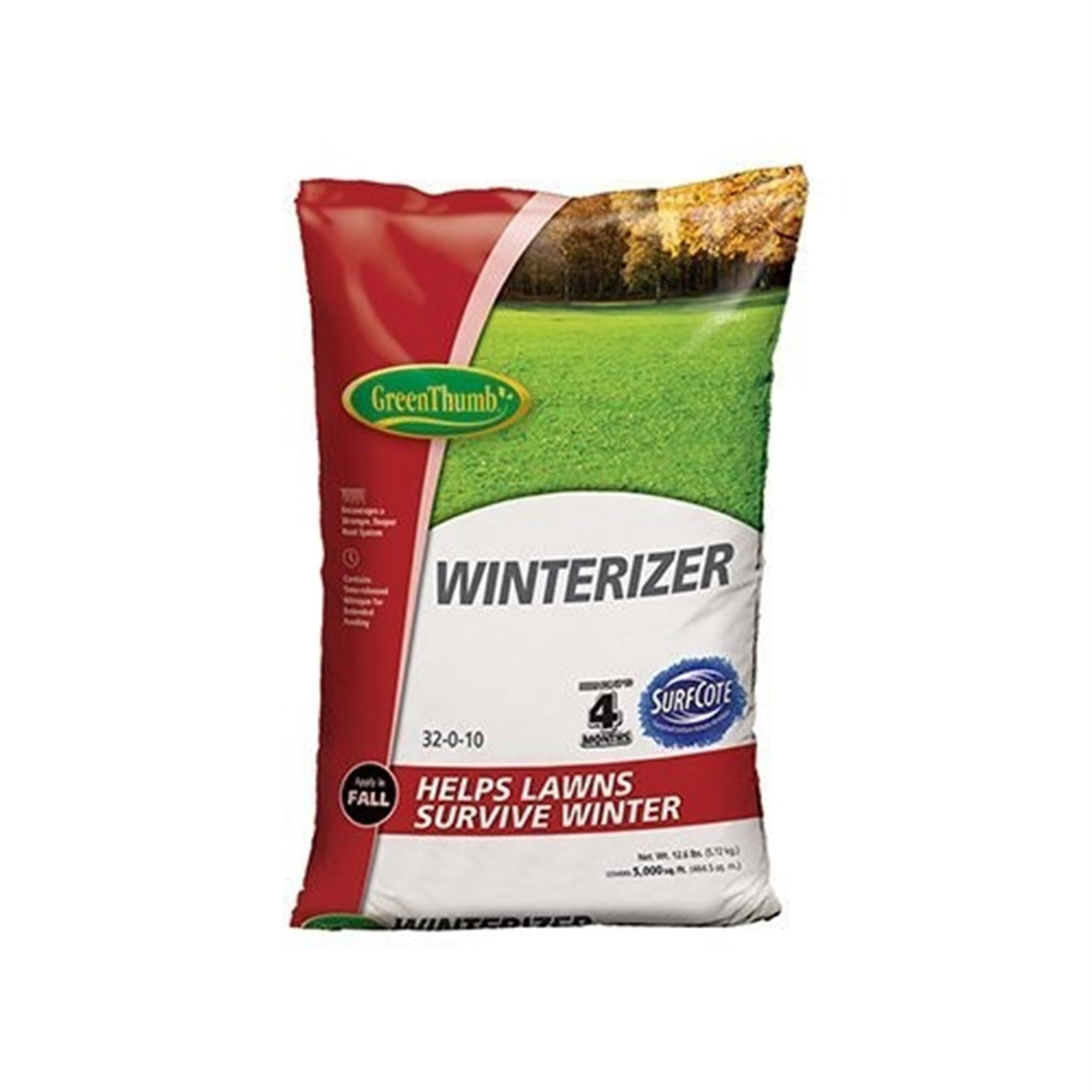
The Green Thumb Winterizer packs a 32-0-10 ratio — the highest nitrogen number in the group — plus 2% iron for deep greening and 50% controlled-release nitrogen that feeds for up to 16 weeks. For the price, you get a lot of nutrient density per bag. The 12.6-pound bag covers 5,000 square feet, the standard small-lot size. What you are paying less for is brand prestige and a refined formula. The 32% nitrogen is very high for a winterizer and could push excessive late-season top growth if applied too late. One experienced buyer who left a detailed review described a precise schedule: apply October 1st, water 5 minutes daily for 4 weeks, then blow out the irrigation system. Other reviewers confirm it works great when timed right, and several call it just as good as the more expensive Scotts. If you want the most nutrient for the least money, this is the bag — but you must watch the calendar. Late October at the absolute latest, with careful watering.
What we like
- 50% controlled-release nitrogen feeds for up to 16 weeks
- 2% iron for deep green color without extra blade growth
- Budget-friendly price for a 32-0-10 nutrient density
The downsides
- 32% nitrogen is very high — must be applied early fall, not late
- Requires a precise watering schedule for best results
Understanding the Specs
NPK Ratio
The three numbers on the bag — nitrogen, phosphorus, potassium — tell you exactly what the fertilizer does. Nitrogen (the first number) makes the grass blades grow. In autumn, you want moderate nitrogen (10-24) so you do not push tender new growth that frost will kill. Phosphorus (the middle number) supports root development. Potassium (the last number) is the key fall nutrient — it strengthens cell walls, stores carbohydrates in the roots, and boosts winter survival.
Controlled-Release Nitrogen (CRN)
CRN is nitrogen coated with a polymer or sulfur layer that dissolves slowly with moisture and temperature. Instead of dumping all the nitrogen at once (which causes a growth surge), the coating meters it out over weeks. Look for at least 30-50% of the nitrogen to be controlled-release in a fall fertilizer — this prevents a flush of green growth just before cold weather hits.
FAQ
When is the best time to apply autumn lawn fertilizer in the northern US?
Can I use a regular summer fertilizer for fall application?
Should I water after applying fall fertilizer?
Is organic fall fertilizer as effective as synthetic for winter root storage?
Final Thoughts: The Verdict
For most people, the best autumn lawn fertilizer is the The Andersons Premium Fall Lawn Food because its 24-0-14 ratio with three-phase nitrogen release balances visible green-up and long-term root feeding better than any other option here. If you have a large lawn (over 10,000 square feet), grab the GreenView Fall Lawn Food for the best coverage-per-bag value — one 48-pound bag does 15,000 square feet. And if you want the highest possible potassium for maximum winter root strength, the standout is the Jonathan Green Winter Survival 10-0-20.