
Specs are compiled from manufacturer listings and verified buyer reviews and can change over time — please confirm the key details on the product page before buying.
Forgetting to move the sprinkler or killing your lawn during a heatwave is a thing of the past. An automatic grass watering system handles the scheduling for you, applying the right amount of water at the right time so your yard stays green without you lifting a finger. This guide breaks down the top controllers that make that happen, from simple no-WiFi timers to full smart setups you can tweak from your phone.
I’m Rikta — the founder and writer behind Lawn Gear Lab. This guide is built by comparing the manufacturers’ published specifications and the patterns across verified customer reviews, so you get each pick’s real strengths and trade-offs instead of marketing spin.
if you want an easy drop-in replacement or a weather-skipping smart hub, these are the best automatic grass watering system controllers that balance reliability, coverage zones, and actual user feedback.
Quick Picks
- Rain Bird ARC8 App-Based Indoor/Outdoor Smart WiFi Irrigation Timer — Best Value Smart Pick
- Hunter Hydrawise X2 8 Zone Sprinkler Controller — Premium Outdoor Build
- Rain Bird TRU6I Program-Based Indoor Irrigation Controller — Best Overall
- Hunter X-Core XC800i Indoor Sprinkler Timer — Reliable Classic
- Orbit B-hyve XR Smart Sprinkler Timer – 16-Zone — Maximum Coverage
How To Choose The Best Automatic Grass Watering System Controller
The core job of a watering controller is to open and close your sprinkler valves on a schedule you set. The main decision depends on how you want to interact with that schedule — through a dial on the wall or an app on your phone — and how many separate zones in your yard you need to manage.
Zone Counts and Your Yard’s Layout
Each zone controls a set of sprinklers connected to one valve. You need one zone per area that waters on a different schedule — your front lawn might be one zone, your flower beds another, and a shaded side yard a third. Controllers range from 6 to 16 zones, so pick one that matches your current setup or leaves room to expand.
Smart vs. Dumb Controllers
A “dumb” or program-based timer uses buttons and an LCD screen to set watering days and durations. It just runs the schedule until you change it. A smart controller adds WiFi so you can adjust things from anywhere, and it can automatically skip watering on rainy days based on local weather data. Smart models are more convenient but cost more and rely on your home network.
Indoor vs. Outdoor Installation
Some controllers are designed to mount on an indoor wall (garage or basement) and need protection from rain and direct sun. Others have a weather-resistant cabinet that lets you mount them outside next to your valve manifold. Check the product specifications to confirm where you can place yours.
Quick Comparison
On smaller screens, swipe sideways to see the full table.
| Model | Best For | Zones | WiFi | Weight | Amazon |
|---|---|---|---|---|---|
| Rain Bird ARC8 | Smart features on a budget | 8 | Built-in | — | Amazon |
| Hunter Hydrawise X2 | Outdoor durability + optional smart upgrade | 8 | Optional (WAND module) | 2.75 Pounds | Amazon |
| Rain Bird TRU6I | Value pick with deep programming flexibility | 6 | Optional (LNK2 module) | 2.5 Pounds | Amazon |
| Hunter X-Core XC800i | Rock-solid no-WiFi reliability | 8 | No | 1.2 Pounds | Amazon |
| Orbit B-hyve XR | Max zone count and app control | 16 | Built-in | 3 Pounds | Amazon |
In‑Depth Reviews
1. Rain Bird ARC8 App-Based Indoor/Outdoor Smart WiFi Irrigation Timer

The smart controller that skips watering when it rains, all from your phone.
If you want a controller that uses local weather data to skip watering, get this one. No extra module is needed — the Rain Bird ARC8 connects directly to your home WiFi. It checks weather forecasts for your specific zip code (postal code) and adjusts or skips watering cycles based on what it finds. The manufacturer claims up to 30% water savings via weather-based scheduling. It also works with Amazon Alexa and Google Assistant, so you can use your voice to start the lawn.
Buyers report the install takes about 10 minutes and the app setup about 15 minutes — fast enough to get you running quickly. You can mount it safely in hot locations because it handles an operating temperature of 149 degrees Fahrenheit. That is a 3.0x wider range than the Hunter X-Core XC800i (at 50 degrees Fahrenheit), so it wins easily for a hot garage or direct sun. A few reviews note occasional WiFi disconnects, which can cause missed schedules, and the online documentation could be clearer. For the price, you get a feature set that typically costs more.
It carries EPA WaterSense certification for verified water efficiency. You control 8 zones through the Rain Bird mobile app. You can manually water, view upcoming schedules, and share control with family or your landscaper.
Why it stands out
- Built-in WiFi for weather-based auto-skipping schedules
- Wide operating temperature (149°F) handles hot spots
- EPA WaterSense certified for water efficiency
Know before you buy
- Some users report WiFi connectivity issues and missed schedules
- Limited manual panel controls compared to program-based dials
Reach for this if: you want a fully automatic, app-controlled timer that adjusts to the weather without any extra module purchase.
Look elsewhere if: your home WiFi is unreliable or you prefer a simple dial-based timer with zero network dependency.
2. Hunter Hydrawise X2 8 Zone Sprinkler Controller

A rugged outdoor controller that adds smart features only when you need them.
This controller survives year-round weather because its cabinet is weather-resistant. That extra bulk comes from a design meant to seal out moisture and sun.
from the start, it works as a powerful program-based timer. You get 8 zones, 3 independent programs, 4 start times each, and a built-in Cycle and Soak mode. Cycle and Soak prevents runoff on slopes or clay by breaking long watering cycles into short bursts with rest periods. If you later want WiFi, you add the WAND module separately, unlocking Hunter’s Hydrawise software for weather-based scheduling and phone control. One buyer who replaced a 20-year-old controller said it worked perfectly and took about 15 minutes to install using existing wiring.
The sealed battery backup reportedly dies in about 5 years, which can mean losing your schedule during a power outage. And because the WiFi module costs over extra, the value shifts if you want smart features from day one.
Built for the outdoors: A solid choice if you need a controller mounted outside and want the option of smart control later without replacing the whole unit.
The downside: WiFi is not built-in, and the optional module is expensive, so if you plan on using an app from day one, the Rain Bird ARC8 is a more economical path.
Pick this for: heavy-duty outdoor installation with weather-resistance and the flexibility to upgrade to smart control down the road.
Skip it for: indoor mounting or if you absolutely need built-in WiFi without paying extra for a separate module.
3. Rain Bird TRU6I Program-Based Indoor Irrigation Controller
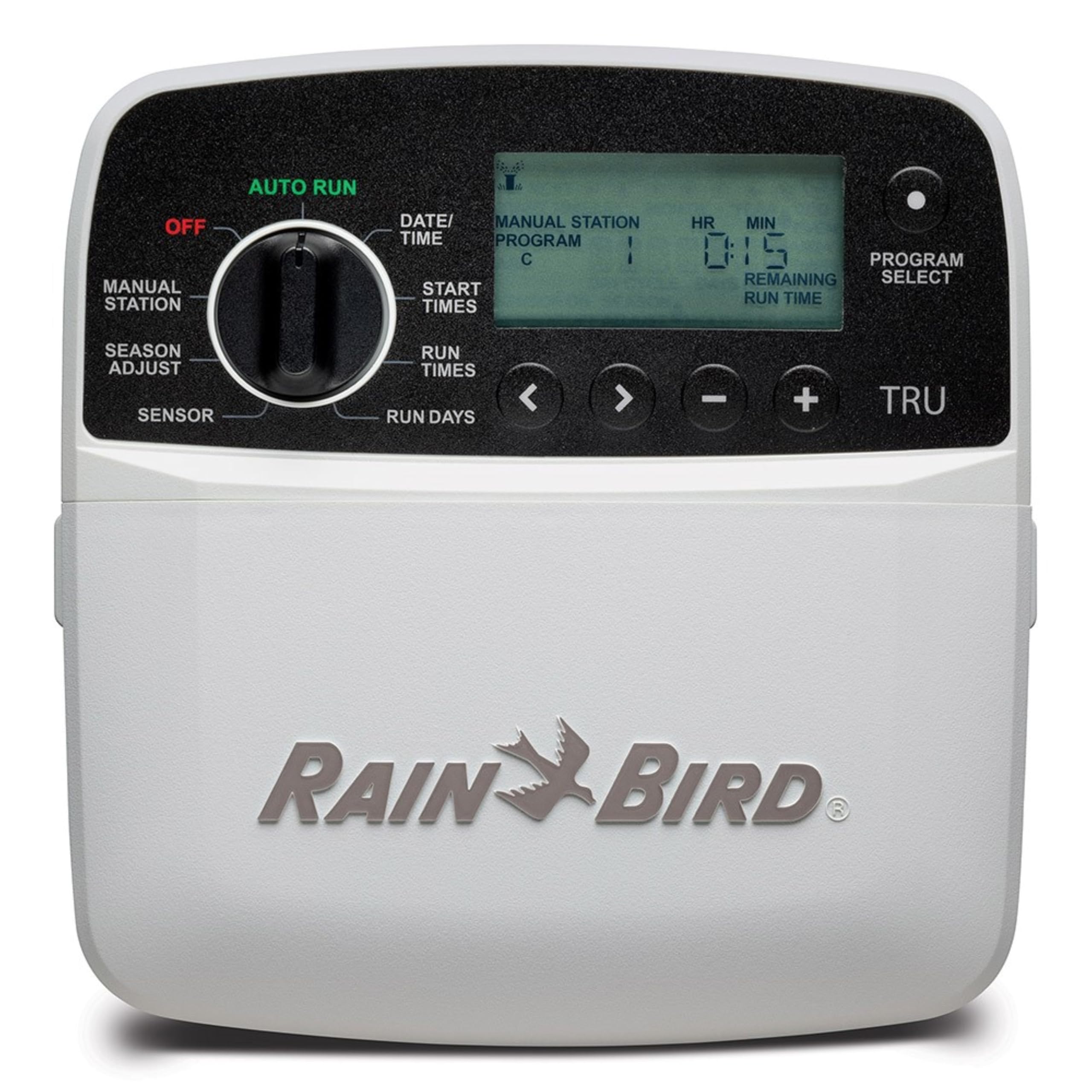
The programming powerhouse that gives you total control without an app.
If you want deep customization without a smartphone, this controller is your best bet. You set everything with an intuitive programming dial and a multi-function LCD (liquid crystal display) screen. It controls up to 6 valves (zones), but the real star is the flexibility inside those zones. Each zone gets its own A, B, and C programs, and each program can have up to 4 start times. That adds up to 12 distinct start times per zone. One reviewer noted that installation was quick, programming is super straightforward, and there are so many ways to customize the schedule that anyone can dial it in.
The features run deep. You can set watering by days of the week, odd/even calendar days, or in cycles every 1 to 30 days. The Season Adjust feature lets you increase or decrease watering times across all programs by 5% to 200% — handy for adjusting for seasons without rewriting each zone. A Rain Delay pauses watering for 1 to 14 days. The controller stores all its programming permanently during power outages, so you never re-enter settings after a blackout. If you eventually want WiFi, you can add a LNK2 module (sold separately).
At 2.5 pounds and 6.63″ x 1.69″ x 6.57″, it is a standard indoor unit for your garage or basement wall. It runs cool, with an operating temperature of 122 degrees Fahrenheit, so it is not built for outdoor mounting.
What powers it
- 12 start times per zone across three programs for precise scheduling
- Season Adjust (5% to 200%) for quick seasonal tuning
- Permanent memory holds programming through power loss
Its limits
- 6 zones only — not enough for very large or complex landscapes
- Indoor use only, so mounting location is restricted
Best for the detail-oriented planner: if you want to fine-tune watering for each area of your yard with sophisticated programming options at a great value, this is it.
Not for you if: you need more than 6 zones or you want to mount the controller outside.
4. Hunter X-Core XC800i Indoor Sprinkler Timer

The simple, fire-and-forget controller that just works for years.
If you do not want to mess with an app or WiFi passwords, this is for you. The X-Core XC800i has no WiFi, no app, and no network login. You set the schedule with an intuitive dial, and it runs. Its operating temperature is 50 degrees Fahrenheit, much lower than the 149 degrees Fahrenheit of the Rain Bird ARC8 (a 3.0x gap), so this is strictly an indoor unit for a garage or basement.
It controls 8 zones across 3 programs with 4 start times each (12 total per zone). The Seasonal Adjustment feature lets you globally reduce or increase run times for cooler or hotter months without touching each zone individually. It also has built-in surge protection to guard against electrical spikes, and it is Smart Port ready for optional Hunter remote controls. One buyer mentioned it lasted 11 years before failing during a thunderstorm, noting a possible surge took out both the transformer and controller.
At just 1.2 pounds and measuring 5.75″ x 2″ x 6.5″, it is light and compact, making it an easy swap for an old controller. The trade-off is clear: you get rock-solid reliability but no remote access or smart scheduling.
low-maintenance reliability: The XC800i is the pick if you value long-term dependability and a simple interface over flashy app features.
The trade-off you feel: No weather skipping, no phone control, and indoor-only placement means you cannot mount it outside.
Your pick if: you want an affordable, straightforward 8-zone controller with a history of lasting over a decade.
Move on if: you need WiFi capability or weather-based auto-adjustment from your controller.
5. Orbit B-hyve XR Smart Sprinkler Timer – 16-Zone
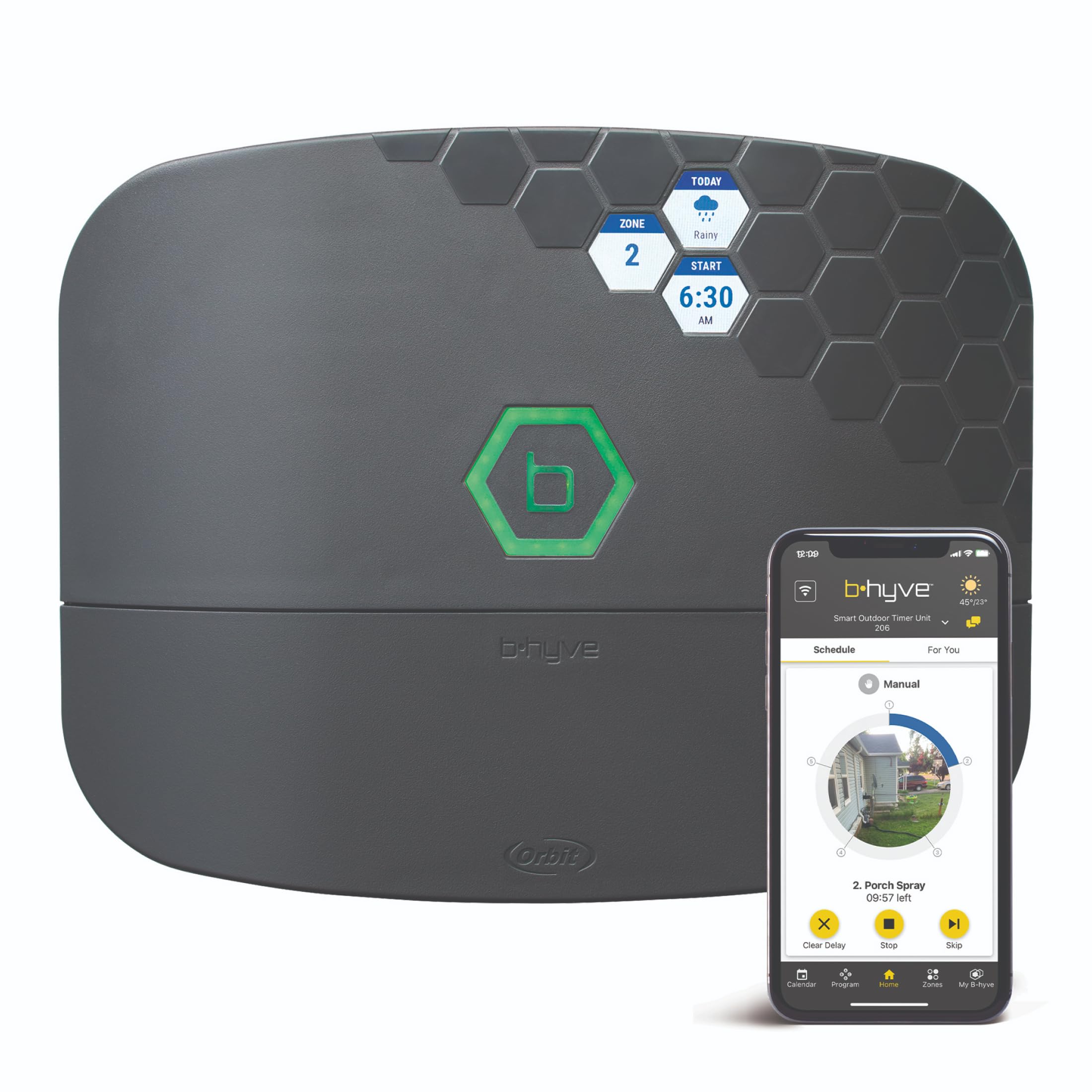
The zone king that handles the biggest, most complex properties.
If you have a front lawn, back lawn, flower beds, a vegetable garden, and dripline zones, you need a controller that can handle them all. The Orbit B-hyve XR handles up to 16 zones — double the 8-zone limit on most competitors. It has built-in WiFi so you control everything from the Orbit app, and it uses forecast-driven technology to automatically adjust watering cycles.
The app lets you set soil type, sun exposure, slope, and sprinkler count for each zone. You can also take photos of each zone and label them for a visual reference. The unit connects via Bluetooth for initial setup and then uses WiFi for ongoing management. At 3 pounds and measuring 11″ x 9″ x 4″, it is the largest and heaviest controller here. It comes with push-button wire clamps that let you connect your valve wires without tools.
Owners mention some quirks. A few note it can struggle to maintain WiFi connection, especially on dual-band networks. Others mention that only 4 programs (A-D) are available, which limits scheduling flexibility for a 16-zone system. One reviewer found the wire terminals had plastic blockage from the molding process, requiring some cleaning. It carries a 2-year limited warranty.
The big advantages
- 16 zones cover the largest residential properties
- App allows soil/sun/slope settings for smart watering
- Indoor/outdoor weatherproof design with tool-free wire clamps
What to watch for
- WiFi connectivity can be inconsistent on some networks
- Only 4 programs may not be enough for 16 unique zone schedules
Grab this for: large properties needing 10+ zones with full app control and weather-aware scheduling.
Think twice if: your property needs only 4–8 zones — the simpler Rain Bird ARC8 offers better reliability at a lower cost.
Understanding the Specs
Zone Count
This is the number of separate valves your controller can operate. Each valve controls a different area of your yard. If you have a front lawn on one valve and a back flower bed on another, you need two zones. A standard home needs 4 to 8 zones; larger properties may need 12 to 16. Pick a controller with at least as many zones as you have valves, plus one or two spare for future expansion.
Seasonal Adjust
This feature lets you increase or decrease the watering time for all zones at once using a single percentage setting. In cooler spring weather, you might set it to 80% so the sprinklers run a bit less. In a July heatwave, you bump it to 150% to keep lawns green without reprogramming every zone individually. It saves time and prevents overwatering.
FAQ
Will a smart watering system work with my existing sprinkler valves?
Can I install a smart controller myself or do I need a landscaper?
What happens to my watering schedule when the WiFi goes out?
How many zones do I need for my lawn and garden?
Does a smart watering system really save water compared to a regular timer?
Can I mount the controller outside on an exterior wall?
What is the difference between Cycle and Soak and regular watering?
Will a smart controller work with voice assistants like Alexa?
How long do these controllers typically last?
Can I set different watering schedules for different zones on the same controller?
Final Thoughts: The Verdict
For most homeowners looking for a straightforward automatic grass watering system, the top choice is the Rain Bird TRU6I because it delivers deep programming flexibility and a proven interface at a price that feels fair, all without needing an app or internet. If you want built-in WiFi and weather-based skipping without stepping up to premium prices, the Rain Bird ARC8 gives you that in a fully-featured 8-zone package. And if you have a complex, large landscape needing 16 zones, the Orbit B-hyve XR gives you the zone count no other controller here can match.
How We Picked
We do not accept paid placement, and we did not hands-on test every unit. Instead, we match each pick to a real buyer and use-case by comparing the manufacturers’ published specifications against the patterns in verified customer reviews — so you get each pick’s real strengths and trade-offs instead of marketing copy.
Sources & Methodology
Specifications: manufacturer listings and product documentation. Review insights: verified customer reviews, as of July 2026. Pricing: not shown on this page (it changes often); check the current price via the retailer link.
As an Amazon Associate, Lawn Gear Lab earns from qualifying purchases. This does not affect which products we feature.