
Specs are compiled from manufacturer listings and verified buyer reviews and can change over time — please confirm the key details on the product page before buying.
You plant daffodils and tulips every fall hoping for a riot of color come spring. The secret is what you put in that hole. The right fertilizer gives bulbs the phosphorus (P) they need for root growth and the potassium (K) that pushes out strong, lasting petals. Too much nitrogen (N) leaves you with tall, floppy leaves and few flowers. You want a mix that puts bloom energy ahead of leaf growth, so every bulb gives you its best show.
I am Rikta, founder of Lawn Gear Lab. This guide compares the manufacturers’ published specs and patterns from verified customer reviews. You get each pick’s real strengths and trade-offs, not marketing spin.
The right choice depends on your soil type, planting style, and whether you prefer organic or synthetic. This guide compares six top-rated picks to help you find the fertilizer for daffodils and tulips that matches your garden goals.
Quick Picks
- Espoma Organic Bulb-Tone 3-5-3 Natural & Organic Fertilizer — Best Overall
- Lilly Miller Bulb & Bloom Food 4-10-10 — Bloom Max
- 4-10-10 Bulb and Bloom Fertilizer (Cz Garden Supply) — Micronutrient Boost
- Garden Trust Flower & Vegetable 15-15-14 Fertilizer — Balanced All-Rounder
- Jobe’s Organics Bone Meal Fertilizer Spikes, 50 Count — No-Mess Spikes
- Espoma Organic Bone Meal Fertilizer 4-12-0, 24 lb. Bag — Bulk Organic
How To Choose The Best Fertilizer For Daffodils And Tulips
Focus on three things before you pick a bag: the N-P-K ratio (the three numbers on the bag), the form it comes in, and your soil’s current condition. Daffodils and tulips need more food during root growth in fall and during bloom in spring, so the numbers matter more than the brand name.
Understand the N-P-K Ratio for Bulbs
The three numbers on a fertilizer bag stand for nitrogen (N), phosphorus (P), and potassium (K). For bulbs like daffodils and tulips, you want the middle number — phosphorus — to be higher than or equal to the first number. Phosphorus drives root growth and flower formation. A formula like 4-10-10 or 3-5-3 is ideal because it gives you less leaf-promoting nitrogen and more bloom-building phosphorus and potassium.
Choose Between Granules, Spikes, and Bone Meal
Granular fertilizers are easy to sprinkle and water in, giving even coverage across a bed. Fertilizer spikes are pre-measured sticks you push into the soil near each bulb. This cuts down on mess and runoff. Bone meal is a natural phosphorus source that also adds calcium, but you need to mix it into the soil at planting time rather than broadcast it on the surface.
Check for Slow-Release or Organic Certification
A slow-release formula feeds bulbs gradually over months without burning tender roots. Organic options, like those certified by OMRI (Organic Materials Review Institute — a non-profit that checks if products meet USDA organic standards), rely on natural ingredients and avoid synthetic chemicals. If you garden organically or want a single application to last the whole season, look for these labels.
Quick Comparison
On smaller screens, swipe sideways to see the full table.
| Model | Best For | N-P-K Ratio | Form | Weight | Amazon |
|---|---|---|---|---|---|
| Espoma Organic Bulb-Tone 3-5-3 | Organic bulb gardens | 3:5:3 | Granules | 4 lb | Amazon |
| Lilly Miller Bulb & Bloom Food 4-10-10 | High-phosphorus bloom boost | 4:10:10 | Powder | 4 lb | Amazon |
| 4-10-10 Bulb and Bloom Fertilizer (Cz Garden Supply) | Micronutrient-rich formula | 4:10:10 | Granules | 4 lb | Amazon |
| Garden Trust Flower & Vegetable 15-15-14 | Balanced all-purpose feeding | 15-15-14 | Granules | 4 lb | Amazon |
| Jobe’s Organics Bone Meal Fertilizer Spikes | Mess-free targeted application | 2-14-0 | Sticks / Spikes | 50 count | Amazon |
| Espoma Organic Bone Meal Fertilizer | Large-scale organic planting | 4-12-0 | Powder | 24 lb | Amazon |
In‑Depth Reviews
1. Espoma Organic Bulb-Tone 3-5-3 Natural & Organic Fertilizer

This organic granule turned one lonely bloom into three in a single week, according to one buyer.
This fertilizer gives you a 3-5-3 ratio (N-P-K — three numbers on the bag) that delivers more phosphorus (the middle number, which drives roots and flowers) than nitrogen (the first number, which pushes leaves). That means your tulips and daffodils get strong roots and bigger flowers while leaves stay compact. It also provides 6% calcium, a nutrient that keeps bulb cell walls firm. You put the granules into the planting hole for new bulbs, or you sprinkle them on the soil surface around established plants and water them in. The OMRI (Organic Materials Review Institute) stamp means it meets USDA organic standards.
One reviewer noted a dramatic shift in results: “Before: 1 bloom. After 1 week: 3 blooms.” That kind of rapid change is rare with organic products. The Bio-tone microbes in the formula help the plant access phosphorus more easily. Unlike the synthetic Garden Trust 15-15-14, this pick is approved for organic gardening and contains no sludges or toxic ingredients. Compared to the Lilly Miller 4-10-10, this Espoma option has a 3-5-3 ratio versus 4-10-10 — meaning it is gentler on the soil while still pushing flowers hard. The only complaint? It smells like chicken manure — noticeable from yards away, according to one gardener.
natural bulb booster: The 3:5:3 ratio gives you 5 phosphorus and 3 nitrogen, versus 10 phosphorus and 4 nitrogen in the 4:10:10 blends — meaning it’s gentler on the soil while still pushing flowers hard. Buyers who want certified organic ingredients and a single product that works on tulips, daffodils, crocus, hyacinths, gladioli, and lilies will be thrilled with the results here. If you cannot stand a strong organic odor near your garden beds, consider the low-smell granular option from Cz Garden Supply instead.
organic gardens: You garden organically, want a specialized bulb formula with a proven bloom booster, and you love seeing results within a week of application.
quick growth: You are sensitive to manure-like smells near your home or need a fertilizer that also works heavily on vegetable crops in the same bed.
2. Lilly Miller Bulb & Bloom Food 4-10-10

A focused phosphorus and potassium punch that makes bulbs bloom brighter than the all-purpose Espoma Bulb-Tone.
You want a high-phosphorus, high-potassium formula without extra filler. This powder delivers exactly that with a 4-10-10 ratio (N-P-K — the three numbers on the bag). The 4% nitrogen (N) is low, so your leaves stay short, while the 10% phosphorus (P) pushes roots and flowers hard. The slow-release coating means one application feeds bulbs steadily through the critical early growth period. You sprinkle the powder around the base of emerging shoots in early spring or work it into the top layer of soil at planting time in the fall.
Buyers report it “outperforms basic 10-10-10” and is “great for amaryllis and bulbs” — but they also note it can be difficult to find in local garden centers. The label says “bulbs,” so you know this was formulated for daffodils and tulips, not as a general-purpose blend. The 4-pound bag covers a medium-sized bed. For a larger plot, you may want to pair it with the 24-pound Espoma bone meal. One buyer mentioned their “purple iris loved this product” — expect similarly striking color from your tulips. The catch is that because it is a powder rather than a granular, you need to be more careful about even distribution to avoid clumping.
high bloom ratio: Where the Garden Trust 15-15-14 feeds everything including green leaves, this Lilly Miller mix starves the foliage and stuffs the bloom. One owner reported their “purple iris loved this product” — expect similarly striking color from your tulips. The catch is that because it is a powder rather than a granular, you need to be more careful about even distribution to avoid clumping. Skip this if you prefer a no-mix spike system like Jobe’s.
flowering bulbs: You want the highest phosphorus content of any bulb-specific formula here and you are comfortable broadcasting a powder across your beds.
organic soil: You want an organic-certified product (this is synthetic) or you need something that doubles as a vegetable fertilizer.
3. 4-10-10 Bulb and Bloom Fertilizer (Cz Garden Supply)

The same 4:10:10 nutrient ratio as Lilly Miller, but with added iron for deeper green leaves.
This granular matches the Lilly Miller ratio exactly at 4:10:10 (N-P-K — the three numbers on the bag), but it adds 2% iron plus a full suite of micronutrients. Iron prevents yellowing between the leaf veins and keeps foliage a rich, healthy green that feeds the bulb underneath — especially important in alkaline or clay-heavy soils where iron is less available. The resealable heavy-duty pouch is easier to store and pour than a paper bag.
Owners mention that “this stuff has my bougainvillea blooming and growing amazing” and that it even got some plants to bloom “when nothing else worked.” That versatility extends to vegetables, lawns, and indoor flowers, making it a more general tool than the bulb-only Lilly Miller. However, at 4:10:10 it has the same phosphorus-to-nitrogen ratio as Lilly Miller’s 4:10:10 — a true apples-to-apples spec match — so your choice depends on if you want the extra iron and resealable pouch or the slower release of the Lilly Miller coating.
budget phosphorus
- Same 4:10:10 phosphorus ratio as Lilly Miller but with added 2% iron for deeper green leaves
- Resealable pouch keeps granules dry between uses
- Works on indoor and outdoor flowers, trees, and vegetables
minimal instructions
- Not labeled as slow-release, so you may need a second application mid-season for heavy feeders
- Not OMRI certified for organic gardening
cost savings: You have heavy clay or alkaline soil and want the iron boost to keep bulb foliage from yellowing.
precise feeding: You require an organic certification on your fertilizer bag or prefer a single-application slow-release product.
4. Garden Trust Flower & Vegetable 15-15-14 Fertilizer
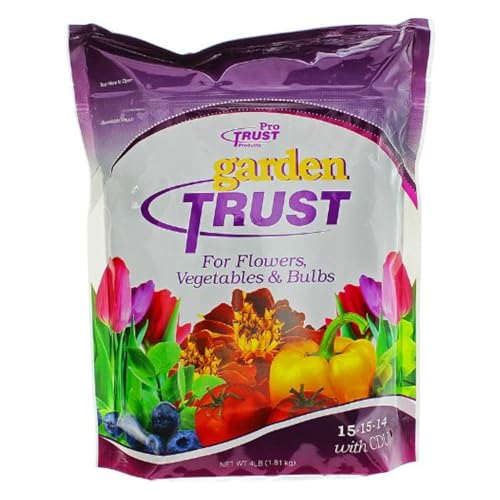
A balanced slow-release formula that feeds bulbs, flowers, and vegetables with one bag — with 15 nitrogen versus 3 in Espoma Bulb-Tone.
This is not a bulb-specific formula — the 15-15-14 ratio (N-P-K — the three numbers on the bag) has equal nitrogen, phosphorus, and potassium. Its slow-release delivery and 14 nutrient compounds make it a standout for gardeners who want one fertilizer for bulbs, annuals, perennials, and vegetables. The nitrogen level is higher than what most bulb specialists recommend, so you will get strong leaf growth alongside your flowers. For daffodils and tulips, that means you should apply it early in spring before the leaves fully emerge, then rely on the controlled release to carry through to bloom.
A long-time buyer reports having “used 10+ years on flowers, shrubs, vegetables” with the note that one feeding per season eliminates the need for weekly liquid feeding — though they add a second feeding for heavy feeders like tomatoes and cucumbers. The slow-release mechanism uses 14 nutrient compounds, meaning the phosphorus and potassium are doled out gradually rather than hitting the soil all at once. Compared to the 3:5:3 Espoma Bulb-Tone, this Garden Trust formula has 15 nitrogen versus 3, so it is better suited to a mixed bed of bulbs and leafy plants than a dedicated bulb-only patch.
all-purpose mix: If you hate keeping separate fertilizers for flowers, vegetables, and shrubs, this is your answer. Buyers who grow fig trees, apple trees, and bulb beds all within the same garden find that a single spring application gives them results on everything. The trade-off is that the equal nitrogen may produce taller, floppier tulip leaves compared to a low-nitrogen feed like the Lilly Miller 4-10-10.
general feeding: You manage a mixed garden of bulbs, perennials, and vegetables and want a single slow-release feeder.
bulb focus: You want a targeted low-nitrogen bloom booster for a dedicated daffodil or tulip bed only.
5. Jobe’s Organics Bone Meal Fertilizer Spikes, 50 Count

Pre-measured spikes that deliver phosphorus straight to the root zone — no scooping, no dust, and no runoff like the granular Espoma Bulb-Tone.
Jobe’s takes the guesswork out of bulb feeding by packing bone meal into 50 pre-formed spikes. The formula is 2-14-0 (N-P-K — the three numbers on the bag), which means it is essentially pure phosphorus with a tiny amount of nitrogen and zero potassium. This makes it the most targeted phosphorus delivery in this lineup. You push a spike into the soil near each bulb about two weeks before the shoots emerge in spring and again after the blooms fade. The OMRI (Organic Materials Review Institute) listing means it meets USDA organic standards.
Customers note the spikes are “very convenient to fertilize bulbs” and “insert easily in soil,” but they also note a distinct dog-food smell that can attract curious pets — one reviewer warned, “bury them deep to deter dogs.” The 2-14-0 ratio has 2 nitrogen, 14 phosphorus, and 0 potassium, versus 15-15-14 in the Garden Trust formula, so this product is strictly for flowering and root support, not general plant health. Unlike the 4-pound Espoma bag, these spikes produce no dust, no runoff, and no mess, making them ideal for raised beds or container plantings where spills are a problem.
spike convenience
- No measuring, no dust, no runoff — just push into soil and you are done
- 50 spikes per box covers a large bulb bed at a budget-friendly price per spike
- OMRI listed for organic gardening
slow release
- Smells like dog food and may attract dogs who will dig up and eat the spikes
- Contains zero potassium (the K in N-P-K), missing a key nutrient for overall plant vigor
set and forget: You want the easiest, mess-free method to deliver phosphorus directly to each bulb root zone and you garden organically.
immediate results: You have dogs that dig in the garden or you want a complete N-P-K formula that also provides potassium.
6. Espoma Organic Bone Meal Fertilizer 4-12-0, 24 lb. Bag

A 24-pound bag of all-natural bone meal — the cheapest phosphorus per pound for organic gardeners planting hundreds of bulbs.
If you are planting a large drift of daffodils or a whole border of tulips, this 24-pound bag of Espoma Organic Bone Meal gives you the volume to feed heavily without running back to the store. The 4-12-0 ratio (N-P-K — the three numbers on the bag) is even richer in phosphorus than Jobe’s spikes, but it is also bulkier. You mix the coarse powder into the soil at planting time or work it lightly into the surface around established bulbs. Because it is 100% all-natural bone meal with no fillers, it provides long-lasting nitrogen, phosphorus, and calcium that slowly release over the season.
Buyers who have tested this product report that “you could really tell where we used it” and that it helps prevent blossom end rot on tomatoes thanks to the calcium content. The bag weighs 24 pounds versus the 4-pound Lilly Miller bag, so it is a serious bulk purchase. One customer observed the bag broke during shipment, and the product is a coarse grind with tan chunks and white flakes rather than a fine white powder, but Espoma confirms that is normal for pure bone meal with natural marrow and cortical bone fragments. For organic gardeners with hundreds of bulbs to plant in fall, this is the most economical phosphorus source per pound.
bulk phosphorus: At 24 pounds, this bag lasts several seasons for most home gardeners and is far cheaper per pound than any smaller bag. The coarse grind prevents it from blowing away in wind and provides slower release than finely milled bone meal. The main downside is the messy packaging — plan to transfer the contents into a lidded bucket when you open it.
large gardens: You have a large bulb bed, you garden organically, and you want the lowest cost per pound of phosphorus available.
small spaces: You need a complete N-P-K formula with potassium, or you dislike handling and storing large, heavy bags of garden amendments.
Understanding the Specs
N-P-K Ratio for Bulbs
The three numbers on a fertilizer bag tell you the percentage by weight of nitrogen (N, for leaf growth), phosphorus (P, for roots and flowers), and potassium (K, for overall plant health). For daffodils and tulips, the middle number — phosphorus — is the one that drives root growth and flower size. A ratio like 4-10-10 has a high second number, meaning it pushes blooms and roots over leaves. A balanced ratio like 15-15-14 feeds the whole plant equally. If you only want flowers, grab a low-first-number mix.
Slow-Release vs. Immediate
Slow-release fertilizers use a coating or special organic compounds that break down gradually over weeks or months. This means one application feeds bulbs through their entire root-development phase in fall and again during spring growth without burning the roots. Immediate-release fertilizers work faster but can wash away in heavy rain and may need reapplication. For bulbs that you plant once and leave in the ground, slow-release saves you effort.
FAQ
When should I apply fertilizer to daffodils and tulips?
Can I use a general all-purpose fertilizer on bulbs?
What is the difference between bone meal and a balanced bulb fertilizer?
Is organic fertilizer better for daffodils and tulips?
Will fertilizer spikes work in clay soil?
How much fertilizer does a single tulip bulb need?
Can I use liquid fertilizer on spring bulbs?
Do daffodils and tulips need different fertilizers?
How long does a bag of bulb fertilizer last stored in the garage?
Will a high-nitrogen fertilizer kill my bulbs?
Final Thoughts: The Verdict
Across the board, the fertilizer for daffodils and tulips winner is the Espoma Organic Bulb-Tone 3-5-3 because its organic certification, proven bloom-boosting formula, and easy granular application make it ideal for both fall planting and spring feeding. If you want the highest phosphorus concentration available for a single product, grab the Lilly Miller Bulb & Bloom Food 4-10-10. And for a large-scale organic planting without the hassle of mixing, the bulk value of the Espoma Organic Bone Meal Fertilizer 4-12-0 at 24 pounds is the cost-effective choice.
How We Picked
We do not accept paid placement, and we did not hands-on test every unit. Instead, we match each pick to a real buyer and use-case by comparing the manufacturers’ published specifications against the patterns in verified customer reviews — so you get each pick’s real strengths and trade-offs instead of marketing copy.
Sources & Methodology
Specifications: manufacturer listings and product documentation. Review insights: verified customer reviews, as of July 2026. Pricing: not shown on this page (it changes often); check the current price via the retailer link.
As an Amazon Associate, Lawn Gear Lab earns from qualifying purchases. This does not affect which products we feature.