
Specs are compiled from manufacturer listings and verified buyer reviews and can change over time — please confirm the key details on the product page before buying.
If your lawn has hard, compacted soil that water beads up on or grass struggles to grow, you have a breathing problem underfoot. A yard aerator punches holes through that crust so air, water, and food can actually reach the roots—it is the single most effective thing you can do for a tired lawn without chemicals. The catch is choosing between a spike tool that just pokes holes and a core aerator that pulls out plugs of soil, and each type handles different ground and effort levels.
I’m Rikta — the founder and writer behind Lawn Gear Lab. This guide is built by comparing the manufacturers’ published specifications and the patterns across verified customer reviews, so you get each pick’s real strengths and trade-offs instead of marketing spin.
Here is what you need to know to pick the right yard aerator for your soil type, lawn size, and your own back.
Quick Picks
- Landzie Hollow Tine Lawn Aerator Tool — Premium Core Puller
- Manual Core Aerator Lawn Tool (LawnVigor) — Best Value Core Tool
- Dolibest Lawn Coring Aerator — Four-Tine Core Machine
- Seeutek 23 Inch Rolling Lawn Aerator — Best Rolling Spiker
- Brinly SAT2-40BH-P Tow Behind Spike Aerator — Ride-On Power
- Senvert Rolling Lawn Aerator — Heavy Roller with Aux Wheels
- Yard Butler Spike Aerator — Budget Spike Step Tool
How To Choose The Best Yard Aerator
The right aerator depends entirely on your soil’s texture, the size of your lawn, and how much sweat you are willing to trade for results. Here are the three decisions that separate a smart buy from a regret.
Spike vs. Core (Plug) Aerators
Spike aerators use solid tines to punch holes into the ground. They are lighter and often cheaper, but they can actually compact the soil around the hole—working against you in heavy clay. Core aerators (also called plug aerators) use hollow tubes to pull out a cylinder of soil, removing material so the ground has room to loosen up. If you have clay soil or severe compaction, a core aerator is the right tool. For sandy or loamy soil with light compaction, a spike tool will get the job done with less effort.
Manual vs. Rolling vs. Tow-Behind
Manual step aerators (like the first three picks below) are the most affordable and give you direct control, but they demand bending or stepping. For a lawn under about 2,000 square feet, a step tool is fine. A rolling push aerator, like the Seeutek or the Senvert, turns the hard work into a walking motion and covers ground faster. If you have a large lawn over half an acre, a tow-behind spike aerator like the Brinly attaches to your riding mower and does the work while you ride—by far the least labor for a big yard.
Weight and Penetration
A heavy tool—or one that lets you add weight—penetrates hard soil without you having to jump on it. The Seeutek rolling aerator weighs 24 pounds and lets you add water or sand up to a higher total. The Brinly has a weight tray that holds up to 150 pounds of extra weight. Lighter step tools rely on your body weight pushing down through a foot bar. If your ground is rock-hard, a model that accepts added weight will save your knees and patience.
Quick Comparison
| Model | Best For | Type | Weight | Tines / Spikes | Amazon |
|---|---|---|---|---|---|
| Landzie Hollow Tine Aerator | Premium core pulling | Core (hollow tine) | 5.6 lbs | 3 | Amazon |
| Manual Core Aerator (LawnVigor) | Core aeration on a budget | Core (hollow tine) | 3.52 lbs | 3 | Amazon |
| Dolibest Lawn Coring Aerator | Four-core efficiency | Core (hollow tine) | 5.54 lbs | 4 | Amazon |
| Seeutek 23 Inch Rolling Aerator | Rolling push power | Spike (rolling) | 24 lbs | Star-shaped spikes | Amazon |
| Brinly SAT2-40BH-P Tow Behind | Large-lawn towing | Spike (tow-behind) | Heavy-duty steel | 11 star tines | Amazon |
| Senvert Rolling Lawn Aerator | Adjustable-weight rolling | Spike (rolling) | 32 lbs (up to 55 lbs) | Spiral-spiked tread | Amazon |
| Yard Butler Spike Aerator | Light-duty spiking | Spike (step) | 2.25 lbs | 4 spikes | Amazon |
In‑Depth Reviews
1. Landzie Hollow Tine Lawn Aerator Tool
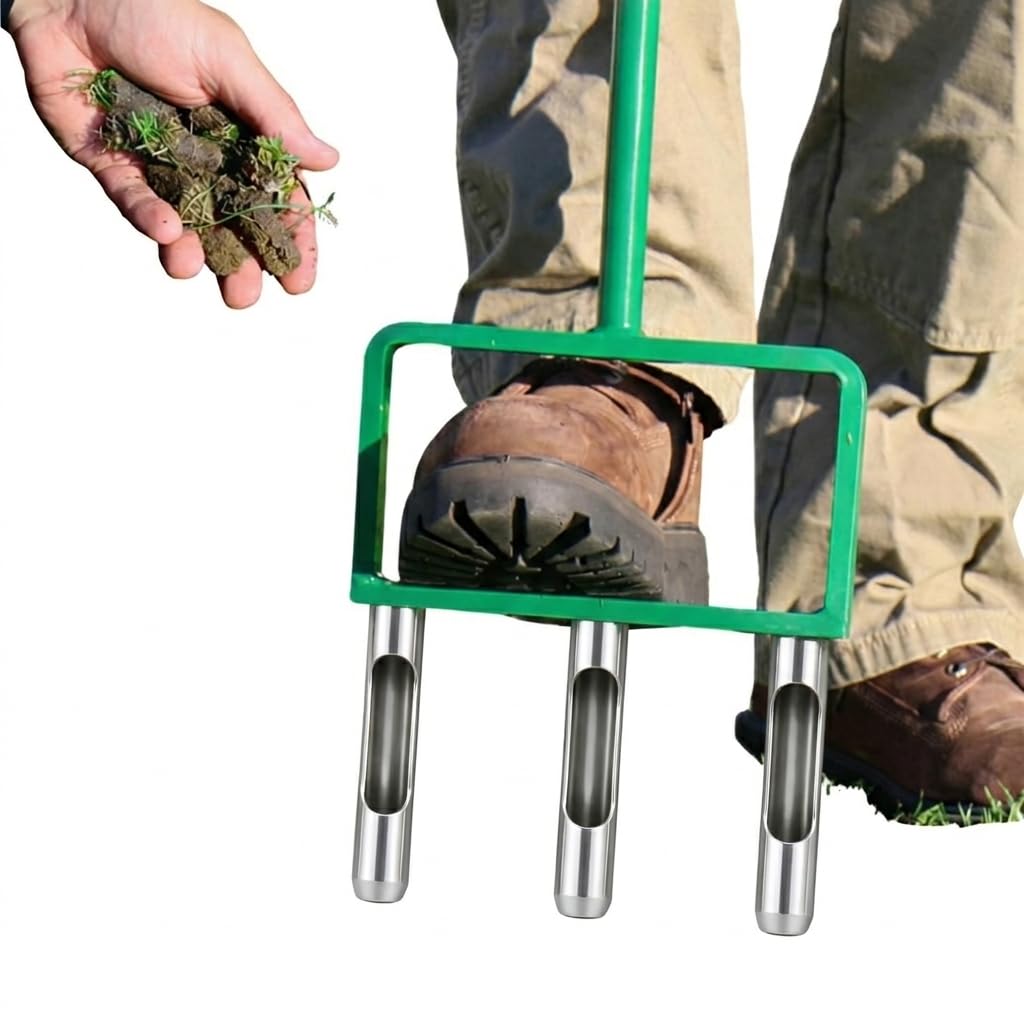
The no-assembly core aerator that pulls plugs with zero clogging.
If you want the real lawn-saving benefit of removing soil plugs instead of just poking holes, the Landzie is the smoothest manual path to that result. Its three stainless steel hollow tines are beveled so the soil core pushes out the top of the tine on every step—no poking, no shaking, no clearing. Buyers report that the tines “self-clean” and “stay sharp,” which is exactly what you need when you have a full afternoon of work ahead.
Unlike the 3.52-pound LawnVigor manual core tool below, the Landzie weighs only 5.6 pounds and arrives fully assembled with the tines already fitted to the frame. The 42-inch handle height is noticeably taller than the Yard Butler’s 36-inch handle, which helps reduce back strain for taller users. But the honest trade-off is that pulling cores is physically demanding work—a buyer who is 6 feet tall and 225 pounds found it “exhausting” for about 1,000 square feet. This is a tool for small to medium lawns where you want the best core aeration results.
Why It Leads
- No assembly needed; ready to use from the start.
- Beveled tines push cores out automatically so you never have to unclog.
- Stainless steel and powder-coated steel build that owners mention lasts through 10+ uses per year.
The Real Effort
- Very demanding on large areas; a buyer doing 3/4 acre found it “slow and tedious.”
- Hollow tines need occasional tightening every 1 to 2 hours during use.
- High price for a manual tool—you pay a premium for the clog-free design.
Buy it if: you have a small to medium lawn with compacted clay soil and want genuine core aeration without fighting clogs.
Look elsewhere if: your lawn is over 3,000 square feet or you prefer a rolling motion over stepping.
2. Manual Core Aerator Lawn Tool (LawnVigor)
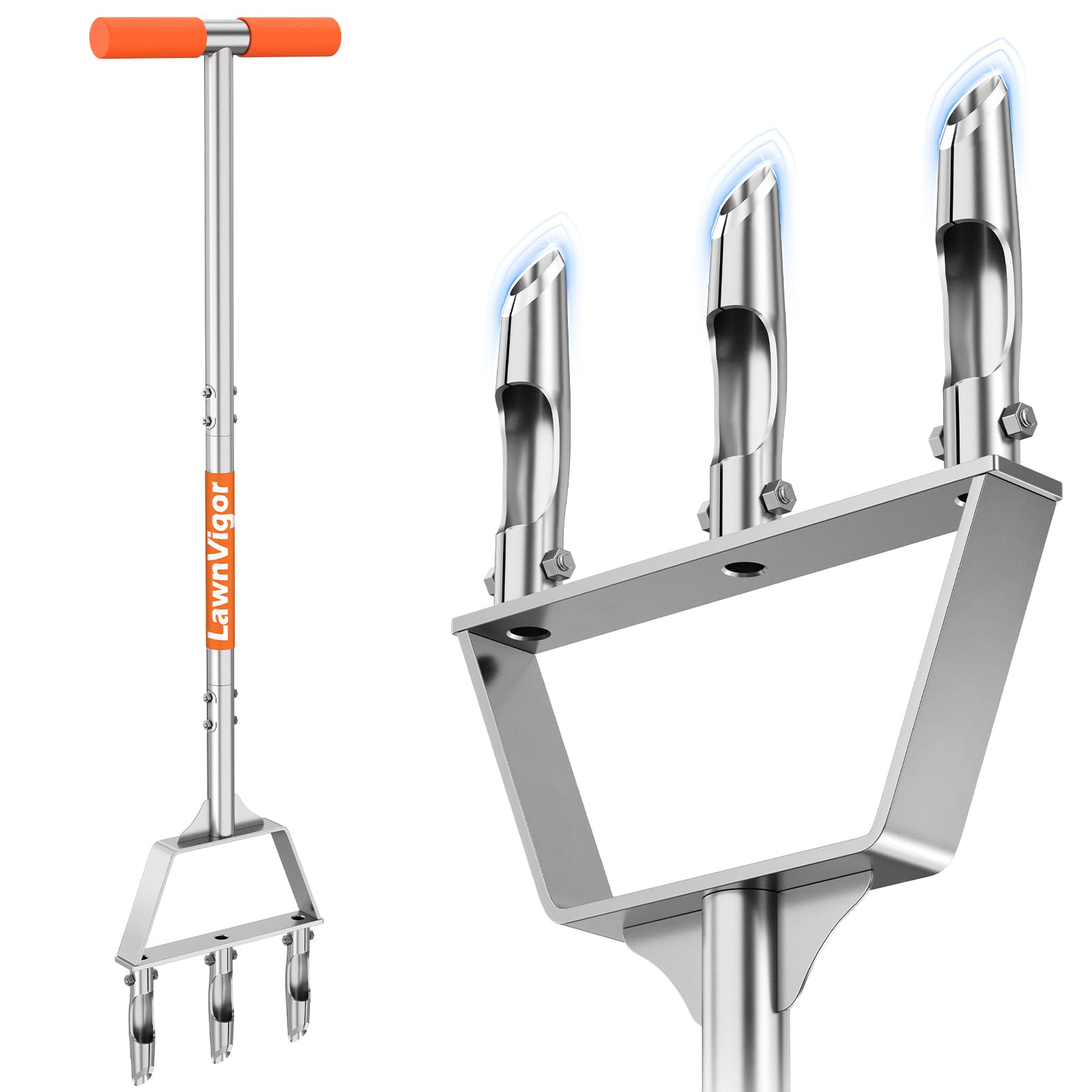
The budget entry into core aeration that punches above its price.
For about half the cost of the Landzie, the LawnVigor manual core aerator gives you the same core-pulling principle with three heat-treated hollow tines that pull deep 3-inch soil plugs. Customers note that its “reliable ejection mechanism rarely clogs,” which is the single biggest headache with inexpensive core tools. The wide T-handle has foam grips, and the semi-assembled design takes about five minutes to finish putting together.
You do sacrifice some weight—at 3.52 pounds it is lighter than the Dolibest below, so you will need to put more of your own body weight behind each step. A buyer mentioned that the bolts on each side “stick out far enough to clip the inside of your knees,” a design annoyance you will notice after a long session. Still, for someone who wants the genuine soil-removal benefit of core aeration without spending premium money, this is the smart pick.
Strengths
- Heat-treated hollow tines that pull full 3-inch cores reliably.
- Quick 5-minute assembly with included tools.
- Powder-coated steel feels sturdy and stable during use.
Trade-offs
- Exposed bolt ends can rub against your knees during repetitive stepping.
- Lighter than the Dolibest, so you work harder to penetrate dry soil.
- Manufacturer advises not to rock or twist the tool in the ground to avoid bending tines.
Reach for this if: you need a core aerator on a tighter budget and have moist soil you can work with.
Pass if: you have very hard, dry clay that demands extra weight to penetrate.
3. Dolibest Lawn Coring Aerator
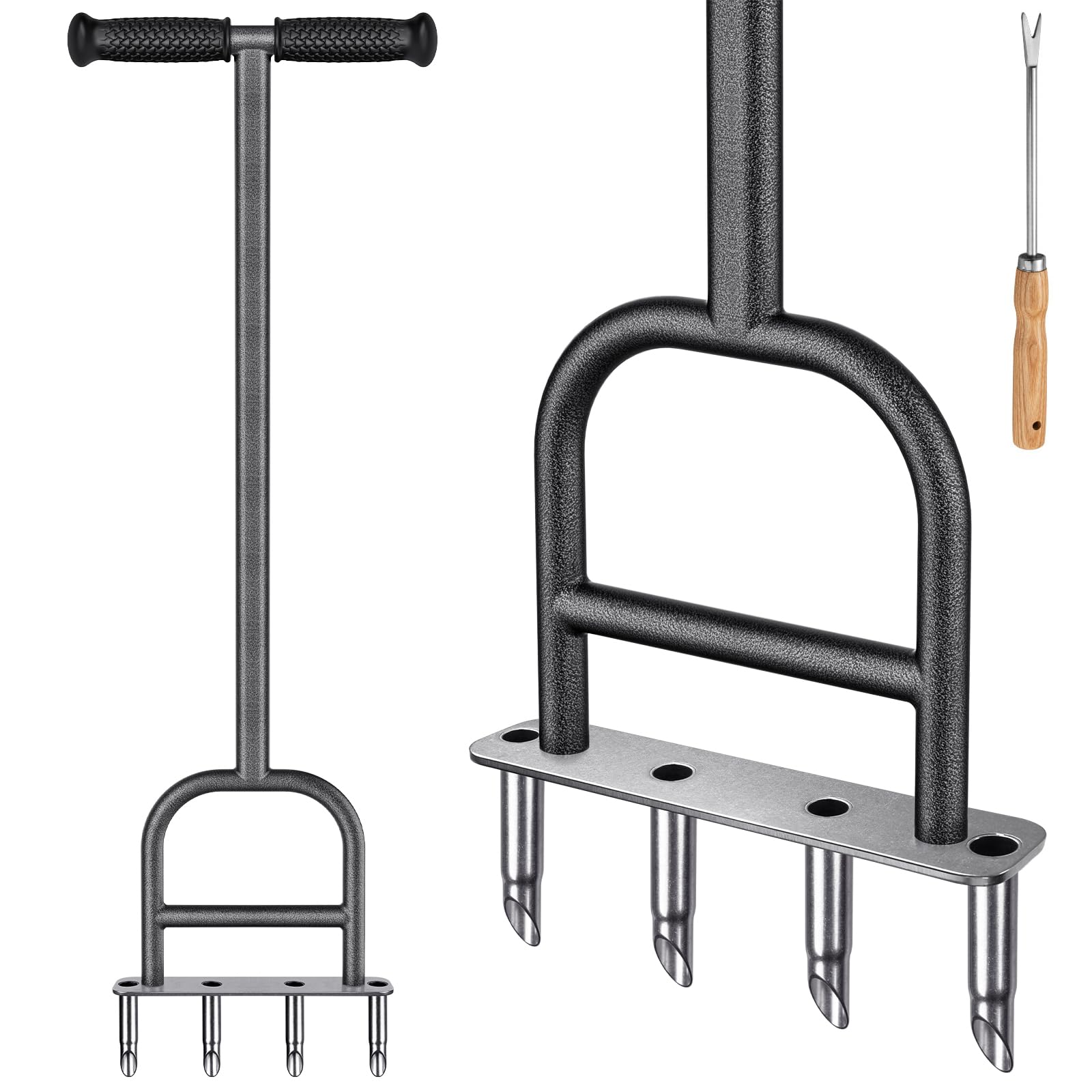
Four hollow tines cram more holes into every step than any other manual pick.
The Dolibest stands out immediately because its four stainless steel corers each pull a 3.5-inch-long soil plug that is half an inch in diameter—that is one more plug per step than the Landzie or LawnVigor, which means you cover ground faster. Buyers mention that “cores ejected decently” and that they “only needed cleaning ~8 times in 2 hours,” which is good for a four-tine tool that inevitably collects more soil. The soft rubber grip on the handle and the foot bar work together to keep your shoes from interfering with the plug ejection.
At 5.54 pounds, it is the heaviest manual step aerator here, and that weight helps it sink into soil. But a buyer noted that the rounded foot step lacks leverage, so the tool often only reaches about 2 inches deep unless you wear sturdy boots or add your own body weight. The package dimensions of 33 x 11.5 x 2.5 inches are noticeably larger than the LawnVigor’s box, a sign of the wider frame. A 12-inch weeder handle tool comes included for cleaning the tines out.
What Works
- Four tines means more ground coverage per push than any three-tine model.
- Stainless steel lower section resists rust and bending.
- Includes a dedicated hand tool for cleaning out the hollow corers.
Where It Falls Short
- Rounded foot step transfers force poorly; depth suffers without extra weight or rocking.
- Tines can clog if the soil is too wet; the cleaning tool is essential.
- Wider frame makes it less maneuverable in tight garden beds.
Best for: a medium-sized lawn where you want more plugs per step and are okay rocking the tool side-to-side.
Not ideal if: you have heavy clay that needs the deepest possible penetration without extra effort.
4. Seeutek 23 Inch Rolling Lawn Aerator

A weighted roller that turns aeration into a walk instead of a squat workout.
If stepping down on a tool a thousand times sounds miserable, the Seeutek rolling aerator changes the game by letting you simply push a drum with star-shaped spikes across your lawn. It weighs 24 pounds from the start, which reviewers point out is “heavier than alternatives for better soil penetration,” and you can add water or sand through a small hole on the side to drive the 2-inch spikes even deeper. The three-position adjustable handle lets you set it to a height that does not force you to stoop.
Unlike the core-pulling tools above, this is a spike aerator, so it punches holes without removing soil plugs—fine for moderately compacted ground but not as effective on heavy clay. The product dimensions of 23 x 15 x 9 inches mean it stores smaller than the Senvert rolling aerator below, but the trade-off is a narrower 23-inch drum that means more passes across your lawn. Assembly took one buyer about an hour, and the included instructions have small images that can be tricky to follow.
Why Push This One
- Filling the drum with sand or water adds weight without buying anything extra.
- Three handle heights let you find a comfortable pushing angle.
- Laser-welded star spikes are sturdy; shoppers say the frame has no flex.
The Drawbacks
- Assembly takes about an hour; instructions have small, hard-to-read images.
- Spike-type aeration does not remove soil plugs—better for maintenance than fixing severe compaction.
- Some buyers needed extra washers and wheel shims that are not included.
Grab this if: you want to aerate a medium lawn by walking instead of stepping, and you are comfortable with spike aeration.
skip it if: your soil is heavy clay that really needs core plugs removed to see improvement.
5. Brinly SAT2-40BH-P Tow Behind Spike Aerator

Hook it behind your mower and let the machine do the hard work.
For anyone with a riding mower and a lawn measured in acres, the Brinly tow-behind aerator is the least labor-intensive option on this list. It spans a full 40 inches wide with 11 star tines, each carrying 12 spike tips that penetrate up to 2 inches into the soil. The patent-pending 3-D galvanized steel tines are designed to resist bending even in compacted ground, and the rigid weight tray holds up to 150 pounds of extra weight—cinder blocks or sandbags—for maximum penetration.
Unlike the manual step tools that demand your body weight, the Brinly relies on the weight you add to the tray and the pull of the mower. A buyer reported that it “transformed cracked, clay-like soil into plantable lawn” after a single season. The transport wheels flip down with a lever so you can cross driveways without the spikes scraping the pavement. But the sharp tines demand heavy-duty gloves during assembly, and a buyer noted that the hex lock nuts on the wheels can loosen quickly—one wheel fell off during use.
The Big Advantage
- Tow-behind design covers a 40-inch path on every pass, perfect for large lawns.
- Weight tray accepts up to 150 pounds for serious penetration in hard soil.
- Galvanized 3-D tines resist rust and bending better than standard flat spikes.
Watch Out For
- Sharp tines require ANSI-rated gloves; assembly is not for bare hands.
- Wheel nuts loosen during use; one buyer lost a wheel entirely.
- Coating on the weight tray can wear off if heavy blocks bounce during transport.
Meant for: large properties where you already own a riding mower and want to aerate without sweat.
Wrong for: small lawns or anyone without a tow vehicle—you cannot push this by hand.
6. Senvert Rolling Lawn Aerator
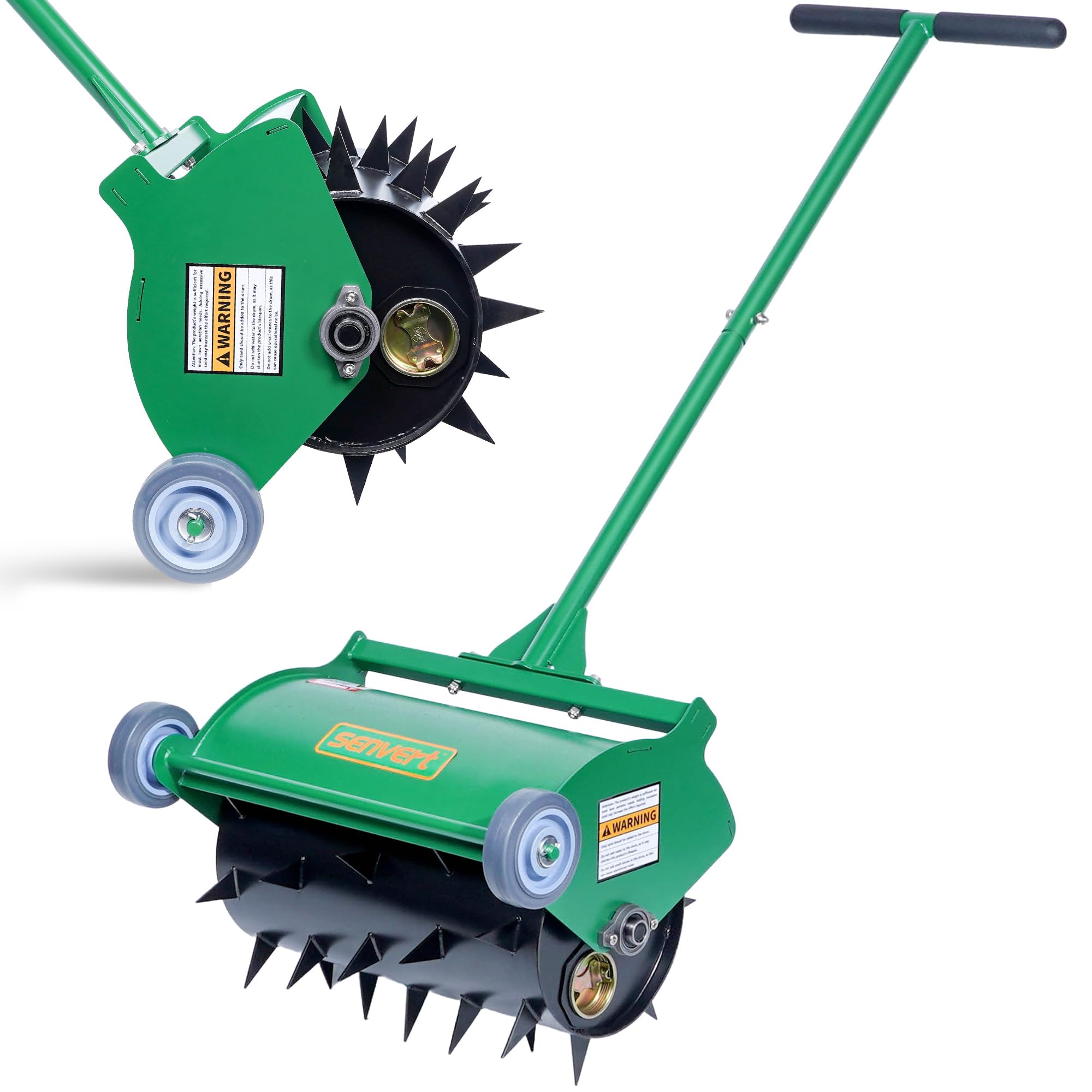
A 32-pound roller that you can stuff with sand to hit 55 pounds.
The Senvert rolling aerator starts at 32 pounds from the start, which is already heavier than the Seeutek’s 24 pounds, and you can add sand or stones through the drum’s covered opening to bring the total weight up to 55 pounds. That extra mass drives the spiral-spiked tread deeper into the ground without you having to lean hard on the handles. The main body comes fully assembled—you only attach the handle in a few minutes, which is a welcome change from the hour-long assembly of the Seeutek.
A pair of auxiliary wheels sits on the side made from quiet TPR material, so you can roll it across driveways without the spikes scratching the surface. Buyers report it is “easy to push around” and “works great” for smaller lawns, but also note that if you load it with extra weight, “you better be in good shape” because pushing a 55-pound drum across a large yard is tiring. The spiral tread design is a spike-type aerator, so it does not pull soil plugs—same limitation as the Seeutek for heavy clay.
What Stands Out
- Fully assembled main body means minutes-long setup instead of an hour.
- Weight-adjustable from 32 to 55 pounds by adding sand or stones.
- TPR transport wheels protect driveways and make storage movement easy.
The Catch
- At maximum weight the drum is heavy to push across larger lawns.
- Spike aeration only—no soil plugs removed, so less effective on severe compaction.
- Adding rocks makes the drum noisy; sand is quieter but heavier to push.
Choose this if: you want a quick-setup roller with weight flexibility and small-to-medium lawn size.
Pass on it if: your lawn exceeds 5,000 square feet or you need core aeration for clay soil.
7. Yard Butler Spike Aerator
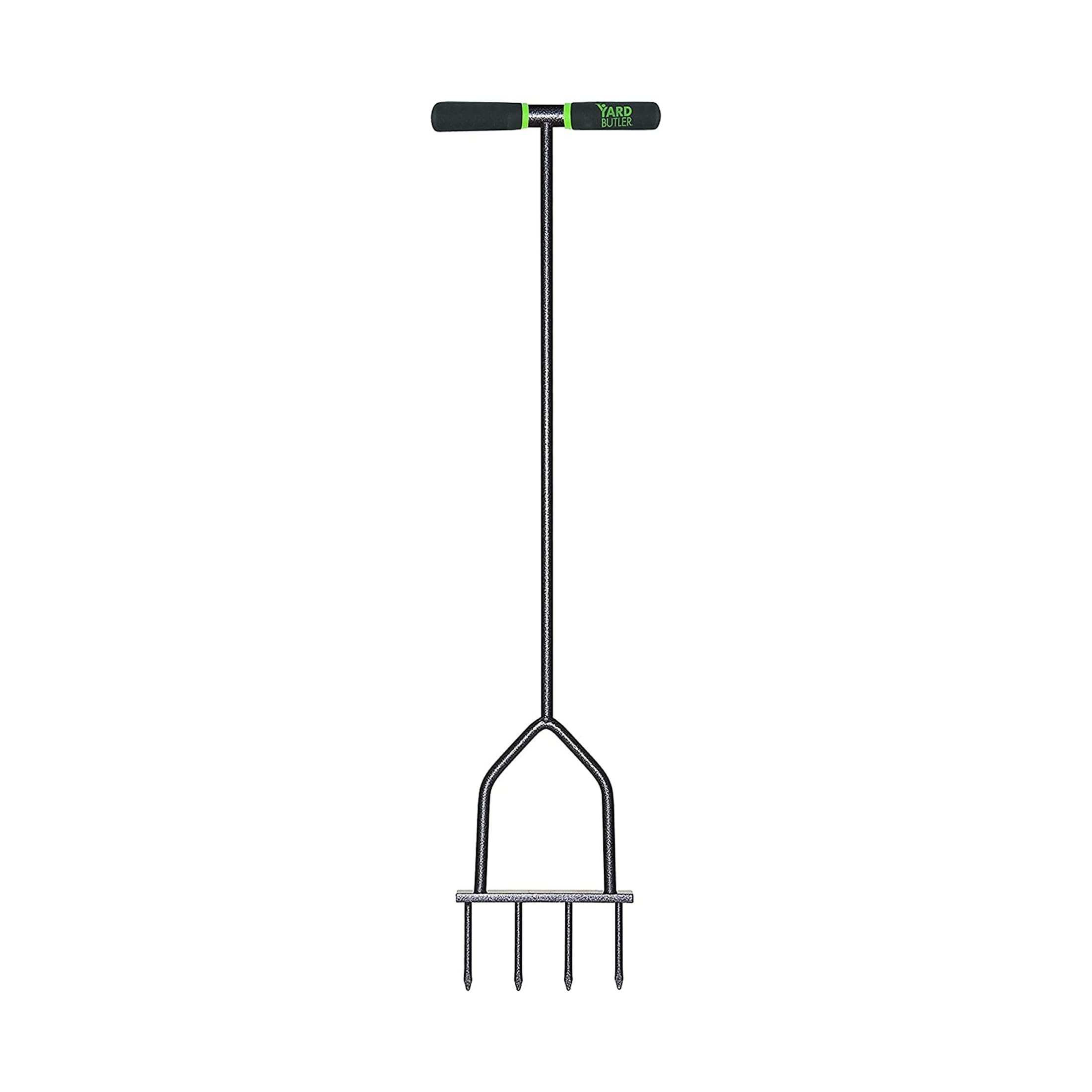
The lightest and simplest spike tool for quick maintenance poking.
At just 2.25 pounds with four 3-inch spikes, the Yard Butler is the lightest tool here by a massive margin—the Seeutek roller is more than ten times heavier at 24 pounds. Owners mention it “works well in moist clay soil” at a pace of about 325 square feet per hour, which means you can cover a 1,000-square-foot patch in a little over three hours. For a small lawn with sandy or loamy soil that just needs an occasional poke, this is the most affordable way to do it.
The honest trade-off is that the 37-inch handle is short—a buyer who is 6 feet tall found it caused “back soreness after prolonged use.” And some recent reviews note that the steel quality has changed; one reviewer noted the tines bent 15 degrees after just 15 minutes of use. The Dolibest above gives you four tines and a rubber grip at a similar price point, making it a stronger value unless you specifically want the absolute lightest tool to carry around. The product dimensions of 37 x 10 x 1 inches are easy to store in a shed corner.
The Upside
- Extremely lightweight at 2.25 pounds; easy to carry and store.
- Simple design with no assembly needed from the start.
- Works fast on moist soil; buyer measured 325 sq ft/hr in clay.
The Downside
- Short 37-inch handle strains the back for users over 6 feet tall.
- Recent units may have softer steel; tines bent after 15 minutes in one report.
- Spike-type aeration can compact soil around the hole in heavy clay.
Best for: quick maintenance aeration on small, already-moist lawns where weight matters.
Not for: tall users, heavy clay soil, or anyone who wants the deeper benefit of core aeration.
Understanding the Specs
Hollow Tines (Core Aerators)
These are metal tubes that cut a circle through the turf and pull out a cylinder of soil—a “plug.” The diameter (usually 0.5 inches) and length (3 to 3.5 inches) of the plug tell you how much soil is removed each time. More tines per step (three vs. four) means more plugs per push, but also more force needed to sink them all. The key advantage is that removing soil creates actual space in the ground for roots to spread, which is the best treatment for compacted clay.
Spike Tines (Rolling and Step Tools)
These are solid metal prongs that push a hole into the soil without removing material. The trade-off is that the soil around the hole gets pushed outward and compressed, which can worsen compaction in heavy clay over time. Spike tools work well for sandy or loamy soil that does not compress easily. Spike depth (usually 2 to 3 inches) matters less than the tool’s total weight, because weight determines how deep the spikes go without you having to jump on the tool.
Weight and Load Capacity
Manual step tools rely on your body weight pushing through a foot bar. Rolling and tow-behind tools have their own starting weight and may accept extra weight—sand, water, or cinder blocks—to drive spikes deeper. A heavier tool (or one you can add weight to) is almost always better for hard soil because it penetrates without extra effort from you. Just remember that extra weight also makes the tool harder to push or pull.
Handle Height and Length
For manual step aerators, a handle that is too short (under 40 inches) forces you to stoop, which causes back pain over a long session. Taller users should look for handles around 42 inches or longer. For rolling aerators, adjustable handles let you set the height that matches your natural walking posture. The wrong handle height turns a manageable chore into a painful one.
FAQ
What is the difference between a spike aerator and a core aerator?
How often should I aerate my lawn?
Can I use a yard aerator on wet soil?
How deep should the aerator penetrate?
Will a rolling aerator damage my lawn?
Is a tow-behind aerator worth it for a small lawn?
How do I clean a core aerator after use?
What should I do after aerating my lawn?
Can I add weight to a rolling aerator?
Are manual aerators hard to use?
Final Thoughts: The Verdict
For most buyers, the yard aerator winner is the Landzie Hollow Tine Aerator because it delivers genuine soil-plug removal without the clogging headache that plagues cheaper core tools, and it arrives ready to use with no assembly. If you want a core aerator on a tighter budget, grab the Manual Core Aerator (LawnVigor). And for large lawns where you want the mower to do the work, the standout is the Brinly SAT2-40BH-P Tow Behind.
How We Picked
We do not accept paid placement. Every pick is matched to a real buyer and a real use-case; we do not hands-on test units.
Sources & Methodology
Specifications: manufacturer listings and product documentation. Review insights: verified customer reviews, as of July 2026. Pricing: not shown on this page (it changes often); check the current price via the retailer link.
As an Amazon Associate, Lawn Gear Lab earns from qualifying purchases. This does not affect which products we feature.