
Nothing ruins a peaceful evening on the patio faster than the aggressive buzz of a yellow jacket dive-bombing your drink. The frustration of watching wasps patrol your grill, deck, or garden entrance while having zero effective plan to deal with them is a specific, daily irritation. The solution is not a frantic swatter chase — what you need is a targeted, strategic trap that works while you relax.
I’m Rikta — the co-founder and writer behind Lawn Gear Lab. I’ve spent countless hours cross-referencing trap specifications, analyzing active ingredient data, and filtering thousands of owner experiences to identify which designs actually break the wasp lifecycle and which ones just catch dust.
This guide breaks down the most effective, scientifically-proven models on the market so you can reclaim your yard. Here is the definitive analysis to find the perfect best wasp trap for your property size and pest pressure level.
How To Choose The Best Wasp Trap
Selecting a wasp trap comes down to understanding the target pest, the trap’s physical design, and the bait strategy. A trap built for yellow jackets is not optimized for paper wasps, and a unit that leaks scent through over-sized holes will fail to contain its catch.
Target Species: Yellow Jacket vs. Wasp vs. Hornet
The rescue-style yellow jacket traps use a proprietary heptyl butyrate attractant that is largely useless for hornets and paper wasps. If your problem is primarily yellow jackets, a species-specific unit like the RESCUE! Reusable Yellowjacket Trap is more effective because it does not accidentally attract honeybees. For mixed populations, a general-purpose trap with multiple entry tunnels and a customizable bait chamber is a better fit.
Entry Geometry: Tunnel Diameter and Escape Prevention
Inspect the funnel or cone design at the entry point. Traps with a single large opening allow wasps to exit just as easily as they enter. The most effective units use a two-stage entry: a wide outer funnel that leads into a narrower inner cone, or a grid of small holes that force the insect deeper into the drowning chamber. The Landisun design with six small inlets is a textbook example of this principle.
Disposable vs. Reusable: Season-Long Investment vs. Instant Cleanup
Disposable bag traps require no maintenance — you cut the opening, add bait, hang it, and toss the entire unit when full. This is ideal for medium-to-large properties where you need multiple traps deployed simultaneously. Reusable models made from ABS plastic require periodic emptying and cleaning with warm soapy water, but they withstand sun, rain, and multiple seasons. Your decision hinges on whether you prefer paying a small premium per season for zero cleanup or a one-time cost plus occasional refill purchases.
Color Psychology and Visual Attraction
Wasps and yellow jackets are strongly attracted to yellow, which is why the vast majority of traps are bright yellow. Orange and blue variants are less effective at luring but can be useful if you want to reduce unwanted bee captures. The Stingmon 4 Pack uses this yellow-targeting principle, and owner reports confirm it consistently draws in the aggressive species while leaving beneficial pollinators alone.
Quick Comparison
On smaller screens, swipe sideways to see the full table.
| Model | Category | Best For | Key Spec | Amazon |
|---|---|---|---|---|
| Stingmon 4 Pack Disposable | Disposable Bag | High-volume yard coverage | 4 traps per pack, 7.8 x 9.5 in each | Amazon |
| Landisun 2 Pack Reusable | Reusable Hard Shell | Non-toxic repeated use | 6 entry inlets, ABS plastic | Amazon |
| RESCUE! Fly Trap Refill 4 Pack | Attractant Refill | Filth fly control near compost | Water-soluble pouch, 0.07 kg | Amazon |
| Stingmon Solar LED 2 Pack | Solar / Light Assisted | Night-time insect reduction | Blue UV LED, solar panel | Amazon |
| Stingmon Reusable 2 Pack | Reusable Hard Shell | All-season orchard protection | Multi-tunnel entry, 11.2 oz | Amazon |
| Stingmon 6 Pack Disposable | Disposable Bag | Large ranch or farm coverage | 6 traps, rain/wind resistant | Amazon |
| RESCUE! Reusable Yellowjacket 2 Pack | Species-Specific | Yellow jacket infestations | Proprietary attractant, 9.45×11.22 in | Amazon |
In‑Depth Reviews
1. RESCUE! Reusable Yellowjacket Trap – 2 Traps

The RESCUE! Yellowjacket Trap is the benchmark for species-specific yellow jacket control. Its attractant chemistry—based on heptyl butyrate—targets roughly a dozen yellow jacket species found in North America while leaving honeybees completely alone. The 9.45 x 11.22 inch hanging unit features a bottom-entry system where yellow jackets fly up into the chamber and die from dehydration, making it one of the most selective designs available.
Owner reports from peak May activity confirm traps catch multiple yellow jackets within the first day, and the durable plastic construction survives full-season sun exposure without cracking. The included attractant lasts for weeks, though some users report better results by supplementing with a sweet soda-soaked cotton ball. The trap is not designed for paper wasps or hornets, so it is not a universal solution.
For anyone who has been stung repeatedly and needs a reliable, scientifically-backed tool that will not destroy local bee populations, this is the most responsible and effective choice. The ongoing cost of replacement attractant pouches is the only recurring expense, but the trap body itself should last many seasons.
What works
- Selectively targets yellow jackets, spares honeybees
- Durable ABS plastic withstands rain and UV for years
- Included attractant is effective immediately
What doesn’t
- Does not capture wasps or hornets reliably
- Ongoing cost of refill attractant pouches
2. Stingmon Reusable 2 Pack Wasp Trap
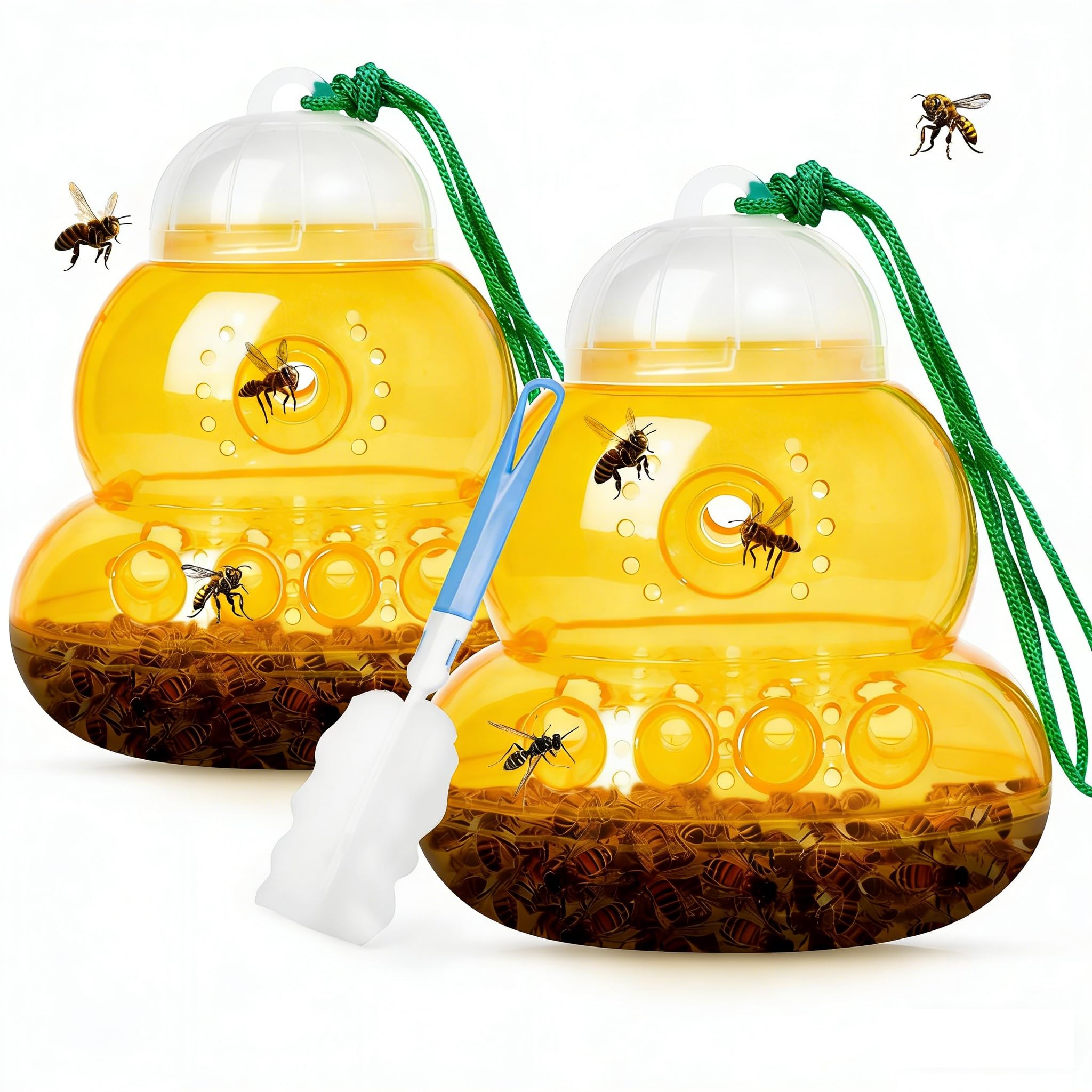
The Stingmon Reusable 2 Pack is built for the property owner who wants a permanent, no-waste solution that accepts any bait. Each 5.12 x 5.12 x 4.72 inch unit uses multiple entry tunnels that allow wasps, yellow jackets, and carpenter bees to enter from any direction, and the integrated bottom design is leak-proof and easy to disassemble for cleaning.
The 11.2 ounce weight gives it a substantial feel that resists wind sway, and the included nylon cord makes hanging straightforward. Owner feedback is overwhelmingly positive when using a bait mix of apple cider vinegar, sugar, and dish soap, with many reporting 15–20 wasps caught in the first two weeks. The orange color option is less attractive to bees than bright yellow, which is a useful nuance for mixed-pollinator yards.
Some users found the entrance holes large enough for larger wasps to escape, though this appears to be an issue mainly with the hornet-sized specimens. If you are dealing with standard yellow jackets and paper wasps, the capture retention is excellent.
What works
- Multiple entry tunnels attract from all sides
- Leak-proof integrated bottom for easy cleaning
- Durable ABS holds up across multiple seasons
What doesn’t
- Larger hornets may escape through entry holes
- Bait is not included — must provide your own
3. Stingmon Solar LED Wasp Trap 2 Pack
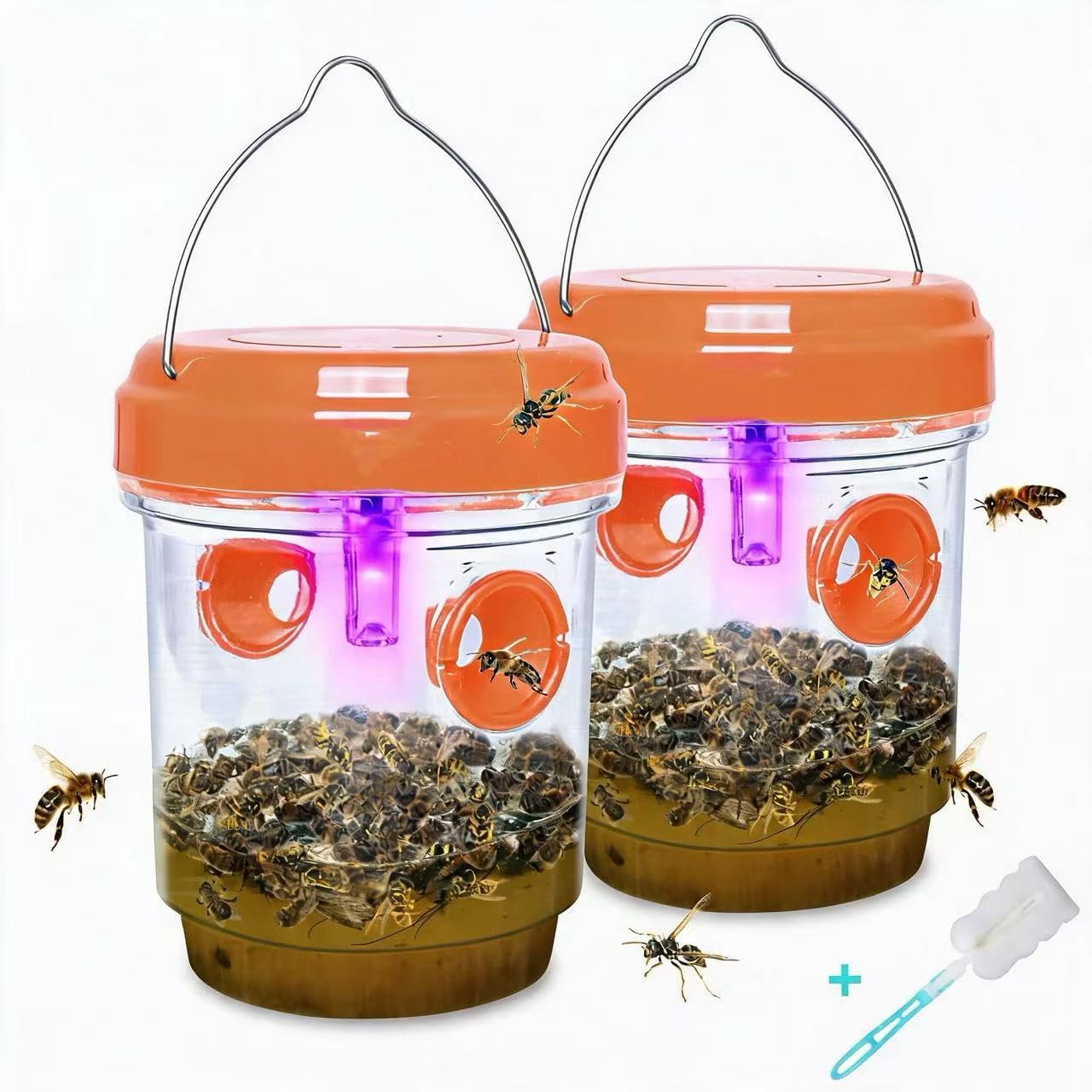
The Stingmon Solar LED Trap adds a technological twist to the traditional bait chamber. A built-in solar panel charges a battery during daylight, which powers a blue UV LED at night to attract nocturnal flying insects. The 3.94 x 3.94 x 4.72 inch casing is compact but features dual entry tunnels—one on each side—with an outer opening larger than the inner to create a one-way funnel effect.
Owner experiences show it catches fungus gnats, fruit flies, and small wasps within 30 minutes of deployment, especially near plant pots and fruit baskets. The color choice between blue and orange allows some visual customization, though blue tends to attract a wider range of night-flying insects. The stainless steel components resist rust, which is critical for a unit designed to sit outside indefinitely.
This is not the trap for heavy yellow jacket pressure—the chamber volume is modest and the entry tunnels are small. It shines as a supplementary tool for light infestations or as a 24-hour fly-and-small-wasp monitor around the garden. The solar system works reliably in direct sun but struggles on heavily overcast weeks.
What works
- Solar panel provides free nighttime UV attraction
- Rust-resistant stainless steel components
- Effective on small flies and gnats within minutes
What doesn’t
- Small entry tunnels limit large wasp capture
- Solar performance drops in extended cloudy conditions
4. Stingmon 4 Pack Disposable Wasp Traps
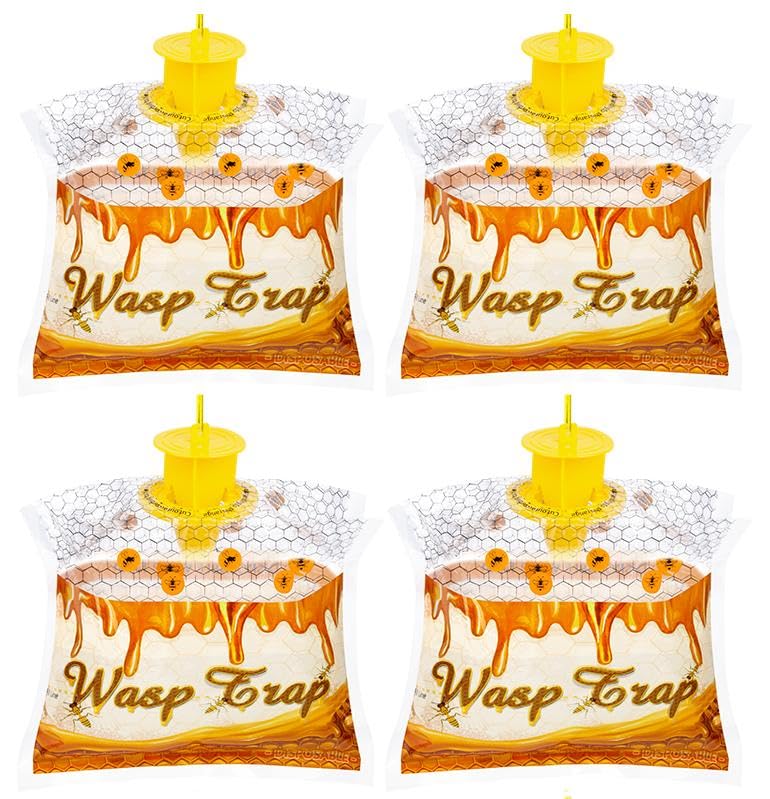
The Stingmon 4 Pack Disposable is the volume play for covering a large yard, barn, or ranch without any cleaning commitment. Each 7.8 x 9.5 inch bag is made from weather-resistant material that protects the bait from rain and wind, and the bright yellow color is scientifically chosen to trigger wasp and bee visual attraction. Adding beer or fruit vinegar inside the included funnel system creates an immediate odor plume.
Owner feedback is extremely consistent: users who add a sweet liquid bait (concord grape juice, beer, or honey wine) report capturing wasps within 24 hours. The funnel top creates a genuine one-way mechanism—once a yellow jacket enters, it cannot find the exit. The most common complaint is that some bags arrive with small air holes that reduce scent concentration, though this seems to affect maybe one in ten units.
This is the easiest entry point for someone who has never used a wasp trap before. Four units let you test different bait recipes and placement locations simultaneously. When a bag fills up, you simply discard the entire unit—no touching dead insects, no soapy wash water.
What works
- Zero maintenance — toss the whole bag when full
- Bright yellow color maximizes target attraction
- Four-pack allows multi-location testing
What doesn’t
- Some bags arrive with imperfect air hole seal
- Cannot be reused — single-season cost adds up
5. Landisun Wasps Bees Traps 2 Pack

The Landisun 2 Pack positions itself as the non-toxic, family-safe trap. The ABS shell is rain-proof and corrosion-resistant, and the design uses six separate inlets to maximize scent emission and entry opportunities. Each 9 x 4.5 x 5 inch unit comes with an 18-inch nylon cord and can be refilled indefinitely with natural baits like sugar water, apple juice, or overripe fruit mash.
Owner reports indicate that the trap works very well when the six-inlet geometry is combined with a solid bait recipe: wheat beer, vinegar, fruit juice, and sugar. However, some users noted that a handful of the inlets were cut slightly too large, allowing determined wasps to escape. A secondary concern is that the trap attracts non-target insects like flies more readily than pure wasp-specific designs.
For the environmentally-conscious buyer who wants to avoid chemical insecticides and disposable plastic waste, this is a solid reusable option. The need to check hole size upon arrival and the tendency to catch some flies are the trade-offs for a fully non-toxic approach.
What works
- Completely non-toxic, safe around pets and children
- Six inlets provide strong scent dispersion
- Reusable ABS design reduces landfill waste
What doesn’t
- Some entry holes may allow wasp escape
- Attracts a wider range of non-target insects
6. Stingmon 6 Pack Disposable Wasp Traps
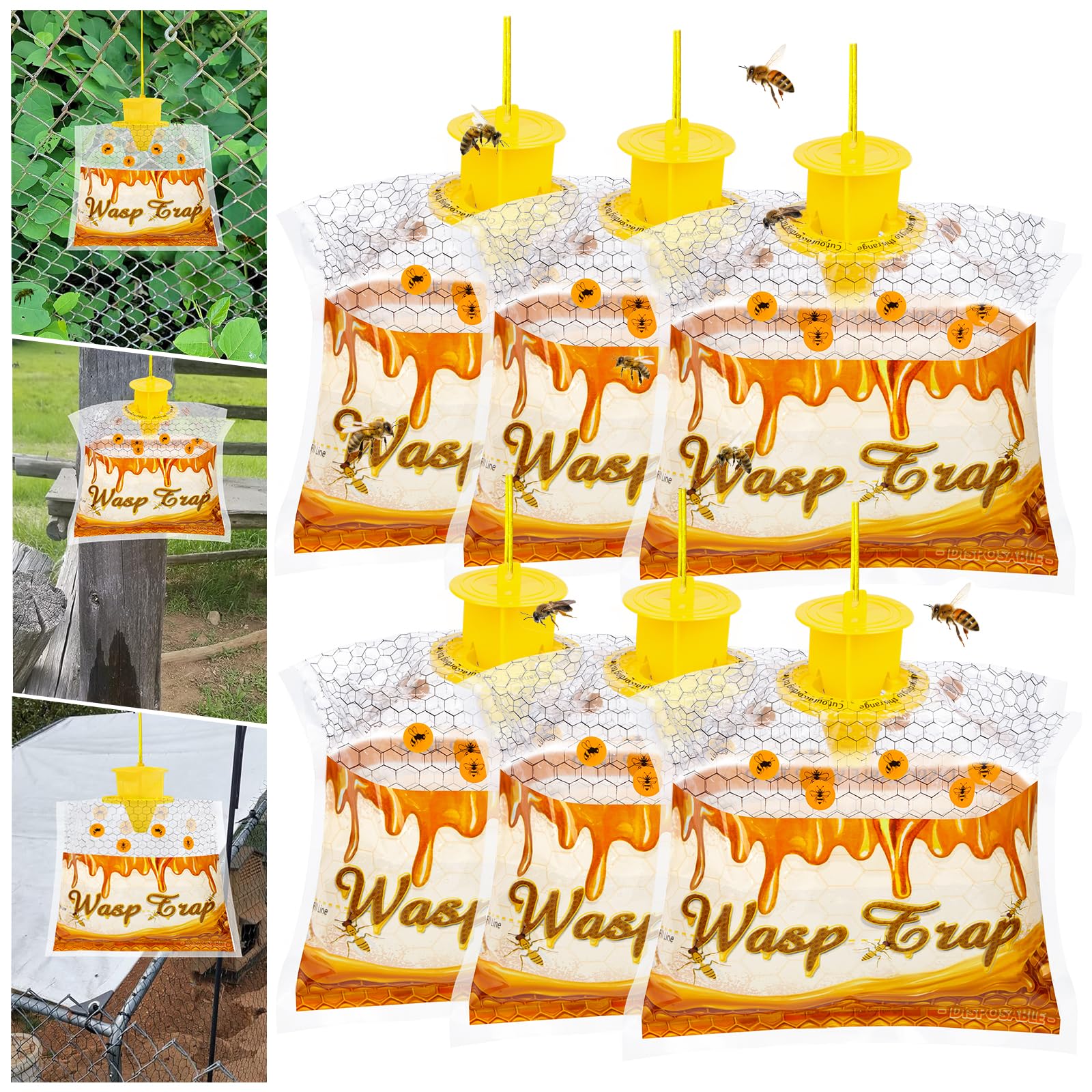
The Stingmon 6 Pack Disposable is the highest-count option from the same proven design as the 4-pack, making it the go-to choice for properties measured in acres rather than square feet. Each bag measures 7.8 x 9.5 inches and uses the same funnel-lock mechanism, bright yellow coloration, and rain-resistant material. The inclusion of six units means you can place traps at every strategic perimeter point around a horse stable, barn, or multi-structure farm.
Owner feedback echoes the 4-pack experience: the traps work quickly when baited with beer, fruit vinegar, or honey, and the disposable nature eliminates any contact with the catch. A handful of owners mentioned that the bags are not as weather-proof as advertised, with some tearing after a week of heavy rain exposure. The funnel construction feels slightly lighter than reusable competitors, but for a single-season disposable, the performance-to-cost ratio is strong.
If you need to deploy a perimeter defense line around a large outdoor living space, six traps at this price level let you saturate the area without worrying about retrieval or cleaning. Just cut, bait, hang, and replace as each fills.
What works
- Six traps provide coverage for large properties
- Easy to deploy, no cleaning required
- Funnel lock prevents most wasp escapes
What doesn’t
- Bag material may tear after heavy rain
- Funnel construction feels less robust than reusable models
7. RESCUE! Fly Trap Refill 4 Pack

This is not a stand-alone trap but an attractant refill pack designed for the RESCUE! Reusable Fly Trap bottle. Each 0.07 kg water-soluble pouch activates when dropped into the trap container with water, releasing a proprietary odor blend that attracts house flies, cluster flies, blow flies, and flesh flies. It is a purpose-specific tool for filth fly control around compost bins, animal enclosures, and outdoor dining areas.
Owner experiences confirm the odor is effective but intensely unpleasant during refill—users universally recommend wearing gloves and holding their breath. The 4-pack provides an entire season of coverage for a single trap, and the attraction radius is genuinely strong, luring flies from across a large yard. It will not attract wasps or yellow jackets, so it is not a substitute for the traps above.
If you already own the RESCUE! Reusable Fly Trap bottle and need replacement attractant, this is the exact refill you want. For someone looking for a wasp-targeted solution, this product is only relevant as a secondary tool to manage fly populations that also attract wasps.
What works
- Highly effective attractant for multiple fly species
- Water-soluble pouch is easy to activate
- 4-pack lasts a full season in one trap
What doesn’t
- Extremely strong odor during refill
- Not designed to attract wasps or yellow jackets
Hardware & Specs Guide
Bait Chemistry and Attractant Type
Wasp traps rely on two broad bait categories: fermentation-based (sugar, beer, fruit juice, vinegar) and species-specific synthesized attractants (heptyl butyrate for yellow jackets). Fermentation baits work across a wide range of species but require regular replacement every 5–7 days. Synthesized attractants last for weeks and are selective, but they fail to attract paper wasps and hornets. Disposable bag traps rely on user-added fermentation baits, while the RESCUE! Yellowjacket Trap uses the proprietary attractant that comes in the box.
Entry Geometry and Escape Prevention
The single most important structural feature is the entry cone or funnel. Traps with a two-stage entry (a wide outer funnel leading into a narrow inner cone) achieve near-zero escape rates. Traps with a single large opening or holes that exceed 0.25 inches allow determined wasps to crawl back out. The Landisun model uses six smaller inlets, while the Stingmon Reusable uses multi-directional tunnels—both represent good engineering. Always inspect the entry diameter before committing to a reusable unit, as you cannot modify it after purchase.
FAQ
How far from the house should I hang a wasp trap?
Will a wasp trap attract honeybees from my neighbor’s hives?
What is the best bait recipe for a reusable wasp trap?
How often should I empty a reusable wasp trap?
Final Thoughts: The Verdict
For most gardeners, the best wasp trap winner is the RESCUE! Reusable Yellowjacket Trap because it combines species-specific chemistry with durable construction and zero honeybee casualties. If you want a multi-species, refillable unit that accepts any bait, grab the Stingmon Reusable 2 Pack. And for covering a large property with zero maintenance, nothing beats the Stingmon 4 Pack Disposable for its per-unit value and ease of deployment.