
Walking behind a mower that won’t pull itself up a damp slope turns lawn care into an upper-body workout nobody asked for. The difference between a machine that glides and one that fights you every step comes down to drive system design, engine displacement, and deck aerodynamics—details that separate a satisfying weekly chore from a frustrating grind.
I’m Rikta — the co-founder and writer behind Lawn Gear Lab. My approach to this guide involves stacking spec sheets against real-world owner experiences, studying transmission types and blade-tip speeds, and filtering out the marketing noise to isolate what actually determines cut quality and long-term reliability in a walk-behind self-propelled mower.
After analyzing hundreds of verified owner reports across seven models spanning gas and battery platforms, I’ve narrowed the field to the most dependable options for different yard types and budgets. This is your practical roadmap to finding the best walk-behind self-propelled lawn mowers that match the specific terrain and grass conditions you deal with every week.
How To Choose The Best Walk-Behind Self-Propelled Lawn Mowers
Selecting the right self-propelled mower starts with understanding your yard’s slope, size, and grass density. A machine that excels on a flat quarter-acre may struggle on a steep half-acre, so matching the drive system and power source to your specific conditions is critical.
Drive System: Rear-Wheel Drive vs Front-Wheel Drive
Rear-wheel drive (RWD) pulls the mower forward, providing superior traction on inclines and uneven terrain because the weight of the engine or battery sits over the driven wheels. Front-wheel drive (FWD) pulls from the front, which can cause the mower to lose grip when climbing hills or when the bag fills with clippings. For sloped properties, RWD is the clear choice. FWD works acceptably on flat, manicured lawns and offers easier maneuvering around flower beds because the front wheels pivot.
Power Source: Gas vs Battery Electric
Gas mowers with engines in the 170cc to 201cc range deliver consistent torque for thick, wet, or tall grass without runtime limits. They require regular maintenance—oil changes, air filter cleaning, spark plug checks—and fuel storage. Battery electric mowers offer instant push-button starts, negligible noise, and zero emissions, but runtime depends on grass conditions and driving speed. A 40V or 48V system typically covers a quarter-acre on one charge; larger yards may need multiple batteries or a higher-voltage platform like EGO’s 56V system.
Cutting Deck Width and Material
A 21-inch to 22-inch steel deck offers the best balance of maneuverability and coverage for medium-sized lots. Stamped steel decks are lightweight but can warp under impact; fabricated or reinforced steel decks handle rocky terrain better. The deck’s airflow design—often called a vortex tunnel—determines how well clippings discharge into the bag or get recut for mulching. A poor deck design leads to clumping and frequent clogging.
Cutting Height Adjustments and Versatility
Central single-lever adjustment systems let you change cutting height without stopping to adjust each wheel individually. Look for a range of at least 1.5 inches to 4 inches to handle seasonal grass length variation. The number of height positions (six to eight) matters less than the system’s ease of use and whether it maintains level deck across all settings.
Quick Comparison
On smaller screens, swipe sideways to see the full table.
| Model | Category | Best For | Key Spec | Amazon |
|---|---|---|---|---|
| EGO LM2135SP w/ Extra Battery | Electric | Large yards, steep terrain | 7.0 ft-lbs torque, 60 min runtime | Amazon |
| Greenworks 48V (24V x 2) | Electric | Flat, small to mid lawns | 45 min runtime, RWD variable speed | Amazon |
| NovorikX 60V Obsidian | Electric | Mid-sized yards, slopes | 1200W motor, 0.9-3.6 MPH drive | Amazon |
| SENIX 22″ 201cc RWD | Gas | Medium yards, slopes | 201cc, 4.7 HP, RWD single speed | Amazon |
| YARDMAX 22″ 201cc CVT | Gas | Variable-speed comfort | CVT 6-speed, 201cc engine | Amazon |
| SKIL PWR CORE 40 | Electric | Small flat lawns | 40V, 6.0Ah, 50 min runtime | Amazon |
| PowerSmart 22″ 170cc RWD | Gas | Budget, small yards | 170cc, RWD, 60L bag | Amazon |
In‑Depth Reviews
1. EGO POWER+ LM2135SP w/ Extra 5.0Ah Battery

This bundle pairs the LM2135SP mower with a second 5.0Ah battery, giving you enough runtime to tackle a half-acre lot without waiting for a recharge. The Select Cut multi-blade system lets you swap between mulching, high-lift bagging, and extended-run lower blades, so you can tailor cut quality to seasonal grass conditions. The Touch Drive self-propel responds to palm pressure, and a dial on the handle lets you fine-tune ground speed without taking your hand off the bar.
Owners consistently report that the variable-speed self-propel handles steep terrain effortlessly, and the 56V brushless motor delivers more than enough torque for overgrown grass. The 8-position cutting height adjustment covers a 1-inch to 4-inch range, and the LED headlights add convenience for evening mowing. The 7.5Ah battery alone provides up to 60 minutes of runtime, and the extra 5.0Ah extends that significantly.
Some users note that the self-propel engagement can occasionally need a second attempt on the first start of the day, and the battery life drops noticeably when mowing wet or thick grass. The mower itself is lightweight at around 54 pounds, making it easy to maneuver and store upright. Overall, this kit eliminates the single-battery anxiety that plagues many electric mower setups.
What works
- Dual-battery bundle covers half-acre lots
- Select Cut blades optimize for mulching or bagging
- Touch Drive with scroll speed dial is intuitive on slopes
What doesn’t
- Self-propel occasionally hesitates on first engagement
- Extra battery ships separately from mower
- Wet grass drains battery faster than advertised
2. Greenworks 48V (24V x 2) 21″ Brushless

Greenworks achieves 48V by combining two 24V 5.0Ah batteries in series, delivering solid cutting power without requiring a single large battery. The brushless motor runs quietly and efficiently, and the rear-wheel drive with variable speed control gives you good traction on moderate slopes. The 4-in-1 system includes mulching, rear bagging, side discharge, and a turbo button that boosts blade speed for leaf pickup or extra power in thick grass.
Owners consistently mention the easy assembly—basically attaching the handle—and the instant push-button start. The 21-inch steel deck cuts evenly, and the self-propel speed adjustment allows you to match your walking pace on flat terrain. The dual-port rapid charger replenishes both batteries simultaneously, which is a practical time-saver.
The runtime comes in around 30 to 45 minutes depending on grass conditions and whether the self-propel is engaged constantly. Users with larger than quarter-acre lots report needing a recharge mid-job. The LED headlight stays on permanently with no off switch, which bothers some owners. The handle attachment hardware has been described as fiddly to tighten securely.
What works
- Dual battery system with rapid simultaneous charging
- Turbo button provides instant power boost for tough patches
- Quiet brushless motor with good torque
What doesn’t
- Limited runtime for lawns over a quarter-acre
- LED light cannot be switched off
- Handle fasteners require extra effort to secure
3. NovorikX 60V 5Ah Obsidian Series
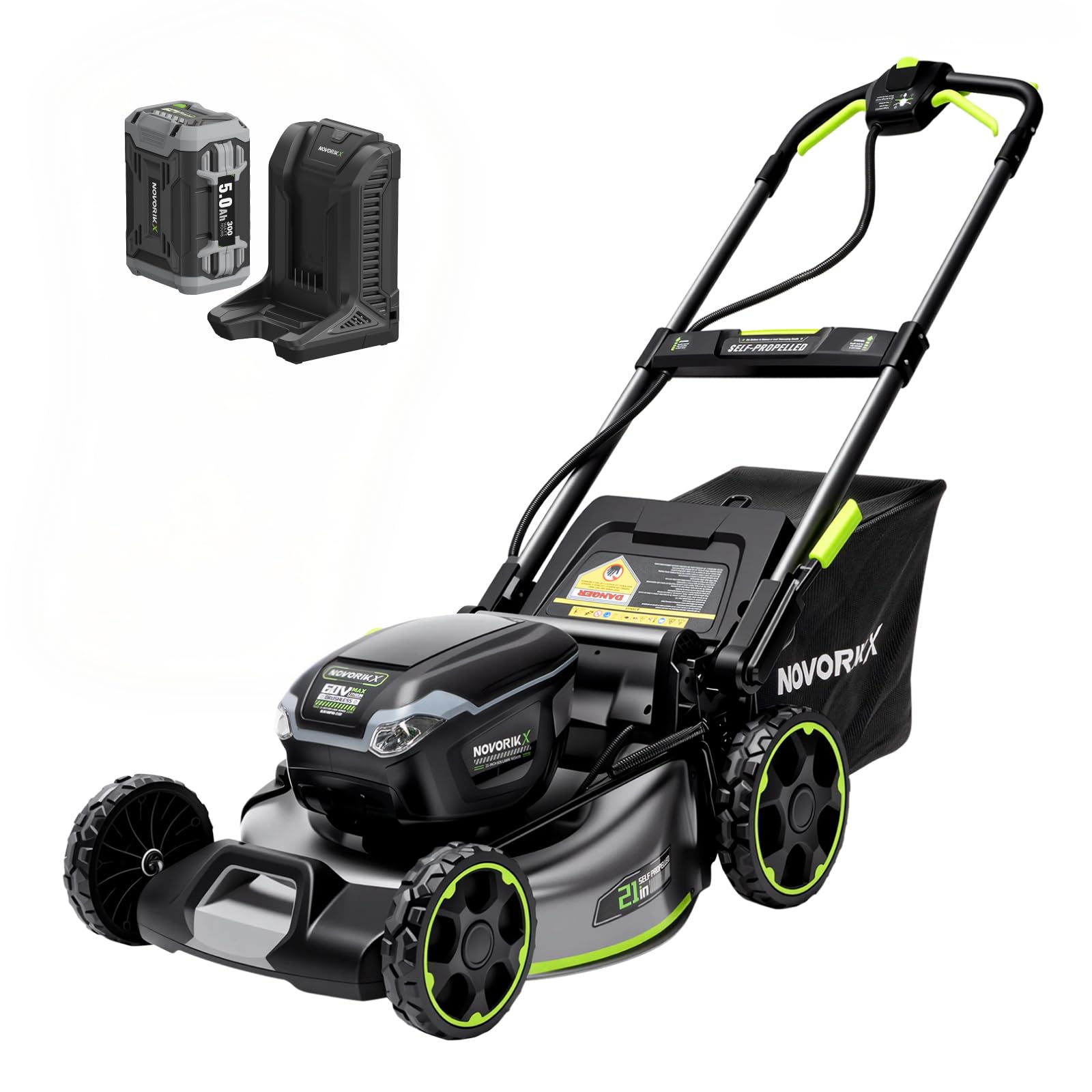
The NovorikX uses a 60V battery platform to drive a 1200W brushless motor, delivering strong cutting force for its 21-inch steel deck. The variable-speed self-propel ranges from a slow 0.9 MPH to a brisk 3.6 MPH, giving you fine control on both gentle slopes and flat straightaways. The 26-position cutting height adjustment is unusually granular, letting you dial in exact grass length preferences.
Owner feedback highlights the easy assembly and the headlight for low-light conditions. The battery provides up to 65 minutes of runtime on a full charge, and users report covering small to mid-sized yards without issue. The 3-in-1 versatility (mulching, bagging, side discharge) covers standard mowing needs, and the 3-year tool warranty and 2-year battery warranty add peace of mind.
A few units arrived with a handle latch issue that caused the mower to shut off intermittently, but the company’s customer service responded quickly with replacements. Some users found the mower heavier than expected at 66 pounds, though the self-propel system compensates. The noise level is moderate—quieter than gas but not silent.
What works
- 26 height settings for precise cut control
- Wide speed range handles slopes and flat runs
- Strong customer service response to defects
What doesn’t
- Handle latch issue reported on early units
- Heavier than other electric mowers in its class
- Not as quiet as some battery competitors
4. SENIX 22″ 201cc RWD Single Speed
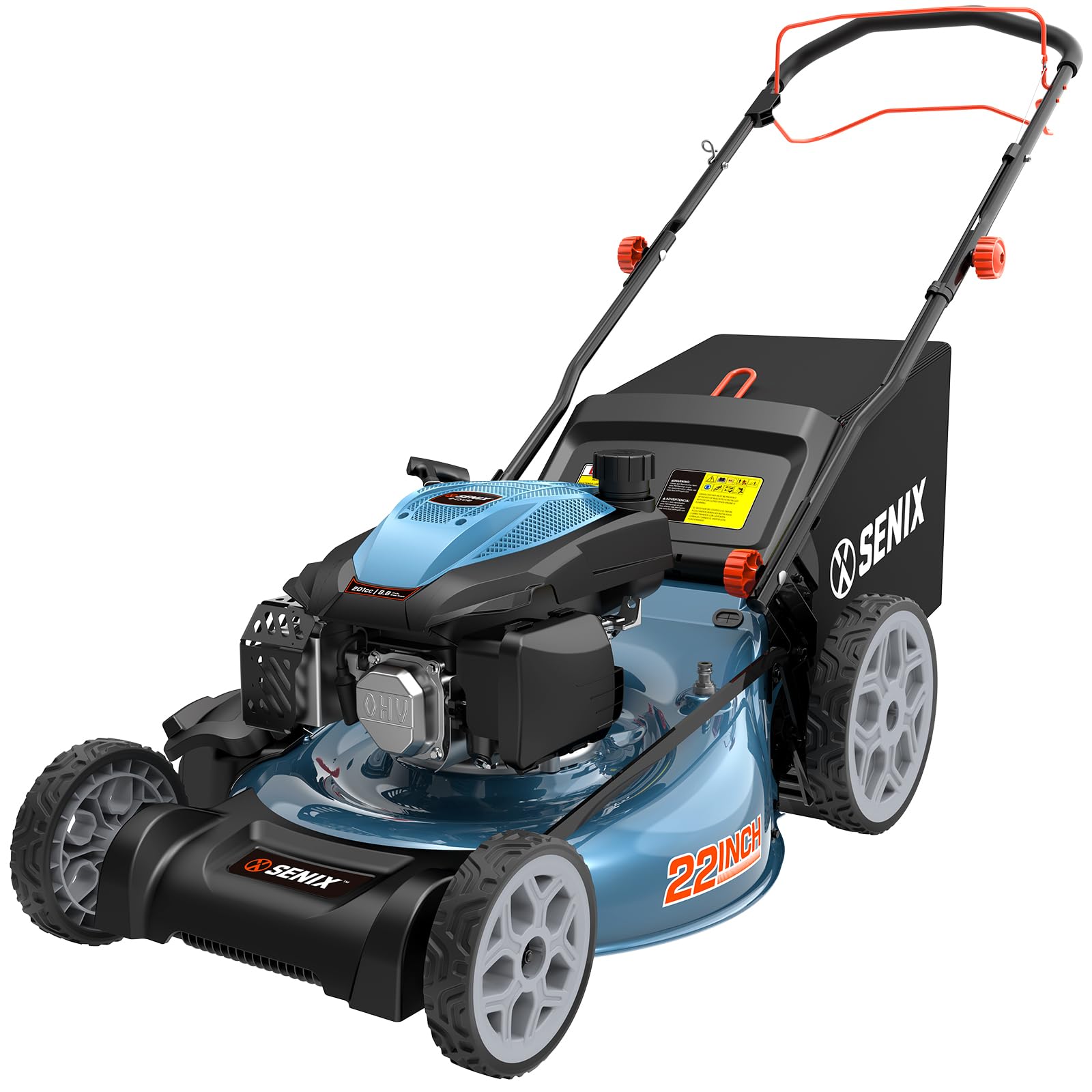
The SENIX 22-inch model packs a 201cc OHV engine that produces 4.7 HP and 8.8 ft-lbs of torque, giving it serious pulling power for thick grass and moderate inclines. The single-speed rear-wheel drive moves at 2.9 MPH, which is a comfortable walking pace for most users. The deck is built from DC04-06 low-carbon high-strength steel, and the manganese steel alloy blades (45–50 HRC hardness) hold an edge well through heavy cutting.
Owners like the tool-free assembly and the way the mower starts on the first or second pull thanks to the primer bulb system. The vortex tunnel deck design minimizes grass buildup underneath, and the 6-position central height adjustment covers 1.25 to 4 inches. The 22-inch cutting width covers ground faster than the standard 21-inch decks, making it efficient for lawns up to about half an acre.
The single-speed self-propel cannot be adjusted, so you must walk at the mower’s pace rather than matching your own stride. A few users experienced wheels that loosened after several uses and needed re-tightening. The manual lacks clear information on oil and gas capacities, requiring some digging online.
What works
- 201cc engine delivers strong torque for slopes
- 22-inch deck reduces passes per yard
- Hardened steel blades resist dulling in thick grass
What doesn’t
- Single-speed self-propel lacks pace flexibility
- Manual has sparse technical detail
- Wheels may loosen and require periodic tightening
5. YARDMAX 22″ 201cc Select PACE CVT FWD

The YARDMAX stands out with a continuously variable transmission (CVT) that offers six distinct speed ranges, allowing you to dial in a pace that matches your walk rather than being locked into fixed ratios. The 201cc engine starts reliably thanks to an automatic choke system that eliminates priming. The deck cleanout port lets you hose off grass buildup from the underside without tipping the mower.
Owners say the mower starts on the first or second pull and handles three-quarter acre lots with ease. The aggressive spiked tread on the rubber tires provides noticeably better traction on damp grass compared to standard smooth wheels. The folding handle makes storage more convenient, and the 22-inch stamped steel deck covers ground efficiently.
The front-wheel drive system draws criticism on sloped terrain, where traction can falter, especially when the bag fills with clippings. A few users report that the speed lever doesn’t stay firmly in place over bumpy ground. At nearly 85 pounds, this is a heavy machine even before adding fuel and the grass bag, making it tiring to maneuver without the self-propel engaged.
What works
- CVT transmission offers infinitely adjustable pace
- Aggressive tread tires grip wet grass well
- Automatic choke simplifies startup process
What doesn’t
- Front-wheel drive loses traction on inclines
- Heavy at 85 pounds without fuel or bag
- Speed lever can slip out of position on rough ground
6. SKIL PWR CORE 40 20″ Self-Propelled

The SKIL PWR CORE 40 mower offers a compact 20-inch cutting deck, making it ideal for tight yards and narrow gates where larger mowers struggle. The 40V brushless motor paired with a 6.0Ah battery delivers up to 50 minutes of runtime, enough for a standard suburban lot. The variable-speed self-propel adjusts to your walking pace, and the push-button start eliminates pull cords entirely.
Owners praise the lightweight design—far easier to push than the gas mowers they replaced—and the quiet operation that allows early-morning mowing without disturbing neighbors. The single-lever height adjustment offers seven settings from 1.5 to 4 inches. The folding handle enables compact vertical storage, and the 3-in-1 system covers bagging, mulching, and rear discharge.
The 20-inch width means more passes to cover the same area compared to a 21- or 22-inch mower. Some users report that the blade tends to clog if the deck is set too low in tall grass, but raising the height solves the problem. The self-propel dead-man switch can snag on pockets, and the bag is smaller than standard 21-inch bags, requiring more frequent emptying.
What works
- Lightweight and easy to maneuver through tight spaces
- Quiet operation suitable for noise-sensitive areas
- Variable-speed self-propel adjusts to user pace
What doesn’t
- 20-inch deck requires more passes than standard width
- Bag size is smaller than average 21-inch bags
- Blade clogs at lowest height settings in tall grass
7. PowerSmart 22″ 170cc RWD

PowerSmart’s 22-inch RWD mower delivers surprising value with its 170cc gas engine and rear-wheel drive system—a combination typically found at a higher price point. The steel deck is durable for its class, and the 3-in-1 functionality (mulch, bag, rear discharge) covers all standard mowing needs. The 60-liter grass bag is larger than many bags on comparable budget models, reducing trips to the compost pile.
Owners say assembly is genuinely tool-free and takes under 30 minutes. The mower starts on the first or second pull thanks to the auto-choke system, and the 6-position height adjustment covers 1.5 to 3.9 inches. The self-propel speed is brisk but manageable, and a few users caution that it can drag you forward if you’re not prepared for the engagement.
The most serious reported issue involves a faulty safety switch that prevents spark on some units, requiring disassembly to fix. Customer support has been described as unresponsive to these defect reports. A few users also note that the blade is not particularly sharp out of the box, and the grass bag can leak small clippings from the top seam. For the price, the performance is solid, but quality control is inconsistent.
What works
- RWD at an budget-friendly price point
- 60L bag is larger than most budget mower bags
- Tool-free assembly with quick startup
What doesn’t
- Quality control issues with safety switch defects
- Weak customer support response to defects
- Blade needs sharpening before first heavy use
Hardware & Specs Guide
Engine Displacement & Power
Gas mowers in this guide span a 170cc engine (PowerSmart RWD) up to 201cc engines (YARDMAX, SENIX RWD). The SENIX 201cc engine is rated at 4.7 HP and 8.8 ft-lbs of torque—torque matters more than horsepower alone, since it determines how well the blade maintains speed under load in thick or wet grass without bogging down.
Battery Voltage & Runtime
Electric mowers use 40V (SKIL), 48V (Greenworks dual 24V), 56V (EGO), or 60V (NovorikX) platforms. Higher voltage generally translates to more cutting torque. Runtime with a 5.0Ah to 7.5Ah battery ranges from 30 to 65 minutes depending on grass density, slope, and self-propel use. The EGO 7.5Ah battery delivers up to 60 minutes, while the Greenworks dual 5.0Ah setup averages 30–45 minutes.
Cutting Deck Width & Material
Standard widths are 20, 21, and 22 inches. A 22-inch deck cuts 4.8% more grass per pass than a 21-inch deck, making a noticeable difference on half-acre lots. Stamped steel decks (most models) are lightweight but can dent on rocks; the SENIX 22-inch uses DC04-06 low-carbon steel for better impact resistance. The 20-inch SKIL deck trades coverage for maneuverability in tight spaces.
Drive System & Traction
Rear-wheel drive (RWD) is preferred for slopes because the weight of the engine/battery sits over the driven wheels. Front-wheel drive (FWD) works on flat terrain but loses traction when climbing. The YARDMAX uses a CVT transmission with six speed ranges, while most others use fixed-speed or variable-speed belt drives. Single-speed (SENIX 22″) forces you to walk at the mower’s pace; variable-speed (EGO, NovorikX) lets you match your stride.
FAQ
Is rear-wheel drive always better than front-wheel drive on self-propelled mowers?
How many volts do I need in a battery mower for a half-acre lot?
What cutting height range should I look for in a walk-behind mower?
Why do some self-propelled mowers feel like they drag or struggle on hills?
Final Thoughts: The Verdict
For most gardeners, the walk-behind self-propelled lawn mowers winner is the EGO POWER+ LM2135SP bundle because it combines the Select Cut blade system with dual batteries for stress-free half-acre mowing and Touch Drive control that handles slopes better than anything in its class. If you want the best value electric option, grab the Greenworks 48V dual-battery mower for its quiet operation and turbo boost on a flat lawn. And if you want maximum torque on slopes without going electric, the SENIX 22-inch 201cc RWD delivers 8.8 ft-lbs of torque and hardened manganese steel blades that shrug off thick grass.