
Pruning high branches with a wobbly ladder is a fall waiting to happen, and fighting dull blades on thick limbs turns a quick yard cleanup into an exhausting chore. The right setup eliminates the danger and the fatigue, letting you reach, cut, and move on with zero drama.
I’m Rikta — the co-founder and writer behind Lawn Gear Lab. I’ve spent countless hours cross-referencing blade steel, anvil versus bypass mechanisms, compound leverage ratios, and pole extension locking systems, sifting through thousands of owner reports to separate the tools that truly grab branches from those that pinch and bind.
Whether you need a lightweight saw for spot-trimming or a heavy-duty lopper for gnarled orchard limbs, this guide breaks down the specific specs that decide which best tree pruners actually earn a permanent spot in your shed.
How To Choose The Best Tree Pruners
Selecting the right pruner isn’t about grabbing the longest pole on the shelf. You need to match the tool’s cutting mechanism, blade material, reach, and leverage system to the specific branch diameters and species you’ll be trimming. Here are the decisive factors to evaluate.
Cutting Mechanism: Bypass vs. Anvil
Bypass pruners work like scissors—two curved blades slide past each other to make a clean, precise cut. This design is ideal for live, green wood because it minimizes crushing and promotes faster healing. Anvil pruners, by contrast, have a single sharp blade that closes against a flat metal anvil, crushing the branch slightly as it cuts. Anvil tools are better suited for dead, dry, or hardened wood where that small amount of crush is irrelevant. For general tree pruning, a bypass is the preferred starting point.
Cutting Capacity & Leverage: The Spec That Matters
Every pruner lists a maximum cutting diameter in inches. A budget model might max out at 1.25 inches, while a heavy-duty compound-action lopper claims 2 inches. That spec only matters if the leverage system backs it up. Compound-action loppers use a pivoting linkage that multiplies the force you apply, often by four times or more. Without compound gearing, cutting a 1.75-inch branch with blade-only force will leave your hands sore after a few cuts. Check the cutting capacity against the leverage type.
Pole Reach & Locking System
For overhead pruning, an extendable pole between 8 and 15 feet lets you reach high limbs without a ladder. The locking mechanism is the weak link on many designs: telescoping poles often use twist locks that slip under load, while sectional poles with leaf-spring locking buttons or threaded ferrules provide a more rigid connection. A wobbly joint transfers vibration into your arms and reduces cutting accuracy. Fiberglass poles are heavier but absorb vibration better than aluminum, though aluminum is lighter for long sessions.
Blade Material & Maintenance
High-carbon steel blades hold a sharper edge longer than stainless steel, but they require oiling to prevent rust. Manganese steel (Mn steel) is a popular compromise for saw blades because it stays tough without becoming brittle. Low-friction coatings, like Teflon on the blade surface, reduce drag during the cut and help sap and pitch slide off. A pruner with a replaceable blade extends the tool’s life significantly compared to a one-piece stamped design.
Quick Comparison
On smaller screens, swipe sideways to see the full table.
| Model | Category | Best For | Key Spec | Amazon |
|---|---|---|---|---|
| Corona TP 6870 MAX | Pole Pruner | Heavy-duty orchard work | 14-ft reach, 13-in saw blade | Amazon |
| Jameson LS-Series Kit | Pole Saw Kit | Professional landscaping reach | 18-ft reach, 16-in tri-cut blade | Amazon |
| TROOZY Electric 2-in-1 | Powered Pole Saw | Fast powered high cuts | 9-ft pole, 6-in chain, 3Ah battery | Amazon |
| Corona TP 3206 SwivelCUT | Long Reach Pruner | Precision limb bypass cuts | 62-in reach, 360° rotating head | Amazon |
| YRTSH Extendable Lopper | Compound Lopper | Mid-reach 2-in branch cutting | 28-41 in adjustable, 2-in capacity | Amazon |
| BlumeTrec 14.5FT Pole Saw | Manual Pole Saw | High reach without a ladder | 14.5-ft reach, Mn steel blade | Amazon |
| YRTSH 3-Piece Combo | Pruner Set | Versatile yard & shrub work | 1.75-in capacity, compound lopper | Amazon |
In‑Depth Reviews
1. Corona TP 6870 MAX RazorTOOTH DualCOMPOUND Action 14-ft. Tree Pruner
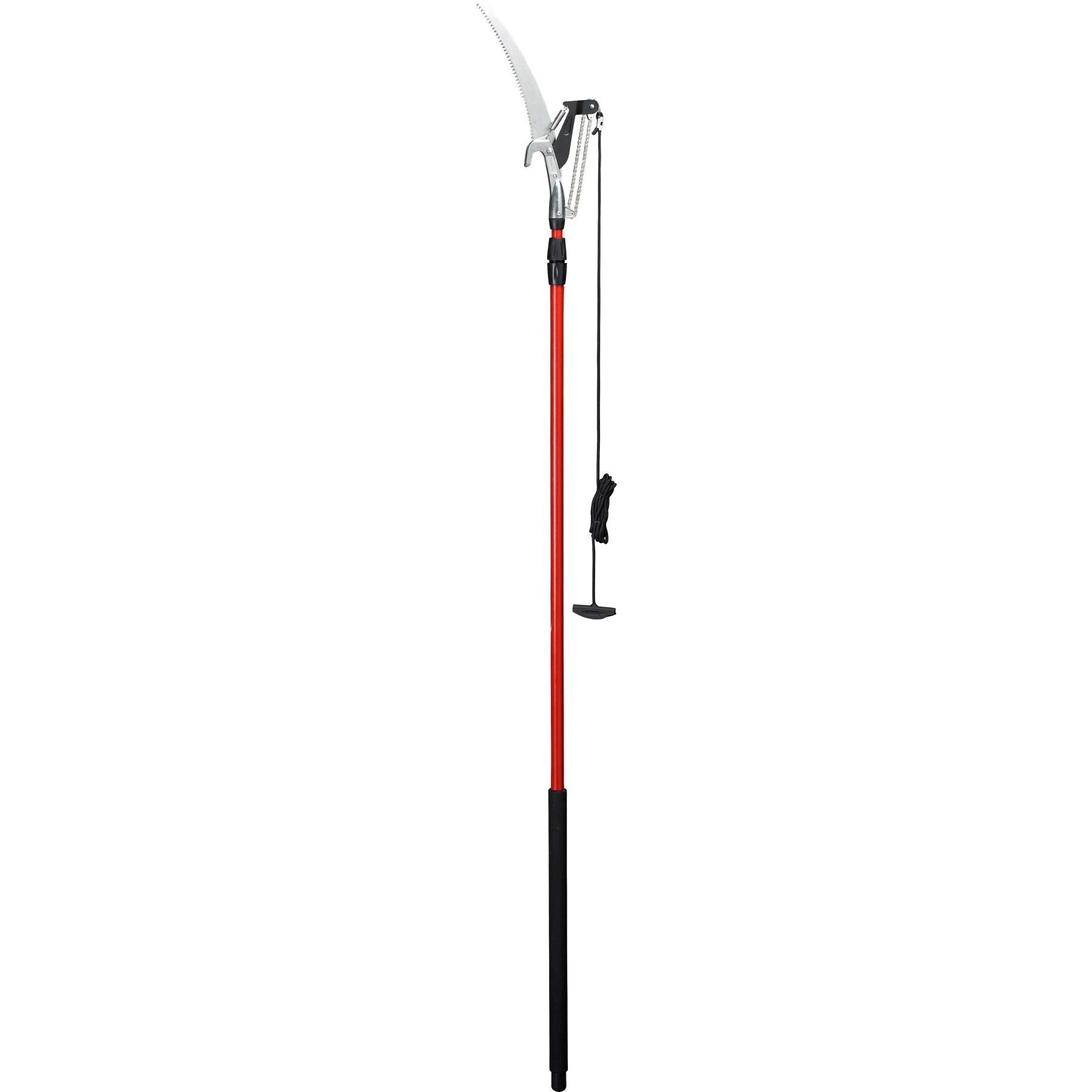
The Corona TP 6870 MAX is the benchmark for heavy-duty pole pruners, combining a 14-foot fiberglass pole with a 13-inch RazorTOOTH saw blade and a compound-action lopper head. The dual-compound mechanism delivers exceptional mechanical advantage, letting you shear through 1.5-inch green wood without the handle flex that plagues lighter designs. The Powerglide rope pull system runs through an enclosed channel, eliminating tangles and keeping tension consistent stroke after stroke.
At full extension, the fiberglass pole exhibits some natural flex, but it’s noticeably stiffer than budget telescoping poles, and the 24-inch foam grip in the center provides a stable, comfortable holding point. The lopper blade is sharp from the box, and the saw cuts aggressively on both the push and pull strokes. Owners consistently report that the saw blade easily handles palm fronds and hardwood limbs without binding, and the clamp-action lopper severs branches cleanly with minimal effort.
The biggest drawback is the foam grip; several units arrive with the foam slightly compressed or nicked from shipping, though it doesn’t affect function. Also, the lopper return spring can wear out faster than the rest of the tool, but it’s a standard replacement part. For anyone who needs to clear orchard limbs or prune high branches regularly, this is the most balanced, durable pole pruner available.
What works
- Dual-compound lopper multiplies leverage significantly.
- Razor-sharp 13-inch saw blade cuts large limbs fast.
- Lifetime limited warranty backs the build quality.
What doesn’t
- Pole is a fixed length and not extendable beyond 14 feet.
- Foam grip can be slightly damaged during shipping.
2. Jameson LS-Series Hollow Core Landscaping Tree Trimming Kit
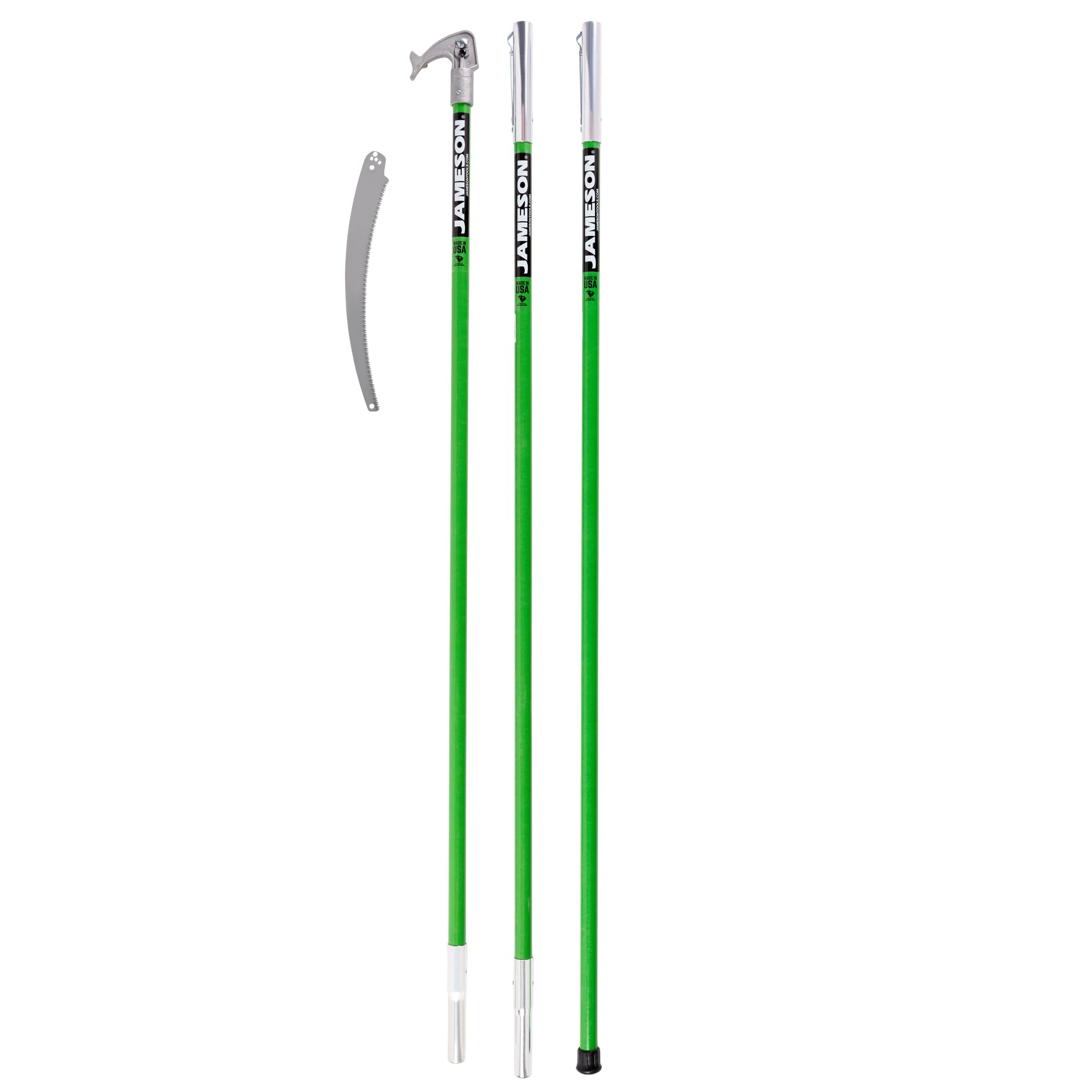
The Jameson LS-Series Kit is engineered for landscapers and arborists who need an 18-foot reach without the wobble of telescoping poles. The kit includes three 6-foot fiberglass poles with 1/10-inch wall thickness, joined by aluminum ferrules with leaf spring locking buttons that create a rigid column. The 16-inch Barracuda saw blade features a tri-cut edge that clears sawdust aggressively, reducing binding even on dense, green limbs.
Assembly is straightforward: each pole slides together and clicks securely in place. The saw head includes a low-profile design that maneuvers through crowded canopies without snagging, and the blade can be set at three different cutting angles. Owners report that the saw cuts through 4-inch limbs rapidly and that the pole construction holds up well under repeated use in professional settings. The locking buttons are more durable than twist-lock mechanisms found on cheaper extendable poles.
On the downside, the three separate poles are slightly inconvenient to carry and store compared to a single telescoping unit. The factory-fitted set screws on the blade mount occasionally have undersized threads, requiring a small drill-out to fit properly. The 16-inch blade is also very sharp and should be stored in a scabbard—none is included. For maximum reach and sawing power, this kit is the top performer.
What works
- Rigid 18-foot reach with leaf spring locking connectors.
- 16-inch tri-cut saw blade cuts large limbs quickly.
- Low-profile saw head navigates dense foliage easily.
What doesn’t
- No scabbard included for the large, sharp blade.
- Set screw holes on the blade mount may need adjustment.
3. TROOZY Electric 2-in-1 Cordless Pole Saw & 6″ Chainsaw
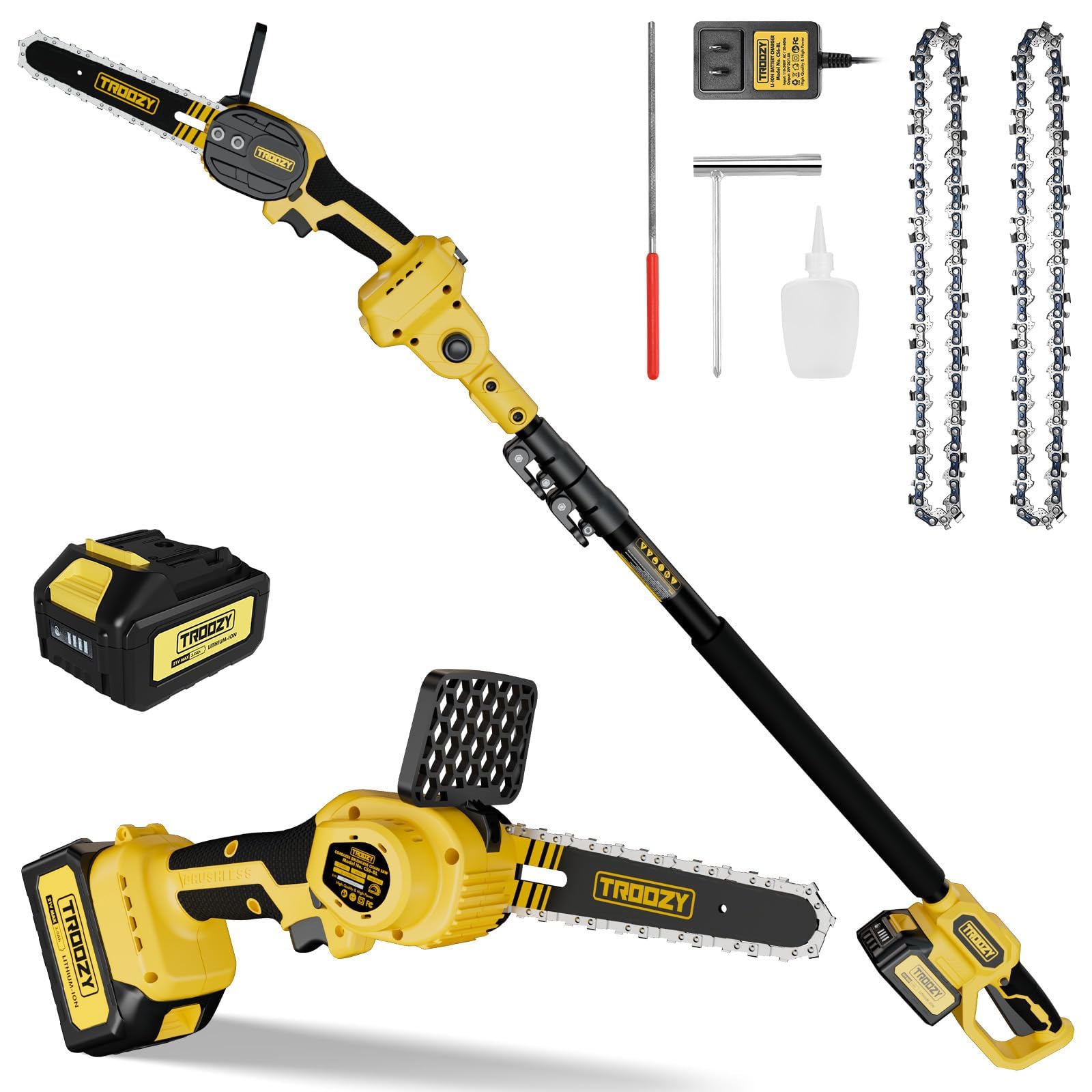
The TROOZY 2-in-1 takes the muscle work out of tree pruning by pairing a brushless motor with a 3.0Ah battery. The pole extends from 4.2 to 9 feet, giving you roughly a 15-foot vertical reach, and the chain speed of 26.5 feet per second lets it rip through 3-to-4-inch hardwoods without stalling. The 0-to-180-degree pivoting head makes it easy to align the chain with horizontal, vertical, or angled branches without repositioning your body.
When detached from the pole, the 6-inch chainsaw body functions as a compact limb trimmer for ground-level tasks, effectively replacing a small gas saw for light cutting. The battery delivers up to 100 minutes of runtime on a full charge, cutting roughly 50 medium branches per cycle. Owners highlight the quick-assembly design, the included spare chain and wrench, and the generally powerful cutting performance relative to the price point.
Reliability concerns are the main reason this isn’t the top pick. A subset of owners report that the pole’s trigger control fails after light use—the saw motor runs even when the trigger is released, or the trigger stops responding entirely. Customer service is responsive, but the failure rate on the pole assembly is higher than on the handheld component. For occasional trimming, it’s a powerful option; for daily professional use, the mechanical connection is a weak point.
What works
- Brushless motor cuts 3-4 inch hardwoods with ease.
- Removable head converts to a handheld chainsaw.
- Long 100-minute battery runtime on a single charge.
What doesn’t
- Pole trigger mechanism has reliability issues.
- No built-in oil reservoir; requires manual lubrication.
4. Corona TP 3206 SwivelCUT Long Reach Pruner

The Corona SwivelCUT is a long-reach bypass pruner that breaks the conventional alignment problem of fixed-head tools. The cutting head rotates, tilts, and swivels 360 degrees, allowing you to approach branches from virtually any angle while keeping your hands in a comfortable position. The Powerglide rope system runs inside an enclosed channel, so there’s no exposed string to snag on twigs or get tangled with the pole.
At just 1.18 pounds, it’s extraordinarily lightweight for a 62-inch tool, making it easy to maneuver through a shrub or over a fence line for precise cuts. The oval end-grip with rubber over-mold extends your effective reach slightly and provides a positive hold. Bypass blades cut cleanly through live wood up to the stated 1.25-inch capacity, making it ideal for ornamental trees, vines, and rose bushes where a ragged cut would invite disease.
The trade-off is that the SwivelCUT is a light-duty pruner; it won’t muscle through thick, hardened branches or dead wood beyond its rated capacity. The sliding mechanism near the base of the pole requires a two-handed grip to operate, which some users find awkward for one-handed branch retrieval. It’s a niche tool—perfect for precision trimming of thin limbs where a saw would be overkill, but not a substitute for a compound lopper or saw.
What works
- 360-degree rotating head reaches branches from any angle.
- Very lightweight and easy to maneuver overhead.
- Enclosed rope system eliminates tangles completely.
What doesn’t
- Limited to 1.25-inch green wood; not for thick limbs.
- Sliding mechanism at mid-pole can pinch fingers.
5. YRTSH Loppers Branch Cutter Heavy Duty Tree Trimmer (Extendable)
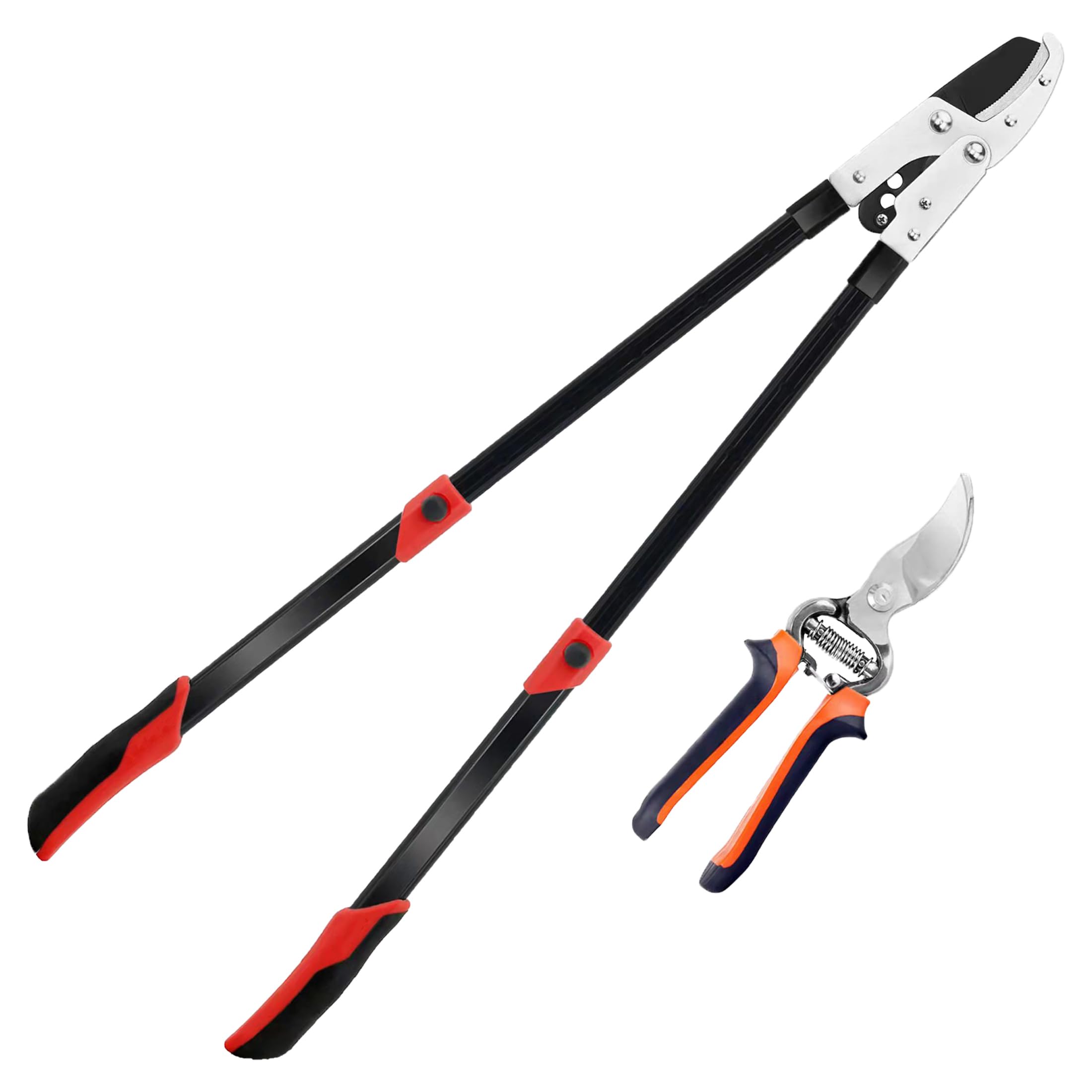
This YRTSH lopper bridges the gap between a handheld pruner and a full pole saw. The anvil-style blade uses compound-action gearing to multiply hand force, letting you cut branches up to 2 inches in diameter with noticeably less effort than a standard bypass lopper. The aluminum handles extend in six steps from 28 to 41 inches, giving you ground-level reach on low branches without needing to crouch.
The Teflon-coated alloy steel blade resists sap buildup, and the soft rubber grips reduce hand fatigue during longer pruning sessions. Owners consistently note that the compound mechanism cuts through 1.5-inch live oak limbs “like butter,” and the 41-inch maximum length gives a solid mechanical advantage without making the tool unwieldy. The included hand pruners in the box are a functional bonus, though they’re noticeably cheaper in feel.
Where this tool struggles is at full extension overhead. When you extend to maximum length and try to cut a 2-inch limb, the aluminum handles show some bending under heavy pressure, and the cuts become less precise. The anvil design also crushes live wood slightly, which can leave a ragged edge on green branches. For ground-level and waist-high trimming of dry or dead limbs, this is a strong value; for top-tier live cuts, consider a bypass head.
What works
- Compound action provides excellent leverage on thick limbs.
- Extendable 28-to-41-inch handle range for comfortable reach.
- Teflon-coated blade stays sharp and resists sap.
What doesn’t
- Anvil blade crushes live wood more than bypass designs.
- Aluminum handles flex slightly at maximum extension.
6. BlumeTrec 14.5FT Pole Saw with Adjustable Length
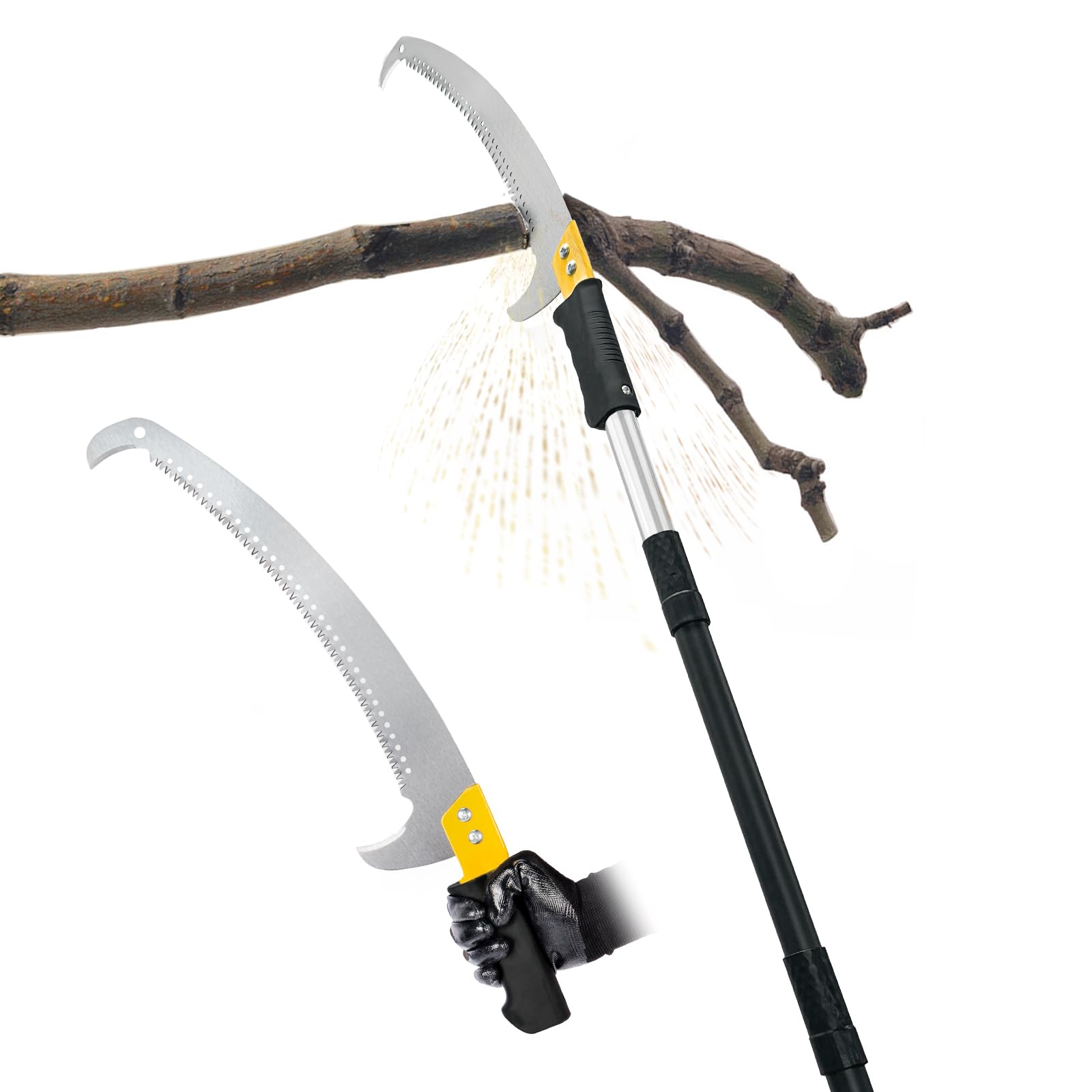
The BlumeTrec 14.5FT pole saw is a manual, no-battery solution for reaching high limbs without a ladder. The manganese steel blade uses a three-sided edge with a double-sided barb design that grips branches during the cut, reducing the chance of the saw skating off. The pole is built from modular stainless steel sections that can be assembled into three lengths: 8.5, 11, or 14.5 feet, giving you flexibility without carrying extra weight.
The blade cuts on both the push and pull strokes, which speeds up the work considerably compared to single-edge saws. Owners report that the saw easily handles limbs up to 4 inches in diameter and that the blade remains sharp after clearing multiple trees. The anti-slip handle wraps are comfortable for extended overhead use, and the total weight of about 5.2 pounds is light enough for seniors and smaller users to manage at full extension.
The main weakness is the pole locking system. The stainless steel sections screw together with threaded ferrules, and over time these can loosen slightly during sawing, creating a small wobble at the joint. The saw’s clip-on hook for pulling down hung branches works well, but the hook itself can bend with heavy use. For occasional high-reaching pruning on a budget, this is an effective tool that punches above its price point.
What works
- Razor-sharp Mn steel blade cuts on both push and pull.
- Modular pole adjusts to three useful lengths.
- Lightweight enough for extended overhead pruning.
What doesn’t
- Threaded sections can loosen slightly during heavy sawing.
- Pulling hook is not heavy-duty for large hung branches.
7. YRTSH Loppers Hedge Shears & Pruners Combo Set 3-Piece

The YRTSH 3-Piece Combo is a starter kit that bundles a 26-inch compound-action lopper, 23-inch hedge shears, and 8-inch pruning shears into one package. The lopper head uses the same compound-linkage leverage system found on more expensive models, giving you up to 4x power multiplication for cutting branches up to 1.75 inches. The alloy steel blades have a low-friction coating that reduces sticking on green wood.
The hedge shears are adequate for light shrub trimming, with serrated blades that grip stems rather than slipping. The pruning shears handle small twigs and deadheading work, making this a functional all-in-one solution for a homeowner who doesn’t want to buy tools individually. Owners generally praise the sharpness of all three tools out of the box and report that the compound lopper punches above its weight for the price.
The most common complaint concerns durability: the lock mechanism on the shears can jam after limited use, and the limb lock on the lopper occasionally breaks under heavy stress. The blades are not replaceable on the shears, so once they dull, the tool is spent. For a homeowner with light-to-moderate pruning needs and a desire for a single-box solution, this set works well. For sustained heavy use, individual tools with replaceable parts are a better investment.
What works
- Compound-action lopper provides solid leverage for the price.
- Three-tool set covers lopping, shearing, and detail trimming.
- Low-friction coated blades resist sap build-up.
What doesn’t
- Durability issues with shear lock and lopper limb lock.
- Non-replaceable blades on the hedge shears limit lifespan.
Hardware & Specs Guide
Cutting Capacity
This spec, listed in inches, defines the maximum branch diameter the tool can sever. Exceeding the rated capacity risks blade binding, handle bending, or catastrophic failure on compound-action loppers. A 1.25-inch rated bypass pruner handles most ornamental tree limbs; a 2-inch rated anvil lopper is needed for trunk branches and dead wood. Always match the tool’s cutting capacity to the thickest branch you expect to cut, not the average.
Pole Reach
Reach is measured from the ground to the cutting head with the pole fully extended. Subtract about 3-4 feet to account for your arm length and the angle of approach. A 14-foot pole effectively reaches about 10-11 feet vertical. Telescoping poles use twist locks; sectional poles use threaded or button-locking ferrules. Sectional poles are generally more rigid but take longer to assemble. Fiberglass poles are heavier and better dampen saw vibration compared to aluminum.
FAQ
What is the difference between anvil and bypass pruners for tree branches?
How does compound action increase cutting power in tree loppers?
Can a manual pole saw cut branches as well as an electric pole saw?
What blade length is ideal for a tree pruning saw?
How often should I sharpen my tree pruner blades?
Final Thoughts: The Verdict
For most gardeners, the best tree pruners winner is the Corona TP 6870 MAX because it combines a 14-foot stable fiberglass pole, a dual-compound lopper head, and a 13-inch aggressive saw blade that handles heavy orchard work without breaking down. If you prioritize maximum reach with a saw-only approach for professional-grade landscaping, grab the Jameson LS-Series Kit and its 18-foot rigid pole system. And for a powered option that eliminates the sawing effort for high, thick limbs, nothing beats the TROOZY Electric 2-in-1 despite its occasional trigger reliability issue.