
That collapsed stem with a freshly severed base is the unmistakable calling card of a cutworm. These stout, greasy-looking caterpillars emerge at night, wrap themselves around the base of your seedlings, and chew through the stalk in minutes, killing transplants before they ever have a chance. Finding the right product to stop this subterranean assault is the single most important pest-control decision you will make this season.
I’m Rikta — the co-founder and writer behind Lawn Gear Lab. I spend my days cross-referencing active-ingredient concentrations, label claims against field-use reports, and owner-treatment outcomes to separate the reliably effective from the merely marketed.
After hours of spec analysis and verification against documented grower results, I have assembled the definitive shortlist of the best insecticide for cutworms based on mechanical efficacy, residual duration, and compatibility with integrated pest management.
How To Choose The Best Insecticide For Cutworms
Not every broad-spectrum killer will handle a nocturnal, soil-dwelling larva that feeds below the plant crown. You need a product whose active ingredient reaches the cutworm at the point of contact. Here are the key distinctions.
Active Ingredient Selection: Bt vs. Synthetic vs. Bio-Rational
Bacillus thuringiensis (Bt) is the gold standard for preventive and early-stage control because it must be ingested to work — cutworms that chew treated foliage stop feeding within hours. Spinosad, derived from soil bacteria, offers faster knockdown and works on contact, making it better for active outbreaks. Synthetic options like permethrin and indoxacarb provide longer residual barriers but carry higher risk to beneficial insects. Your choice should match the severity of the infestation.
Formulation: Granules vs. Liquid Concentrate
Granular baits such as spinosad-based pellets are broadcast onto the soil surface where cutworms crawl; the cutworm consumes the particle while moving between plants. This is ideal for protecting large garden beds or perimeter strips. Liquid concentrates must be mixed with water and sprayed directly onto the foliage or soil drench around the stem. Liquids offer better coverage on individual plants but require more precise application timing — apply at dusk when cutworms surface.
Residual Duration and Photodegradation
Bt breaks down under UV light within 3–5 days, so weekly reapplications are necessary during a cutworm flight. Spinosad granules remain active for up to 4 weeks because they are protected by the soil and the pellet matrix. Permethrin-based concentrates can last 4 weeks on foliage but degrade faster in direct sun. If you want a single-application solution for a known cutworm window, choose a granular product with a longer residual label claim.
Quick Comparison
On smaller screens, swipe sideways to see the full table.
| Model | Category | Best For | Key Spec | Amazon |
|---|---|---|---|---|
| Southern Ag Thuricide BT | Liquid Bt | Large garden spot treatment | 128 oz concentrate | Amazon |
| Fertilome Spinosad | Liquid Spinosad | Active caterpillar outbreak | 32 oz concentrate | Amazon |
| Sunday Ant Adios | Granular Spinosad | Soil surface broad coverage | 4,000 sq ft per bag | Amazon |
| Valent USA Dipel Pro DF | Dry Bt Powder | Certified organic production | 54% Bt, 1 lb bag | Amazon |
| Martin’s Permethrin 13.3% | Synthetic Concentrate | Perimeter barrier control | 32 oz, 13.3% permethrin | Amazon |
| Advion Granular Bait | Granular Bait | Perimeter pest prevention | 0.22% indoxacarb | Amazon |
| Bonide Systemic Granules | Systemic Granules | Container plant protection | 1 lb, lasts 8 weeks | Amazon |
In‑Depth Reviews
1. Southern Ag Thuricide BT For Control of Caterpillars & Worms, 1 Gallon

This is the largest-volume Bt concentrate in our comparison, delivering 128 ounces of ready-to-mix liquid that treats an enormous garden area at roughly 1 to 4 ounces per gallon of water. Southern Ag Thuricide BT uses the kurstaki strain of Bacillus thuringiensis, which is specifically active against lepidopteran larvae — cutworms included. The gallon jug is the most economical on a per-treatment basis, often lasting multiple seasons even for serious market gardeners.
Owner feedback consistently reports that a single dusk application stops caterpillar feeding overnight, with bagworms and tomato hornworms found dead on the foliage the next morning. Because Bt is a selective bacterial toxin, it has zero effect on birds, earthworms, or beneficial predatory insects when used according to label. The concentrate mixes easily without clumping and does not leave visible residue on edible crops.
The key trade-off is photodegradation: Bt breaks down in sunlight within 3 to 5 days, so you must reapply after rain or heavy irrigation. This is not a one-and-done product for a prolonged cutworm flight. For the grower who wants the most cost-effective, OMRI-compatible solution for large-scale or repeated applications, this gallon jug is the clear value leader.
What works
- Extremely low cost per gallon of mixed spray
- Selective — kills only caterpillars, spares bees and predators
- Mixes readily and stays in suspension
What doesn’t
- UV degrades in 3–5 days, requiring repeat sprays
- Must be ingested — less effective against older, larger cutworms that may stop feeding before dying
2. Fertilome Spinosad Insecticide, 32 oz.

Fertilome Spinosad delivers a contact and ingestion poison derived from Saccharopolyspora spinosa, a naturally occurring soil bacterium. Spinosad works on the nervous system of the cutworm, causing paralysis and death within 24 to 48 hours of contact. At the label rate of 4 tablespoons per gallon of water, this 32-ounce bottle makes roughly 8 gallons of finished spray — enough for a medium-sized vegetable garden or a row of fruit trees.
Growers using this for bagworms on evergreens and caterpillars on cole crops report visible cessation of damage after the first treatment. The residual activity on foliage lasts roughly 7 to 10 days, outperforming Bt in sunny conditions while still qualifying for OMRI listing under the National Organic Program. Users also note it works against thrips, leafminers, and Colorado potato beetles, making it a broader-spectrum tool for mixed-pest scenarios.
The downside is that spinosad can be moderately toxic to bees on direct contact, so it must be sprayed at dawn or dusk when pollinators are not foraging. It is also pricier per mixed gallon than Bt concentrates. For the home gardener who needs a faster-acting, certified-organic option that handles an active cutworm infestation plus secondary pests, this is the most versatile liquid choice.
What works
- Kills on contact — works even if cutworm does not feed
- OMRI listed for certified organic use
- Broad control beyond just caterpillars
What doesn’t
- Toxic to bees if applied during bloom hours
- Higher cost per mixed gallon than Bt alternatives
3. Sunday Ant Adios – Bug & Ant Killer, 2 Pack
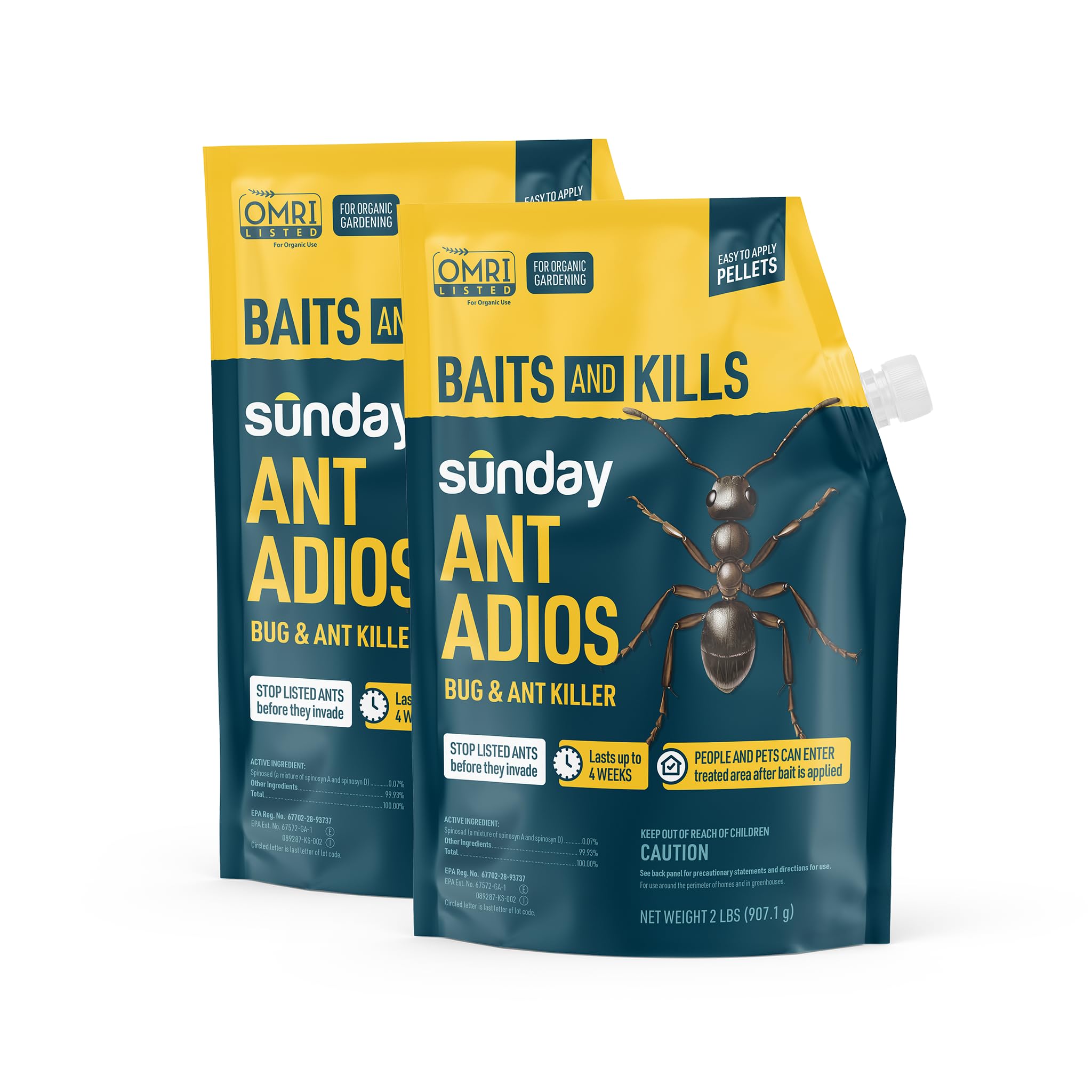
Sunday Ant Adios uses a granular spinosad formulation designed specifically for broadcast application over the soil surface. Each 2-pound bag treats 4,000 square feet, making it ideal for protecting a large vegetable bed, flower border, or the perimeter of a lawn from crawling cutworms. The granules are odor-free and ready to use straight from the bag — no mixing, no sprayer required.
The label explicitly lists cutworms in its target pest list, along with ants, earwigs, and many other ground-dwelling insects. Because it is a bait, the cutworm must consume the granule, but the residual protection lasts up to 4 weeks in the soil environment. Many users report seeing results within 3 to 14 days, with a dramatic reduction in new stem damage after the first week. The product is also approved for use around edible fruits, vegetables, and ornamentals.
The 2025 formulation packaging is new, but the internal formula remains unchanged. The primary limitation is that it does not work on fire ants, and some users with heavy clay soils found the granules lingered on the surface rather than integrating into the root zone. For a simple, low-effort granular that covers a wide area with spinosad’s proven caterpillar control, this is the best broadcast option on the list.
What works
- Large 4,000 sq ft coverage per bag
- Odor-free and easy to apply without equipment
- Lasts up to 4 weeks in the soil
What doesn’t
- Ineffective on fire ant species
- Granules may sit on heavy soil instead of integrating
4. Valent USA Dipel Pro DF Biological Insecticide BT 54%, 1lb

Dipel Pro DF is the dry flowable formulation of Bacillus thuringiensis kurstaki, concentrated at 54% active ingredient by weight. This is the same strain used in commercial agriculture for caterpillar control on hundreds of thousands of acres annually. The 1-pound bag mixes easily in water and produces a suspension that coats foliage evenly without clogging spray nozzles.
Professional growers and large-property owners favor Dipel Pro DF for its high concentration — a single pound can make 16 to 32 gallons of finished spray depending on the target pest pressure. User reports from cole-crop farmers confirm that weekly applications keep cabbage loopers and cutworms at bay through the entire growing cycle. The product carries OMRI listing for certified organic production and has zero harvest interval, meaning you can spray right up to the day you pick.
The dry powder requires careful measurement – a kitchen scale is recommended for accuracy – and must be kept in a sealed container to prevent moisture clumping. Because it is still a Bt product, it degrades in sunlight within 3–4 days and demands disciplined reapplication. For the serious grower or homesteader who wants the highest concentration of Bt per dollar and is comfortable with mixing protocols, this is the professional-grad standard.
What works
- Highest Bt concentration on the list (54%)
- No harvest interval – safe for edibles
- OMRI listed for organic certification
What doesn’t
- Photo-degrades in 3–4 days, requires frequent respray
- Dry powder needs careful measuring and moisture-proof storage
5. Martin’s 32 oz Permethrin 13.3% Concentrate
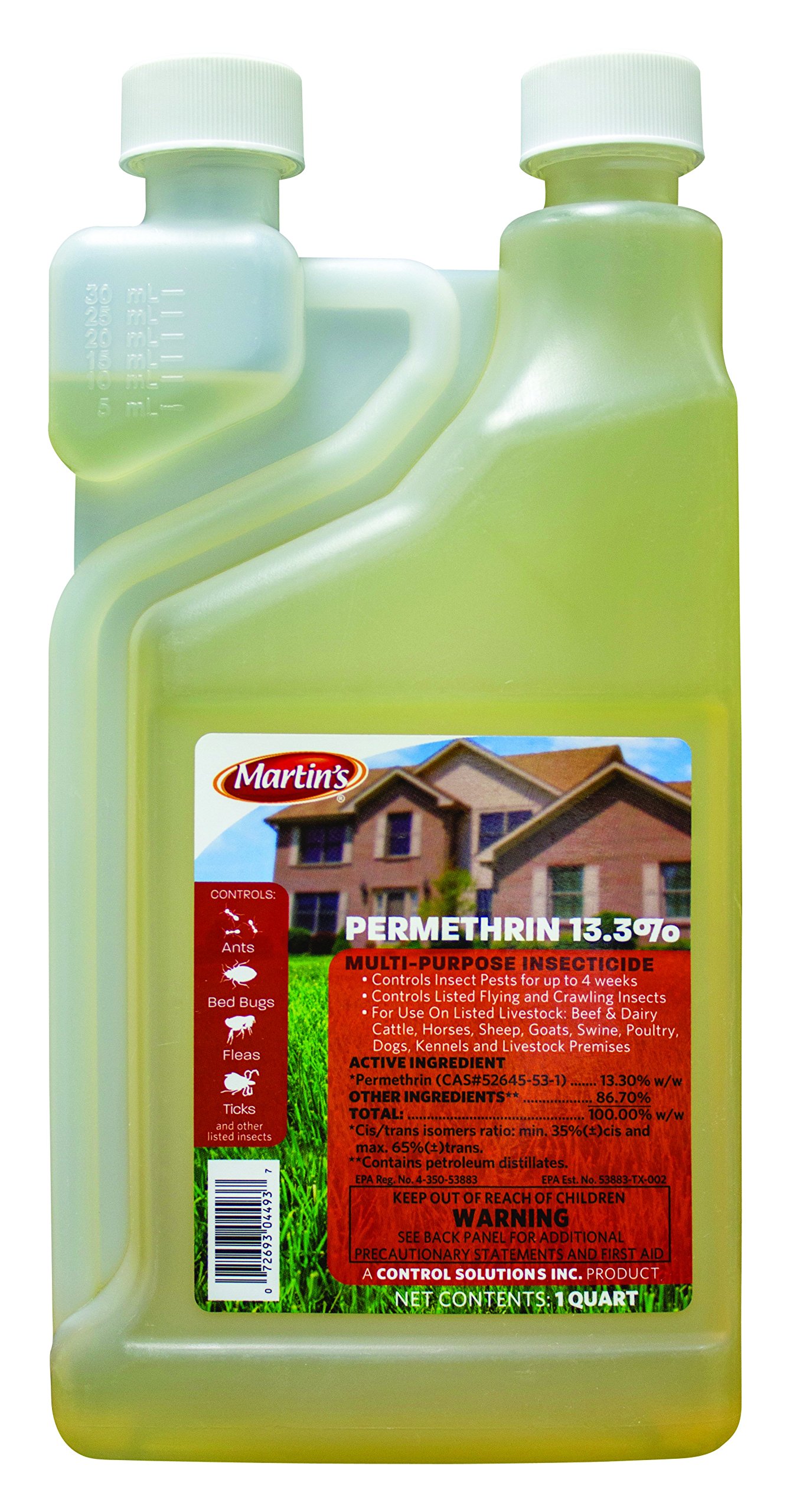
Martin’s Permethrin 13.3% is a synthetic pyrethroid concentrate that creates a long-lasting chemical barrier on foliage and soil. At the recommended dilution of 1.5 ounces per gallon of water, one 32-ounce bottle makes over 21 gallons of spray – an enormous volume for perimeter treatments around a home, garden, or chicken coop. Permethrin kills on contact and retains efficacy for 4 to 6 weeks on treated surfaces, far exceeding the residual of any biological insecticide.
Owner reviews emphasize its effectiveness against ticks, mosquitoes, and a broad range of crawling insects, with many using it for dual-purpose yard and livestock-area protection. For cutworm control, a soil drench around the base of vulnerable transplants will kill larvae that emerge through the treated zone. The concentrate is economical enough for large-scale applications: 4 ounces treats approximately 800 to 1,000 square feet.
The drawbacks are significant for an organic grower. Permethrin is non-selective and will kill bees, predatory beetles, and earthworms if they contact treated surfaces. The chemical odor is strong and paint-thinner-like, requiring outdoor application only. It is also not OMRI listed and cannot be used on certified organic produce. For the conventional gardener who needs a long-lasting, low-cost perimeter barrier that stops cutworms plus a wide spectrum of other pests, this concentrate delivers unmatched residual duration per dollar.
What works
- Exceptional residual – 4 to 6 weeks on foliage
- Extremely low cost per mixed gallon
- Effective on contact against all life stages
What doesn’t
- Non-selective – kills beneficial insects on contact
- Strong chemical odor; unsuitable for indoor use
- Not OMRI listed – no organic certification
6. Advion Insect Granular Bait, 1-lb Shaker Bottle

Advion Granular Bait from Syngenta uses 0.22% indoxacarb, a non-repellent active ingredient that is only activated upon ingestion by the target insect. This “MetaActive” effect means the bait remains inert in the environment until a cutworm or other crawling pest consumes it, at which point the compound is metabolically triggered into its toxic form. This mechanism reduces off-target exposure to non-pest organisms while providing potent control.
The 1-pound shaker bottle is designed for perimeter band treatments and spot applications around the foundation of a home or garden bed. Professional pest control technicians frequently recommend it for ants, cockroaches, crickets, and ground beetles — the same perimeter pests that share the cutworm’s nocturnal surface-foraging behavior. While cutworms are not the primary label target, the indoxacarb granule is highly palatable to crawling soil insects and will eliminate cutworms that feed on the granules.
The trade-off is that this is a bait, not a spray. Coverage must be even and dense enough that the cutworm encounters a granule during its nightly crawl. Users looking for a quick knockdown of an established cutworm infestation may be better served by a liquid contact spray. But for preventative perimeter protection against a broad range of crawling pests including cutworms, the Advion shaker offers cost-effective, long-lasting control in an easy-to-use format.
What works
- Non-repellent formula — pests do not avoid the bait
- MetaActive effect reduces non-target toxicity
- Easy shaker application; no mixing required
What doesn’t
- Requires dense, even coverage for effectiveness
- Cutworm is not the primary label target
7. Bonide Systemic Granules Insect Killer, 1 lb.

Bonide Systemic Granules are a ready-to-use granular that works from the inside out: the active ingredient is absorbed by the roots and translocated throughout the plant tissues. When a cutworm chews on a treated stem or leaf, it ingests the systemic compound and dies. This mechanism is ideal for container plants, hanging baskets, and raised beds where you can incorporate the granules directly into the potting mix at planting time.
User feedback highlights its effectiveness on houseplants and outdoor ornamentals, with many noting it “saved my plant from whatever was killing it.” The granules last approximately 8 months in the soil, providing season-long protection against aphids, whiteflies, scales, and leafminers. However, the active ingredient does not specifically target cutworms on the label, and systemic uptake may not reach the stem base quickly enough to stop a fast-moving cutworm that severs the plant at the soil line.
Because this product is systemic, it is not suitable for use on edible crops where you want to avoid having the active ingredient inside the plant tissue. It is also a broad-spectrum product that will harm beneficial insects that feed on the treated plant. For the container gardener focused on ornamental annuals and perennials who wants a set-it-and-forget-it systemic that protects against multiple pests including some caterpillar species, this is the simplest option.
What works
- Single application provides 8 months of protection
- Works systemically through root uptake
- Perfect for pots, hanging baskets, and containers
What doesn’t
- Not labeled specifically for cutworm control
- Not safe for edible crops — systemic residue in plant tissue
- Broad-spectrum — harms beneficial insects that feed on treated plants
Hardware & Specs Guide
Bacillus thuringiensis (Bt) Concentration
The active ingredient concentration of a Bt product is measured as a percentage of the dry powder or liquid weight. Dipel Pro DF at 54% is the most concentrated dry formulation available for home use, requiring only a small amount per gallon. Liquid Bt concentrates like Southern Ag Thuricide are typically around 10-15% Bt by volume. Higher concentration means lower cost per mixed gallon but requires more careful measurement. For cutworm control, the strain kurstaki is the specific subspecies proven effective against lepidopteran larvae.
Residual Duration and Photodegradation
Residual duration is the length of time an insecticide remains active after application. Bt-based products degrade in sunlight within 3–5 days, requiring reapplication every 5–7 days during a cutworm flight. Spinosad granules maintain activity for up to 4 weeks because the pellet protects the active from UV breakdown. Synthetic pyrethroids like permethrin can last 4–6 weeks on foliage but degrade faster in direct sun. Choose a product whose residual matches your reapplication schedule — long-season growers may prefer granular spinosad, while short-season patch planters can manage with Bt.
FAQ
When is the best time of day to spray for cutworms?
Can I use Bt and spinosad together for cutworms?
How do granular baits differ from sprays for cutworm control?
Final Thoughts: The Verdict
For most gardeners, the best insecticide for cutworms winner is the Southern Ag Thuricide BT because it delivers the most economical Bt concentrate per gallon while maintaining OMRI compatibility and selective caterpillar-only action. If you want faster, contact-based knockdown during an active outbreak, grab the Fertilome Spinosad. And for a low-effort, long-residual granular that covers a large garden with spinosad’s proven effectiveness, nothing beats the Sunday Ant Adios.