
A yellow jacket nest near the patio doesn’t just ruin a barbecue — it turns every trip to the trash can into a high-stakes sprint. These aggressive scavengers swarm sweet drinks, meat scraps, and pet bowls, and one disturbed ground nest can produce thousands of workers by late summer. The right trap intercepts them before they establish a territory, letting you reclaim your outdoor space without fogging the whole yard with pesticides.
I’m Rikta — the co-founder and writer behind Lawn Gear Lab. I’ve spent countless hours cross-referencing manufacturer specs, bait chemistry data, and aggregated owner reports to determine which trap designs actually reduce yellow jacket pressure around homes, patios, and gardens.
The challenge is that yellow jackets behave differently than honeybees or paper wasps, so a generic bug catcher often fails. After sorting through dozens of models, I’ve narrowed down the best options to help you find the most effective trap for yellow jackets that fits your specific property.
How To Choose The Best Trap For Yellow Jackets
Yellow jackets are carnivorous scavengers that switch from protein-seeking in spring to sugar-craving in late summer. A trap that works in June may go empty in August unless the bait strategy matches their seasonal diet. The hardware itself — entry-hole size, chamber design, and material durability — also determines whether the insects stay trapped or simply buzz back out.
Bait Compatibility and Seasonal Switching
Early in the season, yellow jacket workers hunt for meat, dead insects, and pet food to feed developing larvae. A trap that relies solely on a sweet attractant may catch few during this protein phase. Look for traps that allow you to swap baits easily — or those that come with a two-phase attractant system — so you can use a protein lure (canned cat food, fish oil) in spring and switch to a fermenting fruit or sugar-based lure by midsummer.
Entry Design and Escape Prevention
The best yellow jacket traps use a funnel or cone mechanism that forces the insect into a chamber with no easy exit. Traps with oversized holes or poorly fitted lids let the stronger workers chew their way out or squeeze back through the opening. A well-designed trap will have a narrow, downward-angled entry that the yellow jackets can crawl through but cannot navigate upward to escape, especially once they are disoriented inside the chamber.
Reusable vs. Disposable: The Cost-Per-Season Math
Disposable bag traps are cheap and require no cleaning — you toss the whole unit when it fills up. However, if you have a heavy infestation, you may go through several packs in one season, making the per-unit cost add up quickly. Reusable plastic traps have a higher upfront cost but can last multiple seasons; the ongoing expense is limited to attractant refills. For a single season of moderate pressure, disposables are fine. For a multi-year perimeter defense, a reusable trap with a dedicated attractant cartridge delivers better value.
Bee-Specific vs. Broad-Spectrum Attraction
Many generic wasp traps also lure honeybees, bumblebees, and other beneficial pollinators. Specialized yellow jacket traps use attractant chemistry that targets the specific pheromones yellow jackets follow while leaving honeybees alone. If your property has flowering gardens or you keep bees nearby, prioritize a trap that markets itself as honeybee-safe or uses a species-specific lure cartridge rather than a generic sweet scent.
Quick Comparison
On smaller screens, swipe sideways to see the full table.
| Model | Category | Best For | Key Spec | Amazon |
|---|---|---|---|---|
| RESCUE! Reusable Yellowjacket Trap (2-Pack) | Reusable | Season-long control with no honeybee kill | Spec-sheet attractant lasts 10 weeks | Amazon |
| Stingmon 6-Pack Disposable Wasp Traps | Disposable | High-volume perimeter coverage | 6 units per pack, 7.8 x 9.5-inch bag | Amazon |
| Stingmon 4-Pack Disposable Wasp Traps | Disposable | Budget entry for small patios | 4 units per pack, 7.8 x 9.5-inch bag | Amazon |
| Landisun Wasp Traps 2-Pack | Reusable | Non-toxic catch-and-release alternative | 6 entry inlets, ABS plastic body | Amazon |
| Stingmon 2-Pack Reusable Wasp Traps | Reusable | Versatile baiting for various stinging insects | 5.12 x 5.12 x 4.72-inch ABS body | Amazon |
| Stingmon 8-Pack Disposable Wasp Traps | Disposable | Large property or multi-season stockpile | 8 units per pack, funnel-entry design | Amazon |
| RESCUE! Yellowjacket Attractant Cartridge 5-Pack | Refill | Extending life of RESCUE! reusable traps | 10-week attractant supply per cartridge | Amazon |
In‑Depth Reviews
1. RESCUE! Reusable Yellowjacket Trap – 2 Pack

The RESCUE! Reusable Yellowjacket Trap is the most targeted solution on this list. Its proprietary attractant lure is formulated to draw in roughly a dozen North American yellow jacket species while actively repelling honeybees — a critical distinction if you have pollinator plants or a bee hive nearby. The trap uses a non-toxic dehydration mechanism rather than a poison kill, which means the plastic body remains safe around pets and children even after the trap fills up.
Each unit measures 9.45 x 4.21 x 11.22 inches, providing a spacious chamber that can handle a steady influx of workers during peak season. The included attractant cartridge lasts up to 10 weeks, and the two-pack gives you enough coverage for a typical suburban backyard. Multiple users report catching 5 to 6 queens per trap in early spring, which significantly reduces the population that would otherwise build ground nests near the patio.
One limitation is that the included attractant is optimized for yellow jackets only — it will not catch paper wasps or hornets, so if you have a mixed stinging-insect problem, you may need a supplementary trap. A few owners found the stock lure less effective in late summer and switched to homemade bait (soda-soaked cotton balls) placed inside the trap, which revived catch rates. Despite this, the RESCUE! design consistently earns the highest owner satisfaction for targeted, long-term yellow jacket control.
What works
- Species-specific attractant spares honeybees
- Reusable plastic body lasts multiple seasons
- 10-week attractant supply per cartridge
What doesn’t
- Does not attract paper wasps or hornets
- Stock lure may weaken in late summer
2. Stingmon 6-Pack Disposable Wasp Traps
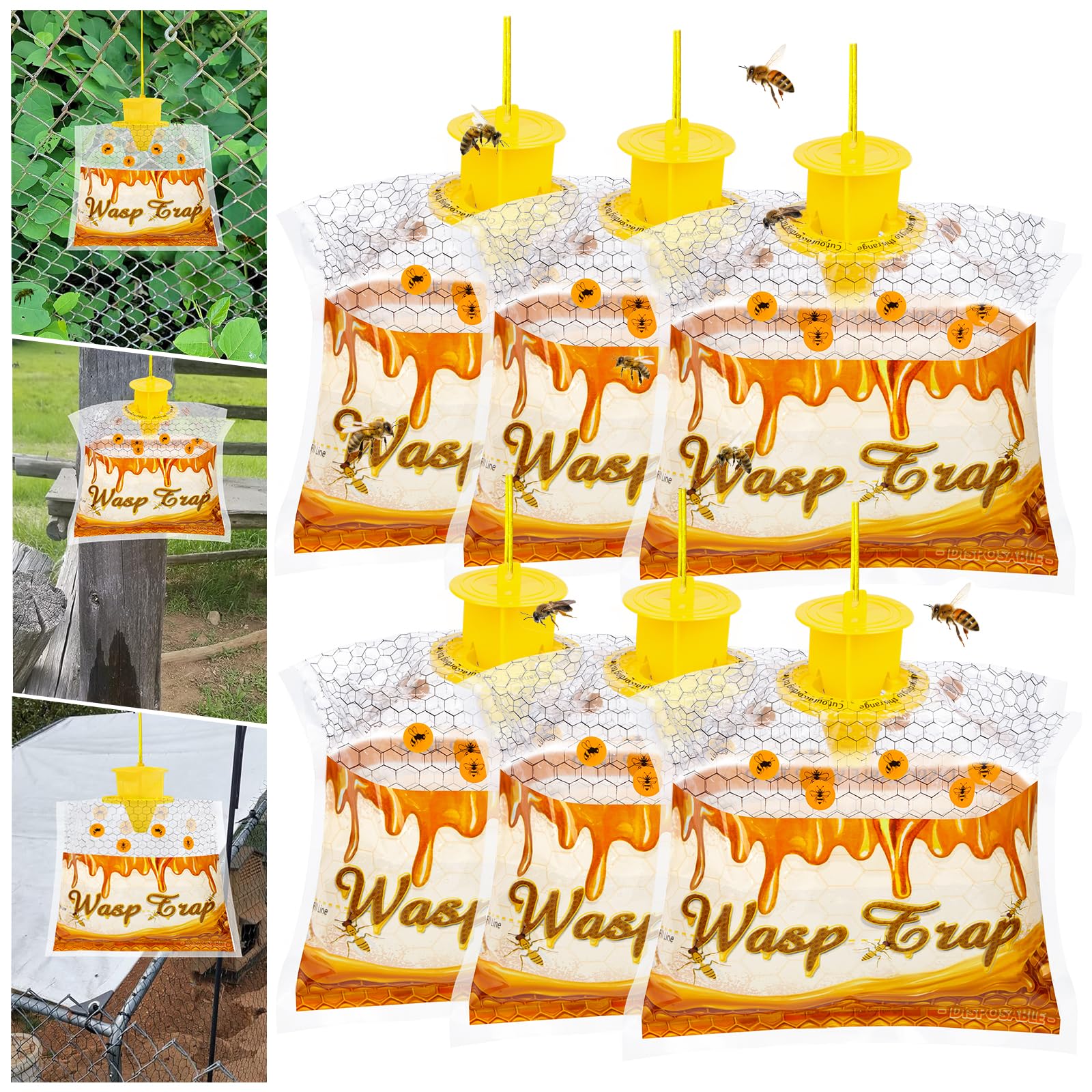
The Stingmon 6-Pack Disposable Wasp Traps provide the highest disposable count at a mid-range price point, making them the most cost-effective option for covering a large yard or wrapping a perimeter around an orchard or chicken coop. Each bag measures 7.8 x 9.5 inches and uses a funnel at the top that allows yellow jackets to enter but prevents them from exiting. The bright yellow color is scientifically chosen to exploit the wasp’s visual attraction to that wavelength.
Because these are disposable, there is zero cleanup — when a bag fills up, you simply tie it off and toss it. The material is lightweight but reinforced enough to withstand rain and moderate wind without tearing. Owners report best results when adding natural bait: beer or fruit vinegar for yellow jackets, or honey and wine for general wasps. The six-pack lets you place traps at multiple hot spots — near the compost bin, around the garbage cans, and along fence lines where yellow jackets tend to patrol.
The main trade-off is that disposable bags create ongoing plastic waste, and the thin plastic can develop small punctures if you hang them in thorny bushes. A handful of reviewers noted that the bags fill quickly under heavy pressure, requiring replacement every 7–10 days. Still, for pure volume of coverage at a reasonable per-trap cost, this pack gets the job done without requiring you to touch a single dead insect.
What works
- High unit count for wide-area coverage
- No-touch disposal — toss when full
- Funnel design effectively prevents escape
What doesn’t
- Generates plastic waste each season
- Bag material can puncture on branches
3. RESCUE! Yellowjacket Attractant Cartridge 5-Pack

The RESCUE! Yellowjacket Attractant Cartridge 5-Pack is the logical companion for anyone who already owns or plans to buy the RESCUE! Reusable Yellowjacket Trap. Each pre-loaded plastic cartridge delivers a full 10 weeks of active attractant — enough to cover the entire yellow jacket season from early spring queen activity through the late-summer worker surge. The attractant works through a non-toxic mode: it lures the insects into the trap, where they die from dehydration without any poison entering the environment.
Installing a cartridge is a 10-second process — just open the trap body, drop the cartridge into the designated slot, and close it. There is no messy liquid bait to mix and no sticky residue to clean. The five-pack provides 50 weeks of total trapping power, which means you can maintain multiple traps across a large property for a full season without ordering refills. Experienced users report that a single cartridge can pull in 5–6 queens during the spring emergence window, drastically cutting the summer nest count.
The limitation here is compatibility: these cartridges only work with the RESCUE! Reusable Yellowjacket Trap (sold separately). If you buy this refill pack without owning the base trap, you will have nothing to put them in. Additionally, because the attractant is yellowjacket-specific, it will not help with wasps or hornets — so if you have a multi-species problem, you will still need a separate solution for the other insects.
What works
- Pre-filled no-mess cartridge installation
- 50 weeks of trapping across a 5-pack
- Non-toxic dehydration kill mechanism
What doesn’t
- Only compatible with RESCUE! brand traps
- Does not attract hornets or paper wasps
4. Landisun Wasp Traps 2-Pack Reusable

The Landisun Wasp Traps 2-Pack takes a non-toxic, reusable approach to yellow jacket management. The trap body is constructed from ABS plastic — a rain-proof and UV-resistant material that can withstand full sun exposure throughout the season without becoming brittle. Its most distinctive feature is the six entry inlets spaced around the top half of the trap, combined with several small air holes that help distribute the scent of whatever bait you choose to use.
Users have had strong success using the recommended recipe of equal parts wheat beer, vinegar, fruit juice, and sugar. The trap design does not rely on chemical killing agents, making it a safe option around vegetable gardens and children’s play areas. Cleaning is straightforward: empty the contents, rinse with warm soapy water, and refill with fresh bait. The included nylon cord makes hanging easy, and each trap weighs only 0.28 kilograms, so it will not sag or pull down branches.
Some owners reported that the six inlets are large enough for a determined wasp to squeeze back out, especially if the trap is not filled with enough liquid bait to create a drowning pool at the bottom. A few units shipped with only one lid for a two-pack, which points to occasional quality-control gaps. However, because the traps are fully reusable, the cost spreads thinner with each season of use — making them a strong mid-term investment.
What works
- Durable ABS plastic withstands weather
- 6-entry design maximizes bait scent spread
- Entirely non-toxic trapping mechanism
What doesn’t
- Holes may allow strong insects to escape
- Occasional missing lid on delivery
5. Stingmon 2-Pack Reusable Wasp Traps
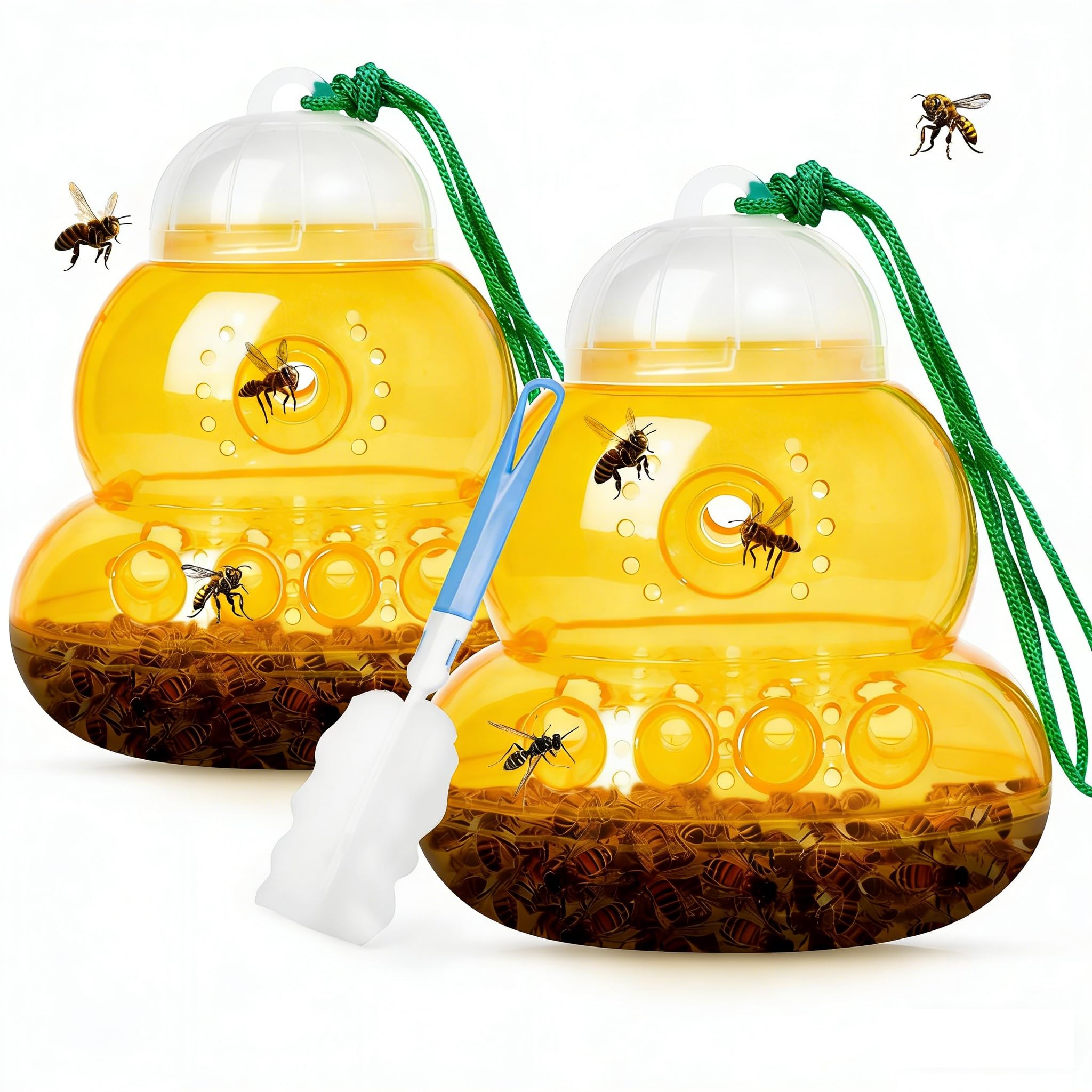
The Stingmon 2-Pack Reusable Wasp Traps bridges the gap between disposable convenience and long-term durability. Each trap measures 5.12 x 5.12 x 4.72 inches and uses multiple tunnels positioned around the body so that yellow jackets can approach from any direction. The bottom of the trap is an integrated base that does not leak, which is important when you are using liquid baits like beer, fruit juice, or a sugar-vinegar-dish soap mixture.
This trap is explicitly marketed for carpenter bees, wasps, yellow jackets, and Asian wasps, making it one of the more versatile options. The ABS construction holds up against rain and snow, and the top unscrews for easy emptying and cleaning. Several owners shared their custom bait recipes — one reviewer caught 15–20 yellow jackets in a few weeks using a dead carpenter bee as a protein lure, while another uses Mountain Dew as a sugar attractant with strong results around a pool area.
On the downside, the included instructions are poorly translated and contain confusing phrases like “Article 1 the” and “Lift Fire,” which leaves first-time users guessing on the optimal bait volume. The traps also caught honeybees in some cases when a sweet sugar-water mixture was used, so pollinator-safe bait choices are essential here. For the price of a two-pack, these are a solid reusable alternative, but you may need to experiment with bait recipes to dial in the right attractant for your specific yellow jacket species.
What works
- Multi-pest target range covers several species
- Leak-proof integrated bottom base
- Unscrew top for easy cleaning
What doesn’t
- Poorly translated directions
- Can attract honeybees with sweet bait
6. Stingmon 4-Pack Disposable Wasp Traps
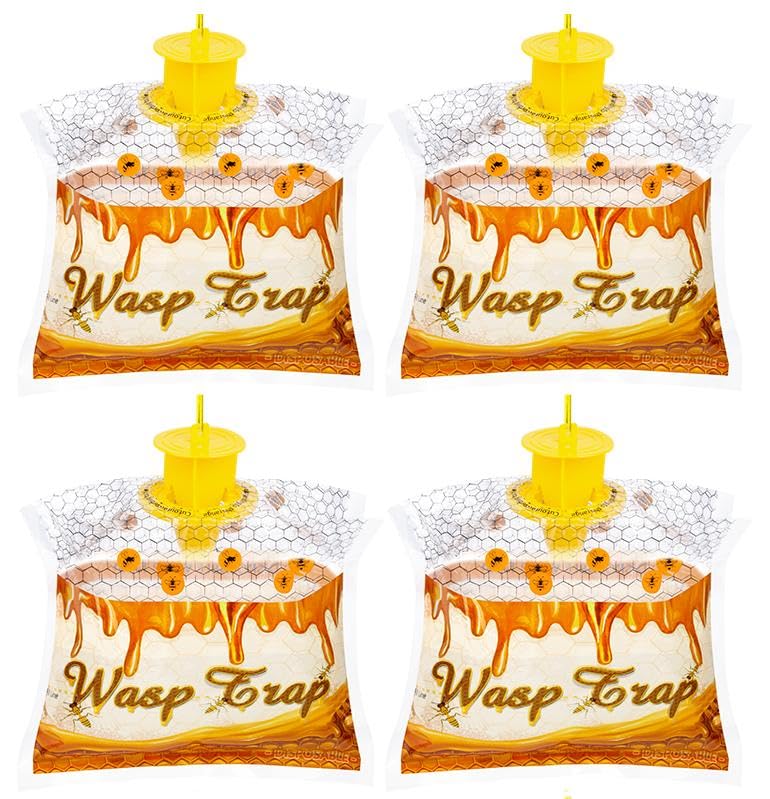
The Stingmon 4-Pack Disposable Wasp Traps is the most accessible entry point for anyone dealing with a small-scale yellow jacket issue around a single patio or front porch. These bag traps mirror the design of the larger 6-pack version but come in a lower count, making them ideal for renters or homeowners who only need to cover a compact area. Each bag measures 7.8 x 9.5 inches and uses a simple cut-open entry system that activates the funnel trap.
Effectiveness depends heavily on bait selection. The manufacturer recommends beer or meat for yellow jackets specifically, while honey or wine works better for honeybees and wasps. The bright yellow bag is designed to exploit the insect’s visual cues, and the funnel-lock mechanism does a good job of preventing captured bugs from crawling back out. The included zip ties make hanging quick, and because the bags are disposable, you never have to handle a dead yellow jacket.
Where this 4-pack falls short is durability under heavy pressure. In areas with high yellow jacket density, the bags can fill in 3–4 days, requiring frequent replacement. A minority of users saw no catch after three days, which typically indicates either the wrong bait or placement too far from the yellow jacket’s foraging route. As a lightweight, low-cost starter kit, this pack works, but you will likely upgrade to a higher-count or reusable option if your infestation is severe.
What works
- Low upfront investment for small areas
- No-contact disposal after filling
- Zip ties simplify hanging
What doesn’t
- Bags fill quickly under heavy pressure
- Inconsistent results depending on bait choice
7. Stingmon 8-Pack Disposable Wasp Traps
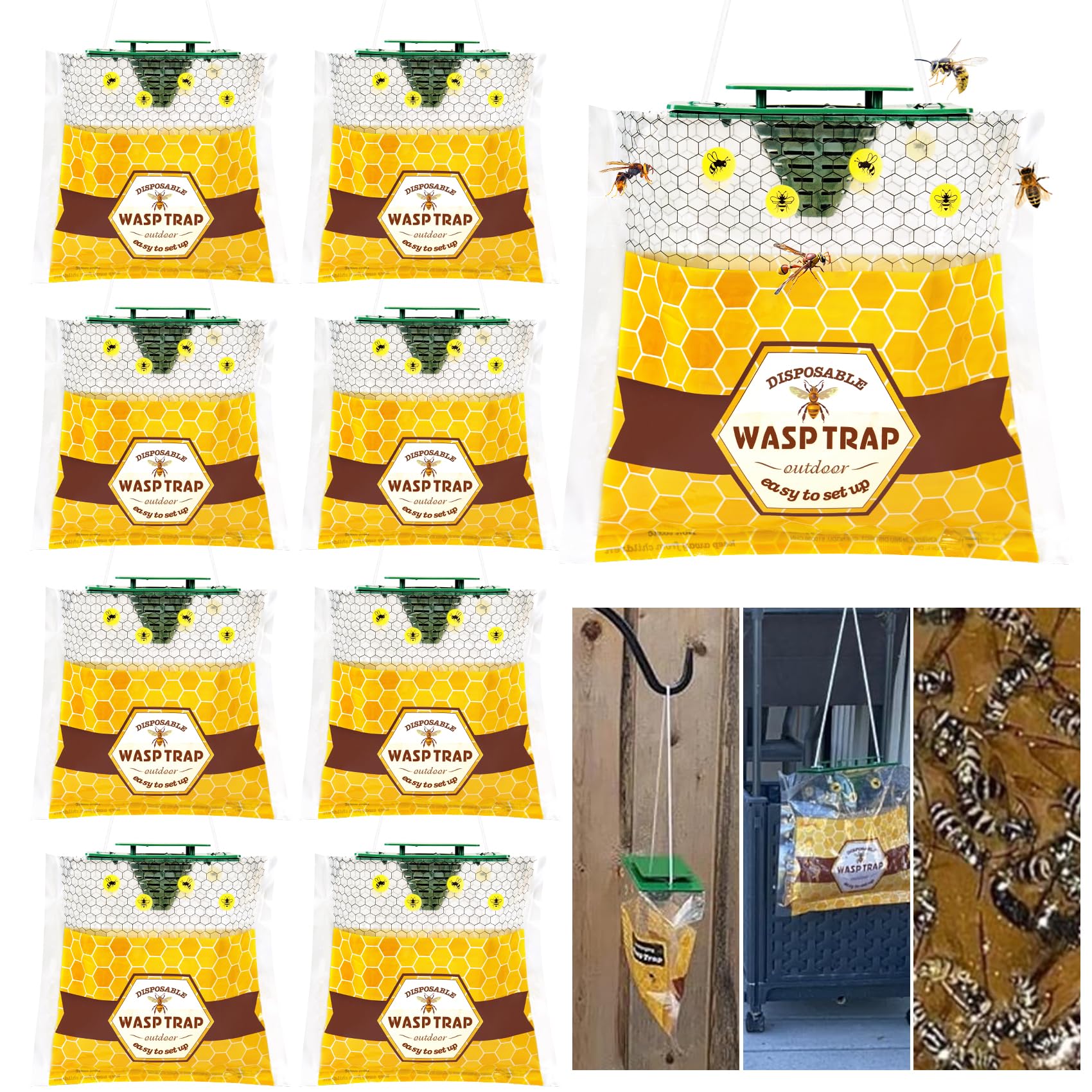
The Stingmon 8-Pack Disposable Wasp Traps is the heavy-duty volume option for properties with multiple yellow jacket hot spots — think farm stands, horse stables, barns, or large rural yards. Each bag uses the same 7.8 x 9.5-inch funnel-entry design as the smaller Stingmon packs, but the 8-count bundle lets you place traps every 15–20 feet along a fence line or around a compost heap without needing to reorder mid-season.
The trap material is designed to hold up against rain and wind, though it remains a thin plastic bag rather than a rigid container. Cutting open the entry slit activates the funnel, and the bright yellow color provides a strong visual attractant. Bait versatility is a major plus here: you can switch between beer, wine, meat, or fruit vinegar depending on the time of year and the foraging behavior of the local yellow jacket population. Because these are disposable, you simply tie off the bag and discard it when full — no messy emptying required.
The biggest consideration is the per-season waste. If you deploy all eight traps and they fill quickly, you will be disposing of a lot of plastic — something that may conflict with a garden-focused sustainability ethos. Additionally, like most disposable bag traps, these work best when paired with a strong, fresh bait; stale or diluted bait reduces catch rates significantly. For a one-time, high-intensity yellow jacket assault, the 8-pack gives you the firepower you need.
What works
- Large count for wide-area deployment
- Versatile bait options for seasonal switching
- No-touch disposal reduces contact
What doesn’t
- Generates significant disposable plastic waste
- Requires fresh bait to maintain catch rates
Hardware & Specs Guide
Disposable Bag Traps — Dimensions and Fill Rate
Disposable Stingmon traps share a consistent bag size of 7.8 x 9.5 inches. The key spec to watch is the funnel diameter — a wider funnel may let yellow jackets enter more easily, but a funnel that is too short can let them crawl back out before they fall into the liquid bait at the bottom. In practice, these bags hold roughly 30–50 yellow jackets before the visual mass of dead insects deters new arrivals, so replacement at 7–10 day intervals is typical during peak season.
Reusable ABS Traps — Inlet Count and Escape Prevention
The Landisun and Stingmon reusable traps use ABS plastic with varying inlet counts (six on the Landisun, multiple tunnels on the Stingmon). The critical dimension is the exit gap: if the inlets are wider than 0.4 inches, a yellow jacket can squeeze back through. RESCUE! solves this with a cartridge-based attractant and a trap body where the entry holes are positioned at the bottom, forcing insects to fly upward into a clear chamber with no re-entry path — a design that yields near-zero escape rates.
FAQ
What bait works best for yellow jackets in a reusable trap?
Where should I hang a yellow jacket trap for maximum effectiveness?
How do I keep honeybees out of a yellow jacket trap?
Final Thoughts: The Verdict
For most gardeners, the trap for yellow jackets winner is the RESCUE! Reusable Yellowjacket Trap (2-Pack) because its species-specific attractant spares honeybees, the reusable plastic body lasts for years, and the 10-week cartridge provides set-and-forget convenience through the entire warm season. If you need high-volume coverage across a large property, grab the Stingmon 6-Pack Disposable Wasp Traps for a broad perimeter defense that requires no cleaning. And for a long-term refill solution that keeps your RESCUE! traps running season after season, nothing beats the RESCUE! Yellowjacket Attractant Cartridge 5-Pack — 50 weeks of targeted trapping in a no-mess cartridge system.