
Weeds don’t just ruin the look of a lawn; their deep taproots steal water and nutrients from your grass, leaving bare patches that invite moss and erosion. Yanking them by hand almost always snaps the stem above the root, guaranteeing a regrowth within weeks — the only real solution is a tool that extracts the entire root system in one motion.
I’m Rikta — the co-founder and writer behind Lawn Gear Lab. I’ve spent weeks cross-referencing steel grades, claw depths, handle ergonomics, and ejection mechanisms to isolate the standalone strongest tool to remove grass based on real-world owner data and commercial-grade durability tests.
This guide breaks down seven dedicated grass and weed removers — from stand-up extractors with dual-eject systems to serrated manual edgers — and tells you exactly which spec numbers separate a lifetime tool from a frustration pile.
How To Choose The Best Tool To Remove Grass
Grass removal tools fall into two broad workflows: upright stand-up extractors that target deep taproots without kneeling, and hand-held/manual edgers that define borders or dig out shorter-rooted weeds. The choice depends on whether your primary pain is back fatigue or soil-cleanup precision.
Claw Count & Root Extraction Depth
A four-claw head with a 3-inch tapered depth is the minimum for reliably gripping dandelion, thistle, and crabgrass taproots without shearing them. Two-prong or three-claw heads often slip sideways on thicker roots or require multiple attempts, which disturbs more soil and leaves regrowth nodes behind.
Ejection Mechanism — Hand Lever vs. Foot Pedal vs. Dual
Single-eject tools require you to bend down or shake the weed loose, defeating much of the ergonomic advantage of a long handle. Dual-eject systems — a hand lever that slides the weed upward plus a foot pedal that pushes it out — let you stay upright the entire time, keeping hands clean and the tool ready for the next weed without pausing.
Steel Grade & Blade Shape
For manual edgers, a 12-13 gauge carbon steel blade with serrated teeth (like an inverted V or half-moon shape) cuts through compacted soil and shallow roots in one step. Painted mild steel blades dull quickly when they hit rocks or heavy clay, turning edging into a punishing foot-stomp exercise instead of a clean cut.
Handle Material & Height
Bamboo handles with threaded metal connectors resist splitting and are naturally lightweight (around 2.3 to 3.6 pounds), reducing fatigue during extended sessions. Painted wood or hollow aluminum can splinter or bend under leverage stress. Look for a handle length of at least 43 to 46 inches so you can stand fully erect during use.
Quick Comparison
On smaller screens, swipe sideways to see the full table.
| Model | Category | Best For | Key Spec | Amazon |
|---|---|---|---|---|
| Weed Puller Tool (Allsetool) | Stand-up Extractor | Dual-eject, chemical-free weeding | 43.7″ bamboo handle, 4-claw, dual eject | Amazon |
| Hand Weeder Tool Kit (Nicofie) | Hand Tool Set | Crevices, sidewalks, precision weeding | 13″ stainless steel set, ergonomic rubber handle | Amazon |
| BellaJoyz Stand-Up Puller | Stand-up Extractor | Seniors, tall users, daily maintenance | 46″ stainless steel, 4-claw, easy-store dissembly | Amazon |
| RexWeed Dual-Eject Puller | Stand-up Extractor | Deep root extraction, one-pass removal | 43.7″ bamboo, 4-claw steel, 2 eject modes | Amazon |
| Grampa’s Weeder Original | Stand-up Extractor | Heritage build, softer soil types | 45″ bamboo handle, 4-claw alloy steel head | Amazon |
| Bully Tools Manual Lawn Edger | Manual Edger | Sod cutting, trenching, lawn bordering | 61.5″ steel, 12-gauge edge, T-grip handle | Amazon |
| Root Slayer Serrated Edger | Manual Edger | Heavy-duty edging, root cutting | 13-gauge carbon steel blade, serrated V-tip | Amazon |
In‑Depth Reviews
1. Weed Puller Tool with 2 Weed Eject Feature (Allsetool)
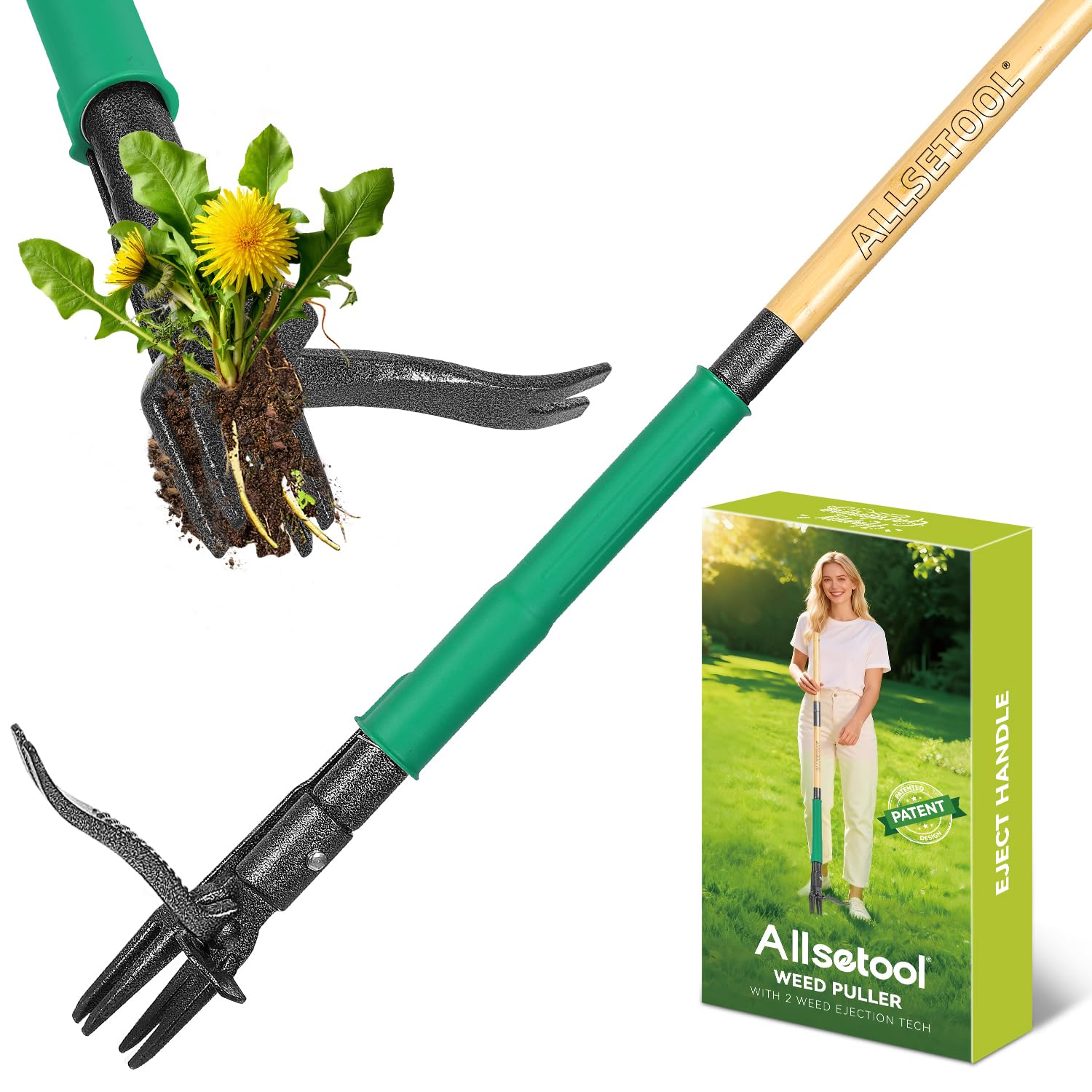
This stand-up weeder from Allsetool combines a 43.7-inch real bamboo handle with a 4-claw metal head and two independent ejection paths — a hand lever that slides the weed upward and a foot pedal that pops it out. The dual-eject design means you never need to touch the weed or bend down to clear the claws, a major ergonomic advantage during longer sessions. The steel foot pedal is textured to prevent slipping even after rain, and the whole assembly weighs 3.6 pounds, which feels solid without being fatiguing.
Owner feedback consistently highlights how effectively the 4-claw head grips dandelion and thistle taproots in damp soil, pulling the entire root without breaking. The bamboo handle is threaded together in sections, so storage is compact, and the natural grip resists splintering better than painted alternatives. Multiple reviews note that the ejection mechanism works flawlessly on medium-to-large weeds, though a smaller subset mention occasional jams when the weed is extremely thick at the crown.
If you want a single tool that handles the widest range of deep-rooted weeds while keeping you upright and clean, this is the strongest all-around pick. The dual-eject feature alone eliminates the most common frustration — having to manually pry out a stuck root — and the metal construction feels far more durable than the price tier suggests.
What works
- Double eject modes (hand lever + foot pedal) keep hands completely clean
- 43.7″ bamboo handle eliminates bending for users over 5′8″
- 4-claw head pulls entire taproot in damp soil on first attempt
- Textured steel pedal provides stable stomping even in wet conditions
What doesn’t
- Release mechanism can clog on very thick weeds, requiring manual clearing
- Threaded sections may loosen slightly during aggressive twisting motions
2. 2026 Hand Weeder Tool Kit (Nicofie)

This three-piece set includes an L-shaped crack weeding sickle for tight spots between pavers, a V-shaped uprooting hand weeder that uses leverage to pry roots, and a 4-tooth weed digger for loosening soil and shallow-rooted weeds. Each tool is built from polished stainless steel with ergonomic rubber handles that reduce fatigue during extended kneeling sessions. At around 13 inches each, the set is designed for portability and storage — the hanging holes and lanyards make them easy to organize on a pegboard.
Real-world owners praise the crevice tool above all: it slides into brick patio gaps and removes weeds in minutes that used to take hours of fingertip-pulling. The V-shaped uprooting tool excels at targeting specific weeds without tearing up surrounding mulch, and the rubber grips prevent slipping even when hands are sweaty. Some users note that the fork/scoop combo struggles with deep taproots in heavy clay, and the grip on one tool showed slight slipping under high torque.
For gardeners whose primary battle is weeds in sidewalk cracks, brick patios, or mulch beds where precision matters, this kit delivers three specialized shapes at a weight that won’t strain your wrists. It pairs perfectly as a complement to a stand-up extractor — use the stand-up tool for lawn dandelions and this set for hardscaping crevices.
What works
- L-shaped crevice tool removes weeds from brick gaps effortlessly
- Stainless steel construction resists rust in damp storage
- Ergonomic rubber handles reduce hand fatigue during repetitive digging
- Lightweight set (1.48 lbs) is easy to carry between garden beds
What doesn’t
- V-shaped tool struggles to grip deep taproots in dry or compacted soil
- Rubber grip on one piece slipped slightly under heavy force
3. BellaJoyz Stand-Up Weed Puller Tool
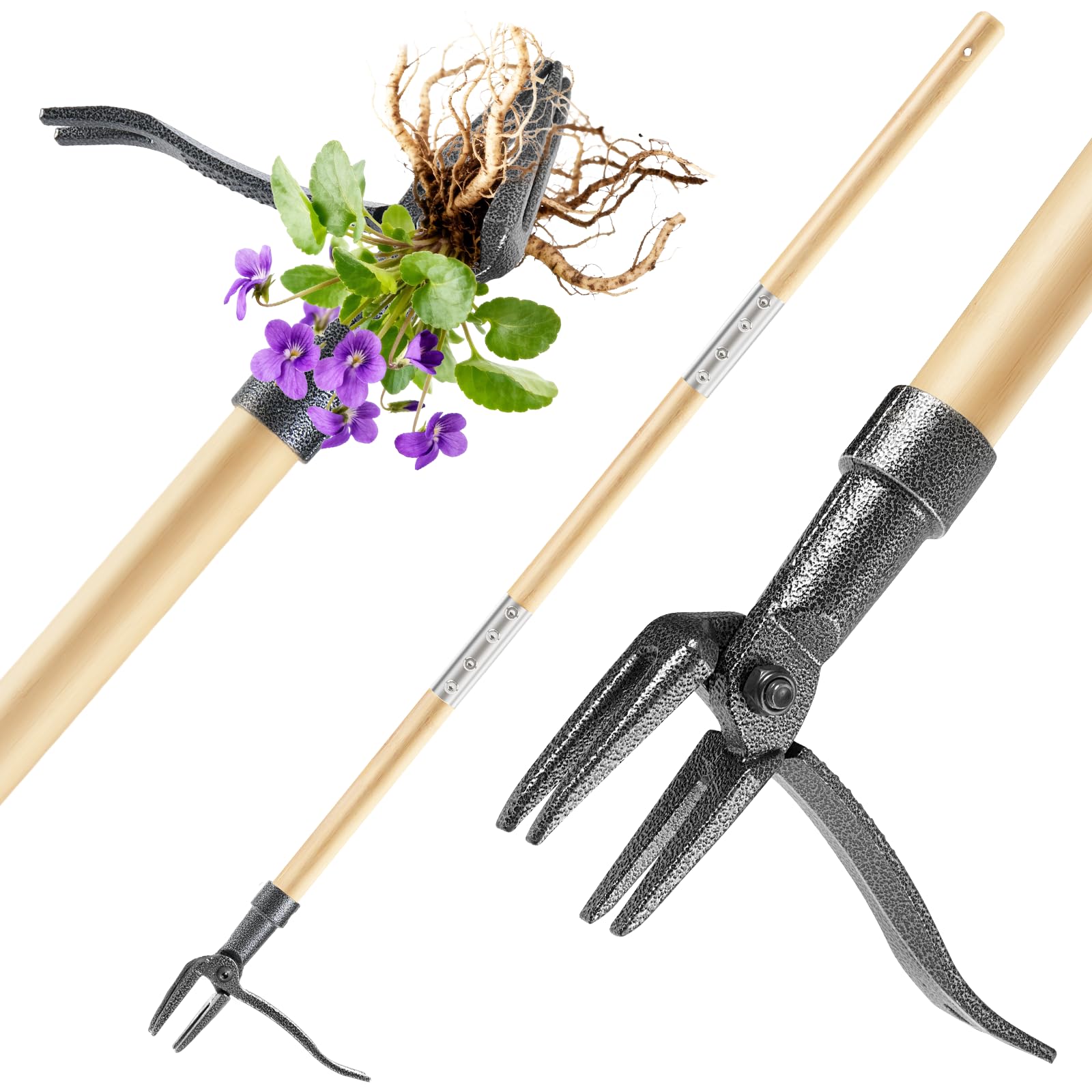
BellaJoyz builds its stand-up weeder with a 46-inch handle made of heavy-duty stainless steel and a four-claw head designed for deep-rooted weeds in any soil type. The handle breaks down into three sections for compact storage, and each section has a built-in hanging hole, so the tool fits into small sheds or garage corners without dominating wall space. The foot pedal is integrated into the claw head, allowing you to push the claws into the root system with your full body weight before tilting backward to lever the weed out.
Owners consistently report that the long handle saves their back and knees, especially senior gardeners and those with pre-existing mobility issues. The stainless steel construction shows no rust after repeated exposure to damp soil, and the bamboo grip sections on the handle stay comfortable even without gloves. Most users find it works best on dandelions, thistles, and crabgrass in moist soil — a few note that tiny or very shallow weeds can slip between the claws.
If you have limited storage space or need a tool that taller family members (over 6 feet) can use without stooping, this model’s 46-inch reach and three-part disassembly offer the best fit. The lifetime warranty adds long-term confidence, and the chemical-free weed removal makes it safe for yards with children and pets.
What works
- 46″ handle accommodates taller users without requiring forward lean
- Disassembles into 3 compact pieces for wall or shelf storage
- Stainless steel head resists corrosion and stays sharp through seasons
- Simple step-twist-pull motion works on 95% of deep-rooted weeds
What doesn’t
- Not effective on very short or mat-forming weeds that don’t protrude above soil
- Single-eject requires occasional manual clearing of stubborn roots from claws
4. RexWeed Stand Up Weed Puller Tool
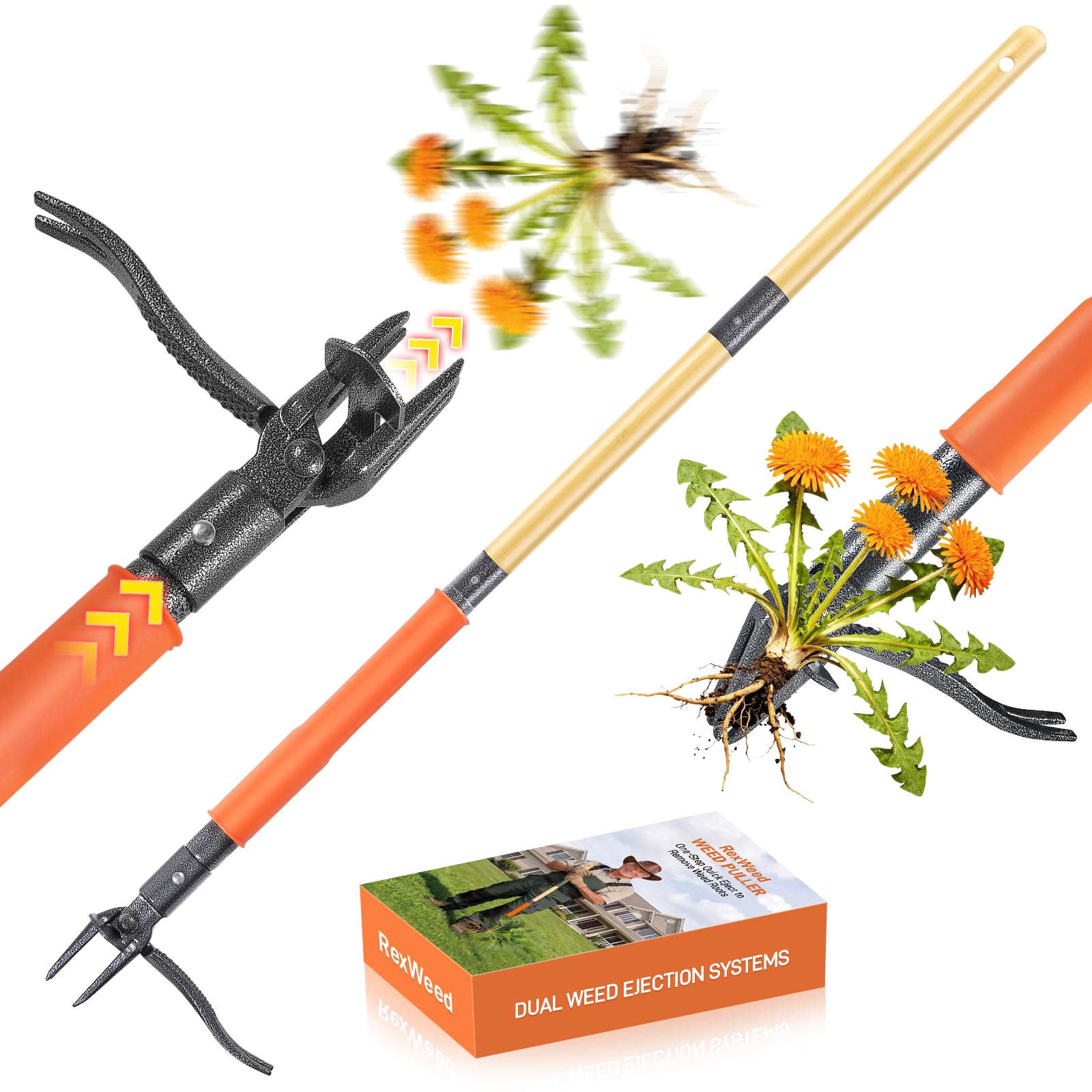
The RexWeed puller features four sharpened hardened steel claws with a 3-inch tapered depth designed to penetrate tough soil and grip taproots firmly. Like the Allsetool, it includes dual-eject modes — a hand lever and a foot pedal — so you never touch the weed. The handle is made from natural bamboo with a threaded connection that minimizes wobbling, and the all-steel footplate has an anti-slip textured surface to support strong stomping force without cracking.
Owners report a 95%+ success rate on dandelion taproots when the tool is centered directly over the weed crown. The stand-up design eliminates bending and kneeling, and the bamboo handle stays comfortable during extended sessions. Most feedback highlights the tool’s sturdiness: the cast metal head, robust clamp, and heavy-duty steel construction feel far more expensive than the price suggests. A small number of reviews mention that the eject mechanism can occasionally miss on very short weeds, and one user noted the claws sometimes failed to extract the entire root in dry soil.
This is the best pick for gardeners who prioritize root extraction success rate over all else. The 3-inch tapered claws and dual eject make it a nearly one-pass tool for dandelions and thistles, and the bamboo handle’s threaded connection stays tight longer than push-fit alternatives.
What works
- 3″ tapered claws grip deep taproots with 95% success rate in damp soil
- Dual eject (hand lever + foot pedal) keeps hands completely clean
- Bamboo handle with threaded connector resists wobbling during twisting
- All-steel anti-slip footplate won’t crack under heavy stomping force
What doesn’t
- May fail to extract full root in dry, compacted, or rocky soil
- Dual eject can jam on extremely thick weed crowns
5. Grampa’s Weeder – The Original Stand Up Weed Puller

Grampa’s Weeder has been manufactured in the Pacific Northwest since 1913, and this version retains the classic 45-inch bamboo handle paired with a four-claw, alloy steel head. The design is intentionally simple — no eject lever or foot pedal — requiring you to center the claws over the weed crown, stomp, and twist. The bamboo handle is noticeably lighter (2.3 pounds) than stainless steel alternatives, which reduces arm fatigue during extended sessions in softer soil.
Longtime owners describe it as “addictive” and “the best thing I have purchased in quite some time,” particularly for dandelions and thistles in loamy or regularly watered soil. The tool works best when the ground is damp after rain, pulling the entire root in one motion without bending. The lack of an eject mechanism means you occasionally need to tap the weed out against a hard surface or remove it manually, but many users consider this a trade-off for the tool’s simplicity and heritage durability.
If you value a proven design with a century of field testing and prefer not to deal with moving parts that can jam, this is the most reliable long-term investment. It requires reading the instructions to master the centering technique, but once dialed in, it becomes a back-saving ritual rather than a chore.
What works
- Lightweight bamboo handle (2.3 lbs) reduces arm fatigue during long sessions
- Proven 4-claw design with century of field testing on dandelions
- No eject mechanism means no moving parts to jam or break
- American-made with lifetime guarantee for structural defects
What doesn’t
- No eject system — you must manually remove or tap out the weed
- Performs poorly on hard clay or rocky soil; requires damp conditions
6. Bully Tools Manual Lawn Edger

Bully Tools’ manual edger is 100% made in the USA with a 12-gauge extra-thick steel edge that cuts through tough soil, roots, and sod. The overall length is 61.5 inches, with a detachable 36-inch head that makes transport more manageable. The T-style steel grip provides secure leverage and precision control, allowing you to maintain sharp borders along sidewalks, garden beds, and driveways without the noise or fuel of a gas-powered edger.
Owners consistently describe it as “the best edging tool out there” and praise its ability to stay sharp through years of use. The foot pedal is wide enough to use with any work boot, and the all-steel construction gives it a commercial-grade feel that outlasts cheaper alternatives by a wide margin. Some reviews note that the handles can loosen and twist off after 10-15 minutes of heavy use, requiring a thread-locking adhesive to fix permanently.
If your primary grass removal task is edging — creating clean lines between lawn and hardscapes, or removing strips of sod for new garden beds — this is the most durable manual option. The 12-gauge edge can handle root masses that would bend a thinner blade, and the lifetime warranty backs its US manufacturing.
What works
- 12-gauge steel edge cuts through thick roots and compacted soil
- T-style steel grip provides excellent leverage and control
- 100% USA-made with commercial-grade build quality
- Detachable head simplifies storage and transport
What doesn’t
- Handles can loosen and twist off during extended use requiring adhesive
- Heavier than lighter edgers at 3.69 pounds, noticeable during long sessions
7. Root Slayer Serrated Garden Edger

The Root Slayer Edger uses a half-moon blade with an inverted V cutting tip and aggressive serrated teeth designed to slice through compacted soil, turf, and shallow roots while creating clean edges around walkways, driveways, and planting beds. The blade is made from powder-coated carbon steel with a 13-gauge thickness, providing a balance of strength and corrosion resistance. The shaft is fiberglass with a resin-encased steel core, and the non-latex grip offers stable control during pushing motions.
Owner feedback highlights the tool’s ability to “cut through tough grass roots” and “stand on like a shovel” due to the flat step area on top of the blade. The serrated teeth grip and shear through roots that a smooth blade would slide over, making it particularly effective for creating professional-looking borders. Some users note that the tool is noticeably heavy (4.8 pounds), which can cause fatigue for smaller-framed individuals, and that it works up a “good sweat” when used extensively.
If you need to establish or redefine lawn borders in heavy soil with abundant surface roots, the serrated V-tip design makes this the most capable manual edger for root cutting. Pair it with a stand-up extractor for a complete grass removal system: edger for borders, extractor for interior weeds.
What works
- Serrated V-tip cuts through compacted soil and surface roots in one pass
- Fiberglass shaft with resin-encased steel core provides excellent durability
- Flat step area on blade allows full body weight for deep penetration
- Powder-coated carbon steel resists corrosion and stays sharp for years
What doesn’t
- Heavy at 4.8 pounds, can fatigue smaller-framed users during extended edging
- Not ideal for shallow, sandy soils where a lighter edger suffices
Hardware & Specs Guide
Claw Depth & Penetration
The tapered length of the claws determines how deep into the soil the tool reaches before gripping the root. A 3-inch taper is the minimum for dandelion taproots, which can grow 6-8 inches deep; shorter claws risk snapping the root rather than extracting it whole. Hardened steel claws maintain their grip point even after repeated impact with rocks and small stones, while mild steel claws can bend or dull after a season of heavy use.
Steel Gauge & Blade Design
For manual edgers, the gauge number refers to the thickness of the steel blade — lower numbers mean thicker metal. A 12-gauge edge is approximately 0.109 inches thick, capable of severing woody roots up to ½ inch diameter without bending. Serrated edges use aggressive V-shaped teeth to grip and shear roots, while smooth straight edges rely purely on sharpness and are better suited to soft soil without significant root mass.
FAQ
Does a stand-up weeder work on crabgrass or only dandelions?
What soil condition gives the best extraction results with a 4-claw weeder?
How often should I sharpen a manual lawn edger blade?
Final Thoughts: The Verdict
For most gardeners, the tool to remove grass winner is the Allsetool Weed Puller because its dual-eject system and 43.7-inch bamboo handle deliver the best balance of ergonomic relief and clean root extraction across the widest range of soil conditions. If you want a precision set for patios and cracks, grab the Nicofie Hand Weeder Kit. And for commercial-grade lawn bordering and root cutting, nothing beats the Root Slayer Serrated Edger.