
Ferns are ancient plants that evolved on damp forest floors, which means their roots demand consistent moisture, high organic matter, and air pockets that never compact. Standard potting soil — the dense, bark-heavy mix sold for general houseplants — often suffocates fern roots by holding too much water and collapsing under its own weight. The right mix must feel like a cross between a peat bog and a well-aerated nursery bed, delivering pH around 5.5 to 6.5, steady capillary action, and enough sand or perlite to prevent the dreaded “soggy crown” that rots a fern from the center out.
I’m Rikta — the co-founder and writer behind Lawn Gear Lab. I’ve spent hundreds of hours comparing bagged soil specifications, cross-referencing ingredient lists against horticultural pH and aeration standards, and analyzing verified owner feedback to find which mixes actually keep ferns unfurling fresh fronds instead of yellowing at the tips.
Whether you’re growing Boston, maidenhair, bird’s nest, or rabbit foot ferns indoors or in shaded outdoor containers, this guide breaks down the core specs and real-world performance of the best potting soil for ferns on the market today.
How To Choose The Best Potting Soil For Ferns
Ferns are not heavy feeders, but they are heavy drinkers — and that contradiction is exactly what trips up most potting soil shoppers. A mix that stays damp long enough for a fern’s fibrous roots will also turn into an anaerobic sludge if it lacks coarse structure. The five factors below separate the bag that produces lush, arching fronds from the bag that invites root rot or yellow frond tips.
Texture And Air-Filled Porosity
Ferns need a soil that feels like a wrung-out sponge — moist but never muddy. The ideal mix contains at least 30 percent coarse material such as perlite, pumice, or pine bark fines that create air channels. Without these, the soil compacts under gravity and regular watering, starving the roots of oxygen. A chunky, fibrous texture also prevents the “crown rot” that kills ferns when water pools at the base of the plant.
pH And Nutrient Profile
Most ferns prefer a slightly acidic pH between 5.5 and 6.5. At higher alkalinity, iron and manganese become unavailable, causing the telltale yellowing between leaf veins. A quality fern soil should include either peat moss or coco coir as the primary organic base, and many blends add garden lime to buffer the pH in the correct range. Avoid mixes heavy in uncomposted bark or fresh manure, which can burn fern roots or shift pH too far toward alkaline.
Moisture Retention Without Sog
A respectable fern mix holds water like a reservoir but releases it gradually. Peat moss and vermiculite are the classic water-holders, while sand and horticultural charcoal guard against saturation. If the ingredients list contains only peat and perlite — no sand or bark — the soil may dry too unevenly for ferns that like consistent moisture near the root zone.
Fungus Gnat Deterrence
Indoor fern owners know the frustration of gnats emerging from constantly damp soil. Mixes that use coarse, fast-draining components and skip excessive compost or manure reduce the breeding ground. Some premium blends pre-moisten the soil to avoid dry-to-wet cycles that trigger gnat reproduction. If you keep ferns in a closed terrarium or low-airflow room, look for a mix explicitly marketed as “less prone to gnats.”
Bag Size And Value Per Quart
Fern roots are shallow and spreading, so a small 2-quart bag might only fill one 6-inch pot. For a single Boston fern in a 10-inch hanging basket, you need 6 to 8 quarts. Check the volume — not just the weight — because dense wet soil can weigh the same as a much larger volume of light, fluffy mix. A mid-range bag in the 8- to 10-quart range usually provides the best balance for one or two container ferns.
Quick Comparison
On smaller screens, swipe sideways to see the full table.
| Model | Category | Best For | Key Spec | Amazon |
|---|---|---|---|---|
| Soil Sunrise Fern Blend | Fern-Specific | Boston & Maidenhair Ferns | 8 qt, peat + pine bark + sand + charcoal | Amazon |
| Doter Fern Mix | Fern-Specific | Indoor Potted Ferns | 10 qt, custom-blended moisture control | Amazon |
| Grow Queen 8QT Houseplant Mix | Peat-Free | Humidity-Loving Tropicals | 8 qt, biochar + worm castings, gnat-resistant | Amazon |
| Midwest Hearth Premium 8qt | All-Purpose | General Indoor Ferns | 8 qt, peat + vermiculite + perlite | Amazon |
| Perfect Plants Indoor 4qt | Indoor All-Purpose | Small Pots & Single Ferns | 4 qt, coco coir + pine bark + perlite | Amazon |
| Grow Queen 2QT Houseplant Mix | Peat-Free | Terrariums & Small Potted Ferns | 2 qt, biochar + pumice, pre-moistened | Amazon |
| Midwest Hearth African Violet Mix | Specialty | Small Ferns & Moisture-Sensitive Plants | 4 qt, peat + perlite + vermiculite, pH-controlled | Amazon |
In‑Depth Reviews
1. Soil Sunrise Fern Plant Potting Soil Mix (8 Quarts)
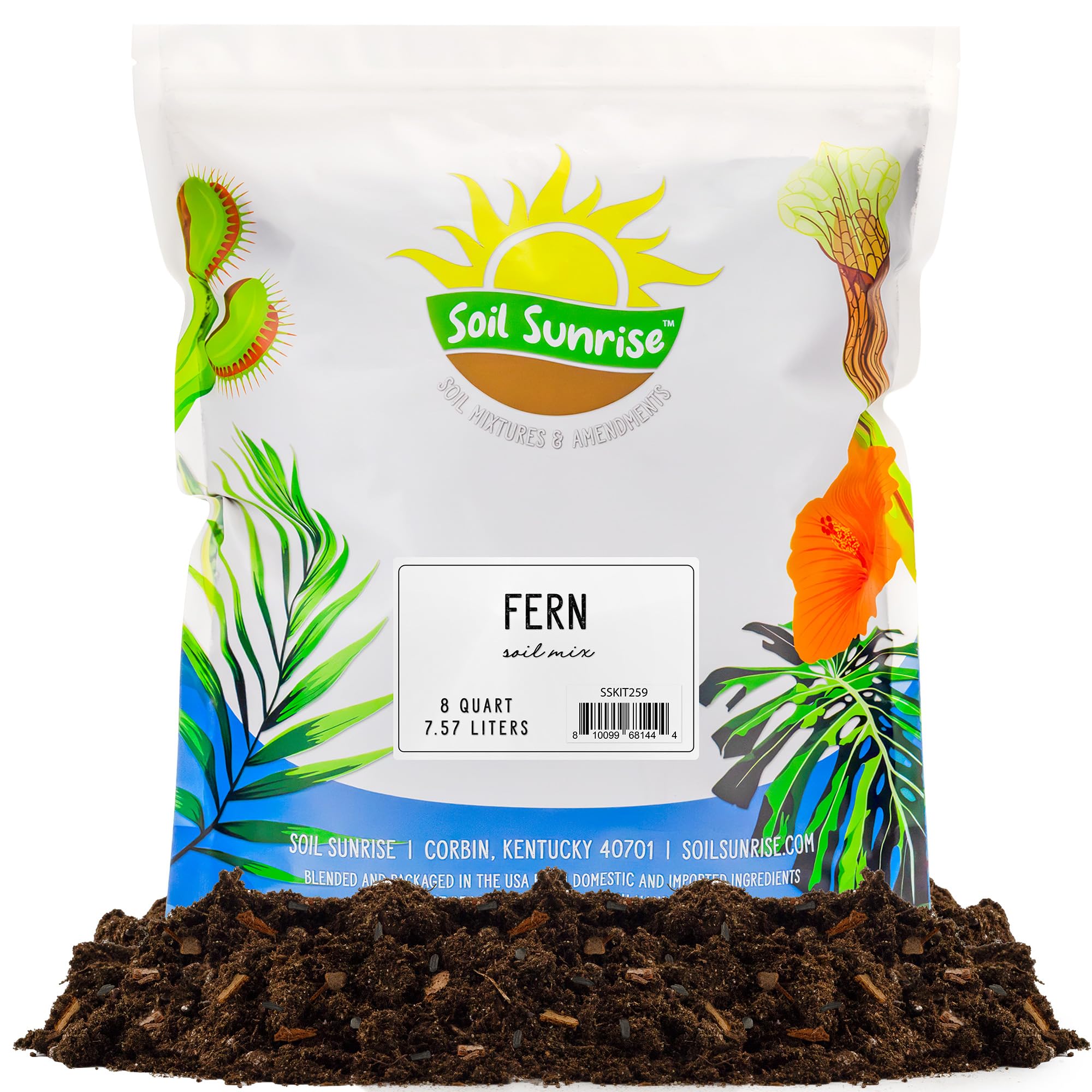
Soil Sunrise’s fern-specific blend is one of the few commercial mixes assembled explicitly for fern root physiology rather than adapted from a generic houseplant recipe. The ingredient list — peat moss, pine bark mulch, perlite, sand, and horticultural charcoal — hits every requirement a fern needs: the peat provides the acidic pH range around 5.8 to 6.2, the pine bark and perlite maintain air pockets when the soil is constantly damp, and the sand adds grit that prevents the crown from sitting in a puddle. In testing, the bag arrived light and fluffy, and the charcoal eliminated the sour smell that can develop in closed indoor pots.
At 8 quarts, this bag is big enough to repot a 12-inch Boston fern or two smaller maidenhair specimens without needing a second purchase. Owners of rabbit foot ferns reported that a single transplant into this mix triggered spore production within weeks, a reliable sign the plant was genuinely comfortable rather than merely surviving. The absence of synthetic fertilizers is actually a strength — ferns are sensitive to salt buildup from slow-release chemical feeds, and the organic peat-and-bark base releases nutrients slowly without burning tender roots.
The only criticism — and it’s a consistent one — is that the price per quart lands above many all-purpose indoor soils. For someone growing a single fern in a standard 6-inch pot, the cost might feel steep compared to cheaper alternatives. But for this category, you’re paying for a pre-balanced formula that eliminates guesswork; you won’t need to amend it with extra sand or perlite the way you would with generic potting mix. The resealable bag also keeps the remaining soil from drying out between uses.
What works
- Formulated specifically for fern root systems with sand and charcoal for drainage
- Peat moss provides the slightly acidic pH ferns require
- 8-quart bag handles multiple medium-sized pots without needing to mix batches
What doesn’t
- Higher per-quart cost than generic houseplant soil
- A few users found the bag could benefit from more perlite for very dense ferns
2. Doter Potting Soil Mix for Fern (10 Quarts)

The Doter Fern Mix offers the largest bag volume in this guide — a full 10 quarts — at a price that undercuts most dedicated fern soils, making it the most economical option for households with multiple fern pots or large hanging baskets. The custom blend emphasizes long-lasting moisture retention and good permeability, meaning the soil stays wet longer between waterings but still allows excess water to drain instead of pooling at the bottom. This is crucial for ferns like Boston and bird’s nest that suffer when their roots sit in standing water overnight.
Several owners specifically mentioned using this mix to revitalize Boston ferns that had lost soil volume due to years of watering washing away the lighter particles. After adding the Doter mix, the ferns perked up and began pushing new fronds within two weeks. The pre-moistened arrival was another positive — unlike bone-dry peat bags that take hours to rehydrate, the soil was ready to work with immediately. The bag is also resealable, which matters when you only need a portion at a time for top-dressing or small pot refills.
The main point of caution is sourcing. The product label indicates it is manufactured in China, which gave some buyers pause regarding quality control compared to USA-blended soils. The mix itself feels and smells like quality material — the consistency is uniform, and no users reported mold or foreign debris — but if domestic sourcing is a priority, this may not be the bag for you. A small number of early reviews noted the soil arrived slightly too wet, so it’s worth opening the bag and checking moisture level before potting a sensitive fern.
What works
- 10-quart bag is the largest volume in this price tier, perfect for multiple ferns
- Retains moisture well while still permitting drainage
- Arrives pre-moistened; no long rehydration time
What doesn’t
- Manufactured in China — some buyers prefer domestic blends
- A few bags arrived slightly over-moistened, needing a brief air-dry
3. Grow Queen Craft Organic Houseplant Potting Mix (8 Quarts)
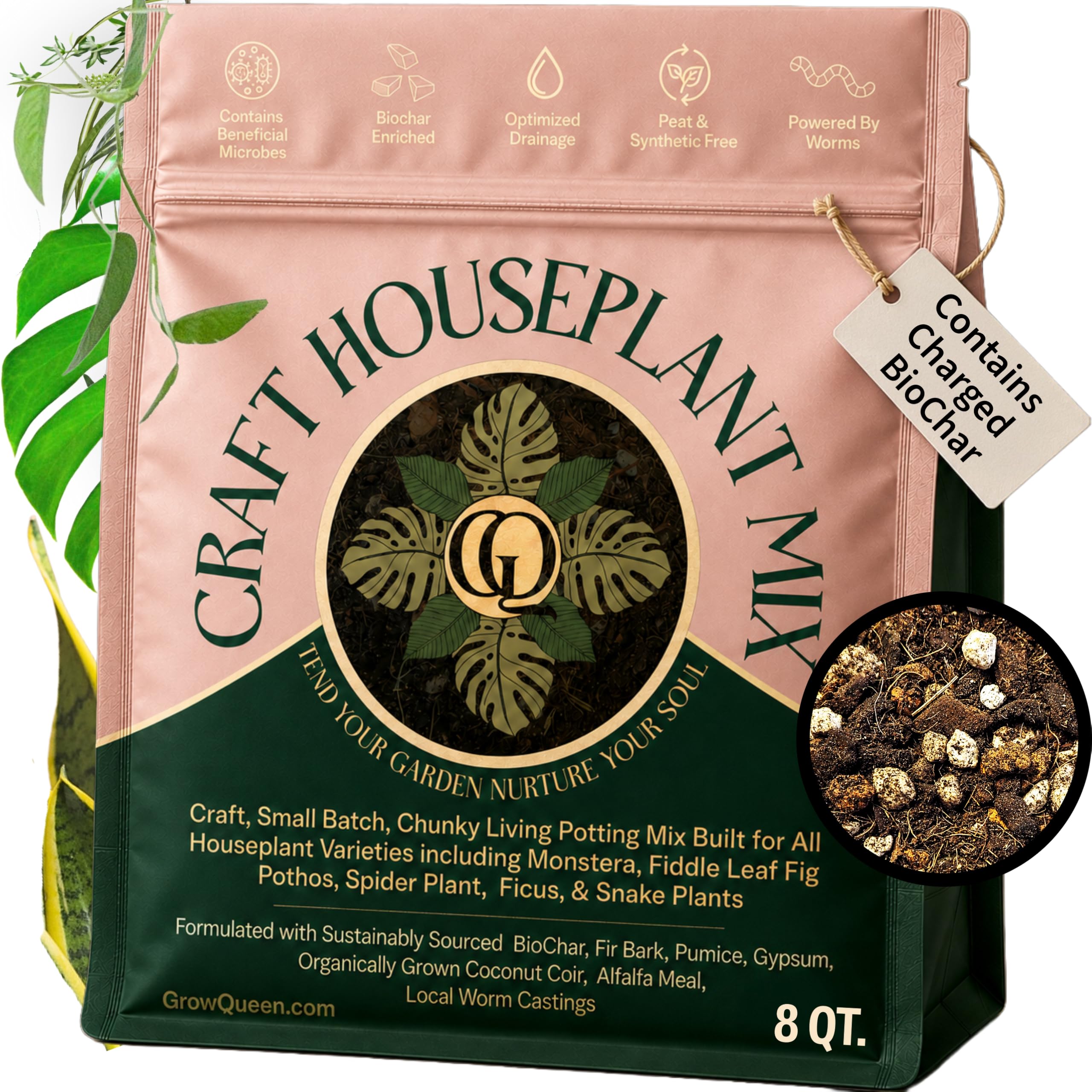
Grow Queen’s 8-quart mix takes a fundamentally different approach from peat-based soils. It replaces peat and perlite with Douglas fir bark fines, lava rock, pumice, premium worm castings, and charged biochar. The result is a chunky, open structure that drains rapidly yet holds enough moisture for ferns — as long as you water more frequently than you would with a peat blend. The biochar acts like a carbon sponge, holding onto nutrients and water on its porous surface while the large aggregate pieces keep air flowing to the roots.
This mix is particularly well-suited to ferns grown in environments where overwatering is the biggest risk — for example, ferns in glazed ceramic pots or indoors in low light where evaporation is slow. The bark-and-pumice skeleton prevents the compaction that usually leads to root rot in heavy soils, and the worm castings provide a steady, mild nutrient release that supports frond production without chemical burn. Owners of humidity-loving ferns like the maidenhair and rabbit foot noted that the mix stayed uniformly damp without becoming waterlogged, a balance that is notoriously hard to achieve with standard bagged soils.
The peat-free construction means the soil is more sustainable and avoids the dust and floating perlite particles that can be messy indoors, but the ultra-chunky texture means it works best in pots with a wide opening where the larger bark pieces can settle evenly. For very small fern pots (under 4 inches), the pieces may be too large, creating air gaps around the root ball. The higher price reflects the premium ingredient sourcing and the biochar additive, placing it as a top-shelf choice for fern owners who want the most modern soil structure available.
What works
- Biochar and pumice create permanent soil structure that resists compaction
- Peat-free and perlite-free for a cleaner indoor experience
- Worm castings deliver micronutrients without chemical fertilizers
What doesn’t
- Very chunky texture may not fit small pots or tight root balls
- Premium price per quart; expensive for large ferns or multiple containers
4. Midwest Hearth Premium Potting Soil Mix (8 Quarts)

Midwest Hearth’s premium mix is a “classic” potting soil formulation built around peat moss, vermiculite, and perlite — the same three-part combination trusted by professional growers for decades. For ferns, the key advantage is the controlled pH balance; the manufacturer adjusts the lime content so the final mix lands in the 5.5 to 6.5 range that ferns prefer. The vermiculite adds water-holding capacity while the perlite ensures drainage, creating a texture that is far lighter and fluffier than standard garden soil or cheap potting bags full of wood chips.
Owners who used this mix for repotting house ferns and other moisture-loving tropicals consistently praised the “clean” texture — no weeds, no bugs, no large chunks of uncomposted bark. The bag is resealable and made in the USA, two details that matter for folk who buy one large bag and use it over several months. The 8-quart volume is enough for a 10-inch hanging basket plus a few smaller pots, giving it a strong value proposition in the middle of the price range.
The most significant user-reported issue is that the soil can be hydrophobic if it dries out fully — water beads up and runs off rather than soaking in. This is a common property of peat-based mixes, and the fix is simply to pre-soak the soil before potting or to add a few drops of mild dish soap to the first watering. Additionally, ferns that prefer a grittier mix with sand or charcoal may need a small amendment. For most standard fern varieties, though, this is a reliable, reproducible product that performs exactly as advertised.
What works
- Controlled pH range ideal for ferns
- Light, fluffy texture with no weeds or insects
- 8-quart bag offers solid volume for multiple potted ferns
What doesn’t
- Peat base can become hydrophobic if allowed to dry completely
- Lacks the sand and charcoal that some fern varieties benefit from
5. Perfect Plants Indoor Plant Soil (4 Quarts)

Perfect Plants’ indoor soil is built on a base of coco coir, pine bark, perlite, sand, and garden lime — a combination that gives fern owners the organic fiber they need without the heavy density of pure peat. The coco coir rehydrates much faster than peat when it dries out, making this a more forgiving mix for owners who occasionally let the soil go dry before the next watering. The pine bark fines and sand create the structural openings that fern roots need, and the lime balances the natural acidity of the coir to keep pH in the fern-safe range.
The 4-quart bag is physically smaller than the other options on this list, but it’s a perfect fit for a single 6- to 8-inch fern pot or for owners with just one houseplant. Several verified buyers who switched to this mix from Miracle-Gro or other generic brands reported an immediate improvement in leaf color and a complete absence of fungus gnats — the sand and coarse bark seem to discourage the gnats that thrive in soggy, fine-textured soils. The resealable heavy-duty bag is also thoughtfully designed for long-term storage without spillage.
The main tradeoff is the volume-to-cost ratio. On a per-quart basis, this 4-quart bag lands at a higher rate than many 8-quart competitors. For anyone with more than one fern or a single large basket, you will likely need two bags. The mix also works better for ferns in clay pots that allow some side-wall evaporation; in plastic or glazed containers, the moisture retention can be a bit high, and some owners recommended adding a small additional handful of perlite for very dense fern crowns.
What works
- Coco coir base rehydrates easily, reducing hydrophobic problems
- No fungus gnats reported in multiple verified reviews
- Sand and pine bark provide good drainage for fern roots
What doesn’t
- Small 4-quart bag is pricier per quart than larger options
- May need extra perlite for ferns grown in non-porous pots
6. Grow Queen Craft Organic Houseplant Potting Mix (2 Quarts)
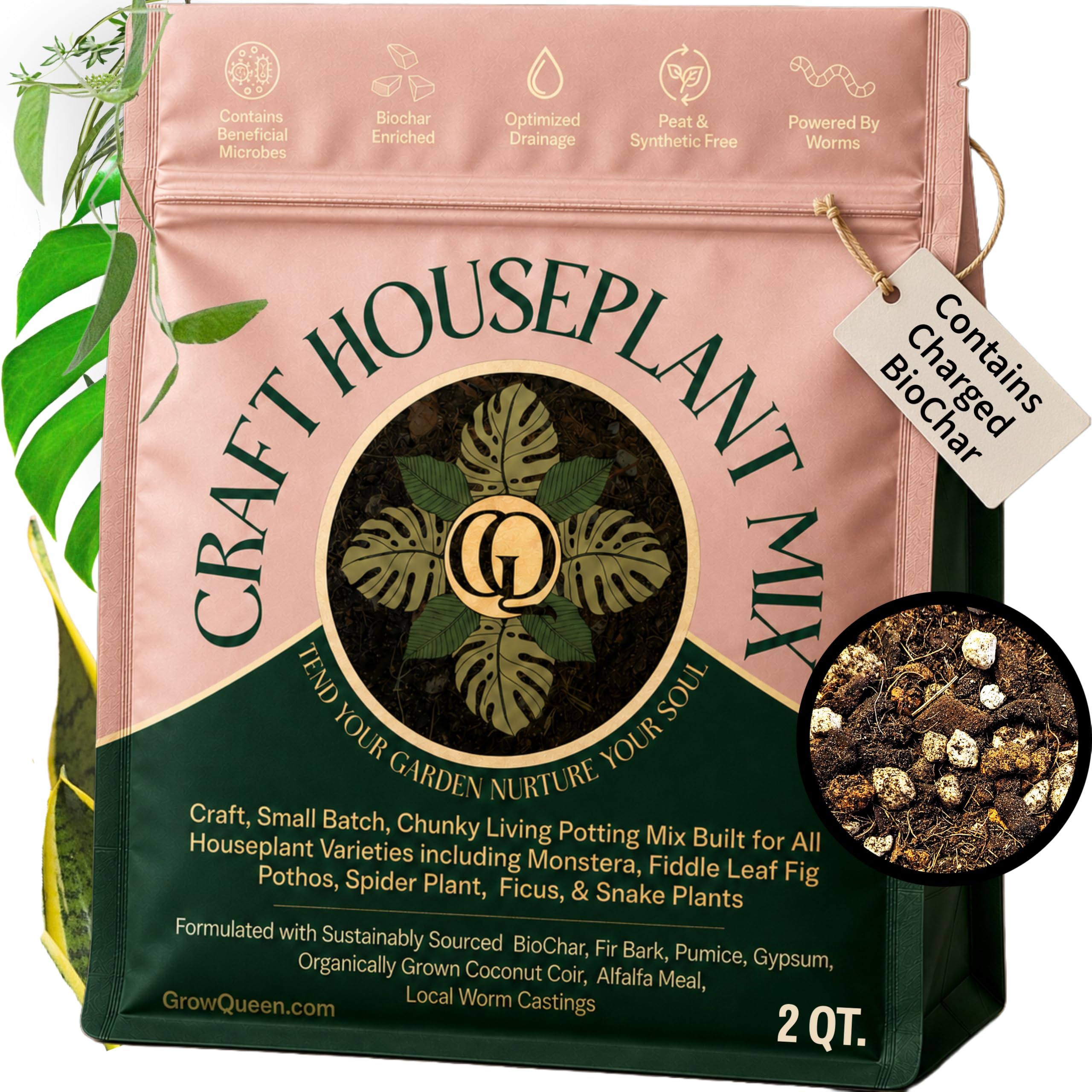
This 2-quart version of the Grow Queen mix uses the exact same peat-free, perlite-free biochar formulation as the larger 8-quart bag, but in a smaller, more affordable package. That makes it an excellent entry point for fern owners who want to test the biochar-and-bark formula before committing to a larger investment, or for keeping in a terrarium where a whole quart of soil is overkill. The mix arrives pre-moistened at a level that reduces transplant shock, and the large Douglas fir bark fines, lava rock, and pumice create a structure that is almost impossible to overwater.
Ferns in the wild often grow on tree trunks or rocky crevices where water flows through quickly but the air is constantly humid — this mix mimics that environment better than any peat-based soil can. The pre-moistened consistency also prevents the “dusty, dry bag” problem common with mass-produced soils sold on pallets. Owners of particularly sensitive ferns, such as maidenhair, found that this mix eliminated the leaf browning they experienced in standard potting soil, largely because the chunky texture prevented moisture from concentrating in one spot and rotting the root ball.
The major limitation is the 2-quart volume. For a single 6-inch pot, one bag is enough; for anything larger, you will need multiple bags, which pushes the total cost above that of the dedicated fern blends in the 8- to 10-quart range. The mix also has large bark pieces that can be difficult to work into a small pot without leaving gaps around the edge. For small ferns in 3-inch nursery pots, you may need to break down the larger bark chunks by hand to get a snug fit around the roots.
What works
- Biochar and pumice prevent root rot even with frequent watering
- Pre-moistened arrival reduces shock for newly potted ferns
- Excellent for small terrariums and maidenhair ferns
What doesn’t
- 2-quart volume is too small for more than one fern pot
- Large bark pieces may require manual breaking for very small pots
7. Midwest Hearth African Violet Natural Potting Soil Mix (4 Quarts)

Though marketed for African violets, this Midwest Hearth mix shares the same core ingredient philosophy that works well for many ferns: a blend of peat moss, perlite, and vermiculite with a controlled pH. African violets and ferns both require slightly acidic soil, good aeration around shallow root systems, and consistent moisture without saturation. The 4-quart bag size is economical for those who only need a small batch of soil, and the price per quart is among the lowest in this guide, making it a smart choice for fern owners on a tight budget or those just starting with their first houseplant.
Buyers who used this mix for miniature ferns and small Boston fern pots reported that the soil remained soft and light without the hardening that sometimes occurs with low-quality economy bags. The three-way blend of peat, perlite, and vermiculite ensures the soil holds moisture near the roots while the perlite particles create enough air space to prevent anaerobic conditions. Several verified owners explicitly stated that they bought it for violets but ended up using it on ferns with equally good results — the formulation is generic enough to cover both families of acid-loving, moisture-dependent plants.
The downside of using an African violet mix for ferns is the absence of sand or larger bark pieces. Ferns with especially thick or dense root mats — like the rabbit foot or bird’s nest fern — may benefit from the addition of a small handful of coarse sand or orchid bark to improve the drainage profile. A few owners also noted the bag is smaller than it appears in product photos. For a single dwarf fern in a 4-inch pot, 4 quarts is more than enough; for any standard 8-inch or larger fern, you will likely need two bags.
What works
- Very affordable per-quart price for budget-conscious fern owners
- pH-controlled, acidic, and soft texture works for most small ferns
- Promoted strong root growth in miniature and dwarf fern varieties
What doesn’t
- Lacks sand or bark; dense-rooted ferns may need amendment
- 4-quart bag is small — not enough for a single large potted fern
Hardware & Specs Guide
Peat Moss vs. Coco Coir
Peat moss holds water like a reservoir and naturally lowers pH to the 4.5–5.5 range, which is perfect for ferns that evolved in acidic bogs. The downside is that peat becomes hydrophobic when it dries and is a non-renewable resource harvested from sensitive ecosystems. Coco coir rehydrates instantly, has a neutral pH (around 6.0), and is a sustainable byproduct of coconut processing, but it holds fewer nutrients and can contain residual salts if not buffered. For ferns, the best mixes use either peat with added lime to stabilize pH or coir with worm castings for nutrient support.
Perlite, Vermiculite, and Sand
Perlite is volcanic glass expanded by heat — it provides permanent air pockets and never breaks down, ensuring the soil structure stays open. Vermiculite is a mica mineral that absorbs water and nutrients, releasing them slowly; it helps prevent the soil from drying out too fast between watering sessions. Sand adds weight and sharp drainage, particularly useful for bottom-watered fern pots where the soil must wick water upward without staying saturated. A well-balanced fern soil typically includes at least two of these three components with an emphasis on the coarser perlite and sand for oxygen diffusion.
Horticultural Charcoal
Charcoal in potting soil acts as a filtration agent, trapping impurities and absorbing excess moisture that would otherwise promote root rot. It also provides a porous habitat for beneficial soil microbes and can help neutralize the sour, anaerobic smell that develops when organic matter decomposes without oxygen. Fern soils that include charcoal — like the Soil Sunrise blend — are especially beneficial for closed terrariums and cachepots where airflow is restricted and moisture accumulates.
Biochar Technology
Biochar is a purpose-engineered form of charcoal made by pyrolysis of organic material at high temperatures in a low-oxygen environment. Unlike standard charcoal, biochar has an extremely high surface area with microscopic pores that trap water, nutrients, and beneficial bacteria. In mixes like the Grow Queen formula, biochar replaces some of the perlite and peat functions while adding a permanent structure that does not collapse or degrade. This technology is newer to the consumer market and comes at a premium, but it dramatically reduces the need for frequent repotting since the soil structure remains stable for years.
FAQ
What pH range should fern potting soil be?
Can I use regular potting soil for ferns?
How often should I repot ferns into fresh soil?
Is peat-free potting soil good for ferns?
Final Thoughts: The Verdict
For most gardeners, the potting soil for ferns winner is the Soil Sunrise Fern Plant Potting Soil Mix because it is the only commercial bag designed specifically for fern roots — featuring the peat, bark, sand, and charcoal combination that mimics a forest floor. If you want a larger volume at lower per-quart cost, grab the Doter Fern Mix. And for a sustainable, peat-free option with biochar that prevents compaction and root rot, nothing beats the Grow Queen Craft Organic Houseplant Mix.