
Hard, compacted soil is the single biggest obstacle between a weekend gardener and a productive bed. Clay-based ground, rocky patches, and sod-bound lawns laugh at lightweight cultivators, leaving you exhausted with shallow scratches instead of a proper seedbed. Breaking through that crust requires torque, counter-rotating tine action, and an engine that doesn’t stall on the first root it meets.
I’m Rikta — the co-founder and writer behind Lawn Gear Lab. I’ve spent hundreds of hours comparing engine displacements, transmission types, tine configurations, and owner-reported durability across dozens of tiller models to find which ones genuinely conquer compacted ground without breaking your back or your budget.
This guide isolates the machines with the real-world torque and ground-penetrating design to handle tough conditions, delivering a clear look at the tiller for hard soil that earns its place in your shed.
How To Choose The Best Tiller For Hard Soil
Not every tiller can handle the stress of compacted clay, rocky ground, or root-infested sod. Selecting the wrong one means wasted time, physical strain, and shallow tilling that leaves you with a hard pan layer just inches below the surface. Here are the four specifications you must evaluate before buying.
Engine Displacement and Torque
For hard soil, engine size matters more than any other single spec. A 99cc engine is a minimum threshold for occasional tough ground, but 209cc to 212cc engines deliver the sustained torque needed to chew through clay without bogging down. Four-cycle engines eliminate the oil-mixing hassle and run cleaner, which is important when you’re spending an hour or more breaking soil.
Tine Type: Counter-Rotating vs. Standard Rotating
Standard rotating tines spin in the same direction as the wheels, which works fine in loose, prepared soil. Counter-rotating tines spin opposite the wheels, actively digging downward and forward to fracture compacted layers. If your primary goal is breaking new ground in clay or sod, counter-rotating tines are not optional — they are the mechanism that transforms a tiller from a cultivator into a ground-breaker.
Rear-Tine vs. Front-Tine Design
Front-tine tillers are lighter and more maneuverable, but they rely on the tines to pull the machine forward, which can cause bucking and arm fatigue on hard soil. Rear-tine tillers place the engine weight over the wheels, allowing the tines to focus purely on soil disruption. For any plot larger than 500 square feet of hard ground, a rear-tine design drastically reduces operator fatigue and delivers deeper, more consistent tilling.
Transmission: Gear-Driven vs. Belt-Driven
Belt-driven transmissions are cheaper to manufacture but prone to slipping under heavy load, especially when the tines hit buried rocks or roots. Gear-driven transmissions, typically with bronze or hardened steel gears, transfer full engine torque directly to the tines without power loss. A full gear transmission is the single most reliable indicator of long-term durability in a hard-soil tiller.
Quick Comparison
On smaller screens, swipe sideways to see the full table.
| Model | Category | Best For | Key Spec | Amazon |
|---|---|---|---|---|
| Earthquake Victory 39381 | Rear Tine | Counter-rotating power for clay | 209cc, Counter-Rotating Tines | Amazon |
| NOVUS NV18DRTG | Rear Tine | Gear-driven durability | 212cc, Full Gear Transmission | Amazon |
| YARDMAX YT4565 | Rear Tine | Deep tilling on a budget | 212cc, Dual Rotating Tines | Amazon |
| Earthquake Pioneer 31285 | Rear Tine | Dual-direction versatility | 99cc, CRT/SRT Switchable | Amazon |
| SPLENDOR KST55RT01 | Front Tine | Maximum width coverage | 212cc, 33.5″ Working Width | Amazon |
| Earthquake Versa 20015 | Front Tine | Adjustable 2-in-1 tilling | 99cc, 11-21″ Adjustable Width | Amazon |
| Honda FG110KiAT | Mini Tiller | Precision work near plants | GX25 Engine, 29 Lbs | Amazon |
| SENIX TL4QL-L1 | Front Tine | Lightweight & all-direction use | 46cc, 4QL Technology | Amazon |
| BILT HARD TOA-0457 | Front Tine | Budget-friendly entry point | 46cc, 16″ Width | Amazon |
In-Depth Reviews
1. Earthquake Victory Rear Tine Tiller 39381

The Earthquake Victory 39381 is built specifically for the worst soil conditions a homeowner faces. Its 209cc Viper engine drives counter-rotating tines that chew downward into clay and compacted ground rather than skipping across the surface. The cast-iron transmission with engineered bronze gears delivers torque straight to the tines without the slippage common in belt-driven alternatives, and the instant reverse handle lets you back out of roots or rocks without shifting gears.
At 154 pounds, this is a substantial machine, but the 3-position adjustable handlebar and one-handed operation help you keep footprints out of your seedbed. The pneumatic wheels provide solid traction, and the 16-inch tilling width with 10-inch depth covers serious ground per pass. Owner reports consistently highlight its ability to turn rock-hard drain fields and Colorado clay into tillable soil on the first pass.
The 5-year limited warranty is among the best in this category, reflecting confidence in the bronze gear transmission. It is not the cheapest rear-tine model available, but the combination of counter-rotating action, durable drivetrain, and warranty coverage makes it the most reliable value for anyone with truly stubborn ground.
What works
- Counter-rotating tines fracture hard clay on first pass
- Bronze gear transmission avoids belt slip under load
- Instant reverse saves time maneuvering around obstacles
What doesn’t
- Heavy at 154 pounds for transport without wheels
- Pneumatic tires can sink in very loose soil
2. NOVUS 18-Inch Dual Direction Rear Tine Tiller NV18DRTG
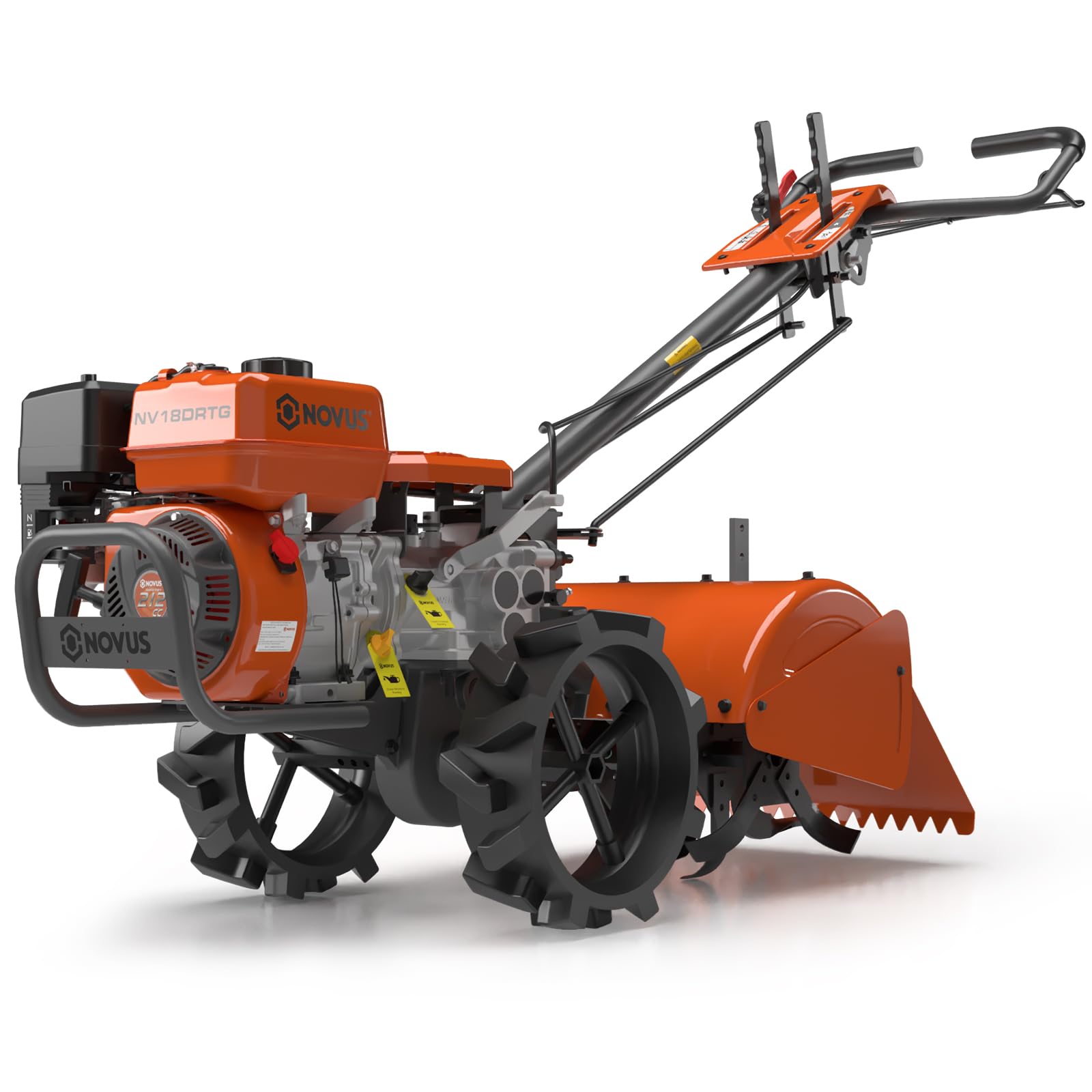
The NOVUS NV18DRTG eliminates the single most common failure point in heavy tillers: the belt. Its full gear transmission directly couples the 212cc engine to the tines, meaning no power loss and no belt replacements when you hit buried rocks. The 16 hardened steel tines provide an 18-inch working width with up to 10 inches of depth, and you can switch between standard and counter-rotating modes depending on whether you are breaking new ground or finishing a seedbed.
Two forward speeds plus reverse give you precise control, and the non-flat airless tires eliminate the risk of punctures on rocky ground — a real advantage over pneumatic wheels. Owners consistently note that assembly takes about 20 minutes with the included tools and oil, and the machine starts on the first pull. The US-based support team and 2-year warranty add peace of mind for a machine in this price tier.
One review describes it as a “thoughtful design” that moves steadily through rocky soil unearthing stones without stalling. For home users with larger gardens or small farms who want gear-driven reliability without the price tag of commercial equipment, this is a compelling choice.
What works
- Full gear transmission never slips under heavy load
- Airless tires eliminate flat-tire downtime
- Switchable tine direction for breaking vs. finishing
What doesn’t
- Heavier than some competitors at over 200 pounds
- Limited dealer network outside direct purchase
3. YARDMAX 18 in. 212 cc Gas OHV Engine Rear Tine Tiller YT4565
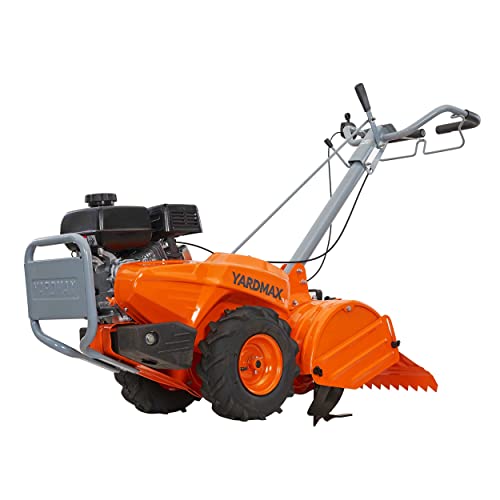
The YARDMAX YT4565 brings rear-tine power to a price point that usually only buys front-tine machines. With a 209cc or 212cc OHV engine — variations occur by production run — it delivers the displacement needed to handle hard soil. The dual rotating tine design allows you to switch between counter-rotation for breaking ground and standard rotation for finishing, giving you two machines in one frame.
Weighing 208 pounds, this tiller uses its mass to stay planted in the soil rather than bouncing. The forward and reverse speeds include a neutral position for easy movement between plots, and the steel construction — including the Briggs & Stratton engine on many units — gives it commercial-grade bones. Owners report one-pull starting and the ability to till 6.5 inches deep even through rocky, sandy, and clay soils.
The primary trade-off is a belt-driven transmission rather than a full gear system. Some owners report needing to adjust the belt cable over time or replace tires earlier than expected. But for the price, this is the most affordable entry into genuine rear-tine, dual-direction capability for hard soil.
What works
- Rear-tine design reduces arm fatigue on hard ground
- Dual rotating tines for breaking and finishing
- Strong engine torque at an accessible price point
What doesn’t
- Belt drive can slip under extreme loads
- Tire tubes may need replacement over time
4. EARTHQUAKE Pioneer Dual Direction Rear Tine Tiller 31285
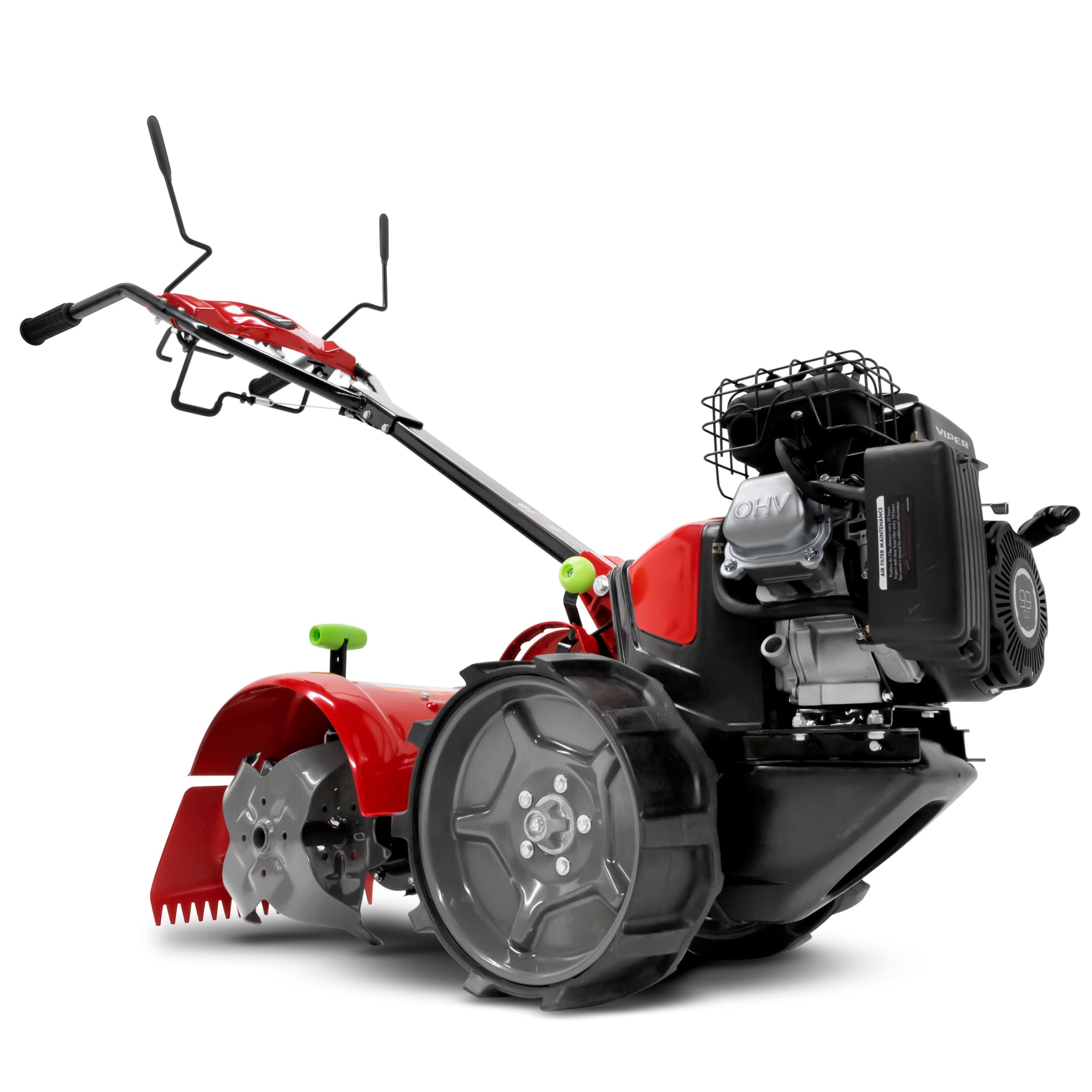
The Earthquake Pioneer 31285 uses a 99cc Viper engine rather than the 200cc-plus engines found on heavier rear-tine models, but it compensates with a dual-direction transmission that lets you switch between counter-rotating tines (CRT) for breaking sod and standard rotating tines (SRT) for finishing. The instant reverse handle is a standout feature — instead of shifting gears, you pull a handle to back up, then release to resume forward motion.
The airless, extra-wide wheels with aggressive lugs provide serious traction and eliminate flat-tire worries. At a lighter overall weight than the 200cc-class machines, the Pioneer is easier to maneuver in tight garden rows and can be operated with one hand to keep footprints out of the bed. The 17-inch tilling width and 11-inch depth are generous for a machine in this weight class.
Owner feedback notes that it struggles somewhat in extremely hard-packed soil and may require multiple passes, and one report mentioned the tine assembly coming apart before being re-seated. However, the 5-year warranty and US-based support provide a safety net that cheaper machines lack. This is the right choice if you want dual-direction flexibility in a more maneuverable package.
What works
- Counter-rotating tines handle sod and tough ground well
- Instant reverse is seamless and easy to use
- Airless wheels with aggressive tread for traction
What doesn’t
- 99cc engine lacks torque for extreme hard clay
- Some initial tine alignment issues reported
5. SPLENDOR Gas Powered Tiller 212cc KST55RT01

The SPLENDOR KST55RT01 is the widest tiller in this lineup, with an adjustable working width from 13 inches up to 33.5 inches by adding or removing tine sets. The 212cc engine delivers 7HP, and the 24 hardened steel knives dig up to 13 inches deep. For large plots or gardeners who want to cover ground fast, this front-tine machine offers the widest single-pass coverage available at this price.
The chain-type gearbox is more serviceable than a sealed belt system, and the forward and reverse speeds let you maneuver without manhandling the machine. The safety lock clutch handle ensures the tines stop when you release your grip. Owners consistently describe it as a “beast” that rips through tough dirt with ease, though several note that the nuts and bolts on the tine assembly require periodic retightening.
One reviewer replaced a 1974 Sears tiller with this machine and reported that it started right up and had plenty of torque. The 2-year limited warranty is reasonable for the price. Just be aware that the front-tine design means you will feel more vibration and bucking than a rear-tine model, especially at the widest tine setting.
What works
- Massive 33.5-inch working width for large areas
- 212cc engine provides strong torque for clay
- Chain-type gearbox is easy to service
What doesn’t
- Front-tine design causes more arm fatigue
- Tine bolts can loosen during operation
6. Earthquake Versa 2-in-1 Tiller Cultivator 20015

The Earthquake Versa 20015 fills the gap between compact cultivators and full-size rear-tine tillers. Its 99cc Viper engine delivers more power than mini tillers but keeps the weight manageable at 78 pounds. The key feature is the tool-less removal of side shields and outer tines, letting you adjust tilling width from 11 to 21 inches depending on the job — 21 inches for breaking ground, 11 inches for weeding between rows.
The tilling depth reaches 11 inches, and the adjustable handlebar height makes it comfortable for different operator heights. Onboard wheels simplify transport across the yard. Reviews consistently praise its ability to handle compacted Colorado clay and hard South Carolina dirt, with one owner using it to prepare a 20×80-foot area over two days.
The main downsides are common to front-tine designs: the machine bucks if you don’t use the drag stake properly, and the bolts can vibrate loose over time. Earthquake includes a 5-year limited warranty, which is generous for a front-tine tiller. This is the best option if you need a single machine that can handle both heavy tilling and precision cultivation.
What works
- Tool-less width adjustment from 11 to 21 inches
- 99cc engine handles hard-packed soil effectively
- Relatively light at 78 pounds for transport
What doesn’t
- Bucking requires constant drag stake adjustment
- Bolts may need frequent retightening
7. Honda FG110 Mini Tiller Cultivator FG110KiAT
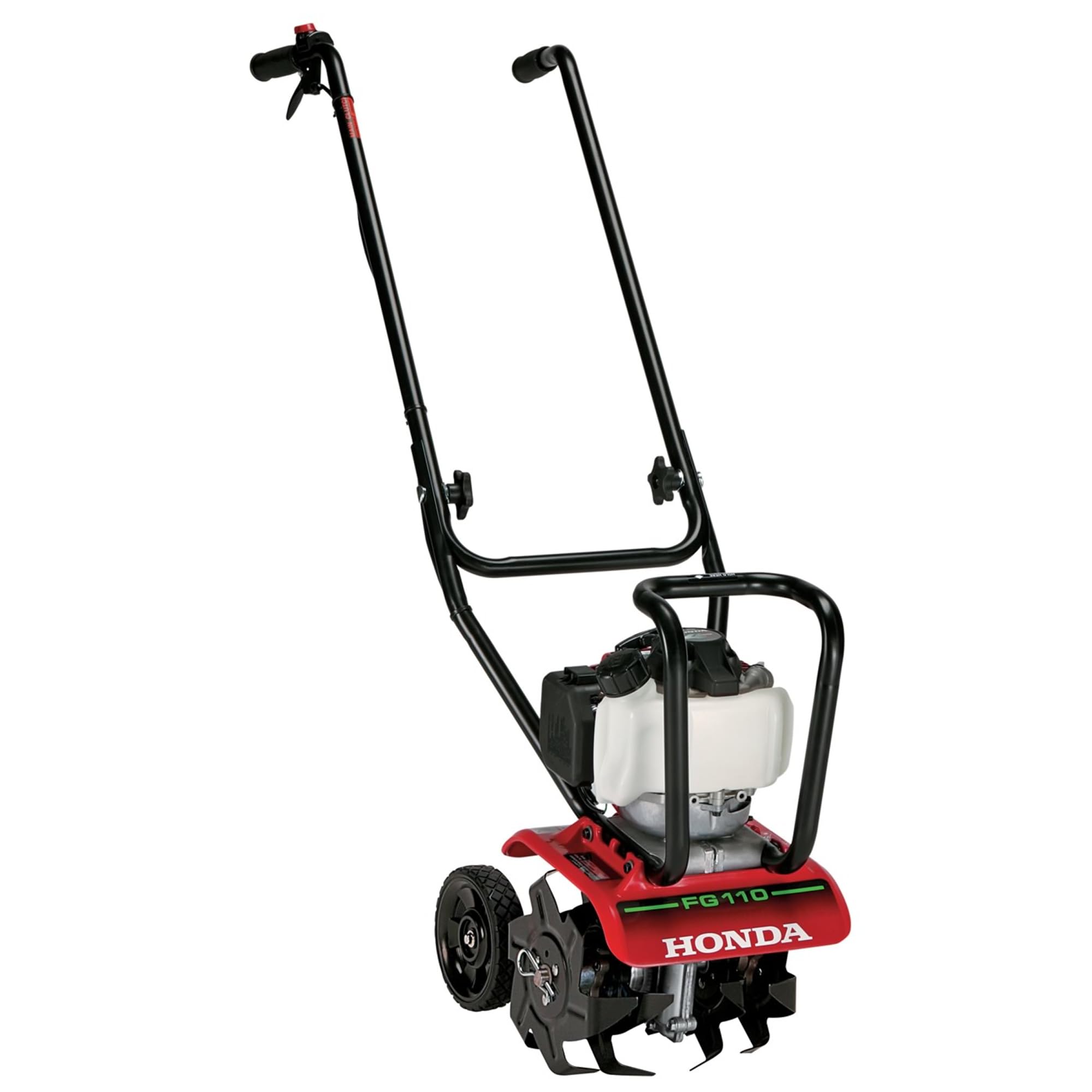
The Honda FG110 is a different tool from the other tillers on this list — it is a lightweight, precision cultivator designed for established beds rather than primary ground breaking. At just 29 pounds with the legendary GX25 four-stroke engine, it is the most portable option available. The hybrid tines feature angled blades for digging and cultivating simultaneously, allowing you to work within one inch of plants without damage.
The adjustable tilling width goes from 9 inches down to 6 inches by removing the outer tines, making it ideal for tight raised beds and between established rows. The two-position transport wheels roll over smooth or rough terrain, and the handle folds for compact storage. Honda backs it with a 2-year residential warranty.
Owner reviews emphasize Honda reliability, easy starting, and surprising power for its size. One user replaced a 20-year-old Toro cultivator with this and called it the right choice. However, Honda is explicit that the FG110 is “intended for light to moderate gardening jobs” and that extremely hard ground may only allow a few inches per pass. Use this for cultivating, not for breaking new ground.
What works
- Extremely light at 29 pounds for easy handling
- Honda GX25 engine is famously reliable
- Tills within one inch of plants safely
What doesn’t
- Not designed for breaking new hard ground
- Limited to 6-9 inch working width
8. SENIX 4QL Gas Powered Tiller Cultivator TL4QL-L1

The SENIX TL4QL-L1 uses a patented 4QL technology that allows all-directional operation — you can tilt the machine without stalling or oil leakage, which is rare for four-cycle engines. The 46cc full crank engine delivers 1.9HP with low vibration, and the six premium steel forward-rotating tines provide up to a 15-inch tilling width and 8-inch depth. The auto choke and compression release system make starting straightforward.
At 31.7 pounds, this is a lightweight front-tine machine that is easy to maneuver in small to medium gardens. The foldable handles reduce storage space, and the 2-year limited warranty is competitive. Owner reports are mixed but generally positive: many praise its power for the size and easy starting, while a small number report durability issues or difficulty with very rocky soil.
One reviewer called it a “little work horse” that packs surprising power, while another reported a unit that died after 20 minutes. The all-directional lubrication system is a genuine innovation that makes this more forgiving than most four-stroke tillers. For soft to moderately hard soil in small gardens, this is a capable budget-friendly option.
What works
- All-directional 4QL engine prevents oil stalling
- Lightweight at 31.7 pounds for easy handling
- Auto choke simplifies starting procedure
What doesn’t
- Not powerful enough for heavy clay or rocky ground
- Mixed reliability reports from owners
9. BILT HARD 46cc 4-Cycle Gas Powered Tiller TOA-0457
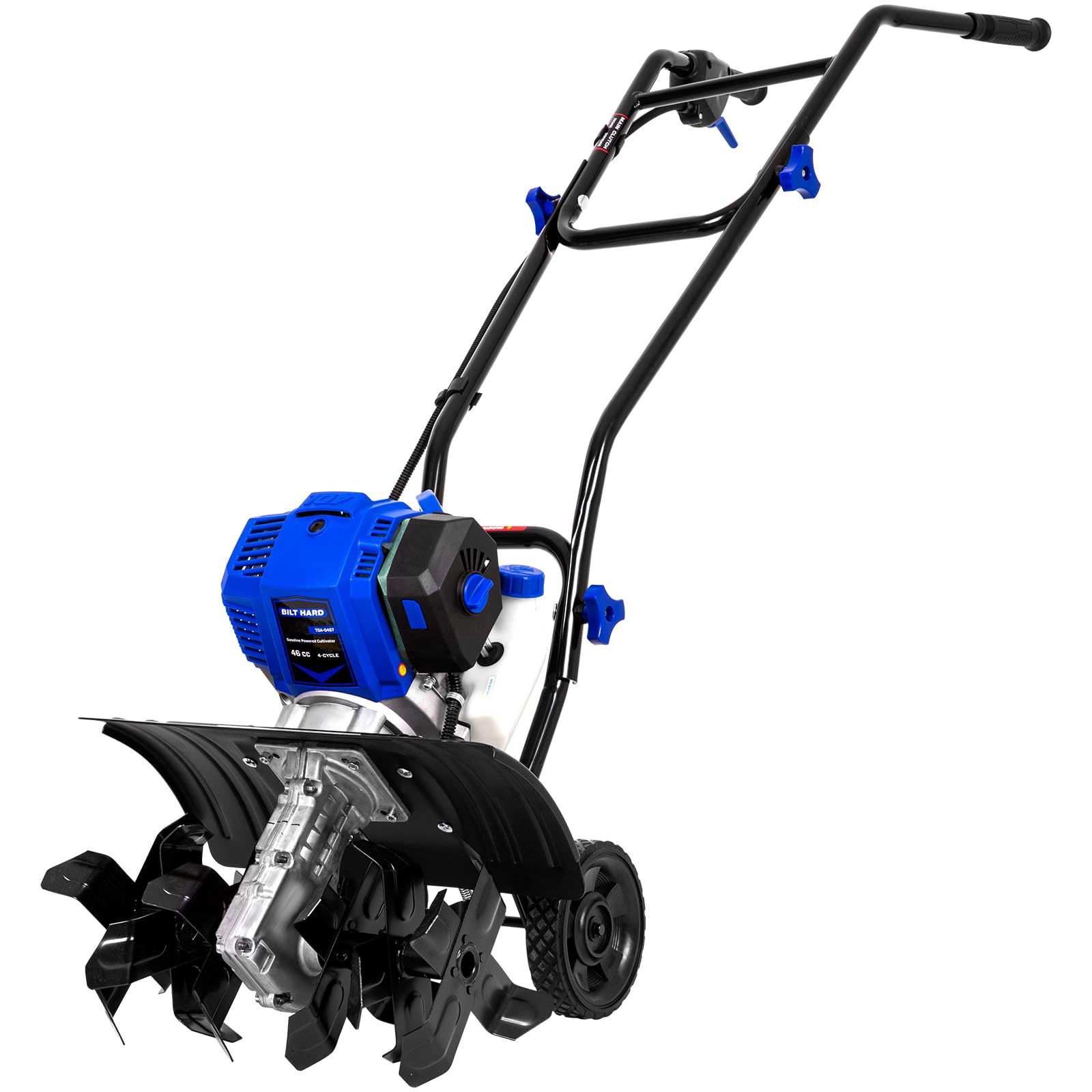
The BILT HARD TOA-0457 is the most affordable entry point in this lineup, powered by a 46cc four-stroke engine that delivers 1,400 watts of peak power. The six forward-rotating steel blades and four angled tines provide a 16-inch working width and 8-inch tilling depth. The one-hand control panel combines the thumb throttle and power switch, and the automatic reset choke lever with compression release makes starting simple.
Owner reviews are surprisingly strong for a machine at this price point. A 59-year-old female user reported tilling hard, grassy ground in 20 minutes with easy assembly. Another verified reviewer with a 300-square-foot garden said it impressed them enough to break their normal rule of not giving five-star ratings. The foldable handles save storage space, and the 4-cycle engine requires no gas-oil mixing.
The primary concerns revolve around customer support — the manufacturer provides only 90-day warranty through a third party and one year direct, and some owners report difficulty reaching support by phone. The manual also lacks the gear oil specification (SAE 80W-90 EP). For hobby gardens and light to moderate soil, this is a functional, wallet-friendly choice, but it will struggle in heavy clay or root-filled ground.
What works
- Very affordable entry price for gas tiller
- Starts easily and runs reliably for small gardens
- No gas-oil mixing with 4-cycle engine
What doesn’t
- Limited power for hard clay and heavy roots
- Short warranty and poor customer support
Hardware & Specs Guide
Engine Displacement (cc)
Engine displacement measured in cubic centimeters directly correlates with torque output. For hard soil, 99cc is the minimum viable displacement for occasional use, while 209cc to 212cc engines provide the sustained torque needed to maintain tine speed through compacted clay without stalling. Four-cycle engines are preferred because they run on straight gasoline, produce fewer emissions, and require less maintenance than two-stroke equivalents.
Tine Rotation Direction
Standard rotating tines spin forward with the wheels and work best in loose, prepared soil. Counter-rotating tines spin opposite the wheels, driving downward to fracture compacted layers. Some dual-direction models allow you to switch between both modes — counter-rotation for initial breaking and standard rotation for finishing. If your primary soil condition is hard-packed, counter-rotation is the mechanism that makes a tiller effective.
Transmission Type
Belt-driven transmissions are cheaper and quieter but slip under heavy load when tines encounter buried rocks or roots. Gear-driven transmissions, particularly those with bronze or hardened steel gears, transfer full engine torque directly to the tines with zero slippage. Gear drives also eliminate belt replacement as a periodic maintenance task. For any tiller expected to handle hard soil repeatedly, a gear transmission is the strongest indicator of long-term reliability.
Tilling Width and Depth
Working width determines how many passes you need to cover a garden area. Front-tine tillers typically range from 11 to 21 inches, while rear-tine models offer 16 to 18 inches. Depth capability matters more for hard soil — look for at least 8 inches of depth to break through the compacted layer and allow root penetration. Adjustable depth stakes let you control how aggressively the tines dig on each pass.
FAQ
Is a rear-tine tiller always better than a front-tine for hard soil?
What does counter-rotating tines mean and why does it matter for compacted soil?
Can I use a lightweight 46cc tiller on hard clay soil?
How deep should a tiller go for hard soil before planting?
Final Thoughts: The Verdict
For most gardeners facing hard soil, the tiller for hard soil winner is the Earthquake Victory 39381 because its counter-rotating tines, 209cc Viper engine, and bronze gear transmission deliver reliable ground-breaking power without breaking down. If you want gear-driven durability with airless tires that never puncture, grab the NOVUS NV18DRTG. And for the most affordable rear-tine dual-direction machine, nothing beats the YARDMAX YT4565 for value.