
Strawberries are notoriously picky about their growing medium. A pH that drifts even half a point above the 5.5–6.5 sweet spot, or soil that holds moisture like a sponge, turns vigorous runners into yellowed, stunted failures before a single berry sets. The difference between a bumper harvest and a pathetic patch of sad leaves starts with the mix you pour into the pot or bed.
I’m Rikta — the co-founder and writer behind Lawn Gear Lab. I’ve spent hundreds of hours comparing soil chemistry analysis, cross-referencing organic certification standards, and mapping aggregate owner feedback to isolate which strawberry soils deliver measurable results and which just bag up generic peat with a berry sticker on the front.
Whether you are planting in raised beds, fabric grow bags, or standard nursery pots, the following guide breaks down seven distinct options into a clear framework. This is the definitive resource for choosing the best strawberry soil based on real spec sheets, verified buyer evidence, and the specific pH and drainage benchmarks that actually govern fruit yield.
How To Choose The Best Strawberry Soil
Strawberries require a growing medium that is acidic, lightweight, and consistently moist but never waterlogged. Unlike general-purpose potting soils that can pack too tightly or carry a neutral-to-alkaline pH, strawberry-specific mixes are engineered to meet three critical criteria: pH range, drainage speed, and nutrient delivery. Below are the factors that separate a productive mix from one that causes more problems than it solves.
pH Level: The 5.5–6.5 Window
Strawberries are obligate acid-loving plants. When soil pH climbs above 6.5, iron and manganese become unavailable to the root system, causing interveinal chlorosis (yellow leaves with green veins) and drastically reducing flower formation. A mix formulated specifically for strawberries should either start within this acidic range or include components like elemental sulfur, peat moss, or pine bark to lower pH naturally. If your tap water is alkaline (pH 8.0 or higher), a standalone soil acidifier may be necessary to maintain the proper pH over the growing season.
Drainage & Aeration Components
Strawberry roots are shallow and highly susceptible to Phytophthora root rot and other fungal diseases triggered by standing water. A premium strawberry soil incorporates perlite, coarse sand, granite sand, or pine bark fines to create pore spaces that allow excess water to drain rapidly while retaining enough moisture for daily uptake. Coconut coir is another common ingredient that holds water without becoming compacted, providing a buffer between watering cycles. Avoid mixes heavy in field soil or dense compost that turns into mud when saturated.
Nutrient Profile & Slow-Release Fertilizers
Strawberries are heavy feeders during the flowering and fruiting stages, but they also burn easily if nutrient levels spike. The ideal mix contains a balanced, slow-release fertilizer — an NPK ratio around 18-6-8 is common in premium blends — that provides a steady supply of nitrogen for foliage, phosphorus for root and flower development, and potassium for fruit quality. Organic sources such as worm castings, composted manure, and humus release nutrients more slowly than synthetic salts, reducing the risk of tip burn while supporting microbial activity in the root zone.
Quick Comparison
On smaller screens, swipe sideways to see the full table.
| Model | Category | Best For | Key Spec | Amazon |
|---|---|---|---|---|
| Coast of Maine Acid-Loving Planting Soil | Premium Organic | General berry beds & containers | Low-pH compost blend | Amazon |
| Perfect Plants Organic Strawberry Mix | Premium Mix | Long-term feeding (12 months) | 18-6-8 slow-release fertilizer | Amazon |
| Gardenera Strawberry Premium Potting Soil | Specialty Mix | Small container / indoor use | Sand + vermiculite drainage layer | Amazon |
| Omitgoter All-Natural Strawberry Soil | Budget Mix | Perfect for new gardeners | 4qt pre-mixed no-additive bag | Amazon |
| Fertilome Soil Acidifier Plus Iron | Liquid Acidifier | pH correction & iron chlorosis | 32 oz liquid concentrate | Amazon |
| Earth Science Fast Acting Sulfur | Granular Amendment | Lowering soil pH & greening | 5 lbs elemental sulfur granules | Amazon |
| Espoma Organic Soil Acidifier | Granular Amendment | Organic blue hydrangea + berries | 6 lb elemental sulfur + gypsum | Amazon |
In‑Depth Reviews
1. Coast of Maine Organic & Natural Planting Soil for Acid Loving Plants

Coast of Maine builds this mix around composted manure and sphagnum peat moss, achieving a naturally low pH that aligns with the 5.5–6.5 target strawberries demand without requiring additional acidifiers. The bag’s texture is fluffy and lightweight, with visible perlite and aged bark fines that create the drainage channels berry roots need to avoid collar rot during wet spells. At 20 quarts, it offers the highest volume-per-dollar footprint in the premium tier, making it suitable for raised beds and multiple large containers in a single purchase.
Buyer reviews consistently highlight improved foliage color and fruit set within two to three weeks of transplanting, with several users reporting that plants that previously struggled in generic potting soil rebounded completely after switching to this blend. The OMRI-listed organic certification ensures no synthetic growth regulators are present, which matters for gardeners who plan to harvest within weeks of potting. The composted manure component provides a gentle nitrogen release that supports steady leaf expansion without the sudden growth spike that attracts aphids.
On the downside, the bag is heavy when wet, and some users note that the bark chunks can be larger than ideal for small nursery pots (four inches or smaller). The mix also contains no added slow-release granular fertilizer, so growers who want a 12-month feed-and-forget approach will need to supplement with a berry-specific granular feed after about six weeks. For pure soil structure and pH readiness, this remains the most reliable all-rounder in the category.
What works
- Naturally low pH (requires no bagged acidifier for most tap water)
- Excellent moisture retention with perlite aeration
- OMRI-listed organic ingredients
- Generous 20-quart volume suits raised beds
What doesn’t
- Bark chunks can be oversized for small seedling pots
- No slow-release fertilizer included
- Bag becomes very heavy when saturated
2. Perfect Plants Organic Strawberry Potting Mix
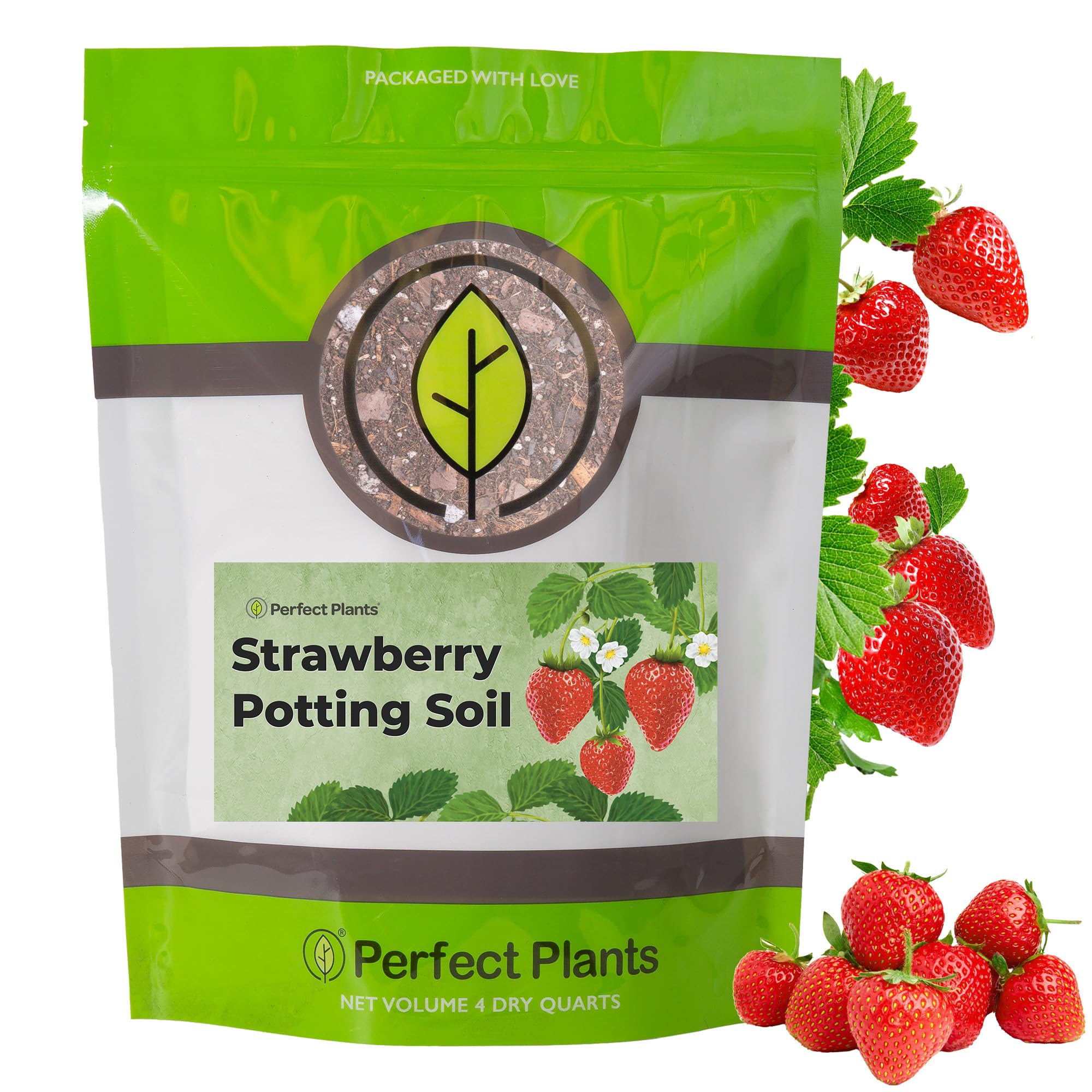
Perfect Plants combines composted pine bark, granite sand, peat moss, and an 18-6-8 slow-release fertilizer that feeds strawberry plants for up to twelve months with every watering. This is the only mix in this comparison that makes a concrete nutrient-duration claim, which eliminates the guesswork around when to start liquid feeding. The granite sand is a particularly smart addition for strawberries: it adds weight to the pot (improving stability for top-heavy fruiting plants) while providing the sharp drainage that prevents anaerobic conditions in the root zone.
Customer feedback from verified buyers shows strong results in vertical strawberry towers and tiered planters, with multiple users noting vigorous runner production within the first month. The acidic blend (pine bark and peat base) keeps pH in the 5.5–6.0 range naturally, which is ideal for pineberries and other Fragaria hybrids that are even more sensitive to alkalinity than standard June-bearing varieties. The heavy-duty resealable bag is a practical bonus for gardeners who use partial quantities and want to store the remainder without spillage.
The most common complaint involves the bark particle size: several buyers mention large wood chunks that feel out of place in a potting mix at this price point. These chunks do not affect drainage or nutrient availability, but they can be visually unappealing and may need screening for small propagation trays. Additionally, the initial moisture wicking can be uneven — the peat component may resist rehydration if the bag has been stored open. Pre-moisten the mix before potting for best results.
What works
- Integrated 18-6-8 slow-release feed lasts up to 12 months
- Granite sand improves drainage and pot stability
- Acidic pH ideal for pineberries and sensitive hybrids
- Resealable heavy-duty bag
What doesn’t
- Large bark chunks present in the mix
- Peat can resist rewetting if bag has been opened
- Premium price point for 4-quart size
3. Gardenera Strawberry Premium Potting Soil Mix
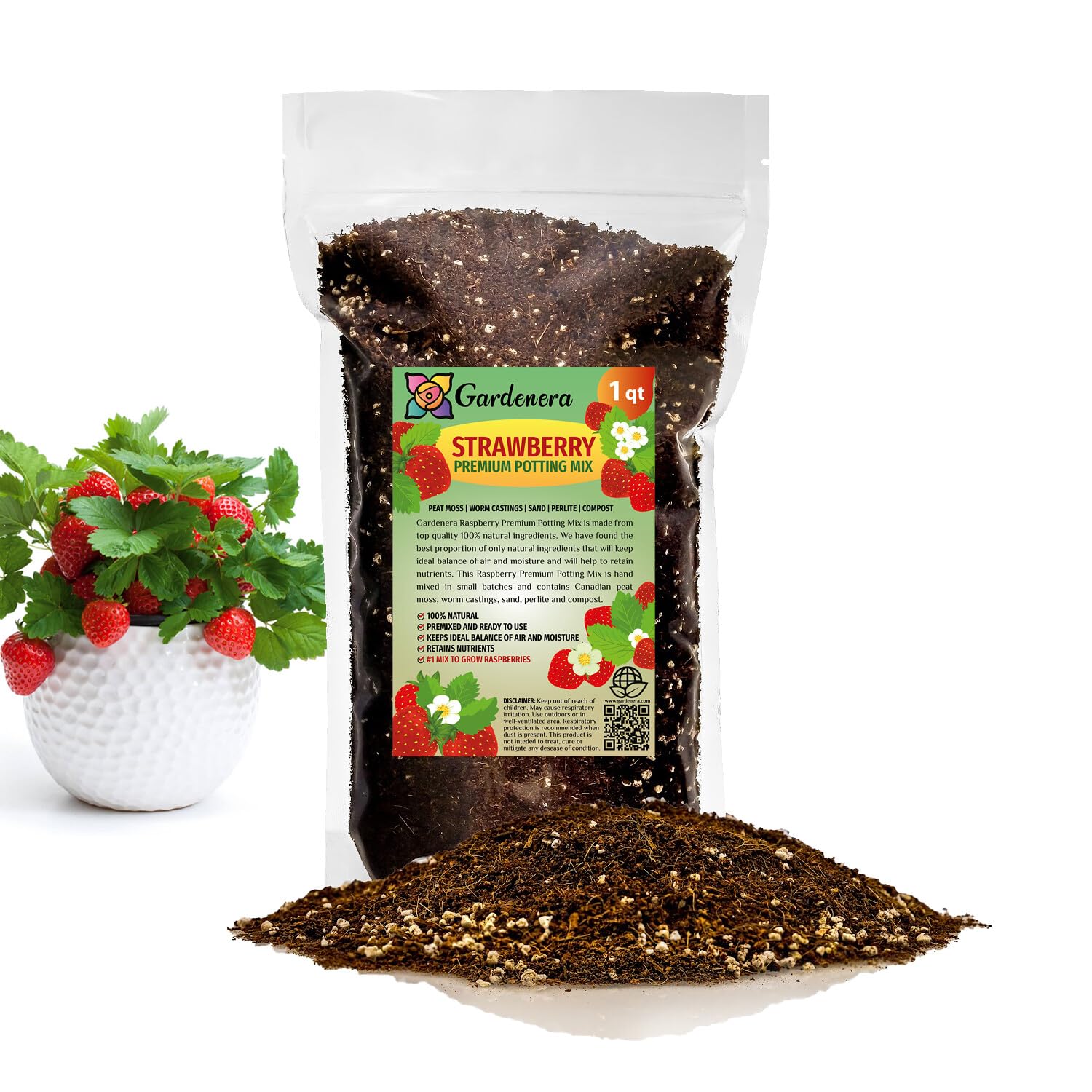
Gardenera packs peat moss, worm castings, lime, sand, vermiculite, and organic compost into a blend that reads like a complete soil-building recipe on the ingredient list. The inclusion of both sand and vermiculite creates a dual-action drainage and aeration system: sand provides the heavy particle weight that lets excess water flow downward, while vermiculite holds a reservoir of moisture against the root ball for even hydration between waterings. The lime addition is notable — most strawberry-specific mixes avoid lime because it raises pH, but the formula uses it in a measured amount to buffer the peat’s acidity while keeping the final pH near 6.0.
The small 1-quart volume is deliberate: this mix is optimized for a single strawberry plant in a 4-to-6-inch nursery pot, making it a good fit for indoor windowsill growers or first-timer experiments. The worm castings and compost provide a gentle organic nutrient base that reduces the need for immediate fertilization. For someone starting a single plant to learn the ropes, this bag eliminates the waste of buying a 20-quart bail of soil for one container.
That small quantity, however, is also the mix’s main limitation. At the budget-friendly price point for the bag, the cost per quart is high compared to bulk options. Several buyer reviews report disappointment with mold developing on the surface after weeks of consistent moisture — likely due to the vermiculite holding too much water in low-light indoor conditions. The mix works best in terracotta pots or fabric grow bags where the sides dry out quickly, not in glazed ceramic pots with minimal evaporation.
What works
- Dual sand and vermiculite aeration system
- Worm castings provide gentle organic nutrition
- Lime buffers pH into the ideal 6.0 range
- Perfect single-plant size for beginners
What doesn’t
- Can grow mold on surface in low-light conditions
- Small 1-quart bag is expensive per unit volume
- Not practical for multiple plants or larger containers
4. Espoma Organic Soil Acidifier (6 lb)
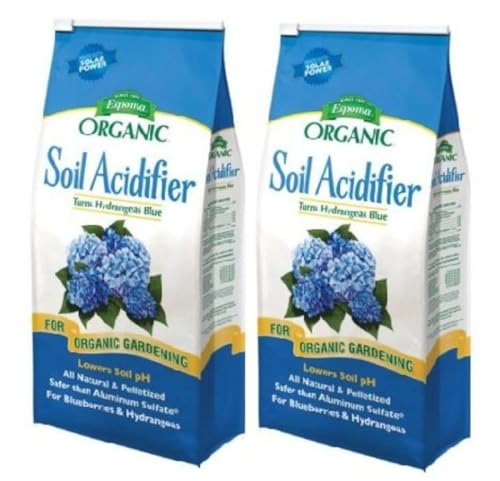
Espoma’s Soil Acidifier delivers elemental sulfur and gypsum in granular form, making it a targeted amendment rather than a complete soil. For strawberry growers who already have a neutral or slightly alkaline base mix and simply need to drop pH into the 5.5–6.5 window, this is the most precise tool in the lineup. The gypsum component adds calcium without raising pH — a rare combination — which supports cell wall strength in developing berries without counteracting the acidification.
This pack contains two 6-pound bags, providing enough material to treat roughly 100 square feet of garden soil at the recommended application rate for a 1.0 pH point reduction. Multiple verified reviewers specifically mention using Espoma to turn hydrangea blooms blue, which is functionally identical to the pH shift strawberries need — the same mechanism that makes aluminum available to hydrangea petals also makes iron and manganese available to berry roots. For strawberry growers using alkaline municipal water (pH 8.0+), a quarterly application of this acidifier offsets the upward pH drift that standard watering causes.
The granules are slow to dissolve in dry soil, requiring several thorough waterings to activate. The product label recommends tilling or working the granules into the top few inches of soil, which is easy for raised beds but impractical for established containers without disturbing roots. Users who prefer faster results often switch to a liquid acidifier like Fertilome, but Espoma’s organic certification and long-lasting sulfur content make it the better choice for gradual, sustained pH management over a full growing season.
What works
- Organic elemental sulfur with gypsum for calcium
- Effective for sustained pH reduction over full season
- Two-bag pack covers larger garden areas
- Trusted brand with decades of grower usage
What doesn’t
- Slow activation in dry soil
- Must be tilled in for best results
- Not a standalone mix — requires base soil
5. Omitgoter All-Natural Strawberry Soil & Potting Mix
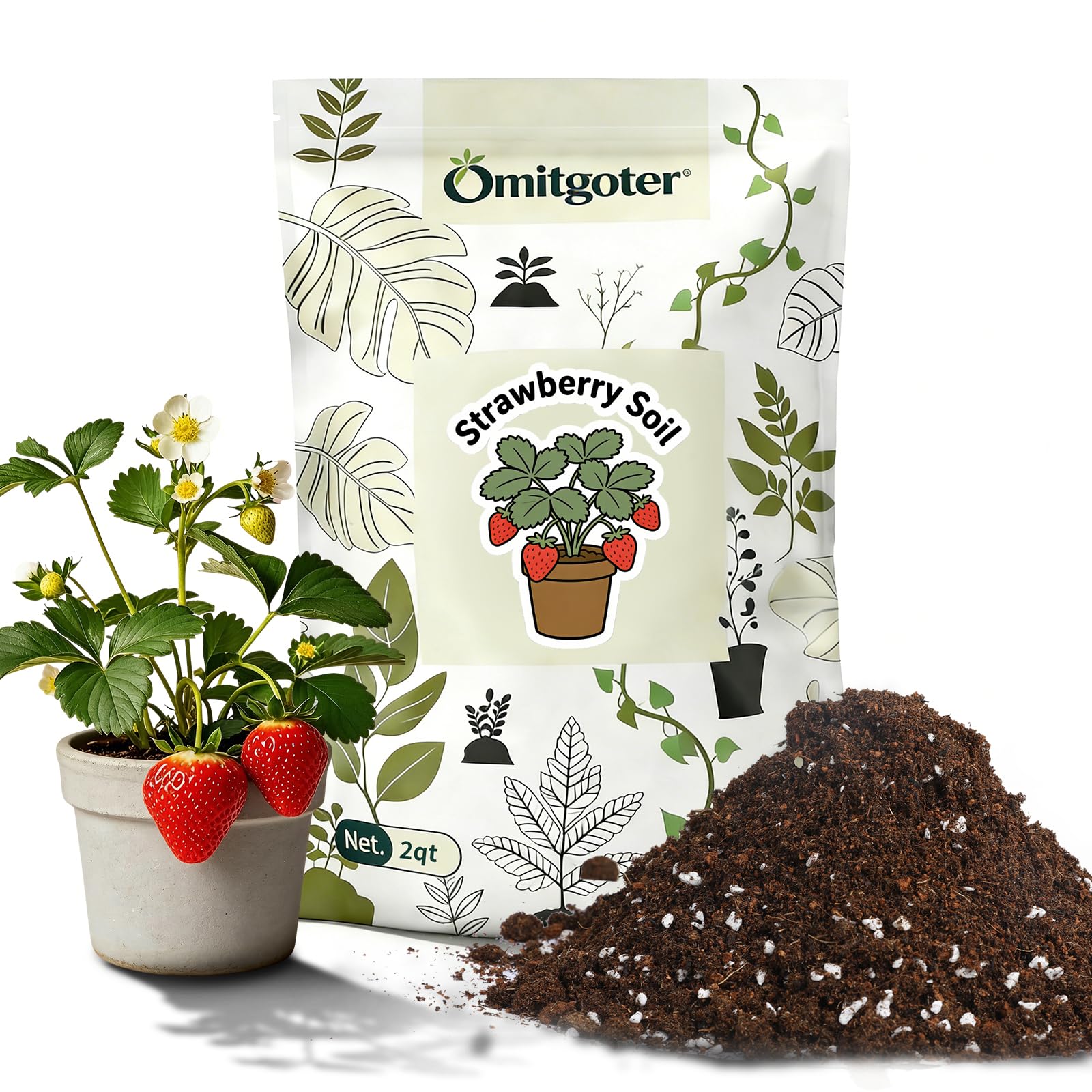
Omitgoter’s all-natural formula combines peat moss, coconut coir, perlite, worm castings, and humus into a 4-quart bag that is ready to use straight from the package — no mixing, no additional amendments required. The coconut coir is a standout inclusion for this price tier: it provides the moisture-holding capacity of peat with faster rewetting properties, reducing the risk of hydrophobic dry patches that plague pure-peat mixes. The absence of synthetic fertilizers makes this an entry-level-organic option for growers who want to avoid chemical salts while still getting decent drainage and aeration.
Buyer reviews are predominantly positive, with 4.4 stars across nearly 200 ratings at the time of research. Many users report using this soil not only for strawberries but also for bonsai trees and roses, which speaks to its versatility and balanced texture. The bag is lightweight and compact, making it easy to store or transport for urban gardeners working on balconies or small patios. For someone dipping into strawberry growing for the first time, the low cost and foolproof application eliminate the intimidation factor.
The main trade-off is that this mix does not contain any slow-release fertilizer. The worm castings and humus provide a mild nutrient boost, but plants will require supplemental feeding within 4–6 weeks, especially once flowering begins. A small number of reviewers noted that the bag appeared smaller than expected for 4 quarts, though this is a subjective packaging perception rather than a product defect. For the price, this is a solid foundation mix that pairs well with a liquid berry fertilizer.
What works
- Ready to use with zero mixing or additives
- Coconut coir prevents hydrophobic dry spots
- Lightweight and easy to handle
- Budget-friendly entry point for new growers
What doesn’t
- No slow-release fertilizer included
- Requires supplemental feeding after 4–6 weeks
- Bag can look smaller than expected for 4 quarts
6. Earth Science Fast Acting Sulfur Granules

Earth Science’s Fast Acting Sulfur uses elemental sulfur granules that begin oxidizing into sulfuric acid the moment they contact moist soil, producing a measurable pH drop within days rather than weeks. The patented Nutri-Bond Technology binds the sulfur particles to soil colloids, reducing the amount that washes away during heavy rain or overhead irrigation — a real advantage for strawberry growers using soaker hoses or drip lines that can leach mobile nutrients quickly.
Buyers report visible greening of chlorotic leaves within 7–10 days of application, which aligns with the speed of sulfur oxidation in warm, moist soil. For strawberry patches planted in ground that previously grew vegetables or grass, where the soil has drifted alkaline from years of lime applications or hard water, this granules provide a corrective tool that works faster than bagged sulfur prills. It is also safe for use around children and pets once watered in, with no odor or staining on walkways.
The “fast acting” claim should be taken in context: the granules still need water and time to break down, and some users report that the pellets are slower to dissolve than the marketing suggests, taking multiple soakings before the pH reading actually changes. In heavy clay soils, the sulfur can sit on the surface without penetrating if not tilled in. For container strawberry growers using potting mix, the fine granules work well when mixed into the top inch of the growing medium.
What works
- Noticeable pH drop reported within 7–10 days
- Nutri-Bond Technology reduces leaching loss
- Safe for people and pets after watering
- Fine granule texture mixes easily into containers
What doesn’t
- Pellets require multiple waterings for full dissolution
- Less effective if not incorporated into soil surface
- Not an instant fix in cold or dry conditions
7. Fertilome Soil Acidifier Plus Iron (32 oz)
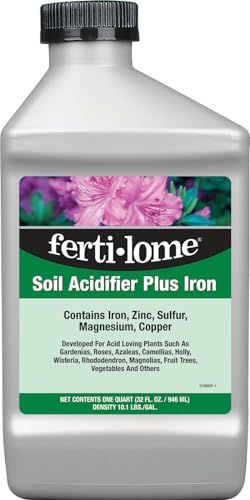
Fertilome’s liquid concentrate is the fastest-acting pH adjustment tool in this roundup. Mixed at a rate of 2 tablespoons per gallon of water and applied as a soil drench, the solution begins correcting iron chlorosis — the yellowing between leaf veins caused by high pH — within days rather than weeks. The formula contains not only sulfur but also chelated iron, zinc, magnesium, and copper, effectively turning a single product into both a pH amendment and a micronutrient supplement for plants that are already showing deficiency symptoms.
Strawberry growers who experience sudden chlorosis after a season of healthy growth, often triggered by accumulated alkaline tap water, will benefit most from this liquid approach. A drench application delivers the acidifying compounds directly to the root zone without the wait time required for granular sulfur to oxidize. The 32-ounce bottle makes approximately 30 gallons of treatment solution, which covers a substantial number of containers or a moderate-sized raised bed over multiple applications.
The liquid formulation is potent, and several verified buyer reviews caution against overuse. Applying too frequently or at a higher concentration than the label directs can drop soil pH too rapidly, causing root stress or nutrient lockout for other elements. Regular pH testing with a meter or test strips is necessary when using this product to avoid overshooting the target range. Fertilome also lists roses, azaleas, and blueberries on the label rather than strawberries specifically, which may concern strict organic growers, but the chemistry is identical for any acid-loving fruiting plant.
What works
- Fastest pH correction of any product reviewed
- Includes chelated iron, zinc, and copper
- Easy liquid application via watering can
- High yield: one bottle treats ~30 gallons
What doesn’t
- Can overshoot pH if used too frequently
- Requires pH meter for safe application
- Not labeled specifically for strawberries
Hardware & Specs Guide
Slow-Release Fertilizer Duration
The number of months a soil continues supplying nutrients without additional feeding is a critical spec. Perfect Plants achieves a 12-month feed window using 18-6-8 encapsulated prills, while most all-natural mixes (Omitgoter, Coast of Maine) depend on compost and humus that exhaust after 4–6 weeks. For low-maintenance growers, longer duration reduces the risk of mid-season nutrient gaps during peak fruiting.
pH Buffering vs. Immediate Adjustment
Pre-mixed soils rely on peat moss and pine bark for natural pH buffering, which maintains acidity over the life of the plant but cannot quickly reverse a high-pH spike from alkaline water. Liquid acidifiers (Fertilome) provide immediate correction in days, while granular sulfur products (Earth Science, Espoma) take 1–3 weeks depending on soil moisture and temperature. Choosing between these depends on whether you are building a mix from scratch or reacting to an existing problem.
Drainage Particle Size
The physical size of aeration components directly affects root zone oxygen. Coarse perlite and granite sand create large pore spaces that drain rapidly, ideal for strawberries in humid climates. Fine vermiculite (found in Gardenera) holds more moisture and works best in arid environments or for growers who water infrequently. Bark fines above 1/4 inch (Perfect Plants) improve drainage but can interfere with delicate seedling roots in small propagation trays.
Volume per Package
Bag sizes range from the 1-quart Gardenera single-plant bag up to the 20-quart Coast of Maine option. Cost per quart decreases significantly at larger volumes, but unused soil degrades over time as peat dries out and becomes hydrophobic. Gardeners with 3–5 containers typically need 4–8 quarts, while raised bed growers should plan on 2–4 cubic feet per 4×4-foot bed. Store opened bags in a sealed container with a damp towel to preserve moisture.
FAQ
Can I use regular potting soil for strawberries?
How do I lower pH if my water is alkaline?
Should I add fertilizer to strawberry soil immediately?
How often should I water strawberries in a container?
Final Thoughts: The Verdict
For most gardeners, the best strawberry soil winner is the Coast of Maine Organic & Natural Planting Soil because it delivers the ideal low pH and drainage structure straight out of the bag at a generous volume that covers both containers and raised beds. If you want built-in slow-release feeding that minimizes mid-season effort, grab the Perfect Plants Organic Strawberry Potting Mix. And for correcting an existing high-pH problem fast, nothing beats the Fertilome Soil Acidifier Plus Iron as a targeted liquid drench.