
Aeration punches thousands of tiny cores into your lawn, relieving soil compaction and opening direct pathways for air, water, and nutrients. The entire point of this exercise is to give those roots immediate access to what they need. Apply the wrong fertilizer during this critical 48-hour window, and you are literally missing the chance of the season.
I’m Rikta — the co-founder and writer behind Lawn Gear Lab. I spend my time cross-referencing NPK ratios, studying slow-release nitrogen technologies, and analyzing hundreds of verified owner experiences to identify which formulations actually deliver when the soil is most receptive.
This guide breaks down the top contenders and explains exactly why each earns a spot in the conversation around the best fertilizer after aeration.
How To Choose The Best Fertilizer After Aeration
Selecting the right feed for post-aeration is not about buying the most expensive bag or the one with the flashiest label. It is about understanding what your soil can actually absorb in that narrow window when the holes are open. Here is what matters most.
Nitrogen Release Profile — Quick vs. Slow
Aeration creates direct channels to the root zone. Quick-release nitrogen offers an immediate green-up, which is visually satisfying within days. Slow-release nitrogen provides sustained feeding for 8 to 12 weeks, preventing the surge-and-fade pattern that leaves your lawn hungry mid-season. The best formulations blend both: fast color now, steady nutrition later.
NPK Ratio and Seasonal Fit
Fall aeration calls for a higher phosphorus (middle number) component to encourage root development before winter dormancy. Spring aeration benefits from a higher nitrogen (first number) ratio to drive leaf growth. Potassium (third number) supports overall stress tolerance and disease resistance regardless of season. Match the ratio to your calendar, not your hopes.
Liquid vs. Granular Delivery
Liquid fertilizers penetrate the aeration holes almost instantly and require no watering-in after application. Granular formulations need moisture to break down and enter the soil, but they provide a longer feeding window. The choice depends on your schedule and whether you want a single application or a prolonged release curve.
Quick Comparison
On smaller screens, swipe sideways to see the full table.
| Model | Category | Best For | Key Spec | Amazon |
|---|---|---|---|---|
| GreenView Fairway Formula | Granular | Sustained 12-week feed | 63% slow-release N | Amazon |
| Sunday Lawn Kickstart | Liquid | Quick greening with iron | 22-0-3 + seaweed | Amazon |
| Urban Farm Liquid Lawn | Liquid | Complete micro-nutrition | 13-1-2 + humic acid | Amazon |
| Petramax Liquid Nitrogen | Liquid | Deep green color boost | 28-0-0 (70/30 blend) | Amazon |
| Yard Mastery Stress Blend | Granular | Summer heat recovery | 7-0-20 + 3% iron | Amazon |
| Safer Brand Lawn Restore | Granular | Pet-safe natural feed | 9-0-2 non-burning | Amazon |
| The Andersons Starter | Granular | New lawn establishment | 20-27-5 + iron | Amazon |
In‑Depth Reviews
1. GreenView Fairway Formula Lawn Fertilizer

The GreenView Fairway Formula delivers a 27-0-5 NPK ratio with 63 percent of its nitrogen locked into slow-release form. This is exactly what you want when the aeration holes are open: an initial green-up from the quick-release portion and then a steady twelve-week feed that prevents the mid-season fade that plagues lesser granular fertilizers.
Each 33-pound bag covers a full 10,000 square feet, making it a practical choice for medium to large lawns. The formulation contains no phosphate, which reduces runoff risk into local waterways — a responsible design choice that does not compromise the deep green color owners consistently report within days of application.
Customer feedback highlights the absence of clumping or spreader issues, and multiple reviewers note that their lawn retained a dark, healthy appearance well into summer. This is the definition of a workhorse post-aeration feed: balanced, long-lasting, and easy to apply.
What works
- 63 percent slow-release nitrogen feeds for 12 weeks without surge patterns
- Phosphate-free formula protects local water quality
- Large 10,000 sq ft coverage reduces bag cost per application
What doesn’t
- Granular form requires moisture to activate after aeration
- Not ideal for small lawns where bag size may be excessive
2. Sunday Lawn Kickstart + Green Machine Liquid Fertilizer

Sunday’s two-bottle system pairs a 22-0-3 Kickstart formula with a Green Machine booster, both built around mystery-free ingredients including nitrogen, iron for deep greening, seaweed for root resilience, and potassium for hydration management. This is a liquid approach that seeps directly into aeration channels without any granular waiting period.
The included sprayer attachment simplifies application to a fifteen-minute hose-end job. Owners report visible deep-green color within a week, and the formulation is safe for pets and children immediately after drying. The recommended application window sits between 60 and 89 degrees Fahrenheit, which aligns well with both spring and early fall aeration schedules.
Some users noted that the sprayer nozzles occasionally delivered inconsistent spray patterns, though customer support resolved those issues quickly. The price per treatment sits above granular alternatives, but the convenience of a hose-end system and the absence of any watering-in requirement makes this a standout for homeowners who value speed over bulk savings.
What works
- Liquid formula penetrates aeration holes immediately without watering in
- Iron and seaweed additives support both color and stress tolerance
- Complete system with sprayer reduces application time to 15 minutes
What doesn’t
- Sprayer nozzle quality can be inconsistent batch to batch
- Cost per treatment is higher than most granular options
3. Urban Farm Fertilizers Liquid Lawn Fertilizer

Urban Farm Fertilizers brings a hand-crafted, micro-brewed liquid that goes far beyond a standard NPK feed. The 13-1-2 formulation includes mycorrhizae, humic acid, enzymes, and a full spectrum of macro and micro nutrients. When applied post-aeration, the humic acid works to chelate soil minerals and improve overall root zone biology, not just dump nitrogen.
One gallon treats a 5,000 square foot lawn a minimum of eight full applications when using a hose-end sprayer. Owners of cool-season grasses report that the lawn thickens and deepens in color within four weeks, even during hot summer months. The inclusion of enzymes helps break down thatch and organic matter at the soil level, which complements the physical aeration process.
The price has climbed noticeably since its original release, and the 14-day return window is shorter than what most competitors offer. However, for a lawn manager who wants biological activity alongside straight nutrition, this liquid delivers a complexity that granular blends simply cannot match. The concentrated format also means less plastic waste over a season.
What works
- Humic acid and mycorrhizae improve soil biology beyond basic NPK feeding
- Concentrated gallon provides up to 8 full treatments at 5,000 sq ft each
- Foliar-feeding compatibility allows application without heavy watering in
What doesn’t
- Price has increased significantly compared to earlier batches
- Shorter 14-day refund window than industry standard
4. Petramax Liquid Nitrogen Fertilizer 28-0-0

Petramax goes straight for the visual payoff with a 28-0-0 ultra-high nitrogen liquid that delivers 70 percent quick-release for near-immediate greening and 30 percent slow-release for lingering nutrition. This is the fertilizer you reach for when your lawn looks pale and you want to see a difference before the weekend.
The mixing ratio is flexible: five ounces per gallon for standard maintenance covers up to 12,800 square feet, or double that concentration for nitrogen-deficient areas. Owners consistently report that their grass turned the deepest green in the neighborhood after one or two applications. The liquid format slips directly into aeration holes without the need to water it in.
The zero phosphorus and zero potassium content means this is a specialist tool, not a complete annual feed. It works wonders for a quick color correction in spring, but lawns needing balanced root development or stress resistance will require a secondary application of a more complete formulation later in the season.
What works
- Very high nitrogen content delivers dramatic greening within days
- Dual-release technology provides both immediate and sustained feeding
- Flexible dilution rates accommodate both maintenance and correction
What doesn’t
- Zero phosphorus and potassium limits its use as a standalone annual feed
- Mixing and measuring required adds a step compared to ready-to-spray liquids
5. Yard Mastery 7-0-20 Summer Lawn Stress Granular Blend

This granular blend from Yard Mastery flips the conventional NPK script with a 7-0-20 analysis that emphasizes potassium and iron over nitrogen. The 20 percent potash content supports cell wall strength and drought tolerance, while 3 percent iron delivers a color pop without forcing excessive leaf growth that demands constant mowing.
The 18-pound bag covers 6,000 square feet, and the Bio-Nite additive helps regulate nitrogen release based on soil temperature. For a post-aeration application in late summer or early fall, this formulation reduces the risk of nitrogen burn during heat stress and instead focuses on root stamina going into winter. Owners in warm-season zones report noticeable recovery of centipede and zoysia lawns from summer yellowing.
Application timing matters: this blend works best when soil temperatures stay below 80 degrees Fahrenheit. Users who apply it during peak heat without watering it in risk uneven results. It is a specialized tool rather than a general-purpose feed, but for lawns coming off a hot summer, it is precisely the tool needed.
What works
- High potassium content strengthens roots against heat and drought stress
- 3 percent iron provides visible greening without forcing excessive growth
- Bio-Nite technology adjusts nitrogen release with soil temperature
What doesn’t
- Requires careful timing and watering to avoid uneven results in high heat
- Low nitrogen ratio may not suit lawns needing aggressive spring recovery
6. Safer Brand Lawn Restore Natural Fertilizer
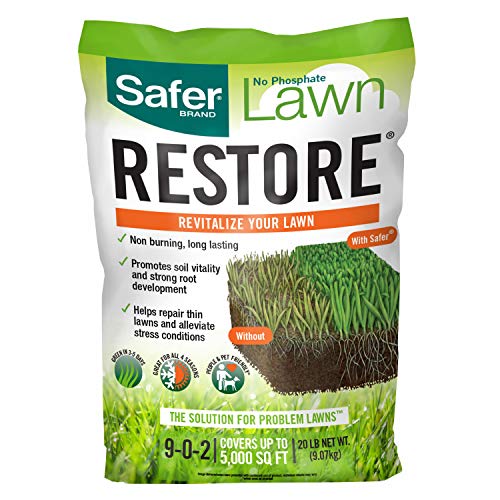
Safer Brand’s Lawn Restore uses a naturally derived 9-0-2 formula that will not burn the lawn or strip soil of beneficial organisms. The granules contain corn gluten, which acts as a pre-emergent weed suppressant — a useful side effect when applied after aeration, since open soil is a prime target for weed seeds.
Users report visible greening within three to five days, and the non-toxic composition means children and pets can walk on the lawn immediately after application. The 22-pound bag covers 5,000 square feet, and the slow-feed nature of the organic ingredients aligns well with the sustained root contact that aeration provides.
The corn gluten component is a double-edged sword: it prevents weed germination, but it also inhibits grass seed germination. If you plan to overseed immediately after aeration, you need to wait two to three weeks after applying this product. This is a strong choice for lawns that only need fertilization, not renovation.
What works
- Naturally derived formula is safe for pets and children immediately after application
- Corn gluten content provides pre-emergent weed control alongside feeding
- Non-burning composition reduces the risk of misapplication damage
What doesn’t
- Corn gluten inhibits grass seed germination, complicating overseeding plans
- Lower nitrogen ratio produces a gentler green than synthetic high-N formulas
7. The Andersons Premium New Lawn Starter 20-27-5
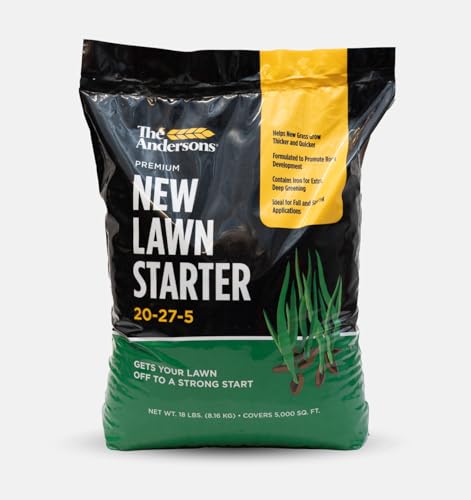
The Andersons starter formulation delivers a 20-27-5 NPK ratio with a heavy phosphorus kick designed for root establishment. This is the fertilizer to use when your aeration is paired with overseeding or when you are renovating a thin lawn into a thick one. The phosphorus drives seedling root development, and the 1 percent iron adds a visible greening boost.
This granular product contains both quick-release and slow-release nitrogen, so new grass gets an immediate energy supply while the longer-lasting fraction sustains growth over several weeks. The 18-pound bag covers 5,000 square feet, and owners consistently report germination within just over a week when used alongside proper watering.
The high phosphorus content is excellent for new turf but unnecessary for established lawns that do not need root stimulation. Overuse can contribute to phosphorus runoff, so this should be reserved specifically for the season when you are actively establishing fresh grass. For that specific purpose, the Andersons formulation is hard to beat.
What works
- High phosphorus ratio dramatically boosts seedling root development
- Dual-release nitrogen feeds new grass immediately and over time
- Iron additive provides deep greening that lasts through establishment
What doesn’t
- High phosphorus is unnecessary and wasteful for established lawns
- Small bag size limits coverage for larger renovation projects
Hardware & Specs Guide
Nitrogen Release Mechanisms
The key distinction in post-aeration fertilizers is how nitrogen is released. Quick-release nitrogen (ammonium nitrate or urea) dissolves in soil moisture within hours, giving an immediate green flush. Slow-release nitrogen (sulfur-coated urea, polymer-coated prills, or methylene urea) breaks down over weeks via microbial activity or moisture diffusion. A blend of both — typically a 70/30 or 60/40 split — is ideal after aeration because the quick portion feeds the roots while the slow portion continues feeding as the aeration holes close up.
NPK Ratios and Seasonal Targeting
The three numbers on a fertilizer bag represent nitrogen (N), phosphorus (P), and potassium (K) by percentage. For fall aeration, a ratio around 20-27-5 supports root growth before winter. For spring aeration, a high-nitrogen ratio like 28-0-0 or 27-0-5 drives leaf and blade development. A summer stress blend like 7-0-20 with elevated potassium helps lawns endure heat and drought. Matching the ratio to the season is the difference between a successful application and a wasted one.
FAQ
How soon after aeration should I apply fertilizer?
Should I use liquid or granular fertilizer after aeration?
Can I apply weed and feed fertilizer after aeration?
Should I water after applying fertilizer post-aeration?
Is it okay to overseed and fertilize at the same time after aeration?
Final Thoughts: The Verdict
For most gardeners, the best fertilizer after aeration winner is the GreenView Fairway Formula because its 63 percent slow-release nitrogen feeds the lawn steadily for 12 weeks without a single surge-and-fade cycle. If you want a fast-acting liquid that works with a hose-end sprayer, grab the Sunday Lawn Kickstart. And for a complete biological soil feed that goes beyond basic NPK, nothing beats the Urban Farm Liquid Lawn.