
Specs are compiled from manufacturer listings and verified buyer reviews and can change over time — please confirm the key details on the product page before buying.
Sticking a finger into the soil and guessing if it’s dry enough to water is a gamble that kills more houseplants than almost anything else. A proper soil moisture sensor replaces your fingertip with a clear, objective reading — so you know exactly when to water and when to wait, no guesswork involved.
I’m Rikta — the founder and writer behind Lawn Gear Lab. This guide is built by comparing the manufacturers’ published specifications and the patterns across verified customer reviews, so you get each pick’s real strengths and trade-offs instead of marketing spin.
You need a soil moisture sensor that tells you when to water without guesswork. The four models here range from no-battery analog probes (a simple metal rod that reads moisture without power) to leave-in sticks that change color, so you can match one to your potted plants, garden beds, or indoor jungle.
Quick Picks
- Dr.meter Soil Moisture Meter Tester for Plants, Long Probe Hygrometer — Best Overall
- Sustee Aquameter (2 Green, Medium) – Plant Soil Moisture Meter — Best for Continuous Monitoring
- XLUX Soil Moisture Sensor Meter Water Monitor, 2 Pack — Top Performer
- IPPINKA Sustee Aquameter, Set of 4, Plant Soil Moisture Sensor (Green, Medium) — Best Multi-Pot Pick
How To Choose The Best Soil Moisture Sensor
The right sensor depends on your pot size, how often you water, and if you want a reading on demand or a constant visual cue. These three factors separate a handy tool from a wasted countertop ornament.
Instant-Read Probe vs. Leave-In Stick
An instant-read probe (like the XLUX or Dr.meter) needs to be pushed into the soil, read within a few minutes, then removed and wiped clean. That works great for a quick check once or twice a week. A leave-in stick (like the Sustee Aquameter) stays in the pot 24/7 and changes color — white means dry, blue means wet — so you can glance at it as you walk by. If you want continuous monitoring without lifting a finger, pick a leave-in sensor.
Probe Length and Pot Size
Deeper pots need a longer probe to reach the root zone rather than just measuring surface moisture. The Dr.meter checks deep watering because of its thin, long probe. The Sustee Aquameter is sized for pots 3.5 to 6 inches deep. If you have large floor plants or an outdoor garden bed, a longer probe is almost always worth it.
Durability and Care
Analog probe meters have a metal tip that can bend or corrode if left in the soil too long or jammed into hard ground. Several buyers report that dropping the meter can break the internal connection, causing false readings. Leave-in sticks don’t share that fragility, but their refillable core lasts about 6–9 months before needing a swap. Pick the care routine you’re more likely to stick with.
Quick Comparison
On smaller screens, swipe sideways to see the full table.
| Model | Best For | Type | Probe Length | Batteries | Amazon |
|---|---|---|---|---|---|
| Dr.meter S10Plus | Deep-potted houseplants & outdoor beds | Analog probe (single) | Long | None | Amazon |
| Sustee Aquameter (2-pack) | Leave-in, continuous monitoring for medium pots | Leave-in stick | Medium (7.09 in) | None | Amazon |
| XLUX T10#2 (2-pack) | Budget-friendly, instant-read for multiple plants | Analog probe (single) | — | None | Amazon |
| IPPINKA Sustee 4-pack | Plant parents with many small-to-medium pots | Leave-in stick | Medium (7.09 in) | None | Amazon |
In‑Depth Reviews
1. Dr.meter Soil Moisture Meter Tester for Plants, Long Probe Hygrometer

The thin, long probe that reaches deep without disturbing roots.
The Dr.meter earns its spot because its single long probe reaches deep into pots, raised beds, or outdoor garden soil — unlike shorter meters that only measure near the surface, so you check moisture at the root zone where it actually matters. The color-coded dial — red for dry, green for moist, blue for wet — is about as simple as it gets: no experience required. Owners mention it works instantly with no battery, making it a reliable grab-and-go tool for anyone with deep containers. skip it if you need a constant visual cue rather than a spot-check probe.
Customers note that the meter arrived slightly bent in some cases and worked temporarily before failing, so it pays to inspect the tip on arrival. Others note it bends further if pushed into very hard soil. But the majority of owners say the long probe is excellent for checking deep watering and that the device helped keep picky plants like Monstera alive. At 0.13 Kilograms versus the Sustee Aquameter at 0.01 Kilograms, it has a noticeably weightier analog gauge.
The catch is fragility. Drop it and the internal connection can break, producing false dry readings. If you handle it with care — wipe the tip after each use, avoid pressing too hard from the top — it will outlast many cheaper plastic alternatives.
What Works
- Long, thin probe reaches deep roots without digging up much soil
- Color-coded dial with ten scales is instantly readable
- No batteries or electricity required
Watch Out For
- Arrived slightly bent in some shipments; inspect before first use
- Bends easily in wet or hard soil if the initial unit is damaged
- Dropping it can break the internal connection, causing false dry readings
Reach for it if: you have deep pots, raised beds, or outdoor plants and want a cheap, no-battery probe that checks moisture below the surface.
Think twice if: you tend to drop tools or have very hard, rocky soil; the thin probe can bend.
2. Sustee Aquameter (2 Green, Medium) – Plant Soil Moisture Meter
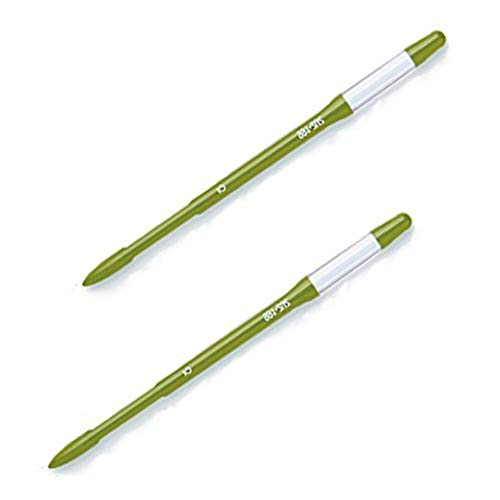
A leave-in stick that changes color so you never have to guess again.
This is the set that turns your plant care into a glance-and-go routine. You insert the Sustee Aquameter into the soil — it works best in pots sized 3.5, 4, 5, and 6 inches — and leave it there. White means the soil is dry; blue means it has been watered. No batteries, no dials, no bending over to read a needle.
Reviewers point out that each stick will last for approximately 6–9 months before the refillable core needs replacing, and that the design drastically reduced overwatering and underwatering in their plants. At 0.01 Kilograms versus the Dr.meter probe at 0.13 Kilograms, it is a featherweight. Its dimensions of 0.39 inches wide by 7.09 inches tall give it a trim profile that slides into snug soil pockets without disturbing roots.
The trade-off is temperature range. Sustee is rated for up to 104 Degrees Fahrenheit, while the XLUX handles 150 Degrees Fahrenheit. If you keep pots in a hot greenhouse or a sun-baked porch, the Sustee may degrade faster.
What Works
- Leave-in design provides continuous monitoring without taking the probe out
- Clear color indicator (white = dry, blue = wet) is easy to read from a distance
- Refillable core; each stick lasts 6–9 months
- Made in Japan, developed in collaboration with Tokyo University of Agriculture
Watch Out For
- Upper temperature limit of 104°F — not ideal for very hot greenhouses
- Works best in soils with good water retention; may not read accurately in loose, fast-draining mixes
Grab these if: you want to see soil moisture at a glance without poking a probe into the dirt every time.
pass on it if: your pots are in direct, intense sunlight that pushes soil temperature above 104°F.
3. XLUX Soil Moisture Sensor Meter Water Monitor, 2 Pack
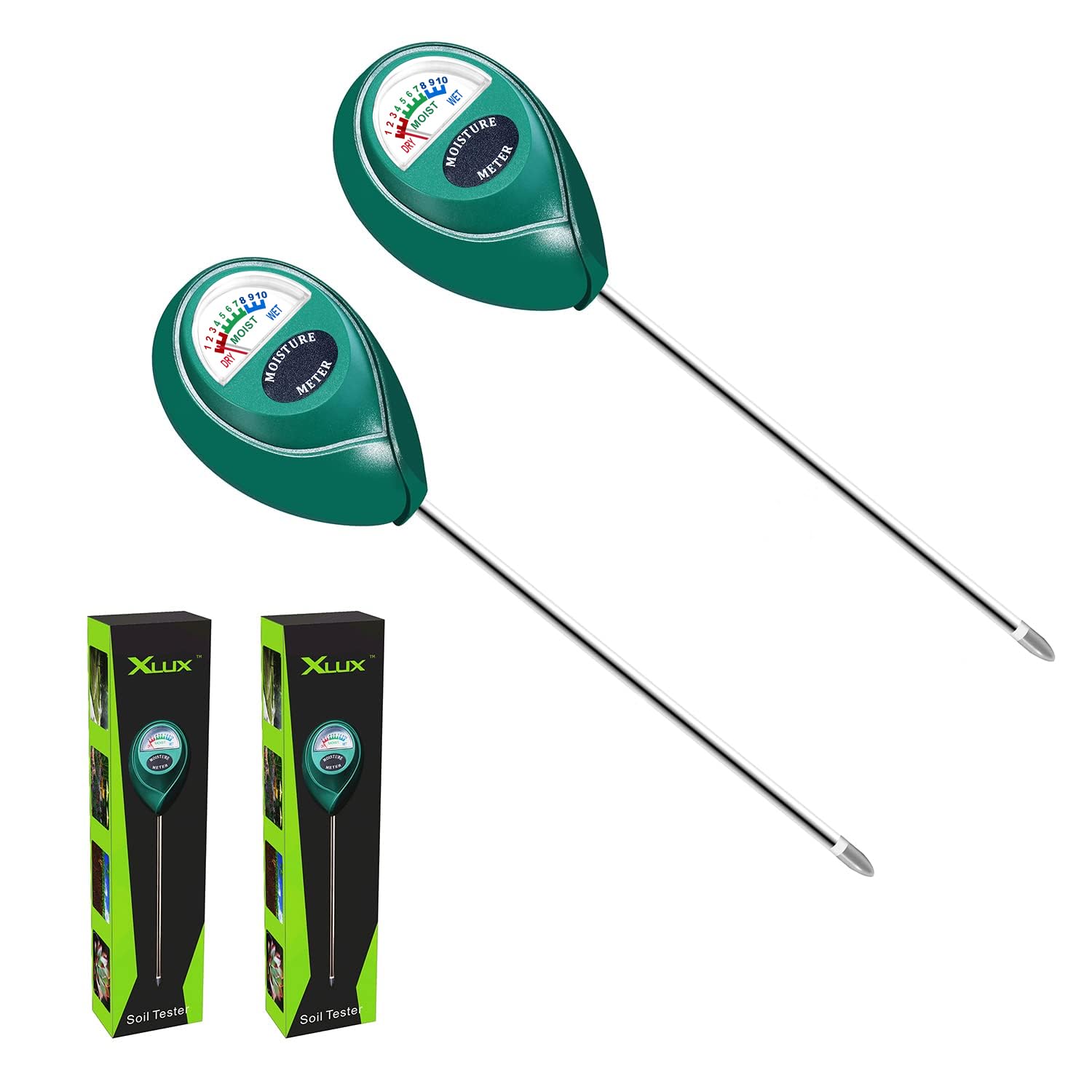
The budget champion that gives you two meters for the price of one.
The XLUX delivers a no-frills, instant-read moisture reading for indoor pots or garden beds and comes as a 2-pack — one for your favorite houseplant and one for the outdoor tomato patch. The large dial uses three color-coded zones and ten scales so you can tell at a glance whether the soil is dry, moist, or wet. A single-probe design causes less damage to roots than double-prong meters.
A critical note from buyers: do not leave this moisture meter in the soil for more than 5 minutes, as the metal tip will gradually corrode. That makes it an on-demand tool rather than a set-and-forget sensor. At 3.5 Ounces and dimensions of 2 inches wide by 1.6 inches deep, it is noticeably wider and boxier than the Sustee sticks, but also sturdier in hand. The upper temperature range of 150 Degrees Fahrenheit is a clear advantage over the Sustee’s 104°F for handling sun-baked garden soil.
Buyers also warn that dropping it can break the internal connection, leading to false dry readings. But for the price of a coffee and a sandwich, two meters that clearly show deep versus surface moisture are a solid deal.
The real verdict: a reliable, instant-read probe that works best when you treat it as a weekly check-in tool — insert, wait 5 minutes, read, remove, and wipe.
Perfect for: anyone starting out with houseplants or container gardening who wants a clear, cheap, and battery-free moisture check.
Not for: people who want a leave-in sensor or tend to forget to pull the probe out after a few minutes.
4. IPPINKA Sustee Aquameter, Set of 4, Plant Soil Moisture Sensor (Green, Medium)

Four leave-in sticks that turn a whole windowsill into a no-guess zone.
If you have a collection of plants across your home, the 4-pack Sustee Aquameter lets you monitor them all at once. Each stick stays in the soil (for pots 3.5 to 6 inches in diameter) and shows white when the soil is dry, blue when it has been watered. Shoppers say that these sticks helped save potted plants that were dropping leaves from over-watering and that even kids can help monitor the color changes.
Buyers also confirm the same 6–9 month lifespan per stick before the refillable core needs swapping. At 0.02 Kilograms and dimensions of 0.39 inches wide by 7.09 inches tall, these are the slimmest option in the list — they disappear into the soil and leave only a small green cap visible. They are also the most expensive set, designed for the avid plant owner who wants protection across multiple pots without maintaining a separate probe for each one.
The same temperature caveat applies: rated 104 Degrees Fahrenheit, so keep them out of direct, roasting sun. But for a tidy indoor setup — succulents, tropicals, herbs — these deliver the easiest ongoing care.
Bottom line: buy this set if you own 4+ small-to-medium pots and want a one-and-done monitoring system that needs attention only when the core runs out.
Best for: plant parents with a growing collection of medium pots who prefer a visual indicator over a manual probe.
it’s not for you if: you have large pots above 6 inches deep or hot outdoor conditions above 104°F.
Understanding the Specs
Probe Type: Analog vs. Leave-In
An analog probe (like the XLUX and Dr.meter) gives you a specific reading on a dial when you insert it into the soil. You remove it after a few minutes and wipe it clean. A leave-in stick (like the Sustee Aquameter) stays in the dirt permanently and changes color based on moisture — white for dry, blue for wet. Neither needs batteries.
Single-Probe Design
Most soil moisture sensors use one metal probe (single) or two (double). A single probe disturbs less soil and causes less damage to sensitive roots when you push it in and pull it out. Double probes can lift more dirt and risk tearing fine root hairs.
FAQ
Can I leave an analog soil moisture meter in the soil permanently?
How long does a Sustee Aquameter stick last before needing replacement?
Will a soil moisture sensor work in very hard or rocky soil?
Do I need batteries for any of these moisture sensors?
What pot sizes work best with the Sustee Aquameter?
Can I use a soil moisture sensor in water or liquids?
What does a white color on the Sustee Aquameter mean?
Why does my analog moisture meter show a false dry reading even when the soil is wet?
Can I use a Sustee Aquameter in a greenhouse or outdoor pot?
Which sensor is best for a plant newbie who keeps overwatering?
Final Thoughts: The Verdict
For the majority of shoppers, the best soil moisture sensor is the Dr.meter because its long, single probe reaches deep roots without batteries and its color-coded dial is easy to read. If you want continuous leave-in monitoring with a glance-and-go approach, grab the Sustee Aquameter 2-pack. And for budget-conscious plant parents with multiple pots, the XLUX 2-pack delivers two reliable instant-read meters at a low cost that still handle hot soil up to 150°F.
How We Picked
We do not accept paid placement, and we did not hands-on test every unit. Instead, we match each pick to a real buyer and use-case by comparing the manufacturers’ published specifications against the patterns in verified customer reviews — so you get each pick’s real strengths and trade-offs instead of marketing copy.
Sources & Methodology
Specifications: manufacturer listings and product documentation. Review insights: verified customer reviews, as of July 2026. Pricing: not shown on this page (it changes often); check the current price via the retailer link.
As an Amazon Associate, Lawn Gear Lab earns from qualifying purchases. This does not affect which products we feature.