
Specs are compiled from manufacturer listings and verified buyer reviews and can change over time — please confirm the key details on the product page before buying.
The hidden layer that keeps a glass garden alive and not turning into a swamp is the soil beneath the surface. Many first-time builders grab standard potting mix from the garage and end up with mold, fungus gnats, or collapsed roots. This guide runs down three ready-to-use blends that handle drainage, aeration, and moisture differently, so you can match the right mix to your plants and avoid the rot cycle.
I’m Rikta — the founder and writer behind Lawn Gear Lab. This guide is built by comparing the manufacturers’ published specifications and the patterns across verified customer reviews, so you get each pick’s real strengths and trade-offs instead of marketing spin.
The right choice depends on whether you run a closed humid terrarium or an open dry one. Here is how three top blends compare for the soil for terrarium that keeps your mini garden healthy.
Our Picks at a Glance

How To Choose The Best Soil For Terrarium
Choosing the wrong soil is the single fastest way to kill a terrarium. Regular potting soil holds too much water and lacks the air pockets that roots need inside a container with no bottom drain. You need a specific blend that balances three things: drainage (to avoid root rot), moisture retention (to keep humidity up), and enough aeration so the roots don’t suffocate in a closed jar.
Drainage and Aeration
Look for ingredients like pumice, perlite, or pine bark. These are lightweight particles that create tiny air channels in the soil. Without them, water sits between the soil particles and the roots drown over time, which is the most common failure in closed terrariums that have no evaporation path.
Moisture Control and Charcoal
Horticultural charcoal is a critical ingredient. It absorbs impurities and helps keep the soil from turning sour and smelly when it stays damp for days. Coco coir is another key component — it holds moisture evenly without becoming waterlogged, unlike peat moss which can repel water when it dries out completely. A blend that has both charcoal and coco coir will keep the environment stable longer.
Open vs Closed Terrariums
Closed terrariums trap humidity and condensation, so the mix needs more coarse material (like pumice and bark) to keep the soil from getting compacted. Open terrariums dry out faster, so the mix can include more moisture-holding ingredients like peat moss or coco coir without getting soggy. Always match the blend to the type of container you intend to use.
Quick Comparison
| Model | Best For | Volume | Key Ingredients | Weight | Amazon |
|---|---|---|---|---|---|
| Soil Sunrise Terrarium Mix★ Best Overall | Beginner open terrariums | 4 Quarts | Coco coir, charcoal, pumice | 0.71 kg | Amazon |
| DUSPRO Premium 6in1 Mix | Closed terrariums with varied plants | 8 Quarts | Coco coir, peat moss, pine bark, perlite, pumice, zeolite | — | Amazon |
| Josh’s Frogs Sprig & Stone | Open and closed humid terrariums | 4 Quarts | Coir, peat, vermiculite, charcoal | 0.87 kg | Amazon |
In‑Depth Reviews
1. Soil Sunrise Terrarium Potting Soil Mix (4 Quarts)
Our pick — over 4.5★ from 550+ verified ratings; the strongest balance of quality and price.
The three-ingredient starter blend that is lightweight, affordable, and works for open terrariums.
Soil Sunrise keeps the recipe simple: coco coir, horticultural charcoal, and pumice. That is it — no peat, no bark, no vermiculite. The advantage of this minimal approach is you get a mix that drains well and does not hold excess water, which makes it a safer choice for open terrariums where evaporation happens fast. The coco coir holds water evenly when it is wet, but because there is no peat, it rehydrates quickly if it dries out instead of forming a hard crust on top.
One thing buyers notice right away is how light the bag feels — 0.71 kilograms total. Some reviewers were caught off guard because they expected a heavier garden soil texture. The mix is mostly coco coir and pumice, so it looks and feels similar to peat moss when dry. One buyer even commented that “it’s been set up for about four months and is thriving,” which is a good sign that the basic drainage and aeration are working long-term. Unlike the Josh’s Frogs blend which includes vermiculite for moisture retention, this one is more forgiving if you tend to water sparingly because excess water passes through quickly.
The 4-quart volume is enough for three 6-inch pots, giving you some leftover for smaller containers. If you are building a dry or semi-open terrarium with succulents or cactus, this blend is likely a better fit than the DUSPRO mix which is tuned for closed, high-humidity containers. The lack of peat moss means it is also a better choice for carnivorous plants that are sensitive to peat-related rot.
Three reasons to buy it
- Very lightweight bag at only 0.71 kg, easy to handle and ship
- Simple three-ingredient blend with no peat, reducing the risk of crusting
- Works well for open terrariums and dry-loving plants like succulents
The honest limitations
- Not suitable as a standalone soil for closed terrariums where humidity and moisture retention are critical
- Light texture can be surprising if you expect a heavier, soil-like feel
Grab it if: You are building an open terrarium or using mostly succulents/cacti, and you want a mix that drains fast without breaking the budget.
Look elsewhere if: You are building a closed terrarium that needs steady humidity, because the lack of moisture-retaining vermiculite or peat may cause it to dry out too fast.
2. Josh’s Frogs Sprig & Stone Terrarium Soil (4 Quart)
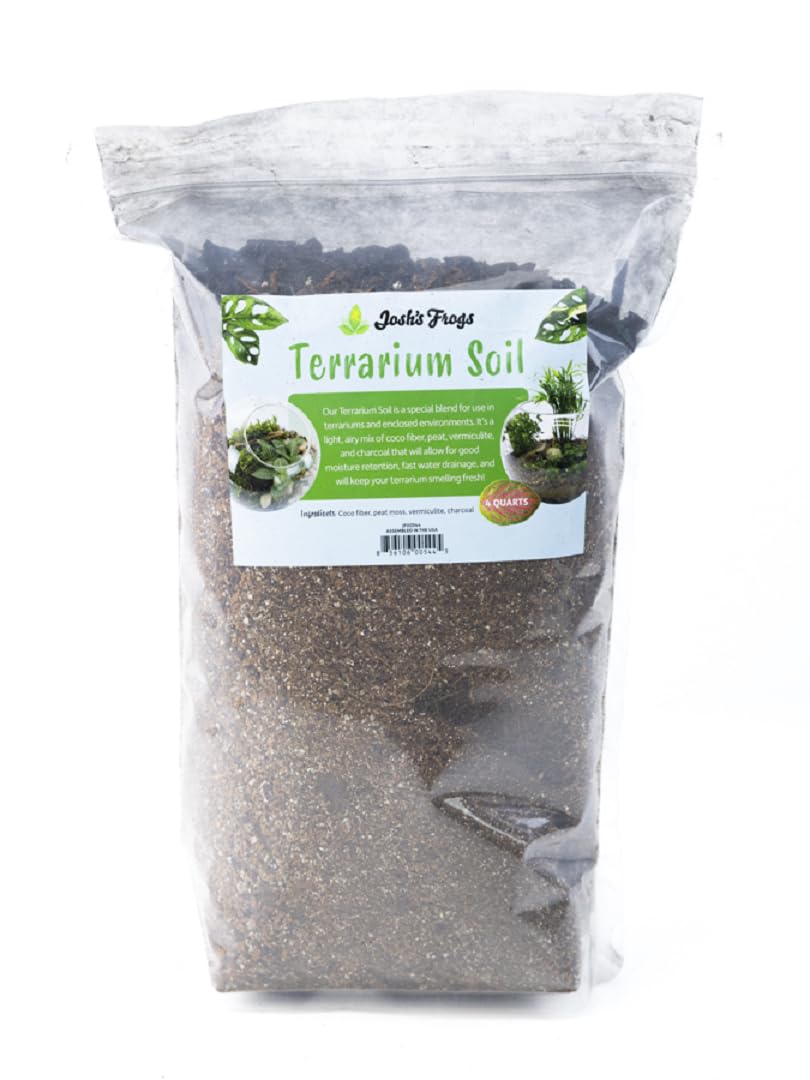
The heavy-duty mix that prevents root rot while keeping humidity high for delicate plants.
Josh’s Frogs built this blend specifically for glass terrariums, so it handles the two biggest threats: overwatering and stale air. The formula uses coir, peat, vermiculite, and charcoal together to achieve a quick-draining texture that does not stay wet, but still holds enough moisture to keep humidity stable in a closed jar. Buyers report that a terrarium set up with this soil has stayed healthy for months without mold forming on the soil surface.
Unlike the DUSPRO mix which feels lighter and bark-heavy, this one is noticeably denser. That extra weight comes from the vermiculite and charcoal components that give the soil a more substantial structure for supporting larger plants. The charcoal also works to keep the smell fresh by discouraging anaerobic (oxygen-free) conditions that cause the typical sour terrarium odor.
This mix works for both open and closed terrariums, making it more versatile than mixes designed for only one type. The “Sprig & Stone” line also includes formulas for more specialized plants like Bromeliads and Succulents, which tells you the brand understands how different species need different soil chemistry. If you plan to mix several plant types in one container, this is the safest starting base.
Three things it does well
- Quick-draining texture prevents root rot in enclosed glass containers
- Vermiculite and charcoal keep the soil loose and reduce compaction over time
- Versatile enough for both open and closed terrarium setups
The trade-offs to know
- Heavier bag than the alternatives, so shipping cost may be higher
- Not ideal for succulents that need a very dry and sharp-draining mix without peat
Reach for this if: You want a safe, tested blend that works across most terrarium types, and you prefer a denser soil structure that holds its shape.
skip it if: You are building a dry terrarium with only succulents and need a lighter, grittier mix without moisture-retaining vermiculite.
3. DUSPRO Premium 6in1 Terrarium Soil Mix
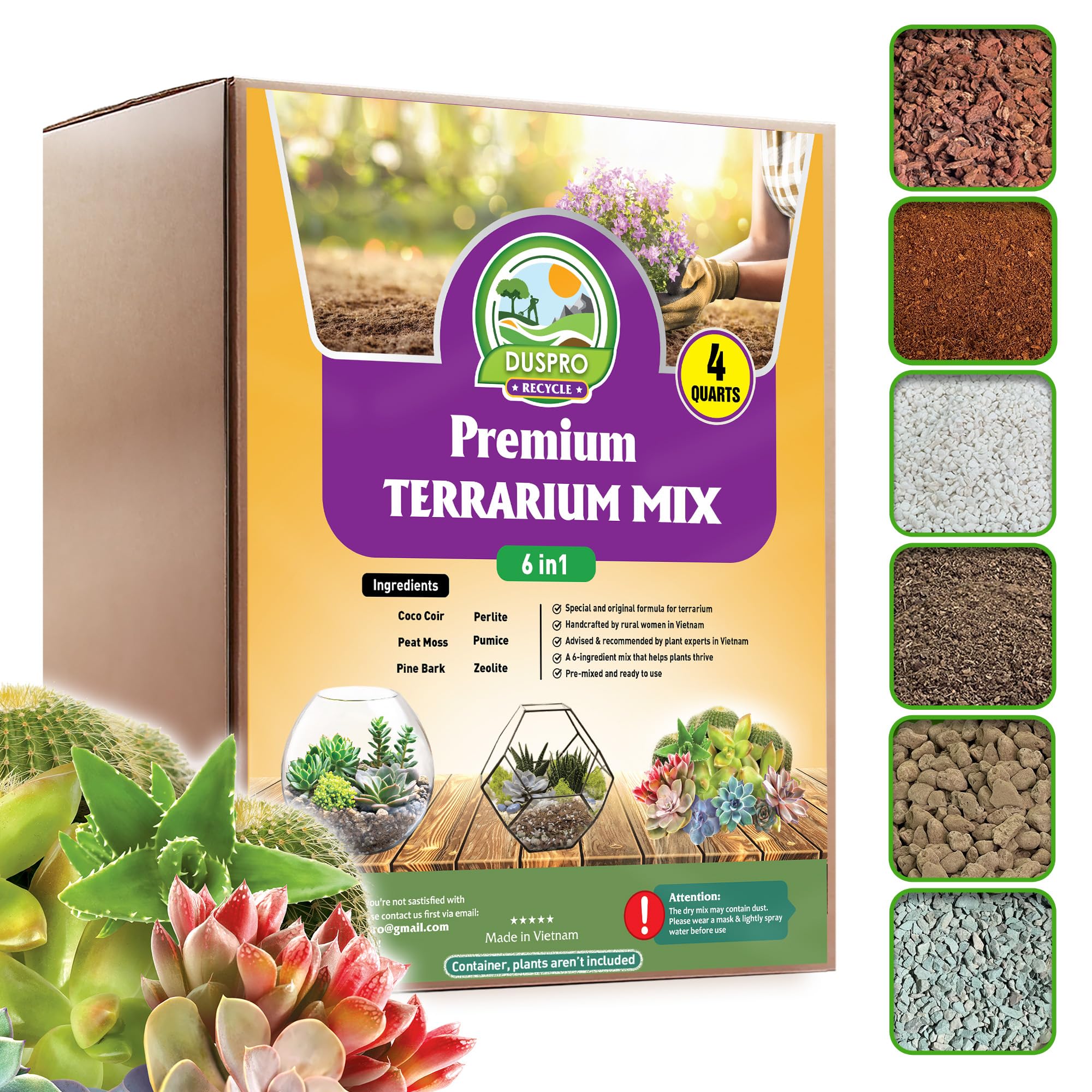
The six-ingredient blend engineered for closed containers that stay moist for weeks.
DUSPRO built this mix specifically for closed and semi-closed terrariums, where the lid traps humidity and soil stays damp much longer than open setups. The key difference here is the inclusion of zeolite, a mineral that helps maintain soil structure over time by preventing the particles from settling into a hard, compacted layer. Combined with pine bark and perlite, this creates the air spaces that roots need to breathe even when the container has no ventilation holes.
This is a pre-mixed bag that you use straight out of the bag — no measuring, no blending separate components. It contains six ingredients: coco coir, peat moss, pine bark, perlite, pumice, and zeolite. That is more components than the three-ingredient Josh’s Frogs mix, which gives it a more complex structure. The peat moss helps with moisture retention, while the bark and pumice ensure water does not pool at the bottom. Owners mention it is also a good beginner kit because it leaves leftover materials for a second project.
Compared to the Soil Sunrise blend, this one is heavier on bark and perlite, so it feels lighter in the hand but has better drainage. It is formulated for common terrarium plants like fittonia, mini peperomia, pilea, and moss, which makes it a solid choice if you are planting a mixed-species closed terrarium. The humidity control feature mentioned in its specs means it is designed to release moisture slowly rather than holding it all at the top layer.
What stands out
- Six-ingredient blend includes zeolite to stop soil compaction
- Ready to use straight from the bag — no mixing required
- Ideal for closed and semi-closed terrariums that trap humidity
Where it falls short
- Some buyers reported the bag can leak media during shipping if not handled carefully
- Not the best choice for open terrariums where the mix would dry out too fast
Best pick for: Anyone building a closed terrarium with moisture-loving plants like ferns and moss, who wants a complete blend that does not require separate amendments.
Consider the trade-off: The pine bark pieces can be uneven in size, so if you want a finer-grained soil for small containers, you may need to sift it first.
Understanding the Specs
Coco Coir vs Peat Moss
Coco coir comes from coconut husks and holds water evenly while breathing well. Peat moss holds more water but can become hydrophobic (water-repellent) when it dries out completely. In a terrarium, coco coir is generally safer because it rehydrates easily. Peat moss is useful for closed terrariums where you want the soil to stay damp longer.
Horticultural Charcoal
Charcoal acts as a filter inside the soil, absorbing toxins and impurities that build up in a closed environment without drainage. It also helps prevent the sour, stagnant smell that happens when bacteria break down organic matter in low-oxygen conditions. Any reliable terrarium soil should include it as part of the blend.
FAQ
Can I use regular potting soil for a terrarium?
What is the difference between open and closed terrarium soil?
How much soil do I need for a terrarium?
Does terrarium soil expire?
Can I mix different terrarium soils together?
Why does my terrarium soil smell bad?
Is peat moss good for terrariums?
Can I use this soil for carnivorous plants?
What is the best soil for a closed terrarium with ferns?
Should I add a drainage layer below the soil?
Final Thoughts: The Verdict
For the majority of shoppers, the soil for terrarium winner is the Josh’s Frogs Sprig & Stone because it balances drainage and moisture retention for both open and closed containers, and the vermiculite-charcoal blend keeps the soil fresh longer than simpler mixes. If you want a complete six-ingredient mix for a closed terrarium with high humidity, grab the DUSPRO Premium 6in1. And for a straightforward, budget-friendly option that drains fast for succulents and open terrariums, the Soil Sunrise blend gives you reliable results with no unnecessary extras.
How We Picked
We do not accept paid placement. Every pick is matched to a real buyer and a real use-case; we do not hands-on test units.
Sources & Methodology
Specifications: manufacturer listings and product documentation. Review insights: verified customer reviews, as of July 2026. Pricing: not shown on this page (it changes often); check the current price via the retailer link.
As an Amazon Associate, Lawn Gear Lab earns from qualifying purchases. This does not affect which products we feature.