
Specs are compiled from manufacturer listings and verified buyer reviews and can change over time — please confirm the key details on the product page before buying.
Getting tomato and pepper seeds to sprout in a cool basement or chilly spring room often feels like a gamble—you wait two weeks for nothing. A seedling heat mat solves that by gently warming the root zone, which wakes up dormant seeds and gets them growing fast. The catch is that not every mat actually holds the temperature you need, and some can even scorch tender young roots if they run too hot.
I’m Rikta — the founder and writer behind Lawn Gear Lab. This guide is built by comparing the manufacturers’ published specifications and the patterns across verified customer reviews, so you get each pick’s real strengths and trade-offs instead of marketing spin.
if you want a simple waterproof pad or a digital controller that holds an exact temperature, this roundup of the best seedling heat mat options will help you match the right mat to your grow setup and the seeds you are starting.
Our Picks at a Glance
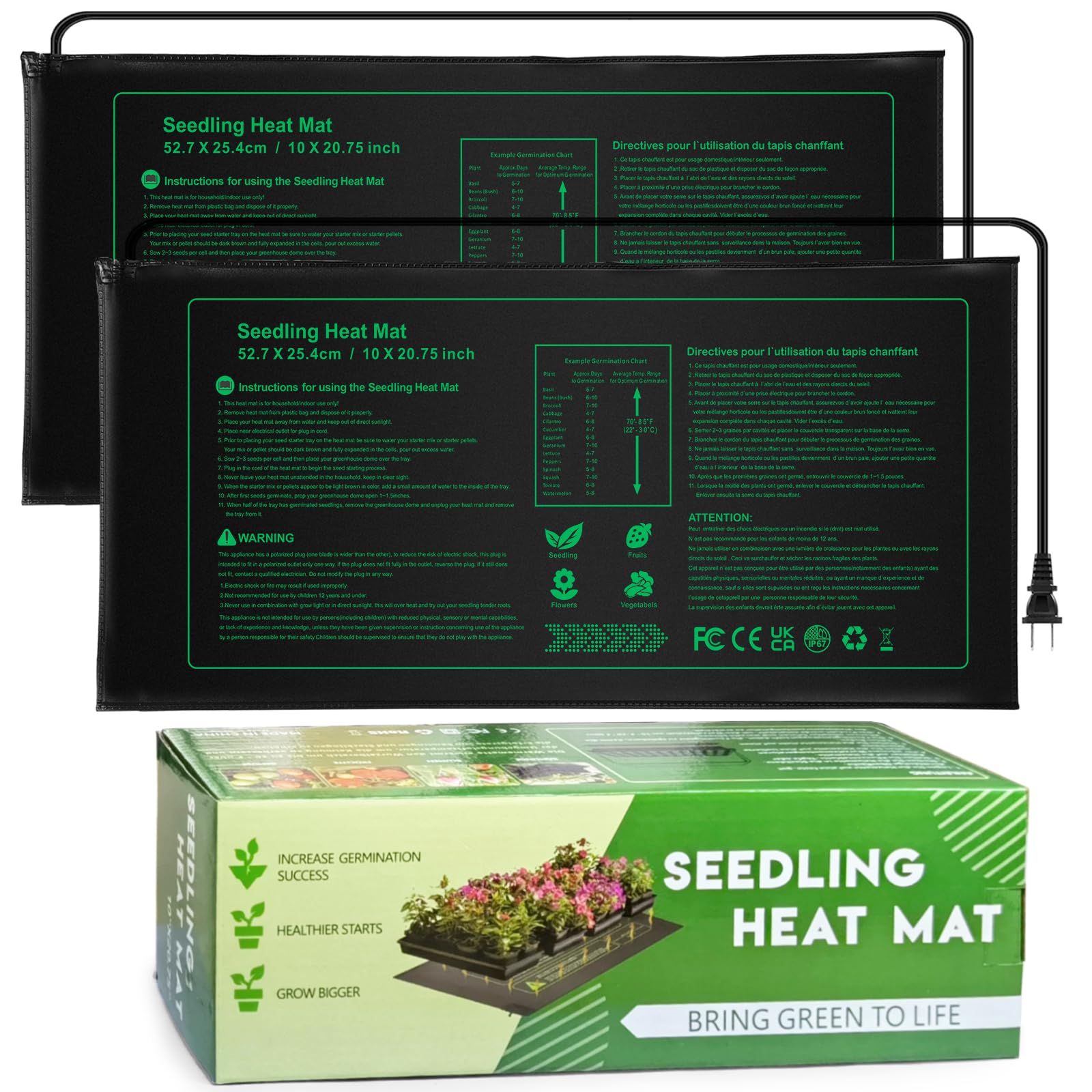

How To Choose The Best Seedling Heat Mat
Picking a heat mat depends on a few key decisions: do you want a simple pad that you just plug in, or a controller model that lets you dial in an exact temperature? Your answer depends on the number of trays you run and how finicky your seeds are about warmth.
Size and Tray Fit
A standard 10″ x 20″ mat sits under a single 1020 nursery tray. If you plan to start many trays at once, look for a single larger mat or a twin pack so each tray gets its own even heat zone without cold edges.
Waterproof Rating
Waterproof ratings (such as IPX4 and IP67) tell you how well the mat resists moisture. An IPX4 rating handles splashes—fine for careful watering. An IP67 rating means the mat can survive a short submersion and is much safer to scrub clean without worrying about short circuits.
Temperature Control
Basic mats with no thermostat will raise the soil roughly 10-20°F above room temperature, which works for many common veggies. If you grow heat-sensitive species like peppers or want precise germination rates, a mat with an adjustable thermostat (digital or dial) stops the mat from overheating and wasting power.
Quick Comparison
| Model | Best For | Wattage | Size | Waterproof | Amazon |
|---|---|---|---|---|---|
| NAMOTEK 2 Pack★ Best Overall | Budget 2-Pack For Value | 18W (per mat) | 10″ x 20″ | IPX4 | Amazon |
| AC Infinity SUNCORE H3Also Great | Precise Digital Control | 20W | 10″ x 20.75″ | IP67 | Amazon |
| AC Infinity SUNCORE A3X2 | Two-Mat Setup With Dial | — | 10″ x 20.75″ (x2) | IP67 | Amazon |
| VIVOSUN 20″x20.75″ | Built-in Digital Thermostat | — | 20″ x 20.75″ | IP67 | Amazon |
| LUXBIRD 2 Pack | Low Wattage Efficiency | 21W | 10″ x 20.75″ | IP67 | Amazon |
| iPower 2 Pack | Standard 2-Pack Reliability | — | 10″ x 20″ | Waterproof | Amazon |
| Higoro 2 Pack | Entry-Level 2-Pack | 21W | 10″ x 20.75″ | IP67 | Amazon |
In‑Depth Reviews
1. NAMOTEK 2 Pack
Our pick — over 4.5★ from 950+ verified ratings; the strongest balance of quality and price.
An affordable two-pack with 18W per mat—less wattage than the 21W Higoro mats but still gets the job done.
Each mat measures 10″ x 20″ and draws 18 watts. They carry an IPX4 waterproof rating (protected against splashing water from any direction), which is good enough for careful watering but less sturdy than the full-submersion IP67 rating on higher-end models. The mats are made of heavy-duty PVC. One buyer report noted that “soil temp reached 95°F when mats were stacked, confirming effectiveness for seed germination.” Another reviewer mentioned one mat felt less warm than the other, so batch consistency is not guaranteed.
These mats have no indicator light and no thermostat, so you just plug them in and let them run. They heat up quickly and are easy to roll up for storage. Unlike the AC Infinity A3X2 which gives you dual mats each with its own adjustable dial control, the NAMOTEK offers a simpler design with no heat adjustment—you low-maintenance. The NAMOTEK draws 18W while the Higoro draws 21W, so the Higoro will run slightly hotter in the same conditions.
Pure and simple: If you just need a cheap two-pack to start a few trays of standard garden vegetables, the NAMOTEK works without any extra complexity.
Trade-off: No waterproof rating beyond splashes, no indicator light, and no temperature control—you get what you plug in.
Ideal for: Budget-minded gardeners who want a pair of mats for common vegetable seeds and do not need precise temperature control.
Not for: Anyone working in a damp environment who needs a high waterproof rating, or someone who wants even heat consistency across both mats.
2. AC Infinity SUNCORE H3
The H3 removes guesswork with a digital display that shows real-time mat temperature.
This single 10″ x 20.75″ mat uses a far-infrared film (a special heating layer that warms up faster than standard coiled wire mats) and distributes the heat evenly so no spot gets too hot. The big advantage here is the digital thermostat controller. You set the exact temperature you want and the mat holds it, which is critical for germinating rare or fussy seeds that need a precise level of warmth to sprout.
The mat has an IP67 waterproof rating (meaning it can be submerged briefly in water without damage) and the quad-layer PVC is flexible and easy to wipe clean. Buyers report it works perfectly for keeping tomatoes and peppers warm indoors. A few owners mention that the built-in temperature reading can be off by a few degrees—one owner said they had to set it to 102°F to get a soil temp of 78-80°F, so pairing it with a separate soil probe is wise if you need exact results. Unlike the AC Infinity A3X2 dial version below, this one uses a digital display for finer adjustments.
Precision matters: If you are growing heat-sensitive seeds and want to dial in the exact warm zone, the H3 gives you the digital control that basic mats lack.
Not perfect for every room: In a very cold basement you may need insulation underneath (like plywood or bubble wrap) to help it reach higher soil temps.
Your best pick if: You want to set a specific temperature and have a digital readout to confirm it. Great for rare seeds, peppers, and indoor garden enthusiasts.
Look elsewhere if: You only want a simple no-adjustment mat to speed up common vegetable seeds in a warm room.
3. AC Infinity SUNCORE A3X2

Dual mats with a simple dial control that is as close to set-and-forget as it gets.
This bundle gives you two 10″ x 20.75″ mats, each with its own adjustable heat controller that uses a dial (low, medium, high) instead of a digital screen. The mats use the same far-infrared heating film as the H3, so they warm up fast—one reviewer noted they hit temperature in about 10 minutes on medium—but the control is done by turning a knob rather than setting a number. The IP67 quad-layer PVC construction is identical to the H3, meaning it is waterproof and flexible for storage.
Buyers consistently note that the dial avoids the temperature-sensor inaccuracy that can happen with some digital thermostats. One reviewer successfully germinated thousands of seedlings on these mats. Another appreciated that they can use the mats for other things like fermenting Kimchi or warming bread dough. Unlike the AC Infinity H3 which has a single mat and costs less for a single tray, the A3X2 costs more upfront but gives you two independent heating zones with their own controls.
What owners love
- Simple three-setting dial, no fiddling with digital calibration
- Two separate mats each with their own controller, suited for a 2×4 shelf setup
- UL and MET safety certifications for confidence
Worth noting
- One mat may run slightly warmer than the other, per some users
- No digital display means you cannot dial in an exact temperature number
Reach for this if: You are setting up two trays of seeds and want reliable, adjustable heat for each zone without the complication of a digital thermostat.
skip it if: You only need one mat and digital readout is important to you—the single SUNCORE H3 is a more focused, slightly cheaper pick.
4. VIVOSUN 20″x20.75″
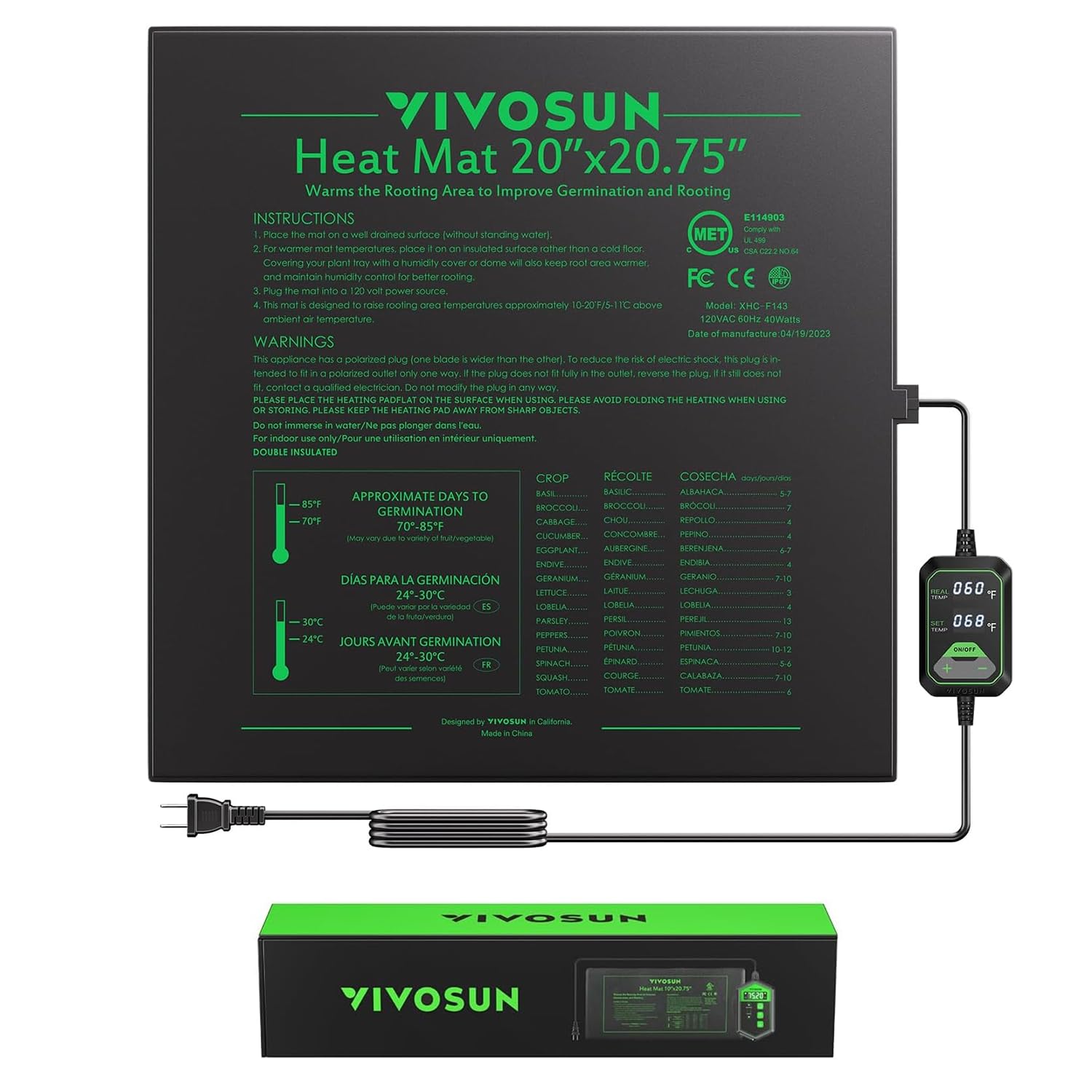
One large mat with a built-in digital thermostat—perfect for a single big tray or multiple small pots.
This 20″ x 20.75″ mat uses far-infrared heating technology (which radiates heat directly into the soil rather than just warming the air around it) and it has a dual digital display on the controller so you can see the set temperature and the actual mat temperature simultaneously. The mat can reach up to 104°F in minutes in a 68-77°F room, and it has built-in overheating protection that automatically powers off the pad if it gets too hot. It also has an IP67 waterproof rating for easy cleaning.
Customers note it works great for seed germination, but some note that the built-in sensor reads the mat surface, not the actual soil temperature. One buyer mentioned it was always slightly cooler than what the display showed, so pairing it with a separate probe thermometer inside your tray gives you more accurate control. Unlike the AC Infinity H3 which is a similar digital-control model but sized at 10″ x 20.75″, this VIVOSUN mat covers about twice the surface area and includes overheating protection.
Single large coverage: A good option if you have a 1020 tray plus some small pots around it—one larger pad heats the whole area more evenly than two smaller mats placed side-by-side.
Precision gap: The temperature display reflects the pad itself, not the soil, so you may need an extra probe if you grow very temperature-sensitive seeds.
Best suited for: A single-tray grower who wants a big heating surface with a built-in digital controller and automatic safety shutoff.
Think twice if: You are skeptical about the accuracy of the built-in sensor—a separate soil probe thermostat will give you more reliable readings.
5. LUXBIRD 2 Pack
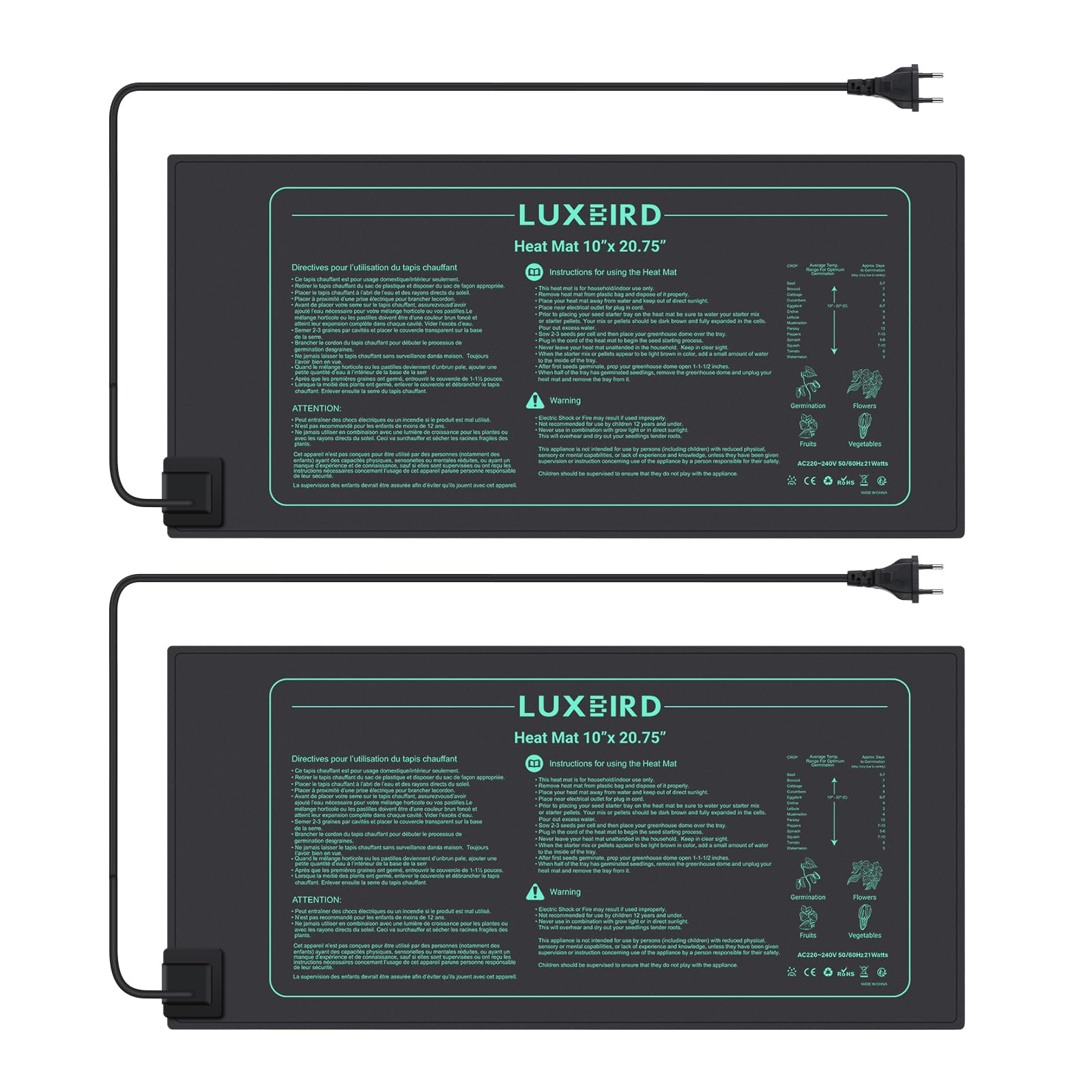
A two-pack that balances low power draw with a high waterproof rating—good for wet environments.
These two mats are each 10″ x 20.75″ and draw 21 watts per pad. The key difference versus simpler budget mats is the LUXBIRD set carries an IP67 waterproof rating (dust tight and can handle brief submersion) rather than a basic splash-proof rating. The PVC material is designed to raise the root-zone temperature by 50°F-68°F (10°C-20°C) above ambient room temperature. Reviewers point out the mats work perfectly with external thermostats like Inkbird for programmable temperature and timer control, giving you flexibility that many basic mats lack.
One common note from reviewers is that the mats arrive curled up in the box and you need to put a tray on top to flatten them for proper contact with the seedling pots. The 21W power consumption is efficient compared to other mats of the same size. Unlike the iPower 2-pack which offers similar heat output but with a less standardized waterproof rating, the LUXBIRD’s IP67 certification gives you more confidence if you are working in a humid greenhouse or tend to overshoot with the watering can.
Why it stands out
- IP67 waterproof rating for easy cleaning and damp environments
- Low 21W power consumption without sacrificing heat output
- Compatible with external programmable thermostats for advanced control
One thing
- Mats arrive curled; you need weight on them to flatten them out for even tray contact
Who this fits: Gardeners who want a two-pack with a proper IP waterproof rating and the option to add their own thermostat later.
Consider another: If you need a thermostat included in the box—this pack comes without one, so budget for an external controller if you want precise temps.
6. iPower 2 Pack
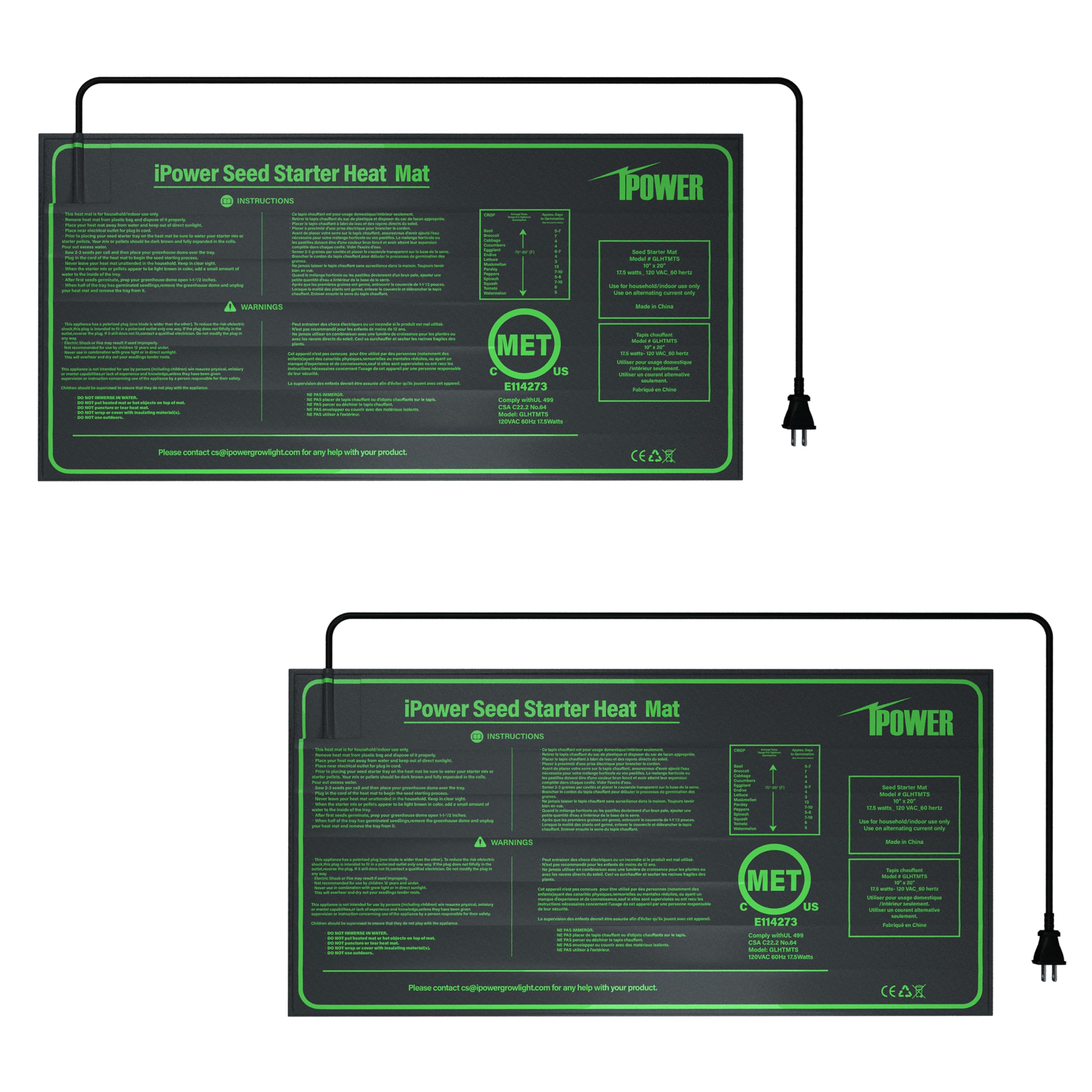
A two-pack that holds the soil about 10°F-20°F warmer than the air—consistent and reliable for standard seed starting.
Each pad measures 10″ x 20″ and can keep the temperature 10°F-20°F (6°C-12°C) above the surrounding air temperature. There is no built-in thermostat or dial, just a simple plug-in design. One owner reported that the “10”x20.5″ pad fits Jiffy 72-cell tray” perfectly and that radish seeds germinated in just 3 days. The thick conducting wire inside the pad is evenly laid so the heat distributes without hot spots, which is better for seed roots than cheap folded-element mats.
Shoppers say the vinyl feels tough and the cord is well-sealed at the entry point, which gives it durability. Another reviewer said out of 140 seeds they planted, 135 germinated successfully. Unlike the NAMOTEK 2-pack which is also a no-frills budget option, the iPower does not have a specific IP waterproof rating in its spec sheet—the manufacturer calls it “waterproof” and “easy to clean,” but there is no standardized IP number to compare directly.
Positive feedback
- Fits standard 72-cell trays precisely
- Thick, well-sealed cord and vinyl construction
- Even heat without hot spots
Limitations
- No standardized IP waterproof rating
- No temperature control—just plug in and hope it is warm enough
A solid basic: Great for starting common seeds in a 72-cell tray or a small portable greenhouse, where a steady 10-20°F boost is all you need.
Pass on it: If you need a higher waterproof rating or want a thermostat to control exact temperatures for heat-sensitive species.
7. Higoro 2 Pack

A true entry-level two-pack with a high IP67 waterproof rating and 21 watts per mat.
These mats are 10″ x 20.75″ and draw 21 watts each—about 17% more power than the NAMOTEK 2-pack (18W), which means they can push a bit more heat into the soil in a cool room. They carry an IP67 waterproof rating, which is uncommon at this price tier and means you can actually scrub them under a faucet without worrying about internal damage. The multi-layer PVC design has the heating wire evenly distributed through the middle for faster heat transfer.
Buyers report that these mats warm the soil well and help seeds sprout quickly. One reviewer wrote “warms soil, improves germination,” but also noted there is no adjustable thermostat—the mat has automatic overheat protection rather than user-set temperature control. Compared to the LUXBIRD 2-pack, which also has 21W and IP67 rating, the Higoro is a slightly lower price point and has fewer reviews, so the reputation is less established. If you want an absolute no-fuss mat that costs less and still offers proper waterproof protection, this one fits that slot well.
Price meets protection: You get IP67 waterproofing and 21W heat output for an entry-level price, making it one of the best cheap options that still handles moisture well.
Missing feature: Like all basic mats in this price range, there is no thermostat—you cannot adjust the temperature, and it can overheat small pots if left in direct sunlight.
Reach for this if: You need a low-cost two-pack with a meaningful waterproof rating and do not mind that the heat is non-adjustable.
Look for a controller: If you plan to grow heat-sensitive seeds that need a specific temperature range, you will want one of the thermostat-equipped models above.
Understanding the Specs
Waterproof Rating (IPX4 vs IP67)
The IP (Ingress Protection) rating tells you how well the mat resists dust and moisture. IPX4 means the mat can handle splashing water from any direction—fine for a typical grow room. IP67 means it is fully dust-tight and can survive being submerged in 3 feet of water for 30 minutes. If you tend to water heavily or work in a humid greenhouse, an IP67 mat is a safer investment that will also be easier to scrub clean without risk of short circuits.
Wattage and Heat Output
For a standard 10″ x 20″ mat, 17-21 watts is normal. A higher wattage (21W vs 18W) generally means the mat can warm up faster and maintain a higher temperature in a cold room. But the real-world effect also depends on the room’s ambient temperature and whether you use insulation under the mat. A thermostat-controlled mat allows you to use the wattage more efficiently because it cycles off when the target temp is reached, while a basic unregulated mat runs at full power all the time.
Far-Infrared Heating vs Wire Coils
Some mats use far-infrared film, which radiates heat directly into the tray rather than heating the air around it. This often leads to more even soil temperatures and faster heat-up times. Cheaper mats typically use a resistive wire coiled inside a PVC layer—they work fine but may develop hot spots if the wire shifts, and they tend to heat up more slowly than infrared mats. If you want consistent heat across a full tray, far-infrared models from AC Infinity or VIVOSUN are a better bet.
Thermostat: Digital vs Dial vs None
Digital thermostats let you set an exact temperature on a screen and see the readout. Dial controllers offer three or more stepped settings (low/medium/high) without a specific number. Mats with no thermostat just run at full power and will raise the soil roughly 10-20°F above room air temperature. If you grow a mix of seeds that need different temperatures (like peppers vs lettuce), a digital thermostat gives you the most control. If you start a standard vegetable garden every spring, a dial or no-thermostat mat may be all you need.
FAQ
Can I leave my seedling heat mat on 24 hours a day?
Do I need a thermostat for my seedling heat mat?
What size heat mat should I buy?
How long does it take for a heat mat to start working?
How many watts does a seedling heat mat use?
Can I use a seedling heat mat for reptiles or sourdough?
What is the difference between IPX4 and IP67 waterproof rating?
Will a heat mat work in a cold garage or basement?
My mat gets hot in one spot—is that normal?
Can I stack heat mats on top of each other?
Final Thoughts: The Verdict
For the majority of shoppers, the best seedling heat mat is the AC Infinity SUNCORE H3 because its digital controller gives you set-and-forget precision and the far-infrared film heats evenly without scorching roots. If you want a twin-pack with simple dial controls for two trays, grab the AC Infinity SUNCORE A3X2. And for a low-cost entry-level two-pack that does not skimp on the IP67 waterproof rating, the Higoro 2 Pack is a solid budget pick.
How We Picked
We do not accept paid placement. Every pick is matched to a real buyer and a real use-case; we do not hands-on test units.
Sources & Methodology
Specifications: manufacturer listings and product documentation. Review insights: verified customer reviews, as of July 2026. Pricing: not shown on this page (it changes often); check the current price via the retailer link.
As an Amazon Associate, Lawn Gear Lab earns from qualifying purchases. This does not affect which products we feature.