
Microgreens demand a growing medium that strikes an almost paradoxical balance: it must hold enough moisture to trigger rapid germination yet drain freely enough to prevent damping-off disease within that critical 7-to-14-day window. A single overwatered tray can collapse an entire crop overnight, making the choice of soil or substrate the single most consequential decision a microgreen grower makes.
I’m Rikta — the co-founder and writer behind Lawn Gear Lab. I’ve spent hundreds of hours comparing peat-based formulas, coco coir expansion rates, and pH buffering methods, along with analyzing thousands of owner reports to separate truly sterile mediums from those that introduce pathogens into indoor grow spaces.
This guide breaks down the best options for indoor tray growing, from budget-friendly coir bricks to lab-grade professional mixes. Whether you grow for personal salads or sell to local chefs, choosing the right soil for microgreens directly affects your harvest speed, yield weight, and seedling health.
How To Choose The Best Soil For Microgreens
Microgreens are harvested so early that they never rely on soil nutrients — they draw energy from the seed itself. This makes the physical structure of the medium far more important than its fertilizer content. You are selecting a sterile, fine-textured anchor that holds water against the seed hull while allowing air to reach the emerging root tip.
Texture and Particle Size
Large bark chunks or perlite pieces create air pockets that cause tiny microgreen roots to dry out between waterings. The ideal medium is a fine, consistent texture — think sieved peat or ground coir dust — that maintains capillary action across the entire tray surface. Coarse mixes require more frequent misting and produce uneven germination patches.
Sterility and Pathogen Load
Damping-off fungus thrives in unsterilized organic matter. Lab-tested mediums with low microbial counts reduce the risk of seedlings collapsing at the soil line. If you reuse trays, sterile medium becomes even more critical because residual spores from a previous crop can infect the next batch within 24 hours.
pH and Electrical Conductivity (EC)
Most microgreens prefer a pH range of 5.5 to 6.5. Coco coir naturally sits around 5.8 to 6.2 when properly buffered, while peat moss tends to be more acidic and requires added lime. High EC levels — from salt residue in unwashed coir — can stunt root elongation and cause tip burn on delicate cotyledons.
Water Retention vs Drainage
A medium that holds 8 to 10 times its weight in water gives you a longer window between waterings, which is valuable for weekend growers who cannot mist twice daily. However, that same water-holding capacity becomes a liability if the medium lacks pore space for oxygen. Look for products that advertise both high water-holding capacity and high porosity — the dual spec separates seedling killers from seedling supporters.
Quick Comparison
On smaller screens, swipe sideways to see the full table.
| Model | Category | Best For | Key Spec | Amazon |
|---|---|---|---|---|
| Premier Pro-Mix HP | Peat-Based | High-porosity professional trays | 2.8 cu ft loose fill | Amazon |
| MagJo Naturals Coco Coir | Coco Coir | Large volume organic grows | 11 lb block expands ~17 gal | Amazon |
| Survival Garden Seeds Pack | Seed Kit | Beginners trying 10 varieties | 10 heirloom types included | Amazon |
| Rainbow Heirloom Kale Trio | Seed Mix | Kale-specialist microgreen growers | 1 lb resealable bag | Amazon |
| Jiffy Organic Seed Starting Mix | Peat Blend | Traditional seed-starting texture | 10 QT bag with lime | Amazon |
| Modellor Premium Coco Coir | Coco Coir | Compact, budget-friendly trays | 4 bricks yield 36 quarts | Amazon |
| Sereniseed Organic Salad Mix | Seed Mix | Spicy-sprout blend for sandwiches | 16 oz organic 4-seed blend | Amazon |
In‑Depth Reviews
1. Premier Pro-Mix HP with Mycorise

The 2.8-cubic-foot loose-fill bag of Pro-Mix HP is the gold standard for serious indoor growers who treat microgreens as a production crop. Its high-porosity formula — a precise blend of sphagnum peat moss, perlite, vermiculite, and dolomitic lime — creates the air-filled pore space that water-sensitive seedlings need to avoid root rot. The inclusion of mycorrhizal fungi (Mycorise) is a bonus for longer-cycle greens, though microgreens harvested at day 10 rarely benefit from the symbiosis.
Owner feedback consistently highlights the absence of clumps, sticks, or bark fragments — the texture is uniformly fine enough to allow capillary water distribution across a 1020 tray without dry spots. The pH is pre-adjusted to the 5.5-to-6.5 sweet spot, so you do not need to test or buffer before sowing. The loose-fill format also saves the hydration step required by compressed coir bricks.
The main trade-off is volume: at 2.8 cubic feet, this bag is oversized for growers running just two or three trays. It is best suited for operations running 10 or more trays per cycle. The peat content also makes it slightly acidic by default, although the included lime compensates well for microgreen pH needs.
What works
- Ready-to-use, no hydration step needed
- Excellent drainage prevents damping-off
- Consistent fine texture with no debris
What doesn’t
- Large bag may be excessive for small growers
- Peat harvesting has environmental concerns
2. MagJo Naturals 100% Pure Coco Coir Block

MagJo’s 11-pound block expands to roughly 17 gallons of coco coir — enough to fill four to five standard 1020 microgreen trays at a 1-inch depth. The defining advantage here is the low electrical conductivity (EC). Unwashed coir often carries residual sea salt that elevates EC above 1.0 mS/cm, which can stunt delicate microgreen roots. MagJo sources from OMRI-registered manufacturers who triple-wash the coir to bring EC levels down near 0.2 mS/cm.
Owner measurements confirm that a single block hydrated in a 20-gallon bin raised TDS from 40 to only 200 ppm — well within the safe zone for seed germination. The pH registers slightly acidic, around 5.8 to 6.2, which aligns with the preferred range for brassica and lettuce microgreens. The block’s dense compression means you must soak the entire brick rather than trying to chip pieces off.
The downside is the sheer physical effort of hydrating 11 pounds of compressed fiber. Plan for a large container and at least 4 hours of soak time. Some users also report a faint tea-tree-like smell upon opening, though this dissipates after hydration and does not affect plant growth.
What works
- Exceptional value per gallon of expanded coir
- Low salt levels protect sensitive seedlings
- OMRI-listed for certified organic growing
What doesn’t
- Requires large container and time to hydrate
- Single-block format is not portion-controlled
3. Survival Garden Seeds Microgreen Variety Pack

This variety pack solves the single biggest problem beginners face: figuring out which microgreen flavors they actually like before committing to a full pound of a single seed type. The ten included varieties — broccoli, pea, sunflower, radish, kale, arugula, beet, cabbage, buckwheat, and alfalfa — span mild, spicy, and earthy profiles. Each packet contains enough seed for one or two 1020 trays, making this an ideal sampling kit.
Germination rates across all varieties consistently test above 90 percent in owner reports, with many noting the seeds are free of chaff and debris that can clog soil-surface misters. The open-pollinated, non-GMO genetics ensure each variety stays true to type, so your first tray of Red Acre cabbage looks identical to your tenth tray. The printed instructions on the back of each packet cover soak times, blackout periods, and harvest windows for each specific seed.
The limitation is that heavy-volume growers will burn through these small packets quickly. If you plan to run weekly trays of pea shoots, you will need to reorder frequently. The packets are also not resealable, so store them with a clip after opening.
What works
- Great variety for taste-testing different microgreens
- High germination rate across all 10 types
- Clear instructions tailored to each seed type
What doesn’t
- Small packet sizes require frequent reordering
- No growing medium included in the kit
4. Rainbow Heirloom Seed Co. Kale Trio Mix

This Kale Trio combines Blue Curled Scotch, Premier, and Red Russian varieties into a single 1-pound bag, offering three distinct textures and colors from one sowing. Blue Curled Scotch produces tight, crinkled leaves with a deep green hue; Red Russian adds purple stems and a flatter leaf shape; Premier fills the middle ground with uniform upright growth. The mix yields a visually striking tray with contrasting leaf shapes that chefs prefer for garnishes.
Germination rates are remarkably high — multiple owner reports describe 100 percent sprouting within 48 hours when kept at 70°F. The Red Russian component is slightly fussier, requiring a full 4-day blackout period to encourage stem elongation, but the trade-off is a peppery-sweet flavor that stands out on sandwiches. The 1-pound bag provides roughly 8 to 10 tray sowings at standard density, offering better per-tray value than standard retail packets.
The seeds are uncoated and untreated, so they are fully compatible with organic growing practices. One reported quality issue involves bag seams splitting during shipping, though the company has addressed this with responsive customer service. The seeds also require a fine-textured medium — avoid coarse potting soils that let small kale seeds fall into crevices.
What works
- Three kale varieties in one bag for visual variety
- High germination rate across all three types
- Good value for regular kale microgreen growers
What doesn’t
- Bag seam can split during shipping
- Red Russian requires longer blackout period
5. Jiffy Natural & Organic Seed Starting Soil Mix

Jiffy’s 10-quart bag is a three-ingredient formula: sphagnum peat moss for water-holding capacity, vermiculite for aeration, and lime to neutralize the peat’s natural acidity. The fine, sifted texture contains no large bark chunks or perlite granules, making it one of the smoothest seed-starting mediums available. This uniformity is critical for microgreens because it allows the root mat to form a cohesive layer that can be harvested as a whole slab.
The peat component absorbs up to 20 times its weight in water, which translates to longer intervals between misting sessions — a practical advantage for growers who cannot water twice daily. Vermiculite prevents the peat from compacting into a dense slab, preserving the air pockets that microgreen roots need at the 0.5-inch depth. The lime inclusion brings the pH from peat’s natural 4.0 range up to approximately 6.0, eliminating the need for separate pH adjustment.
The primary weakness is that this mix is slightly heavier than pure coco coir when fully saturated, which can make tray handling more cumbersome. It also contains no added nutrients, which is fine for microgreens but limits reuse for longer-cycle plants. Some users find the bag size (10 quarts) too small for large tray operations.
What works
- Smooth, sifted texture ideal for fine seeds
- Pre-adjusted pH saves a preparation step
- Strong water retention reduces misting frequency
What doesn’t
- Heavier than coir when wet
- Small bag size for high-volume growers
6. Modellor Premium Super Washed Coco Coir Bricks
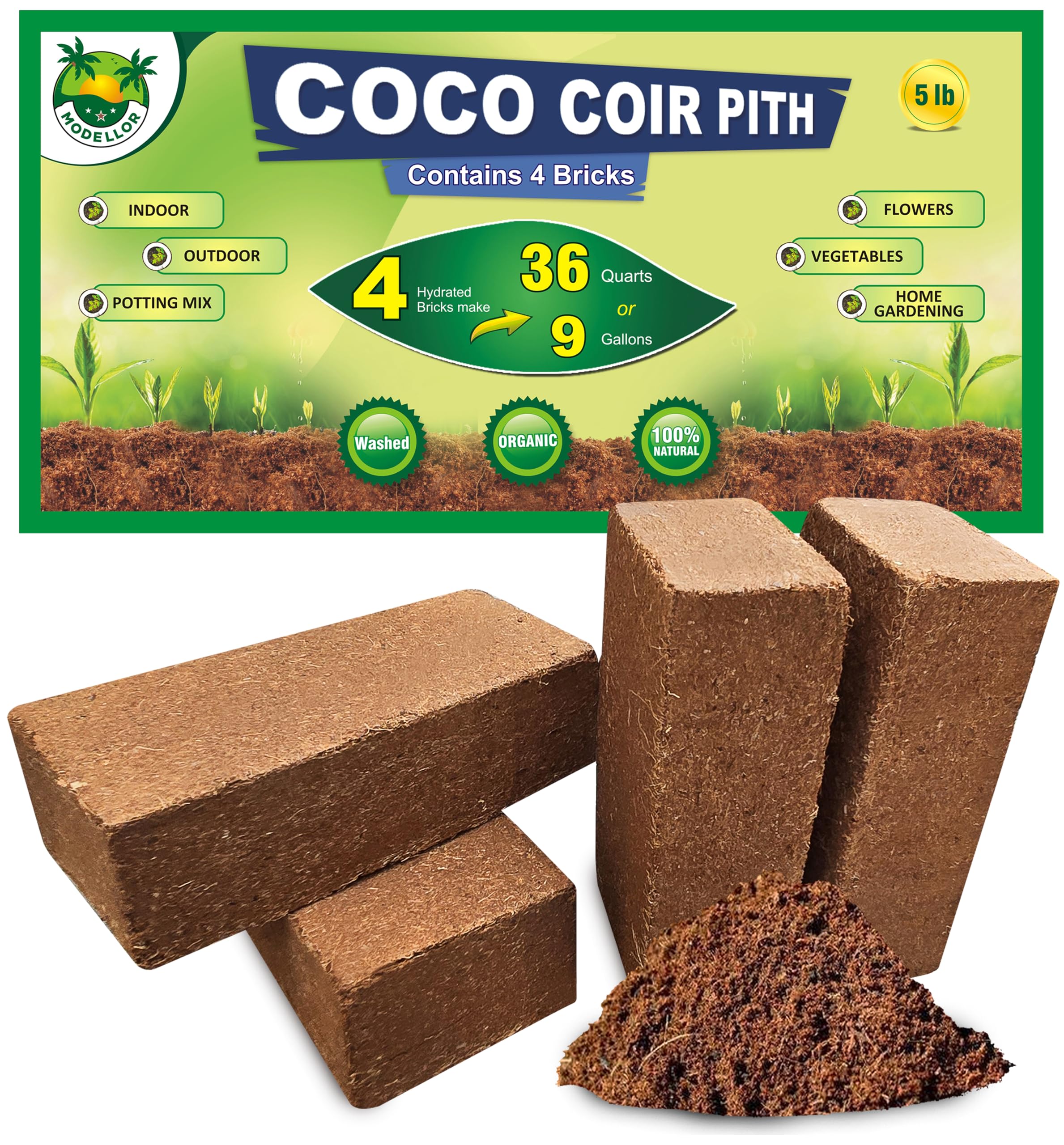
Modellor’s 4-pack of 1.25-pound bricks expands to a combined 36 quarts — or 9 gallons — of fluffy coco coir, making it one of the most space-efficient storage options for urban growers. The triple-washing process removes the salt and tannins that plague cheaper coir products, resulting in a low-EC medium that does not require additional rinsing before use. Owner reports confirm the coir is odorless, debris-free, and consistent across all four bricks.
The hydration speed is notably fast. Each brick breaks apart within 15 minutes of hot water submersion and fully expands within 60 minutes, unlike some compressed coir blocks that need overnight soaking. The final texture is light and fluffy with visible air pockets — exactly what microgreen roots need to avoid waterlogging. The pH arrives pre-balanced between 5.8 and 6.2, so you can sow seeds immediately after hydration without testing.
The 4-brick format is ideal for growers who run 4 to 6 standard trays per cycle. However, the individual brick size (1.25 pounds) yields only about 2.25 gallons per brick, which means heavy users will go through the set relatively quickly. Some users also note that the bricks are dense and require care when breaking apart — soaking the whole brick is more effective than chipping.
What works
- Fast hydration — expands in under an hour
- No additional rinsing or buffering required
- Compact storage before hydration
What doesn’t
- Individual brick yield is modest for high-volume grows
- Dense bricks are difficult to break when dry
7. Sereniseed Organic Salad Mix Sprout Seeds
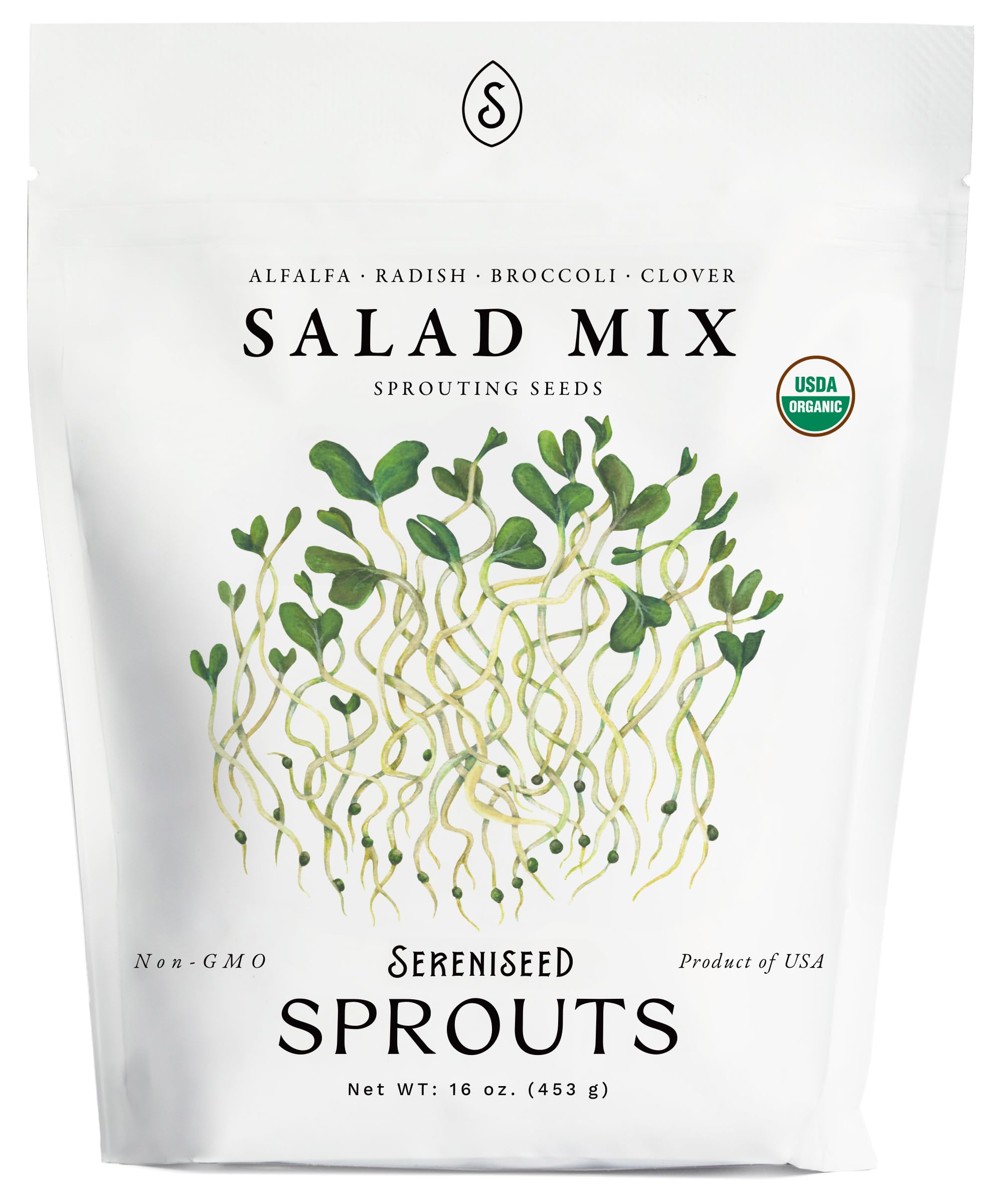
Sereniseed’s 16-ounce bag combines alfalfa, radish, broccoli, and clover into a single sprouting and microgreen blend. The dominant flavor profile leans spicy — the radish component provides a noticeable heat that works well as a sandwich topping or garnish for savory dishes. The seeds are certified organic by Oregon Tilth, non-GMO, and tested for pathogen contamination, which is a critical safety factor for raw-sprout consumption.
Germination speed is a standout feature. Multiple owner reports note visible sprouts within 48 hours and a full harvest-ready crop by day 6 or 7. The alfalfa and clover seeds are small and require a fine-textured medium — standard potting soil with large bark pieces will cause these tiny seeds to fall below the surface and fail to germinate. A thin, even spread across damp coir or seed-starting mix produces the best results.
The bag contains a generous volume of seed, but the tiny seed size means the count is higher than it appears. The spicy profile may be too intense for some palates when eaten raw in large quantities. The bag also lacks a resealable closure, so transfer the seeds to an airtight container after opening to maintain freshness.
What works
- Very fast germination — ready in 6-7 days
- Certified organic and pathogen-tested
- Spicy flavor profile adds punch to dishes
What doesn’t
- Spicy mix may be too strong for some eaters
- Bag is not resealable
Hardware & Specs Guide
Water Holding Capacity
This is the percentage of the medium’s dry weight that it can absorb and retain against gravity. For microgreens, a capacity of 8:1 to 10:1 (water weight to dry weight) is ideal. Coco coir typically achieves 8:1, while peat moss can reach 20:1. Higher capacity means less frequent misting but increases the risk of overwatering if drainage holes are inadequate.
Electrical Conductivity (EC)
EC measures the soluble salt concentration in the medium. Microgreens tolerate an EC range of 0.2 to 0.8 mS/cm. Unwashed coco coir can spike above 1.5 mS/cm, causing root tip burn and stunted growth. Triple-washed coir and peat-based mixes typically fall below 0.5 mS/cm, which is the safe zone for delicate cotyledon-stage growth.
pH Range
Microgreens perform best at pH 5.5 to 6.5. Peat moss is naturally acidic (pH 3.5–4.5) and requires lime amendment. Coco coir sits at 5.8–6.2 when buffered. A pH outside this range locks out micronutrient availability even though microgreens do not rely on soil nutrients — pH imbalance can still affect cell wall development in the root zone.
Particle Size Distribution
The ideal microgreen medium has a particle size of 0.5 to 3 mm. Larger particles (>5 mm) create air gaps that dry out root tips. Smaller particles (<0.5 mm) compact and suffocate roots. Sieved peat and ground coir dust fall within this range, while standard garden soil or coarse potting mix does not.
FAQ
Can I reuse soil from a previous microgreen harvest for the next tray?
What is the difference between coco coir and peat moss for microgreens?
Why do my microgreen seeds rot before they sprout?
Should I add fertilizer to the soil when growing microgreens?
Final Thoughts: The Verdict
For most gardeners, the soil for microgreens winner is the Premier Pro-Mix HP because it offers the most consistent fine texture and highest drainage of any ready-to-use medium on the market. If you want the best per-gallon value and prefer a renewable coir-based medium, grab the MagJo Naturals Coco Coir and invest the time to hydrate the block properly. And for beginners who need a complete seed-plus-medium system, nothing beats the Survival Garden Seeds Variety Pack for sampling ten varieties without overspending on bulk seed bags.