
Specs are compiled from manufacturer listings and verified buyer reviews and can change over time — please confirm the key details on the product page before buying.
You look at the edges of your lawn and see a messy, uneven border where grass creeps over the sidewalk. A gas edger is the tool that solves that—it uses a spinning metal blade to carve a clean, deep line between your grass and the pavement, even through thick sod. The challenge is that these machines range from light handheld models to heavy walk-behind ones, and picking the wrong kind can leave you either underpowered or exhausted.
I’m Rikta — the founder and writer behind Lawn Gear Lab. This guide is built by comparing the manufacturers’ published specifications and the patterns across verified customer reviews, so you get each pick’s real strengths and trade-offs instead of marketing spin.
if you need to tidy up a suburban driveway or tackle deep overgrowth on an acre of curb, this breakdown of the best rated gas edgers will help you match the right engine size (measured in cubic centimeters, or cc) and design to your actual workload without overspending or undershooting.
Quick Picks
- McLane 9 Inch Gas Powered Walk Behind Lawn Edger with 4 Rubber Wheels — Pro Grade
- EARTHQUAKE 41273 79cc 4-Cycle Walk-Behind Edger — Best Overall
- Wild Badger Power Sidewalk Edger Lawn Tool Gas 31cc WB31CCED — Best Value
- ECHO PE-225 21.2cc Curved Shaft Edger with i-30 Starter — Lightweight Pick
How To Choose The Best Rated Gas Edgers
Three specs separate a gas edger that feels easy from one that fights you on every pass: the engine size (displacement, in cubic centimeters), the weight and design type (handheld vs. walk-behind), and the blade depth adjustment range. Here is what each of those means for the actual job of edging your lawn.
Engine Displacement (CC)
The engine displacement, measured in cubic centimeters (cc), tells you how much raw cutting power the machine has. A 21cc to 31cc engine is enough for light residential edging—think standard grass along a driveway. A 79cc engine, on the other hand, will chew through thick sod, roots, and packed dirt, and it typically comes on a walk-behind frame that is much heavier and more stable. The trade-off is obvious: more cc means more cutting torque but also more weight and cost, so match the engine to how deep and thick your edges actually get.
Weight and Design (Handheld vs Walk-Behind)
A lightweight handheld edger around 15 pounds is easy to maneuver for small jobs but puts the vibration and torque in your hands, which can get tiring. A walk-behind design at 57 pounds uses a wheeled frame to carry the engine for you, so you just steer—ideal for long driveways or curbs. Your physical strength and the size of your property should guide this choice: handheld for quick touch-ups, walk-behind for serious acreage.
Blade Depth Adjustment
You need to set the blade deep enough to cut a clean line into the soil, not just skim the grass surface. Good gas edgers offer multiple depth settings or a single-lever adjustment that lets you go from a light trim to a 2.5-inch root cut. If the blade depth cannot get low enough to actually dig into the earth, the edge will look ragged and need redoing faster. Check the max blade depth in inches, not just the number of settings.
Quick Comparison
| Model | Best For | Engine Displacement | Weight | Blade Depth | Amazon |
|---|---|---|---|---|---|
| ECHO PE-225 | Light residential edging | 21.2 cc | 15 lbs | Adjustable (captive wheel mount) | Amazon |
| Wild Badger Power 31cc | Mid-sized yards | 31 cc | 29.6 lbs | 3 settings (5cm – 10cm) | Amazon |
| EARTHQUAKE 41273 | Deep cutting, large properties | 79 cc | 57 lbs | 10 settings (up to 2.5″) | Amazon |
| McLane 9-Inch Walk Behind | Professional-grade edge, USA made | 5.50 Gross Torque (~150cc) | Heavy (steel build) | Single lever clutch & depth control | Amazon |
In‑Depth Reviews
1. McLane 9 Inch Gas Powered Walk Behind Lawn Edger with 4 Rubber Wheels

Its 9-inch spring steel blade and single-lever depth control deliver the most precise edge in this lineup, with a rigid metal frame that keeps everything aligned.
The McLane earns its spot as the pro-grade pick because its cutter head rides on sealed ball bearings, so the blade stays aligned even after years of use. Buyers report the engine started on the second pull. The blade tilts from vertical to horizontal for edging or trimming (a mode buyers call “weed eater mode”). The 5.50 gross torque engine provides the muscle for thick roots. The McLane’s metal frame and wide rubber tires with ball bearing wheels make it stable on uneven ground.
The big catch: several owners note that the handles feel too short for tall users and the grips are small. The hot muffler can also be a burn hazard, and some found the rubber debris guard breaks off during use. At this price, it is a long-term investment for someone who wants a professional-grade edge and is willing to overlook ergonomic quirks. skip it if you are a taller user or only need a lightweight machine for quick driveway touch-ups.
Metal and muscle: The 9-inch spring steel blade and single depth lever give you the most precise edge control in the lineup.
One trade-off: The short handle is awkward for taller users, and the deep cut can act like a self-propelled motor, pulling you forward.
Reach for this if: You want a heavy-duty, made-in-USA edger with a precision blade that will outlast most competitors.
Look elsewhere if: You are a taller user or want a lightweight machine for quick driveway touch-ups.
2. EARTHQUAKE 41273 79cc 4-Cycle Walk-Behind Edger
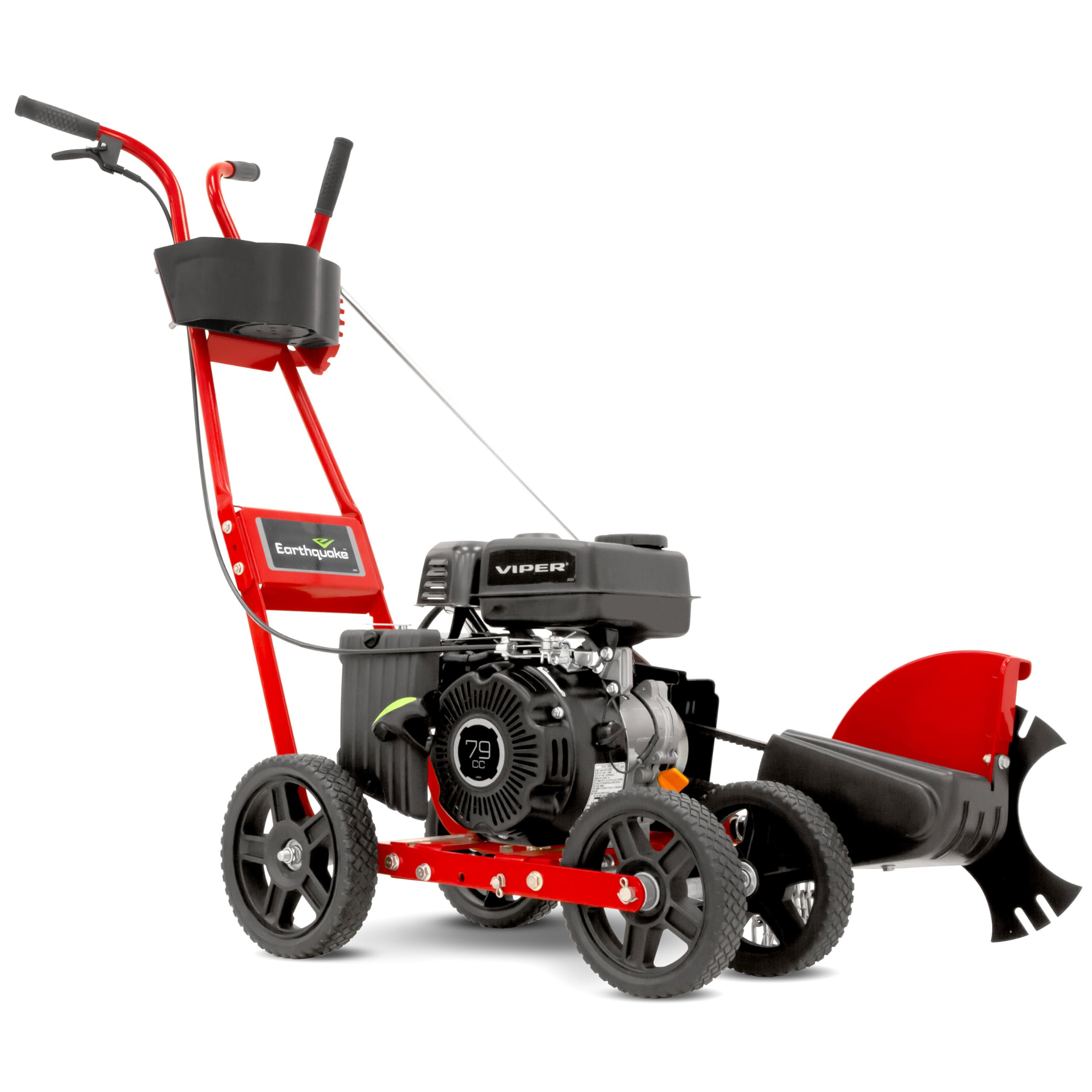
Its 79cc engine, versus the ECHO PE-225’s 21.2cc, gives you the power to cut through packed sod without straining your arms.
The EARTHQUAKE 41273 is the best overall pick because its walk-behind, 4-wheel design keeps the blade planted in the soil while its 79cc 4-cycle Viper engine provides the torque for deep root cuts. The 4-cycle engine (a type of engine that uses a separate oil sump, so you pour straight gasoline without mixing) eliminates the need to mix gas and oil. You get a multi-position pivoting blade that tilts 20 degrees in either direction for straight driveway cuts or beveled flowerbed edges. At 57 pounds versus the ECHO PE-225’s 15 pounds, that weight prevents bounce on long curbs.
Owners mention that the engine started on the second pull, though the assembly took about 4 hours because the instructions lack a parts list and the painted rod needed a mallet to fit through the holes. Once assembled, the variable-speed throttle gives you precise control for starting new cuts or working around corners, and the built-in cup and tool holder is a small but appreciated convenience. Backed by a 5-year limited warranty, this is a buy-once machine for someone with a large property. pass on it if you want something you can assemble in 15 minutes and have only a few straight sidewalk edges to maintain.
Where it shines
- 79cc engine versus the ECHO PE-225’s 21.2cc for serious root cutting
- 10 depth settings and a pivoting blade handle angles and depths that cheaper edgers cannot
- No gas/oil mixing thanks to the 4-cycle engine
Where it stumbles
- Assembly took buyers around 4 hours with poor instructions
- 57 lbs is heavy to push if your ground is very soft or hilly
Go for it if: You need to carve deep lines through packed sod and roots on a large yard and value stability over portability.
it’s not for you if: You want something you can assemble in 15 minutes and have only a few straight sidewalk edges to maintain.
3. Wild Badger Power Sidewalk Edger Lawn Tool Gas 31cc WB31CCED
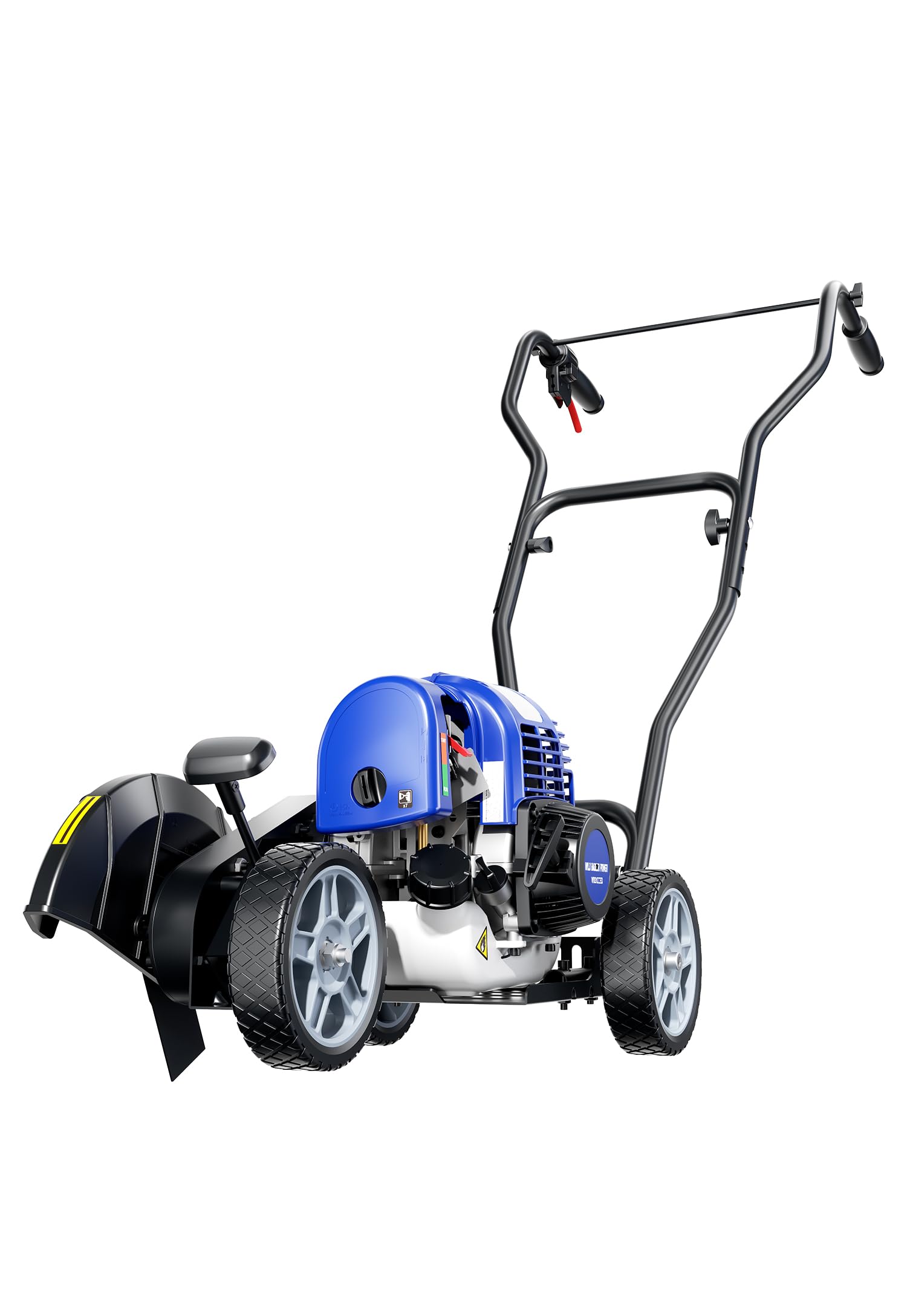
Its 31cc engine spins at 9800 RPM, versus the ECHO PE-225’s 5000 RPM, so it slices through grass quickly for a tool at this price.
The Wild Badger 31cc sits in a practical middle ground between the lightweight ECHO PE-225 and the heavyweight EARTHQUAKE. Its 31cc engine provides enough power for standard grass edges, and at 29.6 pounds it is heavy enough to hold a steady edge but light enough to lift into a truck bed. The 3 adjustable cutting height settings (from 5cm to 10cm, or roughly 2 to 4 inches) let you choose between a light trim and a deeper cut. Compare that to the EARTHQUAKE’s 10 depths up to 2.5 inches.
Customers note that the engine starts easily and runs powerfully, but one critical review points out a major design flaw: the blade depth max is only 1-2 inches at the lowest setting, and at the highest setting the blade sits 2-3 inches above the grass, making it useless. The primer bulb (the rubber button you press to prime the engine before starting) is hidden under the engine and hard to see, and the pull cord is on the same side as the blade—a safety hazard with no foot peg for stability. If your yard only needs a light, clean edge along a driveway and you are on a budget, it does the job—but if you need to dig into thick sod, the Wild Badger will frustrate you.
Budget performance: The 31cc engine and 9800 RPM give you plenty of blade speed for normal grass, at a fraction of the price of a walk-behind.
The real limitation: The max blade depth of 1-2 inches means it cannot create a deep, lasting edge in thick turf, and the pull cord position near the blade is a safety concern.
Best for: A budget-conscious homeowner with light edging needs and a willingness to accept the depth limit and ergonomic quirks.
Not for: Anyone who needs a deep root cut or wants a tool that feels safe and polished from the start.
4. ECHO PE-225 21.2cc Curved Shaft Edger with i-30 Starter

At 15 pounds, it is easy to grab with one hand and edge the front walk in 10 minutes.
The ECHO PE-225 is the lightweight pick. Its i-30 starter technology reduces the effort to pull the cord by 30%, and buyers confirm they did not need to assemble anything—just add fuel and go. The curved shaft and captive wheel mount hardware make height adjustments simple. Reviewers point out that this model is strictly for residential use—landscapers should step up to a bigger ECHO model. The 2-year commercial / 5-year consumer warranty gives confidence that ECHO backs its lightweight design.
The trade-off for the low weight is that the 21.2cc engine, versus the EARTHQUAKE’s 79cc, cannot handle heavy roots or deep sod. If your lawn edges are packed with thick roots or you have a long curved driveway, the PE-225 will still struggle compared to the EARTHQUAKE or McLane. But for a homeowner with a standard lot who wants a tool they can carry with one hand and edge the front walk in 10 minutes, this is the most comfortable option. Avoid it if you need to cut through heavy sod or have a large property that demands a walk-behind machine.
Why it works
- 15 pounds makes it easy to carry and maneuver
- i-30 starter reduces pull effort by 30%, so you do not fight the engine
- No assembly needed from the start
Why it has limits
- 21.2cc engine versus the EARTHQUAKE’s 79cc, so no heavy root cutting
- Handheld design puts vibration in your hands during longer sessions
Reach for it if: You want a grab-and-go edger for small residential jobs and value light weight over raw torque.
Avoid it if: You need to cut through heavy sod or have a large property that demands a walk-behind machine.
Understanding the Specs
Engine Displacement (cc)
This number tells you how much fuel and air the engine’s cylinders can hold—more cc means more power to spin the blade. A 21cc engine is fine for light grass, while a 79cc engine can dig through roots and packed soil. Bigger cc also means more weight and more fuel consumption, so match it to the thickness of your edges, not just the size of your yard.
2-Stroke vs 4-Stroke
A 2-stroke engine (like the one in the ECHO PE-225) is lighter and simpler but requires you to mix oil into the gasoline every time you fill up. A 4-stroke engine (like the one in the EARTHQUAKE) has a separate oil sump, so you pour straight gasoline and change the oil occasionally. For most homeowners, a 4-stroke is less hassle because you never worry about the mix ratio.
FAQ
What is the difference between a gas edger and a string trimmer?
What does engine displacement (cc) mean for a gas edger?
How deep should a gas edger cut?
Is a handheld or walk-behind gas edger better?
Do gas edgers require assembly?
How hard is it to start a gas edger?
Can I use a gas edger for trenching?
What type of gas does a gas edger use?
How loud is a gas edger compared to an electric edger?
What does the blade depth setting actually change?
Final Thoughts: The Verdict
For most buyers, the best rated gas edgers winner is the EARTHQUAKE 41273 because it pairs a massive 79cc engine with 10 depth settings and a stable 4-wheel design that handles deep root cutting without fatiguing your arms. If you want something lightweight for quick residential touch-ups, grab the ECHO PE-225. And for a professional-grade, made-in-the-USA build with a precision spring steel blade, the standout is the McLane 9-Inch Walk Behind.
How We Picked
We do not accept paid placement. Every pick is matched to a real buyer and a real use-case; we do not hands-on test units.
Sources & Methodology
Specifications: manufacturer listings and product documentation. Review insights: verified customer reviews, as of July 2026. Pricing: not shown on this page (it changes often); check the current price via the retailer link.
As an Amazon Associate, Lawn Gear Lab earns from qualifying purchases. This does not affect which products we feature.