
Specs are compiled from manufacturer listings and verified buyer reviews and can change over time — please confirm the key details on the product page before buying.
Your mulch choice depends on two things: how long it lasts before fading and how well it stays put after a heavy rain. Fluffy straw, for example, holds seed in place and breaks down into soil you can till right into. Shredded rubber, on the other hand, sits there for years with no maintenance but can leave a rubber smell in the heat. The right pick solves your specific yard problem — whether you are covering a bare slope, topping a flower bed, or finishing a play area.
I’m Rikta — the founder and writer behind Lawn Gear Lab. This guide is built by comparing the manufacturers’ published specifications and the patterns across verified customer reviews, so you get each pick’s real strengths and trade-offs instead of marketing spin.
This article breaks down six different types of quality mulch so you can match the right material to exactly what your garden, lawn, or landscape actually needs right now.
Quick Picks
- Back to the Roots 100% Organic Mulch, 58 Quart (2 Cubic ft) — Best Overall
- EZ-Straw Seeding Mulch with Tackifier — 2.5 CU FT Bale — Top Performer
- Plantonix Organic Coco Chips (10lbs) — 15 Gallons — Best Value
- Rio Hamza Trading Houseplant Mulch (8 Quarts) — Indoor Pick
- Rubberific Premium Shredded Rubber Mulch (0.8 Cu. Ft., Black) — Zero-Maintenance
- Longleaf Pine Straw Roll for Landscaping — Covers Up to 125 Sq Ft — Wind-Resistant
How To Choose The Best Quality Mulch
Two things matter most: what the mulch is made of, and how much ground it will cover. Organic mulches like straw, coconut husk, and pine straw break down over time and feed the soil. Inorganic options like shredded rubber last for years but do not add organic matter. The volume you get from a bale or a block directly determines how many square feet you can cover, so always match the bag size to the job size.
Volume vs. Weight — The Real Coverage Number
A bag that weighs 10 pounds might expand to 2 cubic feet after you add water, or it might stay small and dense. Look at the cubic feet or quart measurement, not the weight, when comparing how far a product will go. A 2.5 cubic foot bale of straw, for example, can cover up to 500 square feet at a light layer, while a 0.8 cubic foot bag of rubber covers a much smaller zone.
Biodegradable vs. Long-Lasting Materials
If you plan to till the mulch into garden beds at the end of the season, choose something biodegradable like straw, coconut chips, or pine needles. If you are covering a play area or a permanent landscape bed where you never want to replace the mulch, shredded rubber with a long color warranty saves you from buying new material every year.
Tackifiers and Stabilizers That Stop Erosion
Some mulch products include a tackifier — a natural bonding agent that helps the material stick to itself and to the ground. This is important on slopes and in windy spots where loose mulch can wash away during a rainstorm. Plain wood chips without a tackifier tend to float, while processed straw with a tackifier forms a protective blanket that stays in place.
Quick Comparison
| Model | Best For | Material | Volume | Item Weight | Amazon |
|---|---|---|---|---|---|
| Back to the Roots 100% Organic Mulch | Expanding organic garden cover | Coconut Husk | 2 Cubic Feet (58 Quarts) | 10 Pounds | Amazon |
| EZ-Straw Seeding Mulch with Tackifier | Grass seed protection on slopes | Processed Straw | 2.5 CU FT | 21 Pounds | Amazon |
| Plantonix Organic Coco Chips | Soil aeration and moisture hold | Coconut Coir Chips | 15 Gallons | 10 Pounds | Amazon |
| Houseplant Mulch (8 Quarts) | Indoor potted plant topping | Small Bark Wood Chips | 8 Quarts | 1.35 Kilograms (2.98 Pounds) | Amazon |
| Rubberific Premium Shredded Rubber Mulch | Playground or low-maintenance beds | Shredded Rubber | 0.8 Cu. Ft. | 16 Pounds | Amazon |
| Longleaf Pine Straw Roll | Natural coverage that resists wind | Pine Straw | Covers 125 Sq Ft | — | Amazon |
In‑Depth Reviews
1. Back to the Roots 100% Organic Mulch, 58 Quart (2 Cubic ft)
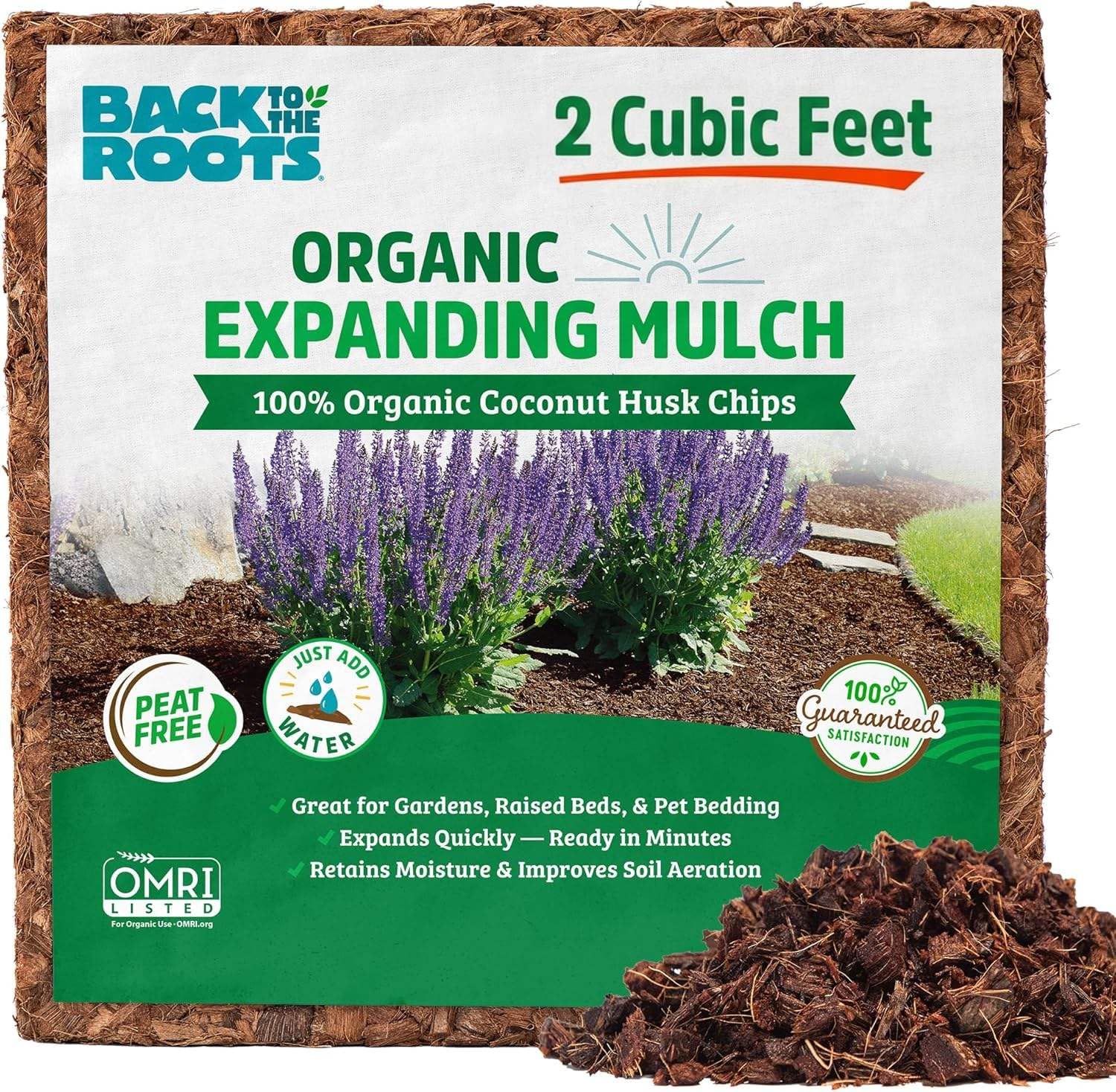
A dehydrated block that turns into a wheelbarrow-load of fluffy organic ground cover.
This compressed coconut husk block starts at 10 pounds and a very compact size, but once you add water it expands to 2 cubic feet of mulch. Buyers report it “expands significantly with water; fills wheelbarrow 3/4 and kiddie pool,” making it a space-saver in storage and a big-value option for vegetable gardens or raised beds. The chips are small enough for pots but abundant enough to cover a decent patch of ground. It is OMRI listed (Organic Materials Review Institute — meaning it is approved for organic gardening) for organic production, so you can till it into the soil at the end of the season without worrying about chemicals.
Unlike the EZ-Straw bale which comes ready to spread loose, this block requires a bucket or wheelbarrow and some soaking time to rehydrate. The payoff is mulch that retains moisture in full sun, aids weed suppression, and smells pleasant when damp — reviewers mention it “works wonders on my hydrangeas.” The trade-off is the manual effort: you need the strength to carry a full bucket of wet, expanded mulch, or you break the block into pieces and hydrate in stages.
What Expands in the Bucket
- Expands to 2 cubic feet from one compact block
- OMRI listed and peat-free for organic gardening
- Retains moisture longer in full sun, per reviewer feedback
- Biodegradable — can be tilled into soil as amendment
What to Weigh Before Soaking
- Requires soaking and breaking up before spreading
- Wet block can be heavy to carry in one piece
Reach for this if: you want a space-efficient, organic coconut husk mulch that expands on-site and can be tilled into your vegetable garden at season’s end.
Look elsewhere if: you need dry, ready-to-spread mulch that does not require soaking or heavy lifting to apply.
2. EZ-Straw Seeding Mulch with Tackifier — 2.5 CU FT Bale

The straw bale that sticks to the ground so your grass seed stays put.
This is the pick for anyone overseeding a bare patch, a slope, or a yard with heavy dog traffic. The bale holds 2.5 CU FT of processed straw and weighs 21 pounds — more than double the 10-pound weight of the Back to the Roots block. That weight difference comes from the straw itself plus the tackifier, a natural bonding agent that makes the fibers sticky when dampened. Owners mention it “prevents seed washaway and bird consumption” and say grass grew in 5 days after application. The tackifier forms a protective blanket that holds the straw together in wind and rain, something loose hay cannot do.
Compared to the 0.8 Cu. Ft. Rubberific bag, the EZ-Straw delivers 2.5 CU FT per package versus 0.8 Cu. Ft. It is messy to handle — reviewers warn it goes everywhere if you are not careful — but once you water it in, the straw mats down and stays. It is biodegradable, so you leave it right there after the grass grows and it breaks down into the soil. Use it for new lawns, patch repair, or erosion control on bare dirt, not for decorative flower beds where you want a neat, dark look.
Seed Protector Benefits
- Tackifier bonds straw together to stop washout and wind blow
- Covers up to 500 sq ft from one 2.5 CU FT bale
- 99% weed free and biodegradable — no cleanup needed
- Safe for pets and children, per manufacturer
Messy Side
- Twice-cut straw can be messy to apply in breezy conditions
- Not a decorative mulch — natural straw color, not dark or uniform
Best for: homeowners fixing bare spots, slopes, or newly seeded lawns where seed washaway is the main problem.
Not for: mulching around shrubs or flower beds where you want a dark, uniform decorative look.
3. Plantonix Organic Coco Chips (10lbs) — 15 Gallons

Compressed coconut chips that hydrate into an airy, moisture-holding soil amendment.
This 10-pound brick expands to 15 gallons of coco chips — usable volume that beats the Houseplant Mulch (8 quarts) by a wide margin for a similar effort. The chips are bigger than standard coco coir, creating air pockets in heavy soil that improve drainage and prevent compaction. Customers note the brick is “compact, breaks into good-sized chips with water, no unpleasant smell.” The chips absorb up to 10 times their weight in water, which means you water less often, and they have a neutral pH (neither acidic nor alkaline, so it will not disturb your soil’s chemistry) that does not mess with your plant’s nutrient intake. Mix them into potting soil for houseplants, use them as a top layer for containers, or spread them as garden mulch around vegetables.
Unlike the Back to the Roots block which expands to 2 cubic feet (58 quarts), this one reaches 15 gallons — about half the volume — so it is better suited for smaller beds and container gardening rather than covering large landscape areas. One trade-off buyers mention: un-buffered coco coir can absorb soil nutrients, so some gardeners prefer buffered coco chips to avoid that issue. If you are using this as a regular soil additive, it works great; if you are covering a large vegetable garden, the Back to the Roots block gives you more area per dollar.
Hydration Highlights
- Absorbs up to 10x its weight in water — less frequent watering
- Creates air pockets in soil for better root oxygen
- Neutral pH and high CEC (Cation Exchange Capacity, which helps it hold plant food) help retain nutrients in root zone
- Expands from a small brick to 15 gallons of usable chips
Things to Know
- 15 gallons of expanded volume versus 2 cubic feet (58 quarts) for the Back to the Roots block
- Un-buffered coco coir may absorb nutrients unless pre-treated
Grab it for: mixing into potting soil for houseplants or covering small to medium container gardens where water retention matters most.
Skip it for: large-scale landscape beds where you need maximum square footage per package.
4. Rio Hamza Trading Houseplant Mulch (8 Quarts)

Fine bark chips sized for small pots and indoor planters that need a tidy finish.
This bag holds 8 quarts of small bark wood chips, sized specifically for indoor potted plants rather than outdoor beds. It adds a clean, consistent visual layer on top of potting soil and helps keep moisture in the pot longer. Reviewers point out it “keep the moisture in my indoor plants” and note it “didn’t seem to bring pests with it either,” which is a real concern when you bring soil products inside. At 1.35 kilograms (about 3 pounds), the bag is light and easy to handle even on a shelf or countertop. Unlike the expanding coco blocks, this is ready to pour straight from the bag with no soaking or breaking apart.
The honest catch, as one buyer puts it: “Good quality and attractive, but too expensive for 2 qts; only mulched 2.5 medium pots.” The bag lasts through only a handful of medium containers, so if you have a large collection of houseplants or want to use this for outdoor pots, you will need multiple bags. That puts it in a different value tier than the Plantonix Coco Chips (15 gallons) or the Back to the Roots block (58 quarts), both of which cover significantly more space for a similar price range.
Indoor-Friendly Points
- Small chip size looks neat on top of potting soil
- Ready to use — open the bag and pour directly
- Shoppers say no pests or bugs came with the product
- Helps retain moisture in indoor plant containers
Space Limitation
- 8 quarts covers only 2-3 medium pots, per buyer reports
- Higher cost per volume compared to larger mulch bags
Choose this for: topping indoor houseplants where a small amount of clean, attractive bark chips is all you need.
Pass on it if: you are mulching multiple outdoor containers or large planters and want more coverage per dollar.
5. Rubberific Premium Shredded Rubber Mulch (0.8 Cu. Ft., Black)

Shredded rubber that looks like wood but keeps its color for over a decade.
This is the set-and-forget option. The Rubberific bag holds 0.8 Cu. Ft. of shredded rubber at 16 pounds — dense stuff compared to the light 10-pound coco bricks. The manufacturer backs it with a 12-year color warranty (a promise that the black dye will not fade over that time), so the black finish should not fade, rot, or compress years down the road. Unlike bark or straw, rubber does not break down, so you spread it once and it stays. It is also designed as a playground surface because it provides a cushioned layer that helps protect kids from falls. Buyers report it is “very realistic looking” and note that “dogs or cats wouldn’t poo on it,” though they add it “smells strong like rubber.”
The volume comparison tells the story: at 0.8 Cu. Ft., this bag covers less area than the 2.5 CU FT EZ-Straw bale or the 2 cubic foot Back to the Roots block. For any sizable garden bed, you will need multiple bags. The strong rubber smell in hot weather is the other real trade-off. Some buyers find it “a little costly” per bag, but the long lifespan can offset the price if you are covering a permanent zone like a playground border or a foundation bed where you never want to re-mulch.
Long-Life Benefits
- 12-year color warranty — does not fade, rot, or compress
- Provides cushioned surface for playground safety
- Reusable and requires no annual replacement
- Shredded texture looks convincingly like natural wood
Volume and Scent Trade-Offs
- 0.8 Cu. Ft. covers a small area — multiple bags needed for beds
- Strong rubber smell reported by buyers, especially in heat
- Does not biodegrade or add organic matter to soil
Ideal for: playground borders, permanent landscape beds, or any zone where you want a one-time application that keeps its color.
Not for: vegetable gardens, areas where you till the soil annually, or spots near patios where rubber smell could bother you.
6. Longleaf Pine Straw Roll for Landscaping — Covers Up to 125 Sq Ft

A rolled blanket of natural pine needles that locks together against wind and rain.
Longleaf pine straw is the traditional choice across the Southeastern states because the needles are about 14 inches long — longer than typical pine straw — and they interlock when spread, forming a mat that resists washing out. This roll covers up to 125 square feet and comes non-colored with no dyes. Owners mention it is “perfect, clean pine straw with no sticks or thorns” and holds up well against “high winds and rain.” One reviewer noted it solved their “muddy paws” problem with dogs, because the needle layer stays in place even when walked on.
The coverage area is listed at 125 sq ft, compared to the EZ-Straw bale that covers up to 500 sq ft, so the pine straw roll suits smaller beds or pathways rather than a full lawn overseeding project. A buyer mentions the round bales are “98% clean needles vs. 90% for competitor,” but notes coverage varies between bales, so you may need to buy one extra to be safe. If you are in a region where pine straw is common, this is a natural, biodegradable option that looks at home around trees, shrubs, and sloped areas where lighter bark chips would wash downhill.
Natural Anchor Advantages
- ~14-inch needles interlock to resist wind and rain erosion
- 98% clean needles with no sticks or thorns, per buyers
- Biodegradable and organic — no dyes or chemicals
- Helps reduce muddy paws on paths and trails
Coverage Notes
- 125 sq ft per roll — smaller coverage than a straw bale
- Coverage can vary between bales, making cost estimation tricky
Reach for this if: you have a sloped bed, a dog path, or a southern-style landscape where longleaf needles are the natural look you want.
skip it if: you need to cover a large, flat area cheaply or want a dark, dyed mulch finish.
Understanding the Specs
Cubic Feet vs. Quarts vs. Gallons
Mulch bags use different volume units: 2 cubic feet equals about 58 quarts. A bag labeled in quarts looks larger than one in cubic feet, but they can be the same volume. Always compare the cubic footage number — that is the standard way to judge how much ground a bag will cover. A 2.5 cubic foot bale, like the EZ-Straw, covers roughly 500 square feet at a light 1-inch layer. A 0.8 cubic foot bag, like the Rubberific, covers roughly 160 square feet at the same depth, versus roughly 500 square feet for the 2.5 cubic foot EZ-Straw bale.
Tackifier and How It Works
A tackifier is a natural bonding agent mixed into processed straw that makes the fibers slightly sticky when they get wet. When you water the straw after spreading it, the tackifier activates and helps the straw form a mat that holds together on slopes and in wind. Without a tackifier, loose straw can blow away or wash into piles during the first rain. The EZ-Straw bale includes a tackifier, which is why customers note it forms a protective blanket over grass seed.
Biodegradable vs. Inorganic Mulch
Biodegradable mulches like straw, pine needles, coconut husk, and bark chips break down over months or years. They add organic matter to the soil, which is great for vegetable gardens and flower beds that you till annually. Inorganic mulches like shredded rubber do not decompose, so they do not feed the soil, but they also do not need replacement. The Rubberific bag comes with a 12-year color warranty, meaning it will look the same years after you spread it, but it will never break down into the earth.
Expanding Block Mulch — How It Works
Some coconut husk mulches come as compressed blocks or bricks. The block weighs 10 pounds and looks small, but when you soak it in water it expands to 2 cubic feet or more of loose, fluffy mulch. This is useful for shipping and storage because the same material takes up much less space until you are ready to use it. The Back to the Roots block and the Plantonix Coco Chips both work this way. The trade-off is that you cannot spread them dry — you need a bucket or wheelbarrow and some water to rehydrate the block before it covers the ground.
FAQ
How many cubic feet of mulch do I need to cover 100 square feet?
Will the EZ-Straw work on a steep slope without washing away?
Does rubber mulch smell like tires in the sun?
Can I use coconut husk mulch if my dog eats regular wood mulch?
How long does it take for a compressed coco block to fully expand?
Is pine straw better than bark mulch for windy areas?
How often do I need to replace biodegradable mulch?
Can I use the Houseplant Mulch (8 Quarts) for outdoor pots?
What does “OMRI Listed” mean for the Back to the Roots mulch?
How much does a 10-pound block of coco chips expand compared to a bag of bark?
Final Thoughts: The Verdict
If you want one dependable pick, the quality mulch winner is the Back to the Roots 100% Organic Mulch because it packs the most usable volume into a compact, easy-to-store block and gives you an organic, OMRI-listed material that works in vegetable gardens, raised beds, and decorative plantings alike. If you are fixing a lawn or covering bare dirt where seed erosion is the problem, grab the EZ-Straw Seeding Mulch with Tackifier — the tackifier bonded straw keeps seed in place on slopes and windy spots. And for a permanent, no-replacement zone like a playground or a foundation bed, the standout is the Rubberific Premium Shredded Rubber Mulch with its 12-year color warranty.
How We Picked
We do not accept paid placement. Every pick is matched to a real buyer and a real use-case; we do not hands-on test units.
Sources & Methodology
Specifications: manufacturer listings and product documentation. Review insights: verified customer reviews, as of July 2026. Pricing: not shown on this page (it changes often); check the current price via the retailer link.
As an Amazon Associate, Lawn Gear Lab earns from qualifying purchases. This does not affect which products we feature.