
Specs are compiled from manufacturer listings and verified buyer reviews and can change over time — please confirm the key details on the product page before buying.
That spongy green carpet creeping through your lawn isn’t just ugly — it chokes out the grass you actually want. Most moss killers either take forever to show results or need a hazmat suit to apply. The real trick is finding a formula that hits hard without damaging the grass, and knowing what to look for separates a one-time treatment from a seasonal chore.
I’m Rikta — the founder and writer behind Lawn Gear Lab. This guide is built by comparing the manufacturers’ published specifications and the patterns across verified customer reviews, so you get each pick’s real strengths and trade-offs instead of marketing spin.
If you want a lawn that’s more grass than sponge, you need to know which moss killer for lawns actually delivers on its promises and which ones will have you re-applying in a month.
Quick Picks
- Jonathan Green Lawn Moss Control — Best Overall
- Scotts Moss Control Granules for Lawns — Best Value
- Bonide MossMax — Fast Acting
- Lilly Miller Moss Out Spot Treater — Spot Treater
- Sunday Dandelion Doom — Spray Option
How To Choose The Best Moss Killer For Lawns
Buying the wrong moss killer is a waste of money and a season of frustration. The choices break down into two groups: big bags of granules you spread with a lawn spreader, and smaller spot-treaters you shake on by hand or spray. Your yard size, your patience for reapplication, and how much moss you have all determine which type works. Here’s what to look for.
Active Ingredient: Iron Is Your Friend
Nearly every effective lawn moss killer uses iron as the active ingredient — usually in the form of ferrous sulfate or chelated iron (FeHEDTA, a stable iron compound that plants absorb quickly). The iron pulls moisture out of the moss and causes it to dry up and turn black within hours. It also greens up the surrounding grass, giving your lawn a double benefit. Always check the active ingredient list; if it doesn’t contain iron, it’s probably not going to touch the moss.
Coverage Area: Match the Bag to Your Lawn
Granular products list coverage in square feet per bag — common sizes range from 600 square feet for spot treaters up to 5,000 square feet for full-yard bags. If you have a small patch of moss in a 500-square-foot yard, a 3-pound spot treater is plenty. If your entire lawn is half moss, a 20-pound bag covering 5,000 square feet is the minimum you need. Buying a spot treater for a large yard means buying multiple containers and paying more per square foot.
Application Method: Granules vs. Spray
Granules are the standard for lawn moss killers — they go into a standard lawn spreader and get broadcast over the entire lawn. This works best for large areas and for preventing moss from coming back. Spray bottles (like the Sunday Dandelion Doom) are for spot-treating small patches of moss that appear here and there. Granules require watering in after application, while sprays stay on the leaf surface. Pick based on how much moss you are dealing with; for full-lawn coverage, granules are the way to go.
Speed of Action: Hours vs. Weeks
Most iron-based products claim visible results “in hours” — the moss turns black and looks dead. But buyers report that the moss often returns within weeks, especially if the underlying conditions (shade, compacted soil, poor drainage) aren’t fixed. A fast-acting product is great for an instant visual cleanup, but managing moss long-term means controlling moisture and sunlight after the killer does its job. Some products prevent new moss from germinating, while others only kill what is already there.
Quick Comparison
| Model | Best For | Coverage | Form | Active Ingredient | Amazon |
|---|---|---|---|---|---|
| Jonathan Green Lawn Moss Control | Large lawns with heavy moss | 5,000 sq. ft. | Granules | Iron | Amazon |
| Scotts Moss Control Granules | Preventative maintenance | 5,000 sq. ft. | Granules | Iron | Amazon |
| Bonide MossMax | Mid-sized yards, fast results | 1,500 sq. ft. | Granules | Iron | Amazon |
| Lilly Miller Moss Out Spot Treater | Small patches and flower beds | 600 sq. ft. | Granules | Iron (10%) | Amazon |
| Sunday Dandelion Doom | Spot spray for moss + weeds | 200 sq. ft. (2 pack) | Liquid Spray | Iron (FeHEDTA) | Amazon |
In‑Depth Reviews
1. Jonathan Green Lawn Moss Control

Serious coverage that treats and prevents moss across a whole lawn.
The Jonathan Green 20-pound bag covers up to 5,000 square feet — the same coverage area as the Scotts option below, and it weighs 20 pounds versus the Bonide MossMax at 6.1 pounds. That means more product per square foot and a higher concentration of active ingredient (iron, which dries out moss and greens up grass), giving it an edge on stubborn infestations. It is formulated to kill all moss types within hours and also prevent new moss from growing, making it a dual-action treatment rather than a quick cosmetic fix. The granules are described as having a small particle size for improved spreader performance, so you get even distribution without clumping.
One thing to note: it will not repair damage already done beneath the moss, so after the moss dies you will still need to rake it out and address the bare spots. But for a single bag that tackles the whole yard, the coverage-to-weight ratio here is the strongest in this lineup — 5,000 square feet for the same price as the Scotts but with a better active-ingredient concentration that owners mention works on heavy moss right through spring, summer, and fall.
If you have a large lawn where moss has been a recurring problem season after season, this is the one to reach for. The small granules spread evenly, and the prevention aspect means you are not just killing what you see — you are reducing the chance it comes back. Just plan to reseed about two weeks after application.
Why It Leads the Pack
- 20-pound bag covers 5,000 square feet — best weight-to-coverage for large lawns
- Treats existing moss and prevents new growth simultaneously
- Small particle size allows even spreader distribution
The One Trade-Off
- Requires manual raking of dead moss and reseeding 2 weeks later
- Heavier bag (20 lbs) for larger lawns; smaller yard owners may have leftover product
Who This Fits: Homeowners with a medium-to-large lawn (up to 5,000 sq. ft.) who want a single product that both kills active moss and prevents regrowth in a single season.
Who Might Pass: Anyone with just a small patch of moss in a tiny yard — the bag is 20 pounds and you would have years of product left over.
2. Scotts Moss Control Granules for Lawns

A familiar brand for regular maintenance, but has limits on heavy moss.
Scotts Moss Control Granules cover the same 5,000 square feet as the Jonathan Green pick above, but several customers note that the moss turns black and dies only temporarily and then returns within weeks, requiring regular reapplication for ongoing control. One reviewer noted it is “less effective than the more expensive Scotts 31005A” and that the claimed 5,000 square foot coverage felt generous. This makes the Scotts better suited as a seasonal maintenance tool rather than a one-and-done eradication product — think of it as keeping moss at bay rather than wiping it out.
It does contain nutrients to green up your grass while it kills the moss, so you get the cosmetic double benefit. Application is best done when the lawn is moist and tall grass has been mowed to expose the low-growing moss, which is standard for granular products. The bag is 18.37 pounds, close to the Jonathan Green’s 20 pounds, but the active ingredient concentration (iron) appears lower based on the pattern in customer reviews.
If you already have a healthy lawn and just need to knock back a little spring moss before it takes hold, this is a reasonable pick. But for heavy infestations, most buyers would be better served by the Jonathan Green above, which has a higher active-ingredient concentration and is designed for both treatment and prevention.
Solid for upkeep: Works well as a yearly application to keep moss from getting out of hand, especially if you are consistent about re-applying when it comes back within weeks.
Not for eradication: Reviewers point out that the moss returns after a few weeks, so do not expect this to permanently solve a major moss problem — you will be buying another bag next season.
Best for Maintenance: If you already have a mostly moss-free lawn and just need a seasonal treatment to keep it clean, this fits the bill.
Skip if: You have a heavy, thick moss infestation covering a large portion of your lawn — you will likely be frustrated by how quickly it comes back.
3. Bonide MossMax

Smaller bag, bigger claim — kills moss in just a few hours.
The Bonide MossMax covers up to 1,500 square feet, while the Scotts and Jonathan Green bags each cover 5,000 square feet. It weighs 6.1 pounds, while the Jonathan Green weighs 20 pounds. The manufacturer says it “kills moss with results in just a few hours” and that it also turns lawns a deep green thanks to the iron content. It comes ready to use from the jug or with a standard lawn spreader — no mixing, no spraying.
For normal infestations, the rate is 4 pounds per 1,000 square feet; for heavy infestations, 8 pounds per 1,000 square feet. With a 6.1-pound bag, the listed 1,500-square-foot coverage does not apply at the 8-pounds-per-1,000-square-feet heavy-infestation rate. This product is also labeled for use around flowers and ornamental shrubs, not just lawns, which gives it more flexibility than the strict-lawn-only products. One thing the data does not show: customer reviews for this specific product are absent from the provided dataset, so the real-world experience is based purely on the manufacturer’s claims and the 6.1-pound weight.
For a mid-sized yard with a moderate moss problem, this is a solid middle ground — larger than a spot treater but more focused than a full-yard bag. It also does not stimulate excess growth, a plus if you are trying to reduce mowing frequency alongside moss control.
What Stands Out
- Kills moss in hours — one of the fastest-acting granular options
- Also deepens grass green color for a double visual benefit
- Can be used around flowers and shrubs, not just open lawn
What to Watch
- 1,500 sq. ft. coverage is modest — larger lawns need multiple bags
- No customer review data available to confirm the “fast acting” claim
Reach for this if: You have a 1,500 sq. ft. area with moderate moss and want a quick-acting granular that also rejuvenates the grass color without extra growth.
Not for: Large lawns or heavy infestations that require the 8 lbs per 1,000 sq. ft. rate — you will run out fast.
4. Lilly Miller Moss Out Spot Treater
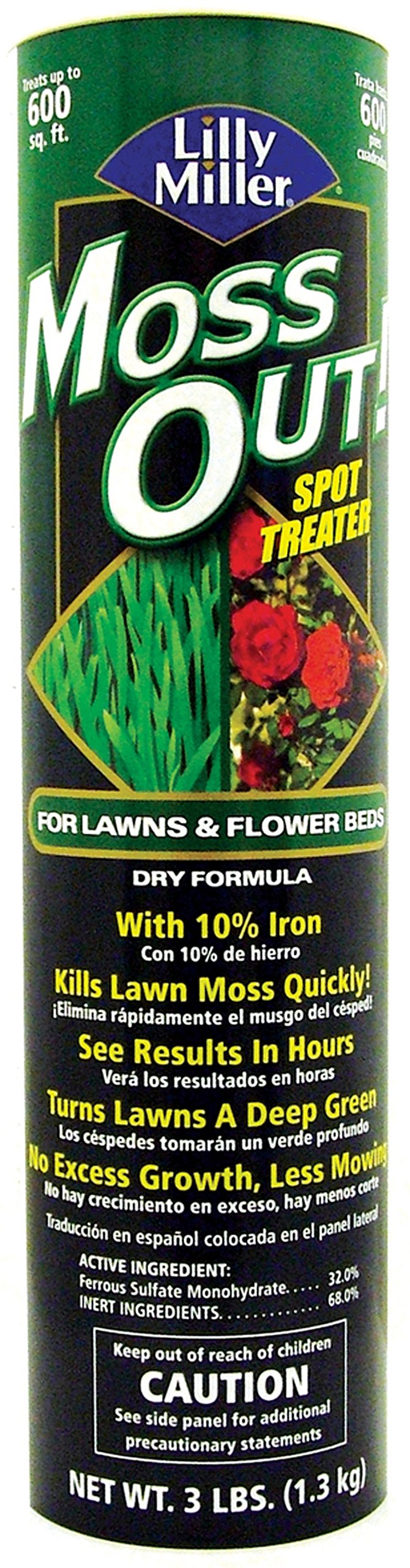
The little shaker that punches above its weight in customer love.
This 3-pound shaker canister covers 600 square feet, while the Scotts and Jonathan Green bags each cover 5,000 square feet. Yet buyers are fiercely loyal: one reviewer wrote “The ONLY PRODUCT that works on Moss” after spending hundreds on other treatments. The key differentiator is the 10% iron content, which is higher per ounce than most granular products and turns the moss black within hours. The shaker canister makes it dead simple to apply — you just walk around and sprinkle it on the patches.
There are real caveats. Several shoppers say that it stains concrete and driveways because of the iron — “the product was excellent, but you have to be careful it will stain your concrete sidewalk or driveway,” one reported. Another reviewer with a 3/5 rating said it turns moss black but does not make removal easier, and that it leaves black debris if not cleaned up. So while it kills fast, you still have to physically remove the dead moss by hand or with a claw rake, and you must keep it off any hard surfaces.
For a small patch of moss in a shady corner or around flower beds (it works in flower beds too, per the label), this is the most targeted option in the list. It is not designed for a full-lawn treatment; the 600-square-foot coverage tells you that. But for its intended use — spot treating patches — it has some of the most enthusiastic customer endorsements across any product here.
Why Buyers Love It
- 10% iron content is high for a spot treater — kills moss within hours
- Easy-to-use shaker canister, no equipment needed
- Works on both lawns and flower beds
The Catch
- Stains concrete and driveways — must keep off hard surfaces
- Still requires manual removal of dead moss
Perfect for: Spot-treating isolated moss patches in a small yard or flower bed, where a full bag of granules is overkill.
Pass if: You need to treat a large area or don’t want to manually rake out the dead moss afterward.
5. Sunday Dandelion Doom
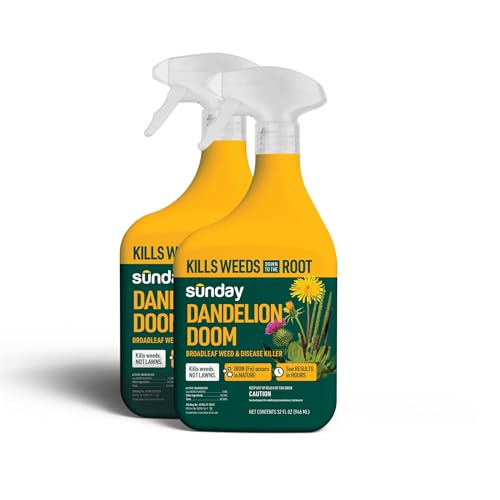
A liquid spray for precision spot application that also handles dandelions.
The Sunday Dandelion Doom is the only liquid option in this roundup. It uses chelated iron (FeHEDTA, a stable form of iron that plants absorb quickly) instead of basic ferrous sulfate — that is a more refined form of iron that is absorbed faster by the plant. Each 32-ounce bottle covers up to 100 square feet, and the 2-pack brings total coverage to 200 square feet. That is tiny compared to the granular bags above, but the trade-off is precision: the adjustable nozzle lets you spray individual moss patches and dandelion clumps without broadcasting product over the entire lawn.
This product targets moss, algae, lichen, and broadleaf weeds — so if you have a mix of moss and dandelions, one bottle handles both. The manufacturer claims visible results within hours and that it kills down to the roots. It is labeled as family and pet-friendly once dry, and it works in temperatures between 50 and 85 degrees Fahrenheit, including cooler weather when some other products slow down. You can apply spring through fall and repeat every 3-4 weeks for stubborn spots.
The obvious limitation is coverage: 200 square feet from the 2-pack will not make a dent in a moss-covered lawn. This is strictly for spot treatments: the odd patch of moss in a shady corner, a clump of dandelions in the flower bed, or an algae streak near a downspout. It is also the only option here if you prefer spraying over spreading granules.
What It Does Best
- Spot-spray precision with adjustable nozzle — no wasted product
- Kills moss plus dandelions, algae, and lichen in one formula
- Pet and family safe once dry
Its Limitations
- 200 sq. ft. coverage from a 2-pack is very limited for large lawns
- Liquid requires careful spraying to avoid drift onto desired plants
Best for: Homeowners who want to spot-treat small moss patches and dandelions with a targeted spray rather than broadcasting granules over the whole yard.
Not for: Full-lawn moss control — you would need too many bottles to cover a significant area.
Understanding the Specs
Coverage Area (Square Feet)
This is the most important number on the bag. It tells you exactly how much lawn one container will treat. A 5,000-square-foot bag (like the Jonathan Green or Scotts) covers a typical suburban lawn, while a 600-square-foot spot treater (like the Lilly Miller) covers about the size of a small patio plus a little grass around it. Do your math: measure your lawn’s rough dimensions and buy a product whose coverage matches or exceeds that number. Buying short means re-upping mid-season.
Form: Granules vs. Liquid Spray
Granules are spread with a standard lawn spreader and need to be watered in after application — they are the most common and practical for large areas. Liquids come in spray bottles with adjustable nozzles and are best for spot-treating small patches without covering the entire lawn. Granules stay put where you drop them; liquids can drift in wind. If you have a full yard of moss, go with granules. If you have one patch near the downspout, the spray is more efficient.
Active Ingredient: Iron Content
Moss killers use iron — either as basic ferrous sulfate or as chelated iron (FeHEDTA) — to dehydrate the moss and turn it black within hours. The percentage of iron matters: the Lilly Miller contains 10% iron, which is high for a spot treater and explains its fast action. Higher iron content means faster kill but also higher risk of staining concrete and driveways. Chelated iron (used in the Sunday spray) is more stable and absorbs faster but is usually found in liquids.
Prevention vs. Eradication
Some products (like the Jonathan Green) claim both to kill existing moss and prevent new moss from germinating. Others (like the Scotts) are primarily for killing what is there, and buyers report the moss returns within weeks. No moss killer fixes the underlying conditions — shade, poor drainage, compacted soil — that cause moss to thrive in the first place. For long-term control, combine a moss killer with aeration, improved sunlight exposure, and proper watering habits.
FAQ
Will moss killer harm my grass?
How long does it take to see results?
Does moss killer stain concrete or driveways?
Can I apply moss killer if rain is forecast?
Is moss killer safe for pets and kids?
Can I use a moss killer in flower beds?
How often do I need to reapply moss killer?
Do I need to remove dead moss after treatment?
Can I seed the lawn right after using moss killer?
What is the difference between a spot treater and a full-yard treatment?
Final Thoughts: The Verdict
If you want one dependable pick, the best moss killer for lawns is the Jonathan Green Lawn Moss Control because it covers 5,000 square feet in a single 20-pound bag, kills actively growing moss in hours, and prevents new moss from germinating — a true dual-action product for homeowners who want results that last beyond one rainstorm. If you prefer a spray for spot-treating small moss patches and dandelions together, grab the Sunday Dandelion Doom. And for a small yard or flower bed where you just need to knock out a few isolated patches without buying a giant bag, the Lilly Miller Moss Out Spot Treater is the cheapest and most targeted fix.
How We Picked
We do not accept paid placement. Every pick is matched to a real buyer and a real use-case; we do not hands-on test units.
Sources & Methodology
Specifications: manufacturer listings and product documentation. Review insights: verified customer reviews, as of July 2026. Pricing: not shown on this page (it changes often); check the current price via the retailer link.
As an Amazon Associate, Lawn Gear Lab earns from qualifying purchases. This does not affect which products we feature.