
Specs are compiled from manufacturer listings and verified buyer reviews and can change over time — please confirm the key details on the product page before buying.
Every gardener has a pair of shears that blunts fast, rusts in the shed, or leaves your palm aching after ten minutes. The real question isn’t which one is popular — it’s which one stays sharp through a season of daily cuts without punishing your hands. That means picking a steel that holds an edge, a bypass blade that shears cleanly instead of crushing stems, and a handle that fits your grip, not a generic mold.
I’m Rikta — the founder and writer behind Lawn Gear Lab. This guide is built by comparing the manufacturers’ published specifications and the patterns across verified customer reviews, so you get each pick’s real strengths and trade-offs instead of marketing spin.
You will find five shears that range from a lightweight snipper for herbs to a forged-aluminum pruner built for thicker branches, each chosen for a different job in the garden. This breakdown of the best pruning shears tells you which one suits your hands and your workload before you spend a cent.
Quick Picks
- ARS HP-130DX 7-Inch Ideal Light Pruner — Precision Pick
- VOTREK 8.5″ Pruning Shears – Stepless Handle Opening — Best Overall
- Corona Tools BP 6250 MAXFORGED Aluminum Bypass Pruner — Heavy-Duty Champion
- Modern Sprout Pruning Shears – Sage — Fine-Stem Specialist
- Dramm ColorPoint Stainless Steel Compact Garden Pruning Shears — Budget Champion
How To Choose The Best Pruning Shears
Picking the right pair depends on three things: what you cut, how often, and whose hands are holding them. A fine-tipped herb snip is useless on a half-inch branch, and a heavy forged pruner is overkill for deadheading roses. Here is what to look for.
Blade Type: Bypass vs. Anvil
A bypass blade glides past a lower jaw like scissors, making a clean slice that heals fast — that is what you want for living plants, green wood, and flowers. Every single shear in this guide uses a bypass blade. Anvil blades crush the stem against a flat surface, which works for dead wood but damages live growth.
Blade Steel: High-Carbon vs. Stainless
High-carbon steel takes a sharper edge and holds it longer than standard stainless steel, but it can rust if you leave it wet. Stainless is more corrosion-resistant, making it ideal for daily use on damp plants. Four of the five shears here use high-carbon steel; the Dramm uses stainless. If you often cut wet foliage after rain, stainless saves you drying time.
Handle Material and Fit
Aluminum handles keep the overall weight low — the Corona is 9.6 ounces with a forged aluminum body. Rubber or PVC grips add comfort but can feel bulky for smaller hands. The ARS HP-130DX is a 7-inch pruner that specifically fits small hands. A one-thumb safety lock is standard across all five picks, and a rotating handle or adjustable opening (like the VOTREK) reduces hand strain further.
Quick Comparison
On smaller screens, swipe sideways to see the full table.
| Model | Best For | Cut Capacity | Blade Steel | Weight | Amazon |
|---|---|---|---|---|---|
| ARS HP-130DX | Small-hand, precision pruning | 0.5″ (per reviews) | High-Carbon Steel | — | Amazon |
| VOTREK 8.5″ Stepless | Adjustable grip, 1″ branches | 26 mm (≈ 1″) | SK5 High-Carbon Steel | 0.52 lb | Amazon |
| Corona BP 6250 | Professional-grade, thick branches | 1″ | Forged Alloy Steel | 9.6 oz | Amazon |
| Modern Sprout Shears | Herb snipping, fine stems | — | High-Carbon Steel | — | Amazon |
| Dramm ColorPoint | Light trimming, rust resistance | 0.25″ | Stainless Steel | 0.02 lb | Amazon |
In‑Depth Reviews
1. ARS HP-130DX 7-Inch Ideal Light Pruner

The pruner that feels like an extension of a small hand, not an afterthought.
What you get is a 7-inch bypass pruner built around comfort for smaller grips — the soft PVC handles are slimmer than most, and the right-hand orientation makes the single-bevel blade feel natural in one palm. The hard chrome plating on the high-carbon tool steel reduces rust, which buyers confirm: one reviewer called it “sharp, no rust!” after repeated use. It slices branches up to about half an inch — a florist who uses them professionally noted they are “excellent for branches up to 0.5 inches” but that the pruner “cannot cut larger branches.”
This is a niche tool that excels at routine garden trimming, deadheading, and flower cutting. One florist reported replacing them every 5-6 months because they prefer not to sharpen, but still called the price “great value.” The latch closure locks the blades securely for apron or pocket carry. Compared to the Corona below, the ARS feels much lighter in hand and fits tighter spaces, but it has less than half the cutting capacity (0.5″ vs 1″). Choose this for daily precision, not heavy tree work.
Why it fits small hands: The 7-inch length and slim PVC handles suit people who find most pruners too bulky. The lock slides easily without getting in the way during cuts.
One real limitation: The cutting capacity stops at roughly half an inch — rough on woody stems thicker than a pencil. Reach for the Corona if your garden has thicker branches.
Reach for this if: you have smaller hands, cut flowers or thin stems regularly, and want a pruner that disappears in a pocket.
Look elsewhere if: you regularly prune branches over half an inch thick or prefer an ambidextrous design.
2. VOTREK 8.5″ Pruning Shears – Stepless Handle Opening
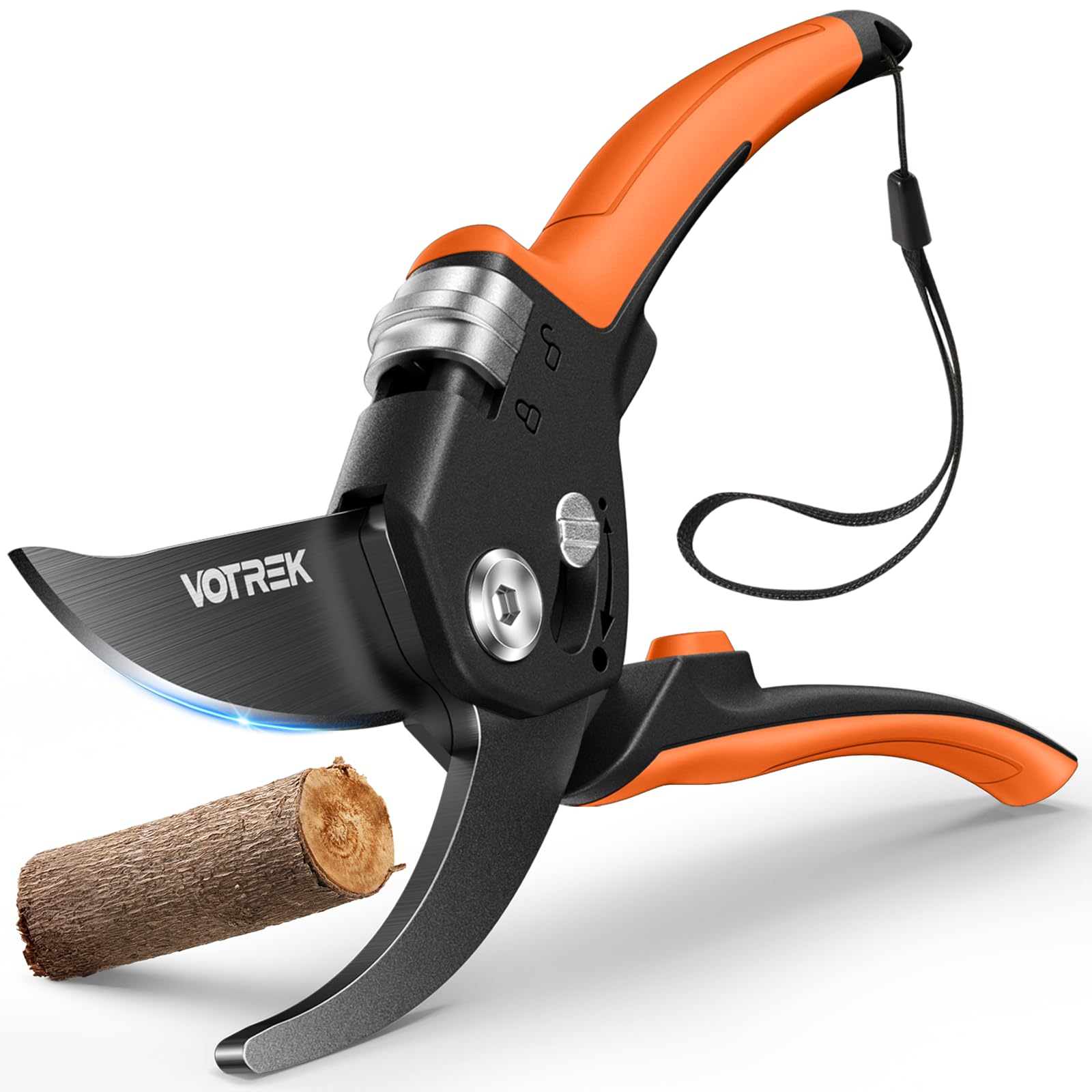
A pruner that adjusts to your hand, not the other way around.
The VOTREK stands out with its stepless handle opening — a tool-free dial that matches both the cutting width and handle spacing to any hand from S to XL. That means someone with a small grip can set it narrow, and a larger hand can open it up, all with one hand. The SK5 high-carbon steel blade is Teflon-coated, so sap slides off and friction drops during a cut. One reviewer noted a “sharp blade, smooth 1 inch cuts” after a week, and multiple reviewers noted how easy the internal spring makes each squeeze. At 0.52 pounds it weighs about the same as a small water bottle — not the lightest here, but the rubber grip and shock-absorbing padding made another reviewer call it “ergonomic, functional.”
The catch is the blade tolerance: one buyer mentioned it is “tight,” which can make it feel stiff until broken in. The serrated blade edge is unusual for a bypass pruner — it helps grip the branch but can leave a slightly rougher cut than a straight-ground edge like the ARS. For a household where multiple people garden with different hand sizes, this is the most accommodating option. The lifetime warranty adds confidence, something the cheaper Dramm lacks.
What fits everyone
- Dual-adjustment system adapts to S through XL hands without tools
- SK5 high-carbon steel with Teflon coating resists sap and corrosion
- Internal spring design is compact and stable, reducing hand fatigue
Where it trips up
- Tight blade tolerance may feel stiff at first
- Serrated edge can leave a less clean surface on thin green stems
Best fit for households: if multiple people with different hand sizes share one pruner, the stepless opening solves the fit problem. Also a strong pick for seniors or anyone with weaker hands who wants less effort per cut.
One caveat: the initial tightness means you need a short break-in period before the action feels truly smooth.
3. Corona Tools BP 6250 MAXFORGED Aluminum Bypass Pruner
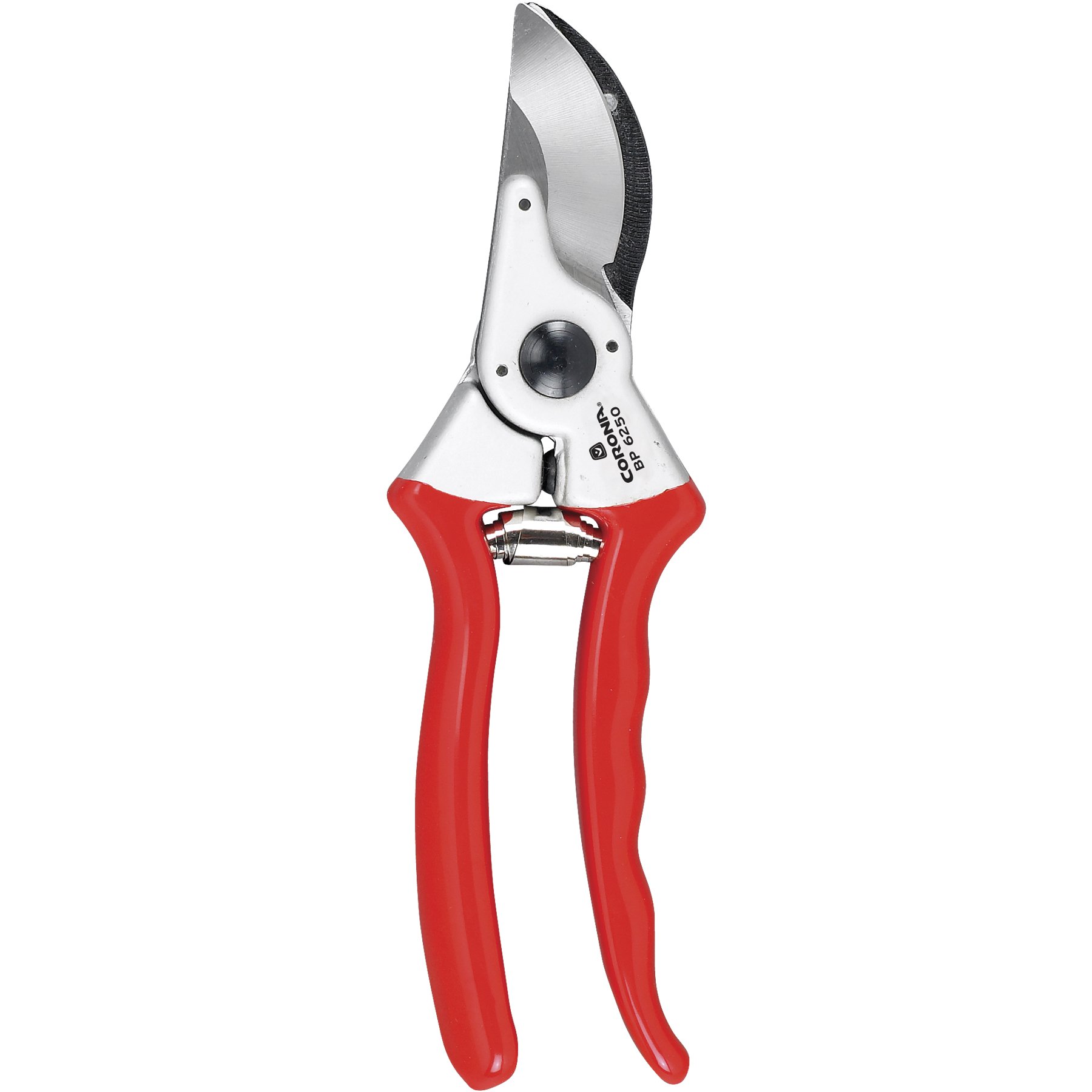
The forged-aluminum workhorse that cuts clean through thumb-thick branches.
With a full 1-inch cutting capacity and a forged alloy steel blade, the Corona is the only pick here built for serious woody stems. Buyers confirm it “cuts 1 inch branches easily,” and one reviewer with arthritis reported zero hand fatigue after four hours of pruning. The lightweight aluminum handles keep the total weight at 9.6 ounces — noticeably less than most heavy-duty pruners. The blade is replaceable, so you do not toss the whole tool when the edge dulls. It also has a self-cleaning sap groove, a wire-cutting notch, and a shock-absorbing bumper, all of which add up to a professional-grade feel at a much lower cost than a Felco.
The one complaint that keeps this from a perfect score is the lack of blade-opening instructions — one reviewer had to watch a YouTube video to figure it out. The blade needs cleaning and liberal oiling after use to prevent rust, which multiple owners emphasize (“requires cleaning and liberal oiling before/after use”). Unlike the VOTREK, there is no adjustable handle spacing, so if the aluminum handle contour does not fit your grip, it feels less custom. This is the pruner to grab when you have branches thicker than a pencil — where the ARS stops, the Corona keeps cutting.
Where it earns the pro label: 1-inch capacity, replaceable blade, self-cleaning sap groove, and a comfort level that users with arthritis found acceptable for hours of work.
The honest trade-off: The unibody aluminum-and-steel construction demands regular maintenance against rust. skip it if you want a rinse-and-store tool.
Reach for this if: you prune trees and shrubs with branches up to an inch thick and want a tool that competes with pruners at half the price.
Look elsewhere if: you prefer a tool that requires no oiling or if the handle shape simply does not fit your palm.
4. Modern Sprout Pruning Shears – Sage
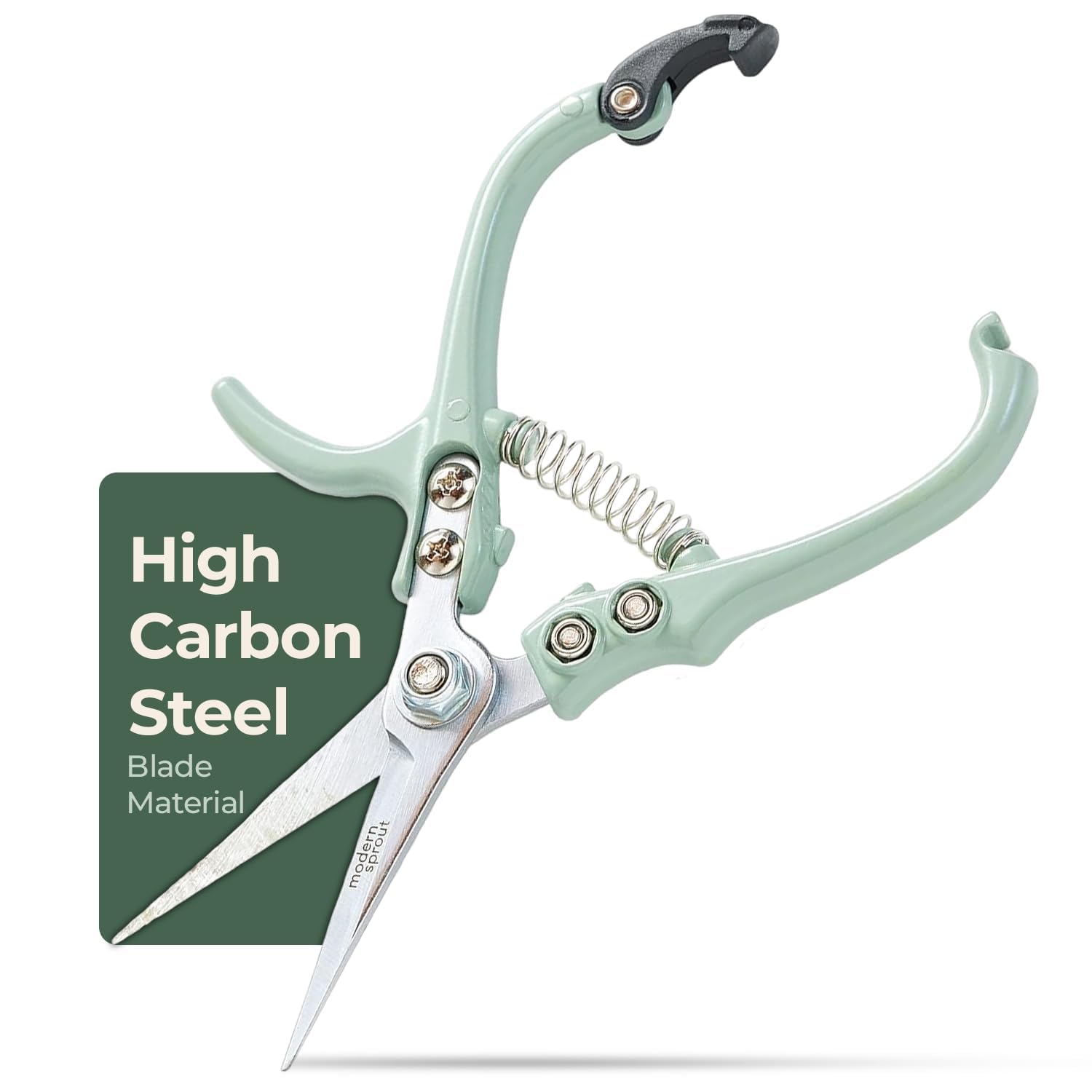
The kitchen-herb snipper with a needle nose that reaches where bulkier shears cannot.
If your garden is mostly basil, mint, bonsai, and delicate blooms, the Modern Sprout shears are purpose-built for exactly that. The high-carbon steel blades are fine-tipped like a needle nose, so you can snip a single stem inside a tight cluster without bruising the leaves around it. Owners call it “perfect for herb snipping, deadheading slender-stemmed spent blooms” and praise the “nicely weighted” feel. The aluminum handles keep it light, and the ergonomic contour reduces hand strain — multiple reviewers mention “no hand strain” even during longer trimming sessions.
The trade-off is that this is not a branch pruner. There is no published cutting capacity — it handles stems up to roughly a quarter inch before the blades feel labored. The safety latch works fine but adds a small button to slide, which some users find fiddly at first. Compared to the Dramm below, the Modern Sprout gives you a sharper, more durable blade (high-carbon vs. stainless) that holds a finer edge, but it costs a few dollars more and offers no rust advantage. Choose it for precision work — herb gardens, flower arrangements, bonsai care — where a clean cut on a thin stem matters more than raw power.
Precision perks
- Needle-nose tip accesses tight spots without damaging nearby stems
- High-carbon steel stays sharp and resists rust (per user reports)
- Ergonomic aluminum handles reduce fatigue during extended snipping
Power limits
- Not designed for branches thicker than a pencil; use stops at fine stems
- Safety latch can feel a bit stiff until you get used to the slide motion
Reach for this if: you spend more time deadheading, trimming herbs, and snipping flowers than sawing branches — the fine tip is irreplaceable for that work.
Look elsewhere if: your pruning needs regularly include woody stems over a quarter inch thick.
5. Dramm ColorPoint Stainless Steel Compact Garden Pruning Shears

A featherlight snip that laughs off rust, day after damp day.
The Dramm ColorPoint is the lightest shear in this lineup at 0.02 pounds — barely noticeable in a pocket or apron. The stainless steel blades are built for corrosion resistance, not razor-edge longevity, and buyers confirm it: “no rust after 2 months daily use.” The cutting width is only 0.25 inches, making this a tool for flowers, tomato suckers, twine, and very small stems — not branches. Multiple reviewers mention using it for “deadheading, trimming veggies, small woody stems, twine/wire” and being impressed with the “sharp from start” performance. One owner compared it to a “fine pruner” and emphasized its suitability for arthritis or small hands.
At this near-entry-level price, the trade-off is durability over time. The stainless steel does not take as sharp an edge as the high-carbon steel on the VOTREK or ARS, and it will dull faster with heavy use. The compact size (2-inch blade) means your hand sits closer to the cut, giving you good control but less leverage than longer-handled shears like the Corona. If you need a rust-proof, take-anywhere shear for daily flower cutting and light garden tasks, this is the best value in the list. If you cut branches regularly, skip it and reach for one of the high-carbon options above.
Where it shines: The stainless steel means zero worry about leaving it in the rain. The ambidextrous handle and simple slide lock work for anyone. One reviewer called it “handy tools, Dramm quality and durability.”
The honest limit: 0.25-inch cutting width stops at slender stems — this is a deadheading/herb snip, not a branch pruner.
Reach for this if: you want a rust-proof, lightweight snip for flowers and light trimming, especially if you have arthritis or small hands.
Look elsewhere if: you prune woody branches thicker than a pencil — the blade simply will not handle it.
Understanding the Specs
Bypass vs. Anvil Blade
Your shears have one of two blade designs. A bypass blade works like scissors — one sharp edge slides past a flat lower jaw. It makes a clean cut that heals quickly, which matters on living plants. Every tool in this guide uses a bypass blade, so you are set for green wood and flowers. An anvil blade (not here) crushes the stem against a flat surface — good for dead wood, bad for living plants.
Cutting Capacity
This is the maximum branch thickness the shears can cleanly slice. The Dramm stops at 0.25 inches, ideal for thin stems and herbs. The VOTREK can cut up to 26 millimeters (about an inch). The Corona matches that at 1 inch. The ARS handles roughly half an inch per user reports. Never try to cut a branch thicker than the rated capacity — you will strain the blade and crush the plant tissue. Match the tool to the thickest branch you regularly prune.
FAQ
Are these shears suitable for women and people with small hands?
Can I use these pruners on thick branches up to an inch thick?
Will the blades rust if I leave them in the rain?
How often do I need to sharpen the blade?
Are these shears left-handed or right-handed?
What is the difference between a bypass and an anvil blade for pruning shears?
Can I use these shears for cutting wire or twine?
How do I clean and maintain the blades after use?
Is the blade replaceable if it dulls or breaks?
Which pruner is best for arthritic hands or weak grip strength?
Final Thoughts: The Verdict
For most buyers, the best pruning shears winner is the VOTREK 8.5″ Stepless Handle Pruner because it adapts to any hand size, cuts up to one inch thick with SK5 steel, and has a lifetime warranty — all without a premium price. If you want a dedicated heavy-duty pruner for woody branches, grab the Corona BP 6250 for its forged aluminum body, 1-inch capacity, and replaceable blade. And for precision snipping of herbs and flowers with a small-hand-friendly design, the standout is the ARS HP-130DX — it is the light touch you need for delicate garden work every day.
How We Picked
We do not accept paid placement, and we did not hands-on test every unit. Instead, we match each pick to a real buyer and use-case by comparing the manufacturers’ published specifications against the patterns in verified customer reviews — so you get each pick’s real strengths and trade-offs instead of marketing copy.
Sources & Methodology
Specifications: manufacturer listings and product documentation. Review insights: verified customer reviews, as of July 2026. Pricing: not shown on this page (it changes often); check the current price via the retailer link.
As an Amazon Associate, Lawn Gear Lab earns from qualifying purchases. This does not affect which products we feature.